
World War Two
Published 31 Jan 2025This episode of the history documentary series “Death of Democracy” covers Q1 1933 with Hitler’s appointment as chancellor, the Reichstag Fire, Reichstag Fire Decree, Enabling Act, rise of Nazi terror, Gleichschaltung, and media control, explaining how Weimar Germany’s democracy collapsed in just sixty days.
(more…)
February 1, 2026
How to End Democracy in 60 Days – Death of Democracy Q1 1933
Comments Off on How to End Democracy in 60 Days – Death of Democracy Q1 1933
The Agora of Athens | A Historical Tour
Scenic Routes to the Past
Published 3 Oct 2025The Agora was the political and economic heart of ancient Athens. This tour explores its long history and evocative ruins.
Chapters
0:00 Introduction
0:47 Bouleuterion
1:44 Tholos
2:22 Monument of the Eponymous Heroes
2:56 Temple of Hephaestus
5:28 The Hellenistic Agora
6:16 Stoa of Attalos
6:57 Augustus and the Agora
8:06 Odeon of Agrippa
9:26 Herulian Wall
10:56 Overview
Comments Off on The Agora of Athens | A Historical Tour
January 31, 2026
QotD: Liberal principles according to Karl Popper
As usual when Popper addressed a meeting, his aim was to challenge and provoke thought, rather than simply endorsing the assumptions that he shared with his audience. […] It may help to start with a summary of the liberal principles that Popper spelled out in section 3. This will be helpful for a general readership (unlike the Mont Pelerin meeting) where there are likely to be many people who do not hold non-socialist liberal principles and some who are not be clear about what these principles are.
(1) The state is a necessary evil and its powers should be kept to the minimum that is necessary.
(2) A democracy is a state where the government can be changed without bloodshed.
(3) Democracy cannot confer benefits on people. “Democracy provides no more than a framework within which the citizens may act in a more or less organised and coherent way.”
(4) Democracy does not mean that the majority is right.
(5) Institutions need to be tempered and supported by traditions.
(6) There is no Liberal Utopia. There are always problems, conflicts of interests, choices to be made between the lesser of evils.
(7) Liberalism is evolutionary rather than revolutionary. It is about modifying or changing institutions and traditions rather than wholesale replacement of the existing order. The exception to this is when a tyranny is in place, that is a government that can only be changed by violence and bloodshed.
(8) The importance of the moral framework.
“Among the traditions that we must count as the most important is what we may call the ‘moral framework’ (corresponding to the institutional ‘legal framework’) of a society. This incorporates the society’s traditional sense of justice or fairness, or the degree of moral sensitivity that it has reached … Nothing is more dangerous than the destruction of this traditional framework. (Its destruction was consciously aimed at by Nazism.)”
Rafe Champion, “Summary and commentary on a paper on public opinion and liberal principles delivered by Popper to the Mont Pelerin Society”.
Comments Off on QotD: Liberal principles according to Karl Popper
January 16, 2026
Rapidly declining democracy in the home of the “Mother of Parliaments”
As I’ve mentioned before, it sometimes seems that Australia, Britain, and Canada are in a three-way race to de-democratize themselves as fast as they possibly can. Here’s the free-to-cheapskates portion of Ed West‘s essay on the return of liberal authoritarianism:
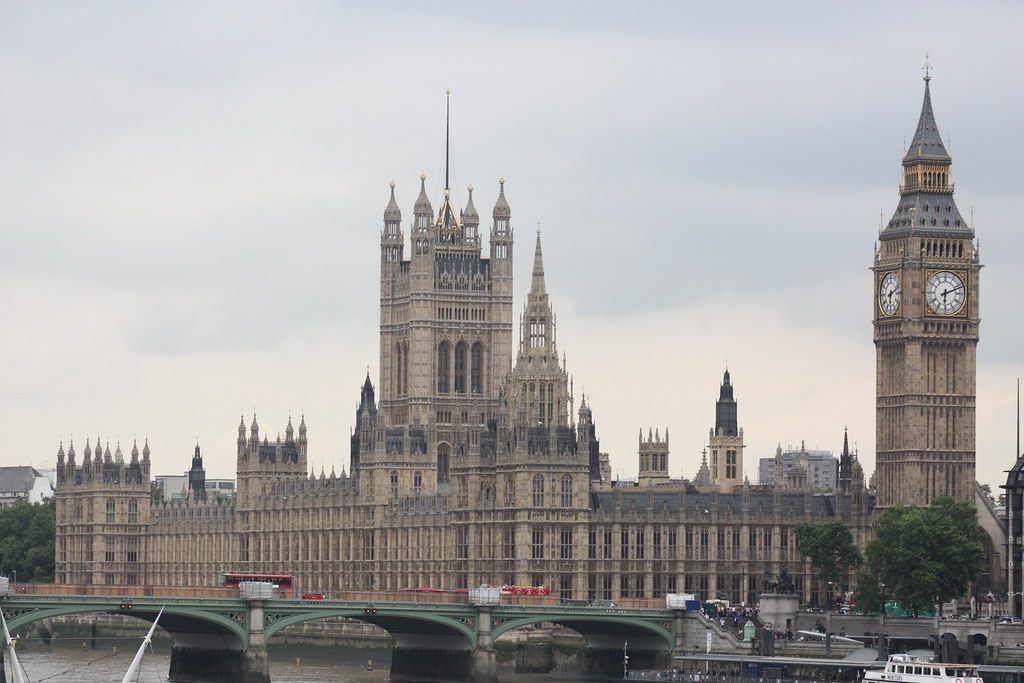
“Palace of Westminster” by michaelhenley is licensed under CC BY-NC-SA 2.0
It’s around this time of year that various NGOs give their assessment on the state of democracy and freedom of the world. The Fraser Institute’s Human Freedom Index was published earlier in December and Freedom House’s next report will arrive in February. It was at the start of last year that Romania was downgraded to a “hybrid democracy” by another body, the Economist Intelligence Unit (EIU), while France is now merely a flawed democracy. Sacré bleu!
What about our own beloved island, the mother of Parliaments? It will be interesting to see where Britain features in this year’s reports, and whether recent developments will impact on our rating.
Just recently, for instance, the British government postponed four mayoral elections until 2028, elections they are certain to lose. The Electoral Commission warned that it risked undermining “the legitimacy of local decision making and damaging public confidence”, while the chairwoman of the Labour Party even refused to rule out delaying the next General Election, leading Nigel Farage to accuse her of having “total contempt for democracy”.
Keir Starmer has also taken effective control of the House of Lords and will almost entirely eliminate opposition among peers by 2027, which he is able to do to the second chamber thanks to Tony Blair’s constitutional reforms. While the government extends the franchise to children, and even plans to place voting booths in schools, a clear violation of rules about politicising the education system, they’re also keen to restrict who can stand in elections.
As the i reported, Emily Darlington, Labour MP for Milton Keynes Central, “is seeking to make the Electoral Commission recommend enhanced DBS checks for candidates and then publish whether or not parties have agreed to the vetting. The aim is to ensure political parties justify whether their candidates are fit for office and name and shame those who refuse to participate.”
This is troubling when one considers that DBS (Disclosure and Barring Service) checks include not just criminal history but “non-crime hate incidents“, which may even appear on the records of people who haven’t been contacted by police. These highly-political charges are far more likely to be directed at those with Right-wing opinions.
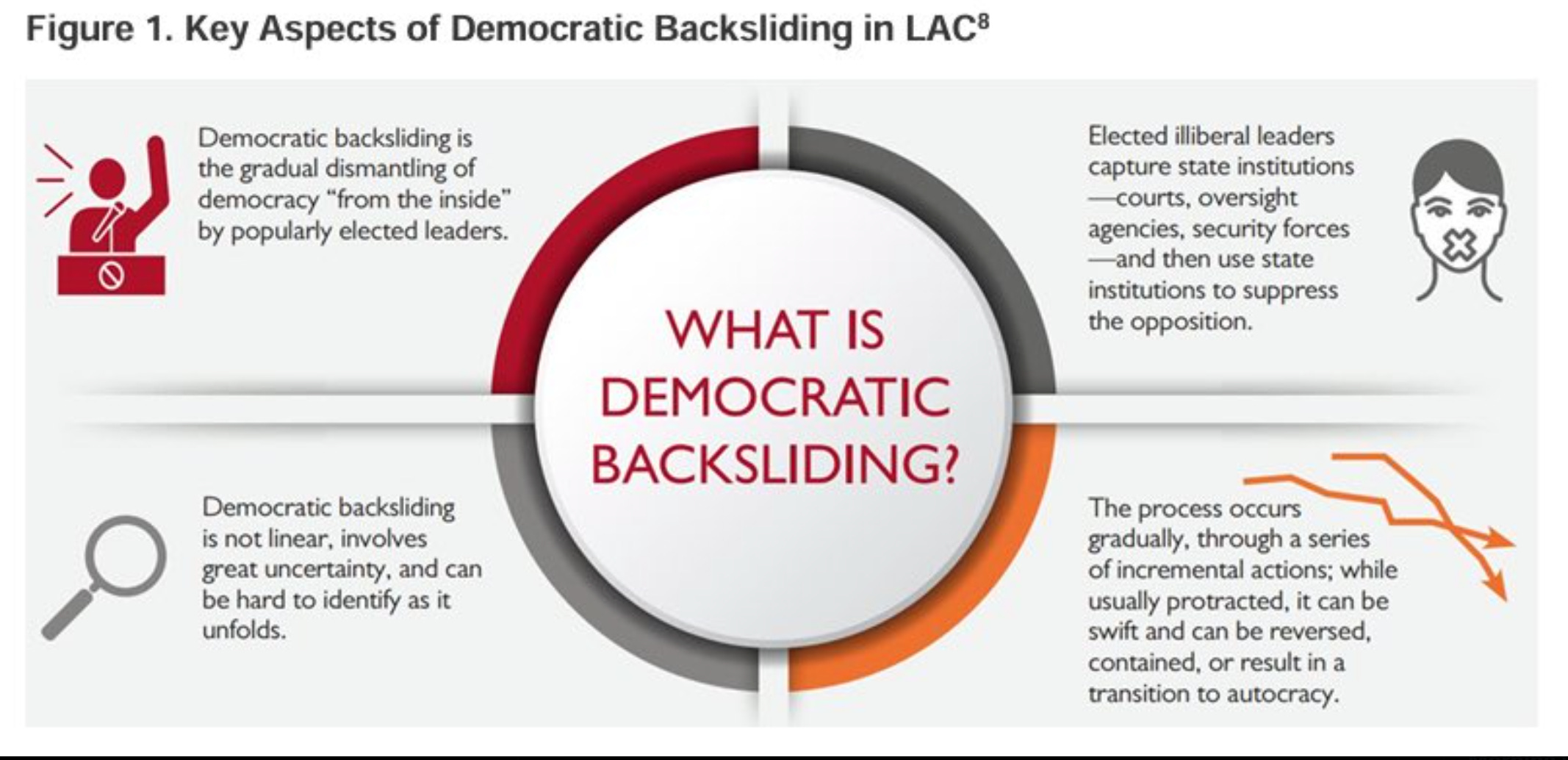
When western European countries do things like this, I try to gauge whether this is normal by asking the question: what if Hungary did this? In most of these cases, I imagine the assessment would be that it was an assault on liberalism and democratic norms. In which case, what if Britain is undergoing the sort of “democratic backsliding” usually levelled at central European countries with conservative governments? What if Keir Starmer is actually one of these illiberal “strongmen” we read about, just not a very effective one.
There are a number of accepted symptoms of democratic backsliding, among the most commonly listed being rejection of democratic rules, a disregard for constitutional norms, attempts to use legal mechanism to sidestep democracy, which is described as “stealth authoritarianism”, denial of opponents’ legitimacy, and the tendency to characterise them as outsiders or a threat to national security; on top of this, one might consider a willingness to curtail civil liberties, restricting the power of the media, and violating freedom of speech and association. Finally, and worst of all, is the toleration or encouragement of violence against opponents.
Credit: the National Opinion Research Center at the University of Chicago
By these broad definitions, Britain arguably meets many of these criteria (but not, most importantly, the last). There is certainly censorship, which has increased with the Online Safety Act, designed to combat “hate” as well as “misinformation”. Misinformation, of course, is everywhere, but its existence certainly provides a convenient excuse for governments to clamp down on the sort of information they dislike. The Government has also pondered banning Twitter, and while I feel that the widespread disgust at the Grok “deepfake” feature is reasonable, such a ban would completely cripple opposition, returning control of the discourse to the old media.
As for the British state’s definition of “hate”, there is a widespread belief that people motivated by hostility to mass immigration are extreme and dangerous, so the full force of the law must be used to stop them gaining support among a public who are totally guileless when it comes to absorbing information. This belief has grown more entrenched with the rise of populism, and makes western European governments increasingly sceptical of democracy itself.
It’s obvious that many people are concerned about the prospect of Nigel Farage becoming prime minister, and as the election date comes closer, and if he’s still in a position to win, the tone will become more shrill. Starmer admitted to this terror when he said, tellingly, that “If there is a Conservative government I can sleep at night. If there was a right-wing government in the United Kingdom, that would be a different proposition.”
Update, 17 January: Welcome, Instapundit readers! Have a look around at some of my other posts you may find of interest. I send out a daily summary of posts here through my Substack – https://substack.com/@nicholasrusson that you can subscribe to if you’d like to be informed of new posts in the future.
October 19, 2025
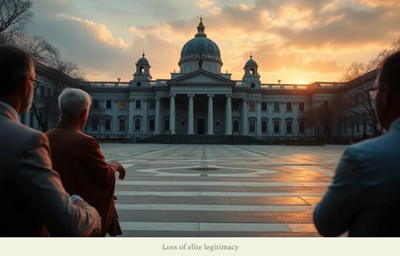
Reframing the loss of elite legitimacy as a “loss of faith in democracy”
On his Substack, Frank Furedi illustrates how the public’s declining trust in political elites across the western world is being reframed in the legacy media as declining faith in democracy itself:
No doubt you have come across commentators and legacy politicians whining about the public’s loss of trust in democracy and in the key institutions of society.
“France is not alone in its crisis of political faith – belief in a democratic world is vanishing” commented Simon Tisdall last week in The Guardian.1 He noted that “belief that democracy is the form of governance best suited to the modern world is dwindling, especially among younger people“.
The tendentious claim that the current era of political malaise is an outcome of a loss of commitment to democracy is regularly echoed by mainstream commentators. This was the message of a recent Politico headline that stated that “Europe’s democracies are in danger, warn Merz and Macron”.2 It cited the German Chancellor Friedrich Merz stating that these “threats dwarf anything seen since the Cold War”. He noted that “the radiance of what we in the West call liberal democracy is noticeably diminishing”, adding: “it is no longer a given that the world will orient itself towards us, that it will follow our values of liberal democracy”.
If anything, the French President Macron was even more pessimistic than Merz. He warns that Europe is undergoing a “degeneration of democracy due to attacks from without and from within”. He was particularly concerned about the loss of faith in democracy within France. “On the inside we are turning on ourselves; we doubt our own democracy”, he noted, before adding, “we see everywhere that something is happening to our democratic fabric. Democratic debate is turning into a debate of hatred.” This statement coming from a man, whose presidency lacks a genuine mandate and relies on bureaucratic maneuvering exposes the cynicism of his concern for the “degeneration of democracy”.
[…]
Loss of elite authority
In reality the crisis of democracy narrative serves to mystify the real issues at stake. This narrative offers a misdiagnosis of the very real loss of legitimacy of the ruling elites as a loss of belief in democracy. As far as this dominant narrative is concerned every time people vote against the representatives of the legacy political establishment democracy is in trouble. So long as they win elections and populists aspirations are confined to the margins of society democracy is represented as a big success. But the very minute people vote the “wrong way” the mainstream commentators craft alarmist accounts about democratic backsliding. That is why the Remainer lobby often represents the outcome of the Brexit Referendum as an expression of “democratic backsliding”.
In theory, the term democratic backsliding refers to the declining integrity of democratic values. In practice it means the estrangement of significant sections of the public from their political institutions. The term democratic backsliding serves to mystify a very significant development, which is the legitimacy crisis of the legacy political establishment. Once understood from this perspective it becomes evident that it is not democracy that people no longer trust but the people and the institutions that rule over society.
As it happens the narrative of “democracy is in trouble” smacks of pure hypocrisy. Those who communicate this narrative are not so much interested in the integrity of democracy but in ensuring that people vote the right way. From their perspective if people vote the wrong way than democracy becomes dispensable. That is why more and more we hear the refrain that there is “too much democracy”. “Democracy Works Better when there is less of it” warned Financial Times commentator, Janan Ganesh.3 As far he is concerned, “no global trend is better documented than the crisis of democracy”, by which he means that too often people vote against the advice of the elites.
Comments Off on Reframing the loss of elite legitimacy as a “loss of faith in democracy”
October 10, 2025
We have to destroy European democracy to save European democracy
Every week it seems like the undemocratic powers-that-be in Europe have had to pull legalistic strings to ensure that the popular will is not translated into political power in nation after nation. Unsurprisingly, the candidates and parties subject to these serial interferences are almost all populist and right-wing. On his Substack, Frank Furedi explains “the EU’s quest to monopolize the doctrine of the Truth”:
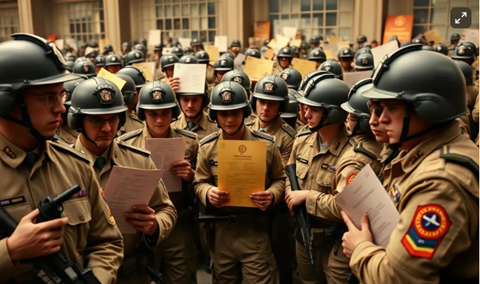
Army of Fact Checkers – Roots & Wings with Frank Furedi
In recent years globalist institutions – including the European Union Commission have become obsessed with the circulation of disinformation. In particular, they point the finger of blame on outside external actors whose fake news supposedly threatens the very existence of democracy. According to the EU Commission “Foreign information manipulation and interference is a serious threat to” European values. It claims that “it can undermine democratic institutions and processes by preventing people from making informed decisions or discouraging them from voting1.
The narrative of foreign misinformation is invariably used to discredit political parties and electoral results that are not to the liking of the centrist technocratic elites that run the EU as well as numerous western governments. Foreign information manipulation served as an excuse to bar a populist candidate from running for the post of the President of Romania. Since by all accounts he was the likely winner of this contest his elimination from the race could be interpreted as a soft coup d’etat. Similar objections were made about foreign interference during the referendum for Brexit as well as during the recent elections in Moldavia and Czechia.
Alarmist accounts of the threat posed by foreign information manipulation rest on the claim that the circulation of so much unreliable information makes it impossible for people to make an informed choice. Yet the electorate has always faced the challenge of having to distinguish factually accurate claims from false ones. Public life was always forced to confront the problem of who to believe and whose words are trustworthy. Throughout history different actors and technologies were blamed for misleading people with false information and dangerous ideas. In ancient Greece it was the smooth-tongued demagogue who could effortlessly and purposefully transmit lies to capture the attention of the public, who served as the personification of misinformation. During the centuries to follow the finger of blame has been pointed at books, mass-publication newspapers, radio, television and now the Internet
Since information manipulation has played an important role in the political life of western societies since the 18th century, it is far from evident why the contemporary public should no longer be able to make “informed choices” and why they should feel discouraged from voting? Despite the recent EU Commission induced panic about information manipulation, the percentage of people voting in the 2024 EU elections was 51 percent, the highest rate of turnout since 1994, when it was 56 percent.
People have always had to contend with fake news and propaganda. So why should they be more likely to be fooled by it today than in the past? The standard argument used to justify this EU elite promoted panic is that new technologies “have made it possible for hostile actors to operate and spread disinformation at a scale and with a speed never seen before”.2 It is worth remembering that the same arguments were used to warn against new information technologies since the 19th century. Even in the late 20th century the media was blamed by politicians for their electoral failures.
Kirsten Drotner has used the term media panic – that is a panic about the media -to highlight the recurrent tendency for change and innovation of the media to incite anxiety and fear.3 Such reactions were a response to the expansion of both publishing and the reading public in the 18th century. The expansion of the media and its commercialization created an environment where competing views and opinions helped foster a climate where the question of which sources could be trusted were raised time and again.
- https://commission.europa.eu/topics/countering-information-manipulation_en
- https://commission.europa.eu/topics/countering-information-manipulation_en
- Drotner, K.(1999) “Dangerous Media? Panic Discourses and Dilemmas of Modernity”, Paedagogica Historica: International Journal of the History of Education, 35:3, 593-619.
Comments Off on We have to destroy European democracy to save European democracy
A POSWID analysis of the contention that “Canada is broken”
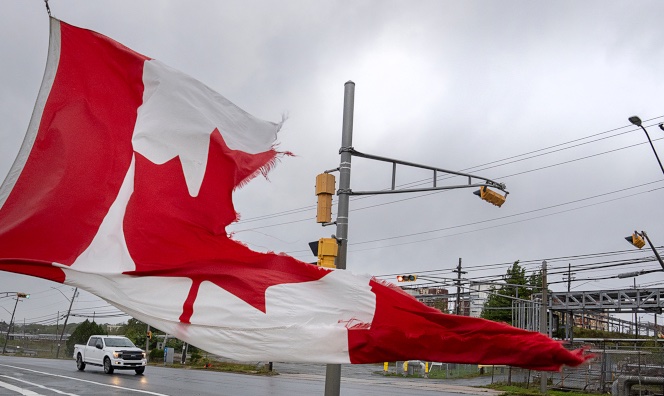
It’s my strong opinion that Canada is indeed “broken”, and much but not all the blame for that goes to former Prime Minister Justin Trudeau and increasingly to current PM Mark Carney. It hasn’t all been the direct action or deliberate inaction of the Liberal party and their bureaucratic minions in the civil service, but their fingerprints are on a lot of the damage. Eberhard Englebrecht analyzes Canada using POSWID framing and concludes that “the Purpose Of Canada is What It Does”:
Now, one of the core criticisms made of POSWID by its opponents is that it leans heavily on a consequentialist interpretation of events, completely discarding the roles human intention, error, and agency play in how things transpire.
However, these critiques only hold validity if you take POSWID and make it your singular mode of analysis — something that I don’t encourage, nor intend on doing myself. Rather, POSWID should be understood and used as a specific tool with a specific purpose — that is, to peel back the noxious platitudes, gaslighting, and wishful thinking that envelop our politics, and hinder our ability to view our present situation with clarity and honesty.
And, unfortunately for the citizenry of Canada, Canadian politics is — and has been for some time — a domain chock full of the misguided idealism and obfuscation that POSWID seeks to erase.
It is why many Canadians — despite their country having experienced a precipitous decline in both general prosperity and the integrity of the common social fabric — remain willfully blind to such an absurd degree.
POSWID, as I will be applying it, can tackle many of the polite pleasantries and mindless incantations that have become embedded in Canada’s “consensus” of acceptable political discourse, exposing them as misaligned with reality. This will take one of two forms: the first is to demonstrate that a common belief in the trope in question has led to results contrary to the intentions of those who originally pushed the trope; the second is that the trope was always purely abstract and aspirational, never described reality, and any attempts to align reality with said trope have failed miserably.
Many of these tropes are sacred cows of Canada’s political establishment — ideas that they would insist define “what it means to be Canadian” or are things that “we all believe”. Going against them, or merely questioning their validity or suitability, would be considered “UnCanadian”. These tropes have, in many cases, dictated the direction of Canadian society since the 1960s and created the foundations for the paradigms that currently define Canadian politics. Therefore, the deconstruction of these tropes constitutes the deconstruction of these paradigms — something that would have cascading ramifications for our country.
It is worth noting, however, that my intention in writing this piece is not to make granular policy prescriptions. My job is merely to provide a clear-eyed account of how three of the values and policy programmes of Canada’s chattering class (you could substitute “chattering class” with “professional-managerial class” or “Laurentian Elite”) are out of step with how this country actually exists — a reality felt and experienced at an intuitive level by many, but rarely articulated in public.
Comments Off on A POSWID analysis of the contention that “Canada is broken”
October 4, 2025
QotD: Roman … democracy?
And today we’re going to look at why it is that the assemblies never roar quite so often as you’d expect and in the process begin developing the arguments of perhaps the central scholarly debate currently about the Roman Republic: how democratic was it really?
Bret Devereaux, “Collections: How to Roman Republic 101, Part II: Romans, Assemble!”, A Collection of Unmitigated Pedantry, 2023-07-28.
Comments Off on QotD: Roman … democracy?
October 1, 2025
“Sean Fraser, the current minister of justice and attorney general, has made two major mistakes of late”
If you’re at all interested in Canadian affairs, you should subscribe to The Line … even a free subscription will definitely provide you with some excellent non-propagandistic coverage of what is happening in the dysfunctional dominion. For instance, last weekend’s weekly post from the editors included this segment about Sean Fraser, who is perhaps the worst of Mark Carney’s cabinet (and that takes some doing):
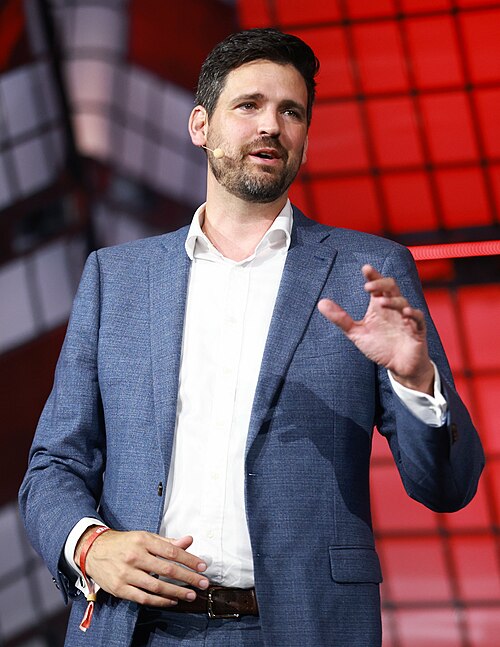
Sean Fraser, as Minister of Immigration, Refugees & Citizenship, during day one of Collision 2023 at Enercare Centre in Toronto, Canada.
Photo by Vaughn Ridley via Wikimedia Commons
We at The Line contend that Sean Fraser, the current minister of justice and attorney general, has made two major mistakes of late.
The first was in deciding not to rescind his decision to spend more time with his friends and family when it became clear that Justin Trudeau was no longer an anchor on his electoral chances. After failing to fix Canada’s housing problem and proving himself integral to blowing apart a pan-partisan consensus on immigration that was once the envy of the world, the man had a real opportunity to leave office on a high note. But, no.
Instead, after hitching his bloated baggage to Mark Carney’s trunk, Fraser decided that Canada needed more of him.
And so, as justice minister, instead of addressing petty stuff like, oh, bail reform, or fixing prisons, or getting crime under control, he turned his attention to … Section 33 of the Charter of Rights and Freedoms. The notwithstanding clause.
You may recall that Quebec’s contentious Bill 21 — which prohibits public-service employees in positions of authority, and teachers, from wearing religious symbols while on the job — is currently before the Supreme Court of Canada. Despite numerous mixed rulings on the law, Quebec moved forward with its stance on secularism by invoking Section 33, which allows parliaments to temporarily override judicial rulings.
Section 33 was placed in the Charter for precisely this kind of situation; one in which the courts and parliament disagree about governance. As we still live in a democracy, and are still nominally governed by representatives we elect, the clause was always a bit of a compromise gesture intended to preserve parliamentary supremacy after granting the courts broad powers to basically reinterpret law according to an expansive and ever-expanding understanding of both their jurisdiction, and of the concept of “rights” writ large.
Section 33, nonetheless, has maintained a heavy odour about it, which has generally limited its application, especially outside Quebec. Among the Sean Fraser set, and the largely Liberal collection of lawyers who will insist that the Supreme Court isn’t remotely political, and how dare we entertain the thought, Section 33 was only ever intended as a symbolic right.
But as the definitely-not-political Supreme Court has edged ever deeper into the territory of override and governance, so too have provincial parliaments responded with a very not-symbolic application of the clause.
We do think there’s some blame to be placed at everyone’s door, here. But we also never really took much issue with Section 33. That’s because, at heart, we at The Line believe in, well, democracy. We believe that the people we elect should be able to decide our laws; and we believe that while the Supreme Court of Canada serves as an important check on Parliamentary power, that power doesn’t and should never override the will of the people.
And that’s basically where we part ways with Fraser and many of his — dare we say it? — Laurentian Consensus ilk. Because the unstated critique of the use of Section 33 is basically always the same: these people dislike the application of the clause because they think politics is icky, and that politicians fundamentally cannot be trusted.
In other words, these people don’t actually want a democracy.
They want a technocracy. One in which the smartest and ablest individuals (as defined by them, of course) are the ones who actually get to set the rules and guardrails for society writ large. One in which parliament really is as theatrical, symbolic and pointless as it often regards itself.
There’s an obvious illogical inconsistency here — Fraser and his colleagues are politicians. We aren’t sure if this desire to go out and limit the ability of he and his fellow parliamentarians to do the best jobs they can for the citizens reflects mere self-loathing, or a particular brand of Liberal blindspot, one that leads them to believe that they alone among politicians are exempt from anything as crass political considerations and/or motivations. Those moral failures are apparently for the other guys. But in any case, we have an elected official making the case that unelected courts should have the ability to override legislators, and that the legislators should have no recourse. However Fraser rationalizes this to himself, it’s where we are.
We think the people who have issues with Section 33 are generally not being honest with themselves in that regard; we also think that their instinctual aversion to politics (or their exemption of themselves from it) tends to make them naive. If you vest all the real power of governance in a “non-partisan” Supreme Court, what you’ll get is not a dispassionate government, but rather a heavily politicized Supreme Court. We need only look at what has happened in the U.S. over the past 30 years to see how that pans out in the long run.
Look, we at The Line don’t like Bill 21. It’s a bad law. It needlessly tramples on minority rights. But there’s a very obvious way to get that law repealed that doesn’t involve flirting with a full-blown constitutional crisis in the midst of, you know, all of the other crises going on right now.
Elect a government that will repeal that law.
That’s what democracies do.
To me, one of the most puzzling things about the Carney government’s recent actions is the overall incoherence of them. They are going ahead with one of the worst policies inherited from the Trudeau years with the “gun buyback” program that the minister responsible has openly admitted is almost completely a sop to voters in Quebec. Okay, that makes cynical sense as the Liberal vote is about as “efficient” as it possibly can be so losing just a few seats in Quebec would make it impossible for the Liberals to get re-elected. Fine. Scummy as hell, but fine. Yet the challenge to Section 33 is guaranteed to piss off far more Quebec voters — and stir up controversy across the country to boot — and you’re going to stage a pitched battle against pretty much all the provinces before the Supreme Court? Are you sure about that?
Comments Off on “Sean Fraser, the current minister of justice and attorney general, has made two major mistakes of late”
September 23, 2025
Voters didn’t have to pay attention, but now they really, really should
On the social media site formerly known as Twitter, Tristin Hopper posted the best explanations I’ve seen for why Canada is in the state it’s in:
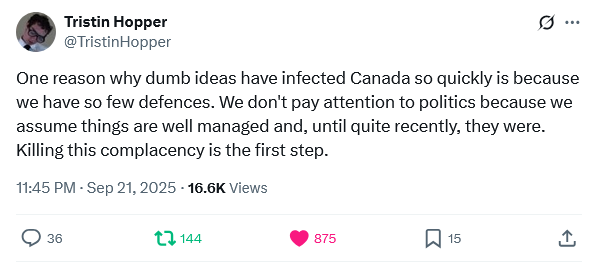
Canadians took it for granted that, no matter which party was in government, the country would continue to be stable, predictable, and competent. That’s clearly wrong today, yet the voters haven’t really accepted the new situation yet. Until they start paying attention, things may not improve.
It’s not just Canada, of course, but Canada is further down the road to ruin and thanks to the governments’ conscious actions, it will probably take longer to recover (and I don’t see a Canadian Javier Milei on the horizon, more’s the pity).
At The Freeman, Will Ogilvie Vega de Seoane discusses a related issue with most forms of representative government:
We are stupid. There, I said it. I feel much better now — like I’ve finally opened up in group therapy. PhDs won’t fix it, nor will subscriptions to all the best outlets. As individuals, we simply do not have the capacity to decide what is best in public life. As voters, we don’t usually care what our representatives are up to, nor do we have the faintest idea what the best policy on agriculture, artificial intelligence, or healthcare should look like — and that’s on a good day. But we do think we know. Deep down we think we are sovereign, that democracy is “all of us”, as though the government were some noble embodiment of “the people” rather than just another collection of organized persons with private agendas.
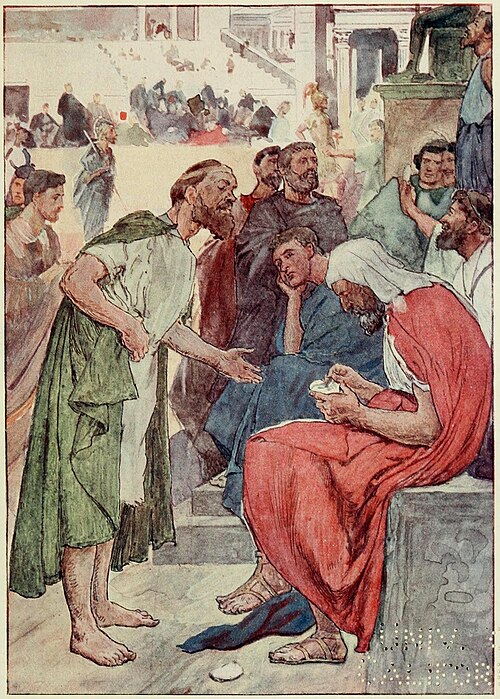
“Aristeides and the citizens” from Plutarch’s lives for boys and girls (1900).
Plutarch tells a story that I have always found marvelous. It’s about Aristeides “the Just”, one of Athens’s heroes in the Persian Wars. The Athenians, weary of kings and tyrants, invented ostracism — a mechanism to expel for ten years any citizen who got too powerful. Each voter would scratch a name onto a shard of pottery, and if more than 6,000 shards had the same name on them, the man was politely asked to take a decade-long sabbatical. Today we’d probably call it “a career break for the common good”.
Anyway, one day a farmer approached Aristeides himself — without realizing who he was — and asked him to write the name “Aristeides” on his shard. Surprised, Aristeides asked if he had ever harmed him. “No,” said the farmer, “nor do I know him by sight. But I am tired of always hearing him called ‘the Just’.” Aristeides, being annoyingly noble, wrote down his own name and handed the shard back. Later, as he left the city in exile, he prayed the opposite prayer of Achilles: that no crisis should come which would force the Athenians to remember him. On LinkedIn, Aristeides might have written: “Currently on a ten-year sabbatical generously sponsored by the people of Athens. Seeking new challenges outside the Attic peninsula #OpenToWork.”
This, in miniature, is how people vote. Not with knowledge, or vision, or even vague coherence — but out of envy, spite, boredom, or some other glorious irrationality. The Athenians had shards; we have hashtags. Instead of ostracism by pottery, we have ostracism by X: one bad joke, one leaked email, and the digital mob sends you packing. Today in Britain, people can even be jailed for their comments on social media. So much for parrhêsia, that old Athenian virtue of speaking frankly to power. We’ve managed to turn it into a crime — and worse, the canceling mob thinks it’s “speaking truth to power” when in fact it is obedience dressed as rebellion.
Modern voters aren’t any better. Some vote because the candidate owns a cute dog. Others because the candidate is endorsed by Taylor Swift. Entire campaigns have been won on promises of free cable, or by a politician smiling the right way on TikTok. In Spain, we even coined a term for it: the Charo. A Charo is usually an old lady with pink hair who parrots whatever our president says. Charos cannot resist the presidential smile. Even when the president contradicts himself, as he normally does, doing the exact opposite of what he promised, they just blush and blink as if to say: “Oh, Pedro, always misbehaving — we love you all the more for it.” They pamper their charming president and dismiss any criticism as fascist slander. Welcome to the Charocracy.
That’s a pitch-perfect description of the typical Liberal voter in Canada. Mark Carney’s Canada is clearly a maple-flavoured Charocracy.
Comments Off on Voters didn’t have to pay attention, but now they really, really should
July 19, 2025
No issue is so important that we can’t have a proper debate on the merits
On Substack, Lorenzo Warby refutes the claim that some issues are just too important/too urgent/already decided:

One of the features of the “progressive” politics of the unaccountable classes — those who are just paid for turning up — is the demand that there be “No Debate” about various issues. The most obvious instances are “No Debate” about Trans and “No Debate” about climate change — hence demands that climate scepticism be outlawed.
All such “No Debate” claims are crap. First, any “No Debate” claim is presumptive evidence that what you are pushing is either not true or, slightly more subtly, is a mountain of bullshit erected on a molehill of truth. Robust cases for claims about the world are not afraid of debate.
Various moral urgency claims are mounted to support such “No Debate” claims. How do we determine moral urgency? From the evidence. If the evidence is clear, debate will not threaten that alleged urgency. On the contrary, it will reveal the urgency more clearly.
The underlying philosophical dynamic underlying “No Debate” claims is Critical Constructivism — the claim that reality is socially constructed; that all statements and knowledge claims are, in fact power claims; and that the righteousness of a claim can be determined by their (alleged) effects on (morally differentiated) social groups.
The underlying social dynamic is the use of affirmed beliefs to determine and display righteousness. If affirming X shows one to be one of the righteous, then not believing X shows one to be of the unrighteous. This is typically expressed in various terms of moral abuse (racist, Transphobe, Islamophobe, etc) whose use in media and academe has soared since 2014.
This is not because Western societies have become more bigoted — on any reasonable measure they have become far less so over time — but because the politics of Righteous Affirmed Belief has dramatically surged and so has therefore the stigmatisation of dissent.
To claim that affirming X shows ultimate moral propriety requires stigmatising not-X. For something is morally proper — indeed morally trumping — only if the opposite is morally improper. Thus is moral propriety is enforced by stigmatisation. Hence silence is violence — one must profess righteousness. Hence also words are violence — if affirmation of belief is the ultimate marker of righteousness then expressed disbelief becomes the ultimate marker of abusive malevolence. These dynamics lead to a great deal of preference falsification — people publicly affirming, or at least not opposing, claims that they do not privately believe.
May 24, 2025
German democracy trembles as the extremely extreme extreme right AfD aren’t going to be banned
eugyppius updates us on the continued shaky state of German democracy, as the scary extremely extreme right Alternative für Deutschland (AfD) party seems to have somehow escaped being banned from participation in politics due to some ridiculous “lack of substantive evidence” excuse:
Last week, a supersecret assessment of Alternative für Deutschland by the Federal Office for the Protection of the Constitution (BfV) leaked to the press. This document was supposed to prove, in excruciating detail, why the AfD are so evil and so fascist and so Nazi and so Hitler, and in this way make a preliminary case for banning the party. In fact its contents turned out to be such an arrant joke that it sapped all remaining momentum within the German political class to prohibit the AfD. I suspect even the “right-wing extremist” classification of the AfD is now in jeopardy and may well be thrown out by the courts, that is how bad this much-heralded supersecret assessment turned out to be.
It took a few days for the full impact of the report’s idiocy to really sink in. That’s how it is with really stupid things – the incredulity they inspire must first dissipate. Finally, though, on Tuesday of this week, Interior Minister Alexander Dobrindt announced that the dubious evidence marshaled by the BfV was “not sufficient” to support ban proceedings. Dobrindt also said that the whole debate had become “counterproductive” and that it was time to begin finding ways to “end social polarisation”, whatever that means. Hours later, it emerged that Chancellor Friedrich Merz had ordered the entire CDU leadership never to say another word about banning the AfD. If everyone will just shut up, Merz believes his party can “avoid further debate” and avoid “giving voters the impression that the CDU is aiming to eliminate a rival party” – which is of course exactly what the CDU were hoping to do until the BfV fucked everything up with their retarded 1,108-page collection of dyspeptic Facebook-grade political takes.
There’s still a few scattered calls for ban proceedings coming from the left, but their heart isn’t in it and they don’t matter anyway. Without Union votes, no ban application will ever get to the Federal Constitutional Court in Karlsruhe. Raed Saleh, an extremely obnoxious politician who heads the SPD faction in the Berlin House of Representatives, whined to the press this morning about how “appalling and disgraceful” it is that outlawing the opposition is no longer on the table and that his party is now being asked to “engage in political debate” with the AfD instead. Federal Justice Minister Stefanie Hubig, also of the SPD, likewise fervently hopes that the AfD might still be banned and she thinks the Interior Ministry should spend more time “evaluating” that BfV dumpster-fire assessment. Since Hubig is Justice Minister and not Interior Minister it doesn’t really matter what she thinks the Interior Ministry should be doing. I don’t understand why so many are citing Hubig’s remarks like they mean anything.
The implosion of this ban-the-AfD arc seems like kind of a big deal to me. Since 2021, the party have been “under suspicion” of right-wing extremism, but despite four years of snooping the BfV have been able to come up with nothing that is not some combination of legally irrelevant, harmless, banal, uninteresting, stupid and a complete waste of government resources. At some point, you have to put the question: If the AfD are so evil and so Nazi and so fascist and so Hitler, why can’t anybody, anywhere, adduce any evidence of their evil Nazi Hitler fascism?
Comments Off on German democracy trembles as the extremely extreme extreme right AfD aren’t going to be banned
May 22, 2025
Trump, “the American Mussolini”, versus ever-so-democratic Mark Carney
In the National Post, John Robson contrasts the authoritarian dictator at the helm of the American ship of state with our peaceful, democratic, and fully accountable to the voters prime minister:
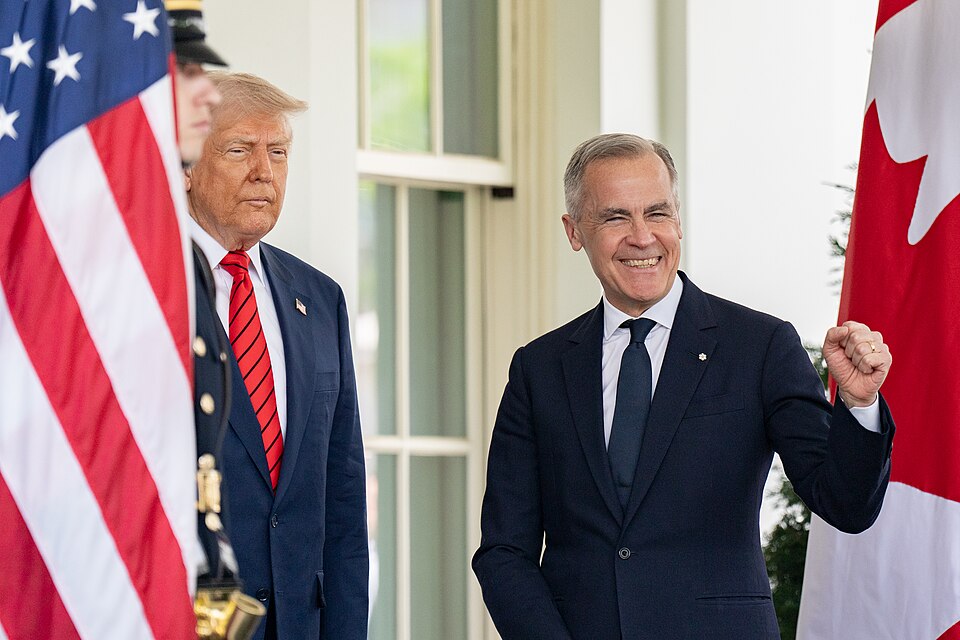
President Donald Trump greets Prime Minister of Canada Mark Carney, Tuesday, May 6, 2025, at the West Wing entrance of the White House.
(Official White House Photo by Gabriel B Kotico)
It was the best of budgets, it was the worst of budgets, it was the age of restraint, it was the age of profligacy, it was the epoch of the legislature, it was the epoch of the executive, it was the season of open debate, it was the season of closed doors, it was the spring of Canada, it was the winter of America. Or possibly the other way around.
The confusion arises because as a patriotic Canadian I keep hearing how U.S. President Donald Trump is an American Mussolini who has abolished the last vestiges of the old Republic, so we should drink rye not bourbon or some other decisive action easily performed while sitting down. Yet the news media mysteriously insist that the Bad Orange Man is having trouble getting his budget through some quaint relic called the United States Congress while Green Mark Carney isn’t bothering to get his spending plans rubber-stamped by some quaint relic called the Canadian Parliament. How can it be?
Tuesday’s the Morning newsletter from the New York Times, which is no MAGA outlet, reads: “Speaker Mike Johnson has a math problem. He wants to pass a megabill before Memorial Day to deliver President Trump’s legislative agenda.” But with only three spare votes in the House, “there are way more than three G.O.P. dissenters, and they don’t agree on what the problem is. Some think the cuts to Medicaid are too large. Others think they’re too small. Some want to purge clean-energy tax breaks. Others want to preserve them because their constituents have used them.”
Likewise The Atlantic, part of the thundering herd of independent liberal American minds, says: “The struggle to pass Donald Trump’s second-term agenda in Congress has never been between Republicans and Democrats … it’s been a battle between the House and Senate GOP, between moderates and hard-liners, and, most salient, between Republicans and reality.”
Egad. What manner of rambunctious folly is this? Open debate within the Maximum Leader’s own party? Dictatorship! By contrast here in decorous Canada can someone remind me which inane or malicious measures from former prime minister Justin Trudeau were ever put at risk by the principled courage, truculence or mere pandering even of his NDP coalition non-partners, let alone the trained seals in red?
Periodically one would bark. But which ever bit? To be sure, as the Canadian Press noted on Sunday, “Prime Minister Mark Carney says the Liberal government will present a federal budget in the fall, allowing time for clarity on some key economic and fiscal issues to emerge”. But if there’s going to be a brawl, it will be inside his office, or head, with his finance minister promising to brush aside Parliament with an “economic statement” before Carney overrode him, saying the government would introduce “a much more comprehensive, effective, ambitious, prudent budget in the fall”.
Comments Off on Trump, “the American Mussolini”, versus ever-so-democratic Mark Carney
May 17, 2025
German democracy … saved by bureaucratic incompetence?
Checking in to the situation in Germany, it seems that the big secret report compiled by the German spy agency on the extremely extreme extreme right-wing Alternative für Deutschland party is a bit less than what was expected. Okay, a lot less:
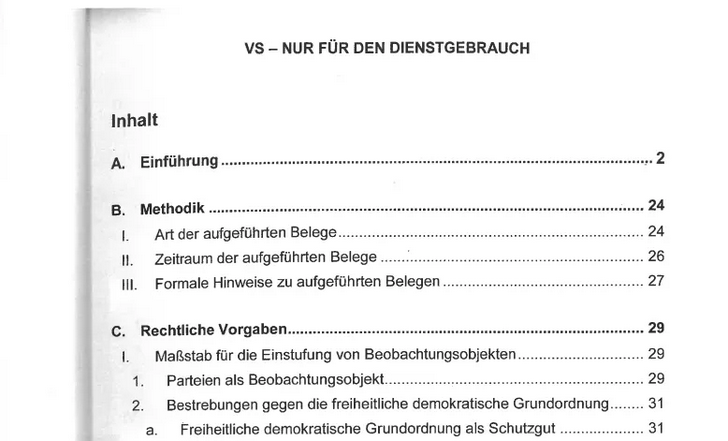
In my last post, I wrote that “The campaign to ban Alternative für Deutschland is not going well“. Today – a mere seventy-two hours later – you could say that the campaign to ban Alternative für Deutschland is all but dead. This is because the people most committed to banning the AfD also happen to be some of the stupidest, most incompetent legal and political operators the world has ever seen. Their incompetence is so enormous that I am for once willing to entertain conspiracy theories as to why they might have undermined their own project. It is that bad.
Two weeks ago, you may remember, Interior Minister Nancy Faeser forced the Federal Office for the Protection of the Constitution (BfV) to rush their long-planned upgrade of the AfD and declare the party to be a “confirmed right-wing extremist” organisation. Word spread of a mysterious 1,100-page assessment, full of damning proofs that allegedly supported this upgrade. This document had to be kept secret, Faeser explained in an interview, “… to protect sources and withhold indications of how our findings were obtained”. So espionage, much secret, wow.
The thing was, the anti-AfD dossier could not have been that secret, because somebody (almost certainly, somebody in the Interior Ministry) immediately leaked it to Der Spiegel, whose journalists published various excerpts in an effort to make the case for how evil and fascist and Nazi and Hitler the AfD are. In this way the press could climax repeatedly in a wave of democratic orgasms over the renewed possibility of an AfD ban, even in the absence of the supersecret report.
The media circus dissipated quickly, however. The publicity campaign, the roll-out – a lot of things went wrong, some of them inexplicably wrong. Still, I thought there was a 40% chance that the Bundestag would try to open ban proceedings sometime this year. That, as I said, was on Monday. What happened on Tuesday, is that Cicero, NiUS and Junge Freiheit all received the secret 1,100-page assessment (actually, it contains 1,108 pages) and published it in its entirety. Since Tuesday evening, a great many people have been reading this document, and they have been realising various things.
The first thing they’ve realised, is that it contains hardly anything derived from supersecret spy sources at all. It is little more than a collection of public statements by AfD politicians. Faeser’s sources-and-methods justification for keeping the report hidden was a total lie.
The second thing they’ve realised, is that it is an abomination. The vast majority of material that the BfV have collected is not even suspect. It is a lot of off-colour jokes, memes, but also just banal nothing statements – thousands and thousands and thousands of them, arranged under various hysterical subject headings. Nothing in here is remotely strong enough to support the case for banning the AfD and a lot of it is also very bizarre in terms of argument. Not only have the prospects of an AfD ban all but evaporated, but I think it’s even likely the party will succeed in their present lawsuit and that the administrative court in Cologne will throw out the “right-wing extremist” label.
Comments Off on German democracy … saved by bureaucratic incompetence?
May 13, 2025
Checking on the parlous state of German democracy this week
First, Sabine Beppler-Spahl points out how difficult it was for the new ruling coalition to get their candidate for Chancellor actually installed:
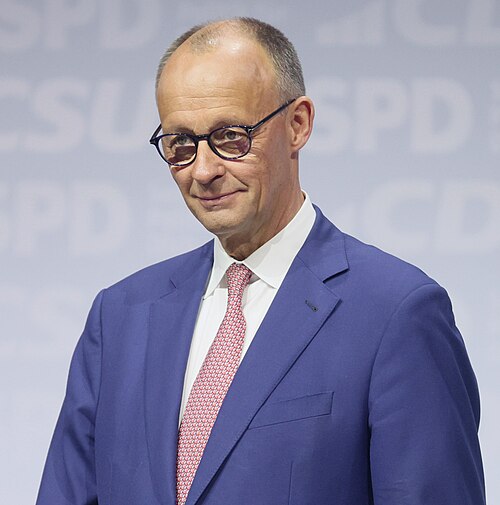
German Chancellor Friedrich Merz, 5 May 2025.
Photo by Sandro Halank for Wikimedia Commons.
The spectacle in the Bundestag this week sent shockwaves through Germany’s political establishment. For the first time in modern German history, a chancellor candidate – Christian Democratic Union (CDU) leader Friedrich Merz – failed to get elected by parliament. In the first round of voting, he received just 310 out of 621 votes – six votes short of the necessary majority. A total of 18 members of his own coalition brazenly refused to support him.
A second round of voting was then called and Merz managed to scrape through with 325 votes. But this was a stinging embarrassment for both Merz himself and the new coalition government more broadly. “Never before has there been a political car crash on such a scale”, wrote Berthold Kohler, editor of the conservative FAZ.
In hindsight, Merz’s failure shouldn’t have been such a surprise. From the beginning, the new government was always going to be in for a rough ride. For a start, it is made up of two parties that both received phenomenally bad results in February’s federal elections. The CDU suffered its second-worst result since its founding. Meanwhile, the CDU’s coalition partner, the Social Democrats (SPD), received its worst result ever.
Worse still, the coalition was losing even more support in the polls in the weeks running up to the chancellor vote. At times, the governing parties barely managed 40 per cent between them. Hermann Binkert, head of the INSA polling institute, described this as a “loss of approval like never before in the period between a federal election and the formation of a new government”.
Many commentators are now questioning whether Merz and his coalition will ever truly recover from this humiliation. The fiasco certainly confirms that Germany is in a deep political crisis, which isn’t going anywhere. It also undermines the smug assertions of Europe’s anti-populist establishment, which has been claiming, against all evidence to the contrary, that German politics is less prone to populist upheavals than those of other Western democracies.
Outside parliamentary machinations, the move to declare the largest opposition party to be a formal threat to German democracy isn’t going smoothly either:
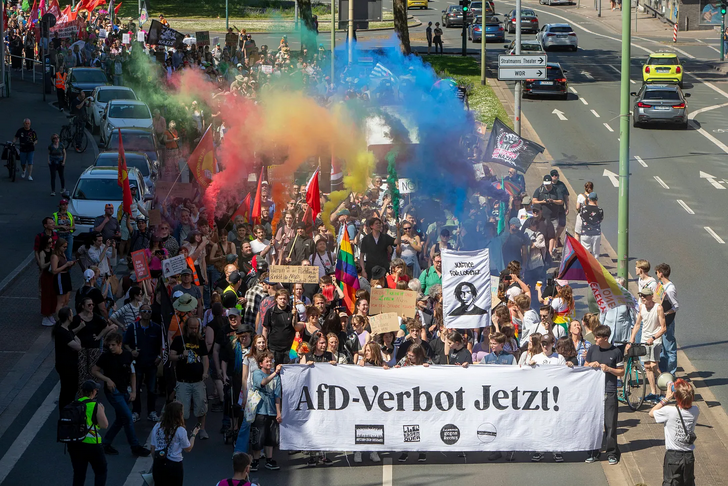
The anti-AfD protest in Essen on Sunday, photographed carefully lest the viewer see how small it was.
On 2 May, the Federal Office for the Protection of the Constitution (BfV) yielded to intense pressure from their boss, Interior Minister Nancy Faeser, and declared Alternative für Deutschland to be a “confirmed right-wing extremist organisation“. The media filled with hit pieces and leftoids began a new round of shouting and morally hyperventilating about the evil fascist Nazi Hitler party. I thought we might be seeing the beginning of an earnest campaign to prohibit the AfD and that over the coming weeks the momentum would just build and build.
Instead it’s kind of fizzled out.
One thing that went wrong, was the roll-out. The AfD immediately filed suit with the Cologne Administrative Court to have their extremist status lifted, and the BfV ended up temporarily suspending their assessment for tactical reasons – above all, to avoid a temporary court injunction that the AfD could portray as a victory. I’ve said many times that a lot of the media pressure against the AfD seems to be coordinated by the constitutional protectors themselves. Now that they’re no longer agitating behind the scenes, the steady drumbeat of pearl-clutching news stories has ground to a halt.
The second thing that has gone wrong, is the publicity campaign. You may remember that the constitutional protectors have produced a 1,100-page assessment documenting the right-wing extremism of the AfD. This dossier, however, remains entirely secret, and so journalists have been leaking choice passages from its pages instead. Their leaks strongly suggest that this document is little more than a vast assemblage of public statements by AfD politicians and functionaries that people in the BfV find untoward.
First we had the three leaks in Welt, which I covered in my first post on this topic. These featured people saying such benign things as “There is more to being German than simply holding citizenship papers” and “Failed migration policy and asylum abuse have led to the importation of 100,000 people from deeply backward and misogynistic cultures”.
That did not impress anybody, so Der Spiegel rushed out a new round of leaks. This piece tells us, breathlessly, that “politicians from the party have been ‘continuously’ agitating against refugees and migrants”, that “they have made xenophobic and Islamophobic statements” and that they have an “ethnic-ancestral understanding” of human descent groups that “is not compatible with the free democratic basic order”. They particularly deplore the use of terms like “knife migrants” (“Messermigranten“) which “attribute an ‘ethnocultural propensity for violence to entire groups'”. They say that the party does not consider Germans “with a migrant background from Muslim-influenced countries” to be equal citizens and that the AfD thus “devalues entire population groups in Germany”, violating their human dignity.
Comments Off on Checking on the parlous state of German democracy this week


