
Quotulatiousness

October 3, 2017

Viking warrior women?

Filed under: Cancon, History, Science — Tags: , , , , — Nicholas @ 03:00

ESR posted a link to this article by Julia Dent on the much ballyhoo’d “discovery” of the grave of a Viking woman warrior:

You may have heard of L’Anse aux Meadows, the discovered Viking site in Canada (because I repeat, Vikings actually settled in North America, even if it didn’t last long), but did you know that they uncovered another Viking site only last year? If you listen to Dan Snow’s History Hit podcast (which I highly recommend), you may have heard about it, but I only saw a couple of articles about the discovery. This finding is further proof that Leif Eriksson and his fellow Vikings actually settled in North America years before Christopher Columbus was even born, so it isn’t insignificant in the least.

But Leif Eriksson was overshadowed once again—this time by an unknown woman’s grave. However, there’s more to the story than meets the eye. I’ve written about the danger of people leaping to conclusions before, and it appears that it’s happened again. While there may have been female Viking warriors, there isn’t strong evidence that this Viking woman was actually a “high-ranking officer” or even a warrior. University of Nottingham professor of Viking studies Judith Jesch burst everyone’s bubbles with an article going through the “evidence” from the grave site and contesting it all. I highly encourage you to read her analysis in full, but here’s a quick summary of some of her points about the authors who published the “evidence” that the grave site was for a female Viking military officer:

    The authors listed on the article don’t include a language specialist, even though it starts with referencing “’narratives about fierce female Vikings fighting alongside men’, and concludes with a quotation from an Eddic poem in translation.” The authors even referenced one of Jesch’s books but not the book where she actually writes about women. The authors also make a lot of references to “historical records” without specifying which ones they’re talking about.

    The authors pretty much decide that this Viking woman is a high-ranking officer based on what she was buried with. The grave contained “’a full set of gaming pieces’ which apparently ‘indicates knowledge of tactics and strategy’” and “’the exclusive grave goods and two horses are worthy of an individual with responsibilities concerning strategy and battle tactics.’” There isn’t even any conclusive evidence that men buried with those items were military leaders.

    This gravesite was actually excavated over a century ago and things weren’t labeled well, so the female Viking bones may not have even been buried with all those items. Someone even commented on Jesch’s article that there was a third femur found with this woman’s bones, but the authors just ignored it. There were also no signs of harm to the bones, which means she was either one heck of a warrior who never got injured, or that she wasn’t a warrior at all.

So the authors assumed this female Viking was a military leader without any actual evidence and they ignored evidence that didn’t go along with their theory. Like many people today, they leapt to conclusions, and everyone was eager to agree that this woman was definitely a military leader because that suited a contemporary narrative, not a historical fact. This doesn’t mean that people in the future won’t find hard evidence that female Vikings could be military leaders, but you can’t “confirm” that this Viking was a military leader quite yet. Even if there weren’t female Viking warriors, women in Viking times were actually well-respected and enjoyed many rights and freedoms; they could divorce their husbands, own land, and could even have government representation. Women like Freydis and Gudrun had a significant impact on their societies, even if they didn’t lead troops into battle.

ESR also commented on the more direct physiological arguments against the “warrior woman” theory:

Accessible treatment of why to be skeptical of the recent media buzz about female Viking warriors.

My wife Cathy and I are subject-matter experts on this. We’ve trained to use period weapons and have studied both the archeological and saga evidence. And we can tell there’s a lot of PC horse exhaust being emitted on this topic.

On average, men are so much faster and stronger than women that what would happen to women using using lethal contact weapons on a pre-modern battlefield is highly predictable. They’d die. They’d die quickly.

The mean difference in physical ability (especially at burst exertion and upper-body strength) is so great that it takes a woman way over in the right tail of the Gaussian to stand against an average male. My wife is one of those exceptions, but we don’t fool ourselves that this is the typical case.

See also the U.S. Olympic women’s soccer team being defeated by a squad of 15-year-old boys. That is what’s normal for humans.

September 25, 2017

The Truth About Stonehenge – Anglophenia Ep 6

Filed under: Britain, History, Religion — Tags: , , — Nicholas @ 02:00

Published on 26 Jun 2014

Siobhan Thompson follows up ‘One Woman, 17 British Accents’ with a video dispelling a commonly believed myth about Stonehenge.

And by the way, Stonehenge isn’t the only stone structure worth visiting in Britain: http://www.bbcamerica.com/anglophenia/2014/06/impressive-british-stone-structures-arent-stonehenge/

Photos via AP Images.

September 8, 2017

Grant Vs Lee Who Was The Better General?

Filed under: Books, History, Military, USA — Tags: , , , — Nicholas @ 04:00

Published on 17 Aug 2016

Today I break down the book: Grant And Lee: A Study In Personality And Generalship By J.F.C Fuller

Here’s a quick break down of the two personalities

Grant: common sense, logical, simple plans with incredible precise execution, the ability to bring a whole lot of moving pieces into focus, and finally the ability to think clearly under stress.
Lee: The ability to motivate his men to an incredible degree, an extremely kind man, very good at doling out troops to his commanders when in a defensive situation.

This video goes into more detail on all of this, I hope you enjoyed!

September 5, 2017

Georges Guynemer – The Flying Icon of France I WHO DID WHAT IN WW1?

Filed under: Europe, France, History, Military, WW1 — Tags: , , — Nicholas @ 04:00

Published on 4 Sep 2017

George Guynemer was one of the top scoring flying aces of the entire First World War with 54 aerial victories. In his lifetime, he was celebrated as a hero, an icon and an inspiration in France. When he went missing 100 years ago, in September 1917, it was a great shock to the nation and to this day his death is not fully understood.

August 24, 2017

Teaching history in the South – the “Lost Cause” school of historiography

Filed under: Education, History, Politics, USA — Tags: , , , , — Nicholas @ 06:00

Warren Meyer gives some background on how most people in the Southern US were taught the history of the “War Between the States”:

The Lost Cause School: I want to provide some help for those not from the South to understand the southern side of the statue thing. In particular, how can good people who believe themselves not to be racist support these statues? You have to recognize that most folks of my generation in the South were raised on the lost cause school of Civil War historiography. I went to one of the great private high schools in the South and realized later I had been steeped in Lost Cause. All the public schools taught it. Here is the Wikipedia summary:

    The Lost Cause of the Confederacy, or simply Lost Cause, is a set of revisionist beliefs that describes the Confederate cause as a heroic one against great odds despite its defeat. The beliefs endorse the virtues of the antebellum South, viewing the American Civil War as an honorable struggle for the Southern way of life, while minimizing or denying the central role of slavery. While it was not taught in the North, aspects of it did win acceptance there and helped the process of reunifying American whites.

    The Lost Cause belief system synthesized numerous ideas into a coherent package. Lost Cause supporters argue that slavery was not the main cause of the Civil War, and claim that few scholars saw it as such before the 1950s. In order to reach this conclusion, they often deny or minimize the writings and speeches of Confederate leaders of the time in favor of later-written revisionist documents. Supporters often stressed the idea of secession as a defense against a Northern threat to their way of life and say that threat violated the states’ rights guaranteed by the Union. They believed any state had the right to secede, a point strongly denied by the North. The Lost Cause portrayed the South as more profoundly Christian than the greedy North. It portrayed the slavery system as more benevolent than cruel, emphasizing that it taught Christianity and civilization. In explaining Confederate defeat, the Lost Cause said the main factor was not qualitative inferiority in leadership or fighting ability but the massive quantitative superiority of the Yankee industrial machine.

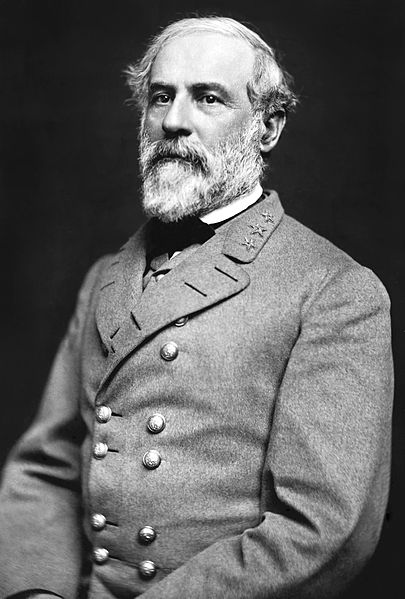
Confederate General Robert E. Lee, commander of the Army of Northern Virginia (via Wikimedia)

Obviously this was promoted by the white supremacists after the war, but in the 20th century many well-meaning people in the South who are not racist and by no means want to see a return of slavery or Jim Crow still retain elements of this story, particularly the vision of the Confederacy as a scrappy underdog. But everything in these two paragraphs including the downplaying of slavery in the causes of the Civil War was being taught when I grew up. It wasn’t until a civil war course in college (from James McPherson no less, boy was I a lucky dog there) that I read source material from the time and was deprogrammed.

The comparisons of the current statue removal to Protestant reformation iconoclasm seem particularly apt to me. You see, growing up in the South, Confederate generals were our saints. And the word “generals” is important. No one I knew growing up would think to revere, say, Jefferson Davis. Only the hard-core white supremacists revered Jefferson Davis. Real lost cause non-racist southerners revered Robert E. Lee. He was our Jesus (see: Dukes of Hazard). Every town in the south still has a Robert E Lee High School. Had I not gone to private school, I would have gone to Houston’s Lee High (I had a friend who went to college at Lehigh in New Jersey. Whenever he told folks in the South he went there, they would inevitably answer “yes, but where did you go to college.”) So Lee was by far and away at the top of the pantheon. Then you had folks like Stonewall Jackson and J.E.B. Stuart who were probably our Peter and Paul. Then all the rest of the generals trailing off through the equivalents of St. Bartholomew or whoever. We even had a Judas, General James Longstreet, who for a variety of reasons was reviled by the Lost Cause school and was blamed for many of Lee’s, and the South’s, losses.

If you want to see the Southern generals the way much of the South sees them, watch the movie Gettysburg, which I like quite a bit (based on the book Killer Angels, I believe, also a good read). The Southern Generals are good, talented men trying to make the best of a losing cause. Slavery is, in this movie, irrelevant to them. They are fighting for their beloved homes in the South, not for slavery. The movie even has Longstreet saying something like “we should have freed the slaves and then fired on Fort Sumter”.

The movie Gettysburg is excellent, but if you don’t know much about the actual battle, you might end up thinking the entire conflict revolved around the 20th Maine …

July 17, 2017

Debunking some myths about sulfites in wine

Filed under: Health, Science, Wine — Tags: , — Nicholas @ 05:00

By way of Scientific American, here’s a bit of clarity from Monica Reinagel about the issue of sulfites in both red and white wine and what relationship it has to wine headaches:

Myth #1: Organic or bio-dynamic wines are sulfite free.

In order to be certified organic, a wine must not contain added sulfites. However, sulfites are produced naturally during the fermentation process as a by-product of yeast metabolism. Even though no sulfites are added, organic wine may contain between 10-40 ppm sulfites.

You may also see wines labeled as being made from organic grapes, which is not the same as organic wine. Wine made from organic grapes may contain up to 100 ppm sulfites.

If you do get a hold of wine made without sulfites, I don’t suggest keeping it in the cellar very long. Wine made without sulfites—especially white wine — is much more prone to oxidation and spoilage.

Myth #2: Red wine is higher in sulfites than white wine

Ironically, the exact opposite is likely to be true. Red wines tend to be higher in tannins than white wines. Tannins are polyphenols found in the skins, seeds, and stems of the grapes. They also act as antioxidants and preservatives so less sulfite is needed.

In fact, while European regulations allow up to 210 ppm sulfites in white wine, the limit for red wine is only 160 ppm.

Other factors that affect how much sulfite is needed are the residual sugar and the acidity of the wine. Dryer wines with more acid will tend to be lower in sulfites. Sweet wines and dessert wines, on the other hand, tend to be quite high in sulfites.

Myth #3: Sulfites in wine cause headaches

The so-called “red wine headache” is definitely a real thing. But it’s probably not due to sulfites. For one thing, white wine is higher in sulfites than red wine but less likely to cause a headache. That suggests that it’s probably something else in red wine that’s responsible for the notorious red wine headache. Other candidates include histamines, tyramine, tannins, not to mention the alcohol itself!

June 24, 2017

The Articles of Confederation – Lies – Extra History

Filed under: Britain, Cancon, Government, History, Liberty, USA — Tags: , , , , — Nicholas @ 04:00

Published on Jun 17, 2017

The Articles of Confederation gave the United States their name, but even beyond that, they exposed many of the issues that would underlie this new nation for the rest of its history. James Portnow interviews series writer Soraya Een Hajji about the Articles of Confederation!

May 14, 2017

Space Myths Debunked – Earth Lab

Filed under: Science, Space — Tags: , , — Nicholas @ 02:00

Published on 4 May 2017

From astrology to the temperature in space, Dom counts down the top 5 space myths and explains why they are baloney.

1 http://astronomy.swin.edu.au/cosmos/N/Neutron+Star
2 http://www.universetoday.com/77070/how-cold-is-space/
3 https://www.wired.com/2007/11/no-dark-side-of/
4 http://www.livescience.com/34212-great-wall-of-china-only-manmade-object-visible-from-space.html
5 http://www.universetoday.com/25364/can-you-see-the-great-wall-of-china-from-space/
6 https://www.scientificamerican.com/article/fact-or-fiction-nasa-spen/
7 https://www.cambridge.org/core/journals/proceedings-of-the-international-astronomical-union/article/div-classtitleastronomy-and-astrologydiv/3171E9B009B4E8421B1913AC0A08AB32

April 23, 2017

Top 5 Gun Myths That Hollywood Taught Us

Filed under: Technology — Tags: , , — Nicholas @ 02:00

Published on 5 Aug 2016

Top 5 Myths about Guns That Hollywood Taught Us

Forget what you see in the latest action movies or even video games, these gun myths shouldn’t be believed. We see it everywhere; James Bond, Westerns, Call of Duty, Fast and Furious, Terminator, Black Hawk Down, The Expendables, Goldeneye, Battlefield, Taken, Die Hard, Bon Cop Bad Cop, The Matrix, and so on – They’re all Bullshit, but we fall for them thanks to Hollywood. Here’s looking at you Arnold Schwarzenegger and Sylvester Stallone.

Can Bullets shoot through cars? Will gas canisters explode if you shoot them? Am I safe from bullets underwater? Those questions and more will be answered in this edition of Watchmojo’s Top 5 Myths.

April 22, 2017

QotD: Vanilla isn’t

Filed under: Food, Health, Quotations, Science — Tags: , — Nicholas @ 01:00

One last, minor thing: Vanilla is a deeply rich flavor that has unfairly become shorthand for boring, basic, and sexually unadventurous. Merriam-Webster’s second definition includes the sad phrase “lacking distinction” to explain the term “vanilla.” I’m not arguing that we drop this secondary use of the word — we’re too far gone for that — but I do want to remind people that vanilla is actually an extraordinarily complex flavor. Chocolate is far more vanilla than vanilla.

Caitlin PenzeyMoog, “Salt grinders are bullshit, and other lessons from growing up in the spice trade”, The A.V. Club, 2017-04-06.

April 11, 2017

QotD: The great American humourists

Filed under: History, Humour, Quotations, USA — Tags: , , , , — Nicholas @ 01:00

The great American humorists have something in common: hatred.

H. L. Mencken and Mark Twain both could be uproariously funny and charming — and Twain could be tender from time to time, though Mencken could not or would not — but at the bottom of each man’s deep well of humor was a brackish and sour reserve of hatred, for this country, for its institutions, and for its people. Neither man could forgive Americans for being provincial, backward, bigoted, anti-intellectual, floridly religious, or for any of the other real or imagined defects located in the American character.

Historical context matters, of course. As Edmund Burke said, “To make us love our country, our country ought to be lovely.” Twain was born in 1835, and there was much that was detestable in the America of Tom Sawyer. Mencken, at the age of nine, read Huckleberry Finn and experienced a literary and intellectual awakening — “the most stupendous event in my life,” he called it — and followed a similar path. Both men were cranks: Twain with his premonitions and parapsychology, Mencken with his “Prejudices” and his evangelical atheism. He might have been referring to himself when he wrote: “There are men so philosophical that they can see humor in their own toothaches. But there has never lived a man so philosophical that he could see the toothache in his own humor.”

The debunking mentality is prevalent in both men’s writing, a genuine fervor to knock the United States and its people down a peg or two. For Twain, America was slavery and the oppression of African Americans. For Mencken, the representative American experience was the Scopes trial, with its greasy Christian fundamentalists and arguments designed to appeal to the “prehensile moron,” his description of the typical American farmer. The debunking mind is typical of the American Left, which feels itself compelled to rewrite every episode in history in such a way as to put black hats on the heads of any and all American heroes: Jefferson? Slave-owning rapist. Lincoln? Not really all that enlightened on race. Saving the world from the Nazis? Sure, but what about the internment of the Japanese? Etc. “It was wonderful to find America,” Twain wrote. “But it would have been more wonderful to miss it.”

Kevin D. Williamson, “Bitter Laughter: Humor and the politics of hate”, National Review, 2016-08-11.

February 27, 2017

“Dumb Norsemen go into the north outside the range of their economy, mess up the environment and then they all die when it gets cold”

Filed under: Americas, History, Science — Tags: , , , , — Nicholas @ 03:00

Debunking the Greenland myth in the Smithsonian:

Those tough seafaring warriors came to one of the world’s most formidable environments and made it their home. And they didn’t just get by: They built manor houses and hundreds of farms; they imported stained glass; they raised sheep, goats and cattle; they traded furs, walrus-tusk ivory, live polar bears and other exotic arctic goods with Europe. “These guys were really out on the frontier,” says Andrew Dugmore, a geographer at the University of Edinburgh. “They’re not just there for a few years. They’re there for generations — for centuries.”

So what happened to them?

**********

Thomas McGovern used to think he knew. An archaeologist at Hunter College of the City University of New York, McGovern has spent more than 40 years piecing together the history of the Norse settlements in Greenland. With his heavy white beard and thick build, he could pass for a Viking chieftain, albeit a bespectacled one. Over Skype, here’s how he summarized what had until recently been the consensus view, which he helped establish: “Dumb Norsemen go into the north outside the range of their economy, mess up the environment and then they all die when it gets cold.”

[…]

But over the last decade a radically different picture of Viking life in Greenland has started to emerge from the remains of the old settlements, and it has received scant coverage outside of academia. “It’s a good thing they can’t make you give your PhD back once you’ve got it,” McGovern jokes. He and the small community of scholars who study the Norse experience in Greenland no longer believe that the Vikings were ever so numerous, or heedlessly despoiled their new home, or failed to adapt when confronted with challenges that threatened them with annihilation.

“It’s a very different story from my dissertation,” says McGovern. “It’s scarier. You can do a lot of things right — you can be highly adaptive; you can be very flexible; you can be resilient — and you go extinct anyway.” And according to other archaeologists, the plot thickens even more: It may be that Greenland’s Vikings didn’t vanish, at least not all of them.

H/T to Kate at Small Dead Animals for the link.

February 12, 2017

British History’s Biggest Fibs with Lucy Worsley Episode 2: The Glorious Revolution

Filed under: Britain, Europe, History — Tags: , , , , , — Nicholas @ 02:00

Published on 3 Feb 2017

In this episode, Lucy debunks another of the biggest fibs in British history – the ‘Glorious Revolution’.

In 1688, the British Isles were invaded by a huge army led by Dutch prince, William of Orange. With his English wife Mary he stole the throne from Mary’s father, the Catholic King James II. This was the death knell for absolute royal power and laid the foundations of our constitutional monarchy. It was spun as a ‘glorious and bloodless revolution’. But how ‘glorious’ was it really? It led to huge slaughter in Ireland and Scotland. Lucy reveals how the facts and fictions surrounding 1688 have shaped our national story ever since.

February 8, 2017

British History’s Biggest Fibs with Lucy Worsley Episode 1 War of the Roses [HD]

Filed under: Britain, History — Tags: , , , , , — Nicholas @ 02:00

Published on 27 Jan 2017

Lucy debunks the foundation myth of one of our favourite royal dynasties, the Tudors. According to the history books, after 30 years of bloody battles between the white-rosed Yorkists and the red-rosed Lancastrians, Henry Tudor rid us of civil war and the evil king Richard III. But Lucy reveals how the Tudors invented the story of the ‘Wars of the Roses’ after they came to power to justify their rule. She shows how Henry and his historians fabricated the scale of the conflict, forged Richard’s monstrous persona and even conjured up the image of competing roses. When our greatest storyteller William Shakespeare got in on the act and added his own spin, Tudor fiction was cemented as historical fact. Taking the story right up to date, with the discovery of Richard III’s bones in a Leicester car park, Lucy discovers how 15th-century fibs remain as compelling as they were over 500 years ago. As one colleague tells Lucy: ‘Never believe an historian!

November 10, 2016

QotD: Science’s Biggest Fail

Filed under: Food, Health, Media, Quotations, Science — Tags: , , — Nicholas @ 01:00

What is science’s biggest fail of all time?

I nominate everything about diet and fitness.

Maybe science has the diet and fitness stuff mostly right by now. I hope so. But I thought the same thing twenty years ago and I was wrong.

I used to think fatty food made you fat. Now it seems the opposite is true. Eating lots of peanuts, avocados, and cheese, for example, probably decreases your appetite and keeps you thin.

I used to think vitamins had been thoroughly studied for their health trade-offs. They haven’t. The reason you take one multivitamin pill a day is marketing, not science.

I used to think the U.S. food pyramid was good science. In the past it was not, and I assume it is not now.

I used to think drinking one glass of alcohol a day is good for health, but now I think that idea is probably just a correlation found in studies.

I used to think I needed to drink a crazy-large amount of water each day, because smart people said so, but that wasn’t science either.

I could go on for an hour.

You might be tempted to say my real issue is with a lack of science, not with science. In some of the cases I mentioned there was a general belief that science had studied stuff when in fact it had not. So one could argue that the media and the government (schools in particular) are to blame for allowing so much non-science to taint the field of real science. And we all agree that science is not intended to be foolproof. Science is about crawling toward the truth over time.

Perhaps my expectations were too high. I expected science to tell me the best ways to eat and to exercise. Science did the opposite, sometimes because of misleading studies and sometimes by being silent when bad science morphed into popular misconceptions. And science was pretty damned cocky about being right during this period in which it was so wrong.

So you have the direct problem of science collectively steering my entire generation toward obesity, diabetes, and coronary problems. But the indirect problem might be worse: It is hard to trust science.

Scott Adams, “Science’s Biggest Fail”, Scott Adams Blog, 2015-02-02.

« Newer Posts — Older Posts »

Powered by WordPress

