
Every young American today is subject to military service; most of them, as shown by the Mayer Report, et al., are not prepared for it, either emotionally or by formal schooling…
He doesn’t see why he should expose himself to death; nothing in his experience justifies it. The whole thing is wildly implausible and quite unfair — like going to sleep in your own bed and waking up in a locked ward of an insane asylum. It strikes him as rank injustice.
And it is … [sic] the rankest sort of injustice.
My basic purpose, then, was to promote in that prototype youth-in-a-foxhole a better understanding of the nature, purpose and function of the ridiculous and dangerous predicament he found himself in.
There were various ancillary purposes but this was the main one … I was forced to limit my scope to: “Why in hell should a young man in good health be willing to fight and perhaps die for his country?” …
I do not expect you to like the book, nor to speak approvingly of it, since you quite clearly do not like it and do not approve of it. But, in fairness, I ask that you, in published criticism of it, (a) read more carefully what I did say and not impute to it things which I did not say, and (b) judge it within its obvious limitations as a short first-person commercial novel and not expect it to unscrew the inscrutable with respect to every possible facet of an extremely complex philosophical question (i.e., don’t expect of me more than you require of yourself).
Robert A. Heinlein, letter to Theodore Cogswell 1959-12-04, quoted in William H. Patterson Jr., Robert A. Heinlein, In Dialogue with His Century Volume 2: The Man Who Learned Better, 2014).
July 18, 2014
QotD: The duty of the soldier
July 11, 2014
DSM-5 turns “everyday anxiety, eccentricity, forgetting and bad eating habits into mental disorders”
Helene Guldberg reviews Saving Normal: An Insider’s Revolt Against Out-of-Control Psychiatric Diagnosis, DSM-5, Big Pharma, and the Medicalization of Ordinary Life by Allen Frances.
Frances’ arguments about the dangers of inflating psychiatric conditions and psychiatric diagnosis are persuasive — maybe more so because he honestly admits to his own role in developing such an inflation. He is keenly aware of the risks of diagnostic inflation ‘because of painful firsthand experience’, he writes. ‘Despite our efforts to tame excessive diagnostic exuberance, DSM-IV had since been misused to blow up the diagnostic bubble’. He is particularly concerned about the exponential increase in the diagnosis of psychiatric conditions in children, writing: ‘We failed to predict or prevent three new false epidemics of mental disorder in children — autism, attention deficit, and childhood bipolar disorder. And we did nothing to contain the rampant diagnostic inflation that was already expanding the boundary of psychiatry far beyond its competence.’
Take Attention Deficit Hyperactivity Disorder (ADHD), which is ‘spreading like wildfire’. This diagnosis is applied so promiscuously that ‘an amazing 10 per cent of kids now qualify’, Frances writes. He points out that in the US, boys born in January are 70 per cent more likely to be diagnosed with ADHD than boys born in December. The reason diagnosing ADHD is so problematic is that it essentially is a description of immaturity, including symptoms such as ‘lack of impulse control’, ‘hyperactivity’ or ‘inattention’. Boys born in January are the youngest in their school year group (in the US) and thus they are more likely to be immature; in the UK, the youngest children in a school classroom are born in August, and so here, August-born kids are more likely to be diagnosed with ADHD. We have medicalised immaturity.
[…]
Until 1980, the DSMs were ‘deservedly obscure little books that no one much cared about or read’. DSM-I (published in 1952) and DSM-II (published in 1968) were ‘unread, unloved and unused’. Now, says Frances, this ‘bible’ of psychiatry ‘determines all sorts of important things that have an enormous impact on people’s lives — like who is considered well and who sick; what treatment is offered; who pays for it; who gets disability benefit; who is eligible for mental health, school vocational and other services; who gets to be hired for a job, can adopt a child, or pilot a plane, or qualifies for life insurance; whether a murderer is a criminal or mental patient; what should be the damages awarded in lawsuits; and much, much more’.
Today, as a result of various trends, including the impact of the DSMs, many human behaviours, quirks, eccentricities and woes which in the past would have been seen as parts of the rich tapestry of life are now branded mental disorders.
July 4, 2014
July 3, 2014
QotD: The death of nuance
… American
liberalismculture is now synonymous with a juvenile Manicheanism that imagines some perfect world we could achieve if people just weren’t so selfish and evil; that getting showily, publicly angry about problems is more popular than actually attempting to solve them; that there is no issue of such emotional and moral complexity that many people can’t reduce it to a black-and-white caricature; and that we have created a media which has made its financial best interest inextricable from destroying depth, nuance, and complexity. I genuinely don’t know if people believe in difficult choices and intractable problems anymore; they’ve been bludgeoned by the loud noises and shouting we mistake for discussion into thinking that all problems have clear villains and easy answers. I do know that this is no way to run a democracy. And I also know that, years from now, when people like Vogell are no longer wasting a second of their time thinking about physical restraint of children who are a danger to themselves and others, the women in my program will be working, quietly and selflessly and for awful compensation, trying to help the children they are now accused of abusing.Fredrik deBoer, “difficult problems after the death of nuance”, Fredrik deBoer, 2014-07-01.
June 29, 2014
QotD: Feminism should not be just reflexive blaming of men
I find myself increasingly shocked at the unthinking and automatic rubbishing of men which is now so part of our culture that it is hardly even noticed.
Great things have been achieved through feminism. We now have pretty much equality at least on the pay and opportunities front, though almost nothing has been done on child care, the real liberation.
We have many wonderful, clever, powerful women everywhere, but what is happening to men? Why did this have to be at the cost of men?
I was in a class of nine- and 10-year-olds, girls and boys, and this young woman was telling these kids that the reason for wars was the innately violent nature of men.
You could see the little girls, fat with complacency and conceit while the little boys sat there crumpled, apologising for their existence, thinking this was going to be the pattern of their lives.
Doris Lessing, quoted by Fiachra Gibbons in “Lay off men, Lessing tells feminists: Novelist condemns female culture that revels in humiliating other sex”, Guardian, 2001-08-14
June 26, 2014
The second volume of Patterson’s biography of Robert Heinlein
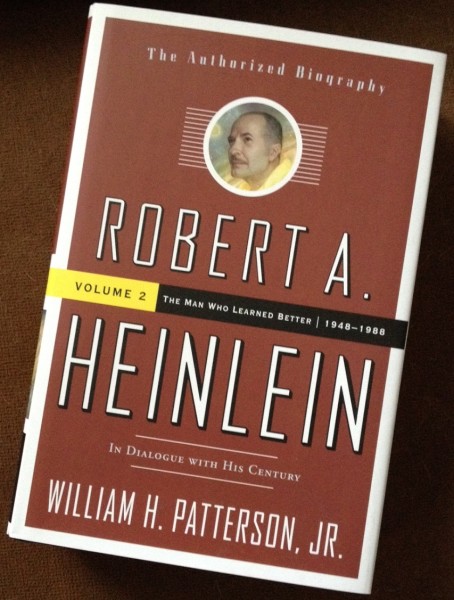 In the Washington Post, Michael Dirda reviews the second (and final) volume of William Patterson’s Robert A. Heinlein: In Dialogue With His Century.
Robert Anson Heinlein (1907-1988) possessed an astonishing gift for fast-paced narrative, an exceptionally engaging voice and a willingness to boldly go where no writer had gone before. In “— All You Zombies—” a transgendered time traveler impregnates his younger self and thus becomes his own father and mother. The protagonist of Tunnel in the Sky is black, and the action contains hints of interracial sex, not the usual thing in a 1955 young adult book. While Starship Troopers (1959) championed the military virtues of service and sacrifice, Stranger in a Strange Land (1961) became a bible for the flower generation, blurring sex and religion and launching the vogue word “grok.”
Heinlein’s finest work in the short story was produced in the late 1930s and early ’40s, mainly for the legendary editor of Astounding, John W. Campbell. But by 1948, when this volume opens, “The Roads Must Roll,” “By His Bootstraps, “Gulf” and “Requiem” are behind him. The onetime pulp writer has broken into the Saturday Evening Post and Boy’s Life, married his third (and last) wife, Virginia, and settled in Colorado Springs, where he designs and builds a state-of-the-art automated house. Apart from his occasional involvement with Hollywood, as in scripting Destination Moon, he will devote the rest of his career mainly to novels.
[…]
Like his fascinating but long-winded first volume, the second half of Patterson’s biography is difficult to judge fairly. Packed with facts both trivial and significant, relying heavily on the possibly skewed memories of the author’s widow, and utterly reverent throughout, volume two emphasizes Heinlein the husband, traveler, independent businessman and political activist. Above all, the book celebrates the intense civilization of two that Heinlein and his wife created. There is almost nothing in the way of literary comment or criticism.
Though Heinlein can do no wrong in his biographer’s eyes, if you use yours to look in Patterson’s voluminous endnotes, you will occasionally find confirmation that the writer could be casually cruel as well as admirably generous, at once true to his beliefs and unpleasantly narrow-minded and inflexible about them. Today we would call Heinlein’s convictions libertarian, his personal philosophy grounded in absolute freedom, individual responsibility and an almost religiously inflected patriotism. Heinlein could thus be a confirmed nudist and member of several Sunshine Clubs as well as a grass-roots Barry Goldwater Republican.
For the record, I loved this volume even more than I loved the first one. But Dirda’s comments are fair: Patterson worked hard to present Heinlein in as positive a light as possible, so it’s not unreasonable to suspect that the great man’s character quirks could make him difficult and awkward to deal with at times (to be kind). In the last post, I talked about the adolescent Heinlein as being “probably a pretty toxic individual” and that aspect of his character can still be discerned in the recounting of his later years.
June 5, 2014
Silly anti-gaming columnist soundly rebuked by readers
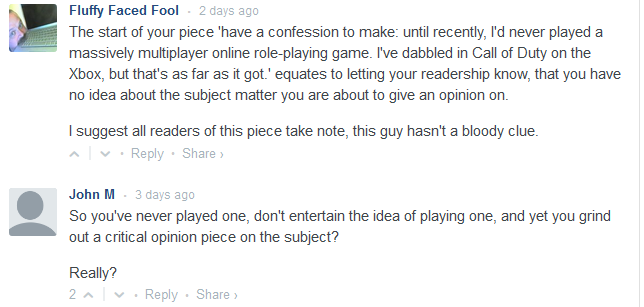
In the Telegraph last week, William Henderson first made it clear that “until recently, I’d never played a massively multiplayer online role-playing game. I’ve dabbled in Call of Duty on the Xbox, but that’s as far as it got.” Having gotten that out of the way, he then launched into a condemnation of the very games he admits he doesn’t play and has already explicitly admitted he knows very little about:
… I felt like Neo at the end of The Matrix when he sees the shimmering green code of the system, and finally realises the true nature of the prison for his mind.
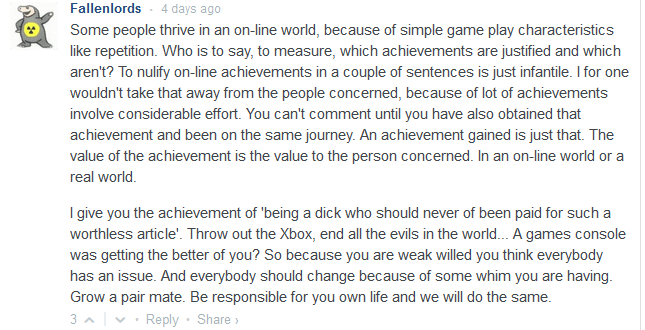
I won’t name the game in question: there’s no need – so many of them feature similar ways of getting the gamer hooked. Is it cynical of me that I no longer view video games as a means of innocuous pleasure? Definitely. But that cynicism is entirely justified: it’s a reflection of the nature of video games today. As I’ve previously written about, games today tend to reward repetition rather than skill, and gone is the social element where guys would go round each other’s house and actually be in each other’s company. The more successful you want to be at video games nowadays, the more you need to be a hermit.
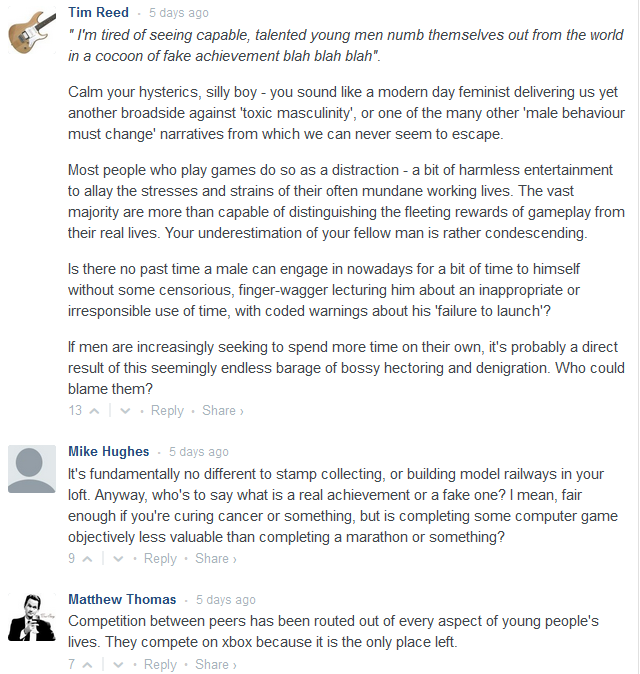
This is not to say that I begrudge gamers – everyone needs their downtime. However, the key word here is ‘success’. I’m tired of seeing capable, talented young men numb themselves out from the world in a cocoon of fake achievement. I’m tired of how their reward for completing utterly meaningless tasks is another load of worthless digital points – and more meaningless tasks. I’m tired of how the biological mechanisms which ensured their survival and evolutionary success are being hijacked to make them slaves to their own mind.
I rarely bother to read the comments on any site, but I was impressed with the quality of the comments here:
June 4, 2014
Piketty’s book as revealed truth
Sean Collins says “thou shalt not doubt St. Thomas”:
The Piketty-FT debate should be seen for the arcane technical dispute that it is, but instead many claimed that it was a Big Deal, a decisive political debate for our times. This overblown reaction highlights how Pikettymania has got out of control. Your attitude to Piketty’s Capital – a 700-page tome that many have not read – has become a badge indicating that you are right-on (or not) when it comes to inequality.
Pikettymania took flight when the left hailed him as extraordinary, a hero, and claimed his book would utterly transform the policy discussion towards questioning capitalism. Liberal economist Paul Krugman considers Capital ‘the most important economics book of the year – and maybe the decade’. Even those who disagree with the content feel obliged to claim the book is exceptional; for example, Lawrence Summers, a top economist in the Clinton and Obama administrations, says it is a ‘Nobel Prize-worthy contribution’, even though he finds Piketty’s theory to be wrong.
[…]
When the Great Man himself responded to the FT, his annoyance at having to deal with someone raising questions about his awesome work was clear. ‘Ridiculous’ and ‘dishonest’ was how he initially described the FT’s findings. In his full reply, he says the FT’s points were ‘criticism for the sake of criticism’ — in other words, this wasn’t a genuine search for the truth. In response to a number of the FT’s specific charges, Piketty says that he often had to adjust the data because of their inadequacies, and he applied his best judgment. He admits that in a few cases he could have been more explicit in describing his adjustments.
Such a response may lead to more questions, but not from his loyal supporters, who were busy celebrating Piketty’s ‘victory’ over the FT. ‘Piketty’s devastating point-by-point rebuttal’, says Robert Kuttner, shows that Giles ‘made a fool of himself’. Economist and New York Times contributor Justin Wolfers tweeted, ‘Debate’s over folks’ — providing further evidence for Joel Kotkin’s theory of the spread of a ‘debate is over’ syndrome among the modern left, which seeks to impose a stifling conformity on a variety of issues (from climate change to the causes of poverty and the definition of marriage, among others). Krugman concluded that the FT-Piketty debate showed the persistence of inequality ‘deniers’ — the same term of abuse thrown at today’s heretics who dare to question climate-change orthodoxy.
This anti-intellectual ‘nothing to see here, folks’ approach is wrong; more, not less, debate should be encouraged. Piketty’s data is fair game, but there’s much more to his argument that should be questioned, too. Even if Piketty’s figures are perfect, he still cannot explain why inequality changes over time, nor back up his predictions for the future. Moreover — as I pointed out in my review of his book — we should challenge the elite’s obsession with the lives of the rich and famous, which distracts from a proper discussion about economic growth and increasing living standards for all.
May 15, 2014
The “typical American voter [is] a moderate national socialist who strongly supports state intervention in many areas”
Kevin Williamson responds to Michael Lind’s recent hit piece on Bryan Caplan:
Mr. Lind’s piece contains no analysis. Like a great deal of what currently passes for commentary, it is mostly a half-organized swarm of insults out of which emerges the occasional tendentious misstatement of Professor Caplan’s views and those of the libertarian thinkers with whom he is sometimes associated. Mr. Lind begins by bemoaning our alleged national descent into plutocracy and writes: “Some on the libertarian right have responded to this research by welcoming our new plutocratic overlords. Among these is Bryan Caplan.” Professor Caplan, author of The Myth of the Rational Voter, is a trenchant critic of electoral decision-making. Voters, he argues, suffer from specific, predictable biases — anti-market bias, anti-foreign bias, make-work bias, and pessimistic bias — that causes them to hold, and act on, untrue beliefs about the way the world works. Being an economist, Professor Caplan focuses on what voters believe about economics vs. what professional economists believe. He characterizes the typical American voter as a moderate national socialist who strongly supports state intervention in many areas, and remarks, “Given public opinion, the policies of First World democracies are surprisingly libertarian.”
There is a great deal of agreement among the poor, the middle class, and the rich on most political issues, but the rich are significantly more libertarian than are the poor. As Professor Caplan notes, the wealthy and the poor both support raising the minimum wage, but the poor much more strongly so. You might think that that is a question of narrow self-interest, but self-interest, counterintuitively, has little effect on public opinion. And the rich are more libertarian than the poor not only on economic issues but also on social issues. The poor are “much more anti-gay,” Professor Caplan writes. “They’re much less opposed to restricting free speech to fight terrorism.” On the relatively few issues on which there is strong disagreement between the poor and the rich, the preferences of the rich have tended to prevail, and that pleases Professor Caplan, because that means that more libertarian policies are put into place than public opinion would suggest. “To avoid misinterpretation,” he writes, “this does not mean that American democracy has a strong tendency to supply the policies that most materially benefit the rich. It doesn’t.” But there is no avoiding misinterpretation when the opposite side is committed to misinterpreting you. Professor Caplan celebrates the advance of gay rights, pushback against the surveillance state, and, regrettably (especially for the author of Selfish Reasons to Have More Kids), abortion rights, among other items on the progressive social agenda. Mr. Lind sees only a champion of plutocracy — because that is all he is inclined to see.
Mr. Lind, who shares with fellow former conservative David Brock the convert’s zeal, is something of a fanatic on the subject of libertarianism, and the bulk of his piece is dedicated to abominating every libertarian thinker he’s ever heard of, making the case that the abominable Professor Caplan should fit right in. He starts with the predictable home-run swing (“you might be tempted to dismiss Bryan Caplan as just another Koch-funded libertarian hack …” and follows up with “Koch-subsidized intelligentsia of the libertarian right,” “almost all of them are paid, directly or indirectly, by a handful of angry, arrogant rich guys,” “third-rate minds like Peter Thiel”), goes right into the shallow insults (“that near-oxymoron, libertarian thought”), and then proceeds to the greatest hits: “Ludwig von Mises praised Mussolini,” “Friedrich von Hayek” [NB: The Hayek family ceased being the “von Hayek” family in 1919, when Hayek was twelve, and he did not use the honorific himself, but that “von” sounds kind of Nazi-ish, so, there you have it] admired the military dictator Augusto Pinochet,” and closes out with moral preening: “Our squalid age of plutocratic democracy has found a thinker worthy of it.”
April 29, 2014
Wikipedia is great … except when it’s not
Nigel Scott discusses some of the more notable problems with Wikipedia:
A man knocks at your door. You answer and he tells you he is an encyclopaedia salesman.
‘I have the largest and most comprehensive encyclopaedia the world has ever seen’, he says.
‘Tell me about it!’
‘It has more editors and more entries than any other encyclopaedia ever. Most of the contributors are anonymous and no entry is ever finished. It is constantly changing. Any entry may be different each time you go back to it. Celebrities and companies pay PR agencies to edit entries. Controversial topics are often the subject of edit wars that can go on for years and involve scores of editors. Pranksters and jokers may change entries and insert bogus facts. Whole entries about events that never happened may be created. Other entries will disappear without notice. Experts may be banned from editing subjects that they are leading authorities on, because they are cited as primary sources. University academics and teachers warn their students to exercise extreme caution when using it. Nothing in it can be relied on. You will never know whether anything you read in it is true or not. Are you interested?’
‘I’ll think about it’, you say, and close the door.
I use Wikipedia all the time … but I rarely depend on it for primary information, and never for topics that are in the news at the time. Even then, I sometimes encounter data that is clearly wrong — from the trivial (minor errors in dates that are clearly typos) to more serious (actually false or misleading information). I have edited articles on Wikipedia a few times, but not for several years. For more dedicated Wikipedians, however, there are other dangers:
The standard of debate around controversial Wikipedia pages often degenerates into playground squabbling, in spite of rules that are intended to foster consideration and the principle of good faith between Wikipedia editors. Established editors who know the ropes find it easy to goad and ban newcomers with differing views. Thus, gamesmanship trumps knowledge.
The self-selection of Wikipedia’s editors can produce a strongly misaligned editorial group around a certain page. It can lead to conflicts among the group members, continuous edit wars, and can require disciplinary measures and formal supervision, with mixed success. Once a dispute has got out of hand, appeals to senior and more established administrators are often followed by rulings that favour the controlling clique.
Wikipedia is particularly unsuited to covering ongoing criminal cases, especially when a clique of editors who have already made their mind up about the case secures early control of the page. The ‘Murder of Meredith Kercher’ entry is indicative of this. The page has been under the control of editors convinced of the guilt of Amanda Knox and Raffaele Sollecito almost continuously since 2007. The page has now been edited over 8,000 times by over 1,000 people. Its bias became so obvious that eventually a petition to Jimmy Wales was launched. Once alerted, Wales took a personal interest and arranged for new contributors to assist in editing the page. He commented: ‘I just read the entire article from top to bottom, and I have concerns that most serious criticism of the trial from reliable sources has been excluded or presented in a negative fashion.’ A few days later, he followed up: ‘I am concerned that, since I raised the issue, even I have been attacked as being something like a “conspiracy theorist”.’
April 26, 2014
QotD: Acting
Of all actors, the most offensive to the higher cerebral centers is the one who pretends to intellectuality. His alleged intelligence, of course, is always purely imaginary: no man of genuinely superior intelligence has ever been an actor. Even supposing a young man of appreciable mental powers to be lured upon the stage, as philosophers are occasionally lured into bordellos, his mind would be inevitably and almost immediately destroyed by the gaudy nonsense issuing from his mouth every night. That nonsense enters into the very fiber of the actor. He becomes a grotesque boiling down of all the preposterous characters that he has ever impersonated. Their characteristics are seen in his manner, in his reactions to stimuli, in his point of view. He becomes a walking artificiality, a strutting dummy, a thematic catalogue of imbecilities.
There are, of course, plays that are not wholly nonsense, and now and then one encounters an actor who aspires to appear in them. This aspiration almost always overtakes the so-called actor-manager that is to say, the actor who has got rich and is thus ambitious to appear as a gentleman. Such aspirants commonly tackle Shakespeare, and if not Shakespeare, then Shaw, or Hauptmann, or Rostand, or some other apparently intellectual dramatist. But this is seldom more than a passing madness. The actor-manager may do that sort of thing once in a while, but in the main he sticks to his garbage. […]
It is commonly urged in defense of certain actors that they are forced to appear in that sort of stuff by the public demand for it that appearing in it painfully violates their secret pruderies. This defense is unsound and dishonest. An actor never disdains anything that gets him applause and money; he is almost completely devoid of that aesthetic conscience which is the chief mark of the genuine artist. If there were a large public willing to pay handsomely to hear him recite limericks, or to blow a cornet, or to strip off his underwear and dance a polonaise stark naked, he would do it without hesitation and then convince himself that such buffooning constituted a difficult and elevated art, fully comparable to Wagner’s or Dante’s. In brief, the one essential, in his sight, is the chance to shine, the fat part, the applause. Who ever heard of an actor declining a fat part on the ground that it invaded his intellectual integrity? The thing is simply unimaginable.
H.L. Mencken, “The Allied Arts: The Cerebral Mime”, Prejudices: Second Series, 1920.
April 21, 2014
Clive Crook reviews Piketty’s Capital in the Twenty-First Century
Clive Crook takes a jaundiced look at what some enthusiastic fans are calling the “most important book ever”:
As I worked through the book, I became preoccupied with another gap: the one between the findings Piketty explains cautiously and statements such as, “The consequences for the long-term dynamics of the wealth distribution are potentially terrifying.”
Piketty’s terror at rising inequality is an important data point for the reader. It has perhaps influenced his judgment and his tendentious reading of his own evidence. It could also explain why the book has been greeted with such erotic intensity: It meets the need for a work of deep research and scholarly respectability which affirms that inequality, as Cassidy remarked, is “a defining issue of our era.”
Maybe. But nobody should think it’s the only issue. For Piketty, it is. Aside from its other flaws, Capital in the 21st Century invites readers to believe not just that inequality is important but that nothing else matters.
This book wants you to worry about low growth in the coming decades not because that would mean a slower rise in living standards, but because it might cause the ratio of capital to output to rise, which would worsen inequality. In the frame of this book, the two world wars struck blows for social justice because they interrupted the aggrandizement of capital. We can’t expect to be so lucky again. The capitalist who squanders his fortune is a better friend to labor than the one who lives modestly and reinvests his surplus. In Piketty’s view of the world, where inequality is all that counts, capital accumulation is almost a sin in its own right.
Over the course of history, capital accumulation has yielded growth in living standards that people in earlier centuries could not have imagined, let alone predicted — and it wasn’t just the owners of capital who benefited. Future capital accumulation may or may not increase the capital share of output; it may or may not widen inequality. If it does, that’s a bad thing, and governments should act. But even if it does, it won’t matter as much as whether and how quickly wages and living standards rise.
Update, 23 April: David Harsanyi says the book is amazing — not for its content, but for the way it is being siezed upon by big government fans, inequality monomaniacs, and confiscatory taxation buffs.
As I write this, Thomas Piketty’s book Capital in the Twenty-First Century is #1 on Amazon. It’s been deemed an “important book” by a bunch of smart people. Why not? It validates many of the preconceived notions progressives have about capitalism: Inequality is growing. Mobility is shrinking. Meritocracy is dead. We all live in a sprawling zero-sum fallacy. And so on.
The book, as you probably know, has also sparked nonstop conversation in political and media circles. Though it’s best to let economists debunk Piketty’s methodology and data, it is worth pointing out that liberal pundits and writers have not only enthusiastically and unconditionally embraced a book on economics, or even a run-of-the-mill leftist polemic, but a hard-left manifesto.
Now, I realize we’re all supposed to accept the fact that conservatives are alone in embracing fringe economic ideas. But how does a book that evokes Marx and talks about tweaking the Soviet experiment find so much love from people who consider themselves rational, evidence-driven moderates?
[…]
The thing is, some of us still believe that capitalism fosters meritocratic values. Or I should say, we believe that free markets are the best game in town. Not that long ago, this was a nearly universal position. A lot of people used to believe that even the disruptions of capitalism — the “caprices of technology” as Piketty dismisses them — that rattle “social order” also happen to generate mobility, dynamism and growth. Today this probably qualifies as Ayn Rand-style extremism.
Then again, I haven’t read Ayn Rand since college (or maybe it was high school) but if I still believed she was the most prophetic writer of her generation, I might feel compelled to defend her ideas. But Piketty’s utopian notions and authoritarian inclinations — ones that I’m pretty sure most Americans (and probably most Democrats) would still find off-putting — do not seem to rattle the left-wing press one bit. While Piketty’s economic data might be worth studying and debating, his political ideas are unworthy of discussion.
Despite the extremism of his positions, Piketty has already become a folk hero to inequality alarmists everywhere. So if his popularity tells us anything, it’s that many liberal “thought leaders” have taken a far more radical position on economic policy than we’re giving them credit for.
Update the second, 28 April: Megan McArdle hasn’t read the book yet, but she addresses one of the ideas most positive reviewers have praised in their glowing reviews.
What I want to quarrel with is not the book’s methods or conclusion, but with the general idea that income inequality is the most important thing going on in the world. In terms of how it matters to lived human experience, I doubt it even makes the top 20.
I am not disputing that something unhappy is going on in the global economy. Nor am I disputing that this unhappiness is unequally distributed. But the proportion of this unhappiness due to income inequality is actually relatively small — and moreover, concentrated not among the poor, but among the upper middle class, which competes with the very rich for status goods and elite opportunities.
If we look at the middle three quintiles, very few of their worst problems come from the gap between their income and the incomes of some random Facebook squillionaire. Here, in a nutshell, are their biggest problems:
- Finding a job that allows them to work at least 40 hours a week on a relatively consistent schedule and will not abruptly terminate them.
- Finding a partner who is also able to work at least 40 hours a week on a relatively consistent schedule and will not be abruptly terminated.
- Maintaining a satisfying relationship with that partner over a period of years.
- Having children who are able to enjoy more stuff and economic security than they have.
- Finding a community of friends, family and activities that will provide enjoyment and support over the decades.
This is where things are breaking down — where things have actually, and fairly indisputably, gotten worse since the 1970s. Crime is better, lifespans are longer, our material conditions have greatly improved — yes, even among the lower middle class. What hasn’t improved is the sense that you can plan for a decent life filled with love and joy and friendship, then send your children on to a life at least as secure and well-provisioned as your own.
How much of that could be fixed by Piketty’s proposal to tax away some huge fraction of national income from rich people? Some, to be sure. But writing checks to the bottom 70 percent would not fix the social breakdown among those without a college diploma — the pattern of marital breakdown showed up early, and strong, among welfare mothers.
April 20, 2014
QotD: Musical tastes
It was my business for a long time to tell people that approached the bandstand that their favorite song was of absolutely no interest to everyone else in the room, and we weren’t going to play it. It’s a delicate thing to tell people that the song that contains both the name of their illegitimate children and their pit bulls, and whose album cover is featured on both a tattoo on their chest and painted on the side of their van, isn’t very entertaining. Such information upsets people, like going to the monkey house at the zoo and throwing your poo at the apes. Those monkeys stop in their tracks and stare at you, I’m telling you.
Don’t ask me how I know that.
Sippican Cottage, “Well, I Put The Quarter Right In That Can, But All They Played Was Disco, Man”, Sippican Cottage, 2013-05-06
April 18, 2014
QotD: Opera
Opera, to a person genuinely fond of aural beauty, must inevitably appear tawdry and obnoxious, if only because it presents aural beauty in a frame of purely visual gaudiness, with overtones of the grossest sexual provocation. The most successful opera singers of the female sex, at least in America, are not those whom the majority of auditors admire most as singers but those whom the majority of male spectators desire most as mistresses. Opera is chiefly supported in all countries by the same sort of wealthy sensualists who also support musical comedy. One finds in the directors’ room the traditional stock company of the stage-door alley. Such vermin, of course, pose in the newspapers as devout and almost fanatical partisans of art; they exhibit themselves at every performance; one hears of their grand doings, through their press agents, almost every day. But one has merely to observe the sort of opera they think is good to get the measure of their actual artistic discrimination.
The genuine music-lover may accept the carnal husk of opera to get at the kernel of actual music within, but that is no sign that he approves the carnal husk or enjoys gnawing through it. Most musicians, indeed, prefer to hear operatic music outside the opera house; that is why one so often hears such things as “The Ride of the Valkyrie” in the concert hall. “The Ride of the Valkyrie” has a certain intrinsic value as pure music; played by a competent orchestra it may give civilized pleasure. But as it is commonly performed in an opera house, with a posse of flat beldames throwing themselves about the stage, it can only produce the effect of a dose of ipecacuanha. The sort of person who actually delights in such spectacles is the sort of person who delights in plush furniture. Such half-wits are in a majority in every opera house west of the Rhine. They go to the opera, not to hear music, not even to hear bad music, but merely to see a more or less obscene circus. A few, perhaps, have a further purpose; they desire to assist in that circus, to show themselves in the capacity of fashionables, to enchant the yokelry with their splendor. But the majority must be content with the more lowly aim. What they get for the outrageous prices they pay for seats is a chance to feast their eyes upon glittering members of the superior demi-monde, and to abase their groveling souls before magnificoes on their own side of the footlights. They esteem a performance, not in proportion as true music is on tap, but in proportion as the display of notorious characters on the stage is copious, and the exhibition of wealth in the boxes is lavish.
H.L. Mencken, “The Allied Arts: Opera”, Prejudices: Second Series, 1920.
April 10, 2014
Erasing the 49th parallel? Not so fast…
Froma Harrop reviews the latest hare-brained scheme geopolitical notion of Diane Francis:
What country do Americans overwhelmingly like the most? Canada.
What country do Canadians pretty much like the most? America.
What country has the natural resources America needs? Canada.
What country has the entrepreneurship, technology and defense capability Canada needs? America.
Has the time come to face the music and dance? Yes, says Diane Francis, editor-at-large at the National Post in Toronto. Her book Merger of the Century: Why Canada and America Should Become One Country is both provocative and persuasive.
“The genius of both societies is that they are very good at assimilating people from all over the world,” Francis told me. “So why can’t they do it themselves?”
Relatively small differences are why. Canadian intellectuals have long portrayed the United States as their violent, unruly twin. Many conservatives in this country, meanwhile, deride Canada as the socialistic land of single-payer medicine, gun control and other heavy regulation.
“I don’t buy the narrative of American exceptionalism or Canadian superiority,” says Francis, a dual citizen (born in Chicago). “Both have good points and bad points.”
Americans close to the border already think a lot like Canadians, she notes. Some northern states actually have more liberal laws and lower crime rates than Canada’s. “They are more Canadian than Canadians.”
We have a set of alliances that ensure continental security is underwritten by the world’s most powerful military. We have a free trade arrangement between the two countries that also includes Mexico. Our respective intelligence services co-operate (along with the UK, New Zealand, and Australia) at a very deep level — both for good (shared military surveillance, analysis, and security) and for ill (very significant individual privacy concerns).
Our economies are strongly inter-linked, but both are still subject to outside forces and inside stresses that affect each country differently.
In other words, aside from the minor convenience of not having to carry passports when moving from one country to the other (and the way the US is moving, that may no longer be true for Americans travelling domestically in a few years), we already have most of the benefits of a merger with none of the drawbacks: the American legal system is a terrifying beast to behold, US federal and state governments are far more intrusive and undemocratic in practice despite the legal framework of the Constitution and the Bill of Rights, and the US political system is if possible even more terrifying than their legal system.
Canada’s legal system could benefit from a few key reforms (getting rid of the human rights tribunals would be a good one, for example), but seem to work in a manner that is both faster and more visibly fair than their American counterparts. Our form of government looks (to American eyes) to be dictatorial, yet yields to democratic pressure from the voters most of the time (most recent example: Quebec). Our head of government is just a politician … and that’s all we expect of a Prime Minister. Our head of state doesn’t even live here, and we’re totally okay with that, too. Of course, if such a merger did take place, the head of state still wouldn’t live here…
A merger? I don’t think so.


