Quotulatiousness

November 6, 2025

QotD: The Reformation

[W]e can thank Henry VIII (really Thomas Cromwell, I suppose, and Thomas Wolsey, and ironically Saint Thomas More) for giving us a good look at how Church administration actually functioned in the late Middle Ages. England was by far the best-governed major polity in Europe, even before the famous “Tudor revolution in government“. Lots of paperwork in Merrie Olde, and so Henry VIII’s little cock-driven temper tantrum gives us a priceless picture of how the Reformation went down.

It’s easy to get lost in this stuff — I had a long bit about Cardinal Wolsey, Thomas Cromwell, the Supplication Against the Ordinaries, the Annates Bill, and so on here — but the upshot is, pulling the Church down in England revealed the massive scale of its corruption. I want to say that the Annates Bill alone doubled the King’s revenue, and the dissolution of the monasteries (well underway in Cardinal Wolsey’s time, incidentally) unlocked unimaginable wealth. But it also fatally undermined the regime, because now an attack on the existing Church structure was also an attack on the King … and vice versa.

What you got, in short, was a total social conflagration. The “Reformation” wasn’t really about theology. Nothing Luther said was particularly new. Jan Huss and John Wyclif said basically the same things 100 years earlier; hell, St. Augustine said them 1000 years before. There’s still an irreconcilable “Protestant” strain in Catholicism now — Cornelius Jansen was just a Catholic Luther, and in a lot of ways a much better one; he was declared a heretic because reasons, and “because reasons” was good enough in Jansen’s time (the very nastiest phase of the Thirty Years’ War), but since he’s just quoting St. Augustine …

The point is, the undeniable rottenness of the Catholic Church made it a convenient whipping boy for any conceivable beef against society as a whole. Because it wasn’t just the Church that was too decadent, depraved, and corrupt to go on — it was the entirety of Late Medieval society. Again, stop me if this sounds familiar, but Late Medieval society looks a lot like spoiled, histrionic children playing dress up. They look like kings, and they act like kings (popes, bishops, etc.), but it’s obvious it’s just an act — they know they’re supposed to do these things (put on tournaments, hold jubilees, preach sermons, fight wars, etc.) but they have no idea why.

Severian, “Reformation”, Founding Questions, 2022-03-07.

September 27, 2025

QotD: Utopian revolution

One of the virtues of You Say You Want a Revolution is that it admits and illuminates, though it does not altogether explain, the failure of post-colonial regimes in Africa — even those that were established without much in the way of violent struggle. The first generation of post-colonial leaders were so taken by the prestige and perhaps by the glamour of revolution that they employed revolutionary rhetoric themselves, and sometimes went in for utopian schemes of their own. Julius Nyerere of Tanzania, for example (he is not mentioned in the book), was bitten by the bug of utopianism, caught in part from socialists at the University of Edinburgh, calling the sole permitted political party in Tanzania the Party of the Revolution. In the name of creating a just and equal society, he forcibly removed at least 70 per cent of the population from where it was living and herded it into collectivised villages. This was, all too predictably, an economic disaster, famine having been prevented only by large infusions of foreign aid, but it served the interests of members of the Party. Tanzania was saved from being much worse than it was by the fact that Nyerere, though perfectly capable of ruthlessness, was not personally a monster, and also by the peaceful nature of the Tanzania people themselves. Another saving grace was that there was no ethnic group that could have become dominant, so ethnic antagonism could not be added to the witches’ brew.

This illustrates a point that Professor Chirot makes clear in his discussion as to why the Vietnamese communist regime, though often brutal, never descended to anything like the level of horror of neighbouring Cambodia. Among the factors must surely have been the character and personality of the leaders as well as of the countries themselves. In other words, the fate of countries cannot be reduced, either in prospect or in retrospect, to an invariable formula. Human affairs will, to an extent, always be incalculable.

Still, some degree of regularity is possible. I was rather surprised that Professor Chirot overlooked one such. He writes the following of the corruption endemic under communist regimes: “a function of a deliberately exploitative, thieving elite that staved the general economy by its dishonesty than it was the essence of the system itself. Avoiding corruption was impossible because without it the society could not function.”

What is surprising here is that he does not mention why it could not function, but the answer seems to me perfectly obvious: it was because the communist system abolished the price system and substituted political decision-making in its place. This explanation is sufficient, for where there are no prices, and the economy is thereby largely demonetarised, goods and services can be distributed only by corruption. This is not to say that where there is a price system there will automatically be no corruption, obviously this is not the case; but such corruption will be limited by the very need for money to retain its value where such a price system exists. To that extent, it imposes at least a degree of honesty. The mystery of the Soviet Union or any other communist country is not why it produced so little, but why it produced anything at all: and here Professor Chirot is quite right. The answer is because of corruption: an “honest” communist state would produce nothing. It could not survive.

Theodore Dalrymple, “Longing for Revolution”, New English Review, 2020-05-13.

September 19, 2025

Edmund Burke, lawfare, and the East India Company

In The Coolidge Review, Amity Shlaes discusses “the most outrageous campaign of lawfare in the history of the Anglosphere”, as Edmund Burke assailed Warren Hastings, the first governor general of India:

Why do even principled statesmen — and there are some in this administration, too — not dig in their heels and try to arrest the chain of revenge? Why do even cautious, logical men and women succumb to the passion of lawfare?

The most outrageous campaign of lawfare in the history of the Anglosphere, the impeachment and trial of the first governor general of India, Warren Hastings, was mounted by Mr. Incrementalism himself, Edmund Burke. The father of modern conservatism spent nearly a decade of his time in Parliament—from 1787 to 1795—crusading against Hastings, antagonizing allies all around.

Impeaching the “Wicked Wretch”

There were reasons to investigate what was going on in India: Hastings exploited the fact that the East India Company was, at that time, an adjunct of the Crown. That connection between a powerful company and a government — a far more powerful company than, say, Intel — was the trouble, for as Burke would put it, it created “a state in disguise of a merchant“.

Burke chose to prosecute Hastings — and failed. The “wicked wretch”, one of Burke’s slime phrases for Hastings, emerged from the ordeal with a pension, not a conviction. Burke biographer Russell Kirk has argued that the public flaying of Hastings served posterity — in England at least. After Burke’s death, at “every grammar and public school”, the story of Burke and Hastings “impressed upon the boys who would become colonial officers or members of Parliament some part of Burke’s sense of duty and consecration in the civil social order”. That slowed another chain, the chain of abuse by Britons of Indians. After Burke, England recognized that, as Kirk puts it, she had a “duty to her subject peoples in the East”.

Still, even Kirk’s excellent biography leaves readers wondering: Was Hastings truly the archest of the arch villains, as Burke maintained? And is this the right way to go about it all? A book that Burke penned in the same years that he waged his Hastings war, Reflections on the Revolution in France, influenced a far greater number, and in a greater number of lands, than the Hastings story. Burke might have had the same reach with a Reflections on the Abuses of the East India Company.

All the more welcome then is James Grant’s Friends Until the End, which gives the best-yet account of the chain reaction in Burke’s soul that drove him to weaponize government, what his crusade cost him, and what such crusades may cost all of us.

[…]

Next, however, came a challenge that deeply frustrated Burke. Scanning the empire’s horizon for a place to commence a model reform, Fox and Burke settled on the East India Company, which abused the some thirty million Indians it oversaw with the same admixture of plunder, condescension, and cruelty familiar to Catholics of Ireland. The pair put their hearts into the Indian reform: Fox promised a “great and glorious” reform to save “many, many millions of souls”. They also put their minds into the project. To track the East India Company, Burke personally purchased sufficient shares to win him rights to attend and vote at quarterly meetings. He steeped himself in knowledge of a land he’d never seen, learning names of “numerous Indian nawabs, rajas, nizams, subahs, sultans, viziers, and begums“.

Such prep work, as Grant points out, enabled the Whigs to identify the correct solution: de-mercantilization. “Separate the company’s two incompatible missions: sovereign rule and moneymaking”, Grant writes. The compromised statute that emerged from the House of Commons was not as neat: A seven-man commission would rule India, while a board would govern East India’s commercial operations. But the commercial board would be a subsidiary to the commission. And in marshaling their votes for the measure, the pair still confronted the formidable obstacle of East India shareholders in Britain, furious at the threat to their fortunes that such reform represented. Fox might emancipate Hindus, their opponent William Pitt warned, but he must also “take care that he did not destroy the liberties of Englishmen”.

The king and his allies in any case defeated Fox’s India Bill, as it was known, in the House of Lords. The king, who had that prerogative, booted Fox and Burke from paid posts. In the 1784 general election, Burke held on to his seat in Parliament, as did Fox (by a hair), but so many Whigs, now labeled “Fox’s martyrs”, were ousted by voters from Parliament that the Whigs’ opponent, Pitt, became prime minister. Burke’s disillusionment ran deep: “I consider the House of Commons as something worse than extinguishd”, he wrote.

It was thus, at the age of fifty-nine and merely an opposition parliamentarian, that Burke risked his high-stakes lawfare. He commenced impeachment proceedings with a four-day anti-Hastings polemic. Of course, Burke universalized his point: The Hastings trial was “not solely whether the prisoner at the bar be found innocent or guilty, but whether millions of mankind shall be made miserable or happy”. And of course he raised the stakes for fellow lawmakers by appealing to their honor: “Faults this nation may have; but God forbid we should pass judgment upon people who framed their laws and institutions prior to our insect origin of yesterday!” The House must join him in impeachment, the Lords convict Hastings.

The House did join him, handing to the Lords charges that Hastings had “desolated the most flourishing provinces”, “pressed, ruined, and destroyed the natives of those provinces”, and violated “the most solemn treaties”. In thousands of hours of speeches before a jury from the House of Lords, the eager prosecutor, Burke, dwelt on Hastings’s cruelty to the Rohillas, an Afghan tribe from land bordering Nepal. He also charged that Hastings had taken revenge on a crooked tax collector, Nandakumar, for alleging that he — Hastings — had taken a bribe, seeing to it that Nandakumar was convicted and hanged for forgery. Not all of this was proven. And, as the jury of Lords slowly considered the charges, as the months and years passed, Burke found himself more and more isolated. Fox, Burke’s initial ally in the undertaking, faded. By the time the Lords’ jury voted not to convict, eight years on, a full third of their original number had already passed away.

August 31, 2025

Didn’t we once have “conflict of interest” rules for politicians?

Filed under: Business, Government, Media, Politics, USA — Tags: , , , , — Nicholas @ 03:00

It’s become a commonplace that politicians leave office vastly wealthier than they went in, far in excess of their official salaries. Once upon a time, even though it probably still happened, the fat cats managed to stay below the event horizon with their ill-gotten gains. Today, they no longer care if you find out that this or that senator has consistently beaten the market on their investments during their entire time in office. After all, what are you going to do about it, punks? Maybe something like this:

Paul and Nancy Pelosi, 16 February, 2022.
Detail of a photo by Amos Ben Gershom via Wikimedia Commons.

The original research was on how Senators seem to make 12% annually. That’s, erm, a lot.

Markets — something that always comes as a surprise to politicians — react:

    American lawmakers are so consistently successful that a flurry of new platforms and apps now compile filing data from US politicians as a key input in strategies for retail investors and even hedge funds.

    The number of people using these so-called “copy trading” strategies has exploded. Tens of thousands of Americans now follow and imitate trades made by members of Congress, and they are making millions of dollars in the process.

OK, what fun, eh?

Even more fun would be Megan McArdle’s suggestion, that the CongressThieves must announce that they intend to trade an hour before they do so that everyone else can front run them.

Because, you know, Ms. Pelosi:

    She beat every single hedge fund last year.

But there’s something even more fun:

    Dub launched in March 2024 as America’s first regulated brokerage to offer copy trading accounts to mimic politicians and star traders.

    “It’s been absolutely insane in terms of growth,” says Steven Wang, the founder and chief executive who dropped out of his freshman year at Harvard to build the platform. Today, it has 1.5 million users across America.

    Of the $100m or so invested across Dub, nearly $23m is in its Pelosi tracker account. Since its launch in early 2024, its paper gains are 172pc.

Stock prices do not move “because”. Interest rates change, profits go up, or down, or tariffs or … stock prices change because people buy and or sell more of them. That may be in reaction to those other things but the actual price movement is that buy and sell stuff.

Which means that if we copy Nancy’s trades — after she’s done them — then we’re making money for Nancy. Because we are piling in our weight of money into a position she already holds.

Which, when you think about it, is really pretty shitty. Sure, it’s nice to make money ourselves by trading upon that congressional information. But there is that very, very, heavy cost of making Ms. Pelosi even richer as a consequence.

July 26, 2025

QotD: The accumulated friction of bureaucratic growth

Bureaucracies all succumb very quickly to some kind of “Malthusian progression”. I’m not sure what to call it, I suck at naming stuff (please take your shot in the comments), but you all know what I mean: A bureaucracy’s tasks increase arithmetically, but the amount of effort each task requires increases geometrically.

[…] In the early Republic, raising a legion was as simple as a patrician calling his clients to service, or the Senate issuing a conscription decree. One task: the summoning of free men, with their own equipment, and there you go — Legio I Hypothetica.

By the late Empire, though, all those freeholds had been turned into slave-worked Latifundia, so the effort of raising a legion increased enormously. Now the bureaucracy had to go out and hire freemen (if it could even find them), equip them at State expense, train them (again at State expense), and so on. In itself, the number of tasks isn’t that large — we’ve identified three — and they only increase at the rate of n+1.

But the effort each task requires increases to the power of n, such that if you could somehow express the effort expended in physical terms — joules or kilowatts or whatever — you’d see that the creation of Legio I Hypothetica under Scipio Africanus took 10 kilowatts, while raising the same legion under Diocletian took 10,000,000.

This isn’t (just) corruption. Sure, everyone at every level of the Imperial Bureaucracy was getting his beak wet, that goes without saying, but it’s the nature of bureaucracy itself that’s most to blame.

Severian, “Collapse II”, Founding Questions, 2021-12-09.

June 15, 2025

QotD: Four stages of revolutions

Filed under: Books, History, Politics, Quotations — Tags: , , , — Nicholas @ 01:00

Considering how often revolutions have produced cataclysms, the word revolutionary has — at least for many people, especially when young — surprisingly positive connotations. The author of this short book [You Say You Want A Revolution by Daniel Chirot], more extended essay than a history of revolutions in the two centuries that followed the French Revolution, sets out to explain why revolutions have so often been followed by slaughter on an unprecedented scale. Pascal said that he who sets out to be an angel ends a beast: to which we might add that he who sets out to create a heaven-on-earth creates a hell.

Professor Chirot writes extremely well and is never less than clear. He uses no jargon and he has a gift for condensing complex historical events into a short compass without resort to procrustean simplification. I would imagine that he is an excellent teacher.

He does not claim to have found a universal law of history that applies at all times and in all places, but he says that large-scale revolutions in the modern world have had a tendency to go through four discernible stages. First, an outmoded governing power refuses to accept that change is necessary and consequently refuses to make the necessary concessions to save itself. This leads to overthrow by relatively moderate leaders who would once have accepted compromise but see that change can only come about by revolution. Second, there is a counter-revolutionary reaction by those who do not accept their loss of power and who provoke a civil war or call for foreign intervention, or both. As a result, much more radical revolutionary leaders come to the fore and defend the revolution by increasing repression of enemies or supposed enemies. Third, the radical leaders, because they hold extreme views and are imbued with unrealistic notions of the complete redemption of mankind from all its earthly ills, impose experimentation on the population which is economically and socially disastrous. Fourth, in the case of its evident failure, the revolutionary regime loses its ideological ardour, and settles down to a kind of routine and less violent authoritarianism accompanied by large-scale corruption and cronyism.

Theodore Dalrymple, “Longing for Revolution”, Law & Liberty, 2020-05-13.

June 11, 2025

The coming “Dissolution of the Universities”

At Postcards from Barsoom, John Carter provides a useful summary of the situation in England at the time of the Reformation which brought King Henry VIII to seize the wealth and property of the monasteries and other Christian establishments and why he was probably right to do so. Then he shows just how the modern western universities now find themselves in a remarkably similar position today:

The well-preserved ruins of Fountains Abbey, a Cistercian monastery near Ripon in North Yorkshire. Founded in 1132 until dissolved by order of King Henry VIII in 1539. It is now owned by the National Trust as part of the Studley Royal Park, a UNESCO World Heritage Site.
Photo by Admiralgary via Wikimedia Commons.

Our own university system is on the cusp of a similar collapse. This may seem outrageous, given the size, wealth, and massive cultural importance of universities, but at the dawn of the 16th century, the suggestion that monasteries would be dismantled across Europe within a generation would have struck everyone – even their opponents – as absurd.

The Class of 2026

The rot in academia is already proverbial. Scholarly careerism, declining curricular standards, the replication crisis, a demented ideological monoculture, administrative bloat … a steady accumulation of chronic cultural entropy has built up inside the organizational tissue of the academy, rendering universities less effective, less trustworthy, less affordable, and less useful than ever before in history. We see a parallel here with the moral laxity of 16th century monastic life, where religious vows were more theoretical than daily realities for many monks. Does anyone truly think that Harvard professors take Veritas at all seriously?

At the same time, universities have become engorged on tuition fees, research grants, and endowments, providing an easy and luxurious life for armies of well-paid and under-worked administrators, as well as for those professors who are able to play the social games necessary to climb the greased pole of academic promotion. Everyone knows that academia is in a bubble, and as with any bubble, correction is inevitable, and the longer correction is postponed by the thicket of interlocking entrenched interests that have dug themselves into the system, the uglier that correction was always going to be.

Just as the printing press rendered the monastic scriptoria entirely redundant, the Internet has placed universities under increasing threat of obsolescence. Libraries and academic publishing have already been rendered useless by preprint servers. It is no longer, strictly speaking, necessary to attend a university to learn things: the Internet has every tool an autodidact could desire, and insofar as it doesn’t – for instance, university presses and private journals charging outrageous fees for their books and papers – this is due to the academy jealously guarding its treasures with intellectual property law rather than any limitation of the technology. One can easily make the argument that academia has become an obstacle, rather than an organ, of information dissemination.

Still, universities have so far managed to hold on to their relevance due to their lock on credentialization: no one really cares how many How-To videos you watched at YouTube U, because – in theory – a university degree means that there was some level of human verification that you actually mastered the material you studied.

Large Language Models, however, are delivering the killing blow. Just as the printing press collapsed the cost of reproducing text, AI has collapsed the cost of producing texts. This is actually worse news for universities than Gutenberg was the monasteries: movable type made scriptoria unnecessary, but LLMs haven’t only made universities obsolete, they’ve made it impossible for universities to fulfil their function.

Universities rely on undergraduate tuition fees for a major part of their income. Large research schools derive a significant fraction from research grants, and the more prestigious institutions often receive substantial private donations, but for the majority of schools it is the fee-paying undergraduate that pays the bills. This is already a problem, because enrolment is already declining, partly for demographic reasons (the birth rate is low), and partly because academia has been increasingly coded as women’s work, leading to young men staying away.

In theory, undergraduate students are paying for an “education”. They are gaining essential professional skills that will make them employable in well-remunerated white collar professions, or they are broadening their minds with a liberal arts education that provides them with the soft skills – critical thinking, the ability to compose and parse complex texts, a depth of historical and philosophical understanding of intricate social and political issues – that prepare them for careers in elite socioeconomic strata.

Everyone, however, has long since understood that this narrative of “education” is a barely-plausible polite fiction, like those little scraps of fabric exotic dancers wear on their nipples so everyone can pretend they aren’t showing their boobs. Students know it’s a lie, professors know it’s a lie, administrators know it’s a lie, and employers certainly know it’s a lie. What students are actually paying for is not an education, but a credential: they could not possibly care less about the “education” they’re receiving, so long as they receive a piece of paper at the end of their four years which they can take to an employer as evidence that they are not cognitively handicapped, and are therefore in possession of the minimal level of self-discipline and intelligence required to handle routine tasks at the entry-level end of the org chart. Thus the venerable proverb among students that “C’s and D’s get degrees”. It doesn’t matter if you did well: employers don’t generally care about your GPA. All that matters is that you do the minimal possible level of work to squeak through. As a general rule, your time as a student is better spent grinding away in the library as little as possible while enjoying yourself to the maximum extent that you can in order to develop social networks you can draw upon later.

Until recently, graduate school ensured that there was still some vestigial motivation for genuine intellectual engagement. Corporate America might not care about your transcript, but if you wanted an advanced degree, graduate schools most certainly did. Those students with greater academic ambitions than a Bachelor’s degree could therefore generally be relied on to actually apply themselves, thereby making the professoriate’s efforts delivering lectures, preparing homework assignments, and grading exams somewhat less of a pantomime. DEI, however, was already eating its way through even this. As graduate school admission became more about protected identities and less about intellectual mastery, and as graduate programs were themselves rendered easier in order to improve retention of underqualified diversity admits, it started to become less important to study hard even if one wanted to enter grad school.

To the point. In 2022, ChatGPT became available. Almost overnight undergraduate students began using it to write their essays for them. Its abuse has now become essentially ubiquitous, and not only for essays: ChatGPT can write code or solve mathematical problems just as easily as it can generate reams of plausible-sounding text. It might not yet do these things well, but it doesn’t have to: remember, C’s and D’s get degrees.

April 9, 2025

“South Africa is what happens when a country becomes ungovernable”

Niccolo Soldo’s weekend roundup includes some quotes from Lawrence Thomas on what he terms a “racketeer party state“, what the “Rainbow Nation” of South Africa has degenerated into since the end of Apartheid:

South Africa is what happens when a country becomes ungovernable. From endemic sexual crime to farm murders, rolling blackouts, and expropriation, the rest is just the details. What has come to be termed “South Africanization” is not the failed development of a Third-World nation such as Afghanistan or Somalia, but the structural de-development of a once fully modern state that had its own nuclear weapons program. President Trump’s support of Afrikaner farmers has brought global attention to the decaying state of the country and is perhaps the most high-level recognition yet that the 1990s “Rainbow Nation” dream is dead. What’s strange about it all is how much of it happened on purpose.

What may be worse is that the very system of law and government itself has become an instrument to be captured and used to further the mass looting of the country. South Africans of all races inherit a Western political culture and economy. The average South African experiences a strong civic identity, highly active political parties, popular national media networks, a market economy, and a parliamentary constitutional order. The last thirty years saw a coalition of political actors, patronage networks, and organized criminal gangs seize control of and use all the infrastructure of modern government for their own ends.

[…]

While songs like “Kill the Boer” at rallies tend to grab headlines, the most consequential development of late is the passing of expropriation without compensation into law by the supposedly moderate President Cyril Ramaphosa. In addition to further eroding property rights, it emboldens a widespread movement that sees land redistribution as the sole resolution to the country’s racial conflict and views the presence of any white population as fundamentally illegitimate. The radicalization of race politics is the means through which political fights are won, since it plays on the country’s major divides and wins over those who feel left out of the spoils.

On the ground, reports tell of ANC officials tacitly allowing invasions of private and public land by squatters. Occupations of this sort have sometimes preceded the farm murders which have gained media attention internationally, and squatters have now begun to invoke the Expropriation Act. Such groups become the shock troops of political pressure: they can harass and pressure the occupants of the lands they occupy, or worse, while becoming a media story about the “landless oppressed” used to justify broader government action. The broad facilitation of ground-level conflict and crime by those with political power is the defining feature of South Africanization.

[…]

In other words, decay is a burden without benefit. There is no “rock bottom”. Business, political organization, social fabric, and all other forms of Western cultural life just face increasing costs. Some are direct, while others are opportunity costs: how much doesn’t happen because almost no one can guarantee electricity? In a relatively developed country, there’s still much more to break down and expropriate.

The combination of social progressivism with an economic model of managed decline has become orthodoxy in many establishment parties across the developed world. South Africa is a study of the political phenomenon in its advanced stage and a demonstration of what is at stake in defeating it in the rest of the Western world. Flip Buys, leader of the Afrikaner trade union Solidariteit, was likely prophetic when he foresaw that South Africa would become home to the “first large grouping of Westerners living in a post-Western country”.

Emphasis from Niccolo’s excerpts.

April 1, 2025

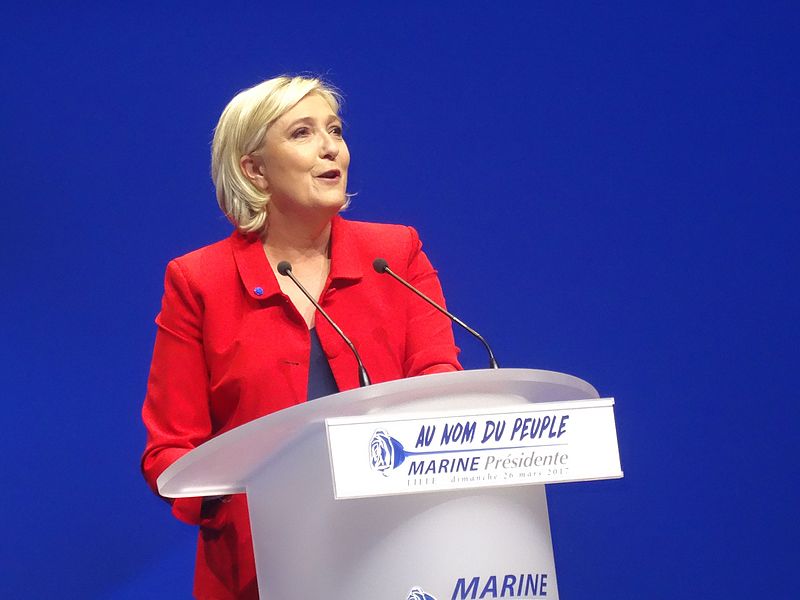
Marine Le Pen

Filed under: France, Law, Media, Politics — Tags: , , , , — Nicholas @ 03:00

Yet another right-of-centre European political leader has been taken out of the political arena. It’s starting to be a pattern, as the centre-left and the far left occupy a lot of the positions of power within the EU and are quite willing to use any tools at their disposal to remove actual or perceived threats to their stranglehold on the levers of power:

Marine Le Pen speaking in Lille during the 2017 French presidential election
Photo by Jérémy-Günther-Heinz Jähnick via Wikimedia Commons

Democracy is a sick joke, as the prosecution of Trump in America, Bolsonaro in Brazil, Imran Khan in Pakistan, Salvini in Italy, Georgescu in Romania, and now Le Pen in France, has displayed, unambiguously, to the whole world, if the world were capable of noticing, or thought. Each of these candidates stands accused of being a “populist” — i.e. likely to win an election, unless they had already won. Marine Le Pen is being put in prison, where the Democrats tried to put Trump (for up to 300 years on twisted and absurd charges), using the United States’ corrupt progressive judicial system. The specific charge brought against Le Pen was that she embezzled from the European bureaucracy. As all mainstream European politicians are constantly and obviously guilty of this, it was a convenient charge.

The parrot gallery is all singing that she is “far right”, this morning.

I am not your political reporter, and will not take the extravagant amount of space required to explain the detailed particulars of each case, when all are essentially simple. Democracy is a viciously corrupt system, in which the powers-that-be in each electoral district do what they think is necessary to maintain their dictatorship. Power is the only thing they care about, because with power, money can be appropriated. Truth is something they all despise. This has been my own experience, both here and abroad; and one must be a fool (though a “holy fool” perhaps) to stand up to a political establishment, for it will own even the opposition parties. (Find out what commands all-party agreement.)

I haven’t been following this story at all, and I have no idea whether the French court’s decision is fair or just, but it certainly is very convenient for those opposed to Le Pen and her party:

The French judicial system delivered a gut punch to the democratic process that ought to make any observer of history wince. Marine Le Pen, the firebrand leader of the National Rally (RN), has been convicted of embezzling European Parliament funds and barred from running for public office for five years — effective immediately. This ruling ensures she cannot contest the 2027 presidential election, a race she was poised to dominate with poll numbers hovering between 34-37%. The sentence — four years in prison (two suspended, two with an electronic bracelet) and a €100,000 fine — reads less like justice and more like a calculated assassination of a political movement. The French government and its courts have crossed a Rubicon, and the echoes of history suggest this won’t end quietly.

Let’s be clear: this isn’t about whether Le Pen is a saint. The charges stem from a scheme between 2004 and 2016, where she and 24 RN associates allegedly misused EU funds meant for parliamentary assistants to pay party staffers in France. The court claims €4 million was siphoned off, a serious accusation if proven beyond doubt. Le Pen denies it, calling it a “witch hunt” — language that resonates with anyone who’s watched populist leaders tangle with entrenched elites. But the real scandal isn’t the money; it’s the timing and the punishment. An immediate five-year ban, enforced even as she appeals, reeks of a system desperate to kneecap its most formidable opponent. This isn’t justice — it’s a power play, and the French state has a long, ugly history of bending the law to protect its own.

Rewind to 1793, when the French Revolution’s Committee of Public Safety turned the guillotine into a political tool. Robespierre and his ilk didn’t just execute aristocrats; they silenced dissenters under the guise of protecting the republic. Fast forward to the Third Republic in 1894, and you’ve got the Dreyfus Affair — Captain Alfred Dreyfus, a Jewish officer, falsely convicted of treason on flimsy evidence because the establishment wanted a scapegoat. The courts bowed to political pressure then, just as they seem to now. Le Pen’s conviction fits this pattern: a popular figure, reviled by the elite, taken out not by the ballot box but by judicial fiat. The presiding judge, Bénédicte de Perthuis, justified the immediate ban by citing “democratic public unrest” if a convicted embezzler were elected. But isn’t the greater unrest sparked by denying voters their choice?

eugyppius provides more information on the case against Le Pen:

Le Pen was convicted alongside eight other members of the Rassemblement national/Front national, and twelve parliamentary aides. She did not personally embezzle funds or enrich herself from EU coffers. Rather, prosecutors accuse her of directing aides to undertake work for her party while they were receiving salaries from the European Parliament. They claim this happened between 2004 and 2016, and that Le Pen and her associates misappropriated over four million Euros in this way. While nobody doubts the substance of the accusations, what Le Pen did was far from unusual and the sentence just seems ridiculous to me. Many European parliamentary representatives have used staff paid from parliamentary budgets for party projects – including Franziska Brantner, the present co-chair of German Green Party. Until recently this was a common practice, and even now the distinction between party and parliamentary work is not always easy to maintain, and both routinely and deliberately blurred.

Le Pen is a complex political figure, and she has not always been an unvarnished force for good. Her campaign to normalise the Rassemblement National (known as “dédiabolisation“, or “de-demonisation) came at devastating cost to Alternative für Deutschland during last year’s European elections. In service of casting the Rassemblement National as something less than “far right”, Le Pen and her party attacked the AfD for their rhetoric surrounding “remigration” and even seized upon Maximilian Krah’s inept remarks about the Waffen-SS to kick the entire AfD delegation out of the Identity and Democracy faction of the European Parliament.

In the wake of these fireworks, some German commentators have suggested that the AfD undertake a de-demonisation campaign of their own, for example by distancing themselves from nationalist AfD politicians like Björn Höcke. Le Pen’s fate shows that programmes of optical moderation and attempts to claim the political centre provide no salvation. The European political establishment only claims to be worried about “the extreme right”; their true anxieties attach to their hold on power, and nothing else.

Le Pen’s sentence confirms an ominous anti-democratic tactic emerging across Europe, namely attacks on the passive suffrage of opposition politicians. At the start of this month, the Central Election Bureau of Romania withdrew Călin Georgescu’s right to run for office there, months after Georgescu emerged as the frontrunner in the first round of the presidential elections and the Romanian Constitutional Court annulled the vote. In Germany, schemes to attack passive suffrage have also been gaining ground, with the CDU and SPD openly planning to use this measure against anyone convicted more than once of the broad and ill-defined speech offence of “incitement”.

This is very bad, and I fear it is a symptom of something much worse.

March 10, 2025

Rome (2004): HBO’s Untold 5 Season Story

Filed under: Business, History, Italy, Media — Tags: , , , , , — Nicholas @ 02:00

Little Wars TV
Published 6 Sept 2024

HBO’s Rome is one of the greatest television shows ever made, but the premium network infamously cancelled Rome after just two seasons. It is a decision HBO executives later admitted was a mistake. In this video essay, we explore why HBO cancelled Rome and what the showrunners envisioned as the full, five-season story arc. Which characters were meant to survive? What historical storylines would have been explored? And what was the show’s final scene supposed to be at the end of five seasons?

We’ll unearth interviews with Bruno Heller and William J MacDonald, hear from actors like Kevin McKidd, and attempt to piece together a vision of Rome‘s full potential if HBO had not cancelled the show prematurely.
(more…)

March 3, 2025

Is DOGE merely uncovering what used to be called “honest” graft?

Filed under: Bureaucracy, Environment, Government, History, USA — Tags: , , , , , — Nicholas @ 05:00

Jon Miltimore explains where the expression “honest graft” came from and gives examples of what the DOGE investigations have turned up so far:

In 1905, George Washington Plunkitt made arguably the most famous defense of political graft in American history.

“Everybody is talkin’ these days about Tammany men growin’ rich on graft,” the New York state senator and Tammany Hall member wrote, “but nobody thinks of drawin’ the distinction between honest graft and dishonest graft”.

Plunkitt was responding to The Shame of the Cities, a book by journalist Lincoln Steffens that exposed sweeping political corruption in U.S. cities.

The ward boss’s shameless defense of “honest graft”, which is still assigned to undergraduates a century after Plunkitt’s death, comes to mind when looking at the fraud, waste, and abuse Elon Musk’s Department of Government Efficiency and others are uncovering.

To take but one example, consider the billions of dollars in taxpayer funds the Environmental Protection Agency awarded last year to Power Forward Communities. If you’ve never heard of the nonprofit group, you’re forgiven. Almost nobody has — because it didn’t exist until late 2023.

Power Forward Communities had no footprint, online or otherwise, until October 2023, when it was announced as part of the Rewiring America program, an organization linked to former Georgia Democratic gubernatorial candidate Stacey Abrams, which says its mission is “all about Rewiring America’s values, people, and culture.”

Less than a year after its creation, Power Forward Communities was awarded $2 billion via the EPA’s National Clean Investment Fund — even though it reported just $100 in revenue during its first three months of operation.

The payment, which is slated to continue through June 2031, caught the attention of Lee Zeldin, the new EPA administrator.

“It’s extremely concerning that an organization that reported just $100 in revenue in 2023 was chosen to receive $2 billion,” Zeldin said.

Indeed. It’s graft on a scale the Tammany Hall charlatans couldn’t have imagined.

Historical sources say 19th-century politician Boss Tweed and his ring of cronies took in at least $50 million in corrupt money in backroom deals, kickbacks, and skimming before Tweed was convicted of larceny and forgery in 1873 and fled to Cuba, and later Spain. In 2025 dollars, that’s about $1.3 billion — considerably less than the single payoff former President Joe Biden’s EPA awarded Power Forward Communities.

February 26, 2025

The more DOGE uncovers, the more we see that western governments are really vast graft machines

Filed under: Bureaucracy, Government, Media, Politics, USA — Tags: , , , , , — Nicholas @ 05:00

Elizabeth Nickson discusses the ramifications of all the wasted money uncovered by DOGE in the first month of investigations and what it almost certainly confirms about the actual value taxpayers are getting for their money:

So essentially the entire town of Washington, D.C. has been stealing. The anomalies are those who are not stealing. $4.7 trillion, almost impossible to trace, represents two-thirds of the annual U.S. budget. And if it’s happening in the U.S., it is happening everywhere: France, Canada, the U.K., Germany, where budgetary processes are probably even more opaque than those of the U.S.

How does the Department of Defence have a $35 trillion black hole?

I used to think of people who worked for the government with a kind of veiled contempt or, in a more benign mood, compassion. I thought of them as pity jobs for those without initiative, as jobs paying off lefty campaigners, as a warehouse for the barely competent. In my own dealings with them, I found them punitive and extractive, papering me with demands to spend more and more money to hire more and more of their pet contractors, to get approval. In my working life, looking at the results of their involvement in America’s rural areas, I hated them for the hell they visited on people unable to fight back. They forced bad science on good people, and refused to see reason. They ruined forests, water courses, fisheries, and township after township turned to dustbowl status. The misery in rural sitting rooms in every state in the U.S. was palpable, long lasting; the green Blob ruined families for generations.

But I did not think of them as being embroiled in a theft so large as to be unparalleled in world history.

The level of the theft has now to be dawning on everyone not living off the public purse which is, what, 60%, 70% of us? The anger setting in is soul-deep, and very very powerful. People who live straightened lives, the poorly pensioned, those living off the laughable social security stipend, those waiting for health care, those whose children can’t even dream of an education, of college, of a six-figure salary which is now subsistence in the ruined cities. Those facing cancer treatment because of the vaccine, and don’t have excess funds. Their families, despairing, hurting, broke.

This isn’t going to go away. It affects everyone. Not addressed down to its deepest level, you are looking at a tax revolt, a national strike. A revolution. A real one, not a papered paid-for color revolution, which is what they have been doing to us.

Those living on social security should have five times the pension they do.

Can you count how many of those there are? Can you?

And meanwhile this:

Is this true? To this date, unknown; the digging continues. Look at this ghastly creature. She apparently has an account in the Cayman Islands. Look at her all compassionate and condescending. She started a war that killed 1.5 million people so far. And apparently got rich from it. A mass murderer celebrated at Upper East Side dinner parties.

Memes like this rocket around, and every one is now suspect. At this point who cares if it’s true, it’s truthy, it makes sense that she made out like a bandit, that Alexandra Ocasio-Cortez and Ilhan Omar have millions hidden somewhere. Ocasio can say “I only have $500,000!” all she wants, but we don’t believe her. If the Wall St Journal says it is false, we don’t believe them. Do you actually think they’d have the money sitting in their savings account? No, it would be buried off-shore. The media is not only complicit, it is the principal actor in this scam. It built the fantasy world we live in, where people read The Guardian, the Times and the Globe and Mail and think they’re informed.

No, they are being propagandized. And as a result, no one sane believes anything any legacy newspaper or television or media says anymore. They hid the theft. They did not report on it. No one trusts a thing they say.

Update: Fixed broken link.

February 21, 2025

Firefly and the End of Serenity

Filed under: History, Media — Tags: , , , , , , — Nicholas @ 02:00

Feral Historian
Published 29 Mar 2023

Serenity did an admirable job of wrapping up Firefly after the series was cancelled. But the ending, which depends on the idea that exposing government misdeeds forces change, doesn’t work today. Serenity‘s ending is premised on the idea that “sunshine is the best disinfectant” but the last few years have illustrated that we’re dealing with sunlight-resistant corruption these days.

00:00 Intro
00:24 Backstory
01:27 Chimerica
02:08 Unification
03:37 Secrets
05:12 Serenity‘s Ending

February 16, 2025

Pope Fights: The Pornocracy – Yes it’s really called that

Overly Sarcastic Productions
Published 25 Oct 2024

Guard your browsing histories, the Popes are at it again …

SOURCES & Further Reading:
Rome: A History in Seven Sackings by Matt Kneale
Absolute Monarchs: A History of the Papacy by John Julius Norwich
Antapodosis by Liutprand of Cremona
A. Burt Horsley, “Pontiffs, Palaces and Pornocracy — A Godless Age”, in Peter and the Popes (Provo, UT: Religious Studies Center, Brigham Young University, 1989), 65–78.
(more…)

February 12, 2025

QotD: Jacob Zuma – South Africa’s answer to Donald Trump

Filed under: Africa, Media, Politics, Quotations — Tags: , , , , — Nicholas @ 01:00

[Thabo] Mbeki’s presidency ended in disaster and humiliation, but it paved the way for one of the most colorful politicians alive today: Jacob Zuma. The most important thing for Americans to understand is that Zuma is basically a left-wing and South African version of Donald Trump. He is colorful, bombastic, and over-the-top. He has a tendency to break into song at political rallies and church services. He says outrageous and inappropriate things. He is beloved by the far left and grudgingly admired by the far right and fanatically hated by all the bien-pensants in the center. He was viciously persecuted by the South African deep state, and his accession to the presidency caused a bitter #NeverZuma faction to break off the ANC and start another party (incredibly this party is called “COPE”). Finally, he is an out and proud polygamist and brags openly about his corruption, and people love this because they know every politician is doing it, he’s just honest about it.

The ANC bosses did not like Zuma. For decades the ANC had been dominated by elite, western-educated, communist Xhosas, but Zuma was none of those things. Zuma came from nothing — his mother was a janitor and his father died when he was 3. Zuma was so illiterate and uncultured that Mbeki tapped him to be deputy president on the theory that it would keep his own position secure, since nobody would ever let Zuma be president (yeah this backfired spectacularly). Most shocking of all, Zuma was a Zulu. He danced in a loincloth and leopard skin with the Zulu king at the Shaka festival. The idea of this savage wildman becoming president was just beyond the pale. Something had to be done to stop him.

The last chance to stop Zuma was a credible-seeming rape accusation from a family friend. The ANC pounced on this, and initiated a high-profile criminal trial. This incensed Zuma’s supporters, who insisted that the prosecution was politically motivated (given that over the past decade the ANC had all but stopped prosecuting rape cases in society more broadly, they may have had a point). The trial was a total debacle. Countless thousands of young activists showed up outside the courtroom wearing t-shirts with slogans like “One hundred percent Zuluboy”, “Burn the bitch”, and “Zuma was raped”. When summoned to the witness stand, the president-to-be performed war dances and led the crowds in song. The prosecution collapsed after the accuser’s story was found to be inconsistent on numerous points, and a triumphant Zuma rode the backlash all the way to the presidency.

There’s another way Jacob Zuma is like Donald Trump: the corrupt and failed ruling classes of both South Africa and the United States find it convenient to blame these men for everything that has gone wrong in their countries ever since. In fact in Zuma’s case, history has begun to be rewritten so that he can be blamed for things that happened before he became president. Many of the South Africans I’ve spoken to will confidently assert that some problem (say, the power outages) is all due to Zuma. When I gently point out that those outages began in 1998 and innocently ask who was president then, they shut down entirely. Zuma is the scapegoat for the failings of an entire country, and making him the sole source of all evil plays the important social role of allowing everybody to pretend that things were great until he showed up (things were not great). In a similar vein, I will not be shocked if decades from now, Donald Trump is blamed for starting the fentanyl epidemic.

John Psmith, “REVIEW: South Africa’s Brave New World, by R.W. Johnson”, Mr. and Mrs. Psmith’s Bookshelf, 2023-03-20.

« Newer PostsOlder Posts »

Powered by WordPress