The Great War
Published 27 Jun 2020Sign up for Curiosity Stream and get Nebula bundled in: https://curiositystream.com/thegreatwar
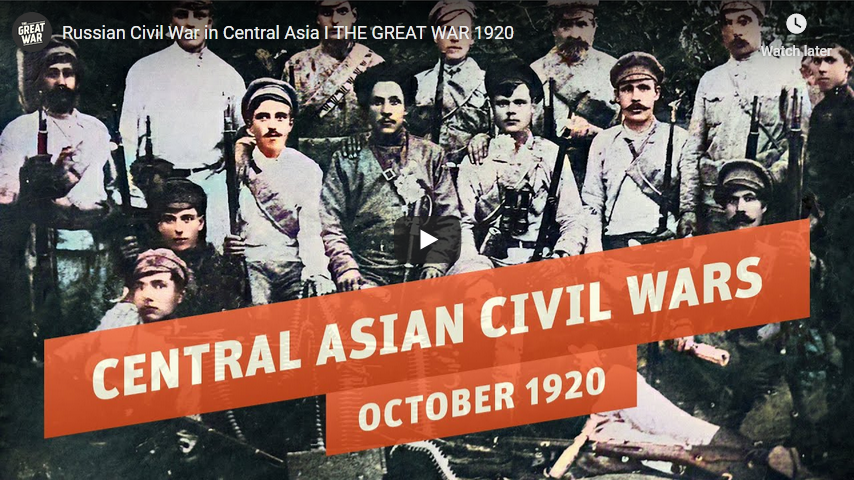
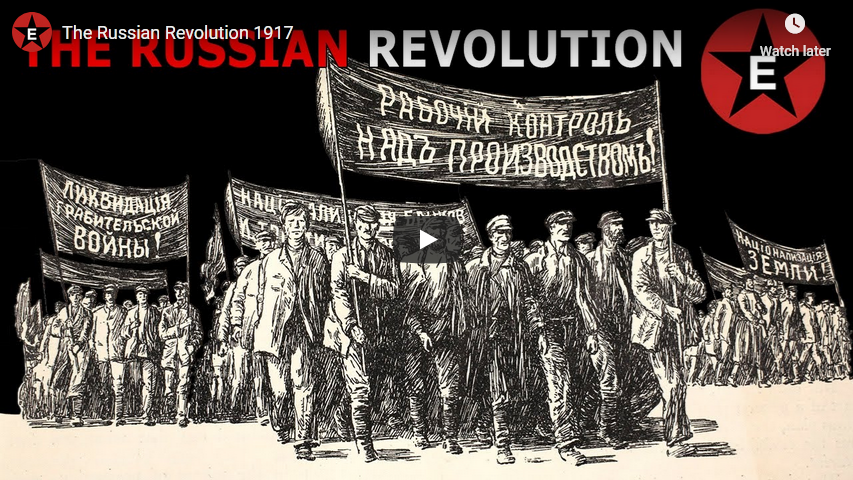
Freeing peasants and workers from oppression was one of the main messages of the Bolsheviks. The peasants in the countryside were happy to get rid of the landowning class and supported socialist ideas of land reform but once the Bolsheviks turned to “War Communism” to maintain their power against the Whites and other forces, the reluctant support of the peasants dropped — and in 1920 they turned to open revolt.
» SUPPORT THE CHANNEL
Patreon: https://www.patreon.com/thegreatwar
Merchandise: https://shop.spreadshirt.de/thegreatwar/» SOURCES
Figes, Orlando. A People’s Tragedy. The Russian Revolution (London: The Bodley Head, 2017 [1996]).
Mawdsley, Evan. The Russian Civil War (New York: Pegasus Books, 2005).
Smele, Jonathan. The “Russian” Civil Wars 1916-1926 (London: Hurst, 2015).
Sumpf, Alexandre. “Russian Civil War,” in 1914-1918 online. International Encyclopedia of the First World War. https://encyclopedia.1914-1918-online.
Engelstein, Laura. Russia in Flames (Oxford University Press, 2017).
Wolf, Eric R. Peasant Wars of the Twentieth Century (New York: Harper, 1969)» SOCIAL MEDIA
Instagram: https://instagram.com/the_great_war
Twitter: https://twitter.com/WW1_Series
Reddit: https://reddit.com/r/TheGreatWarChannel»CREDITS
Presented by: Jesse Alexander
Written by: Jesse Alexander
Director: Toni Steller & Florian Wittig
Director of Photography: Toni Steller
Sound: Toni Steller
Editing: Toni Steller
Mixing, Mastering & Sound Design: http://above-zero.com
Maps: Daniel Kogosov (https://www.patreon.com/Zalezsky)
Research by: Jesse Alexander
Fact checking: Florian WittigChannel Design: Alexander Clark
Original Logo: David van StepholdContains licensed material by getty images
All rights reserved – Real Time History GmbH 2020
June 28, 2020
The Peasants Rise Up Against The Bolsheviks – The Russian Civil War(s) 1920 I THE GREAT WAR 1920
June 20, 2020
Soviet Gender Equality Was a Scam – WW2 – On the Homefront 004
World War Two
Published 19 Jun 2020The future looks bright for soviet women in the 1910s, they have the right to vote and they’re on track for social emancipation. Yet this doesn’t last long. Soon, the demands of the nation will rob them of these promises.
Join us on Patreon: https://www.patreon.com/TimeGhostHistory
Or join The TimeGhost Army directly at: https://timeghost.tvFollow WW2 day by day on Instagram @World_war_two_realtime https://www.instagram.com/world_war_two_realtime
Between 2 Wars: https://www.youtube.com/playlist?list…
Source list: http://bit.ly/WW2sourcesHosted by: Anna Deinhard
Written by: Isabel Wilson
Director: Astrid Deinhard
Producers: Astrid Deinhard and Spartacus Olsson
Executive Producers: Astrid Deinhard, Indy Neidell, Spartacus Olsson, Bodo Rittenauer
Creative Producer: Joram Appel
Post-Production Director: Wieke Kapteijns
Research by: Isabel Wilson
Edited by: Karolina Dołęga
Sound design: Marek KamińskiColorizations by:
Klimbim
Carlos Ortega Pereira, BlauColorizations, https://www.instagram.com/blaucoloriz…Visual Sources:
Library of Congress
Adam Jones from Flickr: https://www.flickr.com/photos/adam_jo…Icons from The Noun Project: Sandhi Priyasmoro, Sarah Rudkin, Andrew Doane, Vectors Market, Adrien Coquet, ProSymbols, Luke Anthony Firth, Russia Woman & Gan Khoon Lay
Music:
“March Of The Brave 10” – Rannar Sillard
“Disciples of Sun Tzu” – Christian Andersen
“Deviation In Time” – Johannes Bornlof
“Other Sides of Glory” – Fabien Tell
“The Inspector 4” – Johannes Bornlöf
“Sailing for Gold” – Howard Harper-Barnes
“London” – Howard Harper-Barnes
“Split Decision” – Rannar SillarResearch sources:
– Lenin On the Emancipation of Women (1965), pp. 63–4. First Published July 1919, as a pamphlet
– Selected Writings of Alexandra Kollontai, Allison & Busby, 1977, First Published 1921, as a pamphlet, trans Alix Holt.
– Wendy Goldman, “Recasting the vision: The resurrection of the family”. In Women, the State and Revolution: Soviet Family Policy and Social Life, 1917–1936, (Cambridge Russian, Soviet, and Post-Soviet Studies, (1993) pp. 296-336), p.310Archive by Screenocean/Reuters https://www.screenocean.com.
A TimeGhost chronological documentary produced by OnLion Entertainment GmbH.
June 18, 2020
June 13, 2020
QotD: The liberal media
As I have pointed out myself, the more one knows about a subject, the more conservative one becomes towards it. Conversely, the less one knows, the more liberal he becomes, and inclined to embrace “progress” and “reforms.” Even a Communist may prove a very conservative stamp collector, once he learns something about philately. It’s only economics he knows nothing about.
This is a universal principle. Everyone knows something about something, and is very backward on that which he knows. The one exception may be journalists, who know nothing about anything, and are therefore liberal all round.
David Warren, “I’ll be a Welshman”, Essays in Idleness, 2018-03-01.
June 9, 2020
It was scientifically inevitable for the Communists to win the Cold War – as foretold in the prophecies
Sarah Hoyt on the “script” that progressives operated under during the Cold War and almost unchanged in detail to the present day, too:

Krushchev, Brezhnev and other Soviet leaders review the Revolution parade in Red Square, 1962.
LIFE magazine photo by Stan Wayman.
… the Cold War had two sides: the USSR and our elites, who had been corrupted and taken over for a long time thanks to the communist agents who had long-marched through our media, our entertainment and our bureaucracy.
Heinlein claimed the Democrats had been taken over by communists, secretly, by the 40s. I have no reason to doubt him. I’m sure most of the bureaucracy and governments in Europe had been taken over that way also.
Even so called conservatives assumed communism would eventually win, because according to the numbers coming out of the USSR and the reporters visiting the USSR — anyone know where Duranty is buried? there should be a line to piss on his grave — they were just so much more efficient. Scientific governance, you know? And anyway, technology was going to be so advanced that most humans would be unemployable, and by the way, there were more and more humans every year, so it was impossible to have all these bourgeois luxuries. So communism, efficient, compassionate, communism was the future, the only way.
The realists who saw it was the only way were willing to do anything to bring it about. Because the people who weren’t as intelligent/well informed would otherwise destroy the world and bring about unimaginable catastrophe.
“Conservatives” were merely those who wanted communism to arrive slower and be a little less violent. Communism with a human face. Socialism on the way to communism. Easing us into our role as cogs in the machinery of the future — where there was no room for personal frills or really emotions — with gentle pneumatic shocks, instead of with the excesses of the Russian and Soviet revolution.
All of this btw is based on three glaring fallacies (phaluscies, since you have to be a dickhead to believe them particularly now.)
1- People are a drain not an asset. They are also a sort of robot incapable of changing behavior in response to changing circumstances.
2- Wealth can’t grow, nor can the carrying capacity of the Earth improve. So since humans can’t respond to reduced infant mortality by having fewer children, the only way to feed everyone is to reduce everyone’s rations. Forever.
3- It is possible for “the best”, properly educated people to be utterly selfless and to administer everyone’s wealth equally and for the common good. They will not revel in power, nor will they avail themselves of any excess. Because, they are absolutely moral and all seeing.
Note the left is still running this script. And some on the right too (Hello, Pierre Delecto!) not to mention all of Europe, left and right. Also note #1 conflicts with the left idea that they can bring about a future in which humans change to be all selfless, etc. But that’s actually complicated and tied in to their myths, which honestly are a Christian heresy, complete with paradise lost.
I know when they started out, the USSR thought it could “engineer” a new human. Homo Sovieticus. But I don’t know enough of Soviet myth to know what underlay that. Maybe it was a behaviorist thing and they thought humans could be trained into being completely selfless automatons. I know by the time I was reading communist theorists (no, I didn’t buy their arguments, but I was required to read them, given when and where I grew up) in the seventies, the philosophy had fallen prey to the agitprop notion that people in madhouses in the US were political prisoners just as in the USSR. (BTW this is part of what underlay the closing of the madhouses.) And that was part of a push in the seventies, as the malfeasance of USSR was starting to be glaring, amid escaped dissidents and escaping information. The push was to “prove” that both systems were equally bad. (The left is still flogging that dead equine, too. So Cubans and Venezuelans are starving? So how many people die of anomie and not being loved enough under capitalism? REEEEE.) So, since Soviets put dissidents in mad houses, so did we. But that necessitated that people who widdled on themselves and/or thought they were a lampshade with a set of dishes thrown in be completely sane “political dissidents”. The only way to do this was to attribute anything communists don’t like to “insanity brought about by capitalism.” This led to crazier byways of thought. For instance, it led to the idea of the pre-historic, pre-agriculture paradise, where everyone was equal, there was no poverty, need, greed, or the heartbreak of psoriasis. A sub-branch of the church believed women were in charge and everyone worshiped the mother goddess. And some of these “scientific, atheist socialists” also believe the goddess actually exists, though G-d doesn’t.
David Friedman had a different formulation for the utopian world many progressives wish for the rest of us:
In the ideal socialist state power will not attract power freaks. People who make decisions will show no slightest bias towards their own interests. There will be no way for a clever man to bend the institutions to serve his own ends. And the rivers will run uphill.
June 2, 2020
May 29, 2020
QotD: Historical ways to deal with your “rage heads”
The main lesson I hope our distant descendants draw from the Orange Man Era is: The rage heads ye have always with you, so ye must find a way to channel them into something as non-destructive as possible. The story of modern politics can be written in a sentence: The weaponization of rage heads, combined with the inability of any society to properly dispose of said WMDs.
Set the Wayback Machine to the turn of the 20th century. Lenin’s great insight is that “the masses” will never achieve the proper revolutionary consciousness without a dedicated cadre of hardcore, professional revolutionaries to lead the way. Lenin recognized the prevalence of incipient rage heads in his society — how could he not? — but realized that, absent some guiding hand, they’d flounder around incoherently. At best (from the “furthering the Revolution” point of view), they’d do what his, Lenin’s, idiot brother did: Try to knock off the tsar, and get himself hung for it. Thus, the Bolsheviks.
The problem, though, is that rage heads by definition suffer from poor impulse control. The tiny subset of them that are pure sociopaths (like Lenin), and thus have the icy-veined self-control to hold their fire, have to maintain the very tightest discipline over the Party, or all hell breaks loose. See, for example, the massive street battles in Weimar Germany between the KPD (German Commies) and the SD. Hitler, like Lenin, had to get his rage heads on a tight leash, so he channeled the disciplined sociopaths from the SD into the SS, cooled out the coolable in the SD by buying them off, and shanked the incorrigible remainder. See also the almost-exactly-contemporary Moscow Show Trials.
Note please that this is your best-case scenario for a purely ideological revolution. From Robespierre to Kim Il Sung, the first step in consolidating the Revolution is killing off a large fraction of the original revolutionaries.
The worst-case scenario (again, from the “furthering the Revolution” standpoint) is what the American wannabe-bolshies did / are currently doing. Knowing that you can’t shank or show-trial the dreadlocked poetry majors that make up your goon squad, you try to channel them into academia, the Media, the “arts.” Which fails egregiously, because whatever tenuous contact with reality they once had gets completely severed by those institutions’ social bubbles. They never were very good at holding fire, and now they can’t, literally can’t, see any reason to — life is great here on campus, so why can’t it be that way everywhere?
Severian, “Living in End Times”, Rotten Chestnuts, 2020-02-28.
May 16, 2020
Polish-Soviet War – First Phase 1919 – May 1920 I THE GREAT WAR 1920
The Great War
Published 15 May 2020Sign up for Curiosity Stream and Nebula – and get 40% off annual plans right now: https://curiositystream.com/thegreatwar
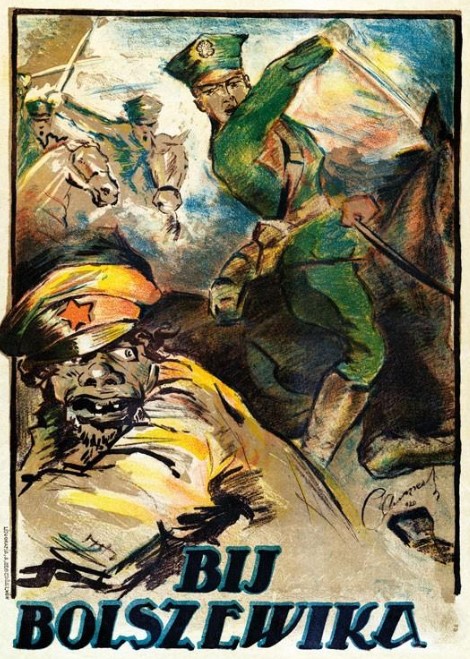
The Polish-Soviet War was one of the biggest conflicts after the armistice of 1918 and the culmination point of the many sub-conflicts that made up the Western Front of the Russian Civil War. The question about the Polish-Russian border was decided with armored trains, cavalry charges and also on the negotiating table.
» SUPPORT THE CHANNEL
Patreon: https://www.patreon.com/thegreatwar
Merchandise: https://shop.spreadshirt.de/thegreatwar/» SOURCES
Centek, Jarosław: “Polish-Soviet War 1920-1921”, in: 1914-1918-online. International Encyclopedia of the First World War, ed. by Ute Daniel, Peter Gatrell, Oliver Janz, Heather Jones, Jennifer Keene, Alan Kramer, and Bill Nasson, issued by Freie Universität Berlin, Berlin 2014-10-08Leonhard, Jörn. Der überforderte Frieden. Versailles und die Welt 1918-1923 (CH Beck, 2018).
Borzecki, Jerzy. The Polish-Soviet Peace of 1921 and the Creation of Interwar Europe (New Haven and London: Yale University Press, 2008)
Engelstein, Laura. Russia in Flames (Oxford University Press, 2017).
Smele, Jonathan. The “Russian” Civil Wars 1916-1926 (London: Hurst, 2015).
Davies, Norman. White Eagle Red Star (Random House, 2003 (1972))
Böhler, Jochen. Civil War in Central Europe, 1918-1921 (Oxford University Press, 2019)
Timothy Snyder. The Reconstruction of Nations. (New Haven: Yale University Press, 2003)
» SOCIAL MEDIA
Instagram: https://instagram.com/the_great_war
Twitter: https://twitter.com/WW1_Series
Reddit: https://reddit.com/r/TheGreatWarChannel»CREDITS
Presented by: Jesse Alexander
Written by: Jesse Alexander
Director: Toni Steller & Florian Wittig
Director of Photography: Toni Steller
Sound: Toni Steller
Editing: Toni Steller
Mixing, Mastering & Sound Design: http://above-zero.com
Maps: Daniel Kogosov (https://www.patreon.com/Zalezsky)
Research by: Jesse Alexander
Fact checking: Florian WittigChannel Design: Alexander Clark
Original Logo: David van StepholdA Mediakraft Networks Original Channel
Contains licensed material by getty images
All rights reserved – Real Time History GmbH 2020
May 14, 2020
1948: The Dutch vs. the USA – 2nd Police Actions | The Indonesian War of Independence Part 4
TimeGhost History
Published 13 May 2020The international community forces the Dutch to end their first colonial offensive with the Renville Agreement. However, as the Dutch, the Indonesian Republicans and the multiple other groups continue fighting, an impasse devolops.
Join us on Patreon: https://www.patreon.com/TimeGhostHistory
Hosted by: Indy Neidell
Written by: Joram Appel
Director: Astrid Deinhard
Producers: Astrid Deinhard and Spartacus Olsson
Executive Producers: Astrid Deinhard, Indy Neidell, Spartacus Olsson, Bodo Rittenauer
Creative Producer: Joram Appel
Post-Production Director: Wieke Kapteijns
Research by: Joram Appel and Isabel Wilson
Edited by: Karolina Dołęga
Sound design: Marek KamińskiColorizations:
Dememorabilia – https://www.instagram.com/dememorabilia/
Carlos Ortega Pereira (BlauColorizations – https://www.instagram.com/blaucoloriz…
Jaris Almazani (Artistic Man) – https://instagram.com/artistic.man?Research Sources: https://bit.ly/IndoSources
Visual Sources:
Nationaal Archief
National Archives NARA
Tropenmuseum, part of the National Museum of World CulturesIcons from the Noun Project by Wonmo Kang, Creative Mania & Claudia Revalina
Archive by Screenocean/Reuters https://www.screenocean.com.
Music:
“Other Sides of Glory” – Fabien Tell
“Remembrance” – Fabien Tell
“Sailing for Gold” – Howard Harper-Barnes
“Last Point of Safe Return” – Fabien Tell
“It’s Not a Game” – Philip Ayers
“Moving to Disturbia” – Experia
“March Of The Brave 10” – Rannar Sillard
“March Of The Brave 9” – Rannar SillardA TimeGhost chronological documentary produced by OnLion Entertainment GmbH.
Three reasons the Western allies fail to fully acknowledge the efforts of the Soviets in WW2
Arthur Chrenkoff suggests three major reasons for why many Russians and other Soviet-nostalgics feel the west is wrongly denying the Soviet Union full credit for the defeat of Nazi Germany:

Kombat (Russian: Комбат, lit. “battalion commander”) is a black-and-white photograph by the Soviet photographer Max Alpert. It depicts a Soviet military officer armed with a TT pistol who is raising his unit for an attack during World War II. This work is regarded as one of the most iconic Soviet World War II photographs, yet neither the date nor the subject is known with certainty. According to the most widely accepted version, the photograph depicts junior politruk (political officer) Aleksei Gordeyevich Yeryomenko, minutes before his death on 12 July 1942, in Voroshilovgrad Oblast, Ukraine.
Wikimedia Commons.
But while the Russian – or, more correctly, Soviet – role in defeating Hitler is beyond question and deserves wider attention and recognition, there are several reasons why the Western acknowledgement of the eastern front will always remain qualified and somewhat ambiguous.
Firstly, while Russia continues to variously deny, downplay or excuse the fact, the Soviet Union was the initial co-aggressor in World War Two and for the first two years a Nazi ally and collaborator. Stalin might have had legitimate realpolitik reasons for the Ribbentrop-Molotov pact, in effect sacrificing Europe to win more time to prepare for the inevitable war with Germany (nice in theory, the gambit in any case did not work out in practice), but the fact remains that in concert with Hitler, Stalin invaded Poland and was rewarded with its eastern half, subsequently also helping himself to Bessarbia, annexing the Baltic states and invading Finland. In turn, the fact that Hitler assured himself he would not be facing a war on two fronts, which doomed Germany in World War One, allowed him to successively snatch Poland, Norway, Denmark, the Netherlands, Belgium, France, Yugoslavia and Greece, giving Germany a complete dominance over the continental Europe from the Atlantic to the Bug river and the Arctic Circle to Crete. And while Great Britain stood alone against Germany for a year from mid-1940 to mid-1941, Soviet resources and produce kept flowing in, feeding and arming the Nazi monster. This makes Stalin’s subsequent anger over the Allied delay in launching the Second Front in the West quite hypocritical – where was the Second Front in the East while Luftwaffe was blitzing Britain and its troops were battling Italians and Rommel in north Africa?
Secondly, without in any way diminishing the German barbarity in the east, a significant proportion of the Soviet military and civilian casualties were unnecessary and resulted from the communist government’s complete and utter disregard for the lives and well-being of its subjects. Stalin fought the war as he fought the peace at home. The man who prior to 1941 had managed to send somewhere upwards of 15 million of his own people to an early grave, clearly wasn’t going to spare the long suffering population when faced with an external existential threat. The Soviet Union might not have (at least initially) had much else, but it certainly had people, and they were sacrificed in obscene numbers by the man in the Kremlin and his minions on the ground. For most of the war, several Red Army soldiers were dying for every one German, while obeying absurd orders to stand ground or frontally attack in total disregard for the local circumstances or for that matter any reasonable tactical and strategic consideration. When Eisenhower and Zhukov caught up some time later in the war and the conversation turned to the best method of clearing mine fields, the Russian astonished the Allied Commander-in-Chief when he nominated simply sending the infantry through as the easiest and the cheapest method. This wasn’t a joke either; it was the way the Red Army fought from the first days of Barbarossa all the way to Berlin, even though the eventual overwhelming material superiority did save many an Ivan’s life in the later stages of the conflict. Not enough, however, to wipe out the entire generation of men born in the mid-1920s.
Thirdly, while the Red Army did indeed end the brutal Nazi occupation of the Central and the Eastern Europe, it did not bring freedom in any meaningful sense of the word, except perhaps (in most cases) freedom from sudden death. Debates about similarities and differences between the two totalitarian systems will no doubt continue well into the future. Unquestionably, for an average Slav, the Soviet domination was a better option that the Nazi one. Nazis, by and large, considered Slavs to be subhuman (though making some allowances, often quite significant, for their Slavic allies, like the Slovaks, the Croats or the Bulgarians), fit only to be initially enslaved and eventually exterminated. This was the far deadlier and much more ideological continuation of Germany’s 1000-year “drang nach osten” or the “civilising” mission to expand into the fertile east. Particular hatred was reserved for the Poles, who stood as a barrier for most of that millennium, preventing the dream of lebensraum from being realised. Russia was a much more recent enemy, having overlaid its Slavic barbarity with a Bolshevik malignancy. Even the initial Nazi plans called for starving between 25-30 million Belorussians, Ukrainians and Russians in order to free up food and resources for Germany. Communists could be deadly too, of course, and both the Reds and the Blacks were fond of decimating the local elites and intelligencia, but the Soviets at least did not see their Slavic brethren as subhumans but as proletarian masses to be converted to the glories of Marxism-Leninism.
Be that as it may, the Soviet liberation did not bring liberty or independence to the people of Eastern Europe. That had to wait until 1989-91.
May 8, 2020
Soldier of Three Armies Pt. 3 – Vietnam War – Sabaton History 066 [Official]
Sabaton History
Published 7 May 2020Crossed the water a new start, war still beating in his heart, a new legend has been born.
Arrested by the Finnish secret police and tried for treason, war-hero and living legend Lauri Törni realized that his home country held no more future for him any longer. Törni made a run for it. Towards a new country, a new life and a new name. And a new war.
Support Sabaton History on Patreon: https://www.patreon.com/sabatonhistory
Listen to “Soldier of Three Armies” on the album Heroes:
CD: http://bit.ly/HeroesStore
Spotify: http://bit.ly/HeroesSpotify
Apple Music: http://bit.ly/HeroesAppleMusic
iTunes: http://bit.ly/HeroesiTunes
Amazon: http://bit.ly/HeroesAmz
Google Play: http://bit.ly/HeroesGooglePCheck out the trailer for Sabaton’s new album The Great War right here: https://www.youtube.com/watch?v=HCZP1…
Listen to Sabaton on Spotify: http://smarturl.it/SabatonSpotify
Official Sabaton Merchandise Shop: http://bit.ly/SabatonOfficialShopHosted by: Indy Neidell
Written by: Markus Linke and Indy Neidell
Directed by: Astrid Deinhard and Wieke Kapteijns
Produced by: Pär Sundström, Astrid Deinhard and Spartacus Olsson
Creative Producer: Joram Appel
Executive Producers: Pär Sundström, Joakim Broden, Tomas Sunmo, Indy Neidell, Astrid Deinhard, and Spartacus Olsson
Post-Production Director: Wieke Kapteijns
Edited by: Iryna Dulka
Sound Editing by: Marek Kaminski
Maps by: Eastory – https://www.youtube.com/c/eastoryArchive by: Reuters/Screenocean https://www.screenocean.com
Music by Sabaton.Sources:
– Helsinki City Museum
– KANSALLISARKISTO
– Lauri Törni in 1951 from Forum Marinum, CC BY-ND 4.0
– Cricket sound by damonmensch from freesound.org
– Photo of Lauri and Marja courtesy of Hillevi KopsAn OnLion Entertainment GmbH and Raging Beaver Publishing AB co-Production.
© Raging Beaver Publishing AB, 2019 – all rights reserved.
May 2, 2020
After The Berlin Wall: Making Germany’s Armed Forces (Bundeswehr 1991 Documentary)
Forces TV
Published 5 Jan 2018It’s more than 27 years since German reunification, when East and West Germany came together again after the fall of the Berlin Wall. This documentary looks at the challenges facing the West German Army as they took over the East German National People’s Army.
Read more: http://www.forces.net/news/comment-bu…
Subscribe to Forces TV: http://bit.ly/1OraazC
Check out our website: http://forces.net
Twitter: https://twitter.com/ForcesNews
How things change … back in 1991, the Bundeswehr had a vast over-supply of military vehicles between the mass of Soviet-era equipment inherited from the DDR and the excess due to planned down-sizing of Germany’s overall military expenditure (the “peace dividend”). Earlier this year, Bild reported that German soldiers are being advised to take personal vehicles during military training exercises, due to a lack of infantry fighting vehicles and other military transport.
April 30, 2020
1946: Kill and Only Kill – Death to Colonialism | The Indonesian War of Independence Part 2
TimeGhost History
Published 29 Apr 2020The Indonesian War of Independence is heavily fuelled by the gangs of youngsters who go by the name of Pemuda. They engage in clandestine guerrilla fighting as their revolution takes a violent turn.
Join us on Patreon: https://www.patreon.com/TimeGhostHistory
Hosted by: Indy Neidell
Written by: Isabel Wilson and Joram Appel
Director: Astrid Deinhard
Producers: Astrid Deinhard and Spartacus Olsson
Executive Producers: Astrid Deinhard, Indy Neidell, Spartacus Olsson, Bodo Rittenauer
Creative Producer: Joram Appel
Post-Production Director: Wieke Kapteijns
Research by: Isabel Wilson and Joram Appel
Edited by: Karolina Dołęga
Sound design: Marek KamińskiColorizations:
Dememorabilia – https://www.instagram.com/dememorabilia/
Jaris Almazani (Artistic Man) – https://instagram.com/artistic.man?ig…
Carlos Ortega Pereira (BlauColorizations) – https://www.instagram.com/blaucoloriz…Research Sources: https://bit.ly/IndoSources
Sources:
Tropenmuseum part of the National Museum of World Cultures
Nationaal Archief
Imperial Wars Museum: SE7034; SE5663Music:
“Deviation In Time” – Johannes Bornlof
“Disciples of Sun Tzu” – Christian Andersen
“Epic Adventure Theme 4” – Håkan Eriksson
“Guilty Shadows 4” – Andreas Jamsheree
“Last Point of Safe Return” – Fabien Tell
“Magnificent March 3” – Johannes Bornlöf
“March Of The Brave 10” – Rannar Sillard
“The End Of The World 2” – Håkan Eriksson
“The Inspector 4” – Johannes Bornlöf
“The Unexplored” – Philip Ayers.
“Try and Catch Us Now” – David CelesteArchive by Screenocean/Reuters https://www.screenocean.com.
A TimeGhost chronological documentary produced by OnLion Entertainment GmbH.
From the comments:
TimeGhost History
1 day ago (edited)
For the research of this episode about Indonesian revolutionary culture in 1946, I mostly turned to the diaries and writings of those who were there. Reading the untouched experiences was so absorbing and allowed for writing a bottom-up narrative. Something that didn’t make it into the video was the work of Chairil Anwar, a poet who died young a few years after the War of Independence. Dwelling about the life and death of the individual during the revolution, his poetry defied Indonesia’s antagonists. In his poem “Notes for 1946”, he writes of how it felt to be among the young generation of Indonesia: “We – running dogs, hunting hounds – we get to see only a moment of this drama we play in.” I’d definitely recommend reading his work if you’re interested!
Cheers, Izzy.
April 18, 2020
Chairman Xi, the Wuhan Coronavirus, and the “Mandate of Heaven”
It is a little-known fact that no government can do anything, without the cooperation of its victims. Of course that cooperation may be obtained by force and falsehood, but there will always be a few people who won’t play along. This creates a “technical problem” for the tyrant, which can also be solved by violence and deceit, but in the heart of every dictatorship there must be calculations. At what point do so many people want us dead, that they will actually kill us?
This is a political calculation, and it can turn even a genocidal maniac into a thoughtful politician. A monstrously evil country, such as Red China, can be moderated in this way. Superficially, it may sometimes come to resemble a bourgeois, Westernized, rule-of-law state, like Japan, Taiwan, South Korea. It may, indeed must in its own interest, pretend to be benign. But under sufficient pressure it has only two choices. One is to be openly monstrous, with all the risks that entails; and the other is to disintegrate.
My interest has been piqued as a China-watcher. Recent events have been bringing that kettle back to the boil. That the Peking politburo has been making serious mistakes, we may observe. It could not possibly have intended the Batflu crisis, which its own malign incompetence brought about. But as it tries to manage the crisis, for its own purposes, the mistakes multiply. Even the people it had diligently bought — such as our progressive journalists, politicians, and businessmen — are turning against it.
Within China itself, the unthinking default loyalty of the masses, has been disturbed. “Narratives” which conflict with the official ones are circulating, along with the virus — and even among those who “test negative,” as it were. These are people who would never rebel, but they become sympathetic to rebels. Moreover, the state’s image of invincibility — the Mao/Xi portrait, a hundred feet tall — is cracking. Imagined lines of contempt appear in the plaster. Chairman Mao, of course, is dead, but Chairman Xi must be sensing his mortality.
As the Soviet Union was collapsing from within, progressive Westerners tried to ignore it. This wasn’t something they wanted to look at, which is why they were all taken by surprise. The fall of the Berlin Wall inwardly distressed everyone on the Left. For a few years their confidence was shaken, slowing their efforts to regroup around “environmentalism,” or some alternative leftwing cause, that wasn’t in shambles like socialism. But eventually their smugness recovered, and those revealed to have been absolutely wrong about everything they had ever told us, were able to resume their status as “experts.”
From Wikipedia‘s entry on the Mandate of Heaven:
The Mandate of Heaven (Chinese: 天命; pinyin: Tiānmìng; Wade–Giles: T’ien-ming, literally “Heaven’s will”) is a Chinese political and religious teaching used since ancient times to justify the rule of the King or Emperor of China. According to this belief, Heaven (天, Tian) — which embodies the natural order and will of the universe — bestows the mandate on a just ruler of China, the “Son of Heaven” of the “Celestial Empire”. If a ruler was overthrown, this was interpreted as an indication that the ruler was unworthy, and had lost the mandate. It was also a common belief that natural disasters such as famine and flood were divine retributions bearing signs of Heaven’s displeasure with the ruler, so there would often be revolts following major disasters as the people saw these calamities as signs that the Mandate of Heaven had been withdrawn.
[…] The Mandate of Heaven was often invoked by philosophers and scholars in China as a way to curtail the abuse of power by the ruler, in a system that had few other checks. Chinese historians interpreted a successful revolt as evidence that Heaven had withdrawn its mandate from the ruler. Throughout Chinese history, times of poverty and natural disasters were often taken as signs that heaven considered the incumbent ruler unjust and thus in need of replacement.
March 26, 2020
The Deadly Dry Run for WW2 – The Spanish Civil War | BETWEEN 2 WARS I 1939 Part 1 of 3
TimeGhost History
Published 25 Mar 2020After years of political violence and strife, a military coup in 1936 finally brings Spain into all-out civil war. Mass executions and revolutionary upheaval, as the eyes of the world focus on the Iberian Peninsula.
Join us on Patreon: https://www.patreon.com/TimeGhostHistory
Watch part one of the Spanish Civil War (1936) here: https://youtu.be/ncUkPavahCU
Hosted by: Indy Neidell
Written by: Francis van Berkel
Directed by: Spartacus Olsson and Astrid Deinhard
Executive Producers: Bodo Rittenauer, Astrid Deinhard, Indy Neidell, Spartacus Olsson
Creative Producer: Joram Appel
Post-Production Director: Wieke Kapteijns
Research by: Francis van Berkel
Edited by: Daniel Weiss
Sound design: Marek KamińskiSources:
(Kutxa Photograph Library) – Brigadas de Navarra Photos,
EBNZ; HansenBCN – Emblem of Spanish Legion,
Foto Kutxateka – Eibar in Ruins,
Herbert Behrens / Anefo – Guernica Painting,
Dorieo – Battle of Brunete,From the Noun Project:
noun_Death by Icon Island,
noun_soldier by Wonmo Kang,
noun_Arm Sling by Sergey Demushkin,
noun_Government by Adrien Coquet,Photos from Color by Klimbim
Colorizations by:
– Daniel Weiss
– Julius Jääskeläinen
– Adrien Fillon – https://www.instagram.com/adrien.colo…
– Dememorabilia – https://www.instagram.com/dememorabilia/Soundtracks from Epidemic Sound:
– “Not Safe Yet” – Gunnar Johnsen
– “The Inspector 4” – Johannes Bornlöf
– “Watchman” – Yi Nantiro
– “Split Decision” – Rannar Sillard
– “Guilty Shadows 4” – Andreas Jamsheree
– “Disciples of Sun Tzu” – Christian Andersen
– “Last Point of Safe Return” – Fabien Tell
– “First Responders” – Skrya
– “One More Thought” – Johan Hynynen
– “Dark Beginning” – Johan Hynynen
– “Easy Target” – Rannar Sillard
– “The Charleston 3” – Håkan ErikssonA TimeGhost chronological documentary produced by OnLion Entertainment GmbH.
From the comments:
TimeGhost History
1 hour ago
Just in terms of the complexity of things, researching and writing this episode has been my biggest challenge so far. So much happens and at such a fast pace that it’s difficult to understand everything as it is, let alone get it into a chronological video that actually makes sense! The amount of actors both nationally and internationally gives you a feeling that you are writing about a continental, or even global, war rather than one in a relatively small country. It is this way for several reasons, a lot of which you’ll know if you watched our last episode on the Second Spanish Republic. But we’d be interested to see what you guys think about the Spanish Civil War? Why was it so complicated? Why does it hold so much significance beyond Spain’s borders? Why did it get so violent so quickly? Let us know what you think, we want to hear your opinions.Cheers, Francis.