Quotulatiousness

January 22, 2020

QotD: National “wealth”

Filed under: Americas, Economics, Liberty, Quotations — Tags: , , — Nicholas @ 01:00

All the wealth we’ve accumulated is ultimately between our ears.

While working on my book, I read all these different accounts of where capitalism comes from. I was amazed by how many of them start from the assumption that wealth is … stuff. Depending on which Marxist you’re talking to, capitalism is the ill-gotten-booty of the Industrial Revolution, slavery, imperialism, and the rest. I don’t want to get into all of that here — there will be plenty of time when the book comes out.

But all of these assumptions are based on the idea that having stuff makes you rich. Now, in fairness, that’s true for individuals. But it doesn’t really work that way for societies. Writing about Venezuela earlier this week is what got this in my head. Venezuela is poor and getting poorer by the minute: Babies are dying from starvation.

Meanwhile, Venezuela has the largest proven oil reserves in the world. According to lots of people, not just Marxists, this should make no sense. Oil is valuable. If you have more of it than anyone else, you should be able to make money. For a decade, the American Left loved Hugo Chávez and then Nicolás Maduro because they allegedly redistributed all of the country’s wealth from the rich to the poor. These dictators were using The Peoples’ resources for the common good. Blah blah blah.

It turns out that the greatest resource a country has is its institutions. In economics, an institution is just a rule, which is why the rule of law in general and property rights in particular are the most important institutions there are, with the exception of the family. Take away the rule of law in any country, anywhere and that country will get very poor, very fast. Stop protecting the fruits of someone’s labor, enforcing legal contracts, guarding against theft from the state or the mob (a distinction without a difference in Venezuela’s case) and wealth starts to evaporate.

But even that is too complicated. Oil is worthless on its own. If you went back in time to the Arabian Peninsula before oil became a valuable commodity, you wouldn’t look at the squabbling nomads and call them rich, even though they were playing polo with a goat’s head above billions of barrels of oil. Go get lost in the Amazon by yourself. What would you rather have, a map or big-ass diamond? The diamond only has value once you get out of the jungle, but you can’t get out without the map.

Jonah Goldberg, “America and the ‘Original Position'”, National Review, 2017-12-22.

January 1, 2020

Communist jokes through the ages

Filed under: History, Humour, Politics, Russia — Tags: , , , — Nicholas @ 03:00

At Catallaxy Files, Steve Kates recently read Hammer and Tickle: A History of Communism Told Through Communist Jokes by Ben Lewis:

It looks at the jokes themselves; the evolution of these jokes as communism aged and new leaders took over; it looks at the different kinds of jokes told in different communist countries; it examines the fate of those who told such jokes and the difference in the fate of those who made such jokes depending on who was the leader of the Party; it asks whether such jokes helped the communists consolidate power or whether they helped bring communism down; it looks into the difference between telling anti-Nazi jokes in Nazi Germany versus telling anti-communist jokes in communist countries; it asks about the psychology of those who told such jokes and whether they helped relieve tensions; and much else. But I will say this, some of I found really funny. This is my favourite.

    Khrushchev is walking through the Kremlin, getting worked up about the Soviet Union’s problems, and spits on the carpet in a gesture of disgust.

    “Behave yourself, Nikita Sergeyevich,” admonishes the aide. “Remember that the great Lenin walked through these halls!”

    “Shut up,” responds Khrushchev. “I can spit all I like here; the Queen of England gave me permission!”

    “The Queen of England?”

    “Yes! I spat on her carpet in Buckingham Palace too, and she said, ‘Mr Khrushchev, you can do that all you like in the Kremlin if you wish, but you can’t behave like this here …'”

Easy to see this one added to the Donald Trump canon and now that I have pointed it out, I expect it to be.

I therefore thought I might have a look at what passes for Donald Trump jokes. And google all you like, there really is not much although there was this: Donald Trump Jokes. None were funny but I did like this:

    Where’s Donald Trump’s favorite place to shop?

    Wall-mart!

Mere pun though it is, it seems appropriate. At least it’s policy-related and almost entirely a joke that could only be told about Trump. The rest are re-treads, never specifically about anything related to Trump himself and his policies, but are almost entirely forms of insult than anything with any associated wit or insight. The most interesting part to me about the communist jokes was that the ones that became acceptable were those directed at the failures of communism relative to the promises that had originally been made. Lots like that. The way to end up in the gulag was to tell jokes about actual party leaders, especially Lenin and Stalin. Very few like that.

I rather liked the one from the Amazon page for the Kindle edition: “Q: Why, despite all the shortages, was the toilet paper in East Germany always 2-ply? A: Because they had to send a copy of everything they did to Moscow.”

December 29, 2019

Changing western views about China

Filed under: Business, China, Economics, Government, Politics — Tags: , , , , — Nicholas @ 05:00

John Gray charts the image of China that has held steady for years among western countries but which has been severely shaken with the unrest in Hong Kong and the Chinese government’s reactions:

“The Chinese People’s Liberation Army is the great school of Mao Zedong Thought”, 1969.
A poster from the Cultural Revolution, featuring an image of Chairman Mao, published by the government of the People’s Republic of China.
Image via Wikimedia Commons.

The most important year of the decade is the one that is just ending. The struggle that will most deeply shape the global scene in years to come is not occurring in Britain, the US, Europe or any Western country. It is underway in Hong Kong, where a popular demand for democracy is confronting the immovable power of the world’s most highly developed authoritarian state.

It is a struggle no government wants to see escalate. More realistic than its Western counterparts, the Chinese leadership shows few signs of believing the conflict can be definitively resolved any time soon. Incremental concessions and large-scale repression both carry high levels of risk for Xi Jinping’s regime. The ideal end-state for Beijing is probably long-term containment. But the situation in the former colony is not stable, and it is difficult to exaggerate the impact that suppressing the protestors by force would have on China’s position in the world.

It is often pointed out that Hong Kong’s economic importance has dwindled with the rise of mainland cities such as Shanghai. But this leaves out how much two-system governance shapes global perceptions of China and its future. Xi’s progress towards a neo-totalitarian surveillance state has deflated the Western elites’ confidence that China is on a path of slow evolution towards liberal democracy. Yet the fantasy still lingers. The likelihood that China will be an authoritarian great power in any realistically imaginable future is too disturbing to contemplate.

It is worth recalling the comforting tale on which Western governments have modelled China’s development. The country was getting rapidly richer, and while average incomes remained low by international standards, the middle class was steadily growing. This process of embourgeoisement would lead to stronger demands for democratic freedoms, and China would become ever more like the West. Embedded in practically every Western government and regularly invoked by the Western businesses that operate in China, this is a story with almost no basis in reality.

It is true that the rise of the middle classes in early 19th-century Europe coincided with an expansion of liberal freedoms in some countries. This was the main thrust of Marx’s analysis of bourgeois democracy. (A little-noted aspect of recent liberal thinking is that it relies heavily on a crude version of Marxian class analysis.) But there is nothing in the historical record that says the middle classes are inherently a force promoting liberalism. In the late 19th century, they backed the restoration of monarchy and empire in France and militarism In Prussia. In the early 20th century, large sections of the European middle classes embraced ethnic nationalism and then fascism. There was not much sign of the freedom-loving bourgeoisie in interwar Europe.

Protests continue in Hong Kong, 25 November 2019.
Photo by Studio Incendo via Wikimedia Commons

While it is so far less developed, a similar pattern of bourgeois support for illiberal politics has emerged in many European countries since the collapse of the Soviet Union. Across the continent, far-Right parties enjoy the support of significant sections of the middle classes. In America, Trump’s constituency includes many from precarious middle income groups.

So, the linkage between the middle classes and liberal values is tenuous throughout Western countries. In the UK and other English-speaking countries, it is middle class students, professors and administrators that have shut down freedom of inquiry and expression in higher education. Woke capitalism and much of the mainstream media are continuing this trend. Threatened by what they call populism, bourgeois liberals have ditched the values that once defined them. Far from being a universal law, middle class support for liberalism looks like a brief historical accident.

December 19, 2019

Vive la Résistance! well, not really… French Resistance 1940 – WW2 – War Against Humanity 007

Filed under: France, Germany, History, Military, WW2 — Tags: , , , , , , — Nicholas @ 06:00

World War Two
Published 18 Dec 2019

Immediately after France is occupied by the Nazis in 1940, the French are divided about what to do; resist for collaborate? To put it mildly, it’s complicated.

Join us on Patreon: https://www.patreon.com/TimeGhostHistory
Or join The TimeGhost Army directly at: https://timeghost.tv

Follow WW2 day by day on Instagram @World_war_two_realtime https://www.instagram.com/world_war_t…
Join our Discord Server: https://discord.gg/D6D2aYN.
Between 2 Wars: https://www.youtube.com/playlist?list…
Source list: http://bit.ly/WW2sources

Written and Hosted by: Spartacus Olsson
Produced and Directed by: Spartacus Olsson and Astrid Deinhard
Executive Producers: Bodo Rittenauer, Astrid Deinhard, Indy Neidell, Spartacus Olsson
Creative Producer: Joram Appel
Post-Production Director: Wieke Kapteijns
Research by: Spartacus Olsson and Francis van Berkel
Edited by: Wieke Kapteijns
Map animations: Eastory (https://www.youtube.com/c/eastory)

Colorizations by: Julius Jääskeläinen – https://www.facebook.com/JJcolorization/

Sources: Bundesarchiv, Mémorial de la Shoah
Icons via the Noun Project: collaboration by Pause08, protester by Blaise Sewell, Dove by Luis Prado, confused by Llisole

Archive by Screenocean/Reuters https://www.screenocean.com.

A TimeGhost chronological documentary produced by OnLion Entertainment GmbH.

From the comments:

Spartacus Olsson
16 hours ago
In the aftermath of WW2, everyone was probably pretty tired of the whole tragedy, and ready to just move on. Many of the people that I have met that lived through the war didn’t like talking about the war much. But somehow I had the privilege of getting many of the them that I met to open up and talk about it to me. Maybe not so much because of any personal quality I have other than being very persistent and curious — a pain in the neck is another way of putting it.

Anyway, we talked about many things, terrible things, great things, sad, and happy stories. But there was one thing I never heard anybody talk about, and that was indecision. Fear and regret, yes — everyone spoke of that, but not indecision. There was always an undertone of manifest destiny or complete meaninglessness.

But, when you think about it, how could you not be indecisive when faced with this kind of calamity? How can you not wonder if this is destiny, or just bad luck? How can you not be shocked into a stupor, at least at first? And even if you’re an ideologically convinced partisan or combatant, how do you know for sure what the right thing to do is? Well, when you start looking into it all, those questions were pretty much what gripped France in 1940 after the sudden, tragic loss of independence.

I think that indecision is not something we want to remember, perhaps we shouldn’t if we want to stay our course, perhaps we’re wired not to, so that we can focus better on what we finally decide. But for others who want to learn from our mistakes, and our successes — it is in the moment of indecision that we display our thinking, our reasoning, the true origin of our cause.

I should also tell you that I grew up in France, so this is in many ways the story of the adults around me when I was a child.

December 13, 2019

Communist Boots Are Made For Walking – Mao‘s Long March | BETWEEN 2 WARS I 1935 Part 3 of 4

Filed under: China, History, Military — Tags: , , , , , — Nicholas @ 06:00

TimeGhost History
Published 12 Dec 2019

From 1927 to 1934, the Chinese Communists lived in a state within the National Chinese State led by Chiang Kai-Shek. In 1935, the Nationalists strike and the Communists follow their leader Mao Zedong on a Long March Northwards.

Join us on Patreon: https://www.patreon.com/TimeGhostHistory

Hosted by: Indy Neidell
Written by: Joram Appel
Directed by: Spartacus Olsson and Astrid Deinhard
Executive Producers: Bodo Rittenauer, Astrid Deinhard, Indy Neidell, Spartacus Olsson
Creative Producer: Joram Appel
Post-Production Director: Wieke Kapteijns
Research by: Joram Appel
Edited by: Daniel Weiss
Sound design: Marek Kaminski

Colorizations:
– Klimbim – https://klimbim2014.wordpress.com

A TimeGhost chronological documentary produced by OnLion Entertainment GmbH.

December 6, 2019

Mikhail Gorbachev and the “third generation”

Filed under: Government, History, Russia — Tags: , , , , , — Nicholas @ 05:00

At Rotten Chestnuts, Severian explains why Mikhail Gorbachev’s perestroika was doomed to fail:

US President Ronald Reagan and Soviet General Secretary Mikhail Gorbachev at the Hofdi House in Reykjavik, Iceland during the Reyjavik Summit in 1986.
Official US government photograph via Wikimedia Commons.

Perestroika‘s what happens when you turn the reins over to the third generation — the generation that didn’t come up hard, and thus wasn’t forced to deal with objective reality. For all his faults, and for all the debate over whether Stalin was “really” a Communist (hint: he was), the Boss knew what it takes to hold onto power in a one-party state. He learned his craft in the hardest school — maneuvering against Lenin and Trotsky, two of the coldest, most ruthless sons-of-bitches ever to draw breath. His successor, Nikita Khrushchev, survived both the Great Purge and the Great Patriotic War for the Motherland — an achievement, as you can imagine, that pretty much no one else of consequence could boast.

Mikhail Gorbachev, by contrast, was born in 1931. His childhood was affected by the war — as was every Russian child’s — but his grandfather was a kolkhoznik from way back; Mikhail was wired in to the Party from birth. Stalin died in 1953. Gorbachev was 22 — in an earlier generation he could’ve been a serious player at that age, but the postwar generation didn’t start rising until their 30s, or more usually their 40s. He was still at university when the Boss kicked the bucket; he didn’t start his official political career until 1955, and wasn’t recognized as a bona-fide comer until the late 1960s.

What this meant was that Gorbachev grew up in the kinder, gentler Soviet Union — the one where Khrushchev released a whole bunch of folks from the Gulag and denounced cults of personality. This is not to say that Gorbachev wasn’t a sincere Communist; he was. In fact, that was his problem — he was too sincere. The earlier generations faced the stark choice between hewing to orthodox Marxism, or hanging on to power. They chose the latter, of course, and that’s why Trotsky had to go — he kept on claiming to be the only true Marxist of the bunch (which he was, of course, but that’s a story for another day). Gorbachev, though, got to see Communism “working,” and from this he deduced — not unreasonably for someone who didn’t come up hard — that Communism’s manifest failures were due to not following Marx and Lenin more exactly. Marx and Lenin talked a great game about “openness” (glasnost), “democracy,” and all that “improving the lot of the People” jazz.

So he did all that, the fool, not realizing that Communism “worked,” such as it did, only through repression. Take your foot off The People’s neck enough to let them breathe, by all means — that was Comrade Khrushchev’s great insight — but if you ease off any further, they’ll try to wriggle out … and eventually kill you, their tormentor. Having never seen The People at close range — as everyone in the previous generations had — he couldn’t understand this, and so crashed the system.

December 3, 2019

The Hungarian Romanian War & The Downfall of the Hungarian Soviet Republic I THE GREAT WAR 1919

Filed under: Europe, History, Military — Tags: , , , , — Nicholas @ 06:00

The Great War
Published 2 Dec 2019

SPONSOR: Get 20% off of your first order at Mack Wheldon. Go to https://mackwheldon.com and use promocode “greatwar” at checkout.

In early 1919 Hungary was one of the European territories that saw a communist revolution. Bela Kun and his supporters established the Hungarian Soviet Republic while the country was in great turmoil and fighting against the Romanians, the Czechoslovaks, the Serbs and within Hungary itself.

» SUPPORT THE CHANNEL
Patreon: https://www.patreon.com/thegreatwar
Merchandise: https://shop.spreadshirt.de/thegreatwar/

» SOURCES
Balogh, Eva S. “István Friedrich and the Hungarian Coup d’État of 1919: A Reevaluation” in Slavic Review, 1 June 1976, Vol.35(2): 269-286.

Borodziej, Wlodzimierz and Maciej Gorny. Der Vergessene Weltkrieg. Europas Osten 1912-1923. Band II – Nationen 1917-1923 (wbg Theiss, 2018).

Gosztony, Peter. “The Collapse of the Hungarian Red Army,” in Pastor, Peter, ed. Revolutions and Interventions in Hungary and its Neighbor States, 1918-1919 (New York: Columbia University Press, 1988): 69-80.

Hetes, Tibor. “The Northern Campaign of the Hungarian Red Army,” in Pastor, Peter, ed. Revolutions and Interventions in Hungary and its Neighbor States, 1918-1919 (New York: Columbia University Press, 1988): 55-60.

Horthy, Admiral Nicholas. Admiral Nicholas Horthy Memoirs. Simon Publications LLC, (2000).

Macmillan, Margaret. The Peacemakers: Six Months that Changed the World (London: John Murray, 2001).

Nouzille, Jean. “The July Campaign of the Hungarian Red Army as seen by France,” in Pastor, Peter, ed. Revolutions and Interventions in Hungary and its Neighbor States, 1918-1919 (New York: Columbia University Press, 1988): 81-88.

Révész, Tamás: “Post-war Turmoil and Violence (Hungary)”, in: 1914-1918-online. International Encyclopedia of the First World War, ed. by Ute Daniel, Peter Gatrell, Oliver Janz, Heather Jones, Jennifer Keene, Alan Kramer, and Bill Nasson, issued by Freie Universität Berlin, Berlin 2019-08-05.
https://encyclopedia.1914-1918-online…

Torrey, Glenn. “The Romanian Intervention in Hungary, 1919,” in Pastor, Peter, ed. Revolutions and Interventions in Hungary and its Neighbor States, 1918-1919 (New York: Columbia University Press, 1988): 301-320.

»CREDITS
Presented by: Jesse Alexander
Written by: Jesse Alexander
Director: Toni Steller & Florian Wittig
Director of Photography: Toni Steller
Sound: Toni Steller
Editing: Toni Steller
Mixing, Mastering & Sound Design: http://above-zero.com
Maps: Daniel Kogosov (https://www.patreon.com/Zalezsky)
Research by: Jesse Alexander
Fact checking: Florian Wittig

Channel Design: Alexander Clark
Original Logo: David van Stephold

A Mediakraft Networks Original Channel

Contains licensed material by getty images
All rights reserved – Real Time History GmbH 2019

“Useful idiots” during the Cold War

Robert Reilly reviews Judgement in Moscow: Soviet Crimes and Western Complicity by Vladimir Bukovsky, which has recently been republished in English:

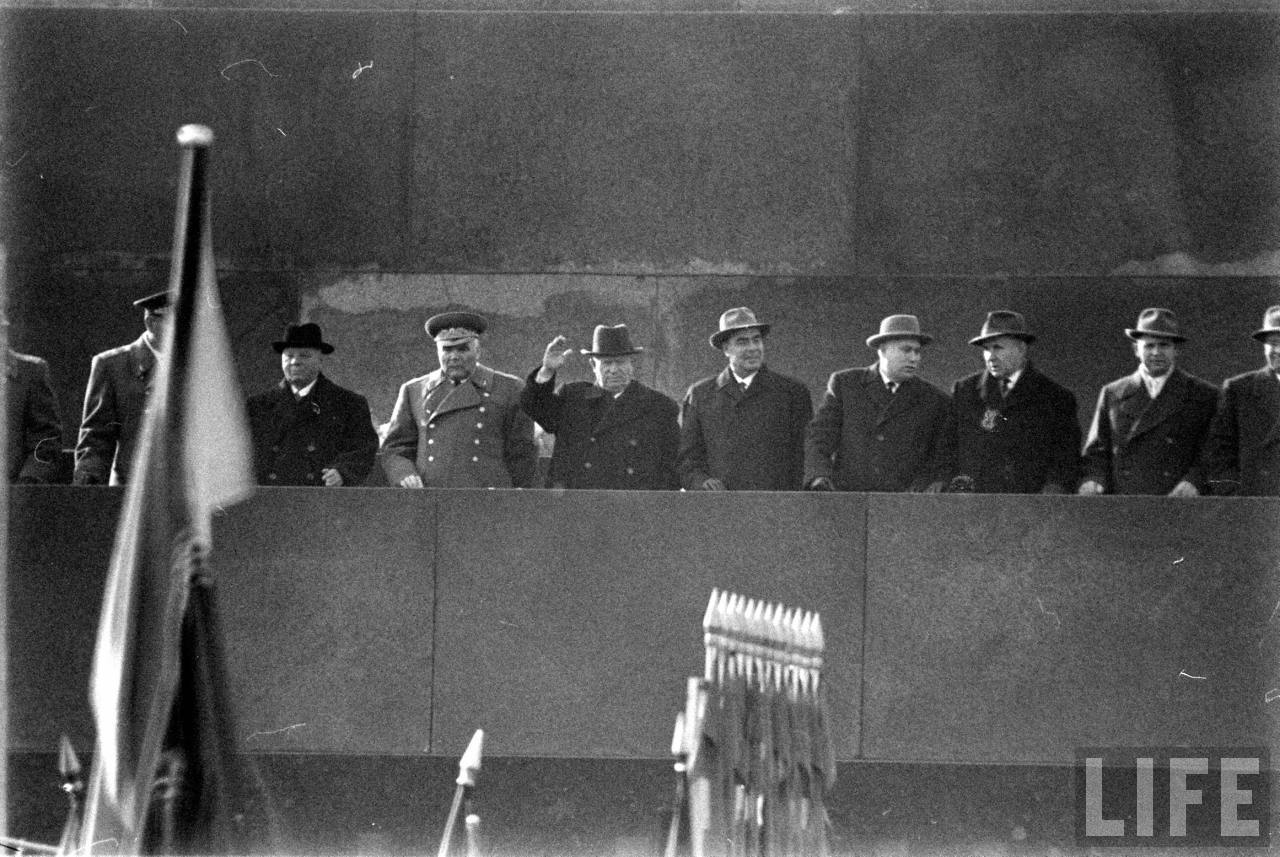
Krushchev, Brezhnev and other Soviet leaders review the Revolution parade in Red Square, 1962.
LIFE magazine photo by Stan Wayman.

Judgment In Moscow contains autobiographical elements but is principally concerned with providing and analyzing documentary evidence for what should have been the USSR equivalent of what the Nuremberg Trials had been for Nazi Germany. In 1991, Bukovsky returned to the Soviet Union to take part in the “trial of the communist party” that was held in 1992. In an audacious move the Communist Party had sued then-President Boris Yeltsin to get its property back. To prepare a defense, Yeltsin ordered that the secret Central Committee archives be opened to Bukovsky. The order was obeyed, but only partially and for a short time. The trial fizzled, but Bukovsky, with the aid of a hand-held scanner, was able to gather many thousands of pages of top-secret Central Committee and Politburo documents and get them out of Russia. Some of these key documents are what we have in this priceless book. They are eye-opening.

During the Cold War, we had to speculate as to why, for instance, the Soviet Union invaded Afghanistan and how the decision was made. Now we know for certain. Bukovsky provides the minutes of the Politburo meetings in which the invasion was decided. The Reagan administration was highly skeptical of détente and was therefore criticized for war-mongering. The skepticism was well-placed because, as the documents reveal, détente was simply a façade for advancing Soviet power and manipulating Western publics and governments against the Reagan plan to place Pershing IIs and cruise missiles in Europe to defend it against burgeoning Soviet power, including the SS-20s.

The revelations of the extent to which the Soviet Union manipulated the “peace” movement in the West should be an embarrassment to its participants, who may have been too naïve at the time to know how they were being used. Others, of course, acceded to being used, or even cravenly sought to be used. The names of some of these useful idiots are in the documents.

Another thing these documents disclose, much to the embarrassment of many American Sovietologists, is that there were no “hawks” and “doves” in the Kremlin — a premise on which they had banked their academic careers. The unanimity of the Politburo decisions reveals that the senior Soviet leaders were all of one stripe. It was to their advantage to create the impression that there were hawks and doves so that they could game the policies of Western governments and the opinions of its publics. For instance, providing Western credits to the USSR — it was thought by many so-called Russian experts in the West — would strengthen the doves in the Kremlin, whereas denying credits would empower the hawks. By buying this line of thought, the West was induced to keep the Soviet Union on life-support for more than a decade past what would have been its earlier collapse, according to Bukovsky.

No one was a greater master of this deception than Mikael Gorbachev. The minutes from many Politburo meetings chaired by Gorbachev show that glasnost and perestroika were façades constructed to ensure the continued existence of the Soviet Union through even more Western subsidies. And it worked to the extent that credits and subsidies ballooned under the Western illusion that Gorbachev had to be supported to ensure his success — ignorant of the fact that Gorbachev conceived of success in ways inimical to Western freedom.

H/T to Blazing Cat Fur for the link.

November 30, 2019

Hong Kong and China

Filed under: China, Liberty, Politics — Tags: , , , — Nicholas @ 05:00

At Samizdata, Brian Micklethwait considers the state of play in Hong Kong’s defiance of the Chinese Communist Party:

Protests continue in Hong Kong, 25 November 2019.
Photo by Studio Incendo via Wikimedia Commons

How can the HongKongers defeat the Chinese Communists (hereinafter termed ChiComs), and preserve their HongKonger way of life approximately as it now is? In the short run, they probably can’t. During the next few months, the ChiCom repression in Hong Kong will surely get ever nastier, and the bigger plan, to just gobble it up and digest it into ChiCom China will surely bash onwards.

But then again, I thought that these Hong kong demonstrations would all be snuffed out months ago. So what the hell do I know? I thought they’d just send in the tanks, and to hell with “world opinion”. But the ChiComs, it turned out, didn’t want to just kill everyone who dared to disobey, plus anyone else who happened to be standing about nearby. That would not be a good look for them. What are they? Russians? Far too unsophisticated. Instead the plan has been to divide and conquer, and it presumably still is. By putting violent agent provovateurs in among the demonstrators, and by ramping up the violence simultaneously perpetrated by the police, the plan was, and is, to turn the peaceful and hugely well attended demonstrations into far smaller, far more violent street battles of the sort that would disgust regular people. Who would then turn around and support law and order, increased spending on public housing, blah blah. So far, this has not worked.

And for as long as any ChiCom plan for Hong Kong continues not to work, “world opinion” has that much more time to shake itself free from the sneer quotes and get itself organised, to try to help Hong Kong to stay semi-free.

Those district rat-catcher (or whatever) elections last Sunday came at just the wrong time for the ChiComs, because they gave peaceful HongKongers the chance to make their opinions known, about creatures of a far more significant sort than rats, and at just the time when the ChiCom plan should have started seriously shutting the HongKongers up. These elections were a landslide.

The ChiComs are very keen to exude indifference to world opinion, but they clearly do care about it, because if they truly didn’t care about it, those tanks would have gone in months ago, just as I had assumed they would. So, since world opinion clearly has some effect, the first thing the rest of us can do to help the HongKongers is to keep our eyeballs on Hong Kong.

As I say, I continue to be pessimistic about the medium-term future in Hong Kong. But in the longer run, if the HongKongers can’t have a local victory, they can set about getting their revenge. And all of the rest of us who care can join in and help them.

November 27, 2019

The Father of Modern China – Sun Yat-sen l HISTORY OF CHINA

Filed under: China, History — Tags: , , , , , , — Nicholas @ 06:00

IT’S HISTORY
Published 2 Sep 2015

Sun Yat-sen is known as the “father of modern China”. He spent his adult life fighting against imperial China and the ruling Qing dynasty. First as revolutionary leader and later as politician. He founded the Tongmenghui League in 1905 and supported rebellions in China. After the Wuchang Uprising, Sun handed over the presidential office for the Republic of China to Yuan Shikai who soon after would ban Sun’s political party, the Kuomintang. So he reformed it as China’s National People’s party. His military and political work laid the groundwork from which his successors would later call out the People’s Republic of China.

» Century of Humiliation
Part 1: http://bit.ly/humiliation1
Part 2: http://bit.ly/Humiliation2

» SOURCES
Videos: British Pathé (https://www.youtube.com/user/britishp…)
Pictures: mainly Picture Alliance
Content:
Chang, Johannes (1960): “Sun Yat-sen – Seine Lehre und seine Bedeutung” in: JCSW 1 [1960] S.179-194
Gernet, Jacques (1988): Die chinesische Welt. Die Geschichte Chinas von den Anfängen bis zur Jetztzeit, Suhrkamp, Berlin.
Klein, Thoralf (2008): “Politische Geschichte Chinas 1900-1949”, auf bpb.de
https://www.bpb.de/internationales/as…
Vogelsang, Kai (2013): Geschichte Chinas, Reclam, Ditzingen.
Weigelin-Schwiedrzik (2012): “Der geteilte Himmel”, in ZEIT Geschichte Nr. 01/2012
http://www.zeit.de/zeit-geschichte/20…

» ABOUT US
IT’S HISTORY is a ride through history – Join us discovering the world’s most important eras in IN TIME, BIOGRAPHIES of the GREATEST MINDS and the most important INVENTIONS.

» HOW CAN I SUPPORT YOUR CHANNEL?
You can support us by sharing our videos with your friends and spreading the word about our work.

» CAN I EMBED YOUR VIDEOS ON MY WEBSITE?
Of course, you can embed our videos on your website. We are happy if you show our channel to your friends, fellow students, classmates, professors, teachers or neighbors. Or just share our videos on Facebook, Twitter, Reddit etc. Subscribe to our channel and like our videos with a thumbs up.

» CAN I SHOW YOUR VIDEOS IN CLASS?
Of course! Tell your teachers or professors about our channel and our videos. We’re happy if we can contribute with our videos.

» CREDITS
Presented by: Guy Kiddey
Script by: Julia Korbik
Translated by: Guy Kiddey
Directed by: Daniel Czepelczauer
Director of Photography: Markus Kretzschmar
Music: Markus Kretzschmar
Sound Design: Marc Glücks
Editing: Markus Kretzschmar

A Mediakraft Networks original channel
Based on a concept by Florian Wittig and Daniel Czepelczauer
Executive Producers: Astrid Deinhard-Olsson, Spartacus Olsson
Head of Production: Michael Wendt
Producer: Daniel Czepelczauer
Social Media Manager: Laura Pagan

Contains material licensed from British Pathé
All rights reserved – © Mediakraft Networks GmbH, 2015

November 24, 2019

QotD: The persistence of culture

Filed under: Education, History, Politics, Quotations — Tags: , , , — Nicholas @ 01:00

The trick to this is not only to give [the people] a fake history. Every tinpot dictator does that. The trick is to give them a fake history starting in kindergarten, that is painted in primary hues and comic-book complexity. There are good guys (the oligarchs who would design society to be more fair) and bad guys (usually capitalists and greedy, they want to “exploit” everyone, which only works if you believe in fixed pie economics and that everyone gets a share at birth, an economic idea so stupid you have to be indoctrinated from birth to believe it.) And everything is explained by “laws” and top down action. Though this history talks about mass movements, and “the people” they don’t actually take THE PEOPLE into account, not with any depth and complexity. The people in this narrative, the entire culture, in fact, is moldable, like butter to the sculpting knife of the powerful.

Societies don’t work that way. Culture doesn’t work that way. In fact culture is so persistent, so stubborn, it leads people to think it’s genetic. (It’s not. A baby taken at birth to another culture will not behave as his culture of origin.) It changes, sure, through invasions and take overs, but so slowly that bits of older cultures and ideas stay embedded in the new culture. It has been noted that the communist rulers of Russia partook a good bit of the Tsarist regime, because the culture of the people was the same and that came through. (They just dialed up the atrocities and lowered the functionality because their ideology was dysfunctional. They blame their failure on Russia itself, but considering how communism does around the world, I’ll say to the extent countries survive it’s because of the underlying culture.)

Sarah Hoyt, “A Generation With No Past”, According to Hoyt, 2017-10-19.

November 22, 2019

The Far Right French Revolution | BETWEEN 2 WARS I 1934 Part 4 of 4

Filed under: France, History — Tags: , , , , , , , — Nicholas @ 06:00

TimeGhost History
Published 21 Nov 2019

In February 1934, France threatens to go down the same political rabbit hole as Germany: anti-Semitic Fascism, but the French extremists are not quite as well organized as the Nazis.

Join us on Patreon: https://www.patreon.com/TimeGhostHistory

Hosted by: Indy Neidell
Written by: Francis van Berkel & Spartacus Olsson
Directed by: Spartacus Olsson and Astrid Deinhard
Executive Producers: Bodo Rittenauer, Astrid Deinhard, Indy Neidell, Spartacus Olsson
Creative Producer: Joram Appel
Post-Production Director: Wieke Kapteijns
Research by: Francis van Berkel
Edited by: Daniel Weiss
Sound design: Marek Kamiński

Colorizations: Klimbim/Olga Shirnina: https://klimbim2014.wordpress.com
Daniel Weiss, Oleg M, Dememorabilia, Julius Jääskeläinen, Adrien Fillon.

A TimeGhost chronological documentary produced by OnLion Entertainment GmbH.

From the comments:

TimeGhost History
52 minutes ago
We now get to some fascinating stuff that is less known outside of France. The events in 1934 will not create a new Fascist state, but they will have deep impact on how France deals with WW2. The February crisis influences military policy, the civilian response, and the way both right wing and left wing political parties deal with the German invasion and occupation. In the next couple of weeks we will come out with a War Against Humanity episode on the WW2 channel about the beginning of French collaboration and resistance — this episode provides essential background to how that plays out in 1940.

November 17, 2019

QotD: Socialist beliefs about “capitalism”

Filed under: Business, Economics, Government, Politics, Quotations — Tags: , , , , — Nicholas @ 01:00

The poor understanding of economic and political institution that Marx did so much to promote remains widespread today. “Progressive” and hard-left opponents of markets hold mistaken – or, at the very least, questionable – presumptions about reality, which include:

  • Wealth is either fixed in amount, or, while it might be destroyed or diminished by certain human activities (such as war), if wealth grows this growth occurs largely independently of human ideas, choices, actions, and institutions;
  • trade and commerce, therefore, are largely zero-sum – that is, each exchange situation pits a party who will win against one who will lose;
  • trade and commerce, in turn, involve activities are thus, at best, suspect; trade and commerce too often reward greediness and duplicity while penalizing generosity and honesty;
  • the “distribution” of wealth – whether conceived as financial flows or assets, or as access to real goods and services – is determined largely by power;
  • prices set on markets are largely arbitrary; prices seldom play any role beyond determining how much one party “wins” from trade and how much the other party “loses.”
  • each of a handful of large groups of people, mostly as conceptualized by intellectuals with no understanding of economics, has its own “interests” – interests that are shared by all members of the group and that are at odds with the interests of other groups; for example, “labor” has interests that are are shared by all workers and that are at odds with the interests of “employers”;
  • while the state can be captured by ill-intentioned people, the state – especially under unlimited majoritarian rule – is also the only possible savior of the powerless against the predations and frauds of the powerful;
  • absent vigorous state intervention, ordinary people – people whose main asset is the value of their own labor – lack both the power to get their fair share of society’s wealth and the intelligence or self-discipline to use wisely whatever share of wealth they do manage to secure;
  • social progress is achieved by the powerless grabbing power under the leadership of men and women of singular vision, intelligence, and courage; “the People” will be led to the Promised Land – can be led to the Promised Land – only if they faithfully follow their caring messiahs;
  • those who argue in favor of free markets are either soulless mercenary cronies for the powerful propertied class or they are ideologically blinded dupes for this class; no intelligent and decent person could possibly deny the enormous benefits available to “the People” when the state is empowered to work on their behalf against the propertied few.

Don Boudreaux, “Some Links”, Café Hayek, 2017-10-08.

November 13, 2019

George Orwell: A Life in Pictures

Filed under: Books, Britain, History, Politics — Tags: , , , , — Nicholas @ 09:45

Albion Noise
Published 27 Dec 2015

George Orwell: A Life in Pictures is a 2003 BBC Television docudrama telling the life story of the British author George Orwell. Chris Langham plays the part of Orwell. No surviving sound recordings or video of the real George Orwell have been found.

Awards:
International Emmy 2004 for Best Arts Programme
Grierson Award 2004 for Best Documentary on the Arts

QotD: Western culture’s mortal wound

Filed under: Europe, History, Politics, Quotations, WW1 — Tags: , , , — Nicholas @ 01:00

Just about every king tried to do it [explain “where we come from” and “what are we here for”], and there was a serious rewrite of history associated with events like Henry VIII’s break from Rome.

None of those attempts were as total or as successful as the 20th century ones, due to several things. The first was that nations hadn’t had their spirits broken as thoroughly as WWI broke them, so people weren’t willing to lend credence to things spouted from on high with that much eagerness, and things leaked through. HOWEVER the most important thing that the twentieth century had in hand to try to remake culture was this: public education, mass media, mass news reporting.

Did it succeed? No. The only result of trying to mold human beings into the utopian version of the man who would live happily under communism was 100 million graves, and a Europe that is dying of senescence and lack of reproduction.

However it succeeded brilliantly in not only separating, now, I suppose two or three generations from their roots, but also convincing them that they are superior to their actual learned ancestors, and somehow, yet, the product of the worst civilization of human history.

Western culture is dying of WWI partly because the “cure” imposed by state education apparatus, corrupted by Soviet agitprop and continued by “intellectuals” who know nothing except that they’re superior to everyone else, more enlightened, kinder, and that they should design society and the world to “improve” it.

Sarah Hoyt, “A Generation With No Past”, According to Hoyt, 2017-10-19.

« Newer PostsOlder Posts »

Powered by WordPress