Quotulatiousness

October 3, 2011

The key to peace in Afghanistan? The Pakistani army and the ISI

Filed under: Asia, Military — Tags: , , , , , , — Nicholas @ 12:06

Strategy Page explains why Afghanistan will not be peaceful until the Pakistani army and their local equivalent of the CIA stop meddling:

The U.S. and Afghanistan still believe a negotiated peace is possible, but Pakistan, not the Taliban, must be the counterparty. And it’s not Pakistan the country that must negotiate, but the Pakistani Army and the ISI (the Pakistani ISI/military intelligence organization). These two organizations have been running their own foreign policy for decades. The army/ISI has gotten rich by gaining control over a large chunk of the national economy and government budget. It’s all done with coercion, corruption and constant anti-Indian/anti-American propaganda. The Pakistani Army cannot justify its privileged position unless they convince the Pakistani people that there is a major threat out there. So the army/ISI has created fearsome foes. This includes Afghanistan, which they portray as a puppet for India and America and a major threat to Pakistan. Most Afghans reject this, and see the Taliban as a Pakistani tool. While many Afghans appreciate scattered Taliban efforts to reduce corruption, they mainly want less violence. The Taliban has been the major source of violence for nearly two decades, and most Afghans want peace. The Taliban want control, above all else. But now, facing severe combat losses, lower morale and defections, increased terror attacks are believed more for internal purposes (to build Taliban morale) than to weaken the Afghan government.

Afghanistan is looking north, towards Central Asia, for economic growth, and as a safer way to move goods into and out of the country. Pakistan is seen as more of an enemy, and not a reliable economic partner. Central Asia, on the other hand, is more stable, and offers as many economic opportunities. Afghanistan calls this the “Silk Road Solution” in memory of the ancient trade route between China and the Middle East (and India), which ran through western Afghanistan. Ocean going European sailing ships put the Silk Road out of business five centuries ago, but the end of the Soviet Union in 1991 has opened Central Asia to more customers and suppliers, including Afghanistan. The Silk Road is returning, as a local economic thoroughfare.

As part of the new approach to Pakistan, the U.S. has revealed that many deaths of American troops along the Afghan border were actually caused by Pakistani troops, not Taliban fighters. These details had been kept quiet for years, to maintain good relations with Pakistan. But now the Pakistani army and ISI are seen as out-of-control, so the gloves are off.

September 27, 2011

Britain (finally) admits it will “never again be among the global superpowers”

Filed under: Britain, History, Military — Tags: , — Nicholas @ 08:56

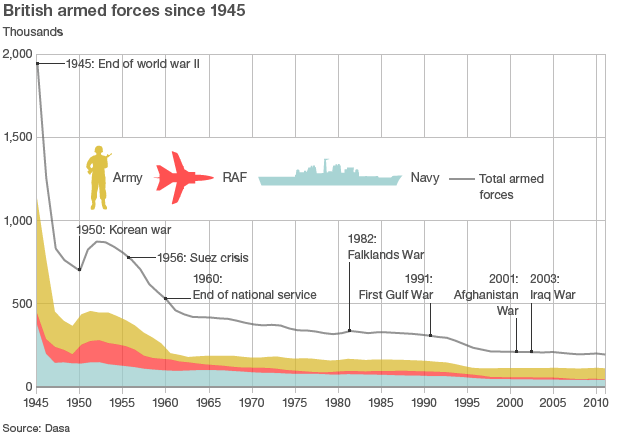
For something that’s been obvious to casual observers since 1945 (1956 if you’re generous), it’s taken a while to admit:

The warning comes from the Royal United Services Institute (RUSI) thinktank in a tough report which questions whether Britain’s defence crisis is really over.

Last year’s Strategic Defence and Security Review led to sweeping redundancies across all three services, and the early mothballing of, among others, the aircraft carrier Ark Royal, and the fleet of Harrier jets.

In a brutally frank assessment of the British military, the report states: “The UK will never again be a member of the select club of global superpowers. Indeed it has not been one for decades.

“But currently planned levels of defence spending should be enough for it to maintain its position as one of the world’s five second-rank military powers (with only the US in the first rank).”

Many in the military are likely to bridle at the analysis; last week the former head of the Royal Navy, Admiral Lord West, struck a completely different tone, causing a furore when he said the UK should not consider itself a second-tier power like “bloody Belgium or Denmark”.

Except for brief wartime surges, Britain’s military strength has rarely been the army: it’s been the Royal Navy that provided Britain with both military and economic clout. Gutting the striking power of the navy (HMS Ark Royal and the Harriers) was merely the final admission that the government had higher priorities domestically than internationally. As Admiral Cunningham once said, “It takes three years to build a ship; it takes three centuries to build a tradition. It’s remarkable how quickly one can destroy a tradition.

September 24, 2011

Canadian military: “the bureaucratic tail is wagging the Parliamentary dog”

Filed under: Bureaucracy, Cancon, Military — Tags: , , , — Nicholas @ 10:48

Christie Blatchford looks at the amazing ability of the military bureaucracy to frustrate, delay, obfuscate, and disobey their parliamentary masters:

Written by distinguished military scholar and veteran Dr. Jack English, it shows how the bureaucracy in Ottawa — an incestuous nest of regular army bosses with turf to protect and intractable civil servants — has consistently ignored or thwarted government directives to increase the size of the reserves.

What’s more, either those defence ministers whose pledges came to nought had the collective attention span of gnats, or they failed to grow a set of nuts sufficient to demand their instructions be followed, or they were simply shifted within Cabinet and the new fellow came in.

Any way you look at it, Dr. English says, the bureaucracy is calling the shots.

In the result, despite pledges to grow the reserves, the militia part-time head count remains still at about 16,500, or, as Dr. English wryly notes, about the size of National Defence Headquarters, or NDHQ as it’s called.

By the way, just getting the damn numbers out of NDHQ is a trick.

[. . .]

Virtually everyone who has studied the Canadian army, and their number is legion, agrees on a couple of things: The bureaucracy is obscenely bloated, far out of proportion for the size of the army; the citizen soldier, who until called up to full-time service costs only about 20% of the regular one, is a bargain for the taxpayer; the militia is more diverse, ethnically and otherwise, than the regular army.

September 21, 2011

Report shows military bureaucracy defied government orders

Filed under: Cancon, Government, Military — Tags: — Nicholas @ 07:34

It’s not really a surprise that the bureaucrats don’t want to increase the size of the militia, but it is surprising that they’ve been willing to ignore direct government orders on the subject:

Canada’s bloated military bureaucracy has consistently defied explicit orders from government ministers and failed to increase the size of the army militia as directed.

The accusation is made in a scorching but carefully documented report done by pre-eminent military scholar Jack English for the Canadian Defence and Foreign Affairs Institute and obtained in advance of its release Wednesday by only a few media outlets, including Postmedia.

It is a “wretched saga” that Mr. English describes as marked by “sandbagging, obstruction, futile wheel-spinning, and endlessly wasted staff effort.”

Using statements made by a series of defence ministers and recommendations either from special commissions or in government “White Papers” — all of them pledging or urging that the part-time militia or reserves, whose members most proudly call themselves citizen-soldiers, would grow — Mr. English shows how bureaucrats and leaders within the regular army, who saw any move to increase the militia as a threat, stubbornly stymied the wishes of their political masters.

In the numbers game, NDHQ has drawn level with the entire militia force, and like all bureaucracies, wants to continue to grow.

September 20, 2011

Finnish MP calls for military coup in Greece

Filed under: Europe, Greece, Media, Politics — Tags: , , , — Nicholas @ 09:33

I guess somebody felt they needed a bit of international headline stimulant:

Jussi Halla-aho, an MP for the populist True Finns party, wrote on social networking website Facebook on Wednesday that the Greek government should use military force against workers on strike.

“What Greece needs at this particular point in time is a military junta that would not have to worry about its popularity and could use tanks to enforce some order among strikers and rioters,” Halla-aho wrote.

The Facebook entry soon sparked outrage, with Halla-aho removing it and retracting his comment.

September 18, 2011

The Pentagon’s current big fear: the sequester

Filed under: Economics, Military, USA — Tags: , , , , — Nicholas @ 12:17

George F. Will explains why Leon Panetta, the secretary of defense, is very worried about the outcome of the “supercommittee” deliberations:

This would take from military budgets nearly $500 billion, in addition to a minimum of $350 billion cuts already scheduled. An almost trillion-dollar trimming, Panetta says flatly, “cannot take place.” Actually, he knows it can: “The gun to the head could really go off.” Even without a sequester, the military “is going to be a smaller force.” And with a sequester? The 1.5 million active-duty members of the armed services and 700,000 civilian employees of the Defense Department depend on an industrial base of more than 3.8 million persons. According to the Pentagon, a sequester would substantially shrink those three numbers, perhaps adding a point to the nation’s unemployment rate. The cuts would leave the smallest Army and Marine Corps in more than a decade and the smallest tactical Air Force since this service became independent of the Army in 1947. The Navy has already shrunk almost to its smallest fleet size since World War I.

Time was, when Democrats looked at the defense budget with a skeptical squint, Republicans rallied ’round it. No more. Few tea partyers remember Washington’s hawk-versus-dove dramas. They live to slow spending, period. They are constitutionalists but insufficiently attentive to the fact that defense is something the federal government does that it actually should do. And when they are told that particular military expenditures are crucial to force projection, they say: As in Libya? Been there, don’t want to do that.

Much of the defense budget is consumed by pay and health care for uniformed personnel, who have been abused enough by repeated deployments. The priciest new weapon, the stealthy F-35 Joint Strike Fighter (at least $90 million per plane), is vital for the continued salience of aircraft carriers, which are the basis of the U.S. strategic presence in the Western Pacific. Inferring China’s geopolitical intentions from its military purchases is difficult, but Panetta says guardedly that in five years China’s force projection will be “much better.” The Marines, with their smaller carriers, need a short-takeoff model F-35. Cut the number of planes built, the cost per plane rises, and the ability to recoup costs through sales to allies declines.

September 15, 2011

Is the end of the manned fighter plane at hand?

Filed under: Military, Technology — Tags: , , , , — Nicholas @ 09:08

Yes, I know we’ve gone through this discussion before (and the comment thread on that first entry is still a good summary of the counter-arguments). Air-to-air combat has become only a small part of what the air forces of the world are expected to do: ground support, while generally disdained by air force brass hats, is the most common combat task now. Here’s the state of play, according to Strategy Page, as far as the future of air combat is concerned:

The last decade has revolutionized air warfare, and air forces. This revolution was brought about by two technologies (smart bombs and UAVs) that have been around for decades but, over a decade ago, became reliable and capable enough to have a decisive effect on warfare. Now UAVs armed with smart bombs are poised to replace manned aircraft. Moreover, the proliferation of GPS guided weapons and short range guided missiles have greatly reduced the need for ground strikes by manned or unmanned aircraft. Since World War II, air forces have demanded, and obtained, a disproportionate share of military budgets. No more.

[. . .]

Underlying all of this is the appearance of so many cheaper, reliable, precision weapons in the last decade. This has changed tactics on the ground. While the air force doesn’t like to dwell on this, it’s the war on the ground that is decisive, not what’s going on in the air. This proliferation of precision has also changed the way smart bombs were designed. With the ability to put a weapon within a meter of the aiming point (using laser guidance) or 5-10 meters (using GPS), smaller is now better, at least in urban areas where there are a lot of civilians about, troops have changed the way they fight. There is more movement in urban warfare because of all this precision firepower, and fewer friendly fire casualties from bombs and artillery. But it’s not just the air force and their smart bombs that have brought this on. The army had precision missiles on the ground long before JDAM came along. Now the army has more of them. Thus, over the last five years, there has been a competition between the army and air force to develop smaller, cheaper and more precise, missiles and bombs.

[. . .]

The air force is not happy about the army having a large force of armed UAVs. Many air force generals believe the army should not have the MQ-1C, or at least not use them with weapons. That has already caused some spats in the Pentagon over the issue, but so far the army has prevailed.

The army argument is that these larger UAVs work better for them if they are under the direct control of combat brigades. The air force sees that as inefficient, and would prefer to have one large pool of larger UAVs, that could be deployed as needed. This difference of opinion reflects basic differences in how the army and air force deploy and use their combat forces. The army has found that a critical factor in battlefield success is teamwork among members of a unit, and subordinate units in a brigade. While the air force accepts this as a critical performance issue for their aircraft squadrons, they deem it irrelevant for army use of UAVs. Seeing army MQ-1Cs doing visual and electronic reconnaissance and firing missiles at ground targets, the air force sees itself losing control of missions it has dominated since its founding in 1948.

[. . .]

Meanwhile, the navy has taken the lead in developing larger, jet propelled UAVs like the 15 ton, X-47B. This UAV uses a F100-PW-220 engine, which is currently used in the F-16 and F-15. The X-47B can carry two tons of bombs or missiles and maneuver like a jet fighter. The X-47B is fast and agile enough to carry out air-to-air missions. With the right software, it can do this autonomously (without human intervention). This is being worked on, and the navy already has perfected the software that enables a UAV to land on aircraft carriers.

The coming decade will see more and more UAVs replacing manned aircraft. Thus after only a century in action, manned combat aircraft are on their way out.

September 12, 2011

Is the People’s Liberation Army a paper tiger?

Filed under: China, Economics, Military, Weapons — Tags: , , , — Nicholas @ 09:36

An interesting article at Strategy Page looks at the myth and reality of China’s army and navy:

You don’t see much in the media about the poor training of Chinese military personnel. You don’t hear much about the poor leadership and low readiness for combat. But all of this is common knowledge in China. There, the military is not walled off from everyone else. Cell phone cameras and the Internet make it easy to pass around evidence (often in the form of “hey, this one is hilarious”). The government tries to play up how modern and efficient the military is, but most Chinese know better, and don’t really care. China is winning victories on the economic front, and that what really counts to the average Chinese.

Meanwhile, U.S. military leaders and defense industries are looking for a sufficiently impressive foe to help scare more money out of Congress. The Chinese Navy (or, more correctly, the Chinese Peoples’ Liberation Army Navy) is now the favorite candidate, for navy and defense industry analysts, to become the new Big Bad. Just how dangerous are these Chinese sailors and their ships? It turns out that, on closer inspection, not very.

This is the sort of thing that what went on during the Cold War. Russian military prowess was hyped by the American military, and their defense suppliers, to justify further increases in defense spending. When the Cold War ended, it was revealed how the Russian military, and defense manufacturers, played the same game. It also revealed that Russian military capabilities were far less than the hype indicated.

The basic weapon for this sort of thing is FUD (Fear, Uncertainty and Doubt). Works every time, although it is difficult to pitch the Chinese navy as a crack force. Most of their ships are elderly, poorly designed and rarely used. Their nuclear subs are worse than the first generation of Russian nukes back in the 1960s. The most modern Chinese ships are Russian made, Cold War era models. Chinese ships don’t go to sea much, not just because it’s expensive, but because Chinese ships tend to get involved in nasty incidents. Like the submarine that killed its crew when the boat submerged (and the diesel engines did not shut down when the batteries kicked in, thus using up all the oxygen.) Breakdowns are more common, as well as a lot of accidents you don’t hear about (weapons and equipment malfunctions that kill and maim.) Nevertheless, the Chinese are working to change this. Ships are going to sea more each year, and troops are getting more training. But unless the corruption is curbed, this could all be wasted.

Of course, if China isn’t the big military threat to the rest of the world, how will the Pentagon get Congress to go along with its perpetual demands for more funding?

August 28, 2011

Britain’s next military target?

Filed under: Britain, Humour, Military — Tags: , , , — Nicholas @ 09:29

James Delingpole tries to draw up a list of the next most likely place for David Cameron’s military adventure:

China

Pros: on the verge of taking over the world and enslaving us all; mines evil rare earth minerals in environmentally unfriendly fashion which Sam Cam, like, totally, like hates, even though it’s OK really because they go towards the wind farms which make Daddy nearly £1000 a day on his estates; a big, juicy target that would impress David Cameron’s Notting Hill friends way more than poxy Libya.

Cons: We’d lose

[. . .]

France

Pros: Would be hugely popular with the home crowd and guarantee re-election in 2015

Cons: Victory would depend, crucially, on whose turn it is to use the aircraft carrier.

[. . .]

The USA

Pros: Would send a clear signal to Guardianistas that Britain is not going to be “America’s poodle”; might well result in a sexy-sexy congratulatory tete a tete with Christine Lagarde; would make the Lib Dem element of the Coalition feel more at home than ever.

Cons: Our record of beating America in wars is not good. Then again, with a President as lame-duck as Obama in charge this could yet be our best hope.

August 25, 2011

Review of Australian defence establishment extended

Filed under: Australia, Law, Military — Tags: , , — Nicholas @ 08:56

They’ve apparently been overwhelmed by complaints, so the original term is being extended:

A review into sexual abuse in the Australian military has received such a high volume of complaints that it is being extended, Defence Minister Stephen Smith says.

The government asked a law firm to begin a review following a sex scandal at an Australian defence academy.

Mr Smith said investigators were dealing with more than 1,000 allegations of abuse.

The review will now report back on 30 September, one month behind schedule.

Investigations began after two cadets from the Australian Defence Force Academy were accused of secretly filming a female cadet having sex and broadcasting it on the internet.

They have now been charged in connection with the incident, which raised questions about the treatment of women within the Australian defence establishment.

August 16, 2011

Renaming isn’t enough

Filed under: Cancon, Military — Tags: , , , , , — Nicholas @ 07:51

The National Post editorial board insists that mere renaming for the Royal Canadian Navy and the Royal Canadian Air Force isn’t enough:

Should the unified Forces be replaced by the three original branches, as is expected from Tuesday’s announcement, many members of the military, past and present, will be delighted and indebted to the Conservatives for restoring the honour and pride of their beloved Navy, Army and Air Force. And if the move is limited to new flags and a nod to history, it is indeed something that Canadians should applaud.

But there is danger in allowing symbolic gestures to supplant firm, material support. It is ironic that the government seems set to make a symbolic move to please serving and retired naval personnel when the naval branch of the Canadian Forces is struggling to sustain itself for want of money and manpower, and operates a fleet of vessels in desperate need of modernization. The navy’s list of woes include losing more than 1,100 full-time members since 2004, despite the continued high demand for its services, a submarine fleet that is essentially undeployable and incapable of firing Canada’s stockpiled torpedoes, 40-year-old supply ships and helicopters that are overdue for replacement, and obsolete, elderly air-defence destroyers.

The government intends to begin a major shipbuilding program to replace dozens of navy and coast guard vessels within the next several years, but warships take a long time to build. It will be years before new vessels enter service or receive needed upgrades. The air force is also in need of major equipment purchases (the controversial F-35 purchase being the best known example) and even the army, despite investments made during the war in Afghanistan, needs more troops and equipment.

August 15, 2011

Navy and Air Force to be “Royal” again?

Filed under: Cancon, Government, Military — Tags: , , , , , , — Nicholas @ 14:12

Andrew Coyne linked to this article at the Huffington Post:

Canada’s navy and air force will get a royal name change Tuesday, The Huffington Post Canada has learned.

The Conservative government plans to announce that Maritime Command and Air Command, the official names of the two Canadian Forces’ units, will be returned to Royal Canadian Navy and Royal Canadian Air Force, monikers last used in 1968. Simultaneous announcements on the name change are planned for Tuesday in Halifax, Kingston, Valcartier, Que., Cold Lake, Alta., and Esquimalt, B.C.

The Canadian army, which is officially called Land Command, will also be renamed simply Canadian Army.

The change is mostly symbolic and won’t affect how the Canadian Forces are run.

It may be “mostly symbolic”, but symbols matter.

Up yours, Mr. Hellyer.

July 18, 2011

Good news for (some) soldiers

Filed under: Military, Technology, USA, Weapons — Tags: , — Nicholas @ 13:15

David Pugliese reports on the US Army’s work on a new, significantly lighter, Squad Automatic Weapon:

“We are using cased telescoped ammunition which uses a strong plastic case instead of a traditional brass case,” said Kori Phillips, a systems management engineer with ARDEC.

Weight reduction for the weapon was achieved by designing the new weapon platform using the latest materials technologies as well as modeling and simulation to achieve minimal weight without compromising performance.

With a basic load of 1,000 rounds, the LSAT light machine gun and its cased telescoped ammunition is 20.4 pounds lighter than a traditional SAW with the same amount of standard, brass-cased ammunition.

[. . .]

“The cased telescoped ammo still provides the same muzzle velocity, range and accuracy as the brass-cased ammo,” Phillips said. “We’re not sacrificing lethality for weight. The plastic case does the same job.”

In addition to significant weight savings, the LSAT is designed to provide other advantages over the current SAW. With a rotating chamber design, the cased telescoped light machine gun improves reliability.

“We’ve avoided the common problem of failure to feed and failure to eject,” Phillips said. “In the current SAW system, that’s one of the places where you primarily have failures and malfunctions.”

Of course, if the new ammunition works well for the SAW, it’ll certainly be adapted for other small arms (in a hot combat zone, you never have “too much” ammunition available, but you often have “too little”).

July 17, 2011

Saudi Arabia upgrades their armoured forces

Filed under: Germany, Middle East, Military, Technology — Tags: , , , — Nicholas @ 10:49

Saudi Arabia will add a few hundred of the most up-to-date panzers to their defence forces:

Saudi Arabia is buying 244 Leopard 2A7+ tanks from Germany. Saudi Arabia is believed to have already ordered 44, and now has increased that order. It was only a year ago that German tank manufacturer KMW has revealed this, the latest version of its Leopard 2.

Two years ago, the German Army announced that it was going to upgrade 150 of its Leopard 2A6 tanks to the A7 standard. That would include more armor on the sides and rear (especially to protect against RPGs), more external cameras (so the crew inside could see anything in any direction, day or night), a remote control machine-gun station on top of the turret, better fire control and combat control computers and displays, more powerful auxiliary power unit and better air conditioning, and numerous other minor improvements. This would increase the weight of the tank to nearly 70 tons.

[. . .]

Saudi Arabia is concerned about Iran, which has a force of 1,500 much older tanks (most of them Russian T-72s and T-54/55s). Saudi Arabia has 1,300 tanks, most of them older American M-60s and French AMX-30s. But the Saudis also have 370 U.S. M-1s and 150 Russian T-90s. The 244 Leopards will increase the Saudi edge. The Saudis also have the money to buy spare parts for their modern tanks, and Western instructors to provide the best training. But the Iranians are better soldiers, so they might have an edge there.

July 14, 2011

Canadian withdrawal from Afghanistan being spun as a Taliban victory

Filed under: Cancon, Media, Military — Tags: , , , , — Nicholas @ 17:15

To the surprise of nobody, the Taliban is claiming a clear win in driving the Canadian infidels out of Afghanistan:

During nine years of operations in Afghanistan, 157 Canadian troops died (87 percent because of the Taliban.) For most of that time, Canada suffered, proportionately, twice as many dead in Afghanistan as the United States. During this period, the U.S. had ten times as many troops in Afghanistan. The U.S. also has ten times the population of Canada, so the 3,000 Canadians are making the same scale of effort, but suffering more losses in the process. But most of those losses were not from “fighting the Taliban,” but from mines in the road. Back in early 2007, 81 percent of Canadian deaths were from IEDs (roadside bombs). But that declined as Canadian troops received more bomb resistant armored vehicles.

Since the Taliban couldn’t cope with Canadian troops in head-to-head combat, they devoted much of their roadside bombing effort against the Canadians. But in the last year, the Taliban were only able to kill four Canadian troops. Still, the constant Taliban propaganda about how killing even a few Canadian troops would eventually force the Canadians to withdraw, is believed by most Afghans. Canada decided to withdraw all their troops from Afghanistan back in 2008, and more American troops have moved in to replace them.

It’s ironic that the reason the government of the day originally committed troops to the Afghanistan campaign was that they thought it would be “safer” than being involved in Iraq. Rather than being seen to support George Bush, the Canadian contingent was sent to a “less tainted” operation instead. The party that sent the troops in the first place lost few opportunities to call for them to leave, once the current government was in power.

« Newer PostsOlder Posts »

Powered by WordPress