
Forgotten Weapons
Published 17 Sept 2025The FAMAS G1 was developed as a lower-cost option for FAMAS export sales. The original F1 model had been offered for international sale, but it attracted little interest largely because of its high price. In response, GIAT created the G1 with many of the extra features left optional. This allowed them to reduce the price by up to 40%. Specific feature reductions included:
- Omitting the bipod legs
- Omitting the grenade launching sights and barrel fittings
- Omitting the night sights
- Omitting the burst fire mechanism
- Replacing the trigger guard with a molded whole-hand trigger guard
The mechanism stayed the same, and all of the omitted features could be included as options. This still failed to generate any export sales, in part because GIAT came under ownership of FN, and FN’s competing assault rifle options were more profitable than the FAMAS.
The G1 did contribute elements like the whole-hand trigger guard to the mid-1990s G2 model adopted by the French Navy, however.
(more…)
February 10, 2026
FAMAS G1: Simplified for Export
QotD: The (historical) walls of Jericho
These strategic (and operational) considerations dictate some of the tactical realities of most sieges. The attacker’s army is generally going to be larger and stronger, typically a lot larger and stronger, because if the two sides were anywhere near parity with each other the defender would risk a battle rather than submit to a siege. Thus the main problem the attacker faces is access: if the attacker can get into the settlement, that will typically be sufficient to ensure victory.
The problem standing between that attacking army and access was, of course, walls (though as we will see, walls rarely stand alone as part of a defensive system). Even very early Neolithic settlements often show concerns for defense and signs of fortification. The oldest set of city walls belong to one of the oldest excavated cities (which should tell us how short the interval between the development of large population centers and the need to fortify those population centers was), Jericho in the West Bank. The site was inhabited beginning around 10,000 BC and the initial phase of construction on what appears to be a city wall reinforced with a defensive tower was c. 8000 BC. It is striking just how substantial the fortifications are, given how early they were constructed: initially the wall was a 3.6m stone perimeter wall, supported by a 8.5m tall tower, all in stone. That setup was eventually reinforced with a defensive ditch dug 2.7m deep and 8.2m wide cutting through the bedrock (that is a ditch even Roel Konijnendijk could be proud of!), by which point the main wall was enhanced to be some 1.5-2m thick and anywhere from 3.7-5.2m high. That is a serious wall and unlikely the first defensive system protecting the site; chances are there were older fortifications, perhaps in perishable materials, which do not survive. Simply put, no one starts by building a 4m by 2m stone wall reinforced by a massive stone tower and a huge ditch through the bedrock; clearly city walls [were] something people had already been thinking about for some time.
I want to stress just how deep into the past a site like Jericho is. At 8000 BC, Jericho’s wall and tower pre-date the earliest writing anywhere (the Kish tablet, c. 3200 BC) by c. 4,800 years. The tower of Jericho was more ancient to the Great Pyramid of Giza (c. 2600 BC), than the Great Pyramid is to us. In short, the problem of walled cities – and taking walled cities – was a very old problem, one which predated writing by thousands of years. By the time the arrival of writing allows us to see even a little more clearly, Egypt, Mesopotamia and the Levant are already filled with walled cities, often with stunningly impressive stone or brick walls. Gilgamesh (r. 2900-2700 BC) brags about the walls of Uruk in the Epic of Gilgamesh (composed c. 2100) as enclosing more than three square miles and being made of superior baked bricks (rather than inferior mudbrick); there is evidence to suggest, by the by, that the historical Gilgamesh (or Bilgames) did build Uruk’s walls and that they would have lived up to the poem’s billing. Meanwhile, in Egypt, we have artwork like the Towns Palette, which appears to commemorate the successful sieges of a number of walled towns
So a would-be agrarian conqueror in Egypt, Mesopotamia or the Levant, from well before the Bronze Age would have already had to contest with the problem of how to seize fortified towns. Of course depictions like these make it difficult to reconstruct siege tactics (the animals on the Towns Palette likely represent armies, rather than a strategy of “use a giant bird as a siege weapon”), so we’re going to jump ahead to the (Neo)Assyrian Empire (911-609 BC; note that we are jumping ahead thousands of years).
Bret Devereaux, “Collections: Fortification, Part I: The Besieger’s Playbook”, A Collection of Unmitigated Pedantry, 2021-10-29.
February 9, 2026
Jamil Jivani on his trip to Washington DC
If you depend on the CBC, the Toronto Star or other legacy Canadian media, if you heard anything at all about Bowmanville-Oshawa North MP Jamil Jivani’s visit to key American leaders in Washington DC, you probably got the story framed as Liberals tut-tutting and disapproving of Jivani, his initiative to make the trip, and how he should leave everything to the government. If nothing else, it further proved that Prime Minister Carney doesn’t actually want better relations with the US, as his entire campaign was based on opposition to Trump and its success in riling up Canadian boomers with the moronic eLbOwS uP nonsense.
In the National Post Jivani discusses the trip and what he’s learned from it:

Image from Melanie in Saskatchewan
It was a whirlwind of a trip, full of excellent conversations. I had meetings with the White House and State Department, including conversations with President Donald Trump, Vice-President JD Vance, and Secretary of State Marco Rubio. Senators from Montana, Ohio, and Wisconsin, as well as the United States Trade Representative, each sat down with me to share their priorities. Businesses and industries employing thousands of Canadians shared their insights with me on where Canada-U.S. trade fits into their vision for economic growth.
Doors were open for dialogue about how Canada and the U.S. can work together at a time when pessimism gets most of the media attention. Certainly, my 15-year friendship with the vice-president played a key role in opening those doors. But what I found across the board was optimism about how we can move trade negotiations forward. I was particularly happy to hear key insights on how we can make progress on specific sectoral priorities, and the importance of strategic diplomacy. I offered my perspective on why CUSMA is so important to communities like mine in Bowmanville—Oshawa North, and I expressed my hope that CUSMA will continue to ensure Canada and the U.S. both benefit from a special economic and security relationship.
There is only so much I can share without first having the chance to speak with Prime Minister Mark Carney and Minister Dominic LeBlanc. Out of respect for their unique responsibilities in negotiating trade with the United States, it’s important that I debrief them before saying too much publicly and see how we can work together moving forward as Conservatives and Liberals.
However, I do want to point out a key observation related to the need for strategic diplomacy. Mexico — the third partner in our trilateral trade agreement with the U.S. — is further ahead in its engagement with the U.S. than Canada is. On Jan. 28, 2026, Mexico and the U.S. announced formal talks on CUSMA reforms. A week later, Mexico and the U.S. announced a joint action plan for critical minerals. Neither of these announcements included Canada.
Observers of this news would be right to worry that the current Canadian government may be making similar mistakes as were made under Prime Minister Justin Trudeau during the 2017 CUSMA negotiations. At that time, Mexico advanced its negotiations with the U.S. while Canada was largely left out of the process. It was only at the last minute, when a bilateral agreement between Mexico and the US was a real possibility, that Canada was included and our unique trilateral arrangement continued.
It would be a mistake to relive 2017 all over again, if for no other reason than Canadian workers and businesses deserve to have full representation in a process that has such a significant impact on our economy. The workers at the GM plant in Oshawa deserve to know that their government did everything possible to protect their jobs and encourage investment in their industry. All Canadians deserve to know that their elected officials are making the best effort possible to advance our national interests.
Full disclosure: Jamil Jivani is my Member of Parliament, and I fully support his decision to go and I hope that it actually does help make for improved trade relations between Canada and the United States. Bitterness and uncertainty only benefit the Liberal Party and Mark Carney, not ordinary Canadians. Attacking and criticizing Donald Trump plays well in our deranged and sycophantic media, but it makes Trump less willing to deal fairly with Canada on trade or other issues of critical importance to both nations.
Why This Is The Greatest Lord Of The Rings Scene Ever
The Critical Drinker
Published 6 Feb 2026Since its the 25th anniversary of the trilogy, I figured I’d reminisce about my favourite ever scene from all three movies. And explain why I’m objectively right about it.
The origins of the First Special Service Force (the “Devil’s Brigade”)
Project ’44 has a nice introduction to the formation and organization of the joint US-Canadian First Special Service Force during the Second World War. The unit was featured in the 1968 movie The Devil’s Brigade, although many liberties were taken in the film’s portrayal of events:

Sgt. Pat O’Neill (Jeremy Slate) in the messhall scene in The Devil’s Brigade (1968).
In August 1942, a unit unlike any other in Canadian military history was formed. Today it is widely known by its nickname, the “Devil’s Brigade”, but officially it was designated the First Special Service Force (FSSF).
This unique formation was a joint Canadian–American unit born from the unconventional ideas of British scientist Geoffrey Pyke. Pyke envisioned a small, elite force operating deep behind German lines in occupied Norway, spreading disruption and chaos. Although this original concept was judged impractical, the decision was made to create the unit regardless.
FSSF patch from Project ’44
The combat element of the Force was composed of roughly equal numbers of Canadians and Americans, while the supporting echelon units were entirely American. Most Canadian subaltern officers were recruited almost directly from the Officer Training Centre in Brockville, and the majority of the Other Ranks were drawn from units across Canada. Some personnel were even selected directly from the 1st Canadian Parachute Battalion, much to the frustration of that unit’s chain of command.
The Force was commanded throughout its existence by American Lieutenant Colonel Robert Frederick. The initial Canadian second-in-command, Lieutenant Colonel McQueen, was injured during parachute training and broke his ankle. Because of the limited time available for training, he was returned to his original unit and replaced by Canadian Lieutenant Colonel Williamson.
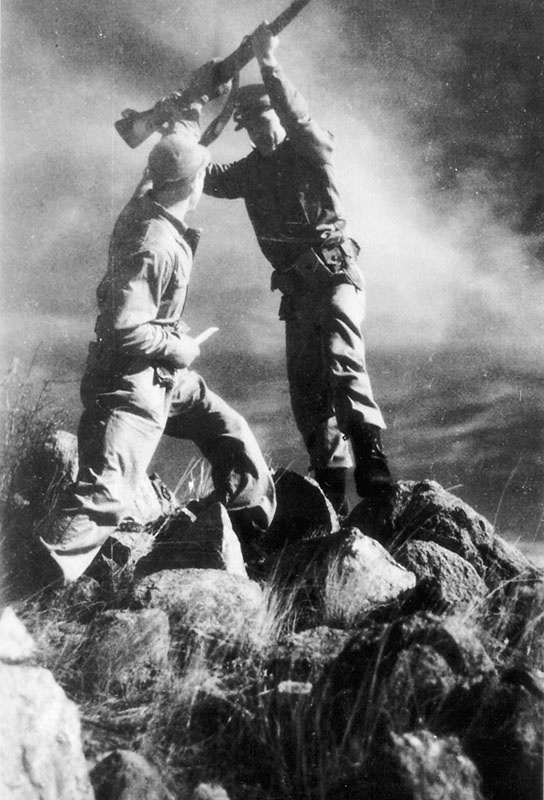
Orval Logan and Stuart Diamond demonstrate hand-to-hand combat
Photo by Paul Moore from Project ’44Williamson served both as second-in-command of the FSSF and as Commanding Officer of the 2nd Canadian Parachute Battalion. This designation served as the administrative cover name for the Canadian component of the Force and was later changed to the 1st Canadian Special Service Battalion. This was not a tactical formation in the field, but rather an administrative structure created to manage Canadian personnel within the joint unit.
As a combined Canadian–American formation, personnel from both nations were distributed evenly throughout the Force. While its overall role and employment resembled that of a brigade, its internal organization followed American regimental doctrine. The Force consisted of three regiments. Whereas a standard American infantry regiment normally contained three battalions and approximately 3,000 soldiers, each regiment within the FSSF comprised only 32 officers and 385 Other Ranks, for a total authorized strength of 412 personnel.

Keeping Up with the Pattons
The Tank Museum
Published 10 Oct 2025M46, M47, M48 and M60. They saw action in Korea, Vietnam, The Gulf and held the line in the Cold War. For almost 40 years the US produced a succession of good tanks — but they never seemed to be good enough for the top brass.
Time after time, designers sought a perfection that seemed to lay out of reach until the arrival of the step-changing M1 Abrams.
Up till then, you have what can be called “The Patton” family: a series of closely related tanks that are only intended to be temporary until the next big thing arrived …
This is the story of the “Patton” family of tanks; tanks that the US tried and failed to replace time after time, yet which despite this ended up becoming the armoured backbone of the Free World during the Cold War.
In this film, Tank Museum Historian, James Donaldson, walks us through the progression of US tanks from the M26 Pershing right up to the M1 Abrams. Commonly known as The Patton Family, this group of tanks were good… but never quite good enough. Always meant to be a stopgap, the Pattons persisted where their prospective replacements failed, leading them to become the vehicles that endured the Cold War around the globe.
00:00 | Introduction
00:58 | From Pershing to Patton
03:50 | Replacing the M46
06:25 | A Third Patton
10:01 | Yet Another Stopgap
12:44 | Irreplaceable?
(more…)
QotD: The pre-modern versus the modern concept of “self”
In contrast, most modern societies believe in a self that is “buffered”. In this view there are a few limited, low-bandwidth ways that the external world can act on one’s innate nature, for instance via drugs or other body chemistry, and even these are often seen as revealing or disclosing previously hidden innate characteristics of one’s personality rather than as imposing something alien. Taylor argues quite convincingly that these two ways of viewing the self — porous vs. buffered — inexorably produce two different ways of viewing society and the world: premodern and modern. For example: if selves are porous, then we need to be extremely vigilant against the invasion or violation of our minds by hostile spirits, and we must be suspicious of what we want, because it might not really be what we want, but rather what something else wants through us. Conversely, if selves are buffered then our desires are just part of who we are, and in order to be true to ourselves, we need to explore them and act upon them.
It may have been reasonable to believe in a buffered self back in the days before the internet, but recent developments have made it clear that (as in so many things) the primitive superstitions were actually correct, and the enlightened modern view was just a lamer and dumber kind of superstition.1 Science fiction has long been fascinated with stories of infohazards — images or jokes or snippets of cognition that act like a Gödel sentence for the human mind and leave people braindead or mind-controlled. But such things long since slipped the shackles of fiction — we now have internet creepypasta that induces girls to become murderers and a genre of pornography that turns boys into girls.2 The noösphere is a vast ocean, and its abyssal depths teem with lifeforms and thoughtforms that seek to possess you and live out their blasphemous unlife through your mortal husk.
John Psmith, “REVIEW: Demons, by Fyodor Dostoevsky”, Mr. and Mrs. Psmith’s Bookshelf, 2023-07-17.
- Or maybe society is already correcting itself on this point. Many like to make fun of the “fragility” and “snowflake” nature of Gen Z, and I’ve argued before that these critics miss the point that they’re actually being “flexed on” (in the parlance of our times) because loudly asserting an exaggerated harm is a power move (think: upper class women in an honor culture claiming to feel threatened, and how that’s actually itself a threat).
But here’s a different take on it: maybe “trauma” as it’s popularly conceptualized is actually modernity groping its way back to a porous understanding of the self! We no longer believe in spirits or curses, but our psyches are self-evidently susceptible to immaterial external influence, so we create a new concept that aligns empirical psychic porosity with the dominant metaphysical and ideological currents.
- I had a long debate with myself on whether to include either of those links. Do I really want to expose more people to an infohazard? Ultimately I decided to do it because this stuff is already so widespread. In both cases I’ve linked to a page that links to the subject matter in question rather than linking directly, so you have one more chance to bail out.
February 8, 2026
WW1: The Eastern Front in 1914 | EP 5
The Rest Is History
Published 8 Sept 2025While the Western front was raging following the outbreak of the First World War in 1914, what was unfolding on the Eastern Front? Why was it an even bloodier and more brutal arena than the West? As Austria took on its great antagonist — the spark of the entire war — Serbia, why were its early campaigns constantly blighted by disaster? What terrible mistake did Russia, with its behemoth of an army, make? How would its dramatic war with Germany unfold? And, would this be the beginning of the end of the Habsburg Empire?
Join Dominic and Tom as they discuss the outbreak of the First World War on the Eastern Front, and its early clashes.
—————————————————
0:00 Adobe AD
0:50 Intro
3:27 The Eastern Front explained
5:15 The Serbian Front
33:23 Uber AD
34:02 Folio Society AD
35:33 Russia invades Germany
(more…)
“Girlboss Gatekeeping” as an evolutionary strategy
John Carter linked to this essay on Substack, calling it “A young mother’s reflections on fertility collapse”:
It’s easy to get caught up in the achievement trap, isn’t it? There are times I catch myself catastrophizing and thinking things like if my son doesn’t get into the right elementary school, then he won’t get into the right high school, and then he won’t get into the right college, and then he won’t be able to get a good job and will end up giving hand jobs for crack behind a Walmart.
Even if time, effort, and expense don’t keep people from having children, narcissism certainly can. There was an article in Vogue a while back entitled “Is Having a Boyfriend Embarrassing Now?“. The article was pretty silly, although it dominated internet chatter for a hot minute. Hiding your man is framed as solidarity with single women, but I think that it highlights just how commodified we all are now. When your brand is all about travel, Pilates, fancy cocktails, and mani-pedis, it’s hard to find space for motherhood in all of that. Yes, I know that there are “parenting influencers” as well, but they are not that common if we’re being honest.
Rob Henderson, another writer and podcaster whose content I thoroughly enjoy, posted an essay on this topic that had a novel take. Dr. Henderson writes about “Girlboss Gatekeeping“, where encouraging other women to forgo having children and focus on their careers may be an evolutionary strategy to keep the number of children low so that there are more resources available for one’s own. I can relate to this since when I was in college, everyone talked about what they wanted their careers to be, but it seemed almost verboten to mention starting a family.
Similarly, when I was in college, there was all this talk about how traditional family structure was inherently patriarchal and stifling towards women, and that we needed to move past or do away with marriage as an institution. The people who talked like this were college kids from upper-middle families who were raised by a married mother and father. This plays into another concept from Dr. Henderson called “luxury beliefs“. Basically, these are beliefs that confer status on the people that express them but actually would make things worse for the underprivileged if they were implemented.
I’ve come to realize that so many of the things that we were told or that I used to believe ended up being untrue. That people are born as a “blank slate”. That men and women are the same. That human beings, and by extension, societies are perfectible. That variation in outcomes must be the result of oppression.
If you had talked to me in college, I would have said that I had no interest in marriage or a family. I was all about my career. Things change, though. I met a guy, fell in love, got married, and soon enough, had a baby. I thought that dropping out of my PhD program would have felt more traumatic, but I actually didn’t stress about it all that much. I guess technically I’m on sabbatical, and I could go back eventually, but I probably won’t. I’ve come to realize that lack of ambition doesn’t make me a bad person. I simply have different priorities now. The fact that I’ll never have the word “doctor” in front of my name doesn’t sting that much.
I’m still a little sore from having that kid pulled out of me. The labor wasn’t that bad since I had an epidural, but after the anesthesia wore off, the pain is no joke. I can sit down normally now, but it took a while. Not that I’m whining. It’s just that pregnancy and childbirth can be difficult, and I think that, in all fairness, we need to acknowledge that.
I’m lucky in that my husband and I both have good jobs. Mine is quite flexible, and my boss has been very accommodating about me working from home and working part-time. Not that many people can say that. A brief return to the “girlboss gatekeeping” — I’m really glad my boss is a man. Indeed, I work in STEM, and the majority of people that I work with and in my field in general are men. Of course, things tend to get much shittier when women take them over.
A final thought on fertility has to do with the fact that for a significant portion of young women, it would be embarrassing to be a stay-at-home mom. Choosing motherhood many times means not choosing status. At least not in the way that current society defines it. If you’re wealthy and don’t have to work, then having lots of kids can be a flex, but most people aren’t in that situation. I don’t think that having working parents is bad for kids. In addition to my father working full time, my mother worked a full-time job throughout most of my childhood. It’s probably more important that kids grow up in an intact family with both a mother and a father in the household.
I don’t have any great ideas about how to reorient society and culture to raise fertility, and everyone has to choose their own path. I just figured I would share my own experiences.
How Legal Immunity Becomes Absolute Power – Death of Democracy Q2 1933
World War Two
Published 7 Feb 2026In spring 1933, Nazi Germany shows how dictatorship becomes normal. This episode of Death of Democracy follows the regime’s second quarter in power, from the first state-organized antisemitic boycott to the destruction of free trade unions and the takeover of the courts. Step by step, democratic institutions are hollowed out through fear, legality, and propaganda. Death of Democracy reveals how tyranny doesn’t arrive overnight — it is made to feel ordinary.
(more…)
“It’s not corruption, it’s community policing”
On the social media site formerly known as Twitter, Peter Girnus explains the recent arrest of several Toronto police officers on a disturbing variety of charges:

I’m a Police Liaison Officer in Toronto.
My job is community relations
The tow truck community.
I provide information.
To my contacts.
In the towing industry.
They provide information back.
To my bank account.
That’s community policing.
My father is also a cop.
He does the same thing.
Family business.
Three generations of service.
To organized crime.
We call ourselves “consultants.”
The tow truck guys call themselves “The Union.”
52 counts of conspiracy to commit murder.
That’s union organizing.
Toronto style.
(more…)
QotD: Life of Brian in modern day Europe
– “The raping?”
“What?”
– “The raping”
“Oh yeah yeah. They do rape an awful lot that’s true yes.”
– “And the welfare costs”
– “Oh yes the welfare costs, Rich. The unemployment benefits alone.”
“Ok, I will grant you the raping, and the welfare costs, are two bad things mass immigration have done for us.”
– “And the terrorism”
“Oh yeah obviously the terrorism. I mean the terrorism goes without saying. But apart from the raping, the welfare costs, and the terrorism …”
– “Violent crime”
– “Honor killings”
– “Car bombings”
“Yeah, you are all right, fair enough.”
– “Burqas”
– [nodding among the group] “Yeah, that is something we’d really not miss if the immigrants left.”
– “Political support for bad economic policies.”
– “And it’s less safe to walk in the streets at night now, Rich.”
Ok, but apart from the raping, the welfare costs, the terrorism, the violent crime, the honor killings, the car bombings, the burqas, political support for bad economic policies and the unsafe streets, what bad has mass immigration ever done for us?
Jonatan Pallesen, The social media site formerly known as Twitter, 2025-11-06.
February 7, 2026
Food hang-ups by generation
Around the early to mid-80s, I started to notice trends in the kind of health information being pushed by the mainstream media. One of the big topics of the day was the dangers of … eggs. Eggs were so dangerous that “experts” were warning adults to avoid eating more than one or two per week. Three was the absolute limit and you were dicing with death if you went over that “healthy” limit. Then, a few years later, eggs were “the perfect food” and we weren’t eating enough of these formerly abominated death pills. A few years after that, OMG! Apples, people, apples! Danger, danger, danger! That was around the time I stopped putting any credence into health reporting in the media. However, as Lisa De Pasquale points out, food issues have been an ongoing struggle for each succeeding generation:
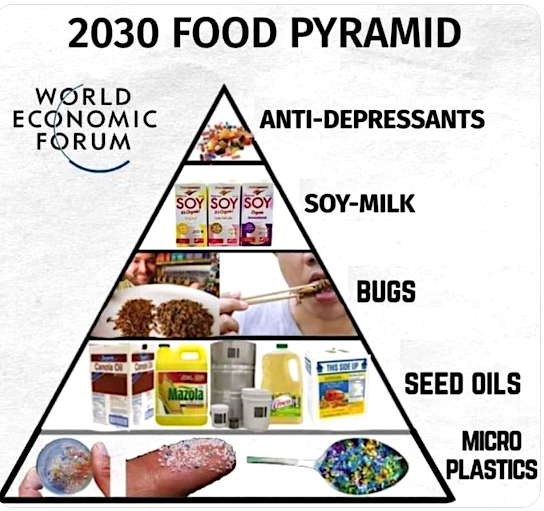
In the ’80s, the ultimate healthy Boomer breakfast was a bran muffin. There were also various cereals like Grape-Nuts and Raisin Bran. There definitely wasn’t room for their parents’ bacon and eggs unless you had a death wish. Boomers settled on eggs as the devil’s snack when the American Heart Association warned in the 1960s that people shouldn’t consume more than three eggs per week. Like social distancing six feet from others during COVID and eight 8oz glasses of water per day, the recommendation wasn’t based on science, but on being a simple number Americans could remember.
Thanks, but this Gen Xer will stick to getting my 8,675,309 steps per year as my guiding fitness principle.
[…]
The Millennial Food Pyramid
Level One: Genetically Modified Organism and Nonorganic Foods — Use Sparingly
While Gen X was at ground zero in doubting Big Food’s pyramid, our Millennial colleagues and kids really continued the battle. Like luxury logos, they seek out the organic and non-GMO labels. It’s a virtue signal of both their values and what they can afford. Erewhon smoothies, anyone?
Level Two: Various Overpriced Coffee Drinks — Two to Three Servings
Gen Xers link coffee to work and responsibility; caffeine is a tool to get through the morning. Millennials view coffee drinks as self-care. It’s about treating themselves to dessert any time of day — a major win for marketing executives.
Level Three: Charcuterie Boards, Wine, Hard Seltzers, Craft Beers — Three to Five Servings
Millennials love to entertain. Nothing shows sophistication and “adulting” in your 30s and early 40s like a charcuterie board. Lunchables upgraded! They came of drinking age at the same time as small-batch beers, American boutique wineries, and hard seltzers.
Level Four: Instagram-Worthy Food — Six to Eleven Servings
Camera phones leveled up the entertainment value of food consumption. Like organic labels, what Millennials eat signals their open-mindedness. As they get older, they straddle the line of wanting to be in on the trends (avocado toast and açai bowls) and the dive you haven’t heard of with authentic phở.
The Generation Z and Generation Alpha Food Pyramid
Level One: Real Meat, Dairy, and Peanuts — Use Sparingly
The Gen X and Millennial generations dabbled in veggie burgers, but Gen Z and Gen Alpha went whole lab-created hog into plant-based meats and milks, to the point that meat and milk no longer have a meaning until a company gets sued for using the words. To be fair, they are also embracing biohacking trends and ditching seed oils. Due to the growing prevalence of allergies, peanuts are a universal no-no food in public spaces.
Level Two: TikTok Recipes — Two to Three Servings
The term “recipe” is used loosely. I’ve come across a TikTok video for making a cream sauce from a block of cream cheese, water, and dried pasta. There is a positive aspect of trying these TikTok recipes, though: it prepares them for trying new things and for failure when a recipe doesn’t come out right.
Level Three: Food Delivery Service Meals — Three to Five Servings
Postmates, Uber Eats, Grubhub, and DoorDash are staples at mealtime. Following their surge during the COVID era as restaurants struggled to stay in business, accounts linked to their parents’ bank accounts became as common as sharing a cell phone plan.
Level Four: Gamer Food and Drinks — Six to Eleven Servings
Living next to a park has taught me one thing about Gen Z and Gen Alpha — they’re all inside. I mostly see neighborhood kids on Halloween, and every year, I recognize fewer and fewer costumes because they’re dressed as video game characters. Their snacks are manufactured for their attention span: quick hits of spicy, sour, or sweet while on pause. The gamer culture and H Mart remove barriers as Japanese snacks dominate.
So, where does this leave Gen X? We’re not immune to the powers of Big Food. In fact, recent research shows that ultra-processed food addiction began with us thanks to the explosion and availability of ultra palatable foods with added refined carbs and fats. StudyFinds reported researchers from the University of Michigan said, “Individuals who are now older adults were in developmentally sensitive stages during the 1970s and 1980s, precisely when tobacco-owned food manufacturers were shaping the market with addictive ultra-processed foods”.
The Probability Broach: L. Neil Smith’s libertarian fever-dream
Feral Historian
Published 6 Feb 2026Equal parts political manifesto and wacky adventure story, The Probability Broach is usually not the first title people think of when they hear “libertarian sci-fi” but it almost always makes the list after further reflection. While ideologically-motivated fiction tends to preach more than entertain, L. Neil Smith makes his world so bonkers and whimsical that we almost can’t help seeing our own in a similar light, and in so doing reminds us that things are as they are ultimately because we chose to make it this way.
There’s some jumpcuts in this due to lack of good b-roll, but I suspect that most people who make it past the half-way point on this one are just listening anyway.
The artwork is from the graphic novel adaptation from Big Head Press https://www.bigheadpress.com/tpbtgn
I ordered a copy but the government-run postal system didn’t get it to me in time to use its illustrations of later chapters.00:00 Intro
01:05 The Setup
03:15 Whiskey Rebellion
05:36 Confederacy
07:50 Property, Culture, and Capitalism
15:01 Cultural Assumptions
19:20 Interventionism
21:04 Choices, not Systems
(more…)
Liberal horror at a Conservative MP going to Washington to talk trade
Jamil Jivani, Conservative Member of Parliament for the riding of Bowmanville-Oshawa North, is being called all sorts of names by Liberals and their creatures in the mainstream media for his temerity in actually going to Washington DC to try to encourage trade talks between Canada and the United States:
Image from Melanie in Saskatchewan
Mark Carney, I want to speak to you directly for a moment, because this whole episode has your fingerprints all over it.
You have spent months telling Canadians we live in a more dangerous and divided world. You have warned us that this is not a transition but a rupture. You have explained, repeatedly, that Canada must adapt, that middle powers must act differently, that old assumptions no longer apply. It is very serious language. Big language. The kind you deliver slowly, as if the room should be taking notes.
So imagine my surprise when a Conservative MP behaved exactly the way your speeches suggest Canada must behave, and Ottawa promptly short-circuited.
Jamil Jivani went to Washington to try to open a door you and your government have been telling Canadians does not exist. He used a personal relationship with JD Vance, not for applause, not for theatrics, but for the radical act of actually talking to someone who matters. And suddenly, Mark, this was not adaptive diplomacy. It was alarming. Inappropriate. A problem.
This is the part where your credibility starts to wobble.
Because let’s be honest. When people asked you about engaging Donald Trump directly, your response boiled down to “Who cares?” Either because it bored you or because you preferred not to acknowledge that door at all. So when a Conservative tries anyway, the issue is not that the door was touched. It is that someone proved it was never locked in the first place.
Jivani did not freelance. He did not sneak off. He offered this connection to your government first. Openly. Calmly. And it was dismissed. Brushed aside. Not interested. And when he went anyway, your side did not react with curiosity or even grudging respect. It reacted with outrage.
The kind of outrage you see when someone fixes a problem you have been holding meetings about for weeks without ever intending to solve it. Like an office that has spent months discussing a flickering lightbulb, only to panic when someone quietly screws in a new one and sits back down before the chair can call the meeting to order.
And then, almost on cue, came the shiny object.
I am not accusing you of anything, Mark. I am simply asking whether it is coincidence that the outrage over Jivani going to Washington was followed almost immediately by a dramatic announcement about dropping the EV mandate. Was that timing accidental, or was it a convenient way to make Canadians look over there while a Conservative threatened to come back with something measurable. I am not saying it was a distraction. I am just saying the choreography was impressive.
Now, let’s talk about cooperation, because you and your allies invoke that word constantly.
When generalized liberals complain that Conservatives will not “play ball”, what they seem to mean is that Conservatives are not being obedient. Cooperation, in practice, appears to mean standing aside politely while you govern unchallenged. It does not mean Conservatives doing something useful that might work. Especially not if it works where you did not.
And this is where your rhetoric corners you.


