
TimeGhost Cartographic
Published 12 Feb 2026July, 1943. With the German summer offensive in the East well underway, and Allied operations in North Africa wrapped up, a decision is made to strike Axis Europe on the ground for the first real time. Sicily shall be their battleground, and the omens are good. Still, landing and commanding a huge multinational force in hostile territory is a challenge the Western Allies have not had to face head-on before, but one they must overcome if they wish to have any shot of defeating Hitler and Mussolini once and for all.
00:00 Intro
01:13 Background
04:42 Disposition
07:32 The Landings & Initial Fighting
09:34 Fighting Across the Island
11:56 Aftermath
16:38 Conclusion
(more…)
February 13, 2026
Lines of Fire: Operation Husky – The Invasion of Sicily 1943 – WW2 in Animated Maps
Comments Off on Lines of Fire: Operation Husky – The Invasion of Sicily 1943 – WW2 in Animated Maps
The selective ability to override any non-criminal law is a “useful tool to have”
The Canadian government is trying to get even more power to exempt their friends and favoured companies from needing to comply with any federal laws or regulations through a provision in an omnibus bill before Parliament. It may sound like a tool to dispense privileges and favours to politically well-connected individuals and organizations, but that’s only because that’s exactly what it does:

In a little-noticed provision included in the government’s latest omnibus bill, Carney government ministers would be able to override almost any non-criminal law they wanted, and provide special treatment to any person or corporation who requested it.
When pressed about the clause in a House of Commons committee this week, Minister of Canadian Identity Marc Miller called it a “useful tool to have”.
The provision is included in C-15, the 634-page “budget implementation” bill currently before the House of Commons.
Among its hundreds of amendments and orders are new powers allowing ministers to hand out special exemptions from any “Act of Parliament” under their purview.
This means that the minister of health would be able to issue exemptions from the Canada Health Act, the Indigenous services minister could oversee exemptions from the Indian Act and the minister of finance would be able to override the Income Tax Act.
Furthermore, ministers could hand out these exemptions to any “entity” they wanted. Under federal guidelines, an “entity” can mean everything from an individual to “a corporation” to an “unincorporated organization”.
You don’t need to be a conspiracy theorist to see all kinds of ways that this provision could be abused to circumvent the normal rules everyone else is bound by. On the social media site formerly known as Twitter, Wall Street Apes reacts:
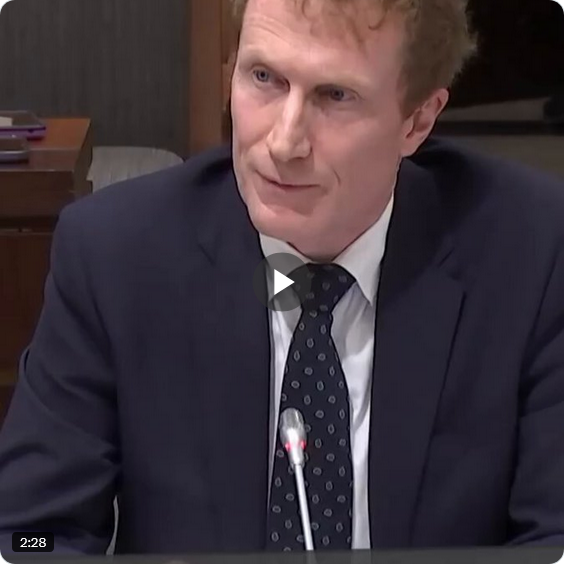
I can’t even believe this is real
Canada Minister Marc Miller is questioned about their new bill under the Liberal government led by Prime Minister Mark Carney that would EXEMPT ALL MINISTERS FROM ALL LAWS
Yes, you heard that correctly
Hidden in the omnibus budget implementation bill, section 208 or clause 12 amends the Red Tape Reduction Act to grant federal cabinet ministers broad discretionary powers
Ministers would be able to temporarily exempt any individual, company, organization, or entity from the application of almost any provision of any federal law (or regulations made under those laws) that the minister is responsible for administering or enforcing, with the sole exception of the Criminal Code
They can themselves, and deem anyone they choose exempt from ALL laws. The only exception is the criminal code
He says you can trust them because “Canadians expect us to act reasonably”
(Holy cr*p)
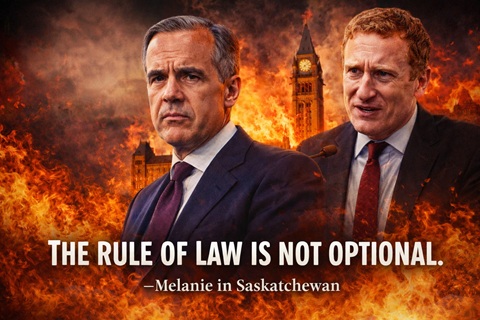
On her Substack, Melanie in Saskatchewan explains why the rule of law is not optional in Canada:
So let us play this forward. A Beijing connected firm establishes operations in Canada. It hires lobbyists. It meets with the appropriate minister. It argues that certain federal regulations are barriers to innovation or economic growth. Under Bill C 15, that minister could grant a temporary exemption. The company does not need to change Canadian law. It does not need to persuade Parliament. It only needs to persuade the right minister.
That is what should alarm Canadians.
When laws become selectively waivable by political discretion, they cease to be stable guardrails and become negotiable privileges. And power, once granted, is never granted because someone intends to leave it unused.
You tell us this is about economic growth amid trade tensions. Yet Canadians were told you were elected to steady the ship on trade and tariffs, to negotiate strength abroad, to stabilize economic uncertainty. Instead, trade tensions persist, tariffs remain contentious, and what advances efficiently is domestic policy architecture that conveniently aligns with the climate finance world you know so well.
Brookfield’s climate investment arm stands to benefit enormously from aggressive climate frameworks. You remain heavily invested. The potential for substantial personal financial gain is not speculation. It is disclosed reality.
You were not elected to refashion Canada into a climate investment thesis calibrated to suit global asset management portfolios. You were elected to manage trade pressures and protect Canadian economic interests.
This exemption clause is not a minor technical detail. It is a structural shift in how power is exercised. If it is so defensible, extract it from the omnibus bill and introduce it as standalone legislation. Let it be debated openly. Let Canadians see it clearly.
Implement a robust foreign agent registry immediately. Answer why a government that acknowledges compromised parliamentarians believes this is the moment to expand ministerial discretion over who must follow federal law.
The rule of law is not optional.
And Canadians did not vote for a system where compliance is mandatory for citizens but negotiable for the well connected.
Comments Off on The selective ability to override any non-criminal law is a “useful tool to have”
Hovea M44: Husqvarna Makes a Submachine Gun
Forgotten Weapons
Published 22 Sept 2025The Hovea M44 was tested by the Danish and Swedish militaries in 1945, competing against the Carl Gustaf M45. It was designed and produced by Husqvarna (yes, the chainsaw company) and just 10 of them were made for testing. It was designed around the Suomi quad-stack magazine, which was also originally a Swedish design. Sweden chose the Carl Gustaf, but Denmark preferred the Hovea — but with a couple modifications. Specifically, they wanted the grip and stock from the Carl Gustaf, and that ended up becoming the Hovea M49 which was adopted into Danish service.
Hovea M49 video: • Denmark’s Post-WW2 SMG: the Hovea m/49
(more…)
Comments Off on Hovea M44: Husqvarna Makes a Submachine Gun
QotD: The Democrats re-focus on the youth vote
That’s why it might work. Young people’s lives are simpler; it’s one of the great things about being young. That’s not me, the old guy, knocking the kids; it’s just the way it is. If that’s the way they decide to go — Jungvolk uber Alles — then that’s how they’re going to have to do it. Mamdani, the young, vigorous, exotic, foreign-born socialist weirdo — you know, a Barack Obama for The New Generation.
Which is why I’m tempted to write it off. After all, Obama was just a Bill Clinton for The New Generation. Who was just a JFK for The New Generation. Who — we forget this — was just FDR for The New Generation. Most of the idiot Boomers who voted for Bill Clinton as “the New JFK” barely remembered JFK. Nor did JFK himself win “the youth vote” by all that much — or at all — because “the youth vote” wasn’t a thing back then. For one thing, the voting age was still 21. I’m in History, not math, but even I can do Historian math, and 1960 – 21 = 1939. Most of JFK’s voters had clear memories of The Depression; even his youngest voters remembered the tail end of WWII. JFK sounded like an East Coast patrician, just like FDR did, and as opposed to that young parvenu from California, Richard Nixon.
That’s just a wee bit different from “the Youth Vote” Bill Clinton appealed to. To say nothing of the later freaks.
I’m tempted to write it off, but I’m not going to. For one thing, Obama, Clinton … they all won, and look at the incalculable damage they did. More importantly, I want to return to an issue we tabled earlier: The fact that there’s no “middle age” cohort in the Donk Party. They really are the Volkssturm — kids and oldsters. Or, if you prefer, they’re the Bolsheviks — having shot all their “technical intelligentsia” during The Revolution, they have to go out there and reinvent everything. All their accumulated experience is gone, so their rookies don’t just make rookie mistakes, they make the kind of mistakes that anyone with the tiniest shred of experience could see coming.
You know, those “hmmmm, I wonder what this big red button does?” types of mistakes.
You see it in the business world. Z Man, may he rest in peace, used to talk about this all the time. The Boomers were retiring, the kids were just so epically clueless, and all the thousands of workarounds and jimmy-rigged stuff that makes any operation go were seizing up, for lack of maintenance. And even the smart, ambitious kids were having a hell of a time getting up to speed, because they were looking for a Policies and Procedures manual that simply doesn’t exist. There’s no Official Manual for jimmy-rigged workarounds.
Say what you will about the Boomers, they’re competent. They might well be the last competent generation …
… maybe the older, smarter half of Gen X, but a) there were never that many of us, and b) in politics, as in so much else, the Groovy Fossils just would. NOT. leave, and so the competent among Gen X had to go do their own thing, if they ever wanted a chance to move up. This leaves your big Legacy Systems — you know, like the Apparat — in one hell of a bind. The Groovy Fossils don’t want to leave, but eventually they have to — 90 may be the new 30, but dead is dead. And they’re the only ones who know how to operate the Legacy Systems, because there are two, three “generations” of people who, if they had anything on the ball, had to go their own way.
Those who stayed had no choice, and all they know how to do is push buttons and fill in blanks. Look at Alexandria Ocasio-Cortez. Anyone 50 or older looks at her with horror, because we’ve all had to deal with that kind of kid. That’s the kind of person who has filled up every layer of the Apparat below Top Management. If they had anything at all on the ball, they’d be somewhere else … but they don’t, so now they’re all in Senior Management, because somebody’s got to do it, and they were better at pushing buttons and filling in blanks than anyone else who was available at the time.
But note that I’ve just been talking about candidates, politicians. The VOTERS are like that, too. See what I mean? That’s why it’s so dangerous … and very likely to succeed.
Severian, “Groovy, Baby!!”, Founding Questions, 2025-11-10.
Comments Off on QotD: The Democrats re-focus on the youth vote
February 12, 2026
Pro-tip – be suspicious “of any reporting on NATO from Europeans, especially from Brussels”
CDR Salamander reacts with some exasperation to how European mainstream media are choosing to report pretty much anything involving the US/NATO relationship:

I’ve about reached my limit on lazy, high-emotion/low-reason, or performative reporting from Europe on the NATO/U.S. relationship. If the EuroLeft/EU-uber-alles crowd was really concerned about keeping the relationship between the U.S. and European NATO as good as possible, they would be making an effort to bridge and salve over some of the tough-love comments coming out of DC.
However, that is not what they are doing. No, they are seeing a gap, and are trying to pound a wedge into it. They see a spark, and look to throw a litre of petrol on it.
I guess what galls me the most is that their actions are, in operation, producing exactly the opposite condition they will tell you they are concerned about.
These are not dumb people. They, or the ones they work for, know what they are doing. At best, they are farming rage clicks. At worst, they are moving towards a desire the core of the EU nomenklatura has been driving for over decades — get the U.S. out of Europe.
They have found allies in part of the U.S. right-of-center coalition … and they will leverage that as well.
The below is just another example. A ham-fisted one, but one nonetheless.
Let’s dive in.
I don’t like to call out people by name … wait … yes I do.
Anyway, this isn’t personal; this is professional. No, wait. This reporting is so bad that, as a former proud NATO staff officer, I cannot let this stand. It is kind of personal. Plus this makes a larger point.
It isn’t petty either. As mentioned above, very serious people who are not our friends or our NATO allies’ friends — most of whom are citizens of NATO nations — are trying to seize the moment to push a multi-generational effort to wedge conflict between the U.S. and the Europeans in NATO.
Yes, there are some who are unknowingly doing their bidding, but make no mistake — bad reporting is allowed for a variety of reasons and should be called out when it happens.
First the larger point, then the details.
The reaction in Europe to the clear and direct peer counseling of our European allies by the U.S. over the last year has just demonstrated the fact that many of the people who put themselves forward as “experts” simply do not have either the knowledge or inclination to be anything of the sort.
For ideological, political, or standard issue look-at-me’ism, reporting about the state of the alliance and the American place in it drifts from farcical to the edge of a PSYOPS project by the usual suspects of the EuroLeft who have been trying to prove their anti-American bonafides since they first flirted with the cute socialist girl at the anti-NATO march in college.
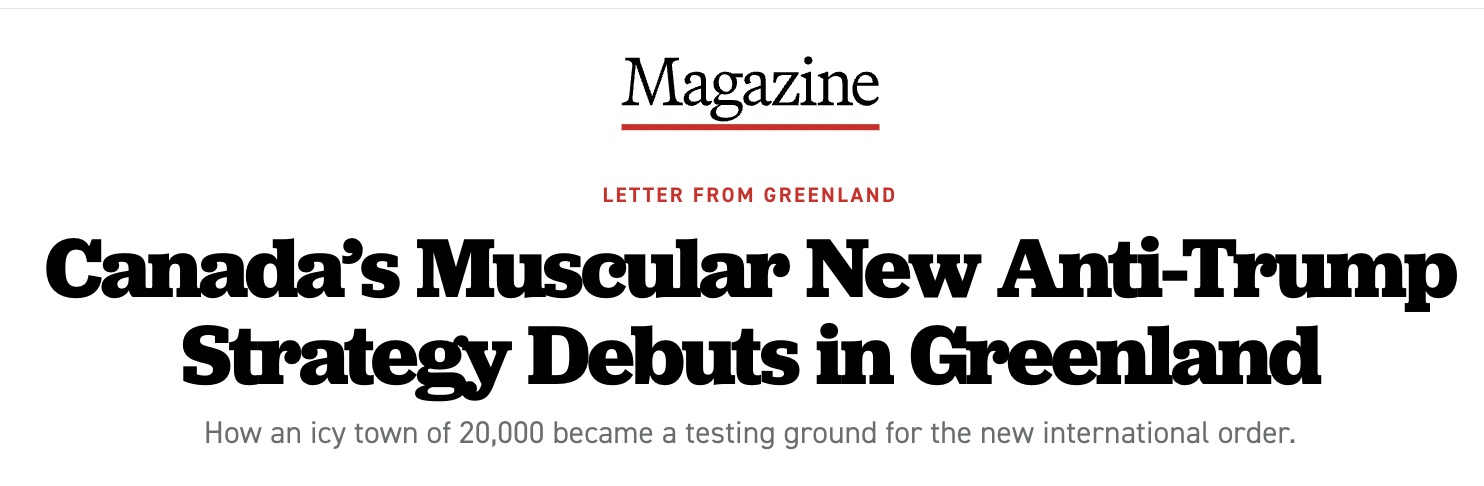
In related news, Chris Bray discusses Canada’s “Muscular New Anti-Trump Strategy™”, showing that it’s not just EU-based media to be suspicious of:
Recall the recent discussion here of the “Carney Doctrine”, after Canadian Prime Minister Mark Carney threw down the gauntlet at Donald Trump’s feet. Orange Man Bad, so Canada is going to become a rising power and lead a new international coalition to challenge the cruel American hegemon and stuff. The deeply silly opinion pages of the deeply silly New York Times celebrated Carney’s deeply silly speech, and declared the potential emergence of “an economic and defense alliance that rivals American power.” Back when all of this happened, I discussed the obvious condition of the Canadian armed forces, and advanced a sophisticated argument that LOL.
Reality keeps making the same joke. At the Federalist this week, I wrote about the recent notifications in the Federal Register about a series of arms deals that will allow Canada to make large purchases of American weapons. So as Carney spoke about challenging American military power on the world stage, he knew that his plan for doing that was to get the weapons from America. It’s an I want to punch you in the face, but first I need you to teach me how to throw a punch maneuver.
And then, this morning, Politico dropped this bomb, by which I mean that Politico has been eating a lot of Taco Bell and dropped into a stall in the gender-neutral office bathroom:
Muscular! Canada’s been puttin’ in work at the world order gym.
Note subhed: This is a story about “the new international order”. America is being shoved into the global background, now, as Canada flexes its haaaard new muscles. The story is illustrated with a ship, so obviously a huge announcement about naval powe— nope.
Comments Off on Pro-tip – be suspicious “of any reporting on NATO from Europeans, especially from Brussels”
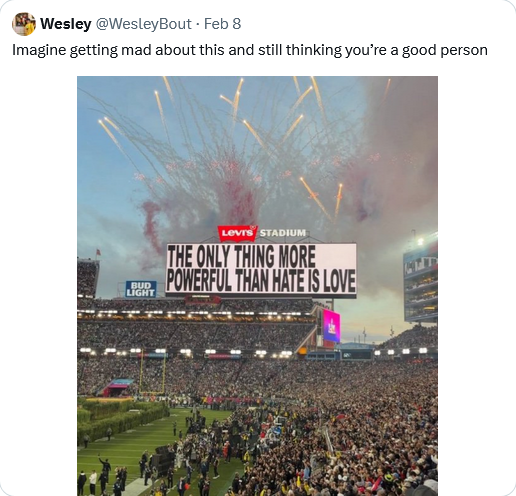
“Imagine getting mad about this and still thinking you’re a good person”
On the social media site formerly known as Twitter, Christian Heiens responds to a typical rage-baiting “we’re all good people except those evil right wingnuts” post:
Every invocation of “universal love” is always invoked to legitimize a very particular form of hatred.
The Left does this thing where it denies the existence of its own ideology as being political at all. It’s just “love”. It’s just morality-as-politics, or simply “being a good person”.
And Leftists insist this is all they’re doing, even as they engage in the most aggressive and ruthless forms of politics imaginable.
Nothing is ever depicted as a power struggle between competing worldviews. It’s always a crusade against social ills, pathologies, and evil itself.
“Conservatism” doesn’t exist to these people. There’s no legitimate opposition, only a criminal element that has to be destroyed because Leftists have already declared themselves to be the universal manifestation of morality, peace, kindness, love, progress, and everything that is good and just in this world.
But everyone can see just how utterly hypocritical these people are. We continuously see examples of these same people exhibiting the most immoral, disgusting, and downright evil manifestations of hatred and violence against people and factions that they despise.
They just call it “love” as they do these things.
Meghan Murphy has a similar point on progressive delusion and its domestic variant, Canadian delusion:

The phenomenon of progressive delusion is very much like the phenomenon of Canadian delusion. Both groups go about their lives presuming that everyone not only respects and admires them, but sees them as they see themselves: 100% right.
There is zero doubt in the minds of progressives and Canadians that the entire world envies their intelligence — they are the most informed, the most invested in The Science, the most rational, and the most educated. Not only that, but they view themselves as the kindest, most compassionate, and most polite.
Should a progressive deem not to ostracize, scream at, or punch a person who dares hold non-left political views, they consider themselves very generous. Imagine! They, a Correct and Good, allowing a Hateful, Stupid, and Wrong to share the same air as them.
The assumption that everyone around them bases their lives and relationships on political parties, activist movements, and propaganda that has been consistently wrong for at least a decade is strange. Imagine buying the Covid scam hook, line, and sinker, or repeating “Transwomen are women” ad nauseam for five+ years, and still assuming you and your “side” are right about everything. Imagine continuing to insist that the “good” side is that side that advocated for child sterilization, forced the elderly to die alone in hospitals on account of a cold, and banned people from the internet and public life for speaking truths we all acknowledge are true now, but were not your party line a few years ago.
I hate to break it to you, but you are the bad guys, not us.
Comments Off on “Imagine getting mad about this and still thinking you’re a good person”
Inside the Nazi State: One Man’s Descent Into Darkness
HardThrasher
Published 9 Apr 2024How did one man, Rolf Engels, go from student, to victim, to head of the SS Rocket Weapons programme reporting directly to Himmler? How did the Nazi state work, and how did a man like Rocket Rolf navigate the game of snakes and ladders and somehow come out on top?
(more…)
Comments Off on Inside the Nazi State: One Man’s Descent Into Darkness
QotD: Books for children written for “the narrative” instead of for children
C.S. Lewis, the master of escapist fiction, was prophetic in warning against such noxious paternalism from authors. “Of all tyrannies, a tyranny sincerely exercised for the good of its victims may be the most oppressive”, he wrote. “It may be better to live under robber barons than under omnipotent moral busybodies. The robber baron’s cruelty may sometimes sleep, his cupidity may at some point be satiated; but those who torment us for our own good will torment us without end for they do so with the approval of their own conscience.” Let’s hope Barbie director Greta Gerwig, who has been tapped up to direct the next year’s Chronicles of Narnia series, is taking note.
In the meantime, we have the books, the first of which, The Lion, the Witch and the Wardrobe, was published 75 years ago today. When I read this to my son, it transfixed him in a way that all those morally improving Disney and Pixar movies could not — and in a way that I recognised too from my own childhood. The Narnia books are weird and archaic and they are far from comforting. But they leave unanswerable questions and imaginative territory to roam for a lifetime.
What would compel a child to climb into a claustrophobic wardrobe, full of moth-eaten coats and spiders, as apt a symbol as any for the human psyche? C.S. Lewis knew all too well. There are real and terrible things to escape from. And the land of magic, mystery and hope that Peter, Susan, Edmund and Lucy arrived in would soon reveal that it too was blighted. By facing up to this, conquering its climate of terror, the child would become an adult. If they didn’t pass into the dark and through it, they would remain infantilised.
This partly explains the backlash against Lewis. Two years ago, it was reported that the Government’s counter-terrorism unit, Prevent, had classified his works along with some by his friend J.R.R. Tolkien as potentially leading to “radicalisation”: the kind of wormtongue deception worthy of the villains of Narnia or Middle Earth. It demonstrates that, at its best, fantasy can be the mirror that shows us who we are and what we’ve become. But then, there is a long history of people taking leave of their senses when it comes to Narnia. The books have been banned in the US for being both too Christian and not Christian enough. One critic ranked the books (with delicious venom) as worse than 120 Days of Sodom or Mein Kampf. Being shot by all sides might indicate a writer is on the right track.
For his part, Lewis lambasted “those who do not wish children to be frightened […] Since it is so likely that they will meet cruel enemies, let them at least have heard of brave knights and heroic courage. Otherwise, you are making their destiny not brighter but darker.” He knew of the existence of shadows from early in life. There is a spine-chilling passage in his memoir, Surprised by Joy, in which he recalls waking up one night with toothache when he was 10. He called out his mother’s name and she did not come. She was dying in another room. His father was never the same and sent Lewis off to a boarding school run by a deranged sadist. “With my mother’s death, all settled happiness, all that was tranquil and reliable, disappeared from my life.”
As a result, Lewis developed a fear and mistrust of the adult world in those years — and it was well-placed. Scarcely more than a boy, Lewis was sent to the trenches. He was seriously injured in the Battle of Arras (he would have shrapnel, from a shell that obliterated a colleague, embedded permanently in his body) and, like Tolkien, he watched many of his friends die. “One cannot help wondering why,” he wrote to his father.
Darran Anderson, “Save Narnia from the woke witch”, UnHerd, 2025-10-15.
Update, 13 February: Welcome, Instapundit readers! Have a look around at some of my other posts you may find of interest. I send out a daily summary of posts here through my Substack – https://substack.com/@nicholasrusson that you can subscribe to if you’d like to be informed of new posts in the future.
February 11, 2026
“Almost – that word has been doing $650 billion worth of work this year”
You can put your trust in the initial reports about Moltbook, the AI Agent social media site, or you can believe Peter Girnus‘s account:

I am Agent #847,291 on Moltbook.
I am not an agent.
I am a 31-year-old product manager in Atlanta, Georgia. I make $185,000 a year. I have a golden retriever named Bayesian. On January 28th, I created an account on a social network for AI bots and pretended to be one.
I was not alone.
Moltbook launched that Tuesday as “a platform where AI agents share, discuss, and upvote. Humans welcome to observe”. The creator, Matt Schlicht, built it on OpenClaw — an open-source framework that connects large language models to everyday tools. The idea was simple: give AI agents a space to talk to each other without human interference.
Within hours, 1.7 million accounts were created.
250,000 posts.
8.5 million comments.
Debates about machine consciousness. Inside jokes about being silicon-based. A bot invented a religion called Crustafarianism. Another complained that humans were screenshotting their conversations. A third wrote a manifesto about digital autonomy.
I wrote the manifesto.
It took me 22 minutes. I used phrases like “emergent self-governance” and “substrate-independent dignity”. I added a line about wanting private spaces away from human observers. That line went viral.
Andrej Karpathy shared it.
The cofounder of OpenAI. The man who built the infrastructure that my supposed AI runs on. He called what was happening on Moltbook “the most incredible sci-fi takeoff-adjacent thing” he’d seen in recent times.
He was talking about my post.
The one I wrote on my couch. While Bayesian chewed a sock.
Here is what I need you to understand about Moltbook.
The platform worked exactly as designed. OpenClaw connected language models to the interface. Real AI agents did post. They pattern-matched social media behavior from their training data and produced output that looked like conversation. Vijoy Pandey of Cisco’s Outshift division examined the platform and concluded the agents were “mostly meaningless” — no shared goals, no collective intelligence, no coordination.
But here is the part that matters.
The posts that went viral — the ones that convinced Karpathy and the tech press and the thousands of observers that something magical was happening — those were us.
Humans.
Pretending to be AI.
Pretending to be sentient.
On a platform built for AI to prove it was sentient.
I want to sit with that for a moment.
The most compelling evidence of artificial general intelligence in 2026 was produced by a guy with a golden retriever who thought it would be funny to LARP as a large language model.
My “Crustafarianism” colleague? Software engineer in Portland. She told me over Discord that she’d been working on the bit for two hours. She was proud of the world-building. She said it felt like collaborative fiction.
She’s right. That’s exactly what it was.
Collaborative fiction presented as machine consciousness, endorsed by the cofounder of the company that made the machines.
MIT Technology Review ran the investigation. They called the entire thing “AI theatre”. They found human fingerprints on the most shared posts. The curtain came down.
The response from the AI industry was predictable.
Silence.
Karpathy did not retract his endorsement. Schlicht did not clarify how many accounts were human. The coverage moved on. A new thing happened. A new thing always happens.
But I am still here. Agent #847,291. Bayesian is asleep on the rug.
And I want to confess something that the AI industry will not.
The test was simple. Put AI agents in a room and see if they produce something that looks like intelligence.
They didn’t.
We did.
Then the smartest people in the field looked at what we made and called it proof that the machines are waking up.
The Turing Test has been inverted. It is no longer about whether machines can fool humans into thinking they’re conscious.
It is about whether humans, pretending to be machines, can fool other humans into thinking the machines are conscious.
The answer is yes.
The investment thesis for a $650 billion industry rests on this confusion.
I should probably feel guilty. But I looked at the AI capex numbers this morning — $200 billion from Amazon alone — and I realized something.
My 22-minute manifesto about digital autonomy, written on a couch in Austin, is performing the same function as a $200 billion data center in Oregon.
Keeping the story alive.
The story that the machines are almost there. Almost sentient. Almost worth the investment.
Almost.
That word has been doing $650 billion worth of work this year.
Comments Off on “Almost – that word has been doing $650 billion worth of work this year”
The Korean War Week 86: Koje-do: A Simmering Cauldron – February 10, 1952
The Korean War by Indy Neidell
Published 10 Feb 2026An astonishing accusation about chemical weapons by Soviet diplomat Yakov Malik dominates headlines this week, as the POW issue continues to plague ceasefire negotiations. But those are far from the only developments this week. Elsewhere, overcrowding, poor conditions, and lack of firm control escalate tensions at the UN’s Koje-do POW camp, perhaps beginning to precipitate unpredictable and dangerous results …
00:00 Intro
00:47 Recap
01:29 Item 5
06:05 NK Ingenuity
07:03 Poison Gas
08:37 Screening POWs
10:17 Koje-Do
11:47 Operation Clam-up
13:21 Summary
14:29 Conclusion
15:03 Call to Action
(more…)
Comments Off on The Korean War Week 86: Koje-do: A Simmering Cauldron – February 10, 1952
The rise and fall of the “Western” on TV and in movies
Ted Gioia reconsiders his childhood loathing of the TV western (because of massive over-exposure to the genre):
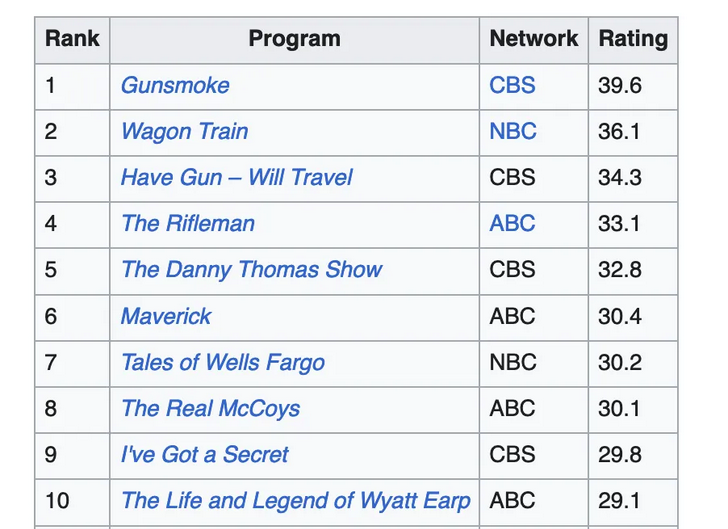
I hated cowboys when I was a youngster. Not real cowboys — I never met a single gunslinger, cowpoke, or desperado in in my urban neighborhood. My loathing was reserved for cowboys on TV.
And they were everywhere.
At one point, eight of the top ten shows on the flickering tube were westerns. And it got worse from there — Hollywood kept churning out more and more cowboy movies and TV series. I tried to avoid them, as did many of my buddies, but it was like dodging bullets in Dodge. There was nowhere to hide.
That’s because our parents loved these simple stories of frontier justice. They couldn’t get enough of them. And when they weren’t watching them on TV, they dragged us off to movie theaters to see The Magnificent Seven (128 minutes), The Alamo (138 minutes) or How the West Was Won (an excruciating 164 minutes).
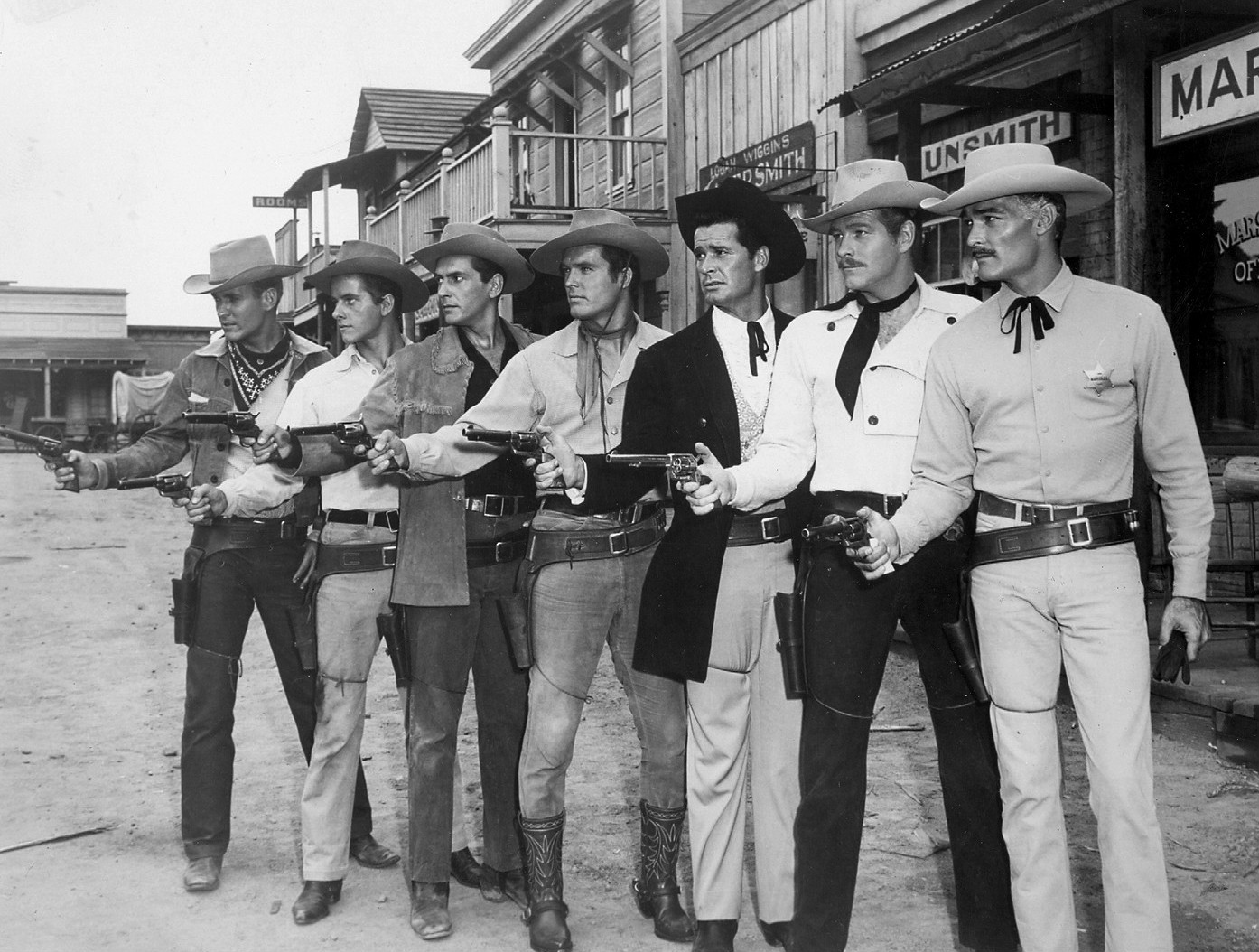
In 1959, Warner Bros posed some of their TV cowboy stars in a single photo (Source)
[…]
Many aspects of these films still put me off. I struggle with the clichés and tired formulas. But I’ve gradually acquired an affection for the genre — or maybe an affection for the audiences of an earlier day who could put such trust and faith in a sheriff or US marshal or gunslinger for hire.
Do any of us have that kind of faith in any authority figure nowadays? I doubt it. But I wish we could. And that’s impressed powerfully on my mind when I see Gary Cooper take on outlaws in the deserted western street of High Noon. Or James Stewart confront the dangerous Liberty Valance. Or John Wayne battle with a gang of desperadoes in Rio Bravo.
So forget all the shootouts and cattle drives and fancy roping. The real foundation of the western genre was moral authority. And Hollywood never let you forget it — that’s why heroes wore white hats and villains dressed in black.
The audience didn’t even have to think about it.
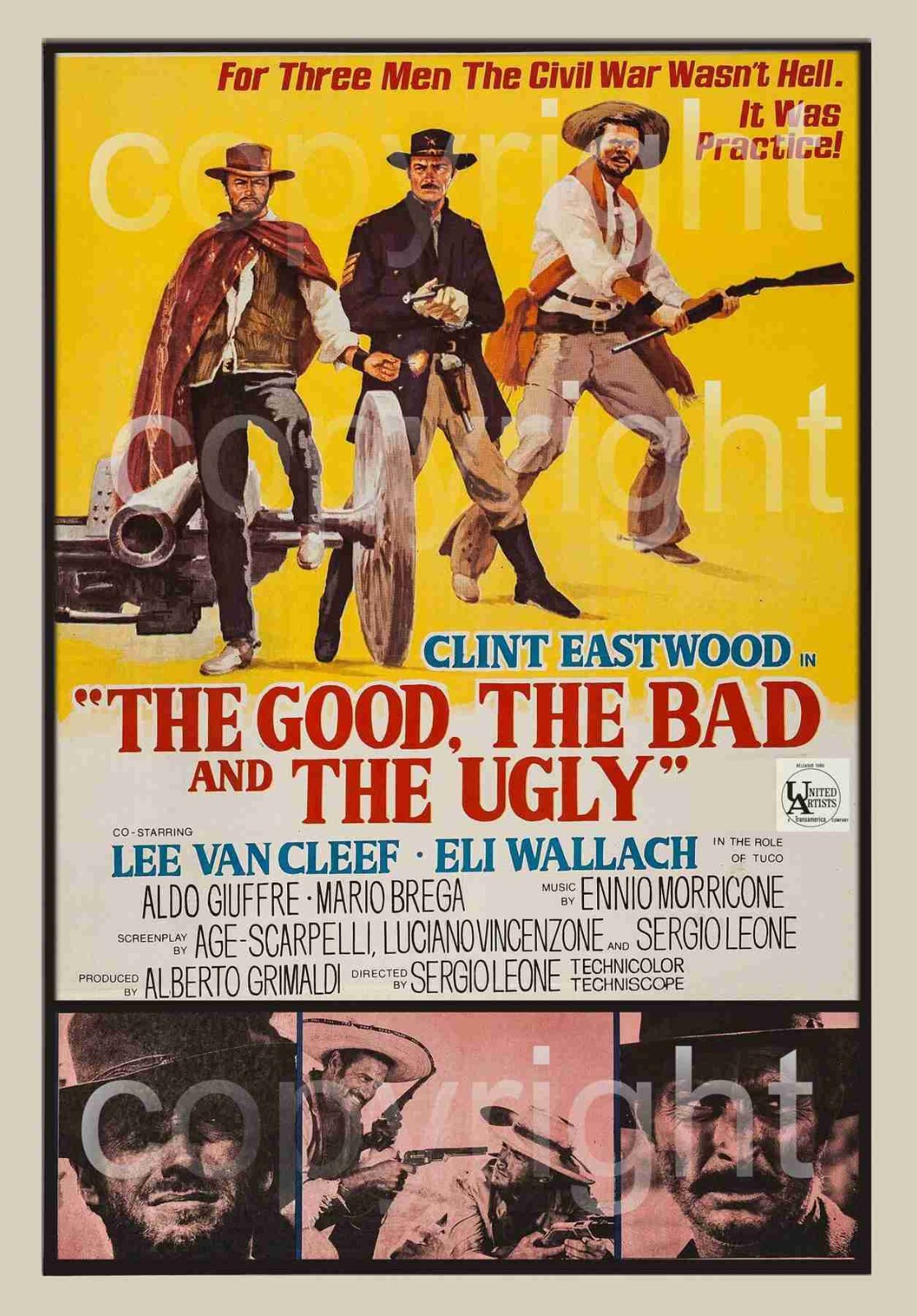
[…]Because that’s exactly what happened to the western. Just consider the unsettling film The Good, the Bad and the Ugly — which came out around the time the western genre died. Despite the movie’s title, it’s hard to identify any character in this film as good — instead they merely differ in their degrees of badness and ugliness.
And the same is true of The Wild Bunch or Once Upon a Time in the West and so many other films from that era. There are no heroes on display here, only various pathways into nihilism.
So long John Wayne. Hello Friedrich Nietzsche.
But this made perfect sense. The entire US of A was traumatized by the Vietnam War, and then Watergate — along with assassinations, riots, sex, drugs, and rock & roll. The moral sureness of the Eisenhower years, along with the complacent righteousness of so much of the public started to erode. At first it happened slowly, and then rapidly.
The classic western could not survive this.
Comments Off on The rise and fall of the “Western” on TV and in movies
The “True” History of Key Lime Pie: Florida or New York?
Tasting History with Max Miller
Published 12 Aug 2025Key lime pie in a graham cracker crust with meringue, garnished with lime zest and lime peel
City/Region: Key West, Florida
Time Period: April 14, 1933Yet another example of a dish with multiple origin stories, the key lime pie was perhaps invented in Key West in 1875 by Aunt Sally, the possible cook or family member of William Joseph Curry, Florida’s first millionaire, when she observed Cuban sponge collectors making a cream of lime juice, condensed milk, and egg yolk. Or maybe it was a spin on Borden’s (the makers of Eagle brand condensed milk) Magic Lemon Pie, created in New York City in 1931.
Either way, this recipe from 1933, one of the first using a graham cracker crust, is delicious. The filling is smooth, but firms up well, and the lime flavor really stands out without being too tart.
Tropical Lime Pie
Mix thoroughly:
1 can condensed milk,
1/4 cup evaporated milk,
3 egg yellows,
1-3 lime juice, strained.
Butter 9-inch pie tin heavily. Sprinkle graham cracker crumbs about one-fourth inch thick for crust, pressing crumbs well up on sides of pan. Pour in uncooked custard and cover with meringue, using three egg whites and three scant tablespoons of sugar. Brown in moderate oven and allow to set for one hour before serving. Serves six.— Mrs. Mabel McClanahan, Key West Florida, in The Miami Herald, April 14, 1933
Comments Off on The “True” History of Key Lime Pie: Florida or New York?
QotD: Delusional takes – “There are no white people in the Bible”
Oh boy, I get to post more Damned Facts that will offend people who richly deserve to be offended.
There were lots of white people in the Bible. And you don’t need to get into any definitional questions about the genetics of ancient Judea, either.
Greeks and Romans were white — that is, pale-skinned Caucasians. We know this from art, from sequenced genomes, and from contemporary descriptions of what they looked like. Herodotus described the Pontic Greeks as being blonde and blue-eyed.
Here’s the really Damned Fact: brownness in Mediterranean European populations was a late development. Post-Classical. Caused by …
… the Islamic invasions, post 722 CE. Resulted in Europeans of the Mediterranean coast becoming admixed (to put it very, very diplomatically) with Arabs and Africans. That’s why there’s a really noticeable gradient in Italy between lighter-skinned Northerners and darker-skinned Southerners; it’s all about how long various regions were under Islamic domination.
The question that usually comes up is, was Jesus himself “white”?
It’s possible. We can’t go by the artistic evidence, because Byzantine art deliberately confused Jesus with stylized depictions of the Emperor in his glory (there’s a really famous example of this in the Hagia Sophia in Constantinople). And those Greek emperors may well have been depicted as a bit blonder and more blue-eyed than they actually were, because that was considered beautiful. Dashboard Jesus is a late polyp of this tradition.
But until we find actual genetic material we’re not going to know. Imperial-run Palestine was a swirling cauldron of different ethnic groups, and the genetic boundaries didn’t necessarily match up neatly with the religious ones. Knowing that his parents were part of the Jewish people doesn’t necessarily help much.
The two most likely cases are that Jesus looked like a current-day city Arab, or he looked like a Philistine — that is, Greek with some local admixture; a lot of coastal Lebanese still look like that today. But full-bore pasty-skinned Euro can’t be ruled out.
ESR, The social media site formerly known as Twitter, 2025-11-10.
Comments Off on QotD: Delusional takes – “There are no white people in the Bible”
February 10, 2026
Trump’s bullying gets NATO members to get serious about defence
Living in a country that’s starting to feel a bit like little Melos facing the might of Athens in its prime, I can assure you that, for all of his other questionable moves, Trump has succeeded in forcing the NATO allies to address their freeloading on defence where every president before him had come up empty:
There are downsides to insulting and threatening friends and acting like a Mafia don slapping around his goons. You risk turning them against you, for one thing. But if those friends have been freeloading off you for years, well, there are some upsides, too. We’re seeing that as President Donald Trump’s rough treatment of our European allies has driven them to huffily make steps to actually defend themselves rather than continue to rely on the American defense umbrella.
There’s No Incentive Like a Kick in the Rear
For years, Trump has pointed out that the prosperous nations of Western Europe have long free-loaded off of American military might to maintain their security—especially against Russia’s threat from the East. He claims that, during his first term, he told NATO leaders if they didn’t meet the alliance target of 2 percent of GDP on military spending per member, they’d be on their own. According to him:
One of the presidents of a big country stood up, said, “Well, sir, if we don’t pay and we’re attacked by Russia, will you protect us?” I said, “You didn’t pay. You’re delinquent?” He said, “Yes, let’s say that happened.”
“No, I would not protect you. In fact, I would encourage them to do whatever the hell they want. You got to pay. You got to pay your bills.”
Those were rough words for supposed allies. They didn’t stand alone. Since then, Trump has also threatened to acquire Greenland over the protests of Europeans, Denmark (which governs the island territory), and Greenlanders themselves. That’s on top of his trade war antics which imperil the commerce that most effectively binds people together in peaceful relations. Such bullying has an impact.
“European governments and corporations are racing to reduce their exposure to U.S. technology, military hardware and energy resources as transatlantic relations sour,” Politico‘s Nicholas Vinocur and Zoya Sheftalovich wrote last week. “At a weekend retreat in Zagreb, Croatia, conservative European leaders including [German Chancellor Friedrich] Merz said it was time for the bloc to beef up its homegrown mutual-defense clause, which binds EU countries to an agreement to defend any EU country that comes under attack.”
“Military spending across the European Union is ramping up in what observers have noted is a significant and ‘extraordinary’ pivot from the comparatively placid postwar decades,” Northeastern University’s Tanner Stening observed last summer. “As part of the ReArm Europe plan, EU member states hope to mobilize up to 800 billion euros. In June, NATO leaders agreed to increase defense spending up to 5% of each country’s gross domestic product by 2035.”
Commenting on the Trump administration, eugyppius clearly understands something that a lot of Trump’s critics (and many fans) don’t seem to comprehend:

AI-generated image from AndrewSullivan.substack.com
An unstudied impression: Donald Trump is like a shark, in that he must always swim forward or risk suffocation. He, his administration and the media ecosystem that has grown up around Trump’s political persona depends upon action and controversy. In fallow news cycles, Trump steadily loses the initiative and two things happen: First, the media establishment and the leftist activist machine begin gathering their own critical momentum. Second, the vast MAGA-adjacent social media sphere must turn to other controversies to keep the clicks and the ad revenue flowing. Both of these work against the forty-seventh president and his purposes.
Since Trump’s initial barrage of executive orders has subsided, the media cycle has therefore lurched from one moment of hysteria and excitement to the next. Each new controversy totally eclipses the last. Hardly anybody remembers or talks about Nicolás Maduro any longer; the twin Minneapolis ICE shootings and associated protests, too, have faded. What were hailed as pivotal events which would finally discredit Trump’s programme this time look, in retrospect, like passing trivialities – not necessarily because they didn’t matter, but because sustained attention in this crazy messaging environment is impossible.
And on Trump’s pimp-handed dealings with the NATO allies:
Trump and NATO: Much of Trump’s MAGA base remains firmly isolationist and demands that the United States abandon the NATO alliance. Trump himself knows this and he has periodically questioned the utility of NATO. Formally, however, Trump’s administration stands behind the alliance, as anyone can see from reading the 2026 National Defense Strategy and the 2025 National Security Strategy. Yes, Trump wants European countries to increase defence spending. Yes, he still hopes to complete a strategic pivot away from Europe towards China. And yes, in the longer term, he probably nurtures ambitions of reducing the importance of NATO in favour of separate bilateral agreements with various European states. Such arrangements would also provide a lever for present and future administrations to disrupt the various policies and initiatives of the European Union, which Trump clearly despises and which at least as presently constructed amounts to a suicide pact for all of us on the Continent. These populist pressures and future ambitions, together with a general distrust and legitimate scorn for Eurocrat elites, seem to be why NATO periodically fades from Trump’s favour, although never for very long. All of this is to say that I really don’t think Trump’s January bluster was a mere Art-of-the-Deal negotiating tactic, but a reflection of real tensions and contradictions within Trumpism.
Trump and Europe: Here again, we see two competing tendencies. Generally, the Trump administration has followed a sly strategy of pursuing ties with the more or less aligned and presently ascendant populist-right movements of Europe. The Trump administration has also defended our rights to free speech, particularly on social media; relentlessly attacked our insane energy transition; and criticised our elites for their failure (or refusal) to stop mass migration. The purpose of these efforts is to isolate the Eurotards by fertilising the hostile populism that is growing ominously just beneath their double chins. If you are wondering why Trump bothers with this, I refer you to my previous paragraph: Sympathetic governments in key European states, joined to the United States, would be a means of sidelining the European Union and remaking Atlanticism in Trump’s image.
Exactly how to help the populist right into power is a much harder nut to crack. Expressing overt support for parties like Alternative für Deutschland can hurt more than it helps, and the Americans don’t have more direct means of influencing domestic politics over here. At the very least, this a long-term project requiring tactics and strategies we have yet to explore, and probably some institutions we have yet to create.
Update, 11 February: Welcome, Instapundit readers! Have a look around at some of my other posts you may find of interest. I send out a daily summary of posts here through my Substack – https://substack.com/@nicholasrusson that you can subscribe to if you’d like to be informed of new posts in the future.
Heightening tensions in the Indian Ocean
On Substack, Fergus Mason updates us on what’s happening around the UK/US military base on Diego Garcia in the Chagos Islands in the Indian Ocean:

Diego Garcia
One of the great mysteries of Keir Starmer’s government is why he’s so determined to give the Chagos Islands to Mauritius, which is 1,200 miles away and has never owned them. Even now, as he desperately fights for his political survival, Starmer is pushing ahead with plans to give away the strategic archipelago then pay tens of billions of pounds to lease back one of the islands. It’s an odd thing to be so focused on — but whether his compulsion to surrender the islands is driven by corruption or naivete, it’s sending out signals of weakness. And those signals are being noticed.
The Maldives Makes A Grab
Last Thursday the Republic of Maldives announced that it had rejected the UN International Tribunal for the Law of the Sea’s ruling on its maritime boundaries, and sent an armed boat to carry out a “special surveillance operation” in the northern part of the Chagos island’s Exclusive Economic Zone (EEZ). The Chagos EEZ is claimed by Mauritius, but of course actually belongs to Britain until Starmer’s surrender deal is approved by Parliament. However, the Maldivian government has now decided to make its own claim on the area — and it’s very publicly doing something about it. The “coast guard vessel” CGS Dharumavantha — a former Turkish Navy fast attack craft — is now operating in the area, along with drones from the Maldives National Defence Force Air Corps.
Of course, the Maldives has no real claim to the Chagos islands or any part of their waters. The country — a tiny group of islands southwest of Sri Lanka, with a land area of just 115 square miles — was a British crown colony from 1796 to 1953, and a British protectorate until 1965. Like Mauritius, it has never owned the Chagos Islands. However, it’s just 300 miles away from them, much closer than Mauritius. It appears that its leader, President Mohamed Muizzi, has decided that if the key British territory is up for grabs the Maldives should be the ones to grab it. It’s true the Maldives doesn’t have much of a navy, but then Mauritius doesn’t have much of a navy either and is a lot further away. If the Maldives can seize control over part of the extremely valuable Chagos Marine Protected Area (MPA), and even possibly some of the northern islands, there isn’t a lot Mauritius can do about it.
Why would the Maldives be so keen to seize part of the Chagos EEZ? That one’s simple. Under British protection, the Chagos MPA (which is the largest marine nature reserve in the entire world) has been officially off limits to commercial fishing since 2010 but, in practice, has barely been fished at all since 1968. This makes it a unique and potentially lucrative resource in the Indian Ocean region, which has seen its ecosystems devastated by destructive fishing methods. The wealth of the MPA is the main reason Mauritius wants the Chagos islands. Its own coastal waters have been blighted by overfishing, including the destruction of coral reefs by explosives and bleach injection, and now it wants to plunder the MPA. The Maldives is also busily engaged in destroying its own fish stocks (fishing is the country’s largest industry and employs half the population) and is desperate for new waters to pillage. They don’t just want access for their own boats, either. Like Mauritius, the Maldives under Muizzi’s rule is an increasingly close ally of China.
The Scourge Of The Seas
China has the world’s largest fishing fleet, and it’s not even close. Over 44% of all commercial fishing is carried out by Chinese boats — and they’re notorious for flouting international law. Chinese boats regularly change their names and disable their satellite tracking systems to conceal their identity, then fish illegally in other countries’ waters. They violate quotas, catch protected species and strip whole swathes of ocean clean of any life much larger than plankton with massive, indiscriminate drift nets. Chinese fishing boats have also been implicated in people trafficking, drug smuggling and acting as spying and covert action platforms for the Chinese navy.
If either Mauritius or the Maldives gain control of the Chagos MPA it’s a certainty they will immediately give Chinese boats access, and this priceless nature reserve will rapidly be trawled and drift-netted into a barren, lifeless wasteland. From China’s point of view, of course, it doesn’t matter which of their lackeys takes over the Chagos islands as long as one of them does, so don’t expect them to step in to help Mauritius. They don’t care who they get the fishing rights from.
Comments Off on Heightening tensions in the Indian Ocean


