Forgotten Weapons
Published 25 Jan 2023The Bechowiec (or Beha) is a fascinating SMG produced in small numbers in southern Poland under German occupation during World War Two. It was made for use by the Bataliony Chłopskie (Peasant Battalions) by a young man named Henryk Strąpoć.
Henryk built his first (quite illegal) gun at the age of 15 in 1937, and was promptly arrested for it. He avoided prison only on account of being a minor, and promised not to do it again. Well, at least he promised not to get caught again — he built three more guns (two semiauto pistols and a revolver) by the time Germany invaded Poland in 1939. During the occupation he joined the the resistance and set to work doing what he must have fantasized about; building clandestine small arms.
Being more or less familiar with pistols but having never handled a submachine gun, he made some creative design choices. His SMG is basically a scaled-up Ruby-type action — chambered for 9x19mm with a simple blowback slide, it is hammer fired from a closed bolt. He designed a complex but effective selective-fire trigger system, complete with a correct auto sear. The first gun was ready in the spring of 1943, and he had a makeshift production going by early 1944. A total of 11 of the guns were made by July 1944, some in 9mm (using bored-out WW1 Mauser barrels) and some in 7.62x25mm Tokarev (using Mosin Nagant barrels).
Only one example survives today, and it is housed in the Polish Army Museum (and sadly, deactivated). Many thanks to the Museum for giving me access to film it for you! Check them out at: http://www.muzeumwp.pl/?language=EN
(more…)
May 11, 2023
Bechowiec: Polish Teenager Makes a Resistance SMG
QotD: Divination
Divination is often casually defined in English as “seeing into the future”, but the root of the word gives a sense of its true meaning: divinare shares the same root as the word “divine” (divinus, meaning “something of, pertaining or belonging to a god”); divination is more rightly the act of channeling the divine. If that gives a glimpse of the future, it is because the gods are thought to see that future more clearly.
But that distinction is crucial, because what you are actually doing in a ritual involving divination is not asking questions about the future, but asking questions of the gods. Divination is not an exercise in seeing, but in hearing – that is, it is a communication, a conversation, with the divine. […]
Many current religions – especially monotheistic ones – tend to view God or the gods as a fundamentally distant, even alien being, decidedly outside of creation. The common metaphor is one where God is like a painter or an architect who creates a painting or a building, but cannot be in or part of that creation; the painter can paint himself, but cannot himself be in the painting and the architect may walk in the building but she cannot be a wall. Indeed, one of the mysteries – in the theological sense […] – of the Christian faith is how exactly a transcendent God made Himself part of creation, because this ought otherwise be inconceivable.
Polytheistic gods do not work this way. They exist within the world, and are typically created with it (as an aside: this is one point where, to get a sense of the religion, one must break with the philosophers; Plato waxes philosophic about his eternal demiurge, an ultimate creator-god, but no one in Greece actually practiced any kind of religion to the demiurge. Fundamentally, the demiurge, like so much fine Greek writing about the gods, was a philosophical construct rather than a religious reality). As we’ll get to next week, this makes the line between humans and gods a lot more fuzzy in really interesting ways. But for now, I want to focus on this basic idea: that the gods exist within creation and consequently can exist within communities of humans.
(Terminology sidenote: we’ve actually approached this distinction before, when we talked about polytheistic gods being immanent, meaning that they were active in shaping creation in a direct, observable way. In contrast, monotheistic God is often portrayed as transcendent, meaning that He sits fundamentally outside of creation, even if He still shapes it. Now, I don’t want to drive down the rabbit hole of the theological implications of these terms for modern faith (though I should note that while transcendence and immanence are typically presented as being opposed qualities, some gods are both transcendent and immanent; the resolution of an apparent contradiction of this sort in a divine act or being like this is what we call a mystery in the religious sense – “this should be impossible, but it becomes possible because of divine action”). But I do want to note the broad contrast between gods that exist within creation and the more common modern conception of a God whose existence supersedes the universe we know.)
Thus, to the polytheistic practitioner, the gods don’t exist outside of creation, or even outside of the community, but as very powerful – and sometimes inscrutable – members of the community. The exact nature of that membership varies culture to culture (for instance, the Roman view of the gods tends towards temperamental but generally benevolent guardians and partners of the state, whereas the Mesopotamian gods seem to have been more the harsh rulers set above human society; that distinction is reflected in the religious structure: in Rome, the final deciding body on religious matters was the Senate, whereas Mesopotamian cities had established, professional priesthoods). But gods do a lot of the things other powerful members of the community do: they own land (and even enslaved persons) within the community, they have homes in the community (this is how temples are typically imagined, as literal homes-away-from-home for the gods, when they’re not chilling in their normal digs), they may take part in civic or political life in their own unique way. […] some of these gods are even more tightly bound to a specific place within the community – a river, stream, hill, field.
And, like any other full member of the community (however “full membership” is defined by a society), the gods expect to be consulted about important decisions.
Bret Devereaux, “Collections: Practical Polytheism, Part III: Polling the Gods”, A Collection of Unmitigated Pedantry, 2019-11-08.
May 10, 2023
From Thomas Szasz to Jordan Neely – how noble ideals can lead to terrible results
At Samizdata, Natalie Solent remembers how her early discovery of Ideology and Insanity by Thomas Szasz helped to shape her philosophical views in a generally libertarian direction. On the other hand, as the death of Jordan Neely shows, one of the long-term results of Szasz’s denunciation of the institutionalization of the mentally ill has been a vast increase in violence, vandalism, and anti-social behaviour in urban areas:

Szasz believed that if we accept that “mental illness” is a euphemism for behaviors that are disapproved of, then the state has no right to force psychiatric “treatment” on these individuals
Great stuff. I think Szasz still has much to teach us… but I suppose by now you have all heard of the killing of Jordan Neely on a New York subway train?
I have linked to the Wikipedia account for convenience, but I do not trust Wikipedia. There are very few media outlets I do trust on subjects like this. The magazine USA Today initially called Neely a “beloved subway performer”. USA Today has changed the article since, but I saw it when it still had the original wording. The article was right to say that Jordan Neely was a human being with a tragic past, but he was not beloved by users of the New York subway. Back in 2013, a Reddit post on /r/nyc warned passengers, “Try to stay away from the Michael Jackson impersonator if you see him … Just avoid the guy at all costs, try not to look at him at all. Stay safe.” That was Neely. By the time of his death, he had been arrested more than forty times, including for crimes of violence.
There are thousands of Americans like Neely who still live as he lived, exercising the right Thomas Szasz helped gain them to be mentally ill (or whatever you want to call it) drug addicts living on the subways and roadside verges of America. It is not going well for them or for others. A viral graph shows the declining proportion of Americans held in mental hospitals and the rising proportion of Americans held in prisons forming a neat “X” over the course of the twentieth century. Liberals in the U.S. sense have a prodigious capacity to not see inconvenient facts, but even they are being forced to notice that the presence of the crazies and junkies is causing their beloved public spaces and public facilities to become dirty, frightening places to which much of the public only goes when it must.
There is a libertarian solution of course: fewer public spaces. This would increase, not decrease, the number of places where the public could happily go. Junkies and crazies are much less of a problem in shopping malls, because the owners still retain some power to eject them. I feel no shame in saying that a further benefit would be that said junkies and crazies would be under more pressure to seek treatment if the state no longer facilitated them sleeping on the sidewalks and the subway trains.
Unfortunately for everyone, this solution is politically impossible in the current climate. Even in the miraculous event that the public transport systems and the streets of New York, San Francisco and Chicago were privatised tomorrow, anti-discrimination law would ensure that practically no one could be excluded.
Thomas Szasz had a noble ideal. Sadly, the way it combined with the dominant ideals of our time has produced very bad results. I know what should and could be done to make things better in a sane society, but the US in 2023 is not that society. So what can be done?
When scapegoating stops working
Chris Bray documents what he calls the “kingdom of the non-sequitur” today:
Americans have lost faith in a broad range of institutions: academia, government at every level and in every branch, media of all kinds, and crony corporations. I just linked to poll results to support that claim, but I suspect you don’t need to be convinced, and the sense of declining trust shows up in your daily discussions with friends and family. The institutional cartel, embodied in the form of a ruling class or new elite who are defined by their uniformity of thought and ritual expression, arrive at the discussion with a top-down model of culture: Trust the experts! “Dr. Fauci says to get vaccinated.”
So they see the loss of trust, and they instinctively look for the driver who’s making the bus go down the low-trust road — the high-status bad actor who’s inculcating the loss of faith in the helpless minds of the ignorant poors. In the current model, Donald Trump and Tucker Carlson tricked people into losing faith in institutions because they spread conspiracy theories and disinformation. So the problem is solved: Hit the off switch on Donald Trump and Tucker Carlson (and fascist billionaire Elon Musk’s mind control platform), and faith in institutions is necessarily reborn. If Donald Trump can’t be president again, people will trust the government again.
This confidence that the loss of faith is caused by top-down manipulation is so stupid it’s making me squirm in my seat as I think about it: Your true self actually likes Gavin Newsom, Congress, woke universities, homeless encampments, and drag queen story hour for children, but Fox News TRICKED YOUR BRAIN, peasant. You can’t possibly be losing faith in institutions yourself, on your own motive force. Have a Bud Light and an mRNA injection, and we’ll talk in the morning when you feel better.
And so the need to purge the folk devils, the manipulative purveyors of discontent, manifests itself over and over again in a ritual behavior as old as humanity itself, the performance of “the crops are failing because this woman is a witch.” Burn the witch, and we restore the corn and the hogs before winter arrives.
If [Person A] is a folk devil and a scapegoat, then everything [Person A] does is dark and cruel. OH MY GOD LOOK AT HIM PETTING THAT KITTEN NOW DO YOU SEE HOW DANGEROUS HE IS!?!?!? Cultural performers show up on the page with a kind of tacit assignment, an agreement they’ve made at the level of choosing an identity and seeking a social status. Folk devils are devils, because people who don’t hate folk devils are of a low-status outgroup. Yes, all of life is just like high school.
Feasting at a Medieval Tournament
Tasting History with Max Miller
Published 9 May 2023
(more…)
19th blogiversary

19th anniversary celebration badge label in golden color
Image by starline on Freepik
Every year for what seems like a long time, I’ve been quietly mourning the “death of the blog”, which vanished from most peoples’ awareness as just one of the old fashioned things we used to do online before social media ate everything. And yet blogging isn’t really dead, it’s just mostly dead. The good folks at Substack figured out that there were enough good writers — and more importantly, people willing to pay money to read the work of those writers — who didn’t want to put up with bait-and-switch headlines, toxic auto-start video ads, and all the rest of the visual and audio garbage so many “mainstream” sites were extruding.
Unlike the many interesting writers on Substack, I’ve never really used my blog for much in the way of original writing, concentrating more on interesting stuff from others that I wanted to share … I guess that’s what most people started using social media for, until they realized that social media is really intended to hurl insults at those heretics who don’t agree with you 1,000% on every last detail of your political beliefs.
I used to post some rudimentary statistics about blog traffic, but it turned out that the antiquated plug-in I was relying on hadn’t been patched in several years and when it had had enough of gathering stats, it blowed up real good, taking the entire site offline for more than a day before I could get it back online. These days, the WordPress stats indicate a much smaller level of traffic, although the time visitors spend on the blog seems to be getting a bit longer.
Earlier anniversary postings:
- Eighteenth anniversary
- Seventeenth anniversary
- Sixteenth anniversary
- Fifteenth anniversary
- Fourteenth anniversary
- Thirteenth anniversary
- Twelfth anniversary
- Eleventh anniversary
- Tenth anniversary
- Ninth anniversary
- Eighth anniversary
- Seventh anniversary
- Sixth anniversary
Unfortunately, the first five years of postings — when I was merely a freeloading tenant on Jon P’s site … and eventually consuming some 90+% of his paid bandwidth and storage — aren’t accessible any more, at least I haven’t been able to get access for quite some time:
- (Very belated) Fifth anniversary
- (Premature) Fourth anniversary (a few days later, I welcomed my 150,000th visitor)
- Third anniversary
- (Belated) Second anniversary
- First anniversary
How to Make a Wall Shelf | Episode 1
Paul Sellers
Published 13 Jan 2023This was one of Paul’s first teaching and training projects he developed specifically for his hands-on classes for early woodworkers to start on. That was in the early 1990s, so 30 years ago, and many a thousand students have made it to learn about shelf making.
The goal is the mastery of accuracy using sharp tools to develop two types of housing dadoes, the stopped and the stepped.
This video gives the first woodworking joint most woodworkers start with and shows how to get a snug fit every time.
(more…)
QotD: The Deadly Force Paradigm
MAY – is the use of deadly force within the law (and in policy for the sworn acting in official capacity and/or within the scope of employment)? This element is also addressed objectively, long before the moment-of-decision presents. There are good books and lectures around for general information, and some for state specific analysis. The latter is very, very important. The legal concepts are not always the same for the LEO and non-sworn. When deadly force is used other than in defense of self, the legal issues become more complicated. Have you considered the legal and moral imperatives for having less-lethal equipment and skills? What about advance decision-making for the “aftermath”?
SHOULD – are the “rewards” significantly greater than the “risks”? Everything you are/have and ever will be/have are at stake. This element introduces subjectivity. Many firearms and “personal defense” trainers include this topic (one way or another) in their preset curriculum or address it by responding to questions and hypothetical scenarios. That’s fine, but their analysis cannot definitively answer much for you — you must have thought about and through “it” in advance. I stray away from providing others guidance on the SHOULD, other than to, in somewhat knee-jerk fashion, say sheepishly, “mind your own business”. But, I will note I am not the arbiter of what “your business” is, you are. Except, when something else is in play … or maybe not. Bottom line: It is your gunfight, your life, your future, etc., not the trainer’s. No matter how you stack up on the CAN, success in a deadly force encounter often includes some luck. A well-executed spin of the wheel can still produce varied results. Maybe it’s just a “crap shoot?”
MUST – will you or someone you cannot live without die or suffer great bodily injury unless deadly force is applied? This element calls for application of objective and subjective reasoning, grounded in your knowledge bases of the CAN and MAY. You will be second guessed … by those who were not present and have not had a similar experience. Does that really matter? Pardon me for asking, but do you know what constitutes great bodily harm and what “weapons” can cause it? The applicable legal definition of deadly force?
What about the interrelationship of the elements? Something well north of most of the time, a green light on the CAN and MAY doesn’t compel a green on the SHOULD. (Never lose perspective, especially just because there is a stand your ground law applicable). Similarly, a green on the MAY and SHOULD doesn’t mean the MUST is invoked. There are alternatives to the use of deadly force: Avoidance, disengagement, de-escalation, non-deadly force. Does it “go without saying” that noble intention, green lights on the MAY and SHOULD, and application of the MUST, may not matter a whit if you don’t possess the CAN?
Steven Harris, “The Deadly Force Paradigm Revisited: Can – May – Should – Must”, Modern Service Weapons, 2015-04-28.
May 9, 2023
How to destroy an industry with one simple trick
Ted Gioia on the precipitous rise and calamitous decline of the clickbait journalism model:
I was going to call this story the “tragedy of American journalism”. But when you dig into the details, it’s more a farce.
Let’s start with act one of this comedy. I could almost begin anywhere, but I picked an especially ridiculous case study — just wait until you learn the reason why.
Did that catch your attention?
It was supposed to. And I learned that from a now (mostly) forgotten website called Upworthy.
Almost exactly 10 years ago, Upworthy was “the fastest growing media site of all time”, according to Fast Company. They had turned news into a science. Upworthy was the future of journalism.
“Upworthy is known for its use of data to drive growth, testing up to 16 different headlines for a single story,” enthused that bright-eyed reporter for Fast Company. The end result was headlines so irresistible, millions of people clicked on them.
Here are some examples:
- A Gorgeous Waitress Gets Harassed By Some Jerk. Watch What Happens Next.
- A Teacher Ran to a Classroom to Break Up a Fight, but What She Found Was the Complete Opposite.
- It’s Twice The Size Of Alaska And Might Hold The Cure For Cancer. So Why Are We Destroying It?
- If You Could Press A Button And Murder Every Mosquito, Would You? Because That’s Kinda Possible.
You get the idea. The headline is in two parts — and it’s just a come-on. You have no idea what the article is about until you click on the link.
That was the whole point. But just wait until you learn the problem with this.
Facebook and other social media sites eventually discovered that people clicked on these links, but didn’t spent much time with the Upworthy articles — and rarely gave them likes and shares.
The stories just weren’t very good — and certainly not as interesting as the headlines. So the algorithms started to punish clickbait articles of this sort.
The Upworthy empire collapsed as quickly as it had risen.
In retrospect, the problem with this gimmicky strategy is obvious. If you trick people into clicking on garbage, your metrics are impressive for a few months. But eventually people can smell the garbage without even clicking on it.
There’s also a deeper reason for this collapse — which I’ll get to in a moment. And it helps us understand the current problems with journalism. But first we need to look at a couple more case studies.

The Republicans’ moment in the sun rain
I joked on Coronation Day that the only people not trying to have a good experience there were the British republicans, but they did get a bit more attention due to their proximity to the Royal Procession than they normally manage:
I mentioned before that it was a happy crowd, with high spirits. The crowd didn’t strike me as remarkable, which is to say, there wasn’t anything particularly notable about it. It was mixed. You’d find every age group and colour there, as well as a smattering of obvious tourists. Lots of people had little Union Jacks they would wave or tuck into the brims of hats or under backpack straps. Some wore full-sized flags as capes. A few young men, who’d obviously been drinking either since early that morning or perhaps the night before, were there in cheap royalty costumes — robes and plastic crowns. The way they were going, I had doubts they’d last much longer. One in particular seemed a bit wobbly on his feet.
One young woman with them had somehow attached a frisbee to her head, in delightfully mockery of the absurd hats women seem to love wearing to royal events. It made me laugh. So begins and ends The Line‘s coronation-related hat commentary.
One of a collection of photos from Kim du Toit’s post-coronation post showing many (perhaps most) of the Republican protestors along the parade route.
https://www.kimdutoit.com/2023/05/08/monday-funnies-post-coronation-edition/Quite near to the front of the viewing area, just off to the left of Nelson’s Column, was a group of a few dozen republican protesters. I have to remind my North American readers — I don’t mean U.S. Republicans, the of-late MAGA-infused husk of the once Grand Old Party. These are British republicans, an arguably even more baffling breed: these are the people that want Britain to be a republic. They too were a mixed group, but as I wandered over to join them, I did note something interesting. I had expected them to be younger and more ethnically diverse than the rest of the crowd. They weren’t. I don’t know if I’d go as far as saying that they were less diverse, but my sense was that, at least in terms of the age of the crowd of protesters, maybe they were a touch older than the rest? In any case, it would have been a near-run thing, but that was one of the only things that really jumped out at me about the protest. My assumption that they’d be younger, more diverse, more obviously progressive was wrong. If they’d dropped their yellow flags and banners and quit their chanting of “NOT MY KING!”, they’d have blended in with the rest.
It started to rain around this time. It’s England, of course it was raining. I’d come prepared with a rain jacket so wasn’t deterred, but the rain did have one admittedly lousy impact. Umbrellas. I’d been gradually able to work my way up quite close to the front of the crowd — I’d stuck close to the republicans and it seems that many people tried to give them a wide berth, and I’d been able to shuffle my way gradually forward. Nelson’s Column was to the right, behind me. To my right and front was Admiralty Arch. And off in the distance, but not too far, was Westminster Abbey itself. It was a pretty perfect place to view the procession.
But for the umbrellas. Once they opened up, all one could see was umbrellas.
And that’s how it stayed, to be honest. Troops began to march past in perfect ranks. Bands struck up patriotic songs. The crowd cheered and more than a few sang. One loud female voice — a surprisingly lovely one — struck up The Star Spangled Banner — which was either some kind of deliberate prank or just a very historically confused soul getting caught up in the moment. I heard the clopping of hooves and the crowd went absolutely wild, and suddenly, thousands of arms shot up into the air holding smartphones, every person present seeking a better angle for their videos. The arms and the umbrellas made it virtually impossible to see a damn thing. (See this video by a New York Times team: they must have been standing within 50 feet of where I was, a bit off to my left. You’ll see what I mean.)
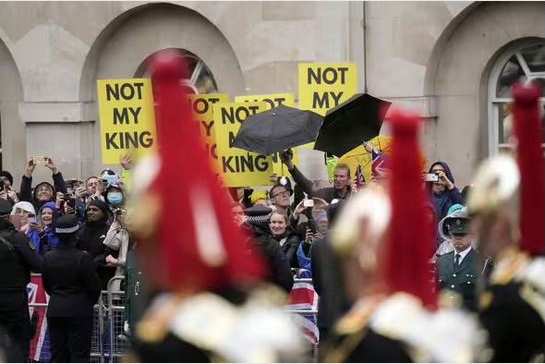
That was from Matt Gurney’s sleep-deprived view of the procession from The Line (that’s not editorializing on my part — he hadn’t slept on the plane from Toronto and got to London at 7am on Coronation Day). In what seemed like a useful break in the public celebrations, he snuck away to get some sustenance and be out of the rain for a bit. When he returned it was lowlight time for the Republicans:
After I’d polished off the pint, I headed back out, back to the square, and that’s where things got interesting. I figured I’d get back to my former spot near the chanting republicans, and did so, no problem. But I noticed there suddenly seemed to be an awful lot of cops around … all heading that way. As in: right toward me, and the chanting people I was standing near. Oops. I left, working my way around the crowd, heading back the way I came from my hotel, and found myself actually facing a rank of advancing cops. Oops again. One had a badge that said inspector, and I walked right up and told him I was a Canadian journalist just watching things. He grinned at me and said, “Alright, mate, come this way,” and had a security guard walk me through the police. I thus ended up missing what has proven to be a controversial event and perhaps the only unhappy moment I know of during the coronation, at least in my area: a bunch of the chanting republicans were arrested just moments after I got out of dodge, and then large metal screen barriers were thrown up, closing off the square due to, apparently, overcrowding. People could leave but no one new could enter.
My sense, as I walked away, was that there was no reason to arrest anyone. (And as I said, this is proving controversial.) I hadn’t seen anything getting out of hand. There had been some chanting and counter-chanting and even some heckling back and forth, but it had all seemed in good enough spirits. Even some of the boos sent at the republicans — two young men with flags had been hamming it up in the main crowd, apart from the main blob of republicans — had seemed in good humour. I don’t know what the police saw or knew. But I couldn’t tell you why they’d moved then and not before, or later. As for overcrowding, I don’t think so. The square really wasn’t all that full. It seemed less full at that moment than it had been when the procession had passed on the way to the abbey. But the barriers seemed to go up quickly, everywhere. Literally everywhere.
And though I was glad to have avoided getting caught up in the Cops vs. Chanting Republicans, I was now on the wrong side of the barriers.
In The Critic, Kittie Helmick recounts finding herself in the vicinity of the “NOT MY KING!” group:
“You seem to find this whole thing rather amusing,” snapped a short angry man with a Not My King sign, about half an hour into the Republic protest against the coronation of King Charles III. I must admit I did. Kettled into a small enclave just off Trafalgar Square, an angry swell of old school socialists, Twitter anarchists, Lib Dem mums, eccentric vicars, boomer hippies, blue haired students and Covid conspiracists had somehow found themselves part of the coronation spectacle. Before the bells of St Martin in the Fields, the full shouty brunt of British republicanism was aimed at a bewildered stream of Chinese tourists and young families out for a day in London.
The survival of the British monarchy is one of the great wonders of modern history. Spending the morning of the coronation with Republic, it began to seem less mysterious. Despite everything in recent years, the Monarchy is still liked more than most of our institutions and probably every one of our elected politicians. No one gathered there could really explain why. The arguments were articulated in between the shouty chanting: things about “modern Democracy” and a “family of Lizards”, none of which quite landed the blow as the day unfolded around us.
Somewhere beyond the crowds, towards Westminster Abbey, an ageing, eccentric dandyish farmer, who secretly wants to be King of Transylvania, was being anointed in holy oil and crowned by an Archbishop wearing hearing aids in a seven hundred year old chair vandalised by 18th century schoolboys. All the while this ceremony was being fawned over across the world by everyone from Kay Burley to one of the world’s most remote tribes. None of it made sense, and that is precisely the point.
Earlier that morning, the CEO of Republic Graham Smith, a man not even the protestors could name, achieved the greatest success of his kind since Cromwell, by being arrested at the hands of the jobsworth Met. For a brief moment, a shiver of excitement spread through the protest. Whilst the country was entranced by a fugue of sombre ritual and Zadok the Priest, Republic were experiencing their own desired reality unfold on the streets of London. Here was a police state enforcing the will of a “politically illiterate” nation brainwashed by bunting and tabloid journalism. The mask was finally off. The incoherent gaggle of shouty slogans and reddit thread arguments made sense. The fight was here and now.
Except that was all a fantasy too. As stupid as the arrests were, nothing could disguise the fact this was a fringe event for a movement that just can’t seem to take off — a Coronation curio to gawp at. “They’re a bunch of wronguns, aren’t they?” said one bored steward to me as we watched a man larping Les Miserables as he chanted Not My King at a trio of giggling Chinese students. The deeper I dug into the many arguments and protestations offered as an alternative to the “fairytale” of monarchy, the more the core transgressive energy of British republicanism revealed itself. It is itself strangely twee and fantastical. Rid us of the Royals, and everything will become better. Gone will be the “psychological baggage” of Britain’s past holding us back. Democracy will triumph. The crown jewels will be sold off and spent on food banks. The plebs will not worship hereditary blood, but NHS rainbows. Britain will become less racist, elitist and classist. The left might even win an election. We could have a poet president like Ireland, a Lineker or a Stormzy shaking hands with the American president.
Apparently, we are all misunderstanding the Trudeau masterplan
All the smoke about Canada not having a national identity is there to hide Justin Trudeau continuing his father’s masterplan to DESTROY QUEBEC:
“Quebec caught in a trap. French forced into decline. Its political influence doomed. 12 million residents in Montreal. Quebec with 5 million. Ottawa’s grand plan explained. Justin is smarter than we think. They want to assimilate us all. All this, without any debate. Two catastrophic scenarios.”
Forget King Charles III’s coronation or the Liberal Party Convention. If you woke up Saturday morning in Quebec, this was the apocalyptic front page that graced your browser, courtesy of the Journal de Montreal:
The Journal‘s cri-de-coeur was in response to the federal government’s increase in the annual immigration level to 500,000 people. This increase, designed to boost the population of Canada to 100 million by the end of the century, would marginalize Quebec’s influence within Canada. It is estimated that Quebec’s overall share of the Canadian population would fall from 25 to 10%, while francophone Quebecers would be in the minority within their own province for the first time in 500 years.
This would displace Quebec from the center of power in Canada. Its official language, French, would be relegated to the same status as all languages and cultures other than English. Instead of being one of Canada’s two official languages, French would merely be one of many, and Quebec, no longer a nation, but a province like any other.
But wait: Journal authors further suggest that this was the grand plan of Prime Ministers Justin and Pierre Elliott Trudeau all along. In a very colorful column, “How the Trudeaus Drowned Quebec“, columnist Richard Martineau even compares the current PM to the protagonist of an infamous Stephen King novel:
“For Justin, Canada is not a country.
It is a hotel, an Airbnb.
And Quebec is just one of the many rooms in this vast real estate complex.
Room 237, here. Like the one in the movie The Shining.
Come, drop your bags and settle in! All we ask is that you pay your taxes.It’s true that Trudeau Sr. paved the way for the reduction of Quebec’s power in Canada, but it didn’t start with his 1981 Charter of Rights, as the Journal claims. It actually began a decade earlier, in 1971, with the creation of Canada’s Official Multiculturalism Policy. The policy enshrined the idea that linguistic and cultural minorities in Canada should be encouraged to preserve their heritage, and allocated federal funding to help them do so.
Official multiculturalism was both a vote-getter for the Liberals and a means of diffusing the English-French “two solitudes” paradigm that was threatening to tear the country apart. At the time, Canada had just lived through the October Crisis of 1970, which had seen Trudeau invoke the War Measures Act in response to terrorist acts by the Front de Liberation du Quebec. Official multiculturalism was seen as a way to boost the federalist cause by aligning the interest of linguistic and cultural minorities within Quebec with those of the federal government.
The larger impact, however, was to enshrine multiculturalism outside Quebec, where most minorities settled, and where garnering favour with different cultural communities became standard operating procedure, particularly for the federal Liberal party. Immigration thus became a politically untouchable issue, except in Quebec, where the protection of the French language continued to take precedence over concerns for minority rights.

Uncancelled History with Douglas Murray | EP. 03 Thomas Jefferson
Nebulous Media
Published 6 Dec 2022Jean Yarbrough joins Douglas Murray on this episode to discuss Thomas Jefferson’s life and legacy. They talk about the Declaration of Independence, his presidency, and the various controversies that have surrounded him. Should Thomas Jefferson stay cancelled?
(more…)
QotD: Changing German Panzer tactics in 1943
The following report, though obviously written in haste with little regard for elegance of expression, gives a good view of the changes in tank tactics which took place on the Eastern Front. This translation was made from a typed copy of the original and thus bears no signature. Nonetheless, there is good reason to believe that the author was the famous Fridolin von Senger und Etterlin, who commanded the 17th Armored Division at this time.
1. The tank tactics which led to the great successes of the years 1939, 1940, and 1941 must now be considered obsolete. Even if it were possible today to breakthrough an antitank front by means of the massive employment of concentrated waves of tanks, we would not be able to make use of these methods, which would once more lead to considerable losses, because of our [tank] production situation. These methods, often employed in rapid succession, would lead to such a quick reduction in tank strength that the character of an armored division would be fundamentally altered. This would lead to difficulties for the higher leadership.
The change in tank tactics is logical. The beginning successes of the weapon, the shock effect of which rested upon the technical achievement and overwhelming invincibility of the attacker, found at last its end in the development of appropriate defenses. From the point of view of production, the building of tanks could not keep pace with the building of antitank weapons. Apparently, a thousand antitank rifles, or dozens of antitank guns, can roll off the production lines for every tank.
The following are drawn from these insights.
2. The new tank tactics, which have already gained inevitable acceptance in the divisions, are outlined below.
The tank group no longer forms the nucleus of the armored division, about which other weapons are grouped as auxiliaries. The tank is a new arm acting in concert with and equal to the old arms. In cooperation with other weapons, it retains its power, even though its numbers are far below those called for by tables of organization.
Its meaning as a new arm is a function of the fact that it combines in itself a goodly portion of the two elements important to the attack: fire and maneuver. It derives these qualities from the fact that it is invulnerable, or less vulnerable, because of its armor.
Because the tank arm combines in itself firepower and mobility to a greater degree than other arms, it is the appropriate weapon for forming the main effort [Schwerpunkt].
The combat of the armored division is characterized by the fact that it is a mobile unit in all its parts and, as a result, the division commander is in a position, in the course of a battle, to chose and form a main effort [Schwerpunkt]. This principle excludes an irrevocable commitment of the tank group before an attack. Rigid employment within the framework of an already established battle plan is replaced by division commander himself holding [the tank group] in readiness and the flexibly employing it in the course of fighting against the required, or known to be appropriate, position.
The battle will begin with the infantry attack. The infantry attack provides the required foundation for the strength of the antitank front, for its length and depth. If the antitank front is known, then the tank attack can be ordered according to the classical principles for leading mobile units against the flanks or, if possible the rear, of an enemy defensive position. This attack should only be carried out exclusively by tanks when they can gain complete surprise. If surprise cannot be gained, then in this flank attack fire superiority must be fought for through the employment of artillery and, for the time being and to a certain extent the fire of the tanks themselves, until the enemy antitank front can be shaken or at least split up. If surprise can be gained, then a break-in against the flank of an antitank front can succeed without preparatory fire.
The attack against an enemy antitank front by means of a successful move against its flanks and rear cannot be carried out by tanks alone. It requires the support of artillery. In our experience, however, tank attacks carried out against the flanks and rear have outrun the artillery groups in direct support. Shifting fires by means of forward observers alone is not enough to ensure the shooting up of defensive fronts. What is needed here is thus the self-propelled batteries, which in the same manner as tanks themselves can quickly change their firing positions and thus attain the same mobility as the tank groups.
3. Now that these principles of the new tactics have been laid out, their use in practice will be explained.
a. The use of tanks as the first attack wave against a strongly fortified, deeply organized defensive position leads always to great losses and is thus false.
b. The use of tanks against deeply organized antitank positions is possible with the stipulation that it be commanded by an all-arms leader in close cooperation with other weapons after the formation of a main effort on the spot and that the further prosecution of the battle be steered by the same all-arms leader.
c. The employment of tanks leads to the greatest success when, sent into action and controlled by the all-arms leader, when they are used to strike the enemy in the flank, soon after the latter has begun an attack and before his antitank weapons have established firm antitank positions. Also in this last case, the attack must, with a view to direction and timing, be ordered by the all-arms leader on the spot. (With this last method the weak forces of the worn out 17th Armored Division annihilated one enemy division at Kuteinikowskaja on the 5th of January 1943 and another at Talowaja on the 27th of January, 1943.)
4. These new tactics are based upon the cooperation of the three main arms (infantry, tanks, and artillery) during the entire course of a battle. This cooperation can only be assured when the leader, that is to say, in all cases where the mass of the division is employed, the division commander himself, controls the cooperation of the arms on the spot throughout the entire battle. If, under the press of circumstance, as generally was the case during the battles between the Don and the Volga, widely separated battle groups [Kampfgruppen] of infantry, tanks and artillery had to be formed, it is essential that each of these battle groups be commanded by an all-arms leader, who is neither the commander of the tank element nor the infantry element of the battlegroup.
The all-arms leader’s means of command is the 10-watt radio built into a tank. With this equipment the leader is connected with the tank leaders as well as the leader of the infantry group, who, in case the proper radios are lacking, is provided with a tank. The all-arms commander is also in contact, by means of his armored personnel carrier, with battlegroups not forming part of the main effort and with his first general staff officer (Ia) working far to the rear.
The leader of the artillery group locates himself, according to the ordinary rules of command and control, with the all-arms leader. He is able, as was explained above, to give effective support only as the leader of an artillery group made up of self-propelled batteries. If he does not have access to some of these, there is always the danger the leader of the tank group would find his mobility limited by being bound to the less mobile towed artillery supporting him.
The place of the leader in combat is far forward, so that he can easily see the tank combat and, on the basis of these observations, can steer the course of the battle. He is sufficiently separated from the forward wave of tanks that he does not get involved in the tank-versus-tank and tank-versus-antitank battles, for this combat will focus his attention on the tanks fighting in the forward lines, to the point where tactical decisions which derive from the cooperation of all arms, can no longer be made.
The place of the leader can, however, rarely be chosen outside of the zone of enemy artillery fire. He can nevertheless remain mobile, thanks to the peculiar virtues of his means of command, namely voice radio. In the course of an attack in progress, he should be far enough forward to allow contact with the infantry group. Through it he can exert the leadership of a combined arms combat.
an armored personnel carrier used as a mobile command post in Russia in 1941From his location the leader should be in a position to himself assemble, according to the development of the situation and the requirements of the cooperation of arms, discrete tank groups.
Cooperation between discrete tank groups and infantry groups is possible if the all-arms leader remains in voice radio contact with the tank group in question. The attachment of tank groups to infantry groups is, as a matter of principle, always to be avoided. The infantry is not in a position to ensure the cooperation of infantry, heavy infantry weapons, and artillery as well as tanks because it is fully occupied with the conduct of the combat of other weapons. On this basis, the attachment of tanks to infantry divisions, which cannot be trained in the cooperation of the three arms, is, as a matter of principle, to be avoided.
The requirement to achieve success by the cooperation of all three arms does not exclude the concentration of all tanks in a single attack. This is still to be striven for. The concentration of tank power in the main effort [Schwerpunkt] will, however, not to striven for through systematic employment on the basis of an established plan, but rather in the course of the battle through the assembling of certain tank groups, in short, through the flexible combat leadership and formation of the main effort [Schwerpunkt] in the course of the battle through the all-arms leader himself.
This battle method, which aims at the close cooperation of the three main arms, cannot function without the formation of a special infantry group mounted in armored personnel carriers. Because it is essentially different, this group does not belong with the wheeled-vehicle mounted infantry of the division. They form, rather, an integrated part of the tank group. They can be attached to the later or will be employed according to the decision of the all-arms leader in accordance with the same principles that apply to the employment of tank waves.
The armored personnel carrier group of the infantry which is attached to the tank group corresponds closely to the self-propelled artillery. Both are special branches of their main arm, which work within the tank group itself and without which the cooperation of the tank group with the mass of the truck-mounted infantry and the towed artillery would not be possible.
5. The following deductions for the construction of tanks can be drawn from the aforementioned portrayal of the tactics and command techniques of the armored division. Because the race between tanks and anti-tank defenses can only be won by even heavier types and thus can not be guaranteed, the focus of effort [Schwerpunkt] in construction must be towards mobility and firepower.
The cooperation of arms can never be so close that artillery-infantry attacks alone can prepare an antitank front so that the tank attack can break through it in a rapid rollover. Instead, tanks must be an a position to use long-range fire to put anti-tank fronts out of action or at least so suppress them so as to make possible the further prosecution of the attack. They are only in a position to do this when they possess weapons of such a caliber that they can win superiority over immobile antitank weapons by means of fire and mobility.
According to this line of reasoning, great things can be expected from the creation of self-propelled artillery batteries. As unarmored fire units with greater range than tanks themselves they are in a position to attain that fire superiority which is necessary to gain the upper hand against the antitank defense.
During this winter’s fighting the best results were gained from assault gun battalions which, because of their great mobility and firepower, were employed and led in the same way as tanks. From the point of view of mobility, they outdid the tanks. Self- propelled guns were likewise successfully employed according to the same principles, to augment tank and assault gun groups, particularly by fire.
In contrast, the Tiger tanks, which were supposed to have fulfilled all three requirements, namely firepower, mobility, and heavy armor, were less successful, for their mobility was not sufficient for the elastic battle leadership outlined above. (In this experience it is important to take into account that the units sent fresh into battle were not at the height of their powers, especially where the use of radio was concerned. The impression of their lack of mobility, especially in rolling country with hard-frozen ground, however, would have been the same, even if the training of the personnel had been completed.)
These lessons of the more and more similar tactics of tanks, assault guns, and self-propelled artillery, which in more or less ad hoc arrangements establish the principle of fast-moving heavy firepower, causes one to wish that these weapons could be organized under a single leader with the goal of combining under him standardized training and well-schooled cooperation. This commander is the commander of the division’s tank group, that is to say, all more or less armored weapons mounted on tracked vehicles that are used for the fire battle. He must also have attached as an essential part an infantry group mounted in armored personnel carriers which should be made available according to a ratio of at least one infantry company for each three tank companies of whatever type.
The self-propelled artillery battalion should not be made an organic part of the tank group because of artillery training and the proposed design that will allow the guns to be dismounted. It should remain an organic part of the artillery regiment and be as- signed, on a case by case basis, to the commander of the tank group.
Unsigned report, probably authored by Fridolin von Senger und Etterlin, who commanded 17th Panzer Division at that time, via Bruce Gudmundsson’s Tactical Notebook, 2023-02-06.
May 8, 2023
Gordon Lightfoot, RIP
Mark Steyn on perhaps the best-known song of the late Gordon Lightfoot:

Edmund Fitzgerald, 1971
Detail of a photo from Wikimedia Commons
In November 1975 Lightfoot chanced to be reading Newsweek‘s account of the sinking of a Great Lakes freighter in Canadian waters. He’s a slow and painstaking author, which is one reason he’s given up songwriting – because it takes too much time away from his grandkids. But that day forty-three years ago the story literally struck a chord, and he found himself scribbling away, very quickly:
The legend lives on From the Chippewa on down
Of the big lake they called Gitche Gumee
The lake, it is said Never gives up her dead
When the skies of November turn gloomy …“Gitche gumee” is Ojibwe for “great sea” – ie, Lake Superior – as you’ll know if you’ve read your Longfellow, which I’m not sure anyone does these days. Evidently Hiawatha was on the curriculum back east across Lake Huron in young Gordy’s Orillia schoolhouse. The Gitche Gumee reference may be why, when I first heard “The Wreck of the Edmund Fitzgerald”, I assumed its subject had sunk long before the song was written. In fact, it sank on November 10th 1975 — just a few days before Lightfoot wrote the number. When she’d launched in 1958, the Edmund Fitzgerald was the largest ship on the Great Lakes, and, when she passed through the Soo Locks between Lakes Superior and Huron, her size always drew a crowd and her captain was always happy to entertain them with a running commentary over the loudspeakers about her history and many voyages. For seventeen years she ferried taconite ore from Minnesota to the iron works of Detroit, Toledo and the other Great Lakes ports … until one November evening of severe winds and 35-feet waves […]
That said, human tragedy alone does not make for singable material. The last contact from the SS Edmund Fitzgerald was with another ship, the SS Arthur M Anderson. Yet “The Wreck of the Arthur M Anderson” would have been a far less evocative title. Arthur Marvin Anderson was on the board of US Steel, as Edmund Fitzgerald was on the board of Northwestern Mutual. But there is something pleasingly archaic about the latter name: in fact, as I think of it, I believe the last Edmund I met was one of Gordon Lightfoot’s fellow Canadian singers — the late operetta baritone Edmund Hockridge. Pair “Edmund” to “Fitzgerald”, and you have something redolent of Sir Walter Scott or Robert Louis Stevenson, of shipwrecks off Cornwall or the Hebrides. Perhaps that’s why “The Wreck of the Edmund Fitzgerald” either sounds like an old Scots-Irish folk tune or, alternatively, actually is one. For any IRA members reading this, Bobby Sands, the hunger striker who starved himself to death in a British gaol, wrote in his cell a song called “Back Home in Derry”, about Irish prison deportees en route to Australia and set to a tune remarkably like “The Wreck of the Edmund Fitzgerald”, which it seems unlikely he ever heard.
I see some musicologists claim the tune is in Dorian mode, although it sounds Mixolydian to me (like “The Wexford Carol”). Whichever it is, there is a perfect union between the emphatic melody, the crash of the waves, the antediluvian moniker of Northwestern Mutual’s chairman, and even the obvious filler phrases, so typical of ancient folk songs:
The lake, it is said
Never gives up her dead— which returns far more effectively in the final verse:
Superior, they said
Never gives up her dead— as if Gitchee Gumee is some vast ravening beast. Go back to Orillia, to Fourth Grade in 1947, and the parents listening to Mr and Mrs Lightfoot’s little boy sing “Too-Ra-Loo-Ra-Loo-Ral” as if a bit of synthetic shamrock from an old Tin Pan Alleyman were a genuine Irish lullaby from the mists of Emerald Isle antiquity. That’s the genius of “The Wreck of the Edmund Fitzgerald”: It was born sounding as if it’s a hundred years old. And its agelessness is all the more amazing when you consider that it’s essentially an act of journalism, an adaptation of a news report about something that happened a few days earlier – just the facts, ma’am, with minimal artistic license:
In a musty old hall
In Detroit they prayed
In the maritime sailors’ cathedral …“Maritime sailors” is surely a redundancy, and it’s not a cathedral but the “Mariners’ Church”, which doesn’t quite go the distance syllable-wise. And a parishioner wrote to Lightfoot to say the church isn’t in the least bit “musty”, so these days he finds alternative adjectives.
But that’s all details. The power of the song lies in its storytelling. It immortalized the fate of the freighter not just for the families of the dead, “the wives and the sons and the daughters”, but for everyone, and it made the Edmund Fitzgerald the Titanic of the Great Lakes – except that the Titanic never inspired any song like this. The mournful toll of the lakes in the penultimate stanza is Gordon Lightfoot at his very best:
Lake Huron rolls Superior sings
In the rooms of her ice-water mansion
Old Michigan steams Like a young man’s dreams
The islands and bays are for sportsmen
And farther below Lake Ontario
Takes in what Lake Erie can send her
And the iron boats go As the mariners all know
With the gales of November remembered …The gales of November howl and the waves rise up and devour the ship. And then the gales subside and the placid surface betrays no trace of twenty-nine men, taken deep into the rooms of an ice-water mansion and never to be found.
Grrrrrrl Power is the only acceptable mode for new female characters, it seems
Janice Fiamengo on the strictly monotone representation of female characters in recent years:
The trend to make female movie characters tough and abrasive has been proceeding for some time. We can all predict that the new partner in the police procedural, let’s say a petite black woman whose entrance surprises (and thus reveals the bigotry of) the white man she’ll be working with, will turn out to be the biggest badass on the force. She’ll almost certainly save her partner’s life — and unearth a crime-solving detail he’d overlooked — before the first episode is over. At the same time, viewers will be treated to her sneering refusal of the partner’s banter, her steely gaze, and her fearless embrace of outrider status. She’s a woman with wise-cracking disdain for men as a group who takes quick revenge for even the smallest hint of sexism, benevolent or otherwise, from her fellow officers. And she quickly earns not only their respect but also their unwilling awe.
Whether police officers, first responders, detectives, firefighters, FBI — or, for that matter, nurses, ER doctors, politicians, or lawyers — the message is clear: these women are at least as capable and fearsome as any man: tough-minded, smart as a whip, and street-wise. Even in this era of agitation about the trans peril to women’s sports, the fictional females are as physically strong and combat-ready as any male, their fists and kicks aimed with staggering accuracy. Even tiny Lucy Tara on NCIS Hawai’i comes to the rescue of her far-larger male colleagues in impressive physical struggles with suspects.
But physical characteristics, the notable fearlessness and strength, are to some extent less striking than the women’s personalities and demeanor. An entire character transformation has been taking place, as traditionally feminine characteristics have been decisively minimized and masculine bravura brought to the fore. These women are, seemingly without effort, brusque, foul-mouthed, and contemptuous, particularly of male authority — and we’re to love them for it. They’re often beautiful, but they never try to be. With hair pulled back and aggressive booted stride, they are independent, uninterested in male approval, and largely indifferent to men as romantic partners, unless they are shown pursuing their occasionally voracious sexual needs, at which times their approach is direct and unsentimental. After an evening of bronco-riding athleticism, they wake up in a tousled bed with a slight grimace and duck out of the lover’s offer of breakfast. They’re not interested in commitment or any continued intimacy. A call comes in on their cell phone, they pull on their clothes nonchalantly, and walk out of the man’s life. They’ve already forgotten him as they prepare to conquer evil once again.
A popular new Netflix series, The Diplomat, takes these now-standard elements to the next level, profiling an ambitious, sexy, oft-frowning, brilliant, and explosively hot-tempered woman, Kate Wyler, who engages in uncontrolled physical and verbal abuse of her husband without remorse or narrative comeuppance. Though one might expect that a portrait of reckless physical violence by one spouse against another would be evidence at least of a serious character flaw — if not criminality (as it certainly would be if the male spouse were delivering the blows) — it is not at all clear in this case that the character’s actions deserve any condemnation. Her violence is simply the most extreme manifestation of her (rather admirable and plucky) unconventionality in breaking the rules of propriety in order to save the liberal world order.