In Woke Watch Canada, Brian Giesbrecht points out the level of delusion necessary to believe that you can “decolonize” Canada and at the same time achieve “reconciliation” between the First Nations and their colonialist oppressors (that’s the rest of us):
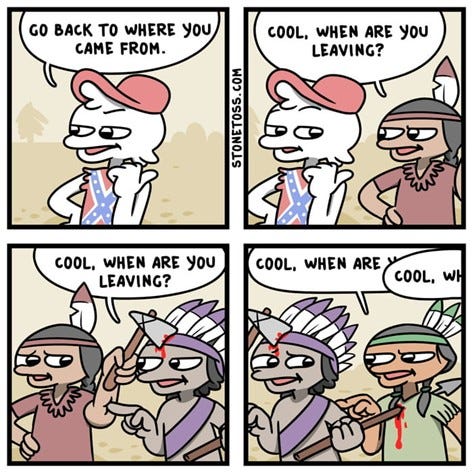
“Decolonization” has become the buzzword at every Canadian institution, from the federal government to universities. Every week, some self-righteous university administrator or federal bureaucrat smugly declares that the great northern nation must be systematically dismantled and returned to its pre-colonial purity. Some even argue that true decolonization requires the repatriation of indigenous land and sovereignty. Land back! One prominent indigenous lawyer even argues that there is a new kind of denialism, called “colonial denial” for anyone in BC who advocates repealing their goldmine, called the Declaration on the Rights of Indigenous Peoples Act (DRIPA).
Their threat is that Canada must be “decolonized” if we want to achieve reconciliation.
So, how would we do that? How would we return to a truly decolonized Canada?
Let’s start with universities. Across Canada, higher education is currently obsessed with “indigenizing” the curriculum — whatever that is. Administrators spend millions restructuring faculties, DEI hiring, colonialism sensitivity groups, and other high-anxiety endeavours.
But the paradox at the heart of their enterprise is this: if you want to achieve a completely decolonized Canada, the very first things to disappear would be the universities. Indigenous peoples in North America had no writing. Given time, reading and writing might have developed. But as of 1534, when Jacques Cartier first set foot in Canada, the indigenous peoples had never seen reading or writing, much less the world of books that arrived with the French settlers.
So universities could be dispensed with, along with all other institutions of learning. School children would cheer. Former university students would have far more time to do what many of them do best — namely, attending protests and drinking beer.
Those dusty school buildings could all be razed to the ground. Canadian youth would no longer waste years and tens of thousands of dollars learning why William Shakespeare is a tool of the patriarchy, or why Christopher Columbus was actually a villain. Instead, they would learn by watching their parents, siblings, and community members fashion primitive tools and weapons needed to survive in a harsh world of hunting, gathering, and making war on neighbouring tribes.
So, if subsistence hunting and gathering, with weapons made of wood and rock, is what you want, then go for it.
Then there is the discussion about decolonizing urban life. Activists argue that modern cities must be redesigned to be more accessible and inclusive to indigenous populations. Again, this misses the point entirely. Cities are a purely colonial phenomenon. A decolonized Canada would have none of them.
Prior to the arrival of the Europeans, most inhabitants of the Great Northwest lived semi-nomadically, following the seasonal migration of food supplies. Permanent buildings were largely unknown. Even on the West Coast or in southern Ontario, where more settled structures existed, they were at the developmental level of pre-agricultural settlements found in Europe and Asia some 10,000 years ago.
Thus, a properly decolonized map of Canada would show a yawning area of lakes, rocks, and forests interspersed with small pockets of temporary indigenous settlements. Instead of the clutter of 40 million people in densely populated cities, there would be a few hundred thousand hunters and warriors interspersed over the vast land mass of what is now the thoroughly colonized Canada. Toronto, Vancouver, and Ottawa would simply cease to exist. The glass towers, the transit systems, the luxury condos, and the coffee shops would vanish, replaced by temporary tents and skin shelters. It would certainly solve the housing crisis, though the winters might prove a touch breezy.
So towns and cities could disappear too.