
World War Two
Published 20 Dec 2022Books, films, and comics are filled with Nazi scientists and explorers travelling the globe to get their hands on ancient artifacts or summoning daemons with black magic. But how much of it is grounded in reality? Well, some of it. In the neo-pagan religion invented by Reichsführer-SS Heinrich Himmler, the world can only be explained through the occult.
(more…)
December 21, 2022
The Nazi Quest for Thor’s Hammer – WW2 Documentary Special
Comments Off on The Nazi Quest for Thor’s Hammer – WW2 Documentary Special
December 18, 2022
A Super Bomber to Break Japan – WW2 – 225 – December 17, 1943
World War Two
Published 17 Dec 2022This war has now lasted as long as the Great War did, but there’s no signs of it slowing. The Soviets have three offensives going on on the Eastern Front, in Italy the Allies are attacking at San Pietro and over the Moro River, in the Pacific there are Allied landings on New Britain, but in Pacific Command, the big talk is all about a new super bomber.
(more…)
Comments Off on A Super Bomber to Break Japan – WW2 – 225 – December 17, 1943
December 17, 2022
The RAF’s Worst Day of the War – War Against Humanity 091
World War Two
Published 15 Dec 2022The United Nations Allies has some success bombing the Nazi German Reich, but it comes at a heavy price. In the village Kalavryta in Greece, the Wehrmacht massacre hundreds of men and boys.
(more…)
Comments Off on The RAF’s Worst Day of the War – War Against Humanity 091
December 14, 2022
The Polish Armed Forces in Exile
World War Two
Published 13 Dec 2022The Polish state was the first to fall in this war, yet across the globe Polish soldiers are fighting on land, air, and sea as part of the United Nations alliance. The story of the tens of thousands of men and women fighting for Polish liberation is equal parts hope and hardship as they battle the enemy and even sometimes their own allies.
(more…)
Comments Off on The Polish Armed Forces in Exile
December 13, 2022
Egypt’s postwar Nazi military advisors
In The Critic, James Barr reviews a book on the roles of former Nazi military and political figures in the Egyptian forces, Nazis on the Nile: The German Military Advisers in Egypt 1949-1967 by Vyvyan Kinross:
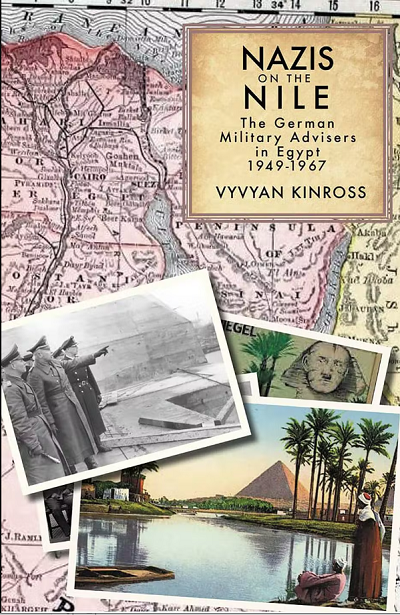
One of the paradoxes of the early postwar era is that, after Germany’s defeat, the Nazis were vilified at the same time that their expertise was sought after by both Cold War superpowers. Germans played key roles in both sides’ space programmes. Less infamous is the part they also went on to play in the Egyptian rocket programme, one of the subjects in this fascinating and disturbing book.
After suffering a humiliating defeat in the war that followed the establishment of Israel, the Egyptians wanted revenge. As the British had refused to help them — despite maintaining a deeply unpopular and large presence astride the Suez Canal — Egypt’s sybaritic King Farouq turned to his enemy’s enemy instead. In 1949 he commissioned an Afrika Korps general, Artur Schmitt, to review the Egyptian army.
Having checked in to a Cairo hotel under the name “Herr Goldstein”, Schmitt inspected Egyptian units and went on to Syria to survey Israel from the Golan Heights. The Egyptians’ failure to combine tanks, artillery and infantry effectively, he decided, explained their “inability to take advantage of the early stages of fighting to wipe the State of Israel off the map”.
Schmitt’s forthright conclusions were unwelcome, and he did not stay long. But some younger Egyptian army officers shared his views and, after they had overthrown Farouq in 1952, they picked up where the king had left off. Within days they offered Fritz Voss, the former head of the Skoda arms factory in Pilsen, the job of masterminding the retraining of the army and the establishment of a military industrial base that could produce jet aircraft and missiles.
Voss in turn invited old contacts to join him, including Wilhelm Beisner, an SS officer who had been part of Einsatzkommando Egypt, which would have spearheaded the Holocaust in Palestine had Rommel won at El Alamein. The Germans found Egyptian working conditions challenging. “Here one has to act much more slowly than in Prussia,” complained a German instructor who found “Oriental sloppiness” irritating. Of forty tanks lined up for a parade to celebrate the first anniversary of the coup, just twelve made it past the junta’s rostrum.
The author, Vyvyan Kinross, is a consultant by profession. He has advised Arab governments and clearly understands the fundamental problems. “The battle” for the Germans, he writes, “was always to reconcile finance, resourcing and the expertise required to execute a sophisticated manufacturing process with the challenging conditions and logistics that prevailed in a country that was late to industrialise and financially underpowered.”
Comments Off on Egypt’s postwar Nazi military advisors
QotD: Postwar Germany
Nowhere in the world (except, perhaps, in Israel or Russia) does history weigh as heavily, as palpably, upon ordinary people as in Germany. Sixty years after the end of the Second World War, the disaster of Nazism is still unmistakably and inescapably inscribed upon almost every town and cityscape, in whichever direction you look. The urban environment of Germany, whose towns and cities were once among the most beautiful in the world, second only to Italy’s, is now a wasteland of functional yet discordant modern architecture, soulless and incapable of inspiring anything but a vague existential unease, with a sense of impermanence and unreality that mere prosperity can do nothing to dispel. Well-stocked shops do not supply meaning or purpose. Beauty, at least in its man-made form, has left the land for good; and such remnants of past glories as remain serve only as a constant, nagging reminder of what has been lost, destroyed, utterly and irretrievably smashed up.
Theodore Dalrymple, “The Specters Haunting Dresden”, City Journal, 2005-01.
Comments Off on QotD: Postwar Germany
December 11, 2022
An Amphibious Landing to take Rome? – 224 – December 10, 1943
World War Two
Published 10 Dec 2022There are plans afoot to hit the enemy from behind in Italy. Allied leaders are meeting again in Cairo to go over other plans, notably what to do about China and Burma. There is active fighting on two fronts in Italy too, though this week it doesn’t go particularly well for the Allies. Attacks in the USSR are unsuccessful for the Soviets, but do go well for the Germans, and there are Allied attacks by air in the Marshall Islands and over France.
(more…)
Comments Off on An Amphibious Landing to take Rome? – 224 – December 10, 1943
December 9, 2022
V-1: Hitler’s Deluded Revenge Plan – War Against Humanity 090
World War Two
Published 8 Dec 2022Japanese planes bomb Calcutta when it is still being crushed by the weight of the Bengali famine. Adolf Hitler and Albert Speer are obsessively trying to increase war production so Germany can begin launching its vengeance weapon against Britain. The wars of resistance continue across the Balkans with continued brutality and a new resistance force emerges in Italy.
(more…)
Comments Off on V-1: Hitler’s Deluded Revenge Plan – War Against Humanity 090
December 8, 2022
Is the Luftwaffe Defeated in 1943? – WW2 Documentary Special
World War Two
Published 7 Dec 2022Outnumbered and outproduced, the once mighty Luftwaffe is battling to hold its own across three fronts. Every month brings new pain for the force. But the Luftwaffe still has a few tricks up its sleeves and can make the Allies bleed heavily. If only Hitler and the Nazi leadership weren’t sabotaging its chances …
(more…)
Comments Off on Is the Luftwaffe Defeated in 1943? – WW2 Documentary Special
December 7, 2022
Pearl Harbor: Before and After December 7th
Geographics
Published 20 Sep 2022
(more…)
Comments Off on Pearl Harbor: Before and After December 7th
December 6, 2022
Tank Chat #160 | M18 Hellcat | The Tank Museum
The Tank Museum
Published 5 Aug 2022Hello Tank Nuts! M18 Hellcat perfectly fit the American Army’s Tank Destroyer doctrine during WW2. This particular M18 saw service during WW2 and conflict in former Yugoslavia. It is part of the Phelps private collection and recently took part in the celebrations for the 75th Anniversary of the liberation of the city of Mons, Belgium. Discover more on Hellcat and watch the latest Tank Chat with David Willey.
(more…)
Comments Off on Tank Chat #160 | M18 Hellcat | The Tank Museum
December 5, 2022
The sinking of HMS Courageous, 17 September, 1939
The Northern Historian
Published 5 Feb 202117th September 1939, just two weeks after Britain had declared war on Germany, aircraft carrier HMS Courageous was on patrol off the west coast of Ireland. Unbeknown to her, she was being stalked by a hidden predator. Within 20 minutes of being attacked she had slipped beneath the Atlantic surface, taking with her the lives of over 500 men. She became the first British naval casualty of World War Two.
She began her life as a light cruiser during World War One as part of the Courageous class of cruisers. They were a trio of ships comprising HMS Courageous, HMS Glorious, and HMS Furious. These ships were designed and built to support Admiral Lord Fisher’s Baltic project.
Following heavy losses at The Battle of Jutland, HMS Courageous became the flagship of the 1st Cruiser Squadron and took part in the 2nd Battle of Heligoland.
Following World War 1 and due to the Washington Naval Treaty of 1922, limiting new ship constructions, HMS Courageous along with her sisters HMS Glorious and HMS Furious were converted into aircraft carriers and became the Courageous class of aircraft carriers for the Royal Navy.
(more…)
Comments Off on The sinking of HMS Courageous, 17 September, 1939
December 4, 2022
Operation Overlord Confirmed at Teheran – WW2 – 223 – December 3, 1943
World War Two
Published 3 Dec 2022The Teheran Conference is in full swing and the Allied leadership and plan for a cross channel invasion of Europe is agreed upon by Stalin, Churchill, and Roosevelt. There are new Allied attacks across Italy, but at Bari a German air raid releases deadly poison gas.
(more…)
Comments Off on Operation Overlord Confirmed at Teheran – WW2 – 223 – December 3, 1943
December 2, 2022
Bombing Berlin with Ed Murrow of CBS – War Against Humanity 089
World War Two
Published 1 Dec 2022Ed Murrow accompanies the RAF on a bombing raid on Berlin, and files one of his most iconic broadcasts with CBS. In Teheran, Winston Churchill walks out on a dinner with Joseph Stalin, after the USSR Premiere suggests mass murdering German officers.
(more…)
Comments Off on Bombing Berlin with Ed Murrow of CBS – War Against Humanity 089


