
Forgotten Weapons
Published 11 Nov 2024Allied troops occupied the Mauser factory complex in Oberndorf in April of 1945, right at the end of the war. The factory was put under French administration and by May that same year production lines were restarted to supply French forces (who needed as many arms as they could get). In total, just under 52,000 new K98k rifles were made for the French between May 1945 and June 1946, when the factory shut back down (and much of it was dynamited by the departing French forces).
The rifles made under French control were all marked with the receiver code svwMB. German production had switched to this code early in 1945 after producing an “a” block of svw45 rifles and about 5,500 guns in the svw45 “b” block. The factory shutdown came midway through svwMB “c” block, and the first French-property rifles had been assembled under German control and were waiting for final inspection when the factory was occupied. Mauser production was non-linear, and some “c” block receivers had been finished and shipped to German forces before the shutdown, while others remained at the factory. There is no specific transition point between French and German rifles because of this. Production of the “c” block ran into the 29,000 range, and was followed by three suffixes of entirely French-production guns; “d”, “h”, and “k”.
The K98k being produced by this point — and what was continued under the French — was the Kriegsmodell, the last-ditch simplified model of the K98k. It had many stamped and welded parts, no barrel band springs (screws were used instead) and no bayonet lug. The French produced the guns in exactly the same configuration as the Germans had, simply substituting a five-pointed star as a final inspection stamp in front of the receiver serial number. At some point later, the French rebuilt many of these rifles and added two distinctive features that are often thought to have been original factory production elements. These are the hexagonal stacking rod under the muzzle and the left-side sling bar on the stock. When these rebuilds were done, the bolts were also scrubbed and renumbered with just the last 3 digits of the receiver serial number.
(more…)
March 1, 2025
Spoils of War: French Occupation-Production Mauser K98k svwMB
February 26, 2025
G33/40: Special Carbine for the Gebirgsjager
Forgotten Weapons
Published 8 Nov 2024When the Germans took over control of the Czechoslovakian arms industry, they took some time to work out what out to mass produce at the Brno factory. In the interim, they decided to restart production of the Czech vz33 Mauser carbine as the Gewehr 33/40 for German mountain troops. This was a truly short carbine with a 19.4 inch (490mm) barrel, which the Czechs had used for mostly police applications. German had used a short carbine back before World War One, but with Spitzer ammunition it was deemed too harsh shooting (both blast and recoil) to be worth the reduced length. Well, that calculation was different for mountain troops.
The G33/40 also had a distinctive added metal plate on the left side of the stock to help protect it in mountain use. The G33/40 would remain in production for three years, from 1940 until 1942 (after which the rifle production changed to standard K98ks). About 130,000 were made, with 945 receiver codes in 1940 and dot codes thereafter.
(more…)
February 24, 2025
“Camouflage” – and a History of Military Deception – Sabaton History 129 [Official]
Sabaton History
Published 22 Oct 2024Today’s episode is about a song that is not a Sabaton original, but a cover they did of Stan Ridgway’s “Camouflage” from 1986. The story itself is easy enough to understand if you follow the lyrics, but it inspired us to do an episode not about the song, but about camouflage itself; its history, how it works, how it’s supposed to work, and even its limitations.
(more…)
February 23, 2025
How WW2 Changed Espionage Forever
World War Two
Published 22 Feb 2025In their struggle to defeat German and Japanese espionage efforts, the Allied intelligence agencies of the KGB, CIA, MI6 and DGSE are all transformed into modern, global, espionage forces. But even as East and West work together to defeat the Axis, they are fighting the first underground battles of a new Cold War against one another.
(more…)
February 22, 2025
The Grim Fate of the Chinese Army – a Korean War Special
The Korean War by Indy Neidell
Published 21 Feb 2025Millions of Chinese served in the Korean War, but until very recently the People’s Liberation Army was by no means the only army in China. A lot has changed in this country in a very short time, with tens of millions of deaths in World War Two, and a brutal civil war that has raged both before and afterwards. How did the PLA become what it is today, and what became of Mao Zedong’s old adversaries?
(more…)
February 20, 2025
Retaking Burma with the Fourteenth Army in 1945
Dr. Robert Lyman discusses the start of the campaign to reconquer Burma from the Japanese led by Lieutenant General Bill Slim and the Fourteenth Army:
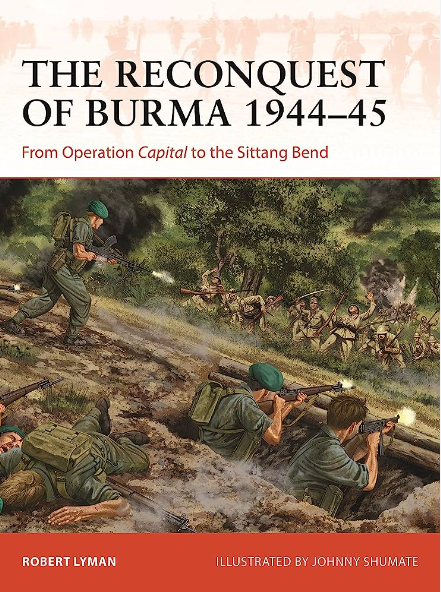
Why Burma? Because in Burma in 1945 a series of marvellous military miracles (is there a synonym starting with “m” for concatenation?) engineered by General Bill Slim and his mighty 14th Army, broke the back of the Japanese Burma Area Army and smashed forever Tokyo’s dreams of an empire in South East Asia. 1945 is worth celebrating!
Even today, few people are aware of just how dramatic these events were, and just how spectacular was the victory wrought by the Indian, British, African, US and Chinese forces in the country.
Indeed, at the start of 1945 few people would have predicted the extraordinary outcome of the developing campaign. If Lieutenant General Sir Bill Slim (he had been knighted by General Archibald Wavell, the Viceroy, the previous October, at Imphal) had been asked in January 1945 to describe the situation in Burma at the onset of the next monsoon period in May, I do not believe that in his wildest imaginings he could have conceived that the whole of Burma was about to fall into his hands. After all, his army wasn’t yet fully across the Chindwin. Nearly 800 miles of tough country with few roads lay before him, not the least the entire Burma Area Army under a new commander, General Kimura. The Arakanese coastline needed to be captured too, to allow aircraft to use the vital airfields at Akyab as a stepping stone to Rangoon. Likewise, I’m not sure that he would have imagined that a primary reason for the success of his Army was the work of 12,000 native levies from the Karen Hills, under the leadership of SOE, whose guerrilla activities prevented the Japanese from reaching, reinforcing and defending the key town of Toungoo on the Sittang river. It was the loss of this town, more than any other, which handed Burma to Slim on a plate, and it was SOE and their native Karen guerrillas which made it all possible.
Crossing the Irrawaddy
(Victoria State Archives)The potential of a Karenni-based resistance raised the possibility, long argued by old Burma hands, of a British armed and trained fifth column operating behind Japanese lines for the purpose of gathering battlefield intelligence and undertaking limited guerrilla action. Slim had long complained about the poor quality of the battlefield intelligence (as opposed to the signals intelligence, about which he was well provided) that he and his Corps commanders received. He was concerned, among other things, about knowing “what was on the other side of the hill”, the product of information provided – where it existed – by effective combat (ground and air) reconnaissance. There was no shortage of organisations attempting to assist in this task – at least twelve – but their coordination was poor and most reported to SEAC or parts of India Command, rather than to 14 Army. Slim dismissed most of these as “private armies” which offered no real help to the task of defeating the enemy on the battlefield. One of the groups, part of Force 136 (i.e. Special Operations Executive, or SOE), which had operated in front of 20 Indian Division along the Chindwin between 1943 and early 1944 under Major Edgar Peacock (and thus known as “P Force”) did sterling work with local Burmese and Karen agents reporting on Japanese activity facing 4 Corps. Persuaded that similar groups working among the Karens in Burma’s eastern hills – an area known as the Karenni States – could achieve significant support for a land offensive in Burma, Slim (to whom Mountbatten transferred responsibility for Force 136 in late 1944 for this purpose) authorised an operation to the Karens. Its task was not merely to undertake intelligence missions watching the road and railways between Mandalay and Rangoon, but to determine whether they would fight. If the Karens were prepared to do so, SOE would be responsible for training and organising them as armed groups able to deliver battlefield intelligence directly in support of the advancing 14 Army. The resulting operation – Character – was so spectacularly successful that it far outweighed what had been achieved by Operation Thursday the previous year in terms of its impact on the course of military operations in pursuit of the strategy to defeat the Japanese in the whole of Burma. It has been strangely forgotten, or ignored, by most historians ever since, drowned out perhaps by the noise made by the drama and heroism of Operation Thursday, the second Chindit expedition. Over the course of Operation Extended Capital some 2,000 British, Indian and Burmese officers and soldiers, along with 1,430 tons of supplies, were dropped into Burma for the purposes of providing intelligence about the Japanese that would be useful for the fighting formations of 14th Army, as well as undertaking limited guerrilla operations. As historian Richard Duckett has observed, this found SOE operating not merely as intelligence gatherers in the traditional sense, but as Special Forces with a defined military mission as part of conventional operations linked directly to a strategic outcome. For Operation Character specifically, about 110 British officers and NCOs and over 100 men of all Burmese ethnicities, dominated interestingly by Burmans (which now also included 3-man Jedburgh Teams) mobilised as many as 12,000 Karens over an area of 7,000 square miles to the anti-Japanese cause. Some 3,000 weapons were dropped into the Karenni States. Operating in five distinct groups (“Walrus”, “Ferret”, “Otter”, “Mongoose” and “Hyena”) the Karen irregulars trained and led by Force 136, waited the moment when 14 Army instructed them to attack.

February 18, 2025
World War 2 rations on the British Home Front
Tasting History with Max Miller
Published 8 Oct 2024Mock banana cream on whole grain National Loaf
City/Region: United Kingdom
Time Period: 1944British rationing lasted from 1940 all the way to 1954, and they had to completely do without foods like bananas for years. The National Loaf began to be distributed in 1941. Made of 85% wholemeal flour enriched with vitamins B and C, it was nutritious, but dense, gummy, and went stale very quickly.
My National Loaf, based on the Imperial War Museum’s version, is dense, but I like the complex flavors from the whole grains. The mock banana cream has a texture that’s really close to mashed bananas, though the taste is an interesting mixture of parsnip and banana. Not bad, but not quite banana.
Mock Banana Cream
Here is a more economical banana cream recipe. Prepare and boil 1lb. parsnips until soft. Add 2 ozs margarine, 1 level tablespoonful sugar, 2 teaspoonfuls banana flavouring and beat until creamy. This must be used quickly, but half the quantity can be made if desired.
— Daily Record, Glasgow, May 27, 1944
February 17, 2025
Forgotten War Ep 9 – Kohima – Hell in the Hills
HardThrasher
Published 16 Feb 2025The Battle of Kohima.
Please consider donations of any size to the Burma Star Memorial Fund who aim to ensure remembrance of those who fought with, in and against 14th Army 1941–1945 — https://burmastarmemorial.org/
(more…)
February 16, 2025
Bismarck’s Final Battle – The Bismarck Part 4
World War Two
Published 15 Feb 2025It is the end for the Bismarck; crippled by airstrikes, there is no hope of salvation. As the British battleships close in, Admiral Gunter Lutjens gives a final Sieg Heil, readies his guns, and prepares to meet his destiny.
(more…)
February 13, 2025
QotD: Social Darwinism
Social Darwinism fails both on its own terms, and in the implementation. On its own terms, because we simply can’t account for all the variables. I use the example of billiards: The math is simple enough behind any given billiard shot, but once you introduce obvious real world variables like imperceptible imperfections in the felt of the table, the balls themselves, the cue … plus the inability of human muscles to consistently apply the necessary force in just the right way … your average PhD physicist should be a much better pool player than, say, your average barfly, but the reality is far different. How much more complex is an entire living system, than a pool table?
Social Darwinism fails in practice for the most obvious reason: You can’t practice it with the necessary consistency without massive State intervention, and what kind of fool would give a State, any State, that power? It has been tried, 1933-45 being the most prominent example, and it didn’t go well.
Severian, “The Experiment”, Founding Questions, 2021-09-25.
February 10, 2025
The Swordfish Strike! – The Bismarck Part 3
World War Two
Published 9 Feb 2025Reeling from the loss of HMS Hood, the Royal Navy chases Bismarck across the Atlantic Ocean. Battleships and search planes comb the vast expanses of water. Finally, they spot the German behemoth. It’s time to unleash the Swordfish!
(more…)
February 8, 2025
Hungarian WWII Rifles (35M, 43M, G98/40)
Forgotten Weapons
Published 11 Jun 2015After the breakup of the Austro-Hungarian Empire, the Hungarian army was armed primarily with Steyr M95 straight-pull rifles and carbines, chambered for the 8x56mm rimmed cartridge. In 1935 they adopted a new Mannlicher turnbolt rifle, the 35M, which used the same 8x56R ammunition and en bloc clips. The rifle was modified in 1940 for production to German specifications as the Gewehr 98/40 (including conversion to 8×57 rimless ammunition and a stripper-clip-fed box magazine). The resulting rifle was good enough that it was adopted by Hungary as well in 1943 as the 43M.
February 6, 2025
Forgotten War Ep 8 – Imphal 44 Pt2 – Edge of Chaos
HardThrasher
Published 4 Feb 2025A video discussing the Battles of Imphal and Kohima at the start of 1944.
Please consider donations of any size to the Burma Star Memorial Fund who aim to ensure remembrance of those who fought with, in and against 14th Army 1941–1945 — https://burmastarmemorial.org/
(more…)
February 3, 2025
A New World Order – War 2 War 01 – Q4 1945
TimeGhost History
Published 1 Feb 2025World War Two is over. The anti-Axis alliance has promised that their victory shall usher in a time of peace, stability, and freedom. They have pledged to uphold new values of humanity, tolerance, solidarity, and the right to self determination. Have they spoken the truth or has it been a string of lies all along?
(more…)
February 2, 2025
HMS Hood – Death in 17 Mins – The Bismarck Part 2
World War Two
Published 1 Feb 2025On May 24, 1941, the Kriegsmarine‘s mighty battleship Bismarck goes head to head with the Royal Navy’s HMS Hood. Seventeen minutes later, just one of the steel titans is left afloat and 1,400 men are dead.
Special thanks goes to the HMS Hood Association, to learn more about HMS hood visit hmshood.org.uk
(more…)


