
Real Time History
Published 8 Aug 2025Germany and the Soviet Union both regarded the Polish state as a creation of the post-WW1 system, and both had claims on Polish territory. In the summer of 1939, Adolf Hitler decided to invade Poland in a fait acompli against the Allies. In a secret agreement between Germany and the Soviet Union they agreed on dividing up the Polish state and Eastern Europe.
(more…)
August 12, 2025
German-Soviet Invasion of Poland 1939
Comments Off on German-Soviet Invasion of Poland 1939
August 11, 2025
Speed vs Armour: The Unexpected History of Fast Tanks
The Tank Museum
Published 21 Mar 2025Would you rather go to war in a tank that was quick but lightly armoured – or heavily armoured but slow?
The concept of fast tanks has existed since the First World War, but making a tank fast is easier said than done. You can increase the speed, but only by compromising the other two sides of The Iron Triangle.
Whilst a good power to weigh ratio is key to making a tank go fast, there are other factors that need to be considered. J Walter Christie pioneered the innovative helicoil spring suspension system – an invention that allowed tanks to cope with travelling at high speeds across country. Although not picked up by the US Army, the brilliance of Christie’s suspension was recognised by the Soviets and soon made an appearance on the BT-Series of tanks – and most effectively on the T-34.
Back in the UK, the newly mechanised cavalry was making use of some brand-new Cruiser tanks. Whilst these were fast vehicles, this was coming at the cost of effective protection. Some military thinkers advocated for the concept of “speed as armour” but results were mixed – with the Crusader and Cromwell both proving to be capable tanks.
After the war, the British Army finally moved on from “speed as armour” and settled on sacrificing a bit of speed for the sake of better protection. This was incorporated first into the concept of Universal Tanks and remains a fixture in the modern Main Battle Tank.
So, we’ll ask again. Would you rather go to war in a tank that was quick but lightly armoured – or heavily armoured but slow?
00:00 | Introduction
00:51 | What Makes it a Fast Tank?
02:39 | What is a Fast Tank For?
04:39 | Suspension of Disbelief
06:34 | Speedy Soviets
08:29 | Cruisers Replace Cavalry
11:20 | The Second Wave
13:19 | Cruising in Europe
19:08 | One Tank to Do It All
(more…)
Comments Off on Speed vs Armour: The Unexpected History of Fast Tanks
August 10, 2025
August 8, 2025
Debunking the idea that Japan was about to surrender anyway
Dr. Robert Lyman on the common misunderstanding of Japan’s situation in July and August of 1945 — no, they weren’t “on the brink of surrender so atomic bombing was unjustified” … instead, they were intending to make the assault on the Home Islands the biggest bloodbath ever:
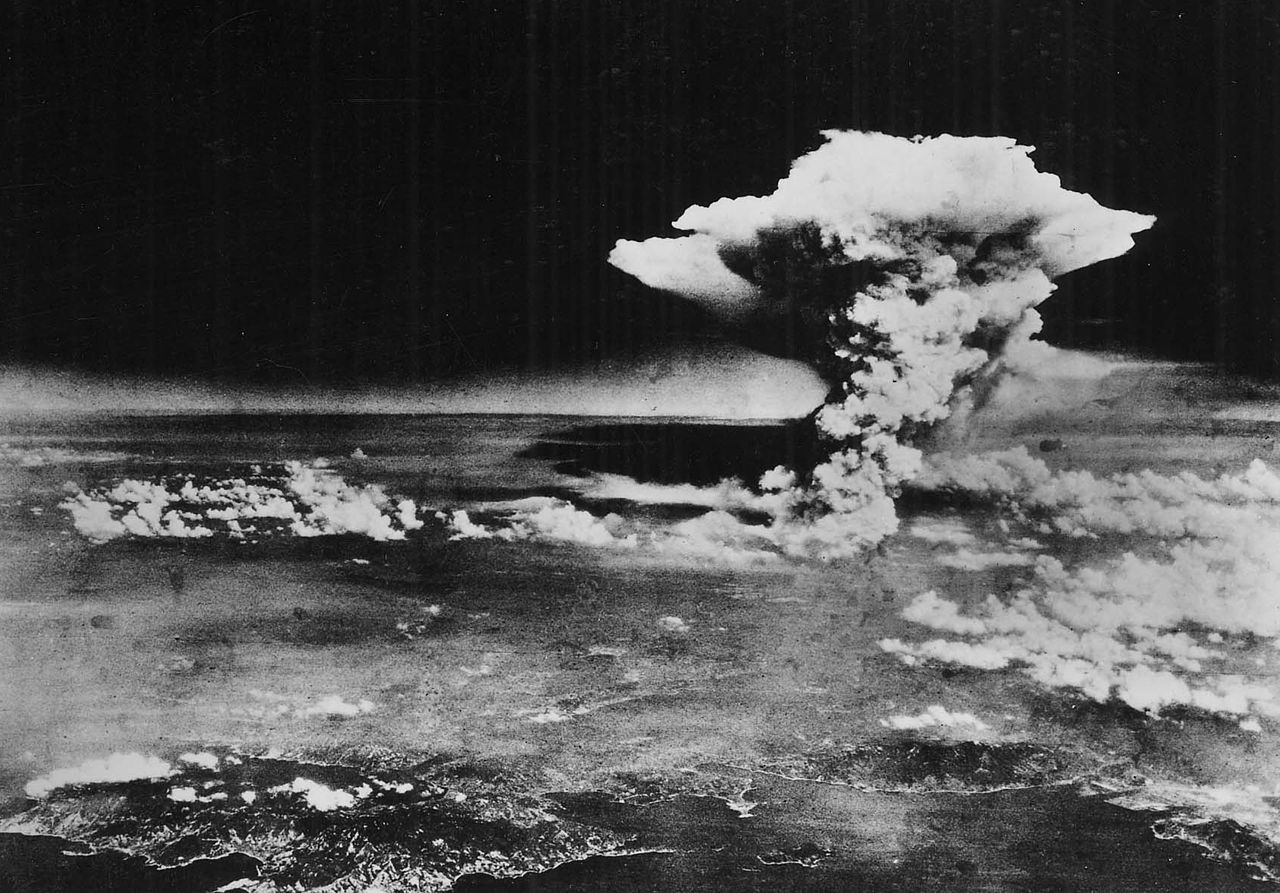
Atomic cloud over Hiroshima, taken from “Enola Gay” flying over Matsuyama, Shikoku, 6 August, 1945.
US Army Air Force photo via Wikimedia Commons.
It’s the anniversary of Hiroshima again today. I wasn’t going to write anything to mark the event (more coming next week on VJ Day), but I’ve been triggered already by nonsense on the radio which suggests that the atomic bombs on Hiroshima and Nagasaki were unnecessary, because Japan was about to surrender.
Nonsense. There is not a shred of real evidence to support this idea. In fact, the evidence that Japan wanted to keep on fighting is irrefutable. And yet this lie persists, despite the deluge of scholarly work demonstrating Japan’s commitment to the ritual suicide of its entire nation right until the end, when Hirohito pulled the plug. If you are in any doubt about the facts of the case, as opposed to the propaganda, read Toland’s Rising Sun (1970), Frank’s Downfall (2001), Spector’s In The Ruins of Empire (2007), Pike’s Hirohito’s War and, more recently, Stewart Binn’s Japan’s War (2025). All are excellent, clear, analytical and well researched. There are lots more, too.
Why does this canard keep on popping up? Is it because people don’t read? Or is it that they just don’t want to believe in the necessity of such a dramatic event to force Japan to surrender and thus bring about an end to the greatest man-made tragedy the world has ever suffered? The origins of this wishful myth in fact derives from hard right nationalist propaganda in post-war Japan (driven by Admiral Suzuki himself), quickly lapped up by the gullible and wishful thinkers in the West. Its one of the most enduring of the Hiroshima and Nagasaki myths, in part because it seems palatable to many, and because it is inherently anti-American.
What is the real story? In short, the Allies tried hard to persuade Japan to surrender. They demonstrated unequivocally to Japan that it was going to lose the war by defeating its armies and by beginning the long, slow and painful crawl towards the Japanese home islands. All the books I’ve mentioned note the extreme chaos of Japanese decision-making before and during the war. Who really was in charge? Who could one talk to, to secure a commitment to negotiate? In any case, the chaotic government under Koiso which replaced that of General Tojo following the fall to the Americans of Saipan in 1944, made not a single effort to engage with the Allies to seek terms. This government also collapsed on 5 April 1945. The replacement prime minister was Admiral Suzuki, and it was from this man that the myth seems to have arisen, after the war, that Japan was considering surrender and that the A-bombs were unnecessary. This is not true. During his entire time as Prime Minister he resolutely refused to do anything but continue to fight, unless the ending of the war could be secured on Japan’s terms. There were some initiatives to persuade the Suzuki government to surrender, but none of them amounted to much, because they didn’t engage directly with the government in Tokyo, and they didn’t derive from the Allied powers. The evidence that peace-feelers were being put out by various sources (such as the Vatican) in 1944 and 1945 is evidence only that the Japanese government ignored them. None were taken seriously in Tokyo.
Indeed, throughout the period of the Suzuki government, the war parties were dominant. In early June the military Supreme Command submitted a paper entitled The Fundamental Policy to be Followed Henceforth in the Conduct of the War, in which it demanded that the government confirmed that Japan would fight to the very last Japanese in an act of national suicide leading to the “honourable death of the hundred million”:
With a faith born of eternal loyalty as our inspiration, we shall – thanks to the advantages of our terrain and the unity of our nation, prosecute the war to the bitter end in order to uphold our national essence, protect the Imperial land and achieve our goals of conquest.
The proposition was passed, not unanimously, but overwhelmingly nonetheless.
There were some in the government – interestingly including Tojo himself – who saw that this was self-defeating, and that Japan must negotiate to secure acceptable peace terms. Naively, it was hoped that this would enable it to retain parts of its empire. Suzuki was part of this group who thought that Japan could negotiate favourable terms to end the war, in the form of a negotiated settlement such as that had brought about the end of the Russo-Japanese war in 1905, but when he suggested this in parliament on 13 June he was shouted down by the war mongers. Hirohito then endorsed an approach to the Soviets in late June. Bizarrely – though Moscow was neutral in the Far Eastern war at this point – Tokyo’s emissaries suggested that the USSR and Japan join forces to rule the world. It was yet more evidence of how Tokyo fundamentally misunderstood the world, and its enemies, and the way the war would have to end: complete and utter surrender by Japan.
Moscow, of course, scorned these “negotiations” as meaningless.
Comments Off on Debunking the idea that Japan was about to surrender anyway
August 7, 2025
War Rationing on the Italian Home Front during WWII
Tasting History with Max Miller
Published 4 Mar 2025Dry, dense wartime version of a traditional chestnut cake with lemon zest and no sugar
City/Region: Italy
Time Period: 1942Food shortages in Italy began years before WWII broke out, and cookbooks that focused on food scarcity had been published as early as 1935. They included recipes for things like soup made from vegetable peels and, like this recipe’s cookbook, instructions for cleaning when soap was rationed.
Castagnaccio is a traditional Tuscan chestnut cake, and this sugarless version is, I imagine, a far cry from what it should be. The cake is very dry, then turns gummy when you chew it, and I definitely recommend having something to wash it down (though you should probably just make a non-wartime version). The flavor isn’t bad, and the lemon really comes through, but it could really use some kind of sweetener.
Chestnut flour cake (without sugar).
What a sweet and lucky surprise to find in your pantry, still in its bag, some chestnut flour which you had completely forgotten about (an incredible thing, indeed, in these times!). Well, such a surprising and lucky circumstance happened to me, in these days, and since you must immediately take advantage of every piece of luck, I…measured 200 grams of the sweet flour; I poured it in a small bowl; I added half a tablespoon of oil, a pinch of salt and only the grated yellow part of a lemon zest; I mixed everything with as much milk as needed (I would have used water if I didn’t have milk at home); I added a whole sachet of yeast; I mixed everything well again; I poured everything in an oiled cake pan; I put the pan in the oven (not too hot); and…when I saw that the cake was swollen and baked…when I put it on the table in front of my family…insatiable gluttons…when the cake was celebrated…
“how lucky we were, mom, since you forgot about the flour” (the kids);
“today’s sweet cake is truly delicious” (the husband);
“what a pity the cake is so small” (the servant girl in her mind)
“it’s lucky that I was able to find such a good remedy for my unforgivable forgetfulness” (me, in my heart).”
— 200 Tips for…these times by Petronilla, 1942
Comments Off on War Rationing on the Italian Home Front during WWII
August 6, 2025
Schmeisser MK-36,II – The Mechanics of the MP40
Forgotten Weapons
Published 24 Mar 2025The German military began looking for a new submachine gun design in secret in the mid 1930s. There is basically no surviving documentation, but the main contenders appear to have featured: Hugo Schmeisser’s MK-36,II and Erma’s EMP-36. Today we are taking a look at the two known examples of the Schmeisser design at the British Royal Armouries. It is a simple blowback design with a full wooden stock, and chambered for 9x19mm (although the second example, made for Hungarian trials, is in 9x25mm). It does have a quite strange magazine safety, which prevents the bolt from opening if a magazine is not present — the purpose of this is a mystery to me.
The Schmeisser gun was simple and effective mechanically (expect for that weird safety), and it ultimately contributed its magazine, bolt, and fire control system to the MP38 and MP40 design. In exchange, the Haenel company that Schmeisser works for was one of the two initial MP38 manufacturers.
Many thanks to the Royal Armouries for allowing me to film and disassemble this unique prototype! The NFC collection there — perhaps the best military small arms collection in Western Europe — is available by appointment to researchers: https://royalarmouries.org/research/n…
You can browse the various Armouries collections online here:
https://royalarmouries.org/collection/
(more…)
Comments Off on Schmeisser MK-36,II – The Mechanics of the MP40
August 4, 2025
Day Ten – German Victory in the Battle of France – Ten Days in Sedan
World War Two
Published 3 Aug 2025May 19, 1940. Ten days into Fall Gelb, Guderian’s panzers thunder toward the Channel, poised to slam a steel ring around nearly half a million Allied troops. In Paris, Paul Reynaud ousts Daladier and Gamelin, calling back Marshal Pétain and General Weygand as France’s last throw of the dice. The pocket is almost shut, yet the story is far from over. Is there time for one more twist? Keep watching as we follow the fight to its end and discuss the aftermath of this campaign.
(more…)
Comments Off on Day Ten – German Victory in the Battle of France – Ten Days in Sedan
August 3, 2025
ZB37: Czechoslovakia’s Super-Heavy Machine Gun
Forgotten Weapons
Published 12 Mar 2025The ZB37 began in 1930 as a design by none other than classic Czech arms designer Vaclav Holek. The Czechoslovakian military was still using the Schwarzlose heavy MG, and wanted something to replace it. To fill all the roles intended, there would eventually be three different models of the ZB37 — one for infantry, one for fortresses, and one for vehicle mounting.
Note that the factory designation for this gun at Brno began as the ZB50, and iterated to the final version being the ZB50. However, it was identified by the military as the ZB37 (for 1937, the year of adoption).
After a series of redesigns, an early version of the gun is finally adopted in 1935 as the ZB35. A series of improvements leads to the final ZB37 model. About 500 of the early ZB35s were produced, and most of these were used to fill export sale contracts. By the time World War Two begins, the Czechoslovak military has about 5,000 of the guns in its possession.
Interestingly, the gun uses a hybrid recoil and gas operating system, with a tilting bolt. It has two rates of fire that can be chosen, and uses the rear spade grips as the charging handle. It is belt fed, using continuous 100- and 200-round metallic belts and chambered for the 8x57mm Mauser cartridge.
During the war, both German and British forces made substantial use of the ZB37. The Germans purchased ongoing production from Brno, and the British had actually purchased a production license before the war began. For the British, the gun was called the BESA and used in several armored vehicles (still in 8mm Mauser) — with about 57,000 being made during the war. A number of export sales were also made, including Romania, Persia, China, and several others. In 1946 another 3,000 were ordered and manufactured for fortress use in the Czech Republic, serving until the end of Communist control of the country.
Thanks to Sellier & Bellot for giving me access to this example to film for you!
(more…)
Comments Off on ZB37: Czechoslovakia’s Super-Heavy Machine Gun
July 27, 2025
Day Nine – Hitler’s Halt Order and Tragedy at La Ferté – Ten Days in Sedan
World War Two
Published 26 Jul 2025May 18, 1940. Our coverage of the German blitzkrieg in France continues. Today, we take a break from the panzers for a spot of old-fashioned siege warfare. At Ouvrage La Ferté, a small garrison of French troops makes a doomed last stand against overwhelming German firepower. We follow their final hours, the decisions that sealed their fate, and what their sacrifice meant for the collapsing French front.
(more…)
Comments Off on Day Nine – Hitler’s Halt Order and Tragedy at La Ferté – Ten Days in Sedan
July 24, 2025
SNK – The Me210 – An Ode To the Best Fighter of the War*
HardThrasher
Published 23 Jul 2025* fighter may actually be rubbish
References
===========
1 https://en.wikipedia.org/wiki/Fisher_…
2 https://planehistoria.com/hawker-typh…
3 https://www.historynet.com/why-britai…
4 The Development of French Interwar Bombers…
5 The Bombing War, Overy, 2012, p.200
6 p1, Profile 161, The Messerschmitt Me210/410 Series, Smith
7 p.43, Chpt 6, The Me210/410 Story, Jan Forsgren, Fonthill Media, 2019
8 The B-29 Turret System: An Expensive, Effe… – Alexander OK’s B-29 Video
9 p.43 The Me210/410 Story, Jan Forsgren, Fonthill Media, 2019
10 Ibid p.74
11 Ibid p.53
12 Ibid p.58
13 Ibid p.65-67
14 Ibid P.78 -85
15 Ibid p.231
16 The Bomber War, Robert Overy, 2012 p.203
17 Inside the Third Reich, Albert Speer, 1970, Simon & Schauster (reprint Touchstone, 1997)
18 p. 175 The Me210/410 Story, Jan Forsgren, Fonthill Media, 2019Cars For Ukraine – https://car4ukraine.com/campaigns/sum…
Comments Off on SNK – The Me210 – An Ode To the Best Fighter of the War*
July 20, 2025
Day Eight – Can Charles de Gaulle Save France? – Ten Days in Sedan
World War Two
Published 19 Jul 2025Ten Days in Sedan continues as our WW2 Blitzkrieg documentary follows the first serious counterblow against the German spearhead. Colonel Charles de Gaulle leads the 4th Armoured Division in an attack against the German flank. De Gaulle’s units are understrength and his assault is improvised but he catches Heinz Guderian by complete surprise. Is this just a fleeting gesture of defiance, or a new kind of French resistance?
(more…)
Comments Off on Day Eight – Can Charles de Gaulle Save France? – Ten Days in Sedan
July 16, 2025
German Sten Copy: MP-3008, aka Gerät Neumünster
Forgotten Weapons
Published 4 Feb 2016The MP 3008, aka Gerät Neumünster, was one of two German efforts to copy the British Sten gun. The first was the Gerät Potsdam (“gerät” meaning device or project; basically project code name), which was a direct copy of the Sten distinguishable only by a marking details and a few differences in manufacturing processes. While 10,000 of those were being manufactured by Mauser, R&D engineer Ludwig Vorgrimmler was simplifying the Sten design even farther, resulting in the MP-3008.
This simplified design did away with the Sten’s barrel shroud, and used a vertical magazine well instead of the Sten’s distinctive horizontal mounting. These were the significant changes, although there was also a sling loop placed on the front of the magazine well and a few minor simplifications to the fire control parts. Unlike the Potsdam, significant variation can be found in the MP-3008 in the details of stock and grip design.
In a masterpiece of insane optimism, German official placed an order for literally a million MP-3008 submachine guns, which of course was completely insane. Manufacture was undertaken at a wide scattering of small shops, with guns being assembled by larger manufacturers from supplied parts. The total made is not known, but is probably in the range of 3000-5000. Some are marked with manufacturing codes from recognized factories, some with codes unknown, and some have no marking at all. This particular example is dewat made by “TJK” — an unknown factory.
Comments Off on German Sten Copy: MP-3008, aka Gerät Neumünster
July 14, 2025
Day Seven – Ghost Division! – Ten Days in Sedan
World War Two
Published 13 Jul 2025May 16 1940: Our WW2 Blitzkrieg documentary, Ten Days in Sedan, continues as Winston Churchill arrives in Paris. The Prime Minister still has hope but he’s shocked to see the French burning documents and preparing to evacuate. Meanwhile French and German tanks slug it out in Stonne, Guderian reaches Montcornet, and Rommel leads his Ghost Division far behind French lines.
Chapters
00:00 Intro
00:58 Recap
01:38 Stonne
03:05 Panzers Drive West
07:02 New French Plan
12:23 Rundstedt’s Halt Order
16:06 Ghost Division
21:53 Churchill in Paris
(more…)
Comments Off on Day Seven – Ghost Division! – Ten Days in Sedan
July 13, 2025
Tiger II: What was the point?
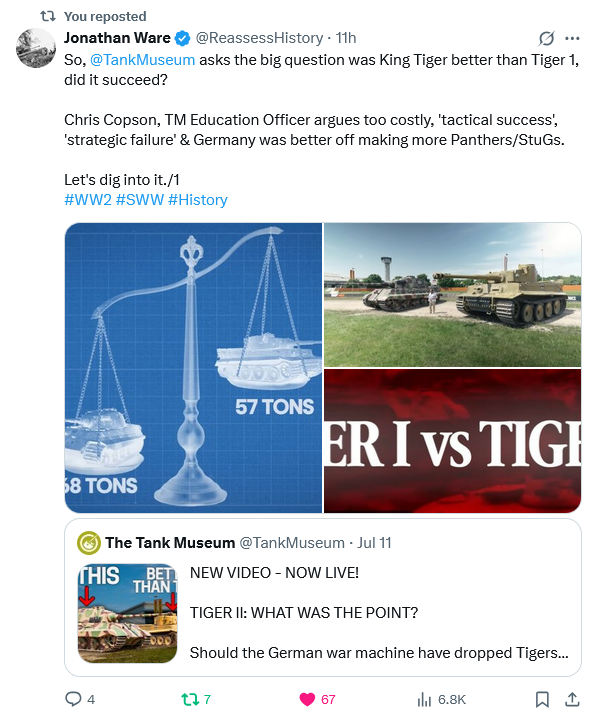
The folks at the Tank Museum at Bovington put together a video comparing the Tiger II to the earlier Tiger I and the typical allied tanks they faced on the battlefield. On the social media site formerly known as Twitter, historian Jonathan Ware posted a long thread about both the topics the Tank Museum’s video raised and where he feels they should have added more context:
And here’s the Tank Museum’s video itself:
FEATURING FOOTAGE OF TIGER I AND TIGER II RUNNING TOGETHER AT TANKFEST 2025 – with thanks to Musée des Blindés and World of Tanks.
It’s absurdly large, heavy, expensive, and difficult to build. So, you have to ask; what is the point of Tiger II when you already have the biggest, toughest and meanest beast on the block – Tiger I.
Whilst the Tiger I has maintained a legendary status since its appearance on the battlefield, there were many aspects of this tank’s design that were pretty much dead ends. The turret couldn’t be resized to fit a more powerful gun. And adding extra weight in the form of armour would put a huge amount of strain on the internal mechanics. So, a new tank was needed to ensure the German’s could maintain their edge against Allied armour.
Enter the Tiger II, otherwise known as the King Tiger. Heavily armed, the Tiger II could take on any Allied tanks that it faced, with its KwK 43 able to penetrate the frontal armour of a Sherman at 1,800m. Its thick sloped armour was incredibly dependable, and no Allied tank commander would willingly engage a Tiger II in a head-to-head fight.
The Tiger II’s battlefield presence came at a significant cost. A single Tiger II could take up to 400,000 hours to build at a price of RM 321,500 – up to 100,000 more hours than a Tiger I, and over twice the cost of a Panther. A while the Allies were churning out tanks that were “good enough”, the Germans were committed to quality and ensuring their tanks would always have the edge against enemy armour.
The Tiger II has often been described as a tactical success for its battlefield prowess, but a strategic failure for being so resource-hungry, expensive and relatively low in number. Given their cost, it forces us to question whether the German war machine should have dropped Tigers altogether in favour producing tanks that were cheaper and easier to build
00:00 | Introduction
00:55 | Durchbruchswagen
06:15 | Tiger I vs Tiger II
12:52 | The Numbers Game
17:34 | Was Tiger II a Success?This video features archive footage courtesy of British Pathé.
In this film, Chris Copson breaks down the differences between two legendary tanks – the Tiger I and Tiger II. Whilst Tiger I was an impressive tank, certain areas of its design were an evolutionary dead-end. Its boxy turret couldn’t be enlarged to fit a bigger gun, and the hull couldn’t be up armoured without adding stress to the drive train. So, Tiger II ordered in 1943, including even thicker, sloped armour and a much more destructive gun. With mixed success on the battlefield, difficulties in maintaining its complex mechanics and reliance on dwindling supply lines, the Tiger II ended up being a tactic success, but a strategic failure.
Want to learn more about the Tiger I and Tiger II? Here are some of the sources we used to make this film:
Panzer Tracts No.23 – Panzer Production from 1933 to 1945 by Thomas Jentz and Hilary Doyle, 2011
Germany’s Tiger Tanks, DW to Tiger I: Design, Production and Modifications by Thomas Jentz and Hilary Doyle, 2000
Germany’s Tiger Tanks, VK45.02 to Tiger II: Design, Production and Modifications by Thomas Jentz and Hilary Doyle, 1997
Encyclopedia of German Tanks of World War Two, Revised Edition by Peter Chamberlain and Hilary Doyle, 1993
Tigerfibel. English translation by The Tank Museum, 2022
Panther and its Variants by Walter Spielberger, 1978
Armored Champion: The Top Tanks of World War II by Steven Zaloga, 2015
www.tankarchives.com
www.forum.axishistory.com
www.achtungpanzer.com
www.feldgrau.net
Comments Off on Tiger II: What was the point?
Q&A: Finland and Finnish Small Arms (From Berdan to New Sako AR)
Forgotten Weapons
Published 19 Feb 2025Today’s Q&A is brought to you by the fine folks at Patreon!
I figured that Finland would be a good subject for this month’s Q&A, as I am visiting the country to shoot Finnish Brutality this month. In fact, this video was filmed during the trip (the match took place last weekend, and its video coverage will be coming soon!).
00:39 – Development of the Suomi and PPSh-41 submachine guns
03:24 – Oldest guns used in Finnish Independence War
04:40 – Biggest strength and weakness of the Suomi
06:43 – Soviet use of captured Suomis?
08:52 – Finnish Maxim guns
11:41 – Finnish alcohol
17:05 – Finnish small arms that could have been globally popular but weren’t?
20:04 – Benefits of a small invaded country using the same weapons as its invader?
23:07 – Favorite and least favorite Finnish customs?
25:57 – Finnish Mosin Nagant book by Matt DiRisio
27:26 – Sisu movie
28:28 – Are the Finns masters of improving other peoples’ guns?
30:08 – Pre-independence Finnish arms production
31:47 – Shower beer or sauna beer?
32:20 – Why so few RK95 rifles made, and RK95 vs RK62M?
35:35 – Swedish Mausers in Finland
37:54 – Commercial Sako rifles before and after Beretta bought Sako
39:19 – Finnish gun laws, specifically CCW
40:58 – Interlude: Finnish Brutality 2025 match update w/ Jari Laine
42:24 – Did Finland improve the PKM and SVD like they did the AK and Mosin?
44:57 – 7.62x54R vs 7.62x53R
47:56 – Thoughts on new Sako AR for Swedish and Finnish militaries
(more…)
Comments Off on Q&A: Finland and Finnish Small Arms (From Berdan to New Sako AR)


