Sabaton History
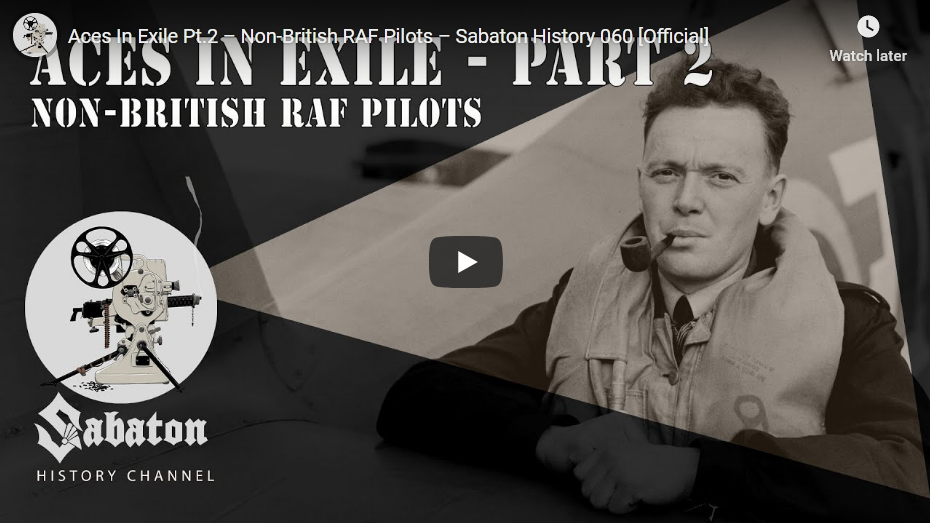
Published 26 Mar 2020“Aces in Exile” return! Interesting times make for interesting men. In this second part we talk about some individual stories of Czechoslovakian, Polish and Canadian pilots that all fought under the banner of the British Royal Air Force during the Second World War. How they escaped German occupation, how they traveled through war torn Europe, and how they eventually found themselves fighting in a different uniform for a different country.
We would like to thank the World of Tanks team for their contribution and help with the video filming. If you’re not yet a World of Tanks player, join the game and get your hands on cool in-game stuff for free via the link: https://redir.wargaming.net/w7fwclmx/…
Support Sabaton History on Patreon: https://www.patreon.com/sabatonhistoryListen to “Aces in Exile” on the album Coat of Arms:
CD: http://bit.ly/CoatOfArmsStore
Spotify: http://bit.ly/CoatOfArmsSpotify
Apple Music: http://bit.ly/CoatOfArmsAppleMusic
iTunes: http://bit.ly/CoatOfArmsiTunes
Amazon: http://bit.ly/CoatOfArmsAmzn
Google Play: http://bit.ly/CoatOfArmsGooglePlayCheck out the trailer for Sabaton’s new album The Great War right here: https://www.youtube.com/watch?v=HCZP1…
Listen to Sabaton on Spotify: http://smarturl.it/SabatonSpotify
Official Sabaton Merchandise Shop: http://bit.ly/SabatonOfficialShopHosted by: Indy Neidell
Written by: Markus Linke and Indy Neidell
Directed by: Astrid Deinhard and Wieke Kapteijns
Produced by: Pär Sundström, Astrid Deinhard and Spartacus Olsson
Creative Producer: Joram Appel
Executive Producers: Pär Sundström, Joakim Broden, Tomas Sunmo, Indy Neidell, Astrid Deinhard, and Spartacus Olsson
Post-Production Director: Wieke Kapteijns
Edited by: Iryna Dulka
Sound Editing by: Marek Kaminski
Maps by: Eastory – https://www.youtube.com/c/eastoryArchive by: Reuters/Screenocean https://www.screenocean.com
Music by Sabaton.Sources:
– Narodowe Archiwum Cyfrowe
– IWM: CH 1566
– Morane-Saulnier icon by Truszko from Wikimedia
– D.520 icon by PpPachy from Wikimedia
– Hurricane icon by Martin Čížek from WikimediaAn OnLion Entertainment GmbH and Raging Beaver Publishing AB co-Production.
© Raging Beaver Publishing AB, 2019 – all rights reserved.
March 27, 2020
“Aces In Exile” Pt.2 – Non-British RAF Pilots – Sabaton History 060 [Official]
March 25, 2020
Hans Oster – A German Against Nazism – WW2 Biography Special
World War Two
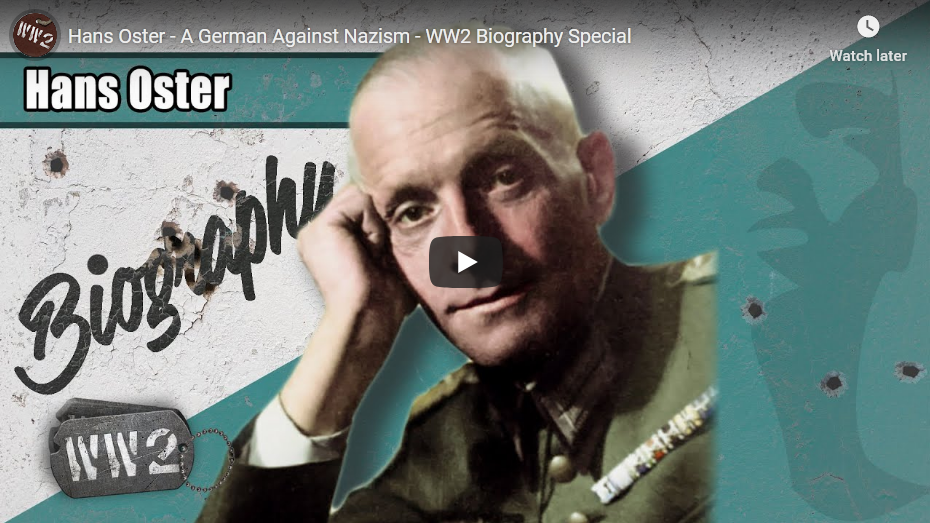
Published 24 Mar 2020Hans Oster opposed the Nazis and tried to oppose them from early on. As a member of the Abwehr, he tried to do whatever he could. During the war, his efforts increased with a dramatic outcome.
Join us on Patreon: https://www.patreon.com/TimeGhostHistory
Or join The TimeGhost Army directly at: https://timeghost.tvFollow WW2 day by day on Instagram @World_war_two_realtime https://www.instagram.com/world_war_t…
Between 2 Wars: https://www.youtube.com/playlist?list…
Source list: http://bit.ly/WW2sourcesHosted by: Spartacus Olsson
Written by: Isabel Wilson, Joram Appel and Spartacus Olsson
Produced and Directed by: Spartacus Olsson and Astrid Deinhard
Executive Producers: Bodo Rittenauer, Astrid Deinhard, Indy Neidell, Spartacus Olsson
Creative Producer: Joram Appel
Post-Production Director: Wieke Kapteijns
Research by: Arnaldo Teodorani and Isabel Wilson
Edited by: Iryna Dulka
Map animations: Eastory (https://www.youtube.com/c/eastory)Colorizations by:
Dememorabilia – https://www.instagram.com/dememorabilia/Sources:
Picture of Dresden, courtesy Wikimedia Commons https://commons.wikimedia.org/wiki/Fi…
Collection of Auckland War Memorial Museum Tamaki Paenga Hira, N2658
Narodowe Archiwum Cyfrowe
Picture of Gijsbertus Jacobus Sas, courtesy ANP Historisch Archief https://www.anp-archief.nl/page/21998…
Picture of Hans Bernd Gisevius, courtesy Gedenkstätte Deutscher Widerstand https://www.gdw-berlin.de/en/recess/b…
id by Flatart from the Noun Project
people by ProSymbols from the Noun Project
documents by Srinivas Agra from the Noun ProjectSoundtracks from the Epidemic Sound:
Johannes Bornlof – “Deviation in Time”
Andreas Jamsheree – “Guilty Shadows 4”
Fabien Tell – “Last Point of Safe Return”
Reynard Seidel – “Deflection”
Jo Wandrini – “Puzzle of Complexity”
Gunnar Johnsen – “Not Safe Yet”Archive by Screenocean/Reuters https://www.screenocean.com.
A TimeGhost chronological documentary produced by OnLion Entertainment GmbH.
March 23, 2020
Naval strategy versus naval tactics in the Battle of the Atlantic
Ted Campbell outlines how the Battle of the Atlantic was fought between the Kriegsmarine and the Royal Navy (and the Royal Canadian Navy and, eventually, the United States Navy) in World War 2:
… there is a rather thick, and quite blurry line between naval strategy and naval tactics. One Army.ca member used the Battle of the Atlantic to distinguish between two doctrines:
- Sea control ~ which was practised by the 2nd World War allies ~ mostly British Admirals Percy Noble and Max Horton in Britain and Canadian Rear Admiral Leonard Murray in St John’s and Halifax; and
- Sea denial ~ which was practised by German Admiral Karl Dönitz.
The difference between the two tactical doctrines was very clear. The strategic aims were equally clear:
- Admiral Dönitz wanted to knock Britain out of the war ~ something that he (and Churchill) understood could be done by starving Britain into submission by preventing food, fuel and ammunition from reaching Britain from North America. (We can be eternally grateful that Adolph Hitler did not share Dönitz’ strategic vision and listened, instead, to lesser men and his own, inept, instincts); and
- Prime Minister Churchill, who really did say that “the only thing that ever really frightened me during the war was the U-boat peril“, who wanted to keep Britain fighting, at the very least resisting, until the Americans could, finally, be persuaded to come to the rescue.
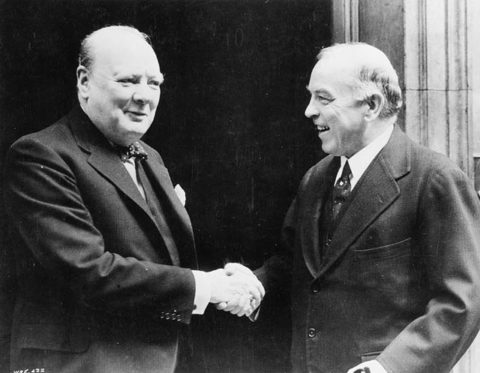
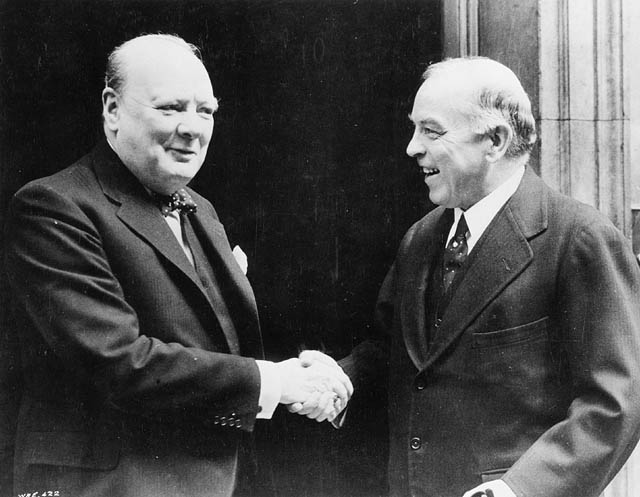
Prime Minister Winston Churchill greets Canadian PM William Lyon Mackenzie King, 1941.
Photo from Library and Archives Canada (reference number C-047565) via Wikimedia Commons.Canada’s Prime Minister Mackenzie King did have a grand strategy of his own. It was to do as much as possible while operating with the lowest possible risk of casualties ~ the conscription crisis of 1917 was, always, uppermost in his mind and he was, therefore, terrified of casualties. He mightily approved of the Navy doing a HUGE share in the Battle of the Atlantic ~ especially by building ships in Canadian yards and escorting convoys which he hoped would be a low-risk affair.
Churchill’s grand strategy was based on Britain surviving … there was, I believe, a “worst case” scenario in which the British Isles were occupied and the King and his government went to Canada or even India. But that has always seemed to me to be a sort of fantasy. The United Kingdom, without the British Isles, made no sense.
(While I believe that Rudolph Hess was, as they say, a few fries short of a happy meal, I think that he and several people in Germany believed that it might be possible to negotiate a peace with Britain which many felt was a necessary precursor to a successful campaign against Russia. The Battle of Britain (die Luftschlacht um England, September 1940 to June 1941) was, clearly, not going in Germany’s favour. Late in 1940, the Nazi high command had been forced to send a German Army formation to Libya to prevent a complete rout of the Italians. Malta still held out, meaning that Britain had air cover throughout the Mediterranean. In short, Britain was not going to go down unless it could be starved into submission ~ and in the spring of 1941, the Battle of the Atlantic was going in Germany’s favour. There was, in other words, some reason for Germans to believe that an armistice might be possible ~ freeing up all of Germany’s power to be used against the USSR.)
(But things were changing for the Allies, too. At just about the same time as Hess was flying to Scotland, then Commodore Leonard Murray of the Royal Canadian Navy, who had been in England on other duties, had met with and persuaded Admiral Sir Percy Noble, who liked Murray and had been his commander in earlier years, that a new convoy escort force should be established in Newfoundland and that it should be a largely Canadian force (with British, Dutch, Norwegian and Polish ships under command, too) and that it should be commanded by a Canadian officer. Admiral Noble insisted, to Canada, that Murray, who he liked, personally, and who had written, extensively, on convoy operations in the 1920s and ’30s, must be that commander. The establishment of the Newfoundland Escort Force, which would be more appropriately renamed the Mid Ocean Escort Force in 1942, was a key decision at the much-debated operational level of war which put an expert tactician (Murray) in command of a major force and allowed him (and Noble) to move closer to achieving Churchill’s strategic aim. The Battle of the Atlantic was not won in 1941, but it seemed to Churchill, Noble and Murray that they were a lot less likely to lose it, even without the Americans.)
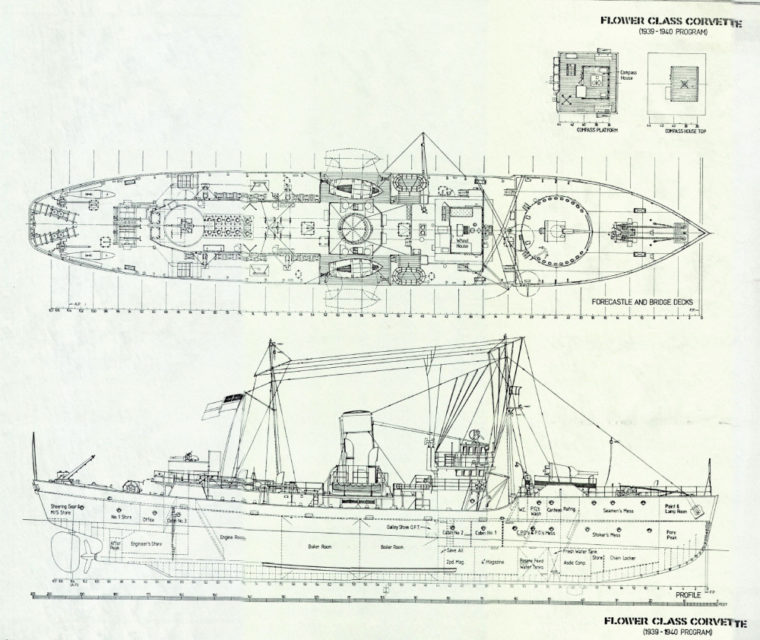
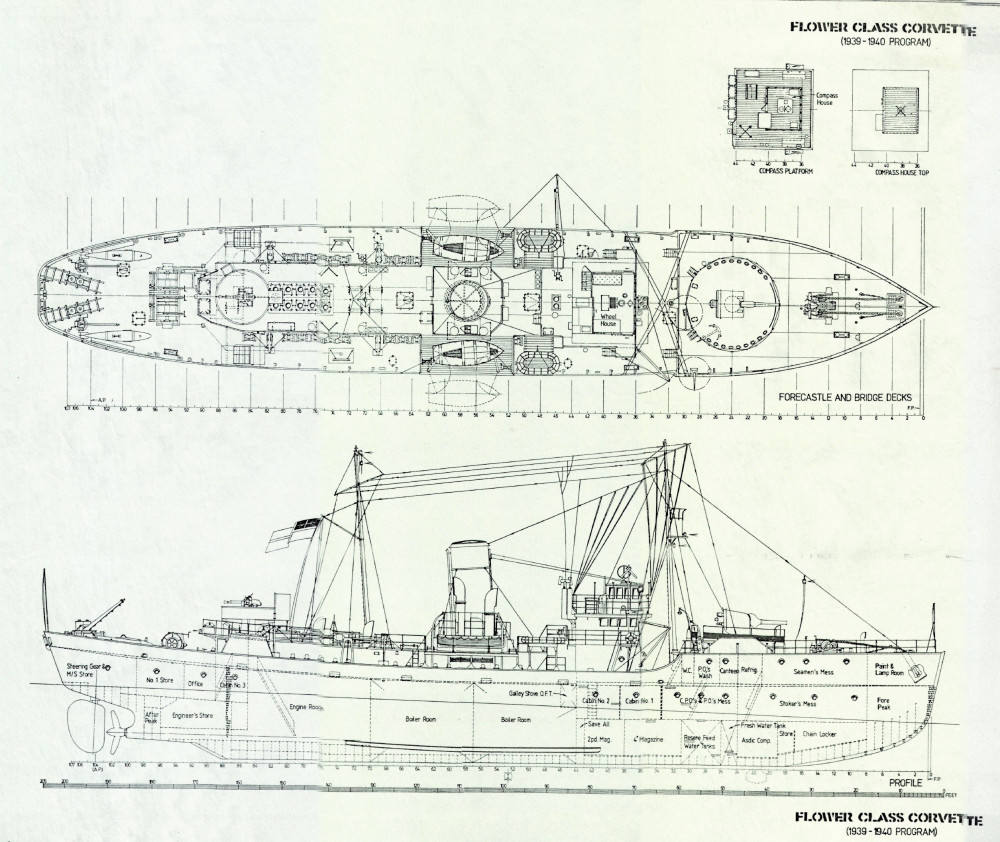
Diagram of the early Flower-class corvettes, via Lt. Mike Dunbar (https://visualfix.wordpress.com/2017/04/12/dreadful-wale-4/)
Anyway, the boundaries of strategy vs. the operational art vs. tactics were as thick and blurry in 1941 as they are today. The decision, taken in 1939, for example, to build little corvettes in the many British and Canadian yards that could not build a real warship was, in retrospect, a key strategic choice, but it was, at the time, totally materialist: just a commonsense, engineer solution to an operational problem ~ lack of ships. Ditto for the eventual decision, which had to be made by Churchill, himself, to reassign some of the big, long-range, Lancaster heavy bombers to Coastal Command. It was, once again, with the benefit of hindsight, a key strategic move, but at the time it would likely have seemed, to Capt(N) Hugues Canuel, the author of that Canadian Naval Review essay, to be materialistic, more concerned with how to use the resources available than with deciding what is needed.
I agree with Capt(N) Canuel that, by and large, Canadians have left strategic and even operational level thinking to first, the British and more recently the American admirals ~ Rear Admiral Murray being known, in the 1930s and early 1940s as a notable exception.

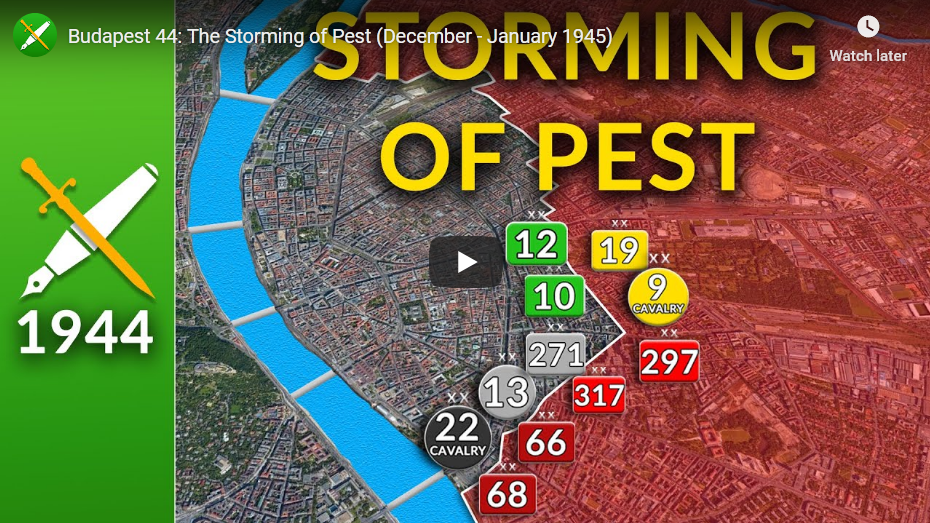
Budapest 44: The Storming of Pest (December – January 1945)
Historigraph
Published 21 Dec 2019Claim your 81% off three years of NordVPN, four extra months for free and NordPass Password Manager right here: https://nordvpn.com/historigraph
—
Buy Historigraph Posters here! https://teespring.com/en-GB/surrender…
Support the channel on Patreon: https://www.patreon.com/historigraph#SiegeOfBudapest #StormingOfPest #Historigraph #NordVPN
►Twitter: https://twitter.com/historigraph
►Instagram: https://www.instagram.com/historigraph
►Patreon: https://www.patreon.com/historigraph
►Discord: https://discord.gg/vAFTK2DMusic:
“Crypto”, Incompetech https://incompetech.com
“Rynos Theme”, Incompetech
March 22, 2020
Culling the Nazi Wolfpacks – Submarines, Spies, China, and Africa – WW2 – 082 – March 21 1941
World War Two
Published 21 Mar 2020While two more Kriegsmarine U-boat aces go down, the moving parts of the war are getting more complex leaving the intelligence services scrambling to separate fact from fiction — they don’t always get it right.
Join us on Patreon: https://www.patreon.com/TimeGhostHistory
Or join The TimeGhost Army directly at: https://timeghost.tvFollow WW2 day by day on Instagram @World_war_two_realtime https://www.instagram.com/world_war_t…
Between 2 Wars: https://www.youtube.com/playlist?list…
Source list: http://bit.ly/WW2sourcesWritten and Hosted by: Indy Neidell
Produced and Directed by: Spartacus Olsson and Astrid Deinhard
Executive Producers: Bodo Rittenauer, Astrid Deinhard, Indy Neidell, Spartacus Olsson
Creative Producer: Joram Appel
Post-Production Director: Wieke Kapteijns
Research by: Indy Neidell
Edited by: Iryna Dulka
Map animations: Eastory (https://www.youtube.com/c/eastory)Colorizations by:
– Olga Shirnina a.k.a. Klimbim – https://klimbim2014.wordpress.com/
– Dememorabilia – https://www.instagram.com/dememorabilia/
– Julius Jääskeläinen – https://www.facebook.com/JJcolorization/Sources:
– BundesarchivArchive by Screenocean/Reuters https://www.screenocean.com.
A TimeGhost chronological documentary produced by OnLion Entertainment GmbH.
From the comments:
World War Two
2 days ago
Indy is at the studio in Bavaria at the moment, shooting new episodes up to May 2020. We don’t know what impact the virus has on our production beyond that, but for now we seem to be fine. That is, thanks to your support! Most of our other (personal) sources of income has fallen away now – we are not able to pay everyone a fair wage just yet. In fact, most of the budget goes into licensing, equipment, editors, researchers and travel. If you can, please consider to support us on www.patreon.com/timeghosthistory or https://timeghost.tv so we can continue to make these series! Thank you all for your support and appreciation! Take care and be safe!
Cheers, Joram
March 21, 2020
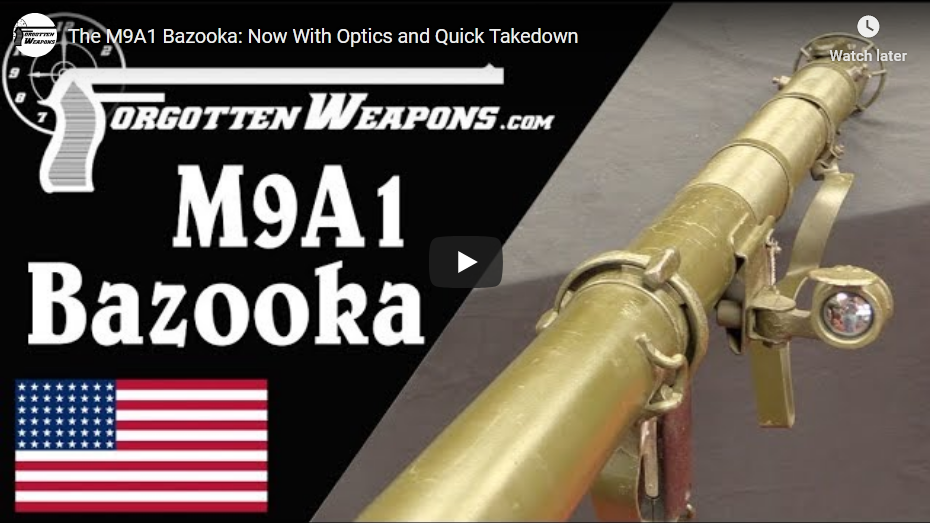
The M9A1 Bazooka: Now With Optics and Quick Takedown
Forgotten Weapons
Published 18 Aug 2018Sold for $7,475
http://www.patreon.com/ForgottenWeapons
Cool Forgotten Weapons merch! http://shop.bbtv.com/collections/forg…
The Bazooka — or rather the Launcher, Rocket, 2.36″, M1 — was introduced by the United States in 1942, the result of a fast development by two Army officers, Captain Leslie Skinner and Lt. Edward Uhl. The US had no infantry antitank weapon at that point, and it had become quite clear that such a thing was needed. The Bazooka offered a theoretical effective range of 300 yards, throwing a 1 pound hollow-charge projectile capable of penetrating 4 inches of armor plate. The 2.36 inch bore measurement, incidentally, was chosen as the inch equivalent of 60mm, to match the common mortar size.
In October of 1943, an improved M9 version was introduced, using a magnet firing system instead of the unreliable batteries of the original. A followup M9A1 variant was adopted in June of 1944, which broke down into two parts for easier transportation, and the T90 optical sight was added in September of 1944. These were effective weapons against armor early in the war, but the heavier tanks introduced late in the war were too heavily armored for the Bazooka to be very effective — although it remained a valuable tool for attacking pillboxes and other fortified positions. It would continue to see extensive service in the Korean War, although its limited armor penetration was particularly acute in that conflict.
Note that the inert M6 rocket in the video is not being sold with the Bazooka.
If you enjoy Forgotten Weapons, check out its sister channel, InRangeTV! http://www.youtube.com/InRangeTVShow
March 20, 2020
Will Stalin invade India? And what about the West Indies? – WW2 – Out of the Foxholes 008
World War Two
Published 19 Mar 2020In today’s episode of Out of the Foxholes, we answer exciting questions concerning Dutch and French colonies in America, British defence strategies in India and French soldiers stuck in Britain post-armistice.
Ask your own question for Out of the Foxholes here: https://community.timeghost.tv/c/Out-…
Join us on Patreon: https://www.patreon.com/TimeGhostHistory
Or join The TimeGhost Army directly at: https://timeghost.tvFollow WW2 day by day on Instagram @World_war_two_realtime https://www.instagram.com/world_war_t…
Between 2 Wars: https://www.youtube.com/playlist?list…
Source list: http://bit.ly/WW2sourcesHosted by: Indy Neidell
Written by: Rune Væver Hartvig
Produced and Directed by: Spartacus Olsson and Astrid Deinhard
Executive Producers: Bodo Rittenauer, Astrid Deinhard, Indy Neidell, Spartacus Olsson
Creative Producer: Joram Appel
Post-Production Director: Wieke Kapteijns
Research by: Rune Væver Hartvig
Edited by: Mikołaj Cackowski
Map animations: Eastory (https://www.youtube.com/c/eastory)Colorizations by:
Norman Stewart – https://oldtimesincolor.blogspot.com/
Dememorabilia – https://www.instagram.com/dememorabilia/Sources:
IWM H 3508, D 1725
gold by Phạm Thanh Lộc from the Noun Project
Rum by Andrejs Kirma from the Noun Project
sugar by Maria Zamchy from the Noun ProjectSoundtracks from the Epidemic Sound:
Hakan Eriksson – “Adventure Theme 3”
Johannes Bornlof – “The Inspector 4”
Reynard Seidel – “Deflection”Archive by Screenocean/Reuters https://www.screenocean.com.
A TimeGhost chronological documentary produced by OnLion Entertainment GmbH.
“Aces In Exile” Pt.1 – Non-British RAF Pilots – Sabaton History 059 [Official]
Sabaton History
Published 19 Mar 2020“Aces In Exile” prevail! Did you know that the war in the skies above Britain was not just fought by men from the British Isles alone? It was also fought by men who were forced to flee their home-countries from Nazi occupation and journey through war-torn Europe to continue the resistance. As France fell, pilots from Poland, Czechoslovakia and Canada found themselves once more in the seat of foreign fighter-planes, to fend off the German war-machine in the Battle of Britain.
Support Sabaton History on Patreon: https://www.patreon.com/sabatonhistory
Listen to “Aces in Exile” on the album Coat of Arms here:
CD: http://bit.ly/CoatOfArmsStore
Spotify: http://bit.ly/CoatOfArmsSpotify
Apple Music: http://bit.ly/CoatOfArmsAppleMusic
iTunes: http://bit.ly/CoatOfArmsiTunes
Amazon: http://bit.ly/CoatOfArmsAmzn
Google Play: http://bit.ly/CoatOfArmsGooglePlayCheck out the trailer for Sabaton’s new album The Great War right here: https://www.youtube.com/watch?v=HCZP1…
Listen to Sabaton on Spotify: http://smarturl.it/SabatonSpotify
Official Sabaton Merchandise Shop: http://bit.ly/SabatonOfficialShopHosted by: Indy Neidell
Written by: Markus Linke and Indy Neidell
Directed by: Astrid Deinhard and Wieke Kapteijns
Produced by: Pär Sundström, Astrid Deinhard and Spartacus Olsson
Creative Producer: Joram Appel
Executive Producers: Pär Sundström, Joakim Broden, Tomas Sunmo, Indy Neidell, Astrid Deinhard, and Spartacus Olsson
Post-Production Director: Wieke Kapteijns
Edited by: Iryna Dulka
Sound Editing by: Marek Kaminski
Maps by: Eastory – https://www.youtube.com/c/eastoryArchive by: Reuters/Screenocean https://www.screenocean.com
Music by Sabaton.Sources:
– IWM: CH1733, Q 69697, CH1501, CH 1438, CH 1291, CH 1294, CH 12321, CH 1286, CH 1540, CH 587, CH 1538, CH 1535, CH 1137, CH 2440, HU 106457, D 1731, CH 4790
– Photo of the Battle of Britain Monument by Eluveitie from Wikimedia
– Instytut Pamięci NarodowejAn OnLion Entertainment GmbH and Raging Beaver Publishing AB co-Production.
© Raging Beaver Publishing AB, 2019 – all rights reserved.
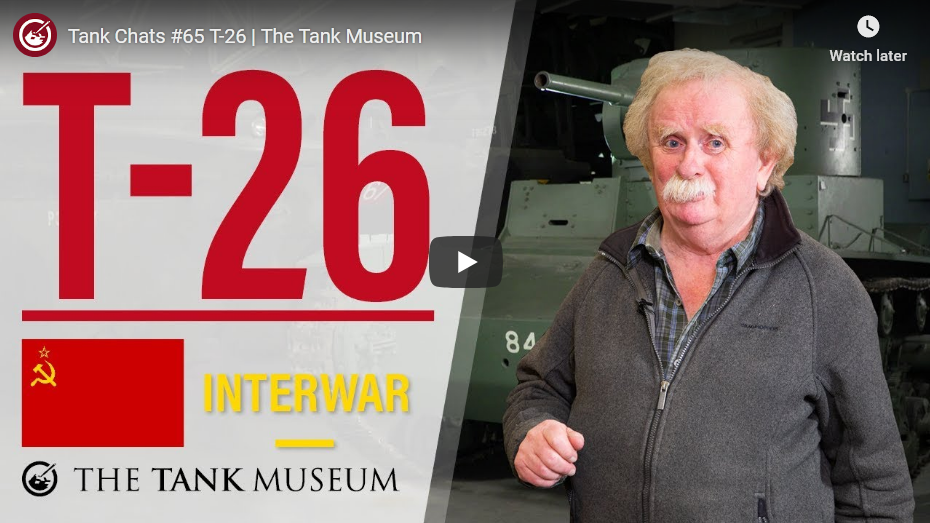
Tank Chats #65 T-26 | The Tank Museum
The Tank Museum
Published 28 Jan 2019This particular T-26 tank, at The Tank Museum, was a T-26A and, after capture by the Finns, modified to T-26B configuration. It was used by Soviet forces in the war against Finland in the winter of 1940/41. It was captured and used by the Finnish Army, in whose markings it is seen.
Find out more about the Winter War from the WW2 Channel and David Willey. https://youtu.be/Etfhio8vrXE
Support the work of The Tank Museum on Patreon: ► https://www.patreon.com/tankmuseum
Visit The Tank Museum SHOP: ► https://tankmuseumshop.org/
Twitter: ► https://twitter.com/TankMuseum
Tiger Tank Blog: ► http://blog.tiger-tank.com/
Tank 100 First World War Centenary Blog: ► http://tank100.com/ #tankmuseum #tanks #tankchats
March 18, 2020
How Does It Work: Roller Delayed Blowback
Forgotten Weapons
Published 17 Mar 2020http://www.patreon.com/ForgottenWeapons
https://www.floatplane.com/channel/Fo…
Cool Forgotten Weapons merch! http://shop.bbtv.com/collections/forg…
Roller delayed blowback originated in the Mauser company R&D department when engineers were attempting to design a roller-locked version of the G43 rifle. They found that when the bolt bounced in automatic fire, the system would sometimes work without being fully locked. With some refinement, this became the roller delayed system, and would have been used in the StG-45 rifle if the war had gone longer. After the war, the system was applied to prototype French arms, then to the Spanish CETME program which eventually became the German G3 rifle. The system would see use primarily as the basis of a whole family of arms from Heckler & Koch, although it has been used in a few other places.
Mechanically, the system uses an angled “locking” wedge to put a mechanical disadvantage on a pair of rollers that must retract into the bolt head before it can move rearward. The combination of the wedge angle and the mass of the bolt carrier assembly are carefully calculated to delay the action from opening until pressure is reduced to a safe level. These systems do typically open faster than locked actions, though, and generally require the use of chamber fluting to ensure reliable extraction.
Contact:
Forgotten Weapons
6281 N. Oracle #36270
Tucson, AZ 85740
When You Run Out of Stuff to Hoard – Rationing 1940 – On the Homefront 001
World War Two
Published 17 Mar 2020In this first episode of On the Homefront, Anna tells you about division of labour, food production and rationing in the early years of the war.
Join us on Patreon: https://www.patreon.com/TimeGhostHistory
Or join The TimeGhost Army directly at: https://timeghost.tvFollow WW2 day by day on Instagram @World_war_two_realtime https://www.instagram.com/world_war_t…
Between 2 Wars: https://www.youtube.com/playlist?list…
Source list: http://bit.ly/WW2sourcesHosted by: Anna Deinhard
Written by: Spartacus Olsson
Produced and Directed by: Spartacus Olsson and Astrid Deinhard
Executive Producers: Bodo Rittenauer, Astrid Deinhard, Indy Neidell, Spartacus Olsson
Creative Producer: Joram Appel
Post-Production Director: Wieke Kapteijns
Research by: Spartacus Olsson
Edited by: Mikołaj Cackowski
Map animations: Eastory (https://www.youtube.com/c/eastory)Sources:
IWM A 1699, A 7812, A 19891, D 6773, A 11856, A 11857, D 10565, D 9366, D 15530, D 10465, D 20087, D 20079, D 7958, D 2373, D 14667, D 7966
Taking blood pressure (SC 191775), National Museum of Health and Medicine https://www.flickr.com/photos/medical…
Picture of Elsie Widdowson and Robert McCance with their staff, courtesy of British Nutrition Foundation
Pie Chart by Ates Evren Aydinel from the Noun Project
Pie Diagram Half by Trevor Dsouza from the Noun Project
Farm by Symbolon from the Noun Project
Meat by chiccabubble from the Noun Project
Fish by Vectors Market from the Noun Project
butter by Nick Bluth from the Noun Project
potatoes by Vectors Point from the Noun Project
Vegetable by Eucalyp from the Noun Project
Poop by Jordan Díaz Andrés from the Noun Project
shelf by Zach Bogart from the Noun Project
Tea box by Tomas Knopp from the Noun Project
Jam by Vichanon Chaimsuk from the Noun Project
Biscuits by John Burraco from the Noun Project
Cheese by Erin Agnoli from the Noun Project
eggs by Oleksandr Panasovskyi from the Noun Project
butter by Imogen Oh from the Noun Project
can by Anniken & Andreas from the Noun ProjectSoundtracks from the Epidemic Sound:
Gavin Luke – “Seasons of Change”
Johan Hynynen – “Dark Beginning”
Anthony Earls – “The Songs We Sing”
Fabien Tell – “Last Point of Safe Return”
Reynard Seidel – “Deflection”
Farell Wooten – “Blunt Object”
Johannes Bornlof – “The Inspector 4”
Howard Harper-Barnes – “Prescient”
Howard Harper-Barnes – “London”
Philip Ayers – “Under the Dome”Archive by Screenocean/Reuters https://www.screenocean.com.
A TimeGhost chronological documentary produced by OnLion Entertainment GmbH.
From the comments:
World War Two
57 minutes ago (edited)
This is the first episode of On the Homefront. For those of you who haven’t watched our trailer or have seen the Between Two Wars episode on the Home Revolution, let me introduce you to Anna. She will be telling us all about the homefronts and the people on them in these monthly sub-series. Now, we know that this episode might seem to be playing on the Corona related hoarding that is going on, but this was already produced before any of that made the news. In any case, as many of you are sitting in your own homefronts, I hope this episode offers some relief and perspective. If you like it, do make sure to Join the TimeGhost Army to keep us running! You can do so at https://timeghost.tv or patreon.com/timeghosthistory
Cheers, Joram
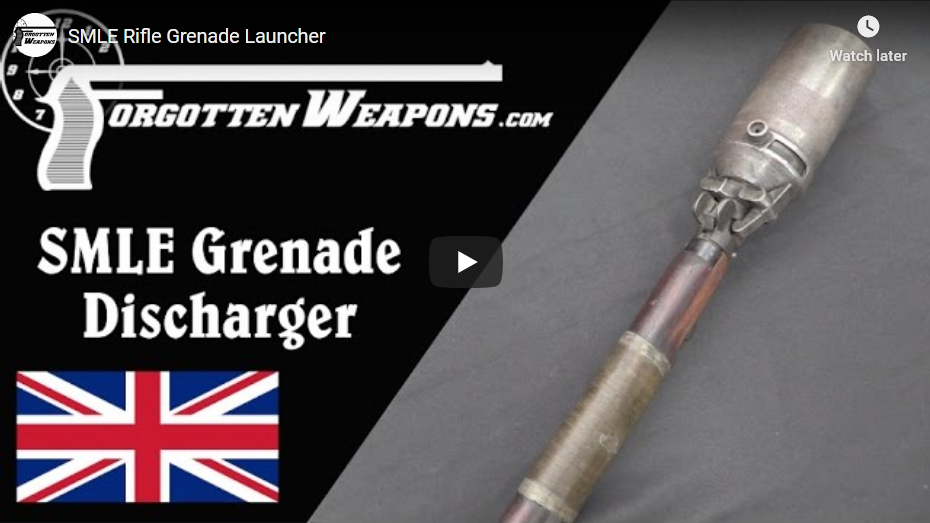
SMLE Rifle Grenade Launcher
Forgotten Weapons
Published 2 Feb 2017While rifle-launched grenades date back hundreds of years, they first came into widespread use during World War One, on all sides of the conflict. The first years of the war saw the use of rod grenades, but their downsides (mediocre accuracy, bulkiness, and a propensity to damage rifle bores) led to the British adopting a 2.5” cup grenade discharger in late 1917. This new launcher used slightly modified Mills bomb hand grenades, and could launch them with significant accuracy from 80 to 200 yards. They would become a staple of WWI combined arms infantry tactics, and be used clear through WW2 until replaced by the 22mm NATO style spigot grenades.
http://www.patreon.com/ForgottenWeapons
Cool Forgotten Weapons merch! http://shop.bbtv.com/collections/forg…
If you enjoy Forgotten Weapons, check out its sister channel, InRangeTV! http://www.youtube.com/InRangeTVShow
March 15, 2020
Nigerians Chasing Italians Like Cheetahs Hunt a Bull – WW2 – 081 – March 14, 1941
World War Two
Published 14 Mar 2020An Italian offensive into Greece is prepared, just as the Germans are preparing to also attack Greece via Bulgaria. Meanwhile, a daring and spectacular dash is made by the Nigerian army.
Join us on Patreon: https://www.patreon.com/TimeGhostHistory
Or join The TimeGhost Army directly at: https://timeghost.tvFollow WW2 day by day on Instagram @World_war_two_realtime https://www.instagram.com/world_war_t…
Between 2 Wars: https://www.youtube.com/playlist?list…
Source list: http://bit.ly/WW2sourcesWritten and Hosted by: Indy Neidell
Produced and Directed by: Spartacus Olsson and Astrid Deinhard
Executive Producers: Bodo Rittenauer, Astrid Deinhard, Indy Neidell, Spartacus Olsson
Creative Producer: Joram Appel
Post-Production Director: Wieke Kapteijns
Research by: Indy Neidell
Edited by: Iryna Dulka
Map animations: Eastory (https://www.youtube.com/c/eastory)Colorizations by:
– Julius Jääskeläinen – https://www.facebook.com/JJcolorization/
– Daniel Weiss
– History Colorizer M.B – https://www.facebook.com/mohamedbayou…Sources:
– Bundesarchiv
– boat sound by bockelsound from freesound.orgArchive by Screenocean/Reuters https://www.screenocean.com.
A TimeGhost chronological documentary produced by OnLion Entertainment GmbH.
March 13, 2020
Fallschirmjäger – Germany’s Finest – WW2 Special Episode
World War Two
Published 12 Mar 2020The Fallschirmjäger were Germany’s own paratrooper branch, designed to deal a swift and fatal blow behind the enemy’s lines. They were deployed with great success in Scandinavia and the Benelux, but they come too close to the sun when they attempt to invade Crete.
Join us on Patreon: https://www.patreon.com/TimeGhostHistory
Or join The TimeGhost Army directly at: https://timeghost.tvFollow WW2 day by day on Instagram @World_war_two_realtime https://www.instagram.com/world_war_t…
Between 2 Wars: https://www.youtube.com/playlist?list…
Source list: http://bit.ly/WW2sourcesHosted by: Indy Neidell
Written by: Joram Appel and Izzy Wilson
Produced and Directed by: Spartacus Olsson and Astrid Deinhard
Executive Producers: Bodo Rittenauer, Astrid Deinhard, Indy Neidell, Spartacus Olsson
Creative Producer: Joram Appel
Post-Production Director: Wieke Kapteijns
Research by: Joram Appel and Izzy Wilson
Edited by: Mikołaj Cackowski
Map animations: Eastory (https://www.youtube.com/c/eastory)
Sound design by: Marek KaminskiColorizations by:
Julius Jääskeläinen – https://www.facebook.com/JJcolorization/
Ruffneck88 – https://commons.wikimedia.org/wiki/Fi…Sources:
IWM E 3066ESoundtracks from the Epidemic Sound:
Rannar Sillard – “March Of The Brave 4”
Reynard Seidel – “Deflection”
Rannar Sillard – “Easy Target”
Gunnar Johnsen – “Not Safe Yet”
Johannes Bornlof – “Last Man Standing 3”
Fabien Tell – “Last Point of Safe Return”Archive by Screenocean/Reuters https://www.screenocean.com.
A TimeGhost chronological documentary produced by OnLion Entertainment GmbH.
From the comments:
World War Two
1 day ago
This is the first of many proper specials that we want to do to add on the weekly World War Two episodes, the War Against Humanity series, the Biographies, our Out of the Foxholes Q&A series and our upcoming On the Homefront sub-series. In these specials, we’ll cover any additional topics in depth — think about hardware, tactics, special forces, bills or decryption systems. We’re interested to hear your suggestions! What do you want to see covered in an upcoming special epsiode?
QotD: Rommel’s generalship
Yes, the reader might respond, but surely we are on firmer ground with regard to [Rommel’s] military skill! After all, no less a figure than British Prime Minister Winston Churchill called him “a great general” on the floor of the House of Commons. Even here, it is possible to make a counterargument. Rommel’s daring exploits at the head of the Afrika Korps (later enlarged and renamed Panzerarmee Afrika) were exciting, to be sure, but many officers in his own army reckoned them as an ultimately valueless sideshow. His disinterest in the dreary science of logistics, his “bias for action,” his tendency to fly off wherever the fighting was hottest are qualities that may make for an exciting movie, but they are problematic in an army commander under modern conditions, and they all contributed materially to the disaster that ultimately befell him and his army in the desert.
[…]
When Rommel arrived in Africa, he brought with him a fully realized art of war. He’d won a Pour le Mérite (the famed “Blue Max“) for a series of nail-biting mountain exploits in the 1917 Caporetto campaign; he had been a very popular tactical instructor at the Dresden Infantry School between the wars; he had commanded one of the army’s precious Panzer divisions (the 7th) during the 1940 campaign in the West. In France, Rommel had behaved more like an 18th century hussar cut loose on a raiding mission than a divisional commander. He led from the front, braved enemy fire on numerous occasions, and turned off his radio from time to time rather than risk receiving orders to rein himself in. He drove forward so rapidly that the 7th Panzer became known as the “ghost division” for its tendency to drop off the situation maps and reappear where least expected. There were many in the German high command, including the chief of the General Staff Franz Halder, who didn’t much appreciate Rommel running amok, but as one analyst put it, “it was impossible to court martial such a successful general, so Rommel instead got the Ritterkreuz” [the Knight’s Cross of the Iron Cross].
Robert Citino, “Drive to Nowhere: The Myth of the Afrika Korps, 1941-43″, The National WWII Museum, 2012. (Originally published in MHQ, Summer 2012).