Quotulatiousness

December 20, 2021

Ross WWI Sniper Rifle w/ Winchester A5 Scope

Filed under: Cancon, History, Military, USA, Weapons, WW1 — Tags: , , , , — Nicholas @ 02:00

Forgotten Weapons
Published 23 Aug 2021

http://www.patreon.com/ForgottenWeapons

https://www.floatplane.com/channel/Fo…

Cool Forgotten Weapons merch! http://shop.forgottenweapons.com

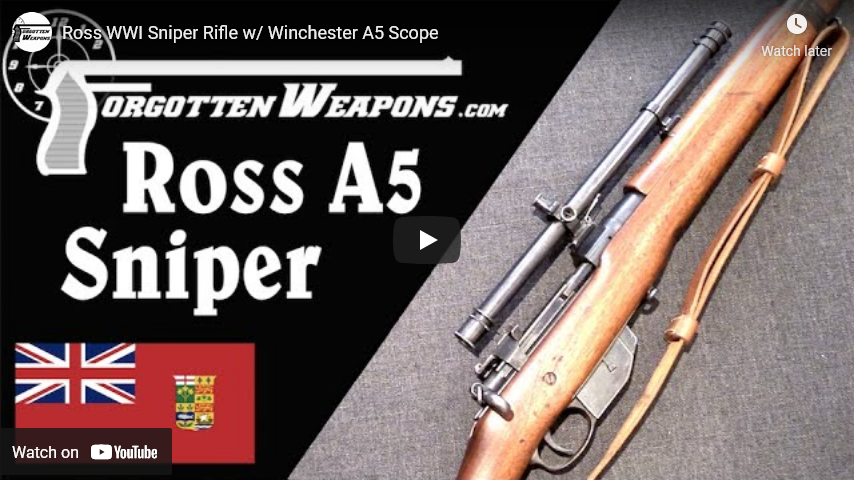
The standard Canadian sniper’s rifle of World War One was the MkIII Ross fitted with a Warner & Swasey “musket sight” purchased from the United States. However, armorers in the field did create sniping rifles using other scopes — in particular the Winchester A5. The A5 was a popular commercial rifle scope at the time, and it found its way onto military rifles for many nations — I have seen examples on Lebel and SMLE rifles as well as of course American Springfields and this Ross.

The A5 was a 5x magnification scope with external adjustments. We don’t know when this example was built into sniper configuration, but it’s provenance is solid (this sort of thing would be relatively easy to counterfeit). Personally, I would much prefer a Winchester A5 over the Warner & Swasey pattern…

Contact:
Forgotten Weapons
6281 N. Oracle 36270
Tucson, AZ 85740

From the comments:

Cole Harris
1 hour ago
The famed Francis Pegahmagabow used a Ross during his service with the Canadian Expeditionary Force during WWI. While the Ross was considered a pretty terrible service rifle because of reliability/durability concerns, on the range it was a superb rifle that he used to great effect. I don’t know if he used irons or not, but he built quite a reputation for marksmanship with the Ross.

If you’d like more information about Francis Pegahmagabow, The Great War channel did a bio special about him and more recently Sabaton wrote a song called “A Ghost in the Trenches” about his military service.

December 11, 2021

The Stahlhelm

Filed under: Germany, History, Military, WW1, WW2 — Tags: , , — Nicholas @ 04:00

World War Two
Published 10 Dec 2021

The Stahlhelm. Perhaps the most iconic symbol of German military power, ever present in images of the war. Hitler believes it strikes fear in his enemies and makes his own troops fearless. But where does it come from and why is it so enduring?
(more…)

December 9, 2021

The sequel to the British disaster at the Battle of Coronel, the German disaster at the Battle of the Falkland Islands

Filed under: Americas, Britain, Germany, History, Military, WW1 — Tags: , , , , — Nicholas @ 03:00

On December 8th, the people of the Falkland Islands observe “Battle Day” to commemorate the British naval victory off the islands in 1914. This is the bookend to the Battle of Coronel the previous month (described here and here), where a Royal Navy squadron was almost annihilated by Imperial Germany’s East Asia Squadron under Vice-Admiral Graf Maximilian von Spee. At the Battle of the Falkland Islands, an equally lop-sided victory eliminated von Spee’s ships with minimal damage to Rear Admiral Sir Frederick Doveton Sturdee’s squadron. In The Critic, A.S.H. Smyth outlines the events as shown in a British film released in 1927:
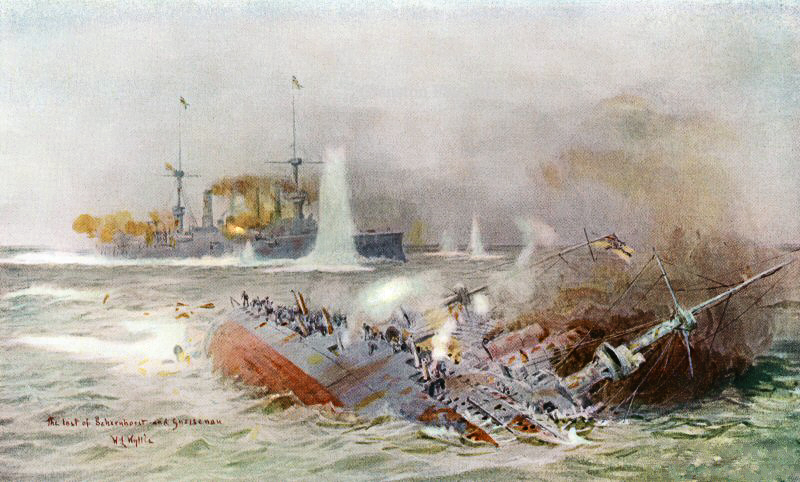
Battle of the Falkland Islands, 1914 by William Lionel Wyllie. SMS Scharnhorst rolls over and sinks while SMS Gneisenau continues to fight.
Originally published in 1918 by Cassel & Company. Retouched image via Wikimedia Commons

Rear Admiral Sir Frederick Doveton Sturdee (unimprovably British, isn’t it?), Chief of War Staff at the Admiralty, and at distinct risk of being scapegoated for the Coronel catastrophe, was summarily appointed Commander-in-Chief South Atlantic and Pacific(!) and despatched posthaste by [First Sea Lord John “Jackie”] Fisher (with whom he did not get on), on something of a do-or-die mission as the commander of new, eight-cruiser squadron.

The Admiral Superintendent of Devonport warns that Sturdee’s two battle cruisers, Invincible and Inflexible, cannot be ready before Friday the 13th November. First Lord of the Admiralty Winston Churchill balks at that ill-omened date, and orders that they sail on the 11th, ready or not. (Students of the 1982 conflict may see more than a couple of parallels here.) Cue: dockyard refitting montage.

Cut to the German colony at Valparaiso, where his countrymen fête von Spee’s glorious German victory in their first naval battle. “Damnation to the British Navy!” they want to toast. No, says, von Spee: “to a gallant enemy.” Handed a bouquet of flowers, he says he’ll keep them for his funeral “when my time comes.” For “when were the British ever content to leave an enemy to his triumph?”

Von Spee was well aware, it seems, that running the gauntlet up through the Atlantic was going to be a torrid prospect, even without a veangeful enemy on the look-out for him personally. But homeless (Tsingtau had fallen to the Japanese), in need of fuel, and down to half their ammunition, von Spee’s captains urged him now to head for Germany, and he agreed.

Von Spee’s ships were in need of dockyard maintenance and not steaming efficiently, but thanks to a captured British collier they were not in need of coal to be able to get home. Before setting off from where they’d been refuelling, Spee decided to strike another blow against the British and raid the Royal Navy’s supply base at Port Stanley in the Falkland Islands where only local militia were expected to be defending.

It was, among other things, sheer bad luck that von Spee came up to Stanley just a few hours after Sturdee had arrived with his group of cruisers — all newer, faster, and better-gunned than their fatigued German counterparts — and was busily refuelling. Likewise, that the sea was calm, there was little wind, and visibility was excellent. Too late, Gneisenau observes that there are British warships in the harbour! (The acting here is particularly terrible.)

It has been suggested that von Spee had not known that the British ships were “waiting” there (they hardly were); but it has also been alleged that he was misled by poor German intelligence, or even false British cryptography. [The Wikipedia article on the battle credits misinformation by British intelligence for leading von Spee into the trap.]

In Britain, meanwhile, the Admiralty is under the impression that Sturdee is the one who has been caught unawares in the Falkland Islands. Von Spee is a mere 12 miles away, and none of the British ships have their steam up. The FIVF [the Falklands Islands Volunteer Force] are called out, as the ships are ordered to go from zero to hero. One poor lad has to run up the Union Jack in local weather conditions (I’ve been that lad: he has my sympathies); another forgets his rifle, as emphasised by a heavily-asterisked title card.

As so often happens, Fate now played its hand, and Canopus, parked, with her fully-functioning 12-inch guns (so missed at Coronel) in Stanley Harbour, as the Islands’ main defensive battery, came into her own. As the Germans turn and run, Canopus opens fire, and soon enough the “grimly purposeful” cruiser group — “fittingly bearing names from the four corners of Britain … Kent, Cornwall, Glasgow and Carnarvon” — set off in pursuit.

The maths was simply not on the Germans’ side. Sturdee even sent his men below to eat. At midday, he called them back to Action Stations. Von Spee responded by ordering his light cruisers to scatter and make for neutral ports, while Scharnhorst and Gneisenau remained to “accept action to cover their escape”. Flashback to the presentation of those flowers.

November 13, 2021

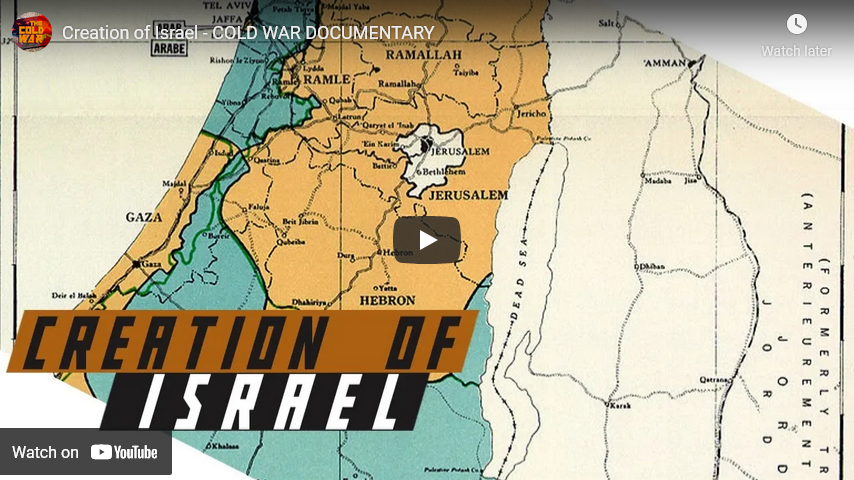
Creation of Israel

Filed under: Britain, History, Middle East, USA, WW1, WW2 — Tags: , , , , , , , — Nicholas @ 02:00

The Cold War
Published 1 Jun 2019

Our series on the history of the Cold War period continues with a documentary on the creation of Israel, Zionist movement, reactions and diplomatic maneuvers of other states and the build-up to first Arab-Israeli war

Consider supporting us on Patreon: https://www.patreon.com/thecoldwar

November 11, 2021

In memoriam

Filed under: Britain, History, Military, WW1, WW2 — Tags: , , — Nicholas @ 03:00

A simple recognition of some of our family members who served in the First and Second World Wars:

The Great War

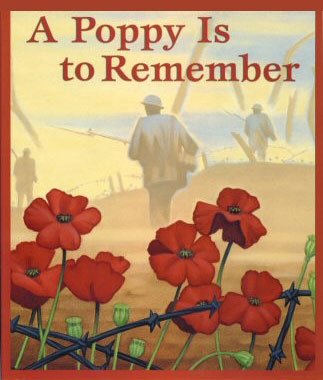
  • A Poppy is to RememberPrivate William Penman, Scots Guards, died 16 May, 1915 at Le Touret, age 25
    (Elizabeth’s great uncle)
  • Private Archibald Turner Mulholland, Argyll & Sutherland Highlanders, mortally wounded 25 September, 1915 at Loos, age 27
    (Elizabeth’s great uncle)
  • Private David Buller, Highland Light Infantry, died 21 October, 1915 at Loos, age 35
    (Elizabeth’s great grandfather)
  • Private Harold Edgar Brand, East Yorkshire Regiment. died 4 June, 1917 at Tournai.
    (My first cousin, three times removed)
  • Private Walter Porteous, Durham Light Infantry, died 4 October, 1917 at Passchendaele, age 18
    (my great uncle)
  • Corporal John Mulholland, Argyll & Sutherland Highlanders, wounded 2 September, 1914 (shortly before the First Battle of the Aisne), wounded again 29 June, 1918, lived through the war.
    (Elizabeth’s great uncle)

The Second World War

  • Flying Officer Richard Porteous, RAF, survived the defeat in Malaya and lived through the war
    (my great uncle)
  • Able Seaman John Penman, RN, served in the Defensively Equipped Merchant fleet on the Murmansk Run (and other convoy routes), lived through the war
    (Elizabeth’s father)
  • Private Archie Black (commissioned after the war and retired as a Major), Gordon Highlanders, captured at Singapore (aged 15) and survived a Japanese POW camp
    (Elizabeth’s uncle)
  • Elizabeth Buller, “Lumberjill” in the Women’s Land Army in Scotland through the war.
    (Elizabeth’s mother)
  • Trooper Leslie Taplan Russon, 3rd Royal Tank Regiment, died at Tobruk, 19 December, 1942 (aged 23).
    Leslie was my father’s first cousin, once removed (and therefore my first cousin, twice removed).

For the curious, the Commonwealth War Graves Commission the Royal British Legion, and the Library and Archives Canada WW1 and WW2 records site provide search engines you can use to look up your family name. The RBL’s Every One Remembered site shows you everyone who died in the Great War in British or Empire service (Canadians, Australians, New Zealanders, South Africans and other Imperial countries). The CWGC site also includes those who died in the Second World War. Library and Archives Canada allows searches of the Canadian Expeditionary Force and the Royal Newfoundland Regiment for all who served during WW1, and including those who volunteered for the CEF but were not accepted.

In Flanders fields the poppies blow
Between the crosses row on row,
That mark our place; and in the sky
The larks, still bravely singing, fly
Scarce heard amid the guns below.

We are the Dead. Short days ago
We lived, felt dawn, saw sunset glow,
Loved and were loved, and now we lie
In Flanders fields.

Take up our quarrel with the foe:
To you from failing hands we throw
The torch; be yours to hold it high.
If ye break faith with us who die
We shall not sleep, though poppies grow
In Flanders fields.

Lieutenant Colonel John McCrae, MD Canadian Army Medical Corps (1872-1918)

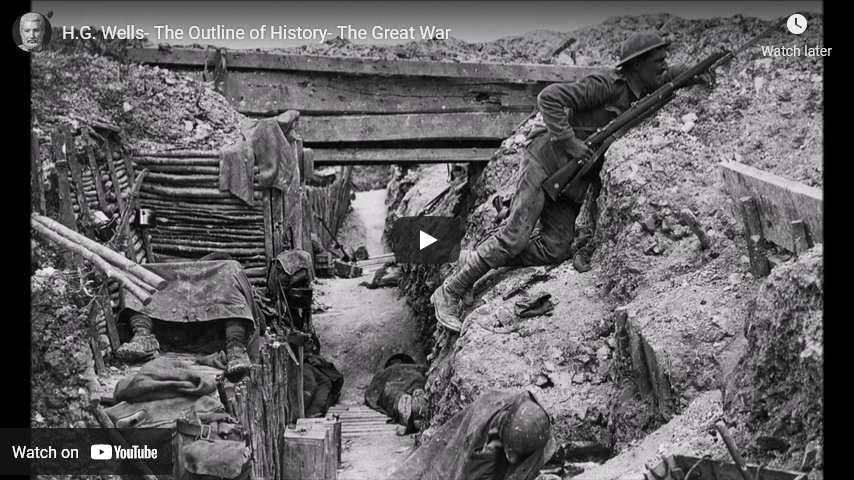
H.G. Wells – The Outline of History – The Great War

Thersites the Historian
Published 5 Mar 2021

In this video, we look at H.G. Wells’ coverage of World War I, from the war’s outbreak to the Armistice. Here, we see Wells at his most passionate and he makes a few controversial claims as well as sharing a couple of his personal experiences as a Londoner dealing with German air raids and celebrating the Armistice.

Patreon link: https://www.patreon.com/thersites

PayPal link: paypal.me/thersites

Discord: https://discord.gg/QCaXXFr

Brave Browser: https://brave.com/noa557

Twitter link: https://twitter.com/ThersitesAthens

Minds.com link: https://www.minds.com/ThersitestheHis…

Steemit/dtube link: https://steemit.com/@thersites/feed

BitChute: https://www.bitchute.com/channel/jbyg…

QotD: War and human capital

Filed under: Germany, History, Military, Quotations, Technology, WW1, WW2 — Tags: , , , , — Nicholas @ 01:00

… perhaps there is a parallel between the state of human capital in the American elite [today] and the German elite during the war. The German soldiers were the best in the world, but the people further up the line were not the best tacticians. At the upper reaches, the strategists were terrible in all sorts of ways, starting with Hitler, who was laughably inept at running a war. Winning was never an option, but the Germans could have avoided total obliteration if they had better leaders.

The blame for this is always put on Hitler and that’s a good place to start, but the Germans had a brain power problem throughout the planning layer. This is obvious in how they went about making tanks. Instead of going for a tank that was cheap and easy to produce by a civilian workforce, they tried to build tanks that were complex and required specialists to produce. The effects of allied bombing raids were amplified by this strategic blunder in production planning. This is a very basic error in planning and execution.

One possible cause of this was that the middle-aged men who would have been sorting these production and design problems had died during the Great War. The German army tended to “use up” their units, rather than cycle them in and out of lines. That meant that a lot of experience with supply and logistics was lost in the trenches. The British and the Americans rotated units in and out of the lines, thus they came out of the war with a vast number of people with experience in the nuts and bolts of war fighting.

The current ruling class needs the Germans to be seen as the ultimate in super villains, but the truth is the Germans were dumb about a lot of important things. The Russians came up with sloped armor, for example, and the Germans never bothered to steal the idea, even after Kursk. The Germans got their hands on the Churchill tank, but never bothered to learn anything from it. They never learned from the Americans how to use communications to coordinate their artillery and their armor.

In many respects, the story of the tank in the war is a great proxy for the story of human capital and cultural intelligence. The Germans had the best trained military on earth, but they lacked human capital in the strategy and tactics layer. Either the culture was unable to produce it or there was simply not enough smart people to create the necessary smart fraction. That was ultimately why Germany was wiped from the map. It’s probably why no new culture has arisen from that place on the map either.

The Z Man, “Tanking It”, The Z Blog, 2019-03-01.

November 9, 2021

Bayonet Development for the Lee Enfield No4 Rifle

Forgotten Weapons
Published 22 Jul 2021

http://www.patreon.com/ForgottenWeapons

https://www.floatplane.com/channel/Fo…

Cool Forgotten Weapons merch! http://shop.forgottenweapons.com

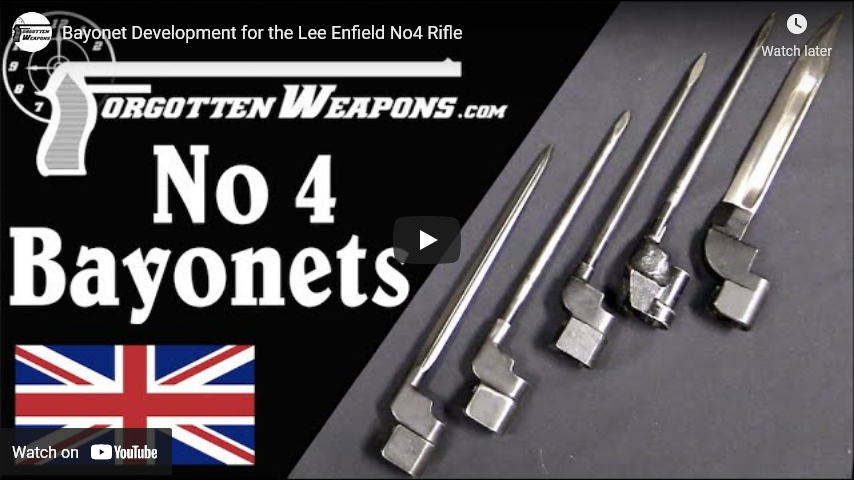
Having wrapped up our series on the major development of the Lee Enfield rifle in British service, I figured it would be a nice addendum to talk about the bayonets developed for the No4 rifle. These went through a substantial evolution, and are an interesting field for collectors all by themselves.

During World War One, the British used the Pattern 1907 bayonet, a long blade type essentially copied from the Japanese Type 30. By the 1920s, this was being reconsidered – the long blades were expensive, fragile, and perhaps not really necessary. When the No1 Mk VI rifle was put into trials, it was given a new bayonet style. This was inspired by the Swiss cyclists’ bayonet, with a cruciform spike instead of a true blade. It was only 8 inches long; this was determined to be long enough for virtually all use cases and being short minimized weight and bulk.

As World War Two progressed, the spike bayonet was simplified several times. Before the initial production of the first standard model (No4 MkI) was completed, the cruciform pattens had already been abandoned for a much simpler (and faster and cheaper) round body spike with a screwdriver-like point at the end. This was in turn simplified by separating the socket and spike into two parts for easier production, and then further simplified by casting the socket instead of forging it. After the war, the spike was replaced by a short blade-type socket bayonet (the No9), although this was rather short-lived because of the adoption of the SLR (FN FAL).

Contact:
Forgotten Weapons
6281 N. Oracle 36270
Tucson, AZ 85740

October 28, 2021

There are bad generals, there are evil generals, and (in a class of his own) there’s Luigi Cadorna

Filed under: Europe, History, Italy, Military, WW1 — Tags: , , , , — Nicholas @ 05:00

Earlier this month, Bret Devereaux took the time to give WW1 Italian general Luigi Cadorna the attention he richly deserved as the worst general of that war (which also included the strong Austrian contender Conrad von Hötzendorf), and certainly must be considered to be in the running as the worst general in military history:

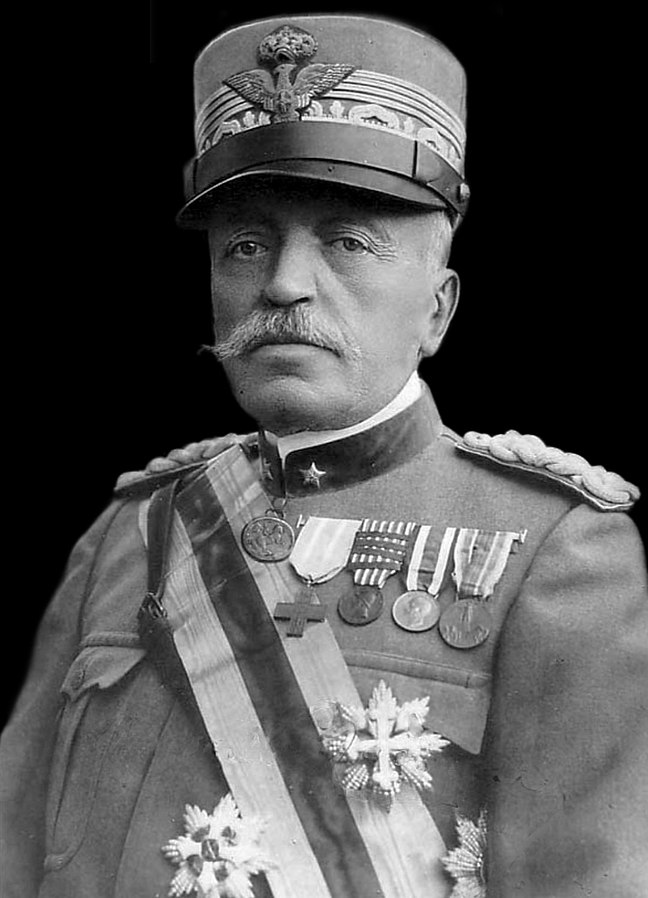
Luigi Cadorna, Marshal of Italy, Chief of Staff of the Italian Army, 1914-1917.
Photo via Wikimedia Commons.

This week we’re going to break from our normal fare and take a bit of a lark. I thought I ought to substantiate the nearly endless shade towards Luigi Cadorna, Italian Army Chief of Staff from 1914-1917 (though I realize after writing this that what I actually ought to have done is just told the same bad joke about Cadorna 11 times in a row and let that stand as the explanation). I said that Cadorna was my pick for the worst general of World War I. Now, as I noted at the time, there is some stiff competition for that position. While I argued that the tactical problem of trench warfare probably wasn’t solvable by any general, that doesn’t mean that some generals didn’t perform better than others under the difficult conditions imposed by the stalemate.

Now I should be clear here what I mean by “worst general”. What I am assessing here is the fellow who was worst at generaling, rather than the worst human being who happened to be a general. That latter prize probably goes to İsmail Enver Pasha, Ottoman Minister of War from 1914 to 1918, a vain, arrogant strutting sort of man who not only utterly botched the only battle in which he commanded directly (Sarikamish, Dec. 1914 – Jan 1915) but who also then blamed his defeat (falsely) on the Armenians and subsequently instigated and played a key role in the Armenian genocide. He then sold his services to the Soviets, before betraying them to side with the Basmachi movement, which didn’t go particularly well either.

We are also here not investigating to see which WWI leader made the single worst decision. As I’ve noted before, the worst decision in the First World War was having a First World War, though the responsibility for that is diffused across multiple different leading figures.

Luigi Cadorna didn’t, to my knowledge, perpetrate any genocides, though as we’ll see, he was cruel and unreasonable. Nor did he bring Italy to war. The son of Count Raffaele Cadorna (who had led the army which captured Rome, completing the unification of Italy), Cadorna’s political connections, particularly to the king Victor Emmanuel III, made him functionally impossible to remove from command after he was made chief of staff in 1914. For his part, Cadorna seems to have spent about as much time fighting a political battle in Rome as he did fighting the actual war on the Isonzo; Cadorna insisted at the outset that he would only accept the job if he was given unfettered, complete authority. As we’ll see, that complete authority is not going to come with complete responsibility for outcomes. But in any event, this is a good illustration of Cadorna’s personality: bitter, arrogant and callous, but with a cruel authoritarian streak and a profound conviction that all of his mistakes were someone else’s fault.

[…] Cadorna has a small, fragile and relatively weak army to work with. Conscription would eventually put millions more Italians in the ranks (and slowly make the equipment situation less of a disaster), but of course everyone else was doing that too and even then it was clear from a simple exercise in demography that Italy’s manpower reserves were likely to be brittle. An equally simple exercise in economic statistics would suggest that while Italy’s army might be made minimally sufficient in equipment (the Italians eventually end up deploying well over a thousand artillery pieces on the Isonzo front, though the quality of their artillery never matched what was available on either side of the Western Front), it would never be excellent. Strategically then, Cadorna had the one army; it was small and weak and it was also effectively all Italy had. Moreover Italy, only recently unified (recall, Cadorna’s father had been directly involved!) was still politically fragile itself and might not take well for horrible casualties. So Cadorna’s army had to be husbanded carefully, spent only in great need and for great benefit.

Instead of doing literally any of that, Cadorna opted to pursue the highest operational tempo of any front of the war. I can’t stress this enough: between May 1915 and October 1917, the French launched (or supported) four offensives (Second Artois, Third Artois/Second Champagne/Loos, the Somme and the Nivelle Offensive; I’m not counting Second Arras as that was a Commonwealth operation in which the French had little part), plus being on the defensive at Verdun. Of course there were lots of minor operations too, but that’s five major operations on the Western Front, where the French were almost totally focused. In contrast, in that same time frame, Cadorna – who again, has the smallest, weakest major army – launches eleven (11)(eleven)(XI)(1011)(I𐤗‎)(ΙΑ)(eleven!?!) offensives on the Isonzo River.

[…]

Because Cadorna thought that discipline and morale were the key components of victory (and also because he seems to have just generally been a cruel, uncaring and authoritarian person) he attempted to enforce both in his army through coercion and cruelty. Cadorna executed around 750 men for cowardice (to my knowledge the highest rate in any army of the war), presided over a military justice regime that convicted something like 3.6% of his army of one disciplinary charge or the other. He dismissed an incredible total of 217 officers during his tenure, frequently because he felt they were not committed enough or aggressive enough and when his army began to fall apart at Caporetto, he ordered the summary execution of officers whose units retreated. It turns out that actually adopting a “the beatings will continue until morale improves” command style does not actually improve morale.

September 28, 2021

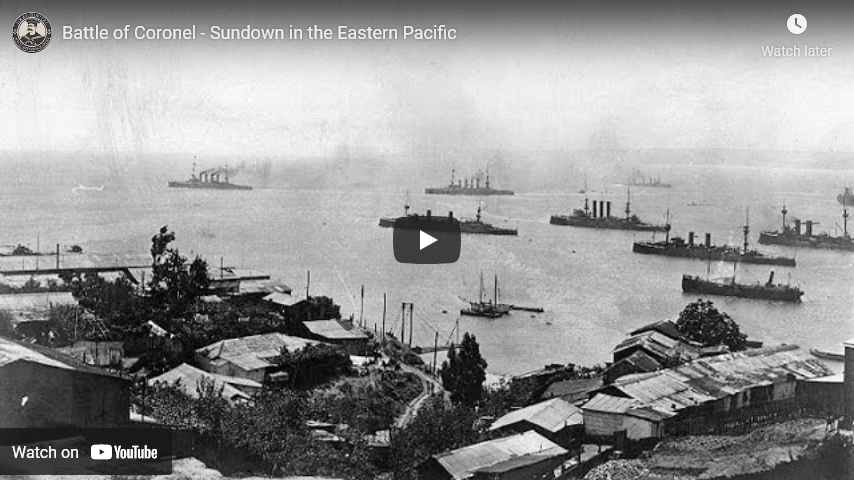
Battle of Coronel – Sundown in the Eastern Pacific

Filed under: Britain, Germany, History, Military, Pacific, WW1 — Tags: , — Nicholas @ 04:00

Drachinifel
Published 18 Mar 2020

Today we look at the first of two battles involving Admiral von Spee, the Battle of Coronel.

Want to support the channel? – https://www.patreon.com/Drachinifel

Want a shirt/mug/hoodie – https://shop.spreadshirt.com/drachini…

Want a medal? – https://www.etsy.com/uk/shop/Drachinifel

Want to talk about ships? https://discord.gg/TYu88mt

Want to get some books? www.amazon.co.uk/shop/drachinifel

Drydock Episodes in podcast format – https://soundcloud.com/user-21912004

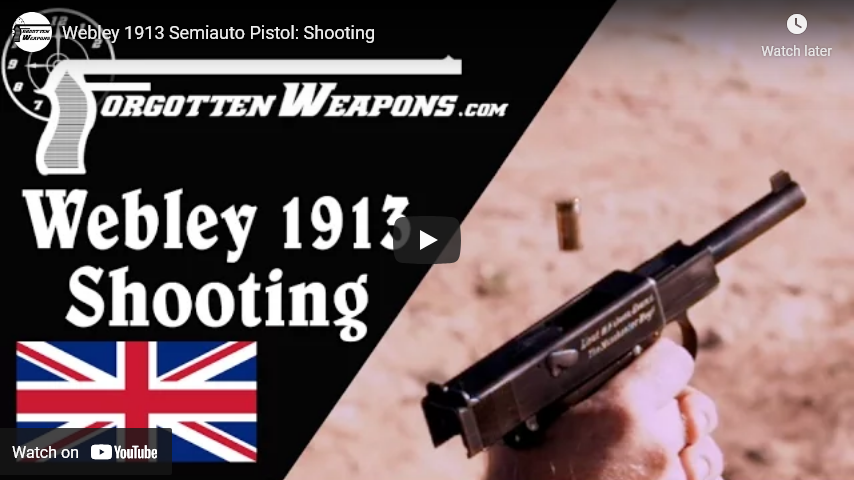
Webley 1913 Semiauto Pistol: Shooting

Filed under: Britain, History, Military, Weapons, WW1 — Tags: , , — Nicholas @ 02:00

Forgotten Weapons
Published 26 May 2017

Following up on yesterday’s history and disassembly of the Webley 1913, today I am taking one of them out to the range. Courtesy of Mike Carrick from Arms Heritage magazine, I am shooting original WWI British .455 SL ammunition. We don’t have a lot of it to work with here, but we will try out some magazine fire as well as some single loading, since the magazine cutoff was one of the relatively unique features of the 1913 Webley.

Overall, from this admittedly limited firing experience, I think the Webley is a rather underrated pistol, probably because of its short service live and unavailable ammunition. Despite its awkward appearance, it handles and points pretty well, and has felt recoil not unlike the Colt 1911, despite having a more powerful cartridge.

Cool Forgotten Weapons merchandise! http://shop.bbtv.com/collections/forg…

http://www.patreon.com/ForgottenWeapons

If you enjoy Forgotten Weapons, check out its sister channel, InRangeTV! http://www.youtube.com/InRangeTVShow

September 27, 2021

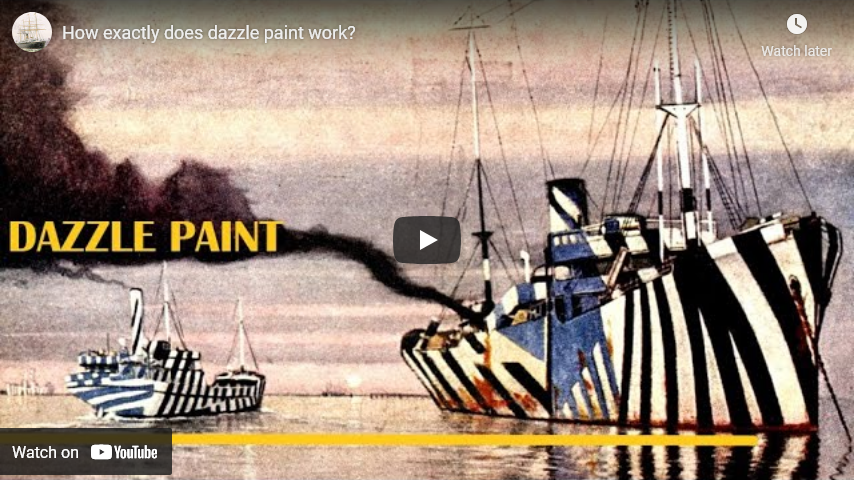
How exactly does dazzle paint work?

Filed under: Britain, Cancon, Germany, History, Military, USA, WW1, WW2 — Tags: , , , — Nicholas @ 02:00

Nautical Study
Published 22 May 2021

In early 1917, a British artist by the name of Norman Wilkinson approached the British admiralty with an ingenious idea that would save countless lives from the German U-boat campaign. His idea: dazzle paint. Complex in concept, but just crazy enough to work.

Thanks for your support!

Music: Emperor’s Waltz
https://www.youtube.com/watch?v=foHeA…

All colorized photos in this video have credits attributed to them if I could find them. If you know who colorized any that are left unattributed, please let me know!

September 25, 2021

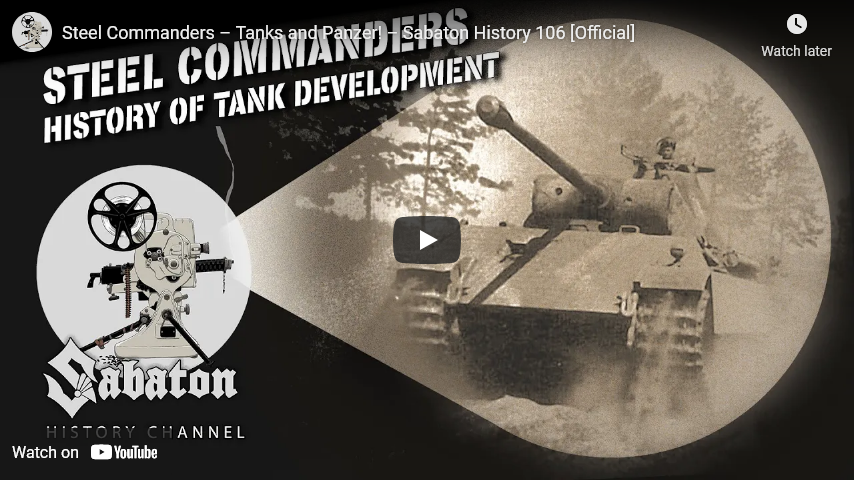
“Steel Commanders” – Tanks and Panzer! – Sabaton History 106 [Official]

Filed under: Britain, Europe, Germany, History, Media, Military, Russia, USA, WW1, WW2 — Tags: , , , , — Nicholas @ 04:00

Sabaton History
Published 24 Sep 2021

From the first landships of the Great War to the massive armor-battles of Prokhorovka and El-Alamein — the introduction of the tank to the battlefield had changed warfare forever. Impregnable to small-arms fire, they crushed barbed-wire and field fortifications underneath their tracks, paving the way for the infantry’s advance. In independent formations they surged forward at the head of the offensive, outmaneuvering the enemy’s defenses and wreaking havoc in their lines. From the Mark V to the T-34, from the Tiger to the Centurion — the evolution of armor is the history of Steel Commanders.

Support Sabaton History on Patreon: https://www.patreon.com/sabatonhistory

Watch the Official Music Video of “Steel Commanders” here: https://www.youtube.com/watch?v=peTCe…

Listen to Sabaton on Spotify: http://smarturl.it/SabatonSpotify
Official Sabaton Merchandise Shop: http://bit.ly/SabatonOfficialShop

Hosted by: Indy Neidell
Written by: Markus Linke and Indy Neidell
Directed by: Astrid Deinhard and Wieke Kapteijns
Produced by: Pär Sundström, Astrid Deinhard and Spartacus Olsson
Creative Producer: Maria Kyhle
Executive Producers: Pär Sundström, Joakim Brodén, Tomas Sunmo, Indy Neidell, Astrid Deinhard, and Spartacus Olsson
Community Manager: Maria Kyhle
Post-Production Director: Wieke Kapteijns
Editor: Iryna Dulka
Sound Editor: Marek Kaminski
Archive: Reuters/Screenocean – https://www.screenocean.com
Sources:
– IWM E 18376, IWM 357, Q 9249, IWM 1198, IWM 130-09+10, Q 107828, IWM 508-70, KID 109, UKY 502, E 7070, H 37169, MH4107
– wall by mara julieta G., Tree by Joni Ramadhan; from the Noun Project
All music by: Sabaton

An OnLion Entertainment GmbH and Raging Beaver Publishing AB co-Production.

© Raging Beaver Publishing AB, 2019 – all rights reserved.

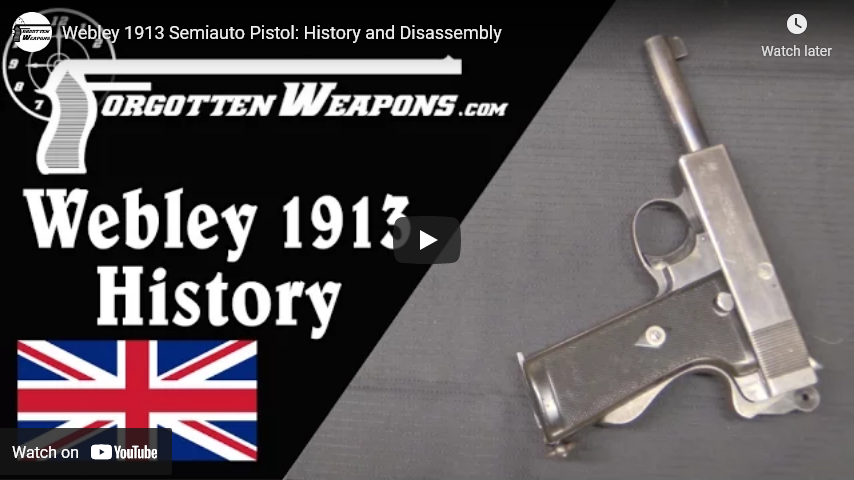
Webley 1913 Semiauto Pistol: History and Disassembly

Filed under: Britain, History, Military, Weapons, WW1 — Tags: , , , , — Nicholas @ 02:00

Forgotten Weapons
Published 25 May 2017

William Whiting and the Webley company had high hopes for their self-loading pistols being adopted by the British military — but they never got the success they were hoping for.

After the poor performance of the Webley 1904 (https://www.youtube.com/watch?v=-hT38…) at trials, William Whiting decided to make sure his next attempt would be fully developed before he put it in the hands of the military. He did very well at that too, as the gun which would become the Model 1913 Webley did very well from its very first military tests. The Royal Navy was, in fact, quite enthusiastic about it, although the Army was not. The Navy would ultimately adopt the gun and purchase about 8,000 of them during World War One, while the Army acquired just a couple hundred and preferred to stick to its revolvers.

Thanks to Mike Carrick of Arms Heritage magazine for loaning me these pistols to bring to you!

Cool Forgotten Weapons merchandise! http://shop.bbtv.com/collections/forg…

http://www.patreon.com/ForgottenWeapons

If you enjoy Forgotten Weapons, check out its sister channel, InRangeTV! http://www.youtube.com/InRangeTVShow

September 22, 2021

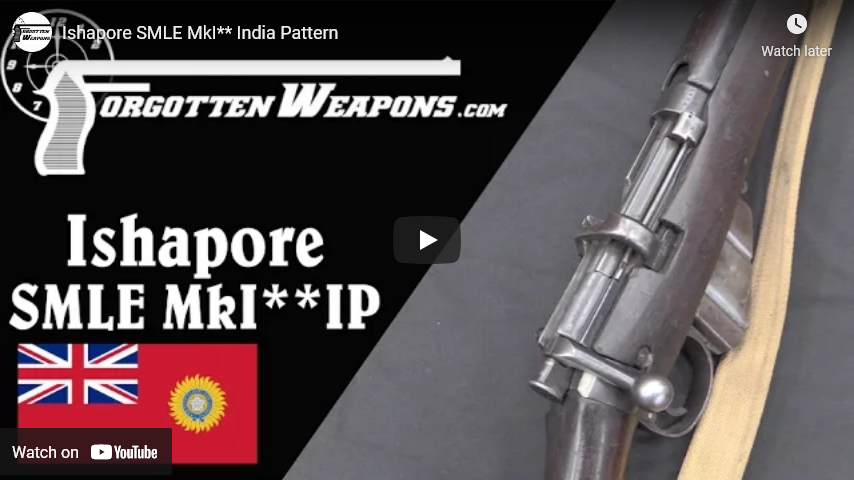
Ishapore SMLE MkI** India Pattern

Filed under: Britain, History, India, Military, Weapons, WW1 — Tags: , , , — Nicholas @ 02:00

Forgotten Weapons
Published 6 Feb 2017

While many people are familiar with the Ishapore 2A1 rifles chambered in 7.62mm NATO (largely thanks to their importation and sale in the US in large numbers), production of Indian Enfield rifles actually dates back to 1905, when the Ishapore arsenal was opened. The first rifles produced there were a batch of 3,000 MkI Enfield rifles in 1908/9. These were of course early pattern SMLEs, with features like split charger bridges, volley sights, and magazine cutoffs. Production quickly changed to the No1 Mk III pattern of rifle, which had been formally adopted in Britain in 1907.

During World War One, the need for arms led to those first early rifles being rebuilt in the MkIII configuration, but they retain their original markings, showing their origin. Today we have one of those first 3,000 to look at.

http://www.patreon.com/ForgottenWeapons

Cool Forgotten Weapons merch! http://shop.bbtv.com/collections/forg…

If you enjoy Forgotten Weapons, check out its sister channel, InRangeTV! http://www.youtube.com/InRangeTVShow

« Newer PostsOlder Posts »

Powered by WordPress