Like many monsters — for he could be a monster to those who defied him, and was often cruel and unfair to his most devoted supporters — he had enormous charm when he chose to turn it on. He was deeply mischievous and enjoyed puzzling and wrong-footing others. When he did not wish to give ground, he could be obtuse, an experience described by one victim as like “being confined … with a cormorant who spoke only cormorant.”
The evidence suggests that he was one of those dangerous people who simply do not know what fear is, and that he discovered this quite early in his long life. If a sergeant had not fallen dead on top of the young Lieutenant de Gaulle when he first went into battle at Dinant in August 1914, he would probably have died in some useless, gallant sacrifice and never have been heard of again. If he had not been knocked unconscious by the blast of a grenade at Verdun in March 1916, it is hard to believe that he would have allowed himself to be taken prisoner by the Germans. In that case he would almost certainly have died in that frightful battle, or not long afterward, another silent shade in that huge legion of shades who marched off into the dark during that appalling war.
Only his wife Yvonne was unimpressed by his grandeur, more than once urging him to retire, or puncturing his ambition. During the long, frustrating wilderness years between his wartime glory and his final presidential triumph, he mused to her that he might one day repeat his great rallying call of 1940. Using the rather patronizing endearment “Pauvre Ami,” she declared flatly, “Nobody will follow you.” He snapped back, “Shut up, Yvonne! I am old enough to know what I want to do!” In fact, on that occasion he was wrong and she was right. She even mocked his soldierly abilities. When the general’s aides suggested that they might install a machine gun at their remote, forbidding country home in Colombey, in case of an attack by communists, Yvonne scoffed that her husband would have no idea how to use it. Perhaps she would have.
Peter Hitchens, “A Certain Idea of France”, First Things, 2019-04.
April 8, 2022
QotD: The fearlessness of De Gaulle
March 24, 2022
QotD: Tolkien’s wartime experiences and The Lord of the Rings
Tolkien arrived on the Western Front in June 1916 as a signals officer in the 11th Lancashire Fusiliers, and experienced the agony of the Somme at first hand. In just three and a half months, his battalion lost 600 men. Yet it was now, amid the horror of the trenches, that he began work on his great cycle of Middle-earth stories. As he later told his son Christopher, his first stories were written “in grimy canteens, at lectures in cold fogs, in huts full of blasphemy and smut, or by candlelight in bell-tents, even some down in dugouts under shell fire”.
But he never saw his work as pure escapism. Quite the opposite. He had begun writing, he explained, “to express [my] feeling about good, evil, fair, foul in some way: to rationalise it, and prevent it just festering”. More than ever, he believed that myth and fantasy offered the only salvation from the corruption of industrial society. And far from shaking his faith, the slaughter on the Somme only strengthened his belief that to make sense of this broken, bleeding world, he must look back to the great legends of the North.
Yet The Lord of the Rings is not just a war book. There’s yet another layer, because it’s also very clearly an anti-modern, anti-industrial book, shaped by Tolkien’s memories of Edwardian Birmingham, with its forges, factories and chimneys. As a disciple of the Victorian medievalists, he was always bound to loathe modern industry, since opposition to the machine age came as part of the package. But his antipathy to all things mechanical was all the more intense because he identified them — understandably enough — with killing.
And although Tolkien objected when reviewers drew parallels between the events of The Lord of the Rings and the course of the Second World War, he often did the same himself. Again and again he told his son Christopher that by embracing industrialised warfare, the Allies had chosen the path of evil. “We are attempting to conquer Sauron with the Ring,” he wrote in May 1944. “But the penalty is, as you will know, to breed new Saurons, and slowly turn Men and Elves into Orcs.” Even as the end of the war approached, Tolkien’s mood remained bleak. This, he wrote sadly, had been, “the first War of the Machines … leaving, alas, everyone the poorer, many bereaved or maimed and millions dead, and only one thing triumphant: the Machines”.
“Trivial”, then? Clearly not. Tolkien was at once a war writer and an ecological writer; a product of High Victorianism and also a distant relative of the modernist writers who, like him, were trying to make sense of the shattered world of the Twenties and Thirties. But he wasn’t just a man of his time; he remains a guide for our own.
Dominic Sandbrook, “This is Tolkien’s world”, UnHerd, 2021-12-09.
March 22, 2022
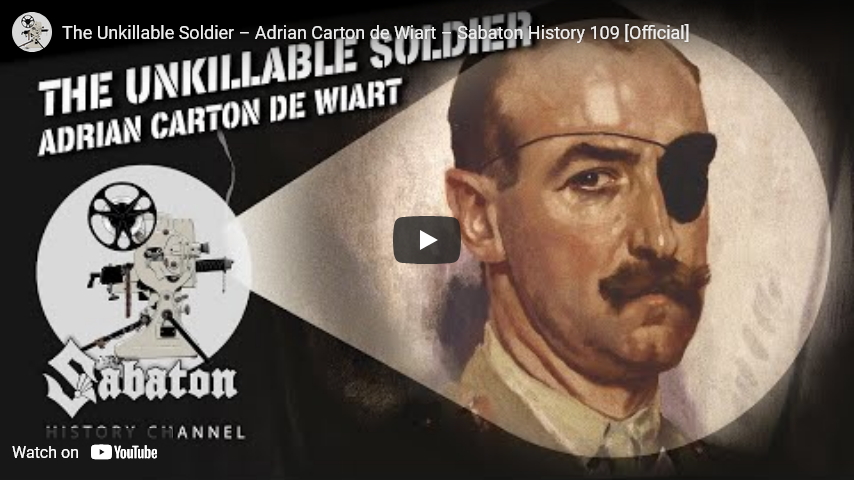
“The Unkillable Soldier” – Adrian Carton de Wiart – Sabaton History 109 [Official]
Sabaton History
Published 21 Mar 2022Adrian Carton de Wiart fought in a variety of wars over more than forty years, and he was wounded … again and again and again, and yet he always came back for more. This episode is his sometimes ridiculous but always interesting and incredible story.
Support Sabaton History on Patreon: https://www.patreon.com/sabatonhistory
Listen to “The Unkillable Soldier” on the album The War To End All Wars: https://music.sabaton.net/TheWarToEnd…
Watch the Official Music Video of “The Unkillable Soldier” here: https://www.youtube.com/watch?v=b4vj_…
Watch more videos on the Sabaton YouTube channel: https://www.youtube.com/user/Sabaton
Listen to Sabaton on Spotify: https://sabat.one/Spotify
Official Sabaton Merchandise Shop: http://bit.ly/SabatonOfficialShopHosted by: Indy Neidell
Written by: Markus Linke and Indy Neidell
Directed by: Astrid Deinhard and Wieke Kapteijns
Produced by: Pär Sundström, Astrid Deinhard and Spartacus Olsson
Creative Producer: Maria Kyhle
Executive Producers: Pär Sundström, Joakim Brodén, Tomas Sunmo, Indy Neidell, Astrid Deinhard, and Spartacus Olsson
Community Manager: Maria Kyhle
Post-Production Director: Marek Kaminski
Editor: Iryna Dulka
Sound Editor: Marek Kaminski
Archive: Reuters/Screenocean – https://www.screenocean.com
Colorization:
– Julius Jääskeläinen – https://www.facebook.com/JJcolorization/Sources:
National Army Museum, London
IWM HU 94459, Q 4511, Q 7105, Q 3140, IWM 32, IWM 162, IWM Q 68300, IWM 130-09+10
National Library of Scotland
All music by: SabatonAn OnLion Entertainment GmbH and Raging Beaver Publishing AB co-Production.
© Raging Beaver Publishing AB, 2019 – all rights reserved.
March 13, 2022
QotD: The Kaiser’s army and their Auftragstaktik innovations
They started developing it before WWI, but proof of concept was in the trenches, and it succeeded spectacularly. It’s hard to exaggerate just how outmanned and outgunned the Germans were in that conflict, and I don’t have the exact numbers to hand, but one especially fearsome measure was “artillery density”. On the German side, the preparatory barrage before an attack averaged, at best, something like 1 shell per square foot (this is from memory, so doubtless incorrect, but you get the idea). The Allies achieved something like one shell per square inch, and there you have it …
… or there you should’ve had it, if the Allies had anything close to German-level command-and-control. But they didn’t. British WW1 memoirs, especially, are full of the kinds of ludicrous fuckups that Joseph Heller wouldn’t dare put in his novels. Robert Graves (yeah, I know, not the world’s most trustworthy source) had an especially funny scene where his company got this elaborate set of orders to move to such-and-such coordinates, build an elaborate strongpoint (laid out in minute detail), then move on to some other coordinates and do something else, again spelled out to the nth degree.
Those coordinates were, of course, a mile and a half behind enemy lines.
Or consider that silly movie 1917. If you haven’t seen it, don’t. If you have, and you know a little bit about WWI, you’ll remember how ludicrous the premise was. You don’t need to send a squad, Saving Private Ryan-style, to get a message to a distant dugout where they’re waiting to jump off for an attack. For one thing, there’s this little gadget called a “radio”, and by 1917 they were portable enough to get there. But even if not, there’s this other gadget called a “telephone”, and any C-and-C bunker anywhere along the line would have one, no matter how fast the advance was moving. Finally, even if they didn’t have either of those, the supporting artillery park sure as hell would’ve — just ring them up and call off the preparatory barrage, and I promise you, none of those troops would’ve moved an inch, even if it meant shooting Colonel Sherlock Holmes right in his prissy, pencil-mustached mug.
If you know a bit more about WWI, that kind of ludicrous, plot-ruining stupidity seems like the most accurate thing in the movie, because that kind of bullshit happened all the time. Telephone wires were always getting cut by shellfire, for instance, and since none of the red tabs [staff officers] back at the base would dream of seeing the situation for themselves, field soldiers were always getting scads of contradictory orders, sent at bewildering times. More than one advance was held up by frontline troops having to send runners back to check the orders of other runners, which had been countermanded by yet other runners, coming up with telephone messages …
The guys in the opposing trenches, meanwhile, were just getting on with it. Graves again (and again, I know), quoting from memory, wondered what the High Command would’ve done had they known that for the better part of a year, the entire sector opposite the Royal Welch Fusiliers had been held by no one higher than a corporal.
Severian, “Auftragstaktik: Logic and Anti-Logic”, Founding Questions, 2021-11-18.
March 7, 2022
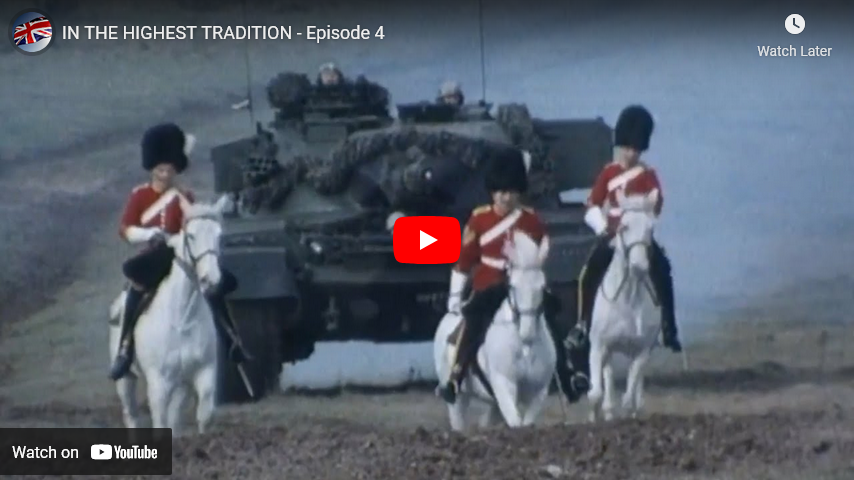
In The Highest Tradition — Episode 4
British Army Documentaries
Published 30 Oct 2021The fourth in a six-part series that delves into the world of regimental tradition. It looks at the illustrious history of the Royal Scots Greys with an account of how a French Imperial Eagle was won at Waterloo, and covers the tragic events of the Charge of the Light Brigade, the origins of the Victoria Cross, and follows the transition from horse to the tank.
© 1989
This production is for viewing purposes only and should not be reproduced without prior consent.
This film is part of a comprehensive collection of contemporary Military Training programmes and supporting documentation including scripts, storyboards and cue sheets.
All material is stored and archived. World War II and post-war material along with all original film material are held by the Imperial War Museum Film and Video Archive.
February 23, 2022
From Shell Shock to PTSD – Understanding the Trauma of War – WW2 Special
World War Two
Published 22 Feb 2022Humanity has spent millennia developing ever more efficient ways to kill. This reaches its apogee in WWI and WWII, the most terrible conflicts in human history. Broken bodies bring with them broken minds. The trauma of war brings with it the mysteries of shell shock, war neurosis and PTSD.
(more…)
February 15, 2022
QotD: Breaking the trench stalemate with tanks
In theory, a good tank ought to be effectively immune to machine-gun fire, able to cross trenches without slowing and physically protect the infantry (who could advance huddled behind the mass of it), all while bringing its own firepower to the battle. Tracked armored vehicles had been an idea considered casually by a number of the pre-war powers but not seriously attempted. The British put the first serious effort into tank development with the Landship Committee, formed in February of 1915; the first real tanks, 49 British Mark I tanks, made their first battlefield appearance during the Battle of the Somme in 1916. Reliability proved to be a problem: of the 49 tanks that stepped off on the attack on September 15th, only three were operational on the 16th, mostly due to mechanical failures and breakdowns.
Nevertheless there was promise in the idea that was clearly recognized and a major effort to show what tanks could do what attempted at Cambrai in November of 1917; this time hundreds of tanks were deployed and they had a real impact, breaking through the barbed wire and scattering the initial German defenses. But then came the inevitable German counter-attacks and most of the ground taken was lost. It was obvious that tanks had great potential; the French had by 1917 already developed their own, the light Renault FT tank, which would end up being the most successful tank of the war despite its small size (it is the first tank to have its main armament in a rotating turret and so in some sense the first “real” tank). This was hardly an under-invested-in technology. So did tanks break the trench stalemate?
No.
It’s understandable that many people have the impression that they did. Interwar armored doctrine, particularly German Maneuver Warfare (bewegungskrieg) and Soviet Deep Battle both aimed to use the mobility and striking power of tanks in concentrated actions to break the trench stalemate in future wars (the two doctrines are not identical, mind you, but in this they share an objective). But these were doctrines constructed around the performance capabilities of interwar tanks, particularly by two countries (Germany and the USSR) who were not saddled with large numbers of WWI era tanks (and so could premise their doctrine entirely on more advanced models). The Panzer II, with a 24.5mph top speed and an operational range of around 100 miles, depending on conditions, was actually in a position to race the train and win; the same of course true of the Soviet interwar T-26 light tank (19.3mph on roads, 81-150 mile operational range). Such tanks could have radios for coordination and communication on the move (something not done with WWI tanks or even French tanks in WWII).
By contrast, that Renault FT had a top speed of 4.3mph and an operational range of just 37 miles. The British Mark V tank, introduced in 1918, moved at only 5mph and had just 45 miles of range. Such tanks struggled to keep up with the infantry; they certainly were not going to win any race the infantry could not. It is little surprise that the French, posed with the doctrinal problem of having to make use of the many thousands of WWI tanks they had, settled on a doctrine whereby most tanks would simply be the armored gauntlet stretched over the infantry’s fist: it was all those tanks could do! The sort of tank that could do more than just dent the trench-lines (the same way a good infiltration assault with infantry could) were a decade or more away when the war ended.
Moreover, of course, the doctrine – briefly the systems of thinking and patterns of training, habit and action – to actually pull off what tanks would do in 1939 and 1940 were also years away. It seems absurd to fault World War I era commanders for not coming up with a novel tactical and operational system in 1918 for using vehicles that wouldn’t exist for another 15 years and yet more so assuming that they would get it right (since there were quite a number of different ideas post-war about how tanks ought to be used and while many of them seemed plausible, not all of them were practical or effective in the field). It is hard to see how any amount of support into R&D or doctrine was going to make tanks capable of breakthroughs even in the late 1920s or early 1930s (honestly, look at the “best” tanks of the early 1930s; they’re still not up to the task in most cases) much less by 1918.
Bret Devereaux, “Collections: No Man’s Land, Part II: Breaking the Stalemate”, A Collection of Unmitigated Pedantry, 2021-09-24.
February 6, 2022
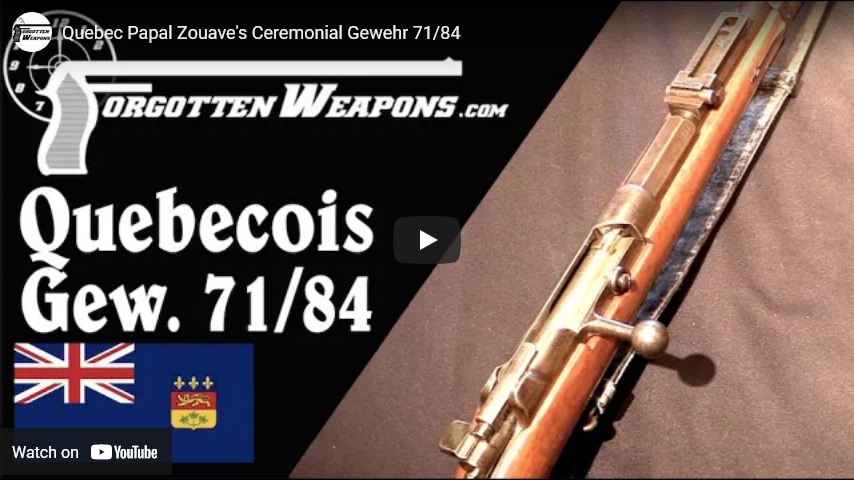
Quebec Papal Zouave’s Ceremonial Gewehr 71/84
Forgotten Weapons
Published 4 Oct 2021http://www.patreon.com/ForgottenWeapons
https://www.floatplane.com/channel/Fo…
Cool Forgotten Weapons merch! http://shop.forgottenweapons.com
Here’s a rifle with an interesting twisting history …
This began life as a German military Gewehr 71/84, made in 1888. It was issued to a unit, but eventually replaced by the Gewehr 1888. It was sold to the Francis Bannerman company at some point around 1900, as part of a big batch of surplus weapons (Bannerman was a massive international dealer in arms and military equipment). Moving ahead a few years, World War One breaks out and prompts the organization of a couple Canadian “Home Guard” units. The Montreal Home Guard has some money, and buys a batch of Savage Model 99 lever action rifles (in .303 Savage, interestingly). The Quebec Home Guard isn’t quite so well-heeled, so they go to Bannerman to see what they can afford. Bannerman sells them a batch of Gewehr 71/84 tube-magazine repeating rifles, in the same configuration as when they were sold off by the German military.
Incidentally, I believe these become the only Mauser rifles formally purchased and issued by the Canadian government, when they are acquired by the Home Guard. At any rate, after the war ends, a subset of those old rifles are given to the Quebec Papal Zouaves, a ceremonial vestige of the Quebecois military volunteers who went to Italy in the 1860s to help defend the Papacy during Italian unification. By this time, the Zouaves are basically just acting as guards in parades, and they crudely cut down the 71/84s, removed their magazines, and fit them with cut-down British Snider bayonets for use as single-shot, blank-firing arms.
Quite the journey, right? And also a reminder that sometimes what looks like sporterized junk is actually something with distinct historical provenance …
Many thanks to Mike Carrick of Arms Heritage Magazine for providing me access to film this example!
Contact:
Forgotten Weapons
6281 N. Oracle 36270
Tucson, AZ 85740
February 2, 2022
QotD: Breaking the trench stalemate with Stormtroopers (Stoßtruppen)
The mature form of this tactical framework is often called “Hutier” tactics, after German general Oskar Emil von Hitier, though he was hardly the sole or even chief inventor of the method. In its mature form, the technique went thusly: instead of attacking with large waves of infantry which cleared each objective in sequential order, attacks ought to be proceeded by smaller units, carefully trained with the layout of the enemy positions. Those units, rather than having a very rigid plan of attack, would be given those general objectives and left to figure for themselves how to accomplish them (“mission tactics” or Auftragstaktik), giving them more freedom to make decisions based on local conditions and the ground.
These elite spearhead units, called Stoßtruppen or “Stormtroopers” were well equipped (in particular with a higher amount of automatic firearms and hand grenades, along with flamethrowers). Importantly, they were directed to bypass enemy strong-points and keep moving forward to meet their objectives. The idea here was that the follow-up waves of normal infantry could do the slow work of clearing out points where enemy resistance was strong, but the stormtroopers should aim to push as deeply as possible as rapidly as possible to disorient the defenders and rapidly envelop what defenses remained.
These sets of infantry tactics were in turn combined with the hurricane barrage, a style of artillery use which focused on much shorter but more intense artillery barrages, particularly associated with Colonel Georg “Breakthrough” Bruchmüller. Rather than attempting to pulverize defenses out of existence, the hurricane barrage was designed merely to force enemies into their dugouts and disorient the defenders; much of the fire was directed at longer ranges to disrupt roads and artillery in the enemy rear. The short barrage left the ground relatively more intact. Meanwhile, those elite infiltration units could be trained to follow the creeping barrage very closely (being instructed, for instance, to run into the shell explosions, since as the barrage advantages, no gun should ever strike the same spot twice; a fresh shell-hole was, in theory, safe). Attentive readers will recognize the basic foundations of the “move fast, disorient the enemy” methods of the “modern system” here.
So did infiltration tactics break the trench stalemate? No.
First, it is necessary to note that while infiltration tactics were perhaps most fully developed by the Germans, they were not unique to them. The French were experimenting with many of the same ideas at the same time. For instance, basic principles of infiltration were being published by the French General Headquarters as early as April, 1915. André Laffargue, a French infantry captain, actually published a pamphlet, which was fairly widely distributed in both the French and British armies by the end of 1915 and in the American army in 1916, on exactly this sort of method. In many cases, like at the Second Battle of Artois, these French tactics bore significant fruit with big advances, but ran into the problem that the gains were almost invariably lost in the face of German counter-attacks. The Russians, particularly under Aleksei Brusilov, also started using some of these techniques, although Brusilov was as much making a virtue of necessity as the Russians just didn’t have that much artillery or shells and had to make due with less and Russian commanders (including Brusilov!) seem to have only unevenly taken the lessons of his successes.
The problem here is speed: infiltration tactics could absolutely more efficiently overrun the front enemy lines and even potentially defeat multiple layers of a defense-in-depth. But after that was done and the shock of the initial push wore off, you were still facing the same calculus: the attacker’s reinforcements, shells, artillery and supplies had to cross broken ground to reach the new front lines, while the defender’s counter-attack could ride railways, move over undamaged roads and then through prepared communications trenches. In the race between leg infantry and trains, the trains always won. On the Eastern Front or against the Italians fighting under the Worst General In History at Caporetto (1917), the already badly weakened enemy might simply collapse, producing massive gains (but even at Caporetto, no breakthrough – shoving the enemy is not a breakthrough, to qualify as a breakthrough, you need to get to the “green fields beyond” that is open ground undefended by the enemy), but against a determined foe, as with the 1918 Spring Offensives, these tactics, absent any other factor, simply knocked big salients in the line. Salients which were, in the event, harder to defend and brought the Germans no closer to victory. Eventually – often quite rapidly – the front stabilized again and the deadlock reasserted itself. Restoring maneuver, the actual end-goal of these tactics, remained out of reach.
Bret Devereaux, “Collections: No Man’s Land, Part II: Breaking the Stalemate”, A Collection of Unmitigated Pedantry, 2021-09-24.
January 26, 2022
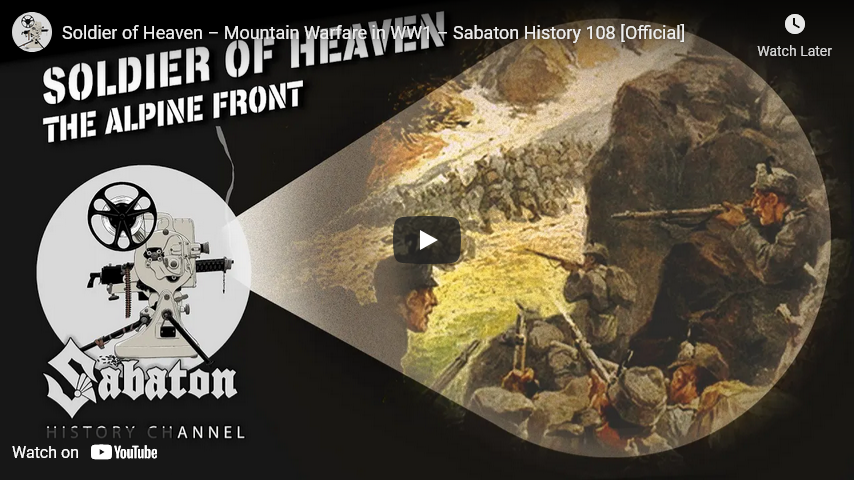
“Soldier of Heaven” – Mountain Warfare in WW1 – Sabaton History 108 [Official]
Sabaton History
Published 25 Jan 2022The war in the Alps between the Italians and the Austro-Hungarians added new dimensions to the fighting in the Great War since mountain warfare has its own unique set of challenges and dangers. What sort of men were doing the fighting here? And how did they cope with it? How did the survivors survive? Let’s take a look.
Support Sabaton History on Patreon: https://www.patreon.com/sabatonhistory
Listen to “Soldier of Heaven”: https://music.sabaton.net/SoldierOfHe…
Watch the Official Music Video of “Soldier of Heaven” here: https://www.youtube.com/watch?v=LYI3e…
Listen to Sabaton on Spotify: http://smarturl.it/SabatonSpotify
Official Sabaton Merchandise Shop: http://bit.ly/SabatonOfficialShopHosted by: Indy Neidell
Written by: Markus Linke and Indy Neidell
Directed by: Astrid Deinhard and Wieke Kapteijns
Produced by: Pär Sundström, Astrid Deinhard and Spartacus Olsson
Creative Producer: Maria Kyhle
Executive Producers: Pär Sundström, Joakim Brodén, Tomas Sunmo, Indy Neidell, Astrid Deinhard, and Spartacus Olsson
Post-Production Director: Wieke Kapteijns
Editor: Iryna Dulka
Sound Editor: Marek Kaminski
Archive: Reuters/Screenocean – https://www.screenocean.com
Sources:
– IWM Q 65115, IWM Q 65299, IWM Q 65062, IWM Q 65324, IWM Q 65102, IWM 1034-4, IWM 1062-14, IWM 459, IWM Q 114805б IWM Q 65104, IWM Q 65053, IWM Q 54778, IWM Q 65114, IWM Q 65130, IWM Q 65158
– esercito.difesa.it
– Médiathèque de l’architecture et du patrimoineS
– Business vector created by macrovector, Background vector created by freepik – www.freepik.com
All music by: SabatonAn OnLion Entertainment GmbH and Raging Beaver Publishing AB co-Production.
© Raging Beaver Publishing AB, 2019 – all rights reserved.
January 22, 2022
QotD: Breaking the trench stalemate with artillery
(I should note I am using “railroad networks” as a catch-all for a lot of different kinds of communications and logistics networks. The key technologies here are railroads, regular roads (which might speed along either leg infantry, horse-mobile troops and logistics, or trucks), and telegraph lines. That last element is important: the telegraph enabled instant, secure communications in war, an extremely valuable advantage, but required actual physical wires to work. Speed of communication was essential in order for an attack to be supported, so that command could know where reserves were needed or where artillery needed to go. Radio was also an option at this point, but it was very much a new technology and importantly not secure. Transmissions could be encoded (but often weren’t) and radios were expensive, finicky high technology. Telegraphs were older and more reliable technology, but of course after a barrage the attacker would need to be stringing new wire along behind them connecting back to their own telegraph systems in order to keep communications up. A counter-attack, supported by its own barrage, was bound to cut these lines strung over no man’s land, while of course the defender’s lines in their rear remained intact.)
Bret Devereaux, “Collections: No Man’s Land, Part II: Breaking the Stalemate”, A Collection of Unmitigated Pedantry, 2021-09-24.
December 30, 2021
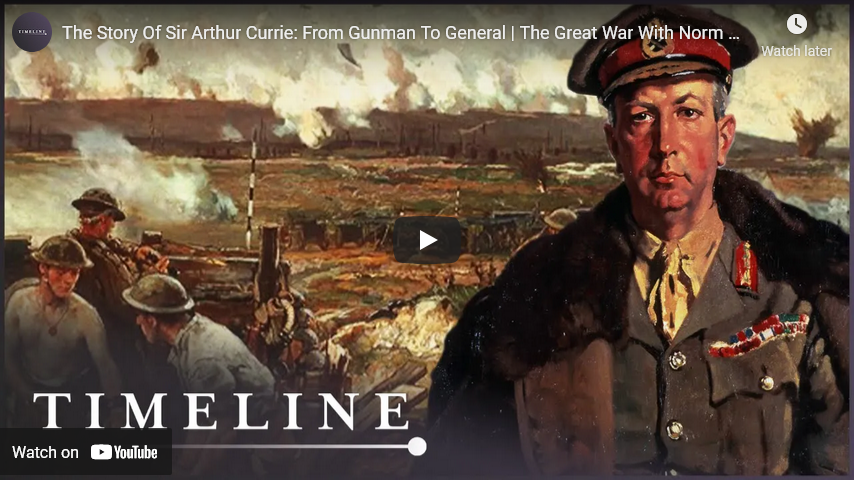
The Story Of Sir Arthur Currie: From Gunner To General | The Great War With Norm Christie | Timeline
Timeline – World History Documentaries
Published 28 Dec 2021Military historian Norm Christie presents a four-part series examining the First World War from a Canadian perspective. As he begins his journey through the historic battlefields of France and Belgium, Christie focuses on the career of General Sir Arthur Currie, a soldier who rose through the ranks from humble gunner in 1897 to lead the Canadian Corps to several victories during the conflict which began in 1914.
📺 It’s like Netflix for history… Sign up to History Hit, the world’s best history documentary service and get 50% off using the code ‘TIMELINE’ http://bit.ly/3a7ambu
You can find more from us on:
https://www.instagram.com/timelineWH
Any queries, please contact owned-enquiries@littledotstudios.com
Note: The original YouTube title said “from Gunman to General”. Perhaps in British usage, “gunman” is a variant of “gunner” (an artilleryman), but in Canadian usage the word “gunman” almost invariably means armed criminal or terrorist, and while Sir Arthur’s career had its difficulties, he was never a criminal.
The Army’s Labor Union: Winchester 94s for the Loyal Legion of Loggers & Lumbermen
Forgotten Weapons
Published 30 Aug 2021http://www.patreon.com/ForgottenWeapons
https://www.floatplane.com/channel/Fo…
Cool Forgotten Weapons merch! http://shop.forgottenweapons.com
Today we have a rifle from a really neat forgotten corner of American military history. During World War One, the Pacific Northwest was the source of prime lumber, in particular Sitka Spruce that was ideal for aircraft production. The US military wanted that spruce for its own aircraft, and there was also massive demand from France and the UK for their production as well. As part of the American war effort, the Signal Corps (which oversaw military aviation) set about increasing spruce production severalfold.
The Corps sent a Colonel to investigate what would be necessary to do this, and he found that logging work was being significantly disrupted by labor union organizing, ranging from strikes to active sabotage. In response, the Army essentially created its own labor union, the Loyal Legion of Loggers and Lumbermen which both provided some of the labor reforms sought by groups like the IWW and also succeeded in massively increasing timber output for the war. The LLLL is a mostly-forgotten organization, and most of the documentation on it is from very left-wing organizations that paint it as a government attempt to quash labor rights. The reality appears to be far more nuanced, with several very legitimate reforms instituted in good faith. Unfortunately, the best reference on this period is completely out of print, Soldiers and Spruce: Origins of the Loyal Legions of Loggers & Lumberman by Harold Hyman (https://amzn.to/3lErrRC).
At any rate, part of the effort included the creation of the Spruce Production Division — 25,000 soldiers (mostly with backgrounds in logging and lumber) to Vancouver. They were seconded to private logging companies with Army-subsidized wages, but retained a military structure and officer corps. The Signal Corps purchased about 1,800 Winchester Model 1894 rifles in .30-30 caliber to arm a segment of the Division for security and military police type duties. Winchester 94s were in production and readily accessible, and the Division’s mission did not justify giving them Enfield or Springfield rifles needed by troops in Europe. These Winchesters were marked with a “US” property stamp and flaming bomb, and had serial numbers between 835,000 and 853,000 (specific numbers are not known because Winchester’s records form this period were destroyed). When the war ended, the guns (along with the Division’s other equipment) were sold as surplus, and they are found to this day in the Northwest. Many are in poor condition from decades of hard use, and they can be difficult to identify (and are also faked …) but they are a really neat artifact of a long-forgotten part of World War One history.
Contact:
Forgotten Weapons
6281 N. Oracle 36270
Tucson, AZ 85740

December 25, 2021
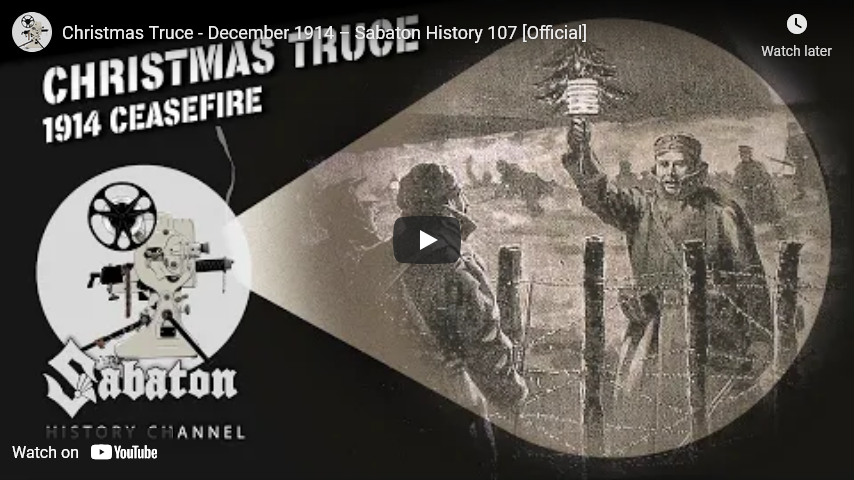
“Christmas Truce” – December 1914 – Sabaton History 107 [Official]
Sabaton History
Published 24 Dec 2021You’ve all heard about it, but here are the nuts and bolts for why and how it happened — the Christmas Truce on the Western Front in December 1914, the first Christmas of the Great War.
Support Sabaton History on Patreon: https://www.patreon.com/sabatonhistory
Listen to “Christmas Truce”: https://music.sabaton.net/ChristmasTruce
Watch the Official Music Video of “Christmas Truce” here: https://www.youtube.com/watch?v=HPdHk…
Listen to Sabaton on Spotify: http://smarturl.it/SabatonSpotify
Official Sabaton Merchandise Shop: http://bit.ly/SabatonOfficialShopHosted by: Indy Neidell
Written by: Markus Linke and Indy Neidell
Directed by: Astrid Deinhard and Wieke Kapteijns
Produced by: Pär Sundström, Astrid Deinhard and Spartacus Olsson
Creative Producer: Maria Kyhle
Executive Producers: Pär Sundström, Joakim Brodén, Tomas Sunmo, Indy Neidell, Astrid Deinhard, and Spartacus Olsson
Community Manager: Maria Kyhle
Post-Production Director: Wieke Kapteijns
Editor: Iryna Dulka
Sound Editor: Marek Kaminski
Archive: Reuters/Screenocean – https://www.screenocean.comSources:
– IWM NTB 178-2, IWM 205, Q 86849, Q 57165, Q 53616, Q 56198, Q 50720, Q 65834, Q 50719, Q 50721, Q 31575, Q 32613, Q 57361, Q 11718, Q 31576, Q 49581, Q 64568, IWM 130-01
– Santa vector created by vectorpocket – www.freepik.comAll music by: Sabaton
An OnLion Entertainment GmbH and Raging Beaver Publishing AB co-Production.
© Raging Beaver Publishing AB, 2019 – all rights reserved.
December 23, 2021
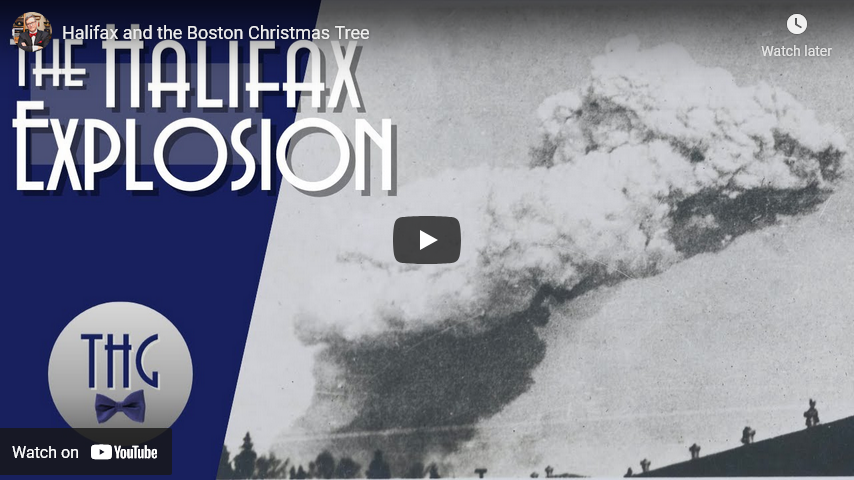
Halifax and the Boston Christmas Tree
The History Guy: History Deserves to Be Remembered
Published 22 Dec 2021One of America’s most famous Christmas trees is intimately linked to one of the most devastating explosions in human history. The story is one of great tragedy, great heroism, and human compassion, that goes to the heart of the true meaning of Christmas.
This is original content based on research by The History Guy. Images in the Public Domain are carefully selected and provide illustration. As very few images of the actual event are available in the Public Domain, images of similar objects and events are used for illustration.
You can purchase the bow tie worn in this episode at The Tie Bar:
https://www.thetiebar.com/?utm_campai…All events are portrayed in historical context and for educational purposes. No images or content are primarily intended to shock and disgust. Those who do not learn from history are doomed to repeat it. Non censuram.
Find The History Guy at:
Patreon: https://www.patreon.com/TheHistoryGuy
Please send suggestions for future episodes: Suggestions@TheHistoryGuy.netThe History Guy: History Deserves to Be Remembered is the place to find short snippets of forgotten history from five to fifteen minutes long. If you like history too, this is the channel for you.
Awesome The History Guy merchandise is available at:
teespring.com/stores/the-history-guyScript by THG
#history #thehistoryguy #Halifax
Update: For more information on the explosion itself, I put together a post on that a few years back.