Compared to your average college town cyclist, Ed Begley Jr. is a paragon of humility. I’ve never understood it, but for so many of my fellow “Americans”, there seems to be this all-purpose Asshole License you can issue yourself. It’s kinda like the “White Privilege” card, in that no one has ever seen one, but unlike “White Privilege”, the people who imagine themselves possessors of the Asshole License use it, every minute of every day. Did the seventeen year old in your life just read The Fountainhead or The Catcher in the Rye? Then you know what I mean — that kid just issued himself the Asshole License. Obviously getting dreadlocks (if you’re White) or existing (if you’re black) grants you the Asshole License, as does “passing a Gender Studies course” or “realizing that Israel’s actions don’t always match up with its rhetoric”.
But, my friends, the easiest way to obtain an Asshole License is to take up cycling. It must be something about those doofy helmets — anyone willing to wear what looks like a giant athletic supporter jammed down over his eyebrows has to be some kind of douchebag to begin with, and since nut-squashing lycra pants must squeeze out whatever residual testosterone they had left, it’s no wonder that cyclists are such bitches.
Severian, “Luxury Beliefs”, Rotten Chestnuts, 2021-06-03.
August 21, 2024
QotD: Cyclists at “Flyover State”
August 19, 2024
If you’ve never worked in the private sector, you have no idea how regulations impact businesses
In the National Post, J.D. Tuccille explain why Democratic candidates like Kamala Harris and Tim Walz who have spent little or no time in the non-government world have such rosy views of the benefits of government control with no concept of the costs such control imposes:
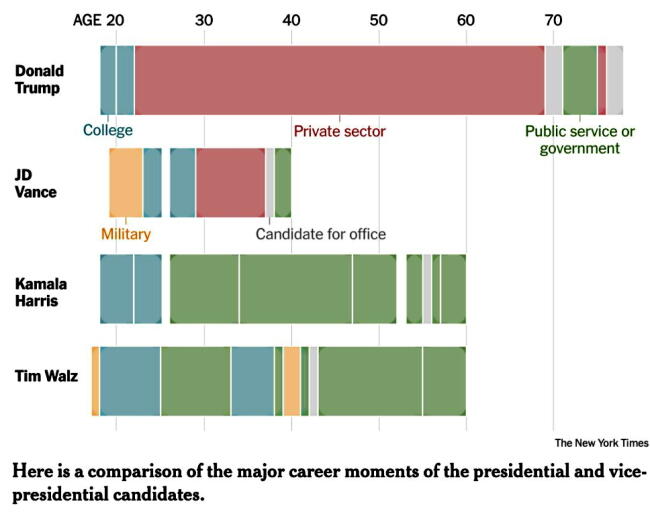
The respective public versus private sector experiences of the 2024 Presidential/Vice Presidential candidates.
New York Times
In broad terms, Democrats have faith in government while the GOP is skeptical — though a lot of Republicans are willing to suspend disbelief when their party controls the executive branch.
The contrast between the two parties can be seen in stark terms in the resumes of the two presidential and vice-presidential tickets. The New York Times made it easier to compare them earlier this month when it ran charts of the career timelines of Trump, J.D. Vance, Kamala Harris and Tim Walz. Their roles at any given age were colour-coded for college, military, private sector, public service or politics, federal government and candidate for federal office.
Peach is the colour used by the Times to indicate employment in the private sector, which produces the opportunities and wealth that are mugged away (taxation is theft by another name, after all) to fund all other sectors. It appears under the headings of “businessman” and “television personality” for Trump and as “lawyer and venture capitalist” for Vance. But private-sector peach appears nowhere in the timelines for Harris and Walz. Besides, perhaps, some odd jobs when they were young, neither of the Democrats has worked in the private sector.
Now, not all private-sector jobs are created equal. Some of the Republican presidential candidate’s ventures, like Trump University, have been highly sketchy, as are some of his practices — he’s openly boasted about donating to politicians to gain favours (though try to do business in New York without greasing palms). I’m not sure I’d want The Apprentice on my resume. But there must be some value to working on the receiving end of the various regulations and taxes government officials foist on society rather than spending one’s career brainstorming more rules without ever suffering the consequences.
In 1992, former U.S. senator and 1972 Democratic presidential candidate George McGovern penned a column for the Wall Street Journal about the challenges he encountered investing in a hotel after many years in government.
“In retrospect, I … wish that during the years I was in public office, I had had this firsthand experience about the difficulties business people face every day,” he wrote. He bemoaned “federal, state and local rules” passed with seemingly good intentions but little thought to the burdens and costs they imposed.
The lack of private sector stints in the career timelines of Harris and Walz means that, like pre-hotel McGovern, they’ve never had to worry about what it’s like to suffer the policies of a large and intrusive government.
That said, it’s possible to overstate the lessons learned by Republicans and Democrats from their different experiences. Vance, despite having worked to fund and launch businesses, has, since being elected to the U.S. Senate, advocated capturing the regulatory state and repurposing it for political uses, including punishing enemies.
Not only does power corrupt, but it does so quickly.
The US Navy’s mis-managed decline continues
Niccolo Soldo from his weekend wrap-up of various news articles that caught his eye:

Artist’s rendering of the US Navy’s FFG(X) Constellation-class guided missile frigate. Initial contract awarded 30 April, 2020, but delivery of the first ship is not expected until 2029 due to design changes and other issues.
US Navy image via Wikimedia Commons.
One data point that works in favour of American Declinism is the US Navy’s inability to not just keep up with the Chinese in terms of the production of ships, but to also maintain its own production output. Many lightly-armed littoral combat ships have been retired, for example, with nothing to replace them.
These production setbacks have been pointed out to me, with one mutual on Twitter/X reiterating the point so that I get it (I do!). This is an actual problem that requires solving, and fast. It is partially to blame for the Americans effectively ceding the Red Sea to the Houthis (for now).
AP has done a partial deep-dive (horrible language here, I apologize) on this issue:
The labor shortage is one of myriad challenges that have led to backlogs in ship production and maintenance at a time when the Navy faces expanding global threats. Combined with shifting defense priorities, last-minute design changes and cost overruns, it has put the U.S. behind China in the number of ships at its disposal — and the gap is widening.
Navy shipbuilding is currently in “a terrible state” — the worst in a quarter century, says Eric Labs, a longtime naval analyst at the Congressional Budget Office. “I feel alarmed,” he said. “I don’t see a fast, easy way to get out of this problem. It’s taken us a long time to get into it.”
Marinette Marine is under contract to build six guided-missile frigates — the Navy’s newest surface warships — with options to build four more. But it only has enough workers to produce one frigate a year, according to Labs.
A lot of the guys who know how to do this work are retiring or have already retired. Sound familiar?
One of the industry’s chief problems is the struggle to hire and retain laborers for the challenging work of building new ships as graying veterans retire, taking decades of experience with them.
Shipyards across the country have created training academies and partnered with technical colleges to provide workers with the skills they need to construct high-tech warships. Submarine builders and the Navy formed an alliance to promote manufacturing careers, and shipyards are offering perks to retain workers once they’re hired.
Andreini trained for his job at Marinette through a program at Northeast Wisconsin Technical College. Prior to that, he spent several years as a production line welder, making components for garbage trucks. He said some of his buddies are held back by the stigma that shipbuilding is a “crappy work environment, and it’s unsafe.”
The problem:
Much of the blame for U.S. shipbuilding’s current woes lies with the Navy, which frequently changes requirements, requests upgrades and tweaks designs after shipbuilders have begun construction.
That’s seen in cost overruns, technological challenges and delays in the Navy’s newest aircraft carrier, the USS Ford; the spiking of a gun system for a stealth destroyer program after its rocket-assisted projectiles became too costly; and the early retirement of some of the Navy’s lightly armored littoral combat ships, which were prone to breaking down.
The Navy vowed to learn from those past lessons with the new frigates they are building at Marinette Marine. The frigates are prized because they’re less costly to produce than larger destroyers but have similar weapon systems.
Now check this out:
The Navy chose a ship design already in use by navies in France and Italy instead of starting from scratch. The idea was that 15% of the vessel would be updated to meet U.S. Navy specifications, while 85% would remain unchanged, reducing costs and speeding construction.
Instead, the opposite happened: The Navy redesigned 85% of the ship, resulting in cost increases and construction delays, said Bryan Clark, an analyst at the Washington-based think tank Hudson Institute. Construction of the first-in-class Constellation warship, which began in August 2022, is now three years behind schedule, with delivery pushed back to 2029.
The final design still isn’t completed.
Shifting threats:
Throughout its history, the Navy has had to adapt to varying perils, whether it be the Cold War of past decades or current threats including war in the Middle East, growing competition from Chinese and Russian navies, piracy off the coast of Somalia and persistent attacks on commercial ships by Houthi rebels in Yemen.
And that’s not all. The consolidation of shipyards and funding uncertainties have disrupted the cadence of ship construction and stymied long-term investments and planning, says Matthew Paxton of the Shipbuilders Council of America, a national trade association.
“We’ve been dealing with inconsistent shipbuilding plans for years,” Paxton said. “When we finally start ramping up, the Navy is shocked that we lost members of our workforce.”
How is the US Navy supposed to protect Taiwan from a potential Chinese invasion?
August 18, 2024
Hirohito Announces Surrender – War Continues – WW2 – Week 312 – August 17, 1945
World War Two
Published 17 Aug 2024Hirohito broadcasts Japan’s surrender to the world- despite an attempted to coup to prevent it from happening, and much of the world celebrates, but the war isn’t really over. The Soviets are busy invading Manchuria, and there’s revolution in Vietnam and Indonesia.
00:00 Intro
00:22 Recap
00:49 Attempted Coup In Japan
04:12 Hirohito Surrenders
08:54 Japanese Surrender In China
12:05 Soviets In Manchuria
17:52 Revolution In Vietnam
20:33 Summary
21:07 Conclusion
(more…)
.30-06 M1918 American Chauchat – Doughboys Go to France
Forgotten Weapons
Published May 4, 2024When the US entered World War One, the country had a grand total of 1,453 machine guns, split between four different models. This was not a useful inventory to equip even a single division headed for France, and so the US had to look to France for automatic weapons. In June 1917 Springfield Armory tested a French CSRG Chauchat automatic rifle, and found it good enough to inquire about making an American version chambered for the .30-06 cartridge. This happened quickly, and after testing in August 1917, a batch of 25,000 was ordered. Of these, 18,000 were delivered and they were used to arm several divisions of American troops on the Continent.
Unfortunately, the American Chauchat was beset by extraction problems. These have today be traced to incorrectly cut chambers, which were slightly too short and caused stuck cases when the guns got hot. It is unclear exactly what caused the problem, but the result was that most of the guns were restricted to training use (as best we can tell today), and exchanged for French 8mm Chauchats when units deployed to the front. Today, American Chauchats are extremely rare, but also very much underappreciated for their role as significant American WWI small arms.
(more…)
QotD: Cell phones on airplanes
Andrew Sullivan, “Terror Cells”, AndrewSullivan.com, 2005-08-09.
August 16, 2024
“Operation Dragoon … was described by Adolf Hitler as the worst day of his life”
The “other” D-Day landing in France that few people know much about: Operation Dragoon.

Southern France, 15-28 August 1944.
West Point Military Atlas.
Often referred to as “the other D-Day”, Op Dragoon ran until 14 September 1944 and was a pivotal turning point in the Second World War.
Op Dragoon was a huge and complex operation by land, sea and air that liberated nearly two-thirds of France by linking up with troops from the Normandy invasion on 11 September and pushing the German forces right back to their frontier.
It also secured the ports of Marseilles and Toulon so Allied troops could flood into France.
This was a bitter blow for Hitler, who during conversations with his generals that were discovered in records written in shorthand, said: “The 15th of August was the worst day of my life”.
Dr Peter Caddick-Adams, a military historian and defence analyst, spoke to BFBS Forces News about Operation Dragoon, a largely French/American operation with support from countries including the UK and Canada.
He said: “It set the victory over Germany firmly on its way — and the end of the Second World War couldn’t really have been achieved without Operation Dragoon.
“This is the D-Day that you’ve never heard of.
“Originally there was planned to be two invasions of France on the same day — in Normandy and on the south coast of France along the Riviera.
“It was found that we didn’t have enough landing craft to do both at the same time simultaneously.”
It also didn’t help that Winston Churchill was against the idea and tried to cancel the operation.
The Prime Minister wanted the Italian campaign to remain dominant and was worried Dragoon would take troops and other resources away from Italy.
However, despite his best efforts, the Americans and French prevailed and Operation Dragoon went ahead.
Initially, the operation was given the codename Anvil, because Operation Overlord, the invasion of Normandy, was originally going to be called Sledgehammer.
The plan was for Germany’s armed forces to be smashed between the hammer and the anvil.
Churchill never changed his opinion about the operation despite its eventual success, as Dr Caddick-Adams explained: “At the last minute Churchill had the name changed to Dragoon and, legend has it, because he felt he was being dragooned into an operation that he didn’t want to undertake”.
After the Trump livestream, Elon Musk’s been “charged with coercive chuckling, a legal first”
Chris Bray has been following the legal sideshow of the United Auto Workers union filing charges with the US National Labour Relations Board (NLRB), alleging that Trump and Musk made threats against organized labour during the recent livestreamed event:
The UAW complaints against Tesla and Trump for President 2024 have been listed on the NLRB website. They really did it, and I got it wrong. The delay in listing the complaints, and the lunacy of the charges, led me to the wrong conclusion. The complaints are real: there are forms with vague and obviously ridiculous complaints on them, and they filed the things.
But they’re still functionally fake, and they’ll die quickly. Anti-Trump organizations have been doing this for years, without success; this is the third complaint filed with the NLRB against Trump campaign organizations.
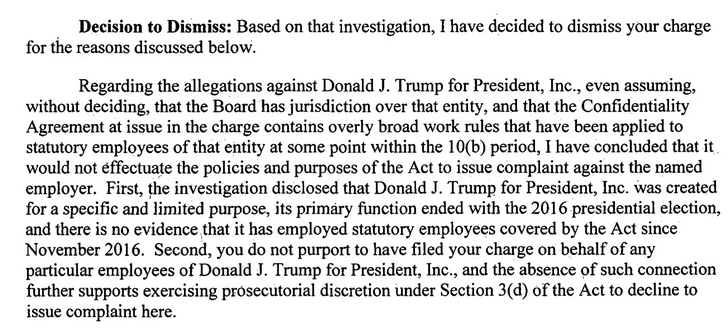
In the first of those previous cases, the NLRB raised the obvious question about jurisdiction, expressing doubt (“without deciding”) that they can police presidential campaigns using labor law:
The NLRB has previously declined to pursue labor complaints against Trump for President, and the UAW has filed a labor complaint against Trump for President. We can make educated guesses about what happens next. I’ve emailed professors who teach labor law to ask them if the National Labor Relations Act governs the political speech of presidential candidates, but they haven’t responded.
As for the complaint against Tesla, Elon Musk had a livestreamed discussion with Donald Trump in which Trump said that striking workers should be fired; Musk laughed, but didn’t say anything in response. This news report includes audio of that exchange. The complaint alleges that Musk therefore made coercive statements

August 15, 2024
QotD: The bitter fruit of deinstitutionalization
Freddie deBoer, “We Closed the Institutions That Housed the Severely Mentally Ill and We Made It Dramatically Harder to Compel Them to Receive Care”, Freddie deBoer, 2024-05-14.
August 14, 2024
All the news the legacy media chooses to share
Mark Steyn grudgingly pays a bit of attention to US politics, or more accurately, the parts of US politics that the legacy media wants Americans to know:

Donald Trump, surrounded by Secret Service agents, raises his fist after an attempt on his life during a campaign speech in Butler, PA on 13 July, 2024. One spectator was killed and two others were reported to be in critical condition. The shooter was killed by Pennsylvania State Troopers, according to reports in the succeeding hours.
In one party, the presidential candidate came within maybe an eighth-of-an-inch of having his head blown off on live TV.
In the other party, the presidential candidate was more successfully dispatched — and the millions of primary votes he’d supposedly received simply nullified.
Either of these would be extraordinary events in any other country. And yet, under the smooth narrative management of the American press, they were mere spasms of momentary discombobulation before the normal somnolent service was resumed. “Democracy Dies in Darkness”, The Washington Post informs its readers every morning. In fact, under the court eunuchs of the US media, democracy dies in broad daylight.
First, the Pennsylvania assassination attempt was memory-holed — in an industrial-strength illustration of Orwell’s brilliant coinage: any day now there will be some poll showing thirty-seven per cent of registered voters are entirely unaware that a would-be killer hit Trump in the ear. And this despite the fact that every few hours there are — oh, what’s the word they use in nations with a real press? — newsworthy revelations about all that the Secret Service did to facilitate the operation, to scrub the evidence afterwards, and to lie to Congress about both.
At this stage, they might as well remake In the Line of Fire with Clint lying on the roof next to the goofball lining up his shot and helpfully suggesting, “Think you might be maybe a half-centimeter off there, sonny …” (On the other hand, if you’re looking for some guys to break into a Massachusetts hair salon to use the toilet for two hours and then leave the joint unlocked for the rest of the weekend, this is the federal agency for you.)
In the American media, a tree can fall in the forest in front of twenty million people — and it still doesn’t make a sound.
On the other hand, we have … wossname, you know, the stiff who was nose-diving off the steps to Air Force One just twenty minutes ago. In the entirety of last week the so-called “President of the United States” had only one bit of state business to perform — a Monday telephone call with the King of Jordan. Her late Majesty Queen Elizabeth II had a heavier workload the day before she died at ninety-six. But the same people who’ve spent the last three-and-a-half years insisting that Joe Biden was the chief executive of the United States can no longer be bothered with the elaborate pretence: the show supposedly has five months to run, but they’ve struck the set and sent the crew home, and left the star sitting slack-jawed and drooling in his Chinese Barcalounger in the dark on an empty stage. Joe’s sole residual presence in the news cycle is when Nancy Pelosi goes on TV and breezily claims to be the one who had him whacked (although the party’s other “senior powerbrokers” are reported to be mildly irked by her braggadocio: they assert that, as in Murder on the Re-Orient Express, everybody did it).
So who is running the United States? If the presidency is so important it’s worth holding a two-year contest to decide who gets to occupy it, why isn’t who’s exercising those powers right now of any interest?
Well, that’s been memory-holed, too. America’s uniquely unique “peaceful transfer of power” has begun six months early, that’s all.
So, on the one side, 24/7 coverage of the candidate being indicted, sued, tried, convicted and (coming soon!) banged up in Rikers Island will continue … but it doesn’t leave any resources to investigate him getting shot in the head on live TV.
And, on the other side, a candidate with not a single primary vote to her name has been imposed on the party by who knows who … but it would be grossly disrespectful to the majesty of her office (President-Designate) to expect her to sit down for a puffball interview with George Stephanopoulos. (“Do you think all these GOP demands that you be able to answer questions on your platform and if you know where it’s being kept are because many Republican men are still uncomfortable with the idea of a strong black Montreal schoolgirl running for president?”)
But it’s not just the regime-aligned mainstream media who want to control what you get to see and hear — the European Union seems to think it can dictate to American social media companies what they’re allowed to share:
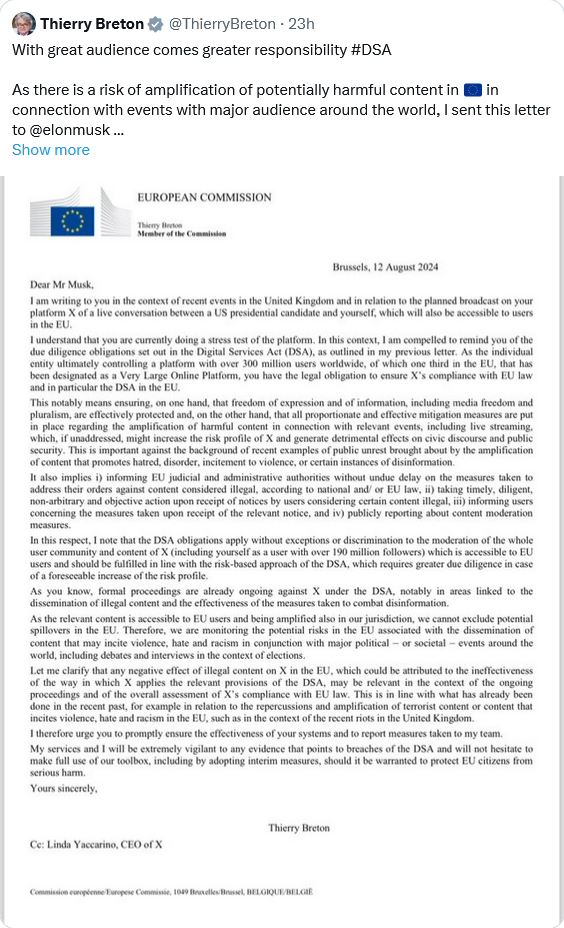
“The European Union’s digital enforcer wrote an open letter to tech mogul Elon Musk on Monday ahead of a planned interview with former United States President Donald Trump to remind him of the EU’s rules on promoting hate speech,” reports Politico.
“As the relevant content is accessible to EU users and being amplified also in our jurisdiction, we cannot exclude potential spillovers in the EU,” wrote Digital Commissioner Thierry Breton on X. “With great audience comes greater responsibility.”
Meanwhile, The Guardian reports that Bruce Daisley, Twitter’s former vice-president for Europe, the Middle East and Africa, has said Musk should face “personal sanctions” — which are “much more effective on executives than the risk of corporate fines” — and even, possibly, an “arrest warrant” if he “continue[s] stirring up unrest” on the platform.
“The question we are presented with is whether we’re willing to allow a billionaire oligarch to camp off the UK coastline and take potshots at our society,” says Daisley. “The idea that a boycott — whether by high-profile users or advertisers — should be our only sanction is clearly not meaningful.” (All Musk has done, for the record, is criticize British Prime Minister Keir Starmer for his handling of riots over immigration, calling him a “hypocrite” and “two-tier Keir“.)
The Korean War Week 008 – The First UN Counterattack – August 13, 1950
The Korean War by Indy Neidell
Published 13 Aug 2024The first UN large scale counterattack goes off this week; this by the American Task Force Kean. It has both successes and failures, and it runs right into a new North Korean offensive. The fighting happens just about everywhere on the Pusan Perimeter this week, though. That’s the area into which the UN forces have been compressed, and it is particularly threatening at the Naktong Bulge. It is, plain and simple, a week of desperate and bloody fighting and that’s about it.
Chapters
00:47 Recap
01:27 The Pusan Perimeter
04:31 Task Force Kean
07:44 The Naktong Bulge
10:09 The Fight Around Daegu
13:45 Summary
(more…)
QotD: The solipsism of the American media
Severian, “Friday Mailbag”, Rotten Chestnuts, 2021-07-09.
August 13, 2024
“We just don’t understand the key role of ‘vibes’ in 2024”
In Spiked, Brendan O’Neill admits to being an “old square” who hasn’t really been able to figure out the Kamala Harris campaigning style:
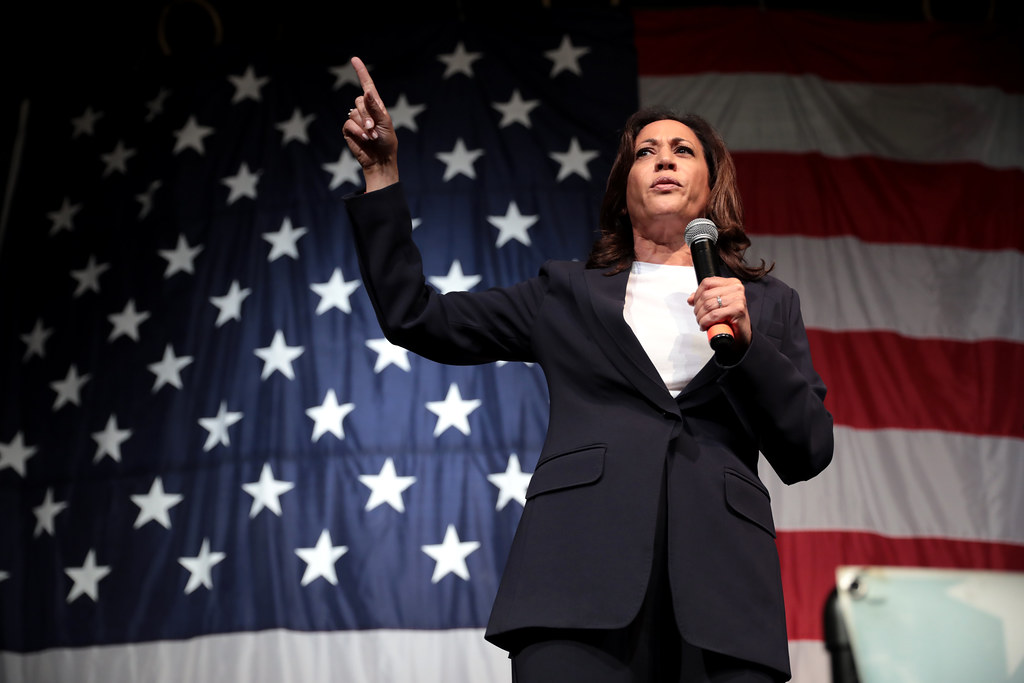
“Kamala Harris” by Gage Skidmore is licensed under CC BY-SA 2.0 

 .
.
I was thinking the other day: what do I know about Kamala Harris? Off the top of my head, no Googling, I know she was the attorney general of California. I know she locked up lots of people for marijuana violations. I know she likes Venn diagrams. I know she didn’t fall out of a coconut tree. I know she’s “brat”, though I don’t know what that means. I know her ceaseless cackle will haunt me to my grave. I know she’s unburdened by what has been. And I know she was the border czar, even if she herself seems to have forgotten that fact.
And that’s it. That is the long and short of my knowledge about the possible future leader of the free world. You could torture me for days and I wouldn’t be able to tell you her positions on the big issues presidential candidates once held forth on. Iran, say. Or global trade. Or job creation. I’m open to the possibility that this is partly down to my lack of reading, but there’s also more to it than that. The truth is Harris is a wholly new kind of politician. One who’s not meant to be known but felt. It’s less her policies we’re meant to be wowed by than her vibes. Brace yourselves: America might soon be ruled by a meme made flesh.
[…]
There’s a twisted irony to this feverish beatification of Kamala as the vibe goddess, the mother brat, the “Gen Z Meme Queen” (kill me now). Which is that it’s the handiwork of the kind of sniffy liberals who laugh at rednecks for falling for the “Cult of Trump“. It’s being pushed by online leftists who spend the rest of the time wringing their hands over Trump’s “demagoguery”, his sinister ensnaring of supposedly dim voters with rhetoric and style. These people urgently need to take a look in a mirror. For their creepy worship of Harris is the very definition of demagoguery. Their excuse-making for her ivory-tower style of campaigning makes the most wide-eyed MAGA people look critically minded in comparison. As to their lying down so that the Kamala vibes might wash over them and provide with them an emotional kick – it’s giving North Korea.
What are “vibes”, anyway? All I know, being middle-aged and literal, is that vibes is short for vibrations. It’s a Sixties thing, originally. It’s about pressing pause on all your thinking and worrying and just letting the beat rush through you. That’s fine in a club or art venue. But in politics? In a presidential campaign? Surely we should expect more from our elected representatives than a fleeting therapeutic thrill. It is a testament to the almost total hollowing out of public life, to “the fall of public man“, as Richard Sennett described the crisis of modernity nearly 50 years ago, that in an era of economic downturn, social conflict, war and fear, all we’re getting from one of the presidential candidates in the United States of America is vibes. And brat. And memes. And laughing. So much laughing.
The new politics of vibes is even more degraded than the politics of personality. That political style of the 1980s and 90s also spoke to a decline in democratic seriousness, where politicians would seek votes less on the basis of what they believed than on their spin-doctored pose as intimate, authentic “good guys”. But at least they tried to connect with us, at least they talked to us. Aloof, inscrutable “brat” Kamala is something far worse – a politician without substance or personality. Bereft of both vision and character, all she has to offer is strange vibrations.
August 12, 2024
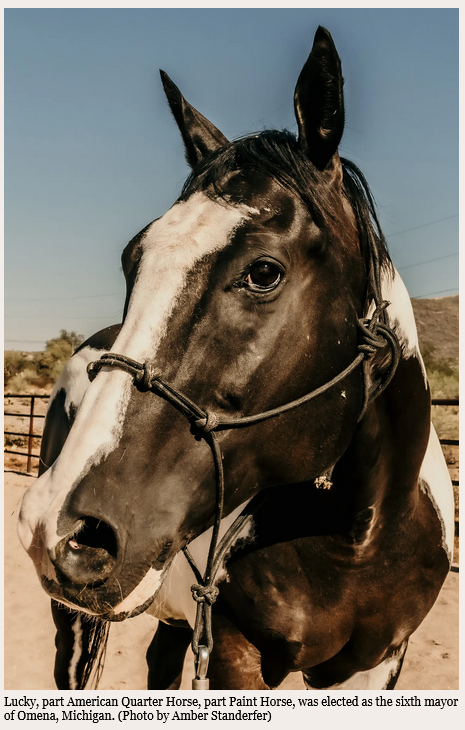
In Michigan, the mayor of Omena is Lucky
In The Free Press, Eric Spitznagel reports on the outcome of the most recent mayoral race in Omena, Michigan:
On July 20 in Omena, a small town in the “little finger” of northern Michigan, a crowd of about a hundred locals gathered in a church parking lot for the inauguration of their new mayor. A brass band played “The Stars and Stripes Forever” as Sally Viskochil, president of the local historical society, walked across the patriotically festooned stage to make the announcement.
“And our new mayor is …” There was a collective intake of breath. “Lucky!”
There was a smattering of applause, but a few members of the audience looked stunned. Mike McKenzie, 53, an Illinoisan with a summer home in Omena, turned to me, befuddled.
“Boy,” he said. “I guess people really are fed up with the old two-species system.”
Lucky, after all, is a horse. He’s a cross between an American Quarter and an American Paint, to be precise, and the first equid to be elected mayor of Omena. Until now, this race has only ever been won by a dog — and, once, a cat. You could say Lucky was an underdog in securing the town’s highest office, except he beat twelve actual dogs, five cats, and a goat. Many of them were in attendance. The victor was not.
As the results sunk in, Rosie, the incumbent mayor, a Golden Labrador mix, wandered around the crowd, saying her goodbyes. The band broke into “Hail to the Chief” for her, and she paused, as if to listen.
Welcome to Omena’s triennial animal election. What began as a fundraising stunt for the local historical society in 2009 is now a source of heated political debate in this middle-of-nowhere Michigan village, population 355. As the crowd began to disperse, a small group of locals gathered under a tree to escape the sun, and to talk frankly.
“The horse isn’t even from here,” groused Cathy Stephenson, the campaign manager for Topsy & Turvy, domestic shorthair cats who ran on one ticket to be co-mayors.
“But isn’t he moving here?” another woman asked. “That’s what I heard.”
“Well, he should’ve waited to run till he lives here full time,” Stephenson said.
Lucky, who is 16, has lived 2,000 miles away in Cave Creek, Arizona, his entire life. He was conspicuously absent throughout the summer campaign season — but allowed to run because his human relatives have owned property in Omena for three generations and plan to relocate here in the fall.
August 11, 2024
Tears are still a powerful weapon for female politicians
Janice Fiamengo on the tactic available to — and resorted to frequently — only females in politics, turning on the waterworks to generate sympathy and support:
Recently, a friend sent me a news article that illustrates, in small, the world of Anglophone politics, in which notions of what is owed to women, who are understood to be far more sensitive and fragile than men, operate alongside stern interdictions against stating that women are in any manner unsuited for strenuous, high stress roles.
Last week, an ABC News report detailed years-old allegations against a former aide to Josh Shapiro, the Governor of Pennsylvania who was, at the time of the article, one of Kamala Harris’s touted VP possibilities (she has since chosen Tim Walz, Governor of Minnesota). Shapiro’s former staffer, Mike Vereb, who resigned in 2023 over a sexual harassment allegation, is said to have brought a woman to tears in 2018 with threats made over the phone (“You will be less than nothing by the time Josh and I get done with you”, he is alleged to have said).
The woman, who runs an advocacy group, was left “weeping and in shock standing alone in a parking lot”. She did not report the alleged incident until she heard about the aide’s resignation five years later.
[…]
With the staffer long gone from Shapiro’s administration, the story had legs only because it was about a man who made a woman cry.
The problem is that women do cry rather frequently in politics. And complain. And perform their sensitivity to criticisms, monikers, crude jokes, the faux terror of J6, and bantering innuendo. Far too often such women make politics about them as women and about the trouble men allegedly cause them.
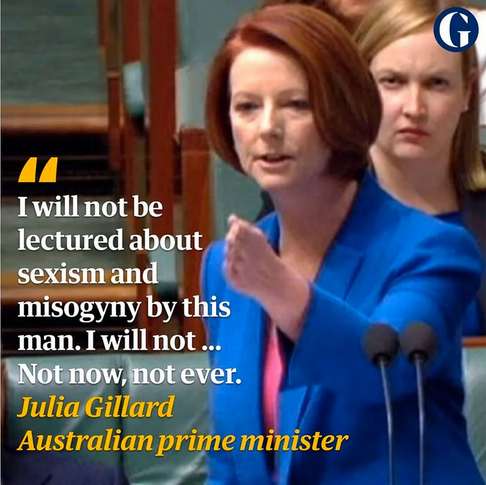
Such was the case with Australian Prime Minister Julia Gillard, who earned plaudits from feminists in 2012 for a fury-filled speech in the House of Representatives about sexism, in which she accused the opposition leader of misogyny for a number of statements he’d made that were not at all misogynistic, including that women were likely under-represented in Australian institutions of power because men were “more adapted to exercise authority”. Gillard also said she was “personally offended” (a more serious state of affairs, one assumes, than simply being “offended”) by the opposition leader’s contention that abortion was “the easy way out”. (The text of her speech is here.) “Julia Gillard’s Attack on Sexism Hailed as Turning Point for Australian Women” ran one enthusiastic headline. And perhaps it was, signaling the point at which women in politics stopped thinking they should accommodate themselves to the rigors of public life, and decided that politicians must instead accommodate themselves to the rigors of women’s demands.
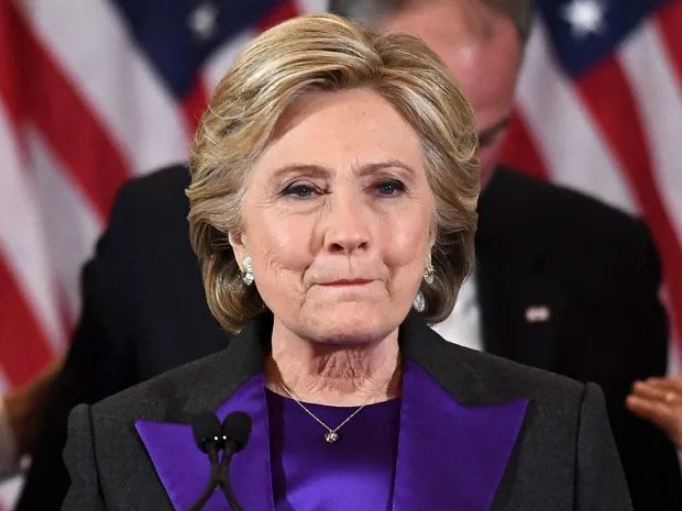
Even seemingly tough-as-nails Hillary Clinton has been allowed to go from interview to interview revisiting the now years-old indignity of her election loss in 2016, like a once-popular debutante who can’t believe she didn’t make the cheerleading squad. No man would ever be given such a prolonged pity party. Having contended for years that it was misogyny that prevented her from beating Donald Trump, she more recently pointed her finger at female voters’ failures of confidence: “They left me [in the final days of the campaign] because they just couldn’t take a risk on me, because as a woman, I’m supposed to be perfect“, she explained in May, 2024. No one seems to have informed Clinton that nothing reveals her crippling unsuitability for leadership than her embarrassing refusal to stop feeling sorry for herself.
And she is, alas, far from unique. Nicola Sturgeon, former First Minister of Scotland, sat and sobbed at last winter’s Covid-19 Inquiry in Edinburgh, deflecting critical questions about her government’s actions during the pandemic by proclaiming that she would carry the impact of them for as long as she lived. Forget the thousands of Scots who suffered or even died because of those decisions: the woman in charge was the one in need of compassion. Sturgeon had previously made a career of complaining about the sexism that allegedly put obstacles in the way of female politicians. Her focus on her own emotional discomfort at the Covid inquiry did more than any naysayers to indict the feminine style. How refreshing if either of these women could simply accept responsibility for their failures.