
Let me interject that I hold no brief for the police in America, at least in the cities. They inspire me with a frisson of fear every time I see one, though I break no law. Their manner is more that of masters of the public than of servants of the same; many of them seem to be the kind of people who wanted to be soldiers but couldn’t make the grade because they were not fit enough. They look menacing and seem to shoot to kill on relatively slight pretexts (or perhaps they are just bad shots). I have little doubt that if I were black my less than warm feelings toward them would be a good deal cooler still. Their increasing militarization, on the flimsiest of pretexts, is another reason to mistrust them. Alas, the British police are increasingly modeling themselves on the American, as if they were permanently on riot duty.
Theodore Dalrymple, “Indulging in Destruction”, Taki’s Magazine, 2014-08-24.
July 15, 2015
QotD: Modern urban policing
July 14, 2015
Washington’s streetcars
Warren Meyer isn’t a fan of streetcars in general, but he views the Washington DC streetcar project as being particularly deserving of scorn:
I am increasingly convinced that the appeal of streetcars and light rail has everything to do with class. From any rational perspective, these systems make no sense — they are 10-100x more expensive than buses and lack the flexibility that buses have to adjust to shifting demand patterns over time. A single extra lane of highway adds more capacity than any light rail line.
Streetcar’s single, solitary advantage is that middle and upper class whites who would not be caught dead on a bus seem to be willing to ride streetcars. I don’t know if this is because of some feature of the streetcars (they are shiny and painted pretty) or if it is some sort of self-segregation (the upper classes want to ride on something that is not filled with “riffraff”).
He also points out that even Vox.com can’t make the case for streetcars particularly well:
The arguments are:
- Tourists like them, because you can’t get lost like you can on buses. My response is, “so what.” Unless you are one of a very few unique cities, tourists are a trivial percentage of transit riders anyway. Why build a huge system just to serve out-of-town visitors? I would add that many of these same cities (e.g. Las Vegas) considering streetcars are the same ones banning Uber, which tourists REALLY love.
- Developers like them. Ahh, now we are getting somewhere. So they are corporate welfare? But not so fast, they are not even very good corporate welfare. Because most of the studies they cite are total BS, of the same quality as studies that say sports stadium construction spurs all sorts of business. In fact, most cities have linked huge tax abatement and subsidy programs to their streetcars, such that the development you get with the subsidy and the streetcar is about what you would expect from the subsidies alone. Reminds me of the old joke that mimicked cereal commercials: “As part of a breakfast with juice, toast, and milk, Trix cereal has all the nutrition of juice, toast, and milk.”
- Good for the environment. But even Vox asks, “as compared to what.” Since they are generally an alternative buses, as compared to buses that have little environmental advantage and often are worse (they have a lot more weight to drag around when empty).
- The Obama Administration likes them. LOL, that’s a recommendation? When you read the text, what they actually say is that mayors like the fact that the Obama Administration likes them, for it means the Feds will throw lots of Federal money at these projects to help mayors look good using other peoples’ money.
- Jobs. This is hilarious Keynesianism, trying to make the fact that streetcars are 10-100x more expensive than buses some sort of positive. Because they are more inefficient, they employ more people! One could make the exact same argument for banning mechanical harvesters and going back to scythes. Left unquestioned, as Bastiat would tell us, is how many people that money would have employed if it had not been seized by the government for streetcar use.
- Je ne sais quoi. I kid you not, that is their final argument, that streetcars add that special something to a neighborhood. In my mind, this is Vox’s way of saying the same thing I did the other day — that the streetcar’s appeal is primarily based on class, in that middle and upper class folks don’t want to ride on a bus with the masses. The streetcar feels more upscale than buses. The poor of course, for whom public transit is most vital, don’t want to pay 10 times more for sexiness.
Every argument I have ever been in on streetcars always boils down to something like “well, all the cool kids like them.”
QotD: Lenin’s moment of clarity
There is not very much good to say about the life and career of Vladimir Lenin, but give the pickled old monster this much: He cut through more than two centuries’ worth of bull and straight to the heart of all politics with his simple question: “Who? Whom?” Which is to say: Who acts? Who is acted upon? Even here in the land of the free, meditating upon that question can be an uncomfortable exercise.
The foundation of classical liberalism, and of the American order, is not the rule of law, a written constitution, freedom of speech and worship, one-man/one-vote democracy, or the Christian moral tradition — necessary as those things are. The irreplaceable basis for a prosperous, decent, liberal, stable society is property. Forget Thomas Jefferson’s epicurean flourish — John Locke and the First Continental Congress had it right on the first go-round: “Life, liberty, and property.” Despite the presence of the serial commas in that formulation, these are not really three different things: Perhaps we should render the concept “lifelibertyproperty” the way the physicists write about “spacetime.”
Kevin D. Williamson, “Property and Peace”, National Review, 2014-07-20.
July 12, 2015
The erosion of meaningful marks in school
Richard Anderson on the move to eliminate “D” as a mark in educational grading schemes:
Thing is that if you get rid of Ds then Cs become the new Ds. If C is now the borderline for pass / fail then the slackers will work hard enough to get Cs, or more likely public school teachers will just drop their standards in order to meet their performance metrics. While this change might mean that the students learn a bit more as a signalling mechanism it’s a lateral move. Employers and colleges will know that the new C minus student is about as mediocre as the D minus student of yesteryear. The end result is that Peppermint Patty gets into the C Minus Hall of Fame instead.
Yet Ds are important in education. They tell the student they’re not very good at that particular subject. This is because they are lacking something: work ethnic, motivation, intelligence or aptitude. The grade system, assuming it is reasonably applied, is providing important feedback information. It’s fundamentally no different from any other form of measurement. Imagine a speedometer that never gave you the correct speed below 20 mph. That’s the same as a grading system were Ds have been done away with.
The D-Reformers are trying to short circuit the educational feedback loop. Instead of providing real information that can be used to draw conclusions, it instead provides false information that misleads and misdirects. While in the short-term this can seem kind, over the long-term it’s very cruel. It gives students an incorrect understanding of their talents and abilities. Sooner or later objective reality catches-up. Often this happens when the student reaches college and flunks out.
July 11, 2015
“They sought to be ‘hypersexual’ or ‘pansexual’ because they never quite understood what it meant to be ‘sexual'”
George Fields wonders why “progressives” have such an adversarial relationship with ordinary life:
Many months ago, as I was wandering about the state of Indiana, a certain woman from Wisconsin advised me that “if one had nothing nice to say, he ought say nothing at all.” Being an introspective type, I took this to heart and determined to never write another article again.
However, I have decided to write at least one more time, provoked by a conversation with my kid sister. Having recently entered a public high school, she has come to enjoy informing me about some of her more eccentric peers. Near the end of the school year, she told me fewer and fewer of her friends were merely normal boys who liked normal girls, or normal girls who liked normal boys. Rather, they identify as a slew of peculiarly novel “sexual orientations.”
Some were, of course, the usual “gay” or “lesbian,” but in addition to these were “demisexuals,” “androsexuals,” and “therians” (which, she explained, are people who are only attracted to individuals who commune with the same spirit animal). One identified as a “panromantic polyamorous asexual non-binary space god.” Upon hearing this, I knew I had something to say, although it is unlikely to be nice. Having heard, however, several episodes of “The Prairie Home Companion,” I am convinced women from Wisconsin are famously kind, so I am sure my friend will forgive me.
I suspect the “space god” is nothing of the sort, but likely the kind of child who did not want to go to the caverns because she was much too busy trying to beat her high score on “Candy Crush Legend.” Meaning, she is likely longing to be “the extraordinary” because she has entirely failed to appreciate the ordinary. This, to any ordinary person of sensible wit, is extraordinary.
To the sane individual, the world is a wonderful thing. At no point in my life have I ever felt compelled to invent novel sexualities, mainly because I am so enthralled with the traditional two. Their complexity and magic never ceases to engage my imagination and bring me pleasure. Indeed, I can not imagine why anyone would critique the symmetrical beauty of “the two sexes.” Yet wherever I look, adversaries are about, seeking to destroy my source of wonderment.
Reason.tv – How the Feds’ Subpoena of Reason and Gag Order Went Public
Published on 7 Jul 2015
You may have already heard about how the government tried to stifle Reason‘s free speech.
Federal prosecutors based in New York sent a grand jury subpoena and letter to Reason, commanding editors to hand over the records of six commenters who wrote hyperbolic statements about federal judge Katherine Forrest below a blog post at Reason.com. Forrest sentenced Ross Ulbricht to life in prison without parole for creating the Silk Road website.
Then came a gag order from U.S. District Court, meaning Reason could not write or speak publicly about the subpoena or gag order — even to acknowledge either existed. But between the subpoena being issued and the gag order being issued, one legal blogger managed to figure out what was going on.
“I got an email and I looked at it and I thought wow, this is a federal grand jury subpoena to Reason magazine,” says Ken White, a writer at the legal blog Popehat who is himself a former federal prosecutor. White sat down with Reason TV to talk about how he broke the story and what he thinks it means for press freedom and open expression online.
“What’s upsetting is that there is no indication whatsoever either that the prosecutor or the judge gave any consideration to the fact that this was being aimed at a reporting organization about a First Amendment issue,” says White. What’s more, White stresses that the comments named in the subpoena are commonplace for the internet and especially at Reason.com, a site, he notes, “whose clever writing is eclipsed only by the blowhard stupidity of its commenting peanut gallery.”
The scrutinized comments ranged from taunts such as “I hope there is a special place in hell reserved for that horrible woman” to “Its (sic) judges like these that should be taken out back and shot,” but none, say White, come close to qualifying as “true” threats or anything other idle chatter. It remains unclear why the U.S. Attorney’s Office was interested in such internet fodder, how often these sorts of subpoenas get sent out to news organizations, and how often they comply. Nevertheless, White points out that federal prosecutors hold an enormous amount of power over human lives and rarely reflect on how they use — and abuse — their position.
“A fish doesn’t know that it’s in water,” says White. “A federal prosecutor doesn’t know that they are swimming in power. They could do it, so they did.”
Produced by Paul Detrick. Shot by Zach Weissmueller and Justin Monticello.
Reason.tv – The TSA’s 12 Signs You Might Be a Terrorist
Published on 9 Jul 2015
Traveling this summer? Avoid these officially terrorist-y behaviors—or you might get detained.
QotD: The Businessman
It is, after all, a sound instinct which puts business below the professions, and burdens the business man with a social inferiority that he can never quite shake off, even in America. The business man, in fact, acquiesces in this assumption of his inferiority, even when he protests against it. He is the only man who is forever apologizing for his occupation. He is the only one who always seeks to make it appear, when he attains the object of his labors, i. e., the making of a great deal of money, that it was not the object of his labors.
H.L. Mencken, “Types of Men 7: The Business Man”, Prejudices, Third Series, 1922.
July 10, 2015
July 8, 2015
Minnesota students face new rules under which “everyone accused of sexual assault will very likely be technically guilty”
Reason‘s Robby Soave on the introduction of new “affirmative consent” rules at the University of Minnesota:
The proposed policy is currently under review for another 30 days before it becomes official. Its language is fairly standard, which leads me to believe that it will suffer from the same problems as other “Yes Means Yes” policies:
- It is the responsibility of each person who wishes to engage in the sexual activity to obtain consent.
- A lack of protest, the absence of resistance and silence do not indicate consent.
- The existence of a present or past dating or romantic relationship does not imply consent to future sexual activity.
- Consent must be present throughout the sexual activity and may be initially given, but withdrawn at any time.
- When consent is withdrawn all sexual activity must stop. Likewise, where there is confusion about the state of consent, sexual activity must stop until both parties consent again.
- Consent to one form of sexual activity does not imply consent to other forms of sexual activity.
“It is the responsibility of each person who wishes to engage in the sexual activity to obtain consent.” But isn’t that redundant? All parties to a sexual activity must be willing participants in the first place, or else they are victims of rape under any standard. That’s what consent is: agreement to engage in sex. I presume the policy’s authors mean to say that it is the responsibility of each person who wishes to initiate the sexual activity to obtain consent. But such a requirement is at odds with the reality of human sexual activity — the initiating party is not always so clearly defined, especially when alcohol is involved (as it often is).
Equally troubling is the mandate that each and every sexual act be hammered out beforehand. May I touch your hand? What about your wrist? May I touch your shoulder? May I kiss this spot on your neck? May I kiss this other spot on your neck? May I kiss the first spot again while I touch your hand? Nobody is going to do this. Does that mean everyone is a rapist?
July 7, 2015
QotD: Laws as blunt instruments
On June 25th, the US Federal Bureau of Investigation seized the venerable San Francisco escort website, MyRedbook, under the usual vague and evidence-free charges the US government always uses when it wants to destroy peaceful businesses who have hurt no one. This time […] the pretenses are “money laundering” and “racketeering”, but others cases include “conspiracy”, “mail fraud” and “tax evasion”. You may believe that these are actual crimes, but the truth is they aren’t (except on paper); they’re simply blunt instruments defined so vaguely that any competent prosecutor can jam nearly any business into one or more of them. Here’s how it works: “racketeering” can mean criminals operating a legitimate business, like when a mobster owns a restaurant. So a “racketeering” charge usually means “we think you committed crimes but can’t prove them, so we’re just going to assume you’re a criminal and prosecute you for owning a regular business.” Any money you’ve deposited is then called “money laundering” on the grounds that you deposited “criminal proceeds” from your imaginary crimes into your legitimate account; “tax evasion” is based on the pretense that you have failed to pay taxes on imaginary income they can’t prove you actually made; “conspiracy” means merely talking about committing the imaginary crimes, and so on. And if you believe that the targeted business is protected by the presumption of innocence, think again.
Maggie McNeill, “Bread and Circuses”, The Honest Courtesan, 2014-07-11.
July 4, 2015
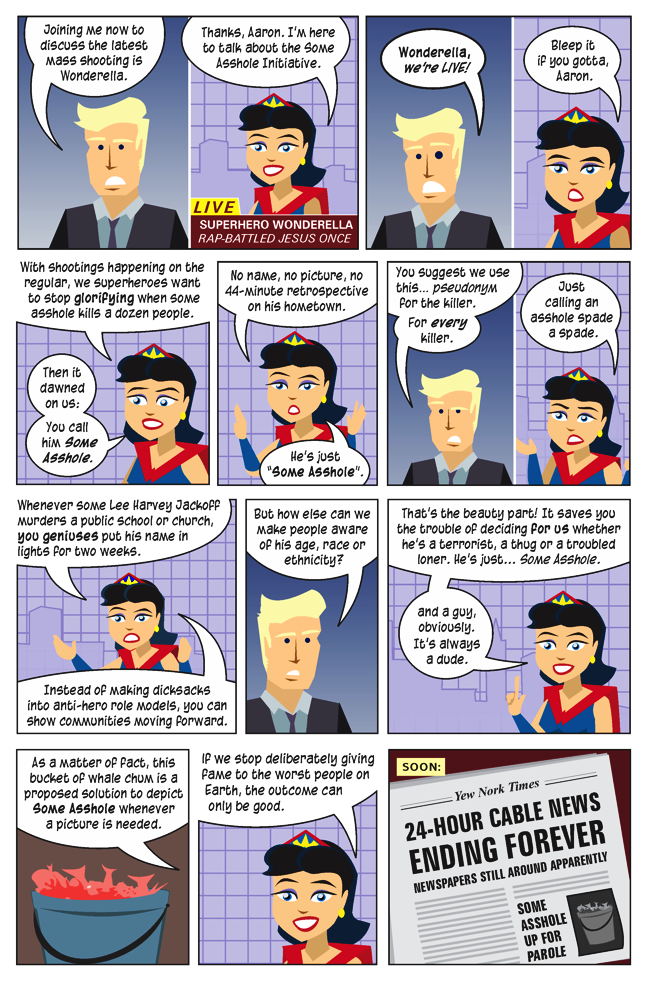
Please support the “Some Asshole” initiative!
By way of American Digest, let’s all get behind the “some asshole” initiative:
Reason.tv – The Secret Scam of Streetcars
Published on 1 Jul 2015
Meet the Thighmaster of urban public policy: Streetcars.
Municipal politicians all across the country have convinced themselves that this costly, clunky hardware can revitalize their flabby downtown economies.
That includes the fearless leaders of America’s capital city. The DC government has spent hundreds of millions of dollars over the last decade trying to erect a streetcar line in the up-and-coming neighborhood of H Street. The project has been an epic disaster, perfectly demonstrating how ill-suited streetcars are to modern urban life.
Watch the full video above, or click below for downloadable versions. And subscribe to Reason TV’s YouTube channel for daily content like this.
Which NFL team is the most AMERICA?
It’s the bitter end of the off-season in the NFL: everyone is waiting for training camps to open and there’s no football news at all (except disciplinary announcements). To help fill these empty days, Dave Rappoccio ranks all 32 NFL teams by how AMERICA they are:
32. Bills
Buffalo is basically Canada[…]
15. Vikings
Yes, they are Norsemen, but charging into villages, burning everything to the ground and ruining lives is totally American as hell.[…]
5. Philadelphia Eagles
The Eagles are very AMERICA. Bald Eagles? Hell yes, slap our big ass scary national bird on it. The face on the logo faces left! Totally different than every other logo, a special snowflake, just like we think we are! It’s angry, SO AMERICA. They are based in Philadelphia, which was literally our capital city for a while! The liberty bell is there! Why aren’t they higher? Because the Eagles ain’t won sh*t, and America wins sh*t.4. The Patriots
Giant annoying bullies who talk stupid and are too proud of themselves, so much so that they make their own rules, man. So America.3. The Cowboys
What? How are they not no. 1? Because no matter how gloriously American the cowboy is, The Cowboys are loyal to Texas, and Texas would be its own country if we let it.2. The Steelers
Fat, angry, out of work industrial giants. Go America.1. The Redskins
The Redskins? First? Why? Think about it. They are the actual first Americans. If you want to look at it a different way, the Skins represent all the shaming and systematic oppression of those people, the most American way to treat others! Plus how we totally ignore them and forget to change the name! They are based in Washington DC, the capital of the country, and is run by a greedy capitalistic megalomaniac with no regard for others but claims to support “traditions” which are actually offensive! Plus, we haven’t actually been all that great since the 90s and we have horrible gun related tragedies all the time (Sean Taylor). That is ‘MERCA as Sh*t.
July 3, 2015
The unintended consequences of a bottled water ban
Mark J. Perry talks about the outcome of a well-intended ban of bottled water at the University of Vermont:
Here’s the abstract of the research article “The Unintended Consequences of Changes in Beverage Options and the Removal of Bottled Water on a University Campus,” which was just published in the July 2015 issue of the American Journal of Public Health (emphasis added):
Objectives. We investigated how the removal of bottled water along with a minimum healthy beverage requirement affected the purchasing behavior, healthiness of beverage choices, and consumption of calories and added sugars of university campus consumers.
Methods. With shipment data as a proxy, we estimated bottled beverage consumption over 3 consecutive semesters: baseline (spring 2012), when a 30% healthy beverage ratio was enacted (fall 2012), and when bottled water was removed (spring 2013) at the University of Vermont. We assessed changes in number and type of beverages and per capita calories, total sugars, and added sugars shipped.
Results. Per capita shipments of bottles, calories, sugars, and added sugars increased significantly when bottled water was removed. Shipments of healthy beverages declined significantly, whereas shipments of less healthy beverages increased significantly. As bottled water sales dropped to zero, sales of sugar-free beverages and sugar-sweetened beverages increased.
Conclusions. The bottled water ban did not reduce the number of bottles entering the waste stream from the university campus, the ultimate goal of the ban. With the removal of bottled water, consumers increased their consumption of less healthy bottled beverages.
[…]
Wow, nothing worked out as expected by the college administrators at the University of Vermont: a) the per capita number of bottles shipped to the University of Vermont increased significantly following the bottled water ban, and b) students, faculty and staff increased their consumption of less healthy bottled beverages following the bottled water ban. Another great example of the Law of Unintended Consequences. And the bottled water ban was not costless – the university paid to modify 68 drinking fountains, they paid for a publicity campaign, and they paid for lots of “free” reusable water bottles; and what they got was more plastic bottles on campus of less healthy beverages!


