
Published on 25 Sep 2014
April 11, 2017
QotD: The great American humourists
The great American humorists have something in common: hatred.
H. L. Mencken and Mark Twain both could be uproariously funny and charming — and Twain could be tender from time to time, though Mencken could not or would not — but at the bottom of each man’s deep well of humor was a brackish and sour reserve of hatred, for this country, for its institutions, and for its people. Neither man could forgive Americans for being provincial, backward, bigoted, anti-intellectual, floridly religious, or for any of the other real or imagined defects located in the American character.
Historical context matters, of course. As Edmund Burke said, “To make us love our country, our country ought to be lovely.” Twain was born in 1835, and there was much that was detestable in the America of Tom Sawyer. Mencken, at the age of nine, read Huckleberry Finn and experienced a literary and intellectual awakening — “the most stupendous event in my life,” he called it — and followed a similar path. Both men were cranks: Twain with his premonitions and parapsychology, Mencken with his “Prejudices” and his evangelical atheism. He might have been referring to himself when he wrote: “There are men so philosophical that they can see humor in their own toothaches. But there has never lived a man so philosophical that he could see the toothache in his own humor.”
The debunking mentality is prevalent in both men’s writing, a genuine fervor to knock the United States and its people down a peg or two. For Twain, America was slavery and the oppression of African Americans. For Mencken, the representative American experience was the Scopes trial, with its greasy Christian fundamentalists and arguments designed to appeal to the “prehensile moron,” his description of the typical American farmer. The debunking mind is typical of the American Left, which feels itself compelled to rewrite every episode in history in such a way as to put black hats on the heads of any and all American heroes: Jefferson? Slave-owning rapist. Lincoln? Not really all that enlightened on race. Saving the world from the Nazis? Sure, but what about the internment of the Japanese? Etc. “It was wonderful to find America,” Twain wrote. “But it would have been more wonderful to miss it.”
Kevin D. Williamson, “Bitter Laughter: Humor and the politics of hate”, National Review, 2016-08-11.
Comments Off on QotD: The great American humourists
April 10, 2017
Audit Hollywood!
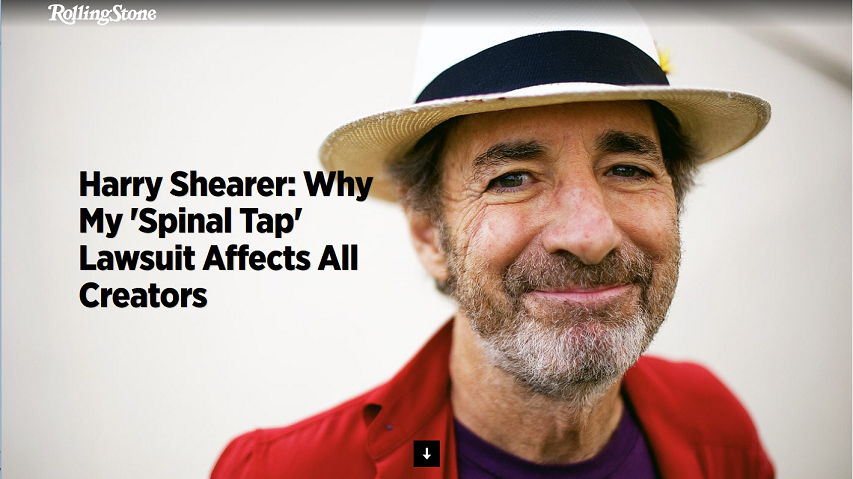
Harry Shearer has launched a suit against the owners of the movie Spinal Tap after he and his co-stars earned a pitiful sum on merchandise and music royalties, despite the film’s continuing popularity. Movie studios and music conglomerates use impenetrable and complex accounting “rules” to hide any profits (as profits need to be shared with actors, directors, musicians, and writers):
Behind the ambitious, creative talent that is Hollywood lies a darker side of the entertainment industry little appreciated by the ordinary moviegoer. It’s an opaque world of film financing, revenue accretion and minimal profit share. If exposed, as our Spinal Tap lawsuit against Vivendi aims to do, fans will no doubt be horrified at the shameful gravy train that rolls for corporate rights holders at the expense of creators. So far, challenges to media conglomerates’ comfortable status quo provoke little more than derision, since the power balance is so skewed in their favor. But, for how much longer?
Spinal Tap began as a mock rock band that we four – Rob Reiner, Christopher Guest, Michael McKean and myself – developed for an appearance on a TV pilot at the end of the 1970s. On our own initiative, we wrote and recorded most of the songs and performed them live in several music clubs around L.A. before any cameras rolled. The ultimate movie was truly, in the words of Michael McKean, “the result of four very stubborn guys working very hard to create something new under the sun.”
[…]
Unfortunately, “Hollywood accounting” isn’t a practice confined to California. Within the success story that is the European film and television industry, which generated €122 billion in 2013, less than one-third of 1 percent was shared with the writers and directors of the works created. A peculiar definition of “fairness,” you might say.
Under French law, filmmakers should be paid a fee for their work plus an ongoing remuneration proportionate to the exploitation of their creation. In reality, less than 3 percent of French writers and directors receive anything more than the initial payment of that minimum guarantee. And 70 percent of all European film directors are asked to defer a proportion of their original fees (as we, the creators of This is Spinal Tap, originally agreed to do).
The Europeans are simply following Hollywood’s lead; however, Spinal Tap‘s rights are determined by US law. In fighting for creators’ rights against a French conglomerate, Spinal Tap is simply pursuing a legal path well-trodden by our American creator peers. The well-known science-fiction “flop” of a film, Return of the Jedi, has apparently never gone into profit despite earning almost $500 million worldwide. Harry Potter and the Order of the Phoenix, apparently “lost” almost $170 million.
Comments Off on Audit Hollywood!
April 8, 2017
The “Three Stooges of the Apocalypse”
David Warren takes a well-deserved kick at Lloyd George, Clemenceau, and (especially) Woodrow Wilson:
A century has now passed since President Wilson disowned President Washington’s advice to his successors — to stay out of European conflicts — and war was declared by the United States on Germany. A moral preener, Wilson justified himself by declaring an even more extravagant mission to go with it:
“The world must be made safe for democracy.”
However large, a war is just a war. It should have a beginning and an end. As my old Indian girlfriend explained, “Too much war only leads to peace. Too much peace only leads to war.” As most people prefer peace, most of the time, it is well that war is not a permanent condition. But a war to some idealistic purpose can get very large, and go on for a long time, and morph into conditions which resemble peace, but are not peace. We’ve been making the world safe for democracy for at least a century. By now we have far too much.
[…]
In my view, that Great War, that Totaler Krieg, hasn’t ended yet. The old etiquette, that war was for soldiers — that non-combatants should be non-involved — became a thing of nostalgia. Vast conscript armies had been summoned, and would never be fully demobilized. The men I call the “Three Stooges of the Apocalypse” — Wilson, Lloyd George, Clemenceau — clinched at Versailles this new normal. It was not simply the punitive terms that were imposed on the war’s losers, but a more fundamental reorganization of all national and international affairs: “statecraft” became “policy.”
For Wilson was also the pioneer of progressive schemes to change the American way of life. He was, in some sense, a second Washington, consolidating a second American Revolution that had begun more modestly with Lincoln and the Union victory in the Civil War. America would be recreated, along bureaucratic lines, in a tireless campaign for full secularization, under centralized government control. The general mobilization of the First World War, now in America as well as Europe, created a new opportunity, by accustoming men to following orders; by the propaganda that made them identify with huge abstractions.
This is of course an inexhaustible topic, at which I pick away, in my attempts to explain if only to myself what makes our world so different from all preceding. It embraces more than any single force or event. We must also go back to the Prussian invention of the welfare state, and for that matter to the Gatling gun. Post-modernity is an invention of modernity, as modernity was an invention of the Middle Ages. The contemporary revolution has antecedents that may be found in the Enlightenment and in the Reformation. (What will post-modernity beget?)
Comments Off on The “Three Stooges of the Apocalypse”
April 7, 2017
The First American Shots Of WW1 – Guam And The Cormoran I THE GREAT WAR Special
Published on 6 Apr 2017
Learn more about Guam in WW1: www.visitguam.com/smscormoranguam/
The Island of Guam was on the other end of the world when the US declared war on Germany in 1917. However, they had been involved in the global conflict for years already. When the Germans lost their colonies in the Pacific, the German merchant raider SMS Cormoran II had no other choice but to seek refuge in the then neutral Arpor Harbour, Guam. For months the German crew around Adalbert Zuckschwerdt stayed on the island and became a kind of sensation. But that all changed on April 6, 1917.
Comments Off on The First American Shots Of WW1 – Guam And The Cormoran I THE GREAT WAR Special
Growth Rates Are Crucial
Published on 12 Jan 2016
In the first video in this section on The Wealth of Nations and Economic Growth, you learned a basic fact of economic wealth — that countries can vary widely in standard of living. Specifically, you learned how variations in real GDP per capita can set countries leagues apart from one another.
Today, we’ll continue on that road of differences, and ask yet another question.
How can we explain wealth disparities between countries?
The answer? Growth rates.
And in this video, you’ll learn all about the ins-and-outs of measuring growth rates.
For one, you’ll learn how to visualize growth properly — examining growth in real GDP per capita on a ratio scale.
Then, here comes the fun part: you’ll also take a dive into the growth of the US economy over time. It’s a little bit like time travel. You’ll transport yourself to different periods in the country’s economic history: 1845, 1880, the Roaring Twenties, and much more.
As you transport yourself to those times, you’ll also see how the economies of other countries stack up in comparison. You’ll see why the Indian economy now is like a trip back to the US of 1880. You’ll see why China today is like the America of the Jazz Age. (You’ll even see why living in Italy today is related to a time when Atari was popular in the US!)
In keeping with our theme, though, we won’t just offer you a trip through ages past.
Because by the end of this video, you’ll also have the answer to one vital question: if the US had grown at an even higher rate, where would we be by now?
The magnitude of the answer will surprise you, we’re sure.
But then, that surprise is in the video. So, go on and watch, and we’ll see you on the other side.
Comments Off on Growth Rates Are Crucial
QotD: You may not have to be crazy to be President, but it helps
Does Mr. Trump really have serious psychiatric problems as increasing numbers of shrinks are suggesting?
Since in their DSM-5 [PDF] (Diagnostic and Statistical Manual of Mental Disorders, Fifth Edition), the Mental Health Guild has classified just about every possible combination of human emotion and behavior as a psychiatric disorder, they can certainly find Mr. Trump — along with the rest of us — has conditions they would gladly treat but not necessarily cure. For a nice fee, of course.
They suggest he’s grandiose, antisocial, narcissistic, and paranoid etc. And, since an Australian study found that 1 in 5 CEOs are psychopaths, we can probably add that and/or “sociopath” to the list.
And they say he’s deceitful and tells lies, so far, at least 129 of ’em. And counting. Well, DUH! That IS how politicians get elected after all. And most of the folks who manage to get a shot at the position are quite accomplished at it.
Bill Clinton was notable, and his wife is no slouch. Obama was quite slick at it and Dubya & Company told 935 thoroughly documented whoppers to get “us” to attack, kill, maim, and displace hundreds-of-thousands of innocent Iraqi men, women and children. Etc.
So, since as POTUS (President Of The United States), Mr. Trump will almost certainly be responsible for killing, etc. large numbers of innocent folks, being a bit of a sociopath — maybe even a psychopath — will help. And to feel better about it — and possibly avoid PTSD — he can follow previous Presidents and call most of those innocent victims “collateral damage” instead of “murder victims.”
The bottom line is that to serve as president, sociopathy etc. has become helpful and lying is necessary. As Historian Zinn put it, “If governments told the truth, they wouldn’t last very long.”
L. Reichard White, “Is Trump Nuts? Does it Matter?”, Libertarian Enterprise, 2017-03-26.
Comments Off on QotD: You may not have to be crazy to be President, but it helps
April 6, 2017
The United States Declares War on Germany I THE GREAT WAR Week 141
Published on 5 Apr 2017
Diplomatic tensions after the return of German unrestricted submarine warfare and the aftermath of the Zimmermann telegram lead to the United States declaration of war on Germany this week 100 years ago. Meanwhile the British and French high command are still debating the upcoming offensive, namely the Battle of Arras which includes taking the contested Vimy Ridge and the Nivelle Offensive at the Chemin Des Dames.
Comments Off on The United States Declares War on Germany I THE GREAT WAR Week 141
American “isolationism” between the wars
Reason‘s Jesse Walker linked to this article by Andrew Bacevich which helps to debunk the routine description of US foreign policy between the first and second world wars as “isolationism”:
… McCain is worried about the direction of world events, with Russian provocations offering but one concern among many. Patterson shares McCain’s apprehensions, compounded by what he sees as a revival of “the isolationism in Europe and America that precipitated World War II.”
Now as an explanation for the origins of the war of 1939-1945, American “isolationism” is as familiar as the sweet-and-sour pork featured at your local Chinese takeout joint. Its authenticity is equally dubious. Yet Patterson’s assertion has this virtue: It captures in less than a sentence a prime obstacle to instituting a realistic, fact-based approach to foreign policy.
In truth, isolationism is to history what fake news is to journalism. The oft-repeated claim that in the 1920s and 1930s the United States raised the drawbridges, stuck its head in the sand, and turned its back on the world is not only misleading, but also unhelpful. Citing a penchant for isolationism as a defect afflicting the American character is like suggesting that members of Congress suffer from a lack of self-esteem. The charge just doesn’t square with the facts, no matter how often repeated.
Here, by way of illustrating some of those relevant facts, is a partial list of places beyond the boundaries of North America, where the United States stationed military forces during the interval between the two world wars: China, the Philippines, Guam, Hawaii, Panama, Cuba, and Puerto Rico. That’s not counting the U.S. Marine occupations of Nicaragua, Haiti, and the Dominican Republic during a portion of this period. Choose whatever term you like to describe the U.S military posture during this era — incoherent comes to mind — but isolationism doesn’t fill the bill.
As for Patterson’s suggestion that the behavior of the United States “precipitated” World War II, the claim is simply laughable. World War I precipitated World War II, or more specifically the European malaise resulting from the bloodletting of 1914-1918, compounded by the Bolshevik Revolution and the spread of fascism, and further exacerbated by profoundly shortsighted policies pursued by Great Britain and France. Throw into the mix the Great Depression, Japanese imperial ambitions, and the diabolical plotting of Adolf Hitler and his henchmen, and you have the makings of a catastrophe. Some few observers foresaw that catastrophe, but preventing it lay well beyond the ability of the United States, even if U.S. leaders had been clairvoyant.
Comments Off on American “isolationism” between the wars
QotD: The “real” “synergies” of corporate mergers
There can be a few factors behind consolidation. For example, massive economies of scale. Or … well, I’m afraid this is a bit delicate, but I can’t let it go unmentioned: Industries consolidate to reduce the number of players in the market, giving the remaining players more pricing power. Antitrust regulators tend to put on their big frowny face if companies cite the latter reason, so the public statements made by companies in consolidating industries tend to focus on more superficially attractive reasons like cost savings and “broader industry reach,” or more ethereally vague words like “synergies.”
True to form, Anthem is claiming that nearly $2 billion in synergy savings will be realized by the merged entities. This is probably true, to some extent. But you should keep in mind that mergers are themselves extremely costly. And I don’t just mean the fabulous fees that investment bankers and consultants collect to facilitate them. Joining two entities into one is really difficult: Corporate cultures clash, turf wars damage morale and profits, IT systems never do work right together, key employees leave, customers are alienated. So in general, these sorts of statements should be taken, not just with a grain of salt, but while sitting next to a salt lick with a big bag of Mr. Salty Pretzels and some cocktail peanuts to wash the whole thing down.
Megan McArdle, “No Wonder Insurers Want to Merge”, Bloomberg View, 2015-07-24.
Comments Off on QotD: The “real” “synergies” of corporate mergers
April 5, 2017
Reining in legalized theft
Jacob Sullum on the efforts to clamp down on civil asset forfeiture abuse, which is another instance of the process being the punishment for too many innocent people:
During a meeting with county sheriffs in February, Donald Trump was puzzled by criticism of civil asset forfeiture, which all the cops in the room viewed as an indispensable and unobjectionable law enforcement tool. “Do you even understand the other side of it?” the president asked. “No,” one sheriff said, and that was that.
Trump might get a more helpful answer if he asked Rep. Jim Sensenbrenner, R-Wis., who last week reintroduced a bill aimed at curtailing civil forfeiture abuses. As Sensenbrenner observed, “These abuses threaten citizens’ Constitutional rights, put unnecessary burdens on innocent Americans, and weaken our faith in law enforcement.”
Civil forfeiture lets the government confiscate property allegedly linked to crime without bringing charges against the owner. Since law enforcement agencies receive most or all of the proceeds from the forfeitures they initiate, they have a strong financial incentive to loot first and ask questions never, which explains why those sheriffs were not eager to enlighten the president about the downside of such legalized theft.
A new report from the Justice Department’s Office of the Inspector General highlights the potential for abuse. Between fiscal years 2007 and 2016, the OIG found that the Drug Enforcement Administration took $4.2 billion in cash, more than 80 percent of it through administrative forfeitures, meaning there was no judicial oversight because the owners did not challenge the seizures in court.
Although the DEA would argue that the lack of challenges proves the owners were guilty, that is not true. The process for recovering seized property is daunting, complicated, time-consuming and expensive, often costing more than the property is worth.
Comments Off on Reining in legalized theft
April 3, 2017
Decoding TLAs among the PUAs
Kim du Toit on a specific example of the use of jargon heavily sprinkled with three-letter acronyms (TLAs) and extended three-letter acronyms (ETLAs, or four-letter acronyms) to create or enhance the impression of their specialized insider knowledge, in this case among the pick-up artists (PUAs):
In every cult, there are people who try to set their group aside from the rest of the population with language — in other words, creating a shorthand that only the initiates or insiders know, which (I guess) makes them feel superior to outsiders. Many times, this language is made up of abbreviations or (my particular bête noir) acronyms that create a level of inscrutability to the casual reader or onlooker and render the simplest of statements completely opaque to the uninitiated. (I’ll talk another time about academic language, which shuns abbreviation and acronym in favor of dense, elliptical words and phrases used as a shorthand among fellow academics and gives the users a veneer of erudition, usually false.)
[…]
All this pales into insignificance by comparison to people who toss off expressions like “This beta orbiter tried to neg the AMOG in front of the SHB to increase his SMV.” Allow me to translate: “This weakling who hangs around pretty women trying to curry favor with them tried to cut down a charismatic man in front of a beautiful woman, in order to make himself more attractive to her.” (AMOG = Alpha Male Of [the] Group or Alpha Male Other Guy, SHB = Smokin’ Hot Babe [sometimes V(very)H(ot)B(abe), and SMV = Sexual Market Value.)
I speak here, of course, of the PUA (pick-up artist) community, in which the High Priests have created this entire glossary of acronyms to show that, yes, they are the gate-keepers of knowledge which, if you buy their training manuals or pay to attend their seminars, you too, Mr. Sad Beta Male, can unlock the secrets of access to SHB pudenda (Latin alert) and become a “notch collector” similar to these skilled exponents of the art.
It’s bad enough when used in a sentence, but when used graphically or in a chart to illustrate a concept or theory, it becomes completely opaque. Here’s a beauty which attempts to show the correlation between a woman’s looks and the likelihood of her being bitchy:
VHB10 -> BQ 0
HB9 -> BQ 0-1
HB8 -> BQ 1-2
PJ7 -> BQ 3-4
PJ6 -> BQ 5-7
PJ5 -> BQ 6-10
PJ4 -> BQ 4-10
UG3 -> BQ 1-8
UG2 -> BQ 1-4
UG1 -> BQ 0-3
VUG0 -> BQ 0-1VHB = Very Hot Babe, HB = Hot Babe, PJ = Plain Jane, UG = Ugly Girl, VUG = Very Ugly Girl, and the numeric qualifiers 1-10 are the common delimiters on the Female Hotness Scale (FHS). BQ, by the way, is Bitchiness Quotient, and the numeric qualifiers there are the levels thereof.
Note that this is presented as a scientific analysis or model, when in fact it’s no such thing: it’s a creation solely of the writer’s observation or theory and not by actual, you know, data — but creating acronyms gives it quasi-scientific gravitas — damn it, another Latin word, but you know what I mean, right? It’s kind of a pity, because the author at Chateau Artiste has an excellent way with the English language, when he’s not talking utter bullshit like the above. (Credit where it’s due, though: he also called Trump for the overwhelming electoral victory long before anyone else did, so he’s a more-insightful observer of trends than most mainstream media pundits.)
Comments Off on Decoding TLAs among the PUAs
April 2, 2017
Visiting the Meuse-Argonne American Cemetery I THE GREAT WAR Special
Published on 1 Apr 2017
Meuse-Argonne App (iOS): http://bit.ly/CemeteryApp
Meuse-Argonne App (Android): http://bit.ly/MeuseArgonne
Meuse-Argonne American Cemetery Facebook Page: http://bit.ly/MeuseArgonneFBDuring our trip to France we visited the Meuse-Argonne American Cemetery and Monument in Romagne. The cemetery contains the largest number of American military dead in Europe and was already dedicated when the war was still raging in Europe.
Comments Off on Visiting the Meuse-Argonne American Cemetery I THE GREAT WAR Special


