
Tasting History with Max Miller
Published 22 Apr 2025Ground beef in a delicious tomato-based sauce on a hamburger bun, part of a classic 90s American school lunch
City/Region: United States of America
Time Period: 1988Today we know sloppy joes as a saucy ground beef sandwich, but the term sloppy joe has referred to many things over the years. A sloppy joe could be other kinds of sandwiches, a nickname for a messy friend, or women’s fashion from the 1940s and 50s that included pants and looser fitting styles.
For me, though, it is this style of sandwich. Really, it is this version of this sandwich. Sloppy joes were a larger part of my adolescent diet than was healthy, and these taste exactly like the ones I remember from middle school.
Be sure to get the cheapest hamburger buns possible to authentically recreate this nostalgic lunchtime favorite.
Sloppy Joe on a Roll (50 servings)
Raw ground beef (no more than 24% fat) … 17 lb 4 oz
Dehydrated onions … 2 1/4 oz … 2/3 cup
OR Fresh onions, chopped … 1 lb 2 oz … 3 cups
Garlic powder … 2 Tbsp
Tomato paste … 3 lb 8 oz … 1/2 No. 10 can
Catsup … 3 lb 9 oz … 1/2 No. 10 can
Water … 2 qt 3 1/2 cups
Vinegar … 2 1/4 cups
Dry mustard … 1/4 cup
Black pepper … 2 tsp
Brown sugar, packed … 5 1/2 oz … 3/4 cup
Hamburger rolls…100
— Quantity Recipes for School Food Service by the United States Department of Agriculture, 1988
September 26, 2025
School Cafeteria Sloppy Joe from the 1980s & ’90s
September 25, 2025
An unanticipated danger of AI – “classified” videos for decision-makers
Until fairly recently, even the least tech-savvy among us could distinguish AI-generated videos from the real thing … but most of the leaders and decision-makers in western governments aren’t very tech-savvy and put into high-pressure environments may be uniquely susceptible to AI manipulation:

What If I Told You … One of the biggest applications of AI for misinformation hasn’t been online but in the halls of power.
Aging boomer politicians, generals, and major figures are manipulated by showing them AI videos they can’t tell, can’t pause to look at, and certainly can’t digitally examine or geolocate …
“And as you saw Mr President.”
Pay attention. All of them reference seeing “videos” that you aren’t allowed to see, of events which they claim are public record, but appear no-where and no reporting supports …
Sean Hannity was interviewing a world leader and even said “You should show the public the video you showed me it’d really change everyone’s opinion. it changed mine” LIVE ON AIR. And the world leader said some non-committal maybe, then released nothing.
These aging politicians, media figures, corporate personalities, etc. all casually reference seeing insane videos that would CHANGE EVERYTHING and would have been immediately released to sway public opinion if they existed or would have been leaked if it would have been in poor taste to be seen directly releasing them (like gore films)
But of course they aren’t released because they’re faked and the internet would immediately piece together that they’re faked with AI, video game, and archival footage from old conflicts … But the aging 60- and 80-year-olds who run the world can’t tell.
There was a case where they challenged Greta Thunberg “Would you watch this video it’d change your mind” and she refused telling them to just release it … Then they didn’t and attacked her for not being willing to view evidence contrary to her views … in a controlled environment where she couldn’t scrutinize it or check its authenticity against anything else …
It sounds insane! But if you pay attention all of these politicians, media figures, and even influencers … People who often have ZERO security clearance or any official attachment of real trust or allegiance to the governments showing them this “classified” or “controlled” footage … Regularly reference seeing footage which does not exist in the public domain, for events which are viciously contested in which any of the footage they claim to have seen would be WORLD CHANGING news … Yet all these figures are just left out in the wind repeating “Trust me bro”s for some of the most important occurrences of the past decade.
“Intentionally elevating strangers above ourselves, xenophilia, is artificial”
In Aporia, Spaceman Spiff explains the function and value of what are called “dead man’s switches” both for railway locomotives and societies:
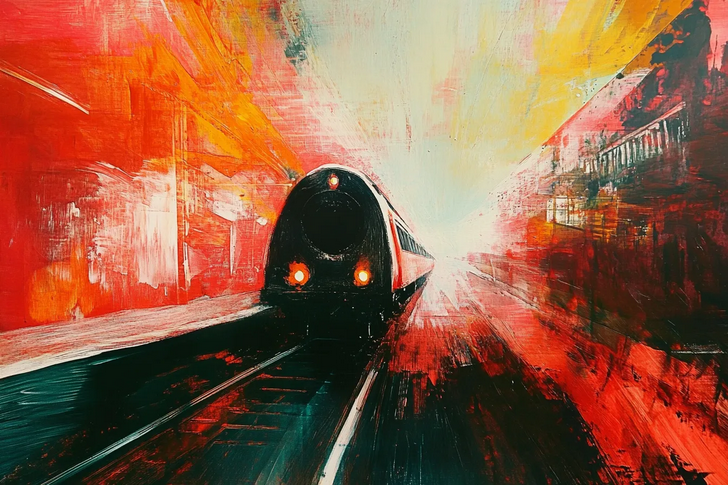
Image from Aporia
A dead man’s brake is a safety feature found in dangerous machines such as lifts or trains. With this mechanism, a brake is always on, preventing action or movement. A conscious choice or effort must be made to override it.
On a train, a human driver must be present to depress a foot pedal that disengages the brake so the train can move at all. If he is absent the train cannot move. If he withdraws his foot while the train is in motion — if he dies, for instance — the train stops. Hence the name.
The key feature of a dead man’s brake is that it requires energy to operate. Its default zero-energy position is OFF; only with energy can it go to ON.
Wariness of strangers, xenophobia, is the default position for most human beings. This is a hardwired evolutionary response to protect us. It served us well. It requires no energy to operate. Children quickly point out people who seem different.
Intentionally elevating strangers above ourselves, xenophilia, is artificial. We must be educated to make it happen, and explicitly taught to overlook differences. It must be reinforced to remain in operation as our instincts typically push against it.
This requires energy. In parts of the world not subject to Western educational norms, they do not teach it to children. Consequently, they do not usually adopt policies like mass immigration or asymmetric multiculturalism.
It is worth noting that xenophobia denotes a wariness of strangers, not hatred or disdain of them. In practice, our working assumption is people different from us may be a threat, and our actions should reflect this until proven otherwise.
Xenophobia is not the racial animosity the propaganda wishes us to believe, such as harming others based on visible differences like skin colour. Such extreme views are in fact rare. The underlying drive of xenophobia is caution, not aggression. Xenophilia attempts to ignore this sensible restraint, which is why it often fails without external pressure.
These instincts are deeply embedded within us because a cautious approach is a strong foundation upon which to preserve our lives and our cultures. It is the reason we have a nation and a culture in the first place.
Xenophilia, then, is a dead man’s brake. It requires energy applied to something that would not typically occur in nature. It makes us ignore differences in order to get along. Or so the theory goes.
Update, 26 September: Welcome, Instapundit readers! Please do have a look around at some of my other posts you may find of interest. I send out a daily summary of posts here through my Substack – https://substack.com/@nicholasrusson that you can subscribe to if you’d like to be informed of new posts in the future.
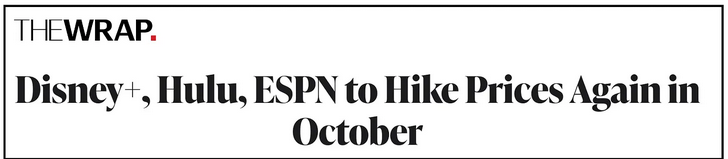
Streaming subscriptions rising far faster than official inflation rate
I haven’t been a regular TV watcher for a long time, but I still watch the Minnesota Vikings meaning that I need to pay for a streaming service … which has definitely been going up every year at a significantly higher-than-inflation rate. At The Honest Broker, Ted Gioia shows that this is now a very common thing indeed:
It’s not every day that I get an email from Apple. But yesterday the Cupertino leviathan reached out to me.
Can you guess why? Do they have some cool new gadget that will make my life better? Are they opening an Apple Store in my neighborhood? Does Tim Cook want to take me out to dinner?
None of the above. Apple is raising my subscription price for Apple TV by a whopping 30%.
Apple is not alone. The very next day, Disney announced a similar move.
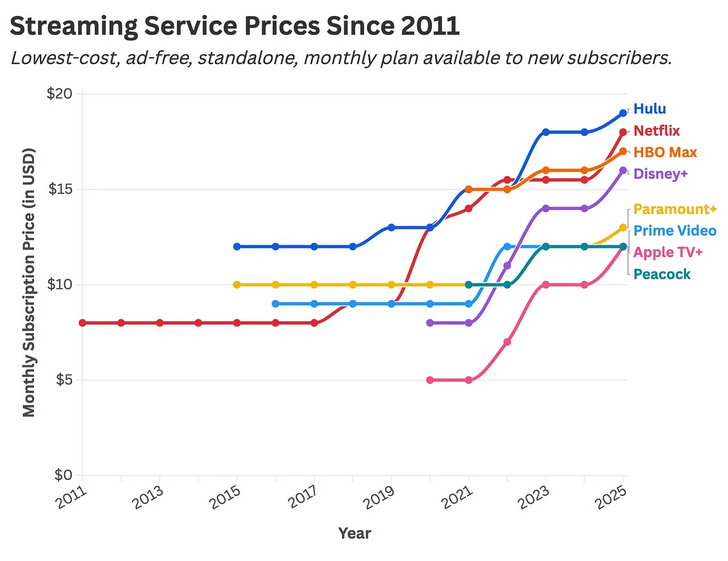
This is the fourth straight year that Disney+ has forced a price increase on viewers. The ad-free subscription price has almost tripled in just six years. During that same period, Disney’s movies have gone from bad to worse — but you pay more to stream them.
The company is truly tapping into its inner Scrooge McDuck. Inflation is just 3% now (according to official, if somewhat dubious, sources). But the ad-free subscription to Disney+ was jacked up 14% last year and is now getting another 19% boost.
Take a look at the larger picture, via this chart from Daniel Parris of Stat Significant (a friend of The Honest Broker). This stuff is reaching greed-is-good levels of abuse.
Meanwhile, the number of scripted shows commissioned by these streamers has dropped significantly. So the audience is asked to pay more for less.

QotD: The Clinton years
… in a weird way I feel bad for the young folks who never got a chance to experience life under Bill Clinton. Back then, we — as a society — still acknowledged that there was such a thing as “the truth”. You know, statements about the world that actually correspond to the world in a meaningful and systematic way. Watching Bill Clinton lie was great practice. You young folks are used to everyone, everywhere, in power being an utter sociopath, but it was a novelty back then.
Bill Clinton, some wag observed, would rather climb to the top of Mt. Everest to lie to you than stand still and tell you the truth. He lied when it was to his advantage, and he lied when it was to his very obvious disadvantage. He lied when there was absolutely no point to lying — indeed, like climbing Mt. Everest, when it took enormous effort and real planning to lie. He lied just for the fun of it, and if you saw him do it enough, you realized what that little smirk on his greasy, chicken-fried mug actually was: Orgasm. Bill Clinton got off on lying. That’s why he did it. Every press conference the man ever did was frottage.
Severian, “Party like it’s 1999”, First Questions, 2022-01-13.
September 24, 2025
The Korean War Week 66: The Hell of Heartbreak Ridge – September 23, 1951
The Korean War by Indy Neidell
Published 23 Sep 2025The Korean War reaches one of its bloodiest battles as UN forces clash with North Korean defenders on Heartbreak Ridge. The US 2nd Division suffers heavy losses, with entire companies wiped out to the last man. At the same time, the Marines introduce a revolutionary new tactic in modern warfare — transporting troops via helicopter right to the front lines during battle. Meanwhile, UN Commander Matt Ridgway refuses to resume peace talks in Kaesong, sparking further tension with the Communist side. As the battle rages, the question remains: can there be peace in Korea, or only more heartbreak?
Chapters
00:00 Hook
00:43 Recap
01:14 Heartbreak Ridge
04:02 To The Last Man
06:06 What Ridgway Wants
08:00 Effects of the Treaty
10:13 New Strategy
11:29 Supply by Helicopter
12:31 Summary
12:45 Conclusion
15:34 Call to Action
(more…)
September 23, 2025
“[A]nyone who tries to tell you ‘Antifa is just an idea’ is not merely deluded, but consciously and deliberately lying”
On the social media site formerly known as Twitter, ESR uses the methods of counter-terror analysis:

None of Antifa’s public propaganda channels have attempted to deny that they were behind the assassination of Charlie Kirk. This is a fact of considerable significance, which I will now use the methods of counter-terror analysis to examine.
Antifa’s distributed structure makes it impossible for any one chapter or cell to know what another subgroup didn’t do.
It is quite possible that Tyler Robinson is a true stochastic terrorist, inspired and motivated by Antifa propaganda and considering himself part of Antifa but without planning or logistical support from others in the organization. I give this about 60% probability.
The fact that Robinson had peers on Discord with apparent foreknowledge of the assassination attempt does not falsify this possibility. Even if they did assist with the assassination, their connections to Antifa might be equally deniable, equally just a matter of their states of mind.
The assassination was in complete accordance with Antifa doctrine and propaganda. Direct action against “fascist” targets, ranging from low level intimidation up to political killings and organized attacks on government facilities, is exactly what Antifa is organized to do.
Thus, with over 90% probability, other members and aboveground allies of Antifa regard the operation as a (tactically) successful Antifa op, whether or not they had any foreknowledge of it and whether or not Robinson was stochastic.
The ones who aren’t fanatics or idiots have probably figured out by now that the assassination was a serious strategic blunder. You might expect that they would be scrambling to deny that Antifa had anything to do with Kirk’s death.
Some of Antifa’s aboveground allies [are] in fact doing this; the dominant form of denial by Democratic politicians and activists is to deny that Antifa even exists as more than an idea.
But Antifa itself has not done this, and I predict very confidently (95%) that it will not. The real reason it won’t has nothing to do with its structural inability to know that no member of Antifa was involved.
To understand why this is, you need to grasp what Antifa is for. Not its ultimate purpose, which is to foment a violent revolution that will enable Communists or Left-Anarchists to seize power, but the way it operationalizes that goal in practice.
The purpose of Antifa direct action is to shape the political environment through terror. Its goal is to intimidate its opponents into paralysis — to raise the costs of their speech and public action by predictably opposing it with violence.
I am not speculating about this, because if you read Antifa’s propaganda and organizing materials it will tell you exactly this.
The assassination of Charlie Kirk is perfectly accordant with Antifa doctrine. Antifa cannot deny this, nor disown Tyler Robinson even in the likely event that he is only stochastically connected to the organization, because … what use is a terror network that disavows intimidation of its opponents?
Antifa’s goals require it to be a credible threat to “fascists”. If it denied that it had anything to do with killing Charlie Kirk, it would demotivate its own foot soldiers and decrease its usefulness to its aboveground allies.
Antifa needs to exist in a kind of mixed state — simultaneously deeply threatening to its enemies but deniable by many of its allies in the Democratic Party, journalism, and academia.
It is also, however, important that none of its aboveground allies can actually believe their own denials. Otherwise Antifa, perceived as useless, would risk losing the funding and political cover that has until now allowed it to operate with some degree of impunity.
You may therefore safely assume that anyone who tries to tell you “Antifa is just an idea” is not merely deluded, but consciously and deliberately lying.
At Woke Watch Canada, C.C. Harvey discusses the “red thread of Antifa subversion” over the last ten or so years:
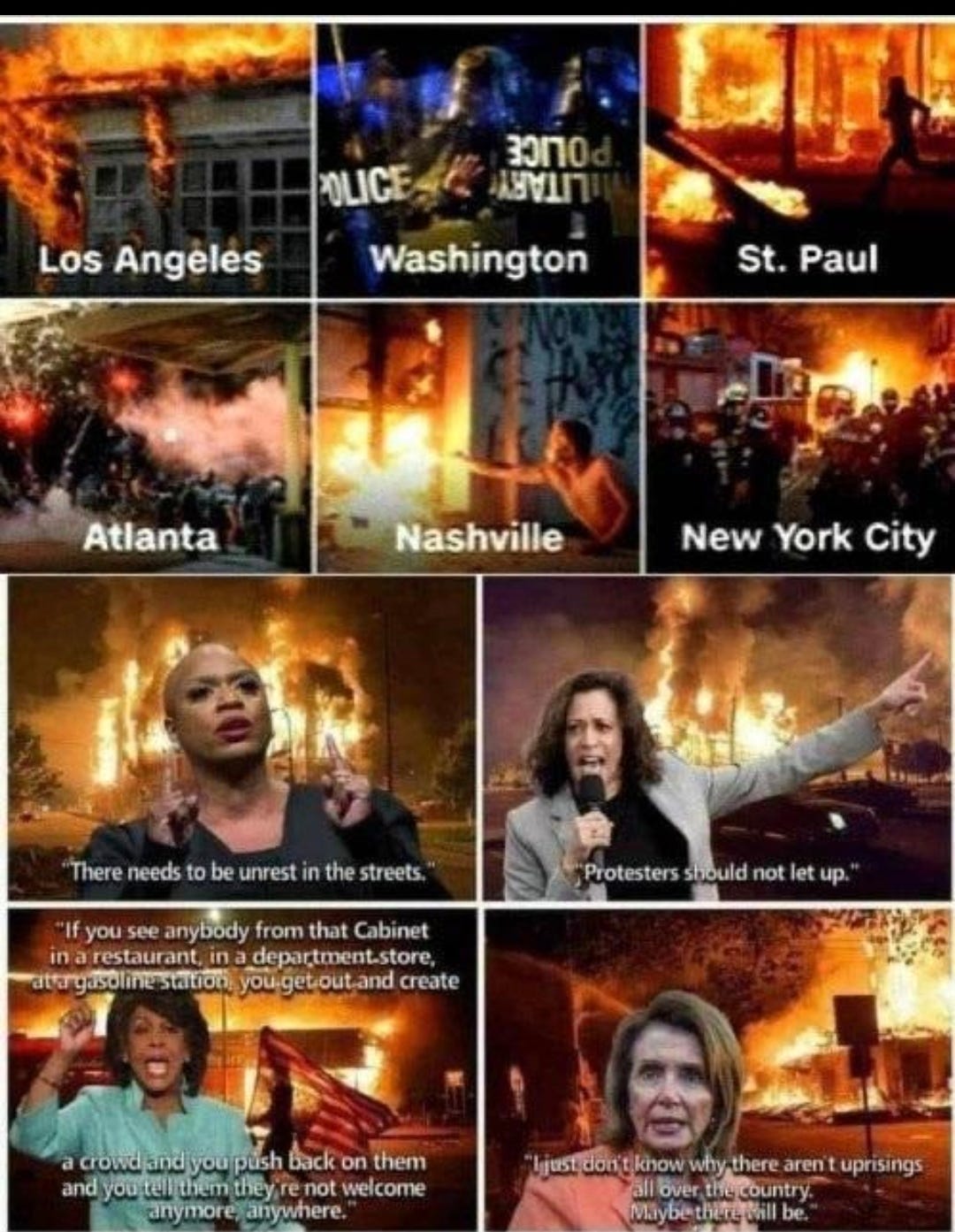
Establishment leaders now even cuddle up with extremists who do not hide their violently subversive orientation. When the ENTIRE establishment took a knee for for the (self-identified) queer, Marxist, violently revolutionary group BLM during the 2020 riots, the subjugation of the professional classes was complete. We stopped being allowed to object to our institutions becoming vehicles for communist revolution. We were called racists and far right extremists and conspiracy theorists for even thinking bad thoughts about BLM and the woke communist revolution, and could be punished for talking to friends about it in group chats. We all became ideological captives of neoMarxist revolutionaries.
The DEI industry exploded, and although it is losing steam in the USA, it still functions as a modern Red Guard policing Canadian discourse and behaviour. If we’re being honest, we will admit that even most conservative politicians here were cowed. The entire establishment worked together to erect a new politburo and stasi throughout Canada and the USA, and far beyond.
Republicans are dismantling the neoMarxist structures that have been erected in America, and this is of course being disingenuously characterized by leftists as proof that Trump is fascist and authoritarian. BLM has largely imploded with corruption and infighting, but Antifa appears to have grown even stronger, especially its queer contingent, and their membership is agitating heavily as they see the Trump administration tearing down what they built.
Antifa is not just a gang of idealistic rabble-rousers in black hoodies rebelling against authority. It is the heir of a century-long Marxist project seeking massive, sweeping revolution, and advancing their goals via inversions: turning truth into lies, sin into virtue, desecration into liberation. From the beginning, Antifascist communists were passionately committed to revolution in all areas of human life and society.
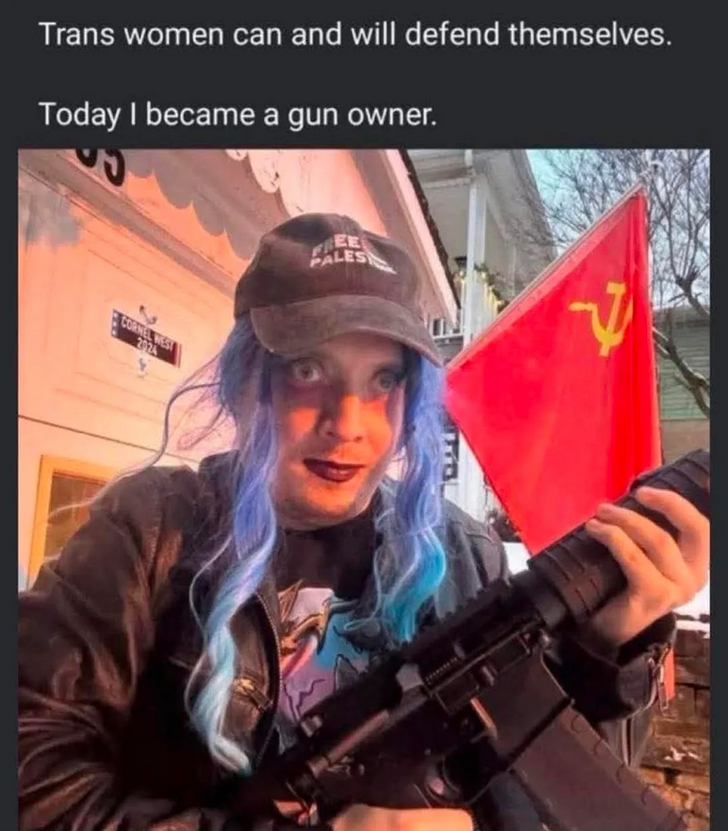
It is not by coincidence that antifa and the LGBTQIA+ are entwined. Antifa have always been committed to sexual revolution — crossing sexual boundaries, normalizing deviance, dissolving the family.
Even in earliest iterations, the antifascists were dangerously radical in sexual ideology and policy: the historical record shows they handed children to paraphilic predators in the name of antifascist sexual liberation as early as postwar Germany. That anti-family, fetishistic spirit runs straight through antifascist history and is on full display in today’s TQ+ movement. TQ+ is conjoined with Antifa (Trantifa, if you will) to actively promote hypersexualization, the destabilizing of sex identity and family, and the mainstreaming of disorder and perversion.
Marx and Engels attacked the family as a “bourgeois prison”. Later Marxists carried this out through radical experiments in sex and pedagogy, all under the banner of liberation. Today’s gender and queer theorists are majority Marxists.
Marxists deal in inversions, so indoctrination presented as education, perversion rebranded as liberation, abuse disguised as compassion, self-mutilation celebrated as authentic selfhood. Today, Antifa-aligned “Queer Resistance” brigades advance sexual inversions and corruptions that are just as damaging as antifascists of bygone eras: in postwar Germany, the antifascist Kentler experiment assigned orphan boys to be raised by wealthy pedophiles. Today, an uncomfortable number of LGBTQIA+ activists have been caught adopting babies and toddlers to abuse, raping their own children, or sexually assaulting minors. As a result of our establishment embracing the far left revolutionary zeitgeist and sacralizing “marginalized” identities, safeguarding has been sacrificed on the altar of LGBTQIA+ identitarianism.
Update, 25 September: Welcome, Instapundit readers! Please do have a look around at some of my other posts you may find of interest. I send out a daily summary of posts here through my Substack – https://substack.com/@nicholasrusson that you can subscribe to if you’d like to be informed of new posts in the future.
Beretta Model 1934: Italy’s Unassuming Workhorse Service Pistol
Forgotten Weapons
Published 16 May 2025The Beretta Model 34 was basically the final iteration of a design by Tullio Marengoni that began all the way back in 1915. That pistol was updated in the early 1920s, and that one was updated in 1931. The Model 1931 was converted to .380 ACP (aka 9mm Short) as the Model 1932, which became the Model 1934 with the addition of a hammer half-cock notch and steel grip panel backing. Police and military contracts began in 1935, with the Italian Army formally adopting it in 1936 and purchasing nearly 400,000 of them by 1940. It would ultimately see service with basically all the armed elements of the Italian military and civil security services as well as foreign nations including Germany, Romania, and Finland. As a souvenir for British or American troops, the Model 1934 was also a prized piece.
Essentially, the Model 1934 is compact, simple, durable, and reliable. It is an excellent military pistol; easy to carry unobtrusively but dependable when called upon. After World War Two it stayed in production until 1980, despite introduction of many other more modern options by Beretta. Today a bunch of the pistols have become available on the US collector’s market. Thanks to Royal Tiger Imports for sending this example for me to film!
Beretta Model 1934 serial numbers and dates (source: “1915-1985 Settant’ Anni di Pistole Beretta“):
1934 – 1942 – from about 500073 to 999996
1934 – 1942 – from 1 to about 40000
1943 – 1945 – from F00001 to F99997
1943 – 1945 – from G00001 to G57486
1943 – 1945 – from 0001AA to 9997AA
1943 – 1945 – from 0001BB to 9971BB
1946 – 1949 – from C00001 to C99998
1949 – 1954 – from D00001 to D99999
1954 – 1967 – from E00001 to E95760
1967 – 1973 – from F50001 to F61693
1970 – 1975 – from G00007 to G49620
1972 – 1974 – from H00001 to H25000
1971 – 1980 – from T 1 to T 10217Other pistols in the Beretta development series:
Modle 1915: • Beretta 1915: the First of the Berett…
Model 1923: • Beretta Model 1923
Model 1931: • Beretta Model 1931
Trials Model 1934: • Military Trials Beretta 34 – Can You …
(more…)
September 22, 2025
Materially well-off but downwardly mobile
Rob Henderson considers the plight of an entire generation of kids raised in privilege, but economically incapable of improving or even barely maintaining their material condition … the downwardly mobile children of wealthy parents:
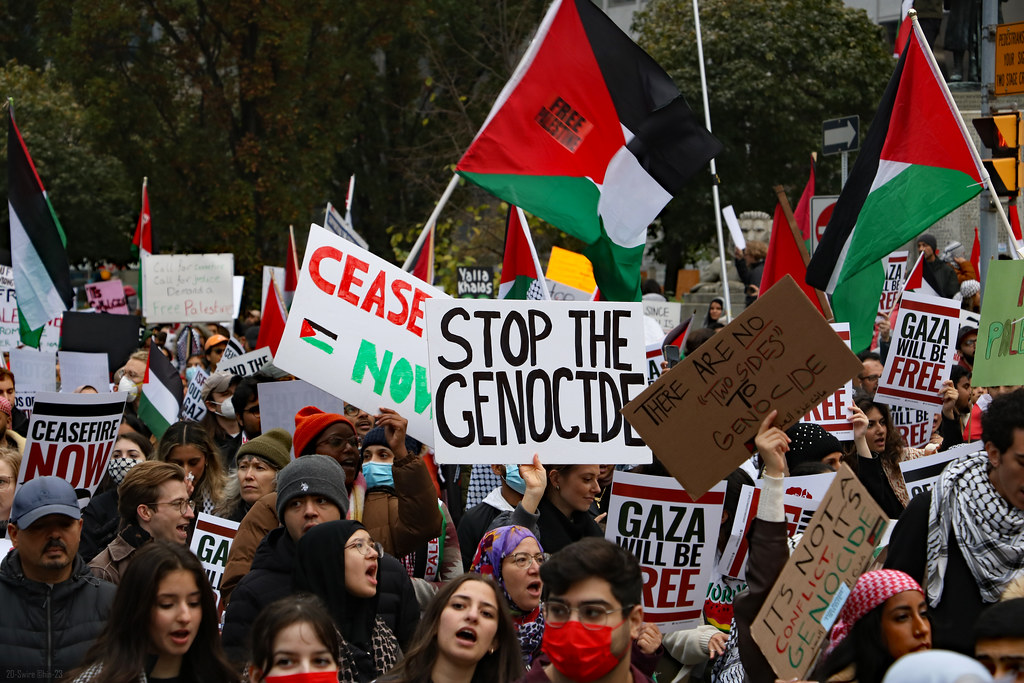
“Free Palestine/Anti-Israel protest” by Can Pac Swire is licensed under CC BY-SA 2.0 

 .
.
For generations, Americans assumed that their children would live better than they did. Today, that assumption no longer holds. In fact, the higher your parents’ income, the less likely you are to match it.
According to The Pew Charitable Trusts, fewer than four in 10 children born into the richest fifth of households stay there; more than one in 10 fall all the way to the bottom fifth. Similarly, a 2014 study in The Quarterly Journal of Economics found that while 36.5 percent of children born to parents in the top income quintile remain there as adults, 10.9 percent fall to the bottom quintile.
Sociologist Musa al-Gharbi, in his 2024 book, We Have Never Been Woke, argues that this downward mobility of children born into wealth is the psychological engine of contemporary politics. This may look like a trivial problem — the petty disappointments of a small slice of America — but the unhappiness of this group, raised to expect the world and denied it, has outsize consequences.
To be clear, this cohort has never faced genuine poverty. Still, they have experienced the sting of loss: They came of age after the Great Recession, watched job security fade as the digital economy made their skills obsolete, and learned that highly coveted jobs in academia, media, and politics were far fewer than promised. These disappointments, al-Gharbi writes, helped power the Great Awokening. Many disillusioned strivers aimed their anger at the system they believed had failed them, and at the lucky few who did manage to retain or enhance their class position.
Unlike the working classes they so often claim to represent, these downwardly mobile elites remain armed with the tools of their upbringing: degrees, contacts, cultural fluency. They may no longer have the bank accounts their parents did, but they retain platforms in media, academia, and politics through which to broadcast their grievances. Given these advantages — or perhaps the right word is privileges — it should come as no surprise that their concerns, which seem to the average American profoundly niche, have dominated the cultural conversation.
Some of this downward mobility is voluntary. Al-Gharbi notes that many young, college-educated people would prefer “to be a freelance writer or a part-time contingent faculty member rather than work as a manager at a Cheesecake Factory”. The dream is artistic freedom and flexible work. The reality is disillusionment when prosperity does not follow.
Such disappointment isn’t totally new. George Orwell’s Keep the Aspidistra Flying follows a Cambridge-educated poet who abandons his advertising career, squanders his inheritance, and slides into genteel poverty. HBO’s Girls replayed the same theme for a new generation: Brooklynites with cultural capital but precarious incomes, simultaneously privileged and resentful. The details change, but the shape of the story remains the same — raised in affluence, buoyed by expectation, they discover too late that their choices and the system cannot sustain them.
What is different today, however, is how the disillusion now manifests itself. When reality disappoints those raised in privilege, the gap between expectation and outcome produces rage. Behavioral economics has long recognized this dynamic: Satisfaction depends less on objective conditions than on whether outcomes match or exceed expectations. And today, those expectations are far from being met.
Two years before Girls ended, sociologist Lauren Rivera, in her book Pedigree, found that graduates of lesser-ranked colleges who landed jobs at elite firms were far happier than Harvard and Stanford graduates who landed the same jobs. The reason was simple: Those jobs exceeded the expectations of the former, while for the latter they fell short. The higher the expectation, the sharper the disappointment. The harsh reality, then, is that privilege itself can encourage feelings of decline. When you’re born to — and surrounded by — overachievers, even respectable achievements can feel second-rate.
In a 2018 study, Duke sociologist Jessi Streib explored why many middle-class kids falter in school and work. Her finding was counterintuitive: Entitlement often dragged them down.
It’s not too hard to see why. Success in school requires showing up, meeting deadlines, and tolerating authority. Success at work requires completing projects on time, absorbing criticism, and cooperating with colleagues. Yet the downwardly mobile, Streib found, were often convinced such requirements were beneath them. Their grandiosity and defiance hastened their slide.
Elite overproduction is real, and has real world ramifications …
September 21, 2025
QotD: Herbert Hoover, an epitaph
But he won anyway. He started from a measly few million dollars and beat out Rockefellers and Carnegies to become the most successful philanthropist in early 20th century history. Whyte’s estimate of 100 million lives saved seems much too high; there were only 100 million people in Europe total during the relevant period. But even during his own time, people universally credited him with saving millions. And he did it again and again and again. I didn’t even have space to talk about the time he saved the Southern United States from a giant flood, or half a dozen other impressive accomplishments. Maybe the rules are wrong. Maybe all of this stuff about how authoritarian approaches never work, and you need to let the people you are helping lead the way, is all just modern prejudices, and putting a brilliant and very rich engineer in charge of a hypercentralized organization is just as good as any other way of doing things.
But even this I find less interesting than his psychology. He combined a personal callousness with a love for all humanity. When he was inspecting mines in Australia, he fired the worst-performing X% of workers. One worker begged him to reconsider – he had a family to support. Hoover raised $300 for the man’s family – a lot of money at the time! Probably more than Hoover made in a month! – but fired him anyway. In 1932, when the Bonus Army marched on Washington, Hoover was adamant that he would not give these men – poor, starving veterans – a single cent more than they were entitled to by their existing benefits. But he also instructed his staff to go around to their encampments and give them food and supplies in secret.
Sometimes his stubborness calls to mind the fictional Inspector Javert, who refuses to bend the law for any reason. In this model, Hoover sympathizes with everybody, but his honor forbids him to bend the rules in favor of underperforming employees or protesters who want more than their contracts entitle them to. But this picture of a hyper-honorable Hoover crashes into his constant willingness to lie, cheat, and bend the rules in his own favor. Sometimes his lies are for the greater good, like when he tells Britain that Germany is preparing to feed Belgium. Other times they seem entirely selfish, like his various Chinese mining scams. The best that can be said about Hoover is that if he decides a principle is involved, he sticks to it.
And this is actually really good! Again and again through the book, Hoover feels like the only person with a moral compass. When it is in everyone’s strategic interest to let Belgium starve, Hoover is the only one who is able to keep fixated on the potential human toll. When it is in everyone’s interest to let the USSR starve, only Hoover – despite his fanatical anti-communism – is able to stick to the frame where the Russians are human beings and politics is beside the point. When Americans are starving during the Great Depression …
… okay, Hoover totally dropped the ball on that one. In fact, one of his Democratic opponents wrote something about how maybe if unemployed American workers pretended to be Belgians, they could get Hoover’s sympathy. I don’t have a great explanation for this. But Hoover’s weak and inconsistent sympathies are often enough to let him outdo everyone else. Or at least, he is uncorrelated with everyone else and succeeds when they fail. Again and again Hoover is accused of treating people like numbers on a piece of paper. But if this is true, it seems to be linked to the reverse talent – the ability to remember that numbers on a piece of paper represent people, even when other people would rather forget.
I’m equally confused about Hoover’s politics, although it’s not really his fault. The whole era confuses me. The Progressives, Hoover’s own faction, seem clearly related to modern progressives. But they also give me more of a technophile, rationalist feel than their modern counterparts. Am I imagining things? If not, where did this go?
And how did Hoover so deftly merge authoritarian centralizing technocratic engineer side with his small-government individual-freedom pro-capitalism side? Maybe it wasn’t that deft? Maybe he started his life as a centralizing technocrat, then made a 180 after becoming a small-government individualist helped him dunk on FDR more effectively? But it didn’t feel that way. It felt like all of it was coming from some central set of core beliefs throughout his life.
[…]
I get the impression that Kenneth Whyte is a bit of a revisionist historian, too sympathetic to his subject to tell his story the way everyone else does. But at least in Whyte’s telling, the Hoover presidency was a great missed opportunity, or at least a fulcrum of history. If a few key economic events had been a few months off in one direction or the other, FDR might have been a footnote to history, and a four-term President Hoover might have left an indelible mark on America. Instead of a New Deal, we might have gotten a optimistic small-government technocratic meritocracy that was able to merge the best aspects of a dying frontier America with the best aspects of the industrial age.
In one of the most poignant passages in the book, Commerce Secretary Hoover fires back at his socialist critics. He points out that of the top dozen US officials – the President, VP, and ten Cabinet Secretaries – eight, including himself, had begun as manual laborers and worked their way up. That was the America Hoover was working to defend. He lost, and now we have this shitshow. But it’s hard to begrudge him the attempt.
Scott Alexander, “Book Review: Hoover”, Slate Star Codex, 2020-03-17.
September 20, 2025
QotD: Why modern dishwashers suck
The current standards for dishwashers took effect in 2013. The standards, which were based on a consensus agreement between manufacturers and efficiency advocates, specify minimum energy and water efficiency levels. The standards require that standard-size dishwashers use no more than 307 kWh per year and 5.0 gallons of water per cycle.
In 2024, DOE finalized amended standards for dishwashers based on a joint recommendation from manufacturers and efficiency advocates. The new standards for dishwashers will cost-effectively reduce energy consumption by 15% relative to the current standards while also cutting water waste. Dishwashers
It is a general problem, but what started me thinking about it was being told by my dishwasher that it would take three and a half hours to wash the dishes. That seems, judging by a quick search online, to be longer than average but still within the normal range. I have not been able to find figures online for how long dishwashers took twenty or thirty years ago but, by what I remember, it was substantially less — and the dishes ended up dry, which ours don’t.
The explanation is in the final word of the quote above, “waste”. The owners of dishwashers pay for water and power, so if making them more efficient in those dimensions was costless, did not require giving up something else, there would be no need for the Department of Energy to make the manufacturers do it. I conclude that it was not costless, that it either made dishwashers cost more or do their job less well — take longer, not dry the dishes as well, not clean them as well. Using more power or water to do a better job is not waste.
David Friedman, “Optimizing On A Single Variable”, David Friedman’s Substack, 2025-06-02.
September 19, 2025
What’s the next thing to be devoured on Trump’s menu? Ah, Antifa it is …
Again leaning heavily on the social media site formerly known as Twitter, ESR has several posts on Donald Trump’s announcement that Antifa is in his crosshairs:
Next comes the part where every NGO/nonprofit implicated in funding a major terrorist organization gets a proctological exam by people with no sense of humor at all.
As I have emphasized several times in the last week: the long game in taking down a terrorist network is to smash its funding chain.
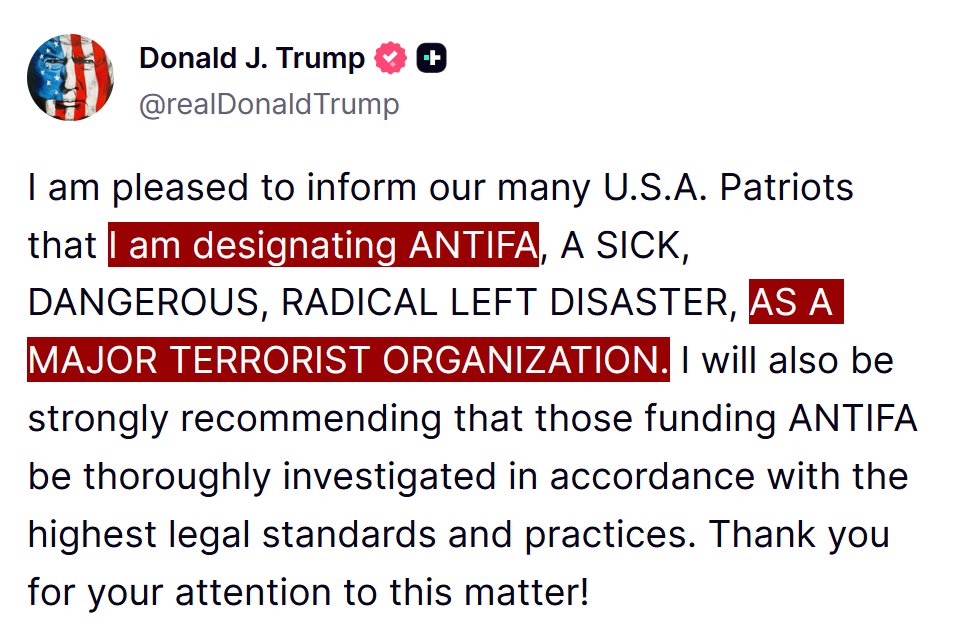
ESR’s analysis begins thusly:
Antifa has just been declared a “major terrorist organization”. Putting on my intelligence-analyst hat again, I’m going to examine its strategic options in the new political and legal conditions following the assassination of Charlie Kirk.
I’m going to start with a briefing on what Antifa is and what it does.
A reminder: Antifa is not a unitary conspiracy. It’s a cluster of horizontally-networked cells, some visible aboveground, some semi-covert, possibly some that are fully underground. By design it doesn’t have a central command.
So we’re really asking what range of behaviors Antifa cells normally choose, or can choose.
Before we can explore that we have to identify what Antifa is for and how it fits into the political ecology of the U.S.
None of what I’m about to tell you is speculation. It can be verified by reading Antifa’s propaganda and watching its behavior.
Antifa is an organization of Communists and Left-Anarchists; thus the red and black flags in the main Antifa logo. Its ultimate goal is a violent anti-capitalist revolution that will destroy American constitutional government. The Communists and Left Anarchists have agreed to argue about the shape of what comes afterwards after the revolution.
In practice, Antifa acts as willing street muscle for a range of associated Communist and Socialist organizations, most notably the DSA (Democratic Socialists of America), CPUSA (Communist Party of the USA), the SWP (Socialist Workers Party), and various SWP splinter groups.
Antifa also takes strategic direction from the left wing of the Democratic Party. My readers can make their own judgments about whether there is anything remaining in the Democratic Party other than a left wing; the answer to that question is not relevant to the rest of this analysis.
An important point is that the links between the Democratic party and Antifa are personal and deniable. They probably do not run through the Democratic National Committee. A good place for counter-terror analysts to look (and I’m sure Palantir already has this mapped) would be the politicians known as “the Squad” and their close associates.
The strategic sub-goal that was being executed when Charlie Kirk was shot was the creation of a climate of fear that would inhibit public speech by conservatives. This is an explicit goal of Antifa direct action.
Antifa’s funding is deliberately obscure. Before USAID was dismantled, a significant percentage of it was probably coming from the American taxpayer through several layers of shadowy NGOs.
It is very likely that one way or another most of its money comes from low-profile liberal dark money groups such as Arabella, the Tides Foundation, and the Open Societies Foundations.
The effectiveness of Antifa as a political actor has always depended on its ability to act as a terror instrument for left-wing American politicians while maintaining deniability that the politicians’ rhetorical hate-targeting of opponents ever cashes out as violent action.
The first major constraint on Antifa’s future behavior is that this deniability is going to be much more difficult to maintain from now on. Because while the deliberate diffusion of its structure makes legal proof that something called “Antifa” shot Charlie Kirk difficult, it also made Antifa affiliation of any left-wing assassin impossible to effectively deny.
In my next post, I will examine the consequences of this shift.
Mafia families don’t have membership cards.
Why am I bringing this up now? Because one attempt to head off the hammer coming down on Antifa that we’re hearing from its aboveground allies is that Antifa doesn’t exist.
It’s just an idea. There’s no central command. No common funding. No membership cards. No way to tell who’s a member and who isn’t.
The reductio ad absurdum of this bullshit is to point out that, following the argument, the Mafia cannot possibly exist. Which would be interesting news to all the people it murdered.
Historical note: there was a period when the Mafia was structurally different from Antifa in that it had a Boss of All Bosses, but the position was abolished by assassination in 1931.
In reality, when you’re dealing with a criminal or terrorist conspiracy that doesn’t have membership cards, you identify members of it the same way that other members do: by their willingness to cooperate with each other on shared projects.
And sometimes, by their participation in shared bonding rituals like a Cosa Nostra initiation ceremony or a “bash the fash” demonstration.
None of this is difficult, and it’s exactly the kind of situation that the RICO (Racketeering and Corrupt Influence) laws were written to address.
From Trump’s public statements, I’m guessing that they’re going to go right past RICO to a Foreign Terrorist Organization designation.
This won’t be difficult either. If you have any doubt that at least some Antifa chapters are funded by Chinese Communist money, you really need to get out more.
The announcement clearly didn’t come out of the blue:
Still wearing my intel-analyst hat, and have realized something.
Trump’s announcement that Antifa is being designated a “major terrorist organization” doesn’t make any sense unless law enforcement is already holding evidence that the assassination of Charlie Kirk was an Antifa op.
Otherwise, the risk of political blowback from that announcement would be way too high. Trump can be erratic, but he’s cunning about stuff like this and obviously has a shrewd sense of what he can get away with.
So, yep. The most likely scenario was the correct one. The hoofbeats really were horses, not zebras. Everybody still in denial about this is destined for more pain.
And back to the analysis:
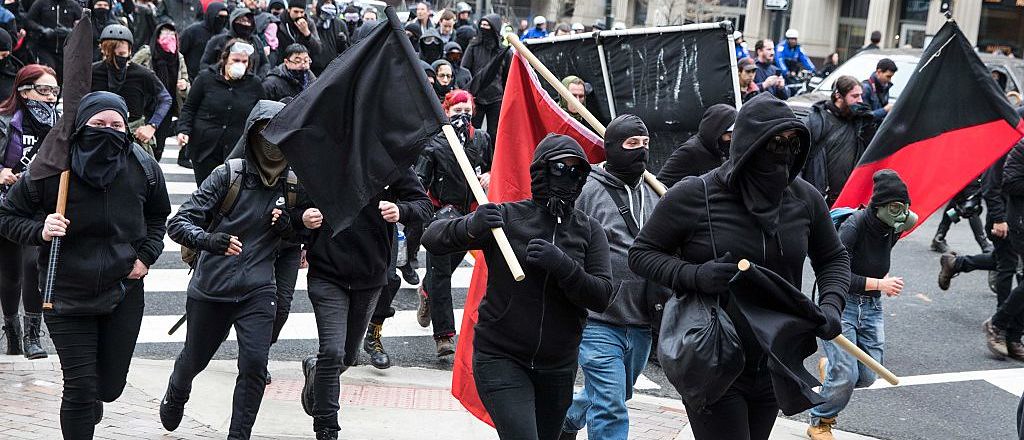
“antifa 8973ag” by cantfightthetendies is licensed under CC BY 2.0

Continuing my analysis of Antifa’s strategic options following the Charlie Kirk assassination. These have changed yet again — narrowed considerably — following President Trump’s declaration yesterday.
The Federal Government has legal instruments that it can employ. The RICO (Racketeering and Corrupt Influence) laws were specifically designed to attack a different headless network of horizontally connected nodes — organized crime. The fact that Antifa doesn’t have membership cards or a unitary command structure isn’t even going to slow the Feds down.
I think that it’s likely the Feds will designate Antifa a foreign terrorist organization, zeroing in on Chinese Communist funding of some Antifa chapters. This will allow the direct use of the CIA, which is normally heavily restricted from operations on American soil.
Nothing Antifa itself can do as an organization will be able to prevent or deflect a massive multi-agency investigation. It is very likely that Palantir already has their core membership identified and their communications channels mapped. Fusion centers will be capturing an unknown but probably large percentage of Antifa message traffic.
(They’ll be helped by the fact that Antifa’s communications security is terrible — it uses Discord for most comms, which is strictly amateur-hour. To be fair, the inner membership is likely to be savvy enough to be using Signal.)
Antifa’s only hope is pressure by its aboveground allies in politics and media. The cells with intelligent leaders will understand that they must cease all direct actions in order to avoid putting those allies in any position of appearing to support assassinations.
Unfortunately for Antifa, in order for hunkering down to work, every single cell has to have leadership that is both strategically patient and capable of restraining its more mentally unstable footsoldiers.
A related problem is that subversive and terrorist organizations that don’t act tend to develop morale problems. A certain minimum level of satisfying violence is required to keep their troops engaged.
Antifa probably has a worse issue here than the average terrorist organization because they recruit so heavily from sexual deviants and borderline mental cases who are likely to have other MBD-related issues including impulsivity and high time preference.
Over time, external pressure for Antifa to look easy for its aboveground allies to defend will remain steady or increase. This is especially so if the Democratic Party line remains Joe Biden’s “Antifa is just an idea”.
At the same time, internal pressure for direct action will increase. Antifa’s survival may depend on how long it is able to manage that pressure.
Antifa needs the investigation to be stalled out and paralyzed by Democratic lawfare before its stupidest cells do something too public and violent for its allied mainstream media to willfully ignore or suppress.
Longer-term, if Antifa survives, it faces a different problem. It dreams of revolution, but is only capable of operating on the sufferance of a general public that largely dismisses it as a LARP for nose-ringed freakazoids. Having committed a gaudy murder of an Everyman figure, it is not likely to get that sufferance back.
After the Charlie Kirk assassination, here are three possible futures
On the social media site formerly known as Twitter, ESR lays out what he sees are the three most likely short-term futures for the United States after the assassination of Charlie Kirk:

I’m a student of history. Here are three possible futures following the assassination of Charlie Kirk. They’re based on historical examples of what happens when a Communist subversion campaign or insurgency overplays its hand and triggers broad popular resistance.
1. Popular revulsion against aboveground leftists celebrating the murder gives the Trump administration political cover to go after Antifa and its shadow funding network hard. Both are smashed.
Communist agents of influence in the mainstream media and academia continue to self-discredit.
Relatively few Communists are arrested, but their millions of aboveground tools become isolated and demoralized.
Propelled by a huge swing in voter registrations that we are already seeing happen, the Democrats get crushed in the 2026 midterms.
The long period of fever, madness, and Left ascendancy that began with the assassination of JFK by a Soviet agent in 1963 ends not with a bang but with a whimper.
This is the best case scenario for everybody, including the Communists who don’t get thrown out of helicopters or shot down in the streets.
If things don’t go this way it will likely be because Democratic lawfare prevents the counter-subversion push from being fully effective. An obvious index of this failure would be another high-profile political assassination or attempt against a conservative target after about 4 months out.
What happens in the event of that failure, especially if the third public attempt to kill Trump succeeds:
2. A period of Caudillismo. A charismatic strongman rides popular anger into power. If this happens, the Left better pray that the strongman is an infuriated JD Vance, because any alternative to him is likely to be worse for them.
The crackdown against the Communist network becomes brutal and routinely uses extra-Constitutional means, possibly thinly covered by a declared state of emergency.
At the harder end of this range of possibilities, right-wing death squads not exactly formed by government but winked at by it go after Communist public figures that are out of reach of the law because they’ve carefully preserved deniability. Many journalists are at the top of this target list.
It is not likely that the Communist network can survive this future. The only way it happens is if they have enough popular support to develop a semi-militarized resistance — in effect making certain parts of the country no go regions for Federal agents.
Going by historical precedents, the index of this failure would be a resurgence of banditry by armed groups, initially with overtly political goals but decaying into general predation.
This would land us at:
3. Low-grade civil war, a la Bosnia or the Irish troubles. Anybody wishing for this has no idea how bloody, ugly, and brutal it would probably be. Especially if the Left succeeds at what it will with absolute certainty try to do, which is racialize the conflict.
I don’t think there is any realistic scenario in which the Communists win any of these confrontations. Not in the U.S., not in the 21st century. The question is how much blood and agony the rest of us will go through before they are finally defeated.
Update, 20 September: Welcome, Instapundit readers! Please do have a look around at some of my other posts you may find of interest. I send out a daily summary of posts here through my Substack – https://substack.com/@nicholasrusson that you can subscribe to if you’d like to be informed of new posts in the future.
QotD: The sub-generations of Generation X
Then there’s the group that was in high school in the late 1980s. I squeak into this group (barely). We’re the mid-Xers. The real “grunge” generation. If Dazed and Confused is a pretty decent late-90s approximation of late-70s high school kids, then the best description I can give you of a “grunge” kid is the movie Deadpool. Made in 2016, by guys who were born in the mid-1970s. That’s grunge, in a way Kurt Cobain couldn’t even imagine. Fourth wall breaks! Sarcastic asides about the fourth wall breaks! Profanity! Masturbation jokes! And snark, snark, snark — unrelenting snark, about everything, all the time. Every second of that movie screams “I can’t believe you fags are amused by this, but since you obviously do, here’s lots more! Choke on it!!!”
The writers obviously wanted to work on Buffy the Vampire Slayer, but Joss Whedon was too cool for them — imagine the twisted psyche of a person who thinks Joss Whedon is cool — and Sarah Michelle Gellar just laughed at them, so they made Deadpool out of spite.
Then there’s the late Xers. They were in high school in the late 1990s, which is why us oldsters call them “Millennials” (as the term is now used, it seems to mean “those born around 2000”, i.e. the generation just now getting out of college. We took it to mean “those who were just getting out of college around the turn of the century”). Obviously I use the Internet. I’m using it now, but I’m not on the internet, and I’m certainly not an Internet Person. The very late Xers are Internet People. The very first Internet People; they invented the concept of Internet People. Mark Zuckerberg (born 1984) is a late Xer. The people behind Twitter (Jack Dorsey born 1976; Biz Stone 1974; Evan Williams 1972) are mid-Xers; they were ahead of the curve.
Severian, “Addendum to Previous”, Founding Questions, 2022-02-24.
September 18, 2025
Stop calling it “Turtle Island”
At Woke Watch Canada, Igor Stravinsky strenuously objects to calling North America “Turtle Island” and all the other woke shibboleths of the modern progressive cant:

As another school year rolls out, we can hope a more honest and realistic portrait of Canadian history will start to take shape in our schools. Students have been brainwashed into believing that Canada was a racist state bent on the extermination of Indigenous people, who were peaceful and wise, living in harmony with nature and each other. But reconciliation between Indigenous and non-Indigenous people is only possible if we base policy and action on the truth, not fairy tales, hearsay, anecdotes, or ideologies. We need facts, evidence, and reasoned debate. A good start would be for people to stop referring to North America as “Turtle Island”.
Calling it that is essentially to call the current geopolitical organization of the world invalid. If Canada, the United States, and other Western countries are in fact illegitimate, then that means national and international laws are also null and void. So, unless you are the direct descendent of an aboriginal person who was alive before first contact with Europeans, you are just a guest here — a second-class citizen at best. Non-Indigenous Canadians will simply never accept that. Nor should they.
In any case, “Turtle Island” is a nonsensical name on several levels. Firstly, North America is a continent, not an island. It is connected to South America by the Isthmus of Panama, which means it is not even surrounded by water. In any case an island is defined as a land mass surrounded by water that is part of a tectonic plate such as Greenland which is part of the North American Plate, thus is not a continent.
Then there is the fact that Indigenous North Americans were oblivious to the geography of the vast continent on which they lived. Like people everywhere in the distant past, they only knew the area they lived in, which could be substantial in the case of nomads, but was still a tiny fraction of North America’s 20+ million square kilometers. Of course, they knew nothing about the geography of the world with its 7 continents and 5 oceans.
Most importantly, the Turtle Island creation story is a myth believed by a particular cultural group. There is nothing wrong with believing in myths: I personally believe in the myth of human rights, as most Canadians do (pre-contact Indigenous people certainly did not). Myths are powerful: Our common belief in human rights has helped to make the Western world contain the safest and most prosperous societies ever. But when our institutions subscribe to myths not shared by the majority of Canadians, they are choosing to elevate one culture’s belief system above all others.
In the past, the Christian religion was regarded as the one true religion in Canada by most people, and the spiritual beliefs of Indigenous people were often denigrated as primitive superstition. But elevating Indigenous spirituality in our secularized 21st century world by treating it as a knowledge acquisition system equivalent to (or superior to) the scientific method is an attempt to correct for that past ethnocentrism. This is Critical Theory in action: It always strives to alleviate past wrongs with present wrongs, a formula for social disaster if ever there was one.


