
TimeGhost History
Published 2 Jun 2021Being the creator of the legendary Sherlock Holmes has made Arthur Conan Doyle famous for his scientific rationality. But Doyle also has a deeply held belief in the existence of the spirit universe. In a world still reeling from the shock of the Great War, he is not alone.
(more…)
June 3, 2021
The Supernatural Adventures of Arthur Conan Doyle | B2W:ZEITGEIST! I E.19 Spring – 1923
Comments Off on The Supernatural Adventures of Arthur Conan Doyle | B2W:ZEITGEIST! I E.19 Spring – 1923
John McWhorter on Affirmative Action
In the latest post at It Bears Mentioning, John McWhorter outlines the history of Affirmative Action in American schooling and explains why it’s no longer doing anything useful and should be re-oriented to actually help disadvantaged students of all races:

John McWhorter’s Twitter thumbnail image
I do not oppose Affirmative Action. I simply think it should be based on disadvantage, not melanin. It made sense – logical as well as moral – to adjust standards in the wake of the implacable oppression of black people until the mid-1960s.
When Affirmative Action began in the 1960s, largely with black people in mind, the overlap between blackness and disadvantage was so large that the racialized intent of the policy made sense. Most black people lived at or below the poverty line. Being black and middle class was, as one used to term it, “fortunate”. Plus, black people suffered open discrimination regardless of socioeconomic status, in ways for more concrete than microaggressions and things only identifiable via Implicit Association Testing and the like. In a sense, black people were all in the same boat.
Luckily, Affirmative Action worked. By the 1980s, it was no longer unusual or “fortunate” to be black and middle class. I would argue that by that time, it was time to reevaluate the idea that anyone black should be admitted to schools with lowered standards. I think Affirmative Action today should be robustly practiced — but on the basis of socioeconomics.
A common objection is that this would help too many poor whites (as if that’s a bad thing?). But actually, brilliant and non-partisan persons have argued that basing preferences on socioeconomics would actually bring numbers of black people into the net that almost anyone would be satisfied with.
I’m no odd duck on my sense that Affirmative Action being about race had passed its sell-by date after about a generation. At this very time, it had become clear, to anyone really looking, that the black people benefitting from Affirmative Action were no longer mostly poor – as well as that simply plopping truly poor black people into college who had gone to awful schools had tended not to work out anyway. It was no accident that in 1978 came the Bakke decision, where Justice Lewis Powell inaugurated the new idea that Affirmative Action would serve to foster “diversity”, the idea being that diversity in the classroom made for better learning.
I highly suspect that most people have always had to make a slight mental adjustment to get comfortable with this idea, as standard as it now is in enlightened discussion. Do students in classes with a certain mixture of races learn better? Really? Not that there might not be benefits to students of different races being together for other reasons. But does diversity make for better learning? Has that been proven?
As you might expect, it has not – and in fact the idea has been disproven, again and again. No one will tell you this when the next round of opining on racial preferences comes about. But this doesn’t mean it isn’t true.
Comments Off on John McWhorter on Affirmative Action
May 30, 2021
New frontiers in cultural appropriation
John McWhorter considers the notion that white people shouldn’t be allowed to use “black” words and phrases because it’s a form of cultural appropriation and therefore another aspect of white supremacy:

Screencap from NBC’s Saturday Night Live highlights for “Gen-Z Hospital” skit.
A little while ago, a Saturday Night Live skit depicted a multiracial group of teens communicating in what was depicted as “Gen Z slang”, with the doctor they were talking with having to “translate” his thoughts into it to communicate with them.
A lot of people didn’t like it, because the slang in question was mostly of Black English origin. The complaint is that the skit was denying the black roots of these terms, and instead ascribing them to Americans in general – i.e. (shudder) white persons. As in, yes – the problem was cultural appropriation.
As I write, there are still people grousing on social media in the wake of that skit about whites “stealing” black language, with a leitmotif being that we should apply our N-word taboo more widely. To wit, many propose that whites should not be allowed to use Black English terms because they are “ours”. Many who haven’t outright proposed this give the notion Likes, which suggests that a considerable group of people – and from what I can see, quite a few of them are white – concur with this line of reasoning.
Let’s break this down. To do so we must understand the sorts of terms in question. The SNL skit included, among others, yo, bestie, vibes, feels for feelings, salty for irritated, bro / bruh and no cap for “I’m not kidding” (as in, these are actual whole gold teeth, not golden caps on teeth).
Is there a case that you should only use these terms if you’re black, or that if you use them as a white person you should “do the work” of thinking hard about whether or not it is problematic (blasphemous)?
Comments Off on New frontiers in cultural appropriation
Rommel’s Desert Dash – The Whole Bloody Afrika Korps! – Gazala – WW2 – 144 – May 30, 1942
World War Two
Published 29 May 2021Erwin Rommel begins his surprise new offensive with “Rommel’s Moonlight Ride”, bringing all of his mighty mobile units to the fray in North Africa, while in the Pacific, dozens of warships and tens of thousands of men set sail from Japan — their mission? Attack the Aleutian Islands and Midway Island, but above all, destroy the US Pacific Fleet!
(more…)
Comments Off on Rommel’s Desert Dash – The Whole Bloody Afrika Korps! – Gazala – WW2 – 144 – May 30, 1942
May 29, 2021
History Buffs: Midway Part Two
History Buffs
Published 28 May 2021As promised here is Part Two of my Midway review. Hope you guys enjoy it 🙂
You can join Nebula today and get Curiosity Stream at 26% off for a year! Click on the link below
http://curiositystream.com/historybuffs
Part Two of this review will be out next Friday on the 28th of May!● Follow us on Twitter: https://twitter.com/HistoryBuffs_

Comments Off on History Buffs: Midway Part Two
Depression and suicide rates during the Wuhan Coronavirus pandemic
At Works in Progress, Scott Alexander looks at the details of rates of depression (which went up during the pandemic) and suicides (which surprisingly went down):
When COVID started spreading, life got more depressing, people became more depressed, but suicide rates went down. Why?
First, are we sure all of that is true? I won’t waste your time listing the evidence that life got more depressing, but what about the other two?
Ettman et al. conveniently had data from nationally representative surveys about how many Americans were depressed before COVID-19. They found another nationally representative sample and asked them the same questions in late March/early April 2020, when the first wave of US cases and lockdowns was at its peak. They found that 3 times as many people had at least one depression symptom, and 5–10x as many people scored in the range associated with “moderately severe” or “severe” depression.
This is a good study. It’s published in the Journal of the American Medical Association, a good journal. It’s been cited 50+ times in 6 months. Really the only thing anyone could have against it is the implausibly large effect it found. But it matches similar studies from Australia, Portugal, and around the world. Let’s say it’s real.
Along with the increased depression came an increase in people who said they were thinking about suicide. According to the US CDC, more than twice as many Americans considered suicide in spring 2020 compared to spring 2018 (10.7% vs. 4.3%).
Yet completed suicide rates stayed flat or declined. It’s hard to tell exactly which, because suicide is rare and noisy, and you need lots of data before anything starts looking statistically significant. But there are studies somewhere between “flat” and “declined” from Norway, England, Germany, Sweden, and New Zealand.
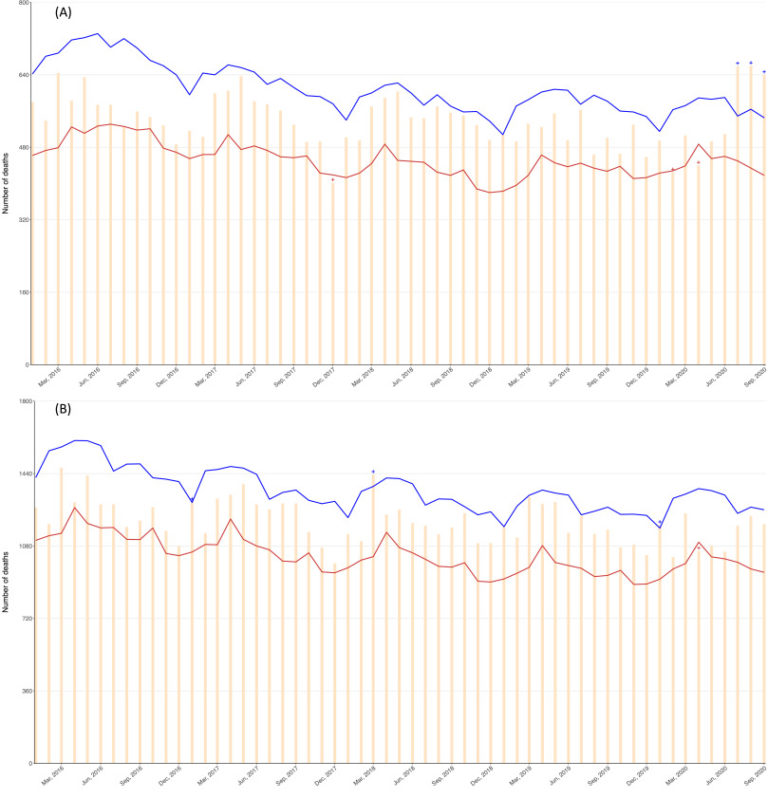
We also have two more complete reports from larger countries that help us see the pattern in more detail. First is Japan. Studies by Tanaka and Nomura broadly agree on a similar pattern — a slight decrease in suicides in the earliest stage of the pandemic (spring 2020) followed by a larger increase during the autumn. Here’s Nomura’s data:
The top graph is women, the bottom is men. The blue and red lines represent the 95% confidence range for an “average” year. Months that differ significantly from the average have little dots on top of their bars. You can see that April 2020 had significantly less suicide than average, among both genders, and July/August/September have more than average for women (and trend on the high side for men too).
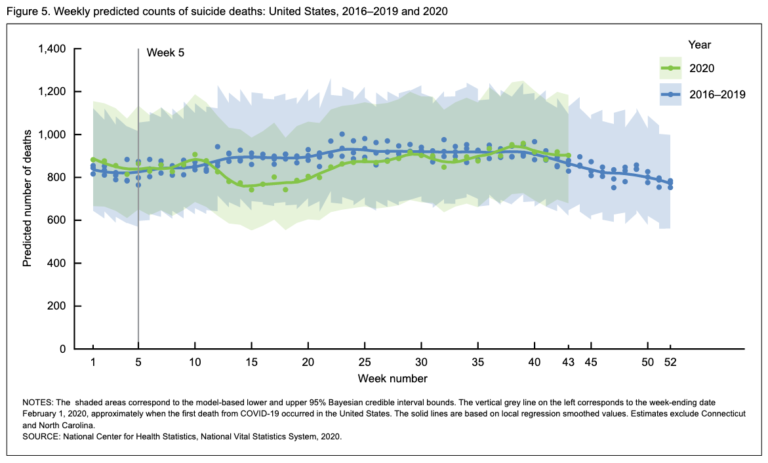
Second is the US. The US Centers for Disease Control recently released their “nowcast” of 2020 deaths. These use the limited amount of data they have now to predict what the trends will look like once all the data comes in; their prediction process seems reasonable and we can probably treat the figures as canonical. Here’s their main result:
Suicide rates were pretty normal until March, when they dropped off pretty quickly and stayed low until midsummer. They’ve since hovered around normal again. Overall, suicides declined by 5.6%.
All these countries combine to form a picture of suicide rates dipping very slightly during the first and most frantic period of the pandemic — March to May — and then going back to normal (except in Japan, where things have since gotten worse). Thus the paradox: increasing depression combined with decreasing suicides. What’s going on?
Comments Off on Depression and suicide rates during the Wuhan Coronavirus pandemic
May 28, 2021
The essential — and largely non-replenishable — trust in government
Last week, Tom posted a then-recent discussion he overheard at The Last Ditch:
[Click to see full-size flowchart]
Two svelte American ladies of a certain age were having coffee today at my West London health club. They were in the next “pod” to me outdoors as I had a post-swim coffee before heading home. Perhaps it’s those wide-open prairies but Americans, bless them, always speak a little more loudly than us so I didn’t really have a choice but to listen to their conversation.
The topic was their mothers. Both moms back in the States are apparently unsure of the wisdom of being vaccinated. One cost of parenthood no-one tells you about beforehand is that one day you will be judged and found wanting by humans you could not love more; your children for whom you would cheerfully die. I confess their mothers immediately had my sympathy, regardless of the correctness of their views.
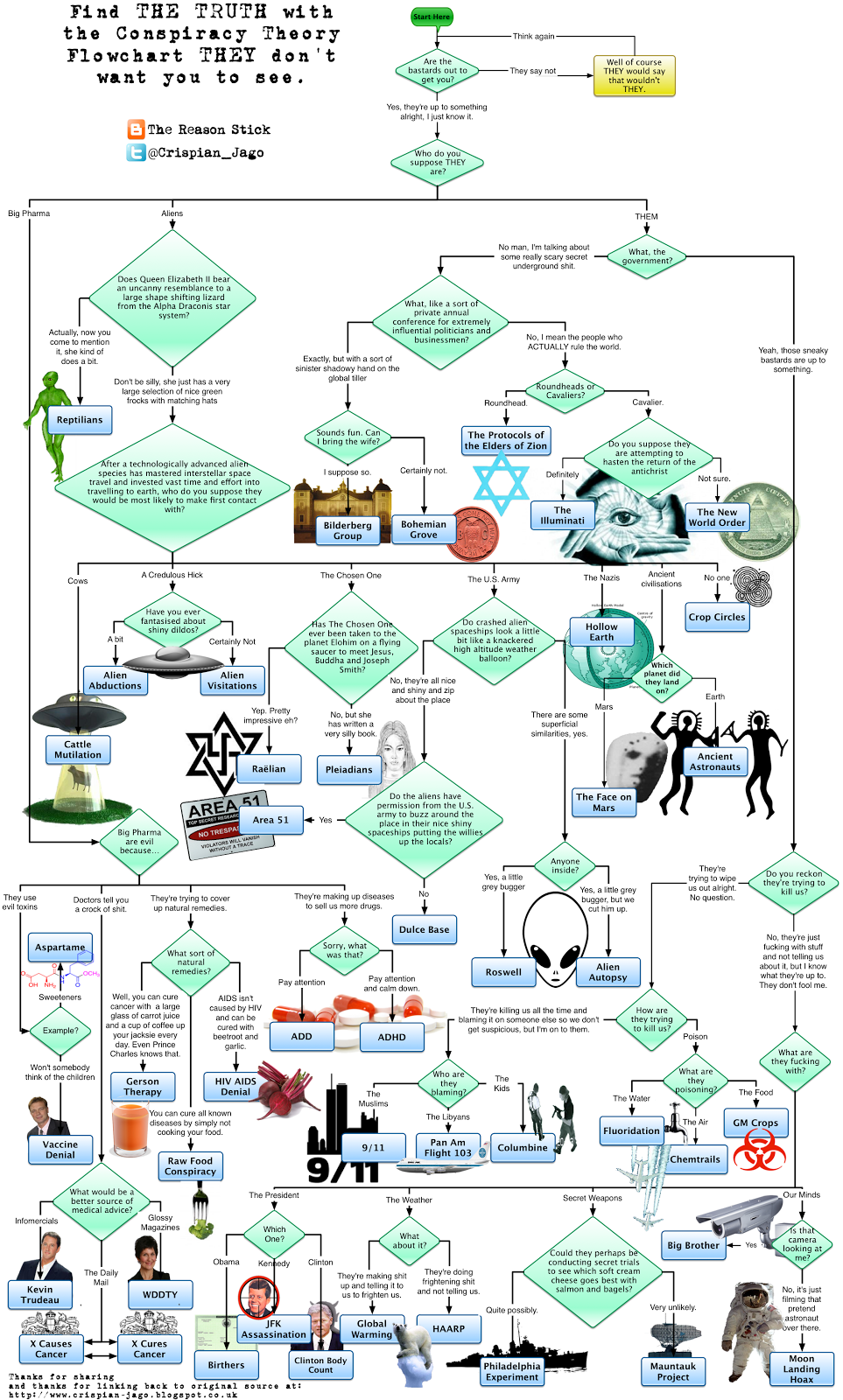
There was a good deal of sneering about conspiracy theories circulating on the internet. I found it surprising that both errant moms believed 5G was involved, but having listened quietly for another few minutes discovered that neither had ever said so. Their daughters were simply assuming that if they doubted government advice on vaccines, they believed all the other stuff too. One of the mothers is apparently a 9/11 “truther” and her daughter’s observation that no government is capable of keeping such a dark secret struck me as fair.
[…]
There are available facts and facts that will only become available in the future. People must make their choices based on their own risk assessment today. That useless truism is not the point of this post. The truly significant thing I overheard was this. Having sneered at her mother’s belief that “we can’t trust government”, one of the ladies said;
I thought to myself – Mom, I don’t want to believe what you believe because if it’s true I can’t have any of the things I believe in.
There, I thought, was a moment of insight; a moment (almost) of self-awareness. If government can’t be trusted, then the societal change she wants isn’t possible. Therefore, whatever the evidence, government must be trusted. That pretty much sums up the statist mindset.
I don’t know whether these mothers or daughters are right about this issue. I do know that one of the daughters (and her companion seemed to agree) is allowing her desires to displace her reason. In consequence, sadly, her mind will only ever be changed by a catastrophe I would never wish upon her.
I suspect many such earnest, well-meaning souls as Goneril and Regan (as I christened them) felt they needed to believe the state could be trusted at key points in the deadly history of the 20th Century. If the brave new world of Communism was to happen, for example, government had to be trusted with enormous power to make immense change.
Many Gonerils and Regans must have ruefully reflected on that in the Gulag.
Comments Off on The essential — and largely non-replenishable — trust in government
Tank Chats #108 | M48 | The Tank Museum
The Tank Museum
Published 23 Oct 2020Tank Museum Historian David Fletcher discusses the M48 “Patton”, an American first generation Main Battle Tank introduced in 1952. Throughout its service life, the M48 has been very successful and has seen service with many countries including the Americans in Vietnam and the Israel Defense Forces.
Support the work of The Tank Museum on Patreon: ► https://www.patreon.com/tankmuseum
Visit The Tank Museum SHOP & become a Friend: ► tankmuseumshop.orgTwitter: ► https://twitter.com/TankMuseum
Instagram: ► https://www.instagram.com/tankmuseum/
#tankmuseum #tanks

Comments Off on Tank Chats #108 | M48 | The Tank Museum
QotD: Declaring war on college
As it currently exists, college is a scheme for laundering and perpetuating class advantage. You need to make the case that bogus degree requirements (eg someone without a college degree can’t be a sales manager at X big company, but somebody with any degree, even Art History or Literature, can) are blatantly classist. Your stretch goal should be to ban discrimination based on college degree status. Professions may continue to accept professional school degrees (eg hospitals can continue to require doctors have a medical school degree), and any company may test their employees’ knowledge (eg mining companies can make their geologists pass a geology test) but the thing where you have to get into a good college, give them $100,000, flatter your professors a bit, and end up with a History degree before you can be a firefighter or whatever is illegal. If you can’t actually make degree discrimination illegal, just make all government offices and companies that do business with the government ban degree discrimination.
Stop the thing where high schools refuse to let people graduate until they promise to go to college. End draft deferment for people who go to college — hopefully there won’t be a draft, but do it anyway, as a sign that studying at college isn’t any more important than the many other jobs people do that don’t confer draft exemptions. Make universities no longer tax-exempt — why should institutions serving primarily rich people, providing them with regattas and musical theater, and raking in billions of dollars a year, not have to pay taxes? Make the bill that does this very clearly earmark the extra tax money for things that help working-class people, like infrastructure or vocational schools or whatever.
Scott Alexander, “A Modest Proposal For Republicans: Use The Word ‘Class'”, Astral Codex Ten, 2021-02-26.
Comments Off on QotD: Declaring war on college
May 27, 2021
QotD: Billy Clinter and the Philosophers Stoned
The result was Billy Clinter and the Philosophers Stoned, in which young Billy attends a party at Oxford and discovers his amazing ability to smoke but not inhale. With that first fantastic adventure of the shy misunderstood boy blessed — and burdened — with the awesome power to feel your pain with just one touch, young Billy Clinter became the world’s most popular schoolboy.
Then came Billy Clinter and the Gusset of Fire, in which the vast right-wing conspiracy led by the sinister Lord Newt and Doleful Bob plant a hogtail disguised as a house elf in his hotel room in Little Hangleton. The elf tricks Billy into revealing his pocket sneakoscope and she glimpses its remarkable distinguishing characteristics, the strange lightning bolt along the side that signals the tremendous potency of his Slytherin Beaubaton. After this narrow escape, the young wizard gets into yet more scrapes in Billy Clinter and the Prisoner of Azkansas, in which Rodham tells the story of how young Billy and his much brainier friend, Hillary Granger, finally escape the hideous swamp of Azkansas after being trapped there for far longer than Hillary had expected to be.
But in the fourth volume events take a grim turn, as the careless schoolboy becomes aware that Professor Starr has in his laboratory a magic dress that could destroy all his and Hillary’s plans. In Billy Clinter and the Chamber of Semen, Billy realises that he splinched while he was apparating, which had never happened before. This is all the fault of Moaning Monica, the intern who haunts the anteroom at Housewhites and has the rare power of Parcelmouth, the ability to look into the eye of the Basilisk, the world’s smallest snake, without being petrified. Is she a Niffler or a Death Eater? Billy cannot be sure. He looks to Housewhites’ giant shambling groundskeeper Reno to protect him, but she’s busy raining down fire on strange cults. As the book ends, their old friend Albus Bumblegore fails to become Headmaster of Housewhites after insufficient chads are found in his sorting hat.
With each new adventure, critics have predicted that the eternal schoolboy has run his course. But he keeps coming back. None the less, there were strange rumours this time that J.K. Rodham was preparing to kill off the most popular character. It’s been known for a while that she sees the series’ future depending more on the much brainier though somewhat unlikeable Hillary Granger and the four female ghosts who write all her words.
Mark Steyn, “Splinching while you’re apparating”, The [Un]documented Mark Steyn, 2014.
Comments Off on QotD: Billy Clinter and the Philosophers Stoned
May 26, 2021
The Great All-Out Battle – Naval Warfare in the Pacific – WW2 Special
World War Two
Published 25 May 2021Before the infamous day that was Pearl Harbor, US and Japanese military planners worked to envision what a future war in the Pacific would look like. With the entire region now a war zone, it is time to put their theories to the test. Watch the video to find out what these are.
(more…)
Comments Off on The Great All-Out Battle – Naval Warfare in the Pacific – WW2 Special
QotD: Modern architecture is ugly … or worse
Take the Tour Montparnasse, a black, slickly glass-panelled skyscraper, looming over the beautiful Paris cityscape like a giant domino waiting to fall. Parisians hated it so much that the city was subsequently forced to enact an ordinance forbidding any further skyscrapers higher than 36 meters.
Or take Boston’s City Hall Plaza. Downtown Boston is generally an attractive place, with old buildings and a waterfront and a beautiful public garden. But Boston’s City Hall is a hideous concrete edifice of mind-bogglingly inscrutable shape, like an ominous component found left over after you’ve painstakingly assembled a complicated household appliance. In the 1960s, before the first batch of concrete had even dried in the mold, people were already begging preemptively for the damn thing to be torn down. There’s a whole additional complex of equally unpleasant federal buildings attached to the same plaza, designed by Walter Gropius, an architect whose chuckle-inducing surname belies the utter cheerlessness of his designs. The John F. Kennedy Building, for example — featurelessly grim on the outside, infuriatingly unnavigable on the inside — is where, among other things, terrified immigrants attend their deportation hearings, and where traumatized veterans come to apply for benefits. Such an inhospitable building sends a very clear message, which is: the government wants its lowly supplicants to feel confused, alienated, and afraid.
Brianna Rennix and Nathan J. Robinson, “Why You Hate Contemporary Architecture”, Current Affairs, 2017-10-31.
Comments Off on QotD: Modern architecture is ugly … or worse
May 25, 2021
John McWhorter’s new book announced
Following on to his Nine Nasty Words, which just became a New York Times best-seller (somewhat to his surprise), John McWhorter’s next book will be Woke Racism: How a New Religion Has Betrayed Black America from Random Penguin:
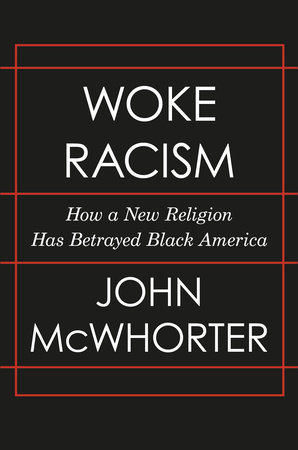
That manuscript will be released as a book by Portfolio (also a Penguin Random House imprint) in October. It will be published under a new title: Woke Racism: How a New Religion Has Betrayed Black America.
I should mention that the often sharp and insightful subscriber comments, as well as the brilliant editorial counsel of Bria Sandford at Portfolio, have already made Woke Racism significantly different from the The Elect excerpts. Woke Racism will express what the Substack excerpts did and then some. It will still analyze Third-Wave Antiracism as a religion. It will still make legions of black people see me as a race traitor. It will still make legions of white people see me as a tragically deluded white supremacist with brown skin who merits dismissal and ostracization.
And amidst all of that, it will still represent what I consider the most pro-black book I have ever written.
But this does mean that from now on, my Substack “newsletter” will be exactly that. I am glad many of you have enjoyed my posts here beyond the The Elect excepts, and they will continue, at the rate of once or twice (and I hope, more often, twice) a week. I have loved communicating to you as well as the feedback I get. Let’s keep this going.
Only: get “The Elect” as a real book, Woke Racism, around Halloween. Here, get my take on things as they happen, unfiltered.
Comments Off on John McWhorter’s new book announced
“Latinx”
At Ace of Spades H.Q., Buck Throckmorton explains why “Latinx” is a silly word-like mouthing that we should not encourage anyone to use:

Original image from inclusion.uoregon.edu
“Latinx” is a white supremacist term used by racist, left-wing Americans to marginalize Spanish speakers and to disparage their culture.
The term “Latinx” itself is overtly racist. Not only is Latinx not a Spanish word, it can’t even be pronounced in Spanish. How offensively paternalistic maternalistic mxternxlistic(?) is it of liberal, white Americans to rip the identity from brown-skinned people, and then impose on them a new identity, which is an unpronounceable collection of consonants … and THEN demand that Hispanics identify by this new, unpronounceable English word.
One of the embarrassing bigotries of left-wing, monolingual, white supremacists is that they are oblivious to the fact that the entire Spanish language is gendered. Because of their racist ignorance of the Spanish language, they don’t understand that the gender of a noun is indicated by the definite article (“el” / “la” ) or the indefinite article (“un” / “una” ) more so than if a word ends in “a” instead of “o”.
American lefties have changed exactly one Spanish word to gender-neutral, and with that done, they now demand that Spanish speakers somehow converse like weird, left-wing English-speakers and remove all gender from their speech. This simply isn’t possible in Spanish. So, in effect left-wing white supremacists are shaming Spanish language speakers for using their native language. I can’t believe such ugly bigotry exists in 21st Century America.
In addition, by imposing the transsexual term “Latinx” on all Hispanics, left-wing whites are asserting that all Hispanics are transsexuals, which could be culturally insulting. A liberal, white American woman may think she is complimenting an Hispanic man by telling him that she sees him as no different than a castrated cross-dresser, but he probably won’t take it as a compliment. But to be fair, most of the men in the orbit of woke white women would be flattered to be thought of that way.
Comments Off on “Latinx”
May 24, 2021
“The revolution will be defeated when people stop being scared”
Sean Gabb discusses some outrageous elements of the ongoing cultural revolution against freedom of speech in Britain, the United States and many other western nations:

David Hume Tower at the University of Edinburgh (listed building number 50189).
Photo by Enric via Wikimedia Commons.
If I am a self-employed plumber or electrician, I can speak my mind and laugh at the complaints. If, like the great majority in this country, I am a salaried employee — whether in the state or private sectors is unimportant: the pressures to conformity are the same in both sectors — I must be careful what I say. I am scared of the sack. I am scared of sudden redundancy. I am scared of missing out on promotions. I am scared of generally unfair treatment because of my opinions. I therefore hide my opinions. The Peter Tatchells among us then look round complacently, telling themselves and each other that silence equals agreement, and that the few squeaks of opposition are from “disreputable extremists.”
This explains the present unbalanced debates over slavery and colonialism. Take these examples:
- First, in September 2020, the David Hume Tower at Edinburgh University was “denamed”. Someone had bothered to read the 1748 essay “Of National Characters”, and found in one of its footnotes an unfashionable statement about race. It was at once set aside that Hume was a philosopher of at least considerable note. More important was the “non-overt disrespect, offence, and racism that Black students have to go through at the University of Edinburgh”.
- Second, the Music Department at Oxford is presently worried that its curriculum “structurally centres white European music”, and that this causes “students of colour great distress”. It therefore wants to change its focus from the European classical tradition to things like “Artists Demanding Trump Stop Using Their Songs”. It also wants to discourage students from studying musical notation, as this is a “colonialist representational system”.
I could give a third illustration, and a fourth. I could fill a pamphlet with more. Some would be more alarming, though few less absurd. But these two can stand well enough for all the others. What makes these debates so irritating is that they are not debates. One side can put its case just as it pleases. The other is reduced to accepting all the main charges and begging for mitigation: “What Hume said was evil and unpardonable — but he was important for other things.” Or: “I feel your pain, but Mozart owned no slaves, and everyone knows that Beethoven was really black.” Because it has been so humbly begged, full mitigation will, in both cases, be granted. Hume will continue to be studied in the universities. Music students at Oxford will continue to use the standard notation and to analyse the usual classics. But preventing these things was never part of the agenda. The agenda was and is to transform what were honoured or unquestioned parts of our civilisation into things useful but more or less suspect, things subject to a toleration that may be varied or withdrawn at any time without notice.
It should be plain that we are, in both England and America, living through a revolution. This is not a normal revolution as these things are considered. Unlike in France or Russia, there has been no overthrow of an established order, no burst of state violence, no establishment after that of an overtly new order. There are no secret police. There are no labour camps. No one is beaten to death in a police cell. All the same, we are living through a revolution. It is a revolution that has involved the gradual capture of education, the media, the administration, the charities and the more permeable religious institutions, and the recent aligning of the larger or more glamorous business concerns. I see no point in discussing its ultimate objects. I am not sure if these are wholly agreed. But its provisional object is the destruction of our traditional identity, and of our liberty so far as this stands in the way of that provisional object.
These two elements of the provisional object are equally important. Our civilisation is being pulled apart because doing so strips away the mass of associations that, left in place, might hold up the more alarming parts of the transformation. Opposition is so feeble not only because that is all that will be tolerated: feeble opposition is all that can be tolerated. This is a revolution in which opponents are not murdered, but only scared into silence. They are scared into silence chiefly by fear of destroyed or blighted careers. The revolution will be defeated when people stop being scared. Then, there will be vicious and unrelenting public mockery, and commercial boycotts, and shareholder rebellions, and lost elections, and the general feeling of solidarity and impunity still sometimes found in a football stadium.
Comments Off on “The revolution will be defeated when people stop being scared”


