
To sum up: the qualities that arouse the protective instinct are the opposite of those that attract a sex partner.
Protector and protégé are outwardly alike; sex partners are complimentary opposites. Protégés are physically and mentally inferior to their protectors; sex partners are physically and mentally equals. These three sets of qualities, opposite and mutually exclusive, of protégés and sex partners, determine the basic attitudes towards each, also opposite and mutually exclusive. And yet we call these profoundly different emotions by the same name: love. Love has become of necessity, then, the most dangerously misleading word in the language.
Esther Vilar, The Polygamous Sex, 1976.
November 10, 2014
QotD: “[T]he most dangerously misleading word in the language”
Comments Off on QotD: “[T]he most dangerously misleading word in the language”
November 7, 2014
Criticizing someone for making an error … while making the same error yourself
That’s another concept that I’m sure must have an eighteen-syllable descriptor in German but doesn’t have a matching name in English. David Friedman has a great illustration of this in the criticism of a nineteenth century anthropologist by Stephen Jay Gould:
The late Stephen Jay Gould was both an evolutionary biologist and a popular essayist. In the book The Mismeasure of Man he argued that scientists unconsciously manipulate their data to fit their preexisting prejudices. As evidence he cited the work of Samuel George Morton, a 19th century physical anthropologist who assembled a large collection of skulls from many parts of the world and measured their cranial capacity in an attempt to answer questions about racial differences. According to Gould, Morton skewed his data in various ways to fit his racial beliefs.
I have just read an article by a group of modern anthropologists who went over Morton’s data and remeasured many of the skulls that Morton measured — something Gould did not do. The authors concluded that most of Gould’s criticisms were poorly supported or falsified. The errors that Gould reported in Morton’s analysis resulted from errors by Gould, not by Morton. Morton did make some mistakes in his work, but they were in the opposite direction from his biases.
[…]
The obvious conclusion, not stated by the authors of the article, is that Gould’s central claim was correct. Scientists sometimes bias their work to fit their preconceptions. As Gould demonstrated by doing so.
Comments Off on Criticizing someone for making an error … while making the same error yourself
November 3, 2014
QotD: Age differences in sexual partners
Polar opposition in the sex-specific areas, then, is combined with resemblance in all other respects. The man will usually be physically stronger than the women, a sex-specific difference that makes them attractive to one another. But as soon as this difference becomes too great — as soon as the woman is so weak, or pretends to be so weak, that the physical difference can no longer be regarded as sex-specific — the stronger partner’s protective instinct may seriously interfere with his sex instinct. He may refrain from sex in order not to hurt his partner. If, in addition to being physically inferior, she is also mentally inferior, the weaker partner tends to become increasingly the object of his protection. The sex act — normally a kind of combat at close quarters — under such conditions involves considerable self-restraint, and loses something essential in the process. Equality on the intellectual level, combined with polarity on the physical, is therefore a condition sine qua non of full-scale love between a man and a woman.
A good guarantee for the necessary resemblance of the partners in the nonsexual realm is their belonging to the same generation. By a generation we mean the time span between the birth of an individual and the birth of its first offspring — about twenty to twenty five years. Sexuality is in any case for adults, but if one partner is more than twenty five years older than the other, and thereby belongs to the generation of the other’s grandparents, the chances for a mutually satisfactory sexual relationship are relatively poor. There are of course cases in which a particular person’s special dynamism can bridge this biological gap for a time, but such exceptions only confirm the rule. The frequent alliances between young women and men who are their seniors by more than a generation are no proof to the contrary; they always depend on the same factor: the wealth or social status of the much older man. If it were a biological mechanism that drove attractive young females into the arms of old men, a poor old pensioner might occasionally have a chance of marrying a rich young girl.
Esther Vilar, The Polygamous Sex, 1976.
Comments Off on QotD: Age differences in sexual partners
October 31, 2014
Placebo effect so powerful that it can influence the climate
JoNova on the newly discovered Global Placebo Effect:
Matt Ridley was questioning Baroness Sandip Verma at the House of Lords this week. He pointed out to the peers that even the IPCC admits there is “hiatus” that modelers can’t explain. Verma responded: “‘It [global warming] may have slowed down, but that is a good thing. It could well be that some of the measures we are taking today is helping that to occur.’” [Source — Dailymail]
Verma raises the intriguing possibility that windmills and solar panels that were built after 2005 have managed to keep global temperatures constant starting from ten years before they were constructed.
What’s even more remarkable is that none of these projects or activities have reduced global CO2 levels. It follows then, that the mere thought of building windmills is enough to change the weather.
Furthermore, it’s well known that more expensive placebo’s are more effective. Hence the final-final copy of the latest IPCC report — issued on Friday after the leak, the draft, and the redraft — will explain that they are 95% certain that if we spend $2 billion dollars a day on renewable energy (instead of just $1 billion) there will be no more category five storms, seas will stop rising, and goats will stop shrinking.
Comments Off on Placebo effect so powerful that it can influence the climate
October 22, 2014
What would Milton Friedman do?
David Friedman, who we can safely assume has a better sense of the late Milton Friedman’s thoughts and beliefs than most people, disagrees with a recent Forbes article asking WWMFD:
A recent Forbes article is headlined “What Would Milton Friedman Do About Climate Change? Tax Carbon.” It reports on a forum at the University of Chicago at which several economists, including Michael Greenstone, described as the “Milton Friedman Professor of Economics at the University of Chicago,” argued that Friedman would have supported a carbon tax. The evidence for that claim was a 1979 clip from the Phil Donahue show where Milton Friedman argued that if the government is going to do something about emissions, they should use an effluent tax rather than direct regulation. He does not actually say that government should do something about emissions, only that there is a case for doing so and, if it is done, the best way to do it is by a tax on emissions.
To get from there to the conclusion that he would have favored a carbon tax requires at least one further step, a reason to think that he would have believed that global warming due to CO2 emissions produced net negative externalities large enough to justify doing something about them. The problem with that claim is that warming can be expected to produce both negative externalities such as sea level rise and hotter summers and positive ones such as longer growing seasons and milder winters. The effects will be spread out over a long and uncertain future, making their size difficult to estimate. My own conclusion, defended in past posts here (one example), is that the uncertainties are large enough so that one cannot sign the sum, cannot say whether the net effect will be positive or negative.
I do not know if my father would have agreed but I have at least a little evidence on the subject, more than offered in the Forbes article. The same issue arose in the earlier controversy over population. Just as it is now routinely assumed that warming is bad, it was then routinely assumed that population increase was bad. Forty years ago I wrote a piece on the subject for the Population Council in which I attempted to estimate the externalities associated with population. I concluded that they were too uncertain for me to tell whether the net effect was good or bad. My father read the piece and commented on it. If he had disagreed he would have said so, and he did not. It is possible that he would have felt differently in the case of climate change, but I can see no reason to expect it.
Comments Off on What would Milton Friedman do?
October 20, 2014
QotD: Sexual differentiation
Our sexual differences can be more or less general, or more or less individual i.e. they may be typical for the whole sex or for only an individual member of that sex. Men with a vigorous growth of beard, hairy chests broad shoulders narrow hips, big penises, for example, are generally more in demand as are, conversely, women with delicate skin, big breasts, wide hips. The more individual polarity exists in any given case, the more ideal the sexual relationship is likely to become. We all do what we can to emphasize our sexual differentiation from the opposite sex — or with respect to a specific member of the opposite sex — as skillfully as possible. Whoever is not strikingly male or female will do everything possible to seem so by, for example, developing his biceps through gymnastics, pad her bra, style the hairdo, etc.
The same motivation also underlies the so-called ‘typically masculine’ and ‘typically feminine’ kinds of behavior: it is always a conscious or unconscious parading of sex-specific characteristics. To smile rarely or often, talk much or little, swing the hips or not in walking, makes people ‘more manly’ or ‘more womanly.’ This kind of behavior is simulated, as shown by the fact that it is subject to fashion and can be dropped at will. The ‘womanly’ mannerisms of the stars in the old movies are markedly different from those we see in films by Truffault or Godard. To behave like a movie vamp of the twenties today is to appear not womanly but ridiculous.
Esther Vilar, The Polygamous Sex, 1976.
Comments Off on QotD: Sexual differentiation
October 19, 2014
Developing salt-tolerant vegetables
Tracy McVeigh on a Dutch experiment to develop food crops that can be irrigated with salt water:
Here, on one of the Netherlands’ northernmost islands, windswept Texel (pronounced Tessel) surrounded by encroaching ocean and salt marshes that seep sea water under its dykes and into ditches and canals, an enterprising farmer has taken the radical step of embracing salt water instead of fighting to keep it out. And now he thinks he might just help feed the world.
Inspired by sea cabbage, 59-year-old Marc van Rijsselberghe set up Salt Farm Texel and teamed up with the Free University in Amsterdam, which sent him [researcher Dr Arjen] de Vos to look at the possibility of growing food using non-fresh water. Their non-GM, non-laboratory-based experiments had help from an elderly Dutch farmer who has a geekish knowledge of thousands of different potato varieties.
“The world’s water is 89% salinated, 50% of agricultural land is threatened by salt water, and there are millions of people living in salt-contaminated areas. So it’s not hard to see we have a slight problem,” said van Rijsselberghe. “Up until now everyone has been concentrating on how to turn the salt water into fresh water; we are looking at what nature has already provided us with.”
Comments Off on Developing salt-tolerant vegetables
October 18, 2014
Unmanned X-37B returns to earth after nearly two years in orbit
In the Telegraph, Rob Crilly tells us what is known about the X-37B’s mission:
It arrived back at a California air base after dark. Only the eagle-eyed would have spotted the snub-nosed spacecraft gliding out of the black sky.
Officially, the unmanned Boeing-built X-37B Orbital Test Vehicle had just completed its longest ever mission, spending almost two years circling the Earth, conducting experiments.
But its secretive history has sparked countless theories about what the computer controlled craft was really doing in space.
One idea is that the US Air Force has developed a drone spy ship, which it uses to shadow Chinese satellites. Another more fanciful claim is that it has been developed to engage in sat-napping — gobbling up rival spy satellites like something from a James Bond film.
There were few clues in an official press release.
“The landing of OTV-3 marks a hallmark event for the program,” said an unidentified programme manager quoted in the Air Force statement.
“The mission is our longest to date and we’re pleased with the incremental progress we’ve seen in our testing of the reusable space plane. The dedication and hard work by the entire team has made us extremely proud.”
Comments Off on Unmanned X-37B returns to earth after nearly two years in orbit
QotD: Mothers, fathers, and children
Human beings also operate on this principle of similarity. Identification with her young is of course easiest for the mother: she has felt it inside her for months, she has known it come out of her own body, it is ‘flesh of her flesh’ i.e. herself. The father, by comparison, depends on hearsay; he is therefore likely to be rather indifferent at first. Despite the repeated assurances from everyone around him that the newborn is his ‘spitting image’ it is not easy for him to see this. It is only some time later that he begins to accept the resemblance and to love the child.
A woman’s predisposition to identify with the infant at once, to a degree impossible for the male, has won her the reputation of being the more selfless parent. Since she instantly accepts the newborn as her charge and actively devotes herself to its care and feeding, a mother’s love is held to be stronger than that of a father. Actually it is only a matter of time lapse between two equally powerful emotional attachments, based entirely upon biological causes.
That fathers are capable of loving their children just as much as mothers, and that the male nurturing instinct is in no way less developed than that of the female, is amply attested by the exchange of parental roles in various primitive cultures, as well as by the experimental knowledge of modern sociology.
Esther Vilar, The Polygamous Sex, 1976.
Comments Off on QotD: Mothers, fathers, and children
October 16, 2014
The trouble with “parenting” in 2014
Jan MacVarish discusses the problems facing today’s parents that inhibit natural parenting instincts and replace them with the diktats of the bureaucracy:
Here are two scenes which illustrate contemporary parenting culture.
In the first, I am called into my son’s primary school by the ‘family-liaison officer’. I am surprised to learn that she is investigating the concerns of a teacher who has overheard my son and his friends discussing their mothers’ favourite punishment methods. Whereas one of the mothers (who I know) reportedly kicks her boy in the privates with her stilettos, and another (who I also know) prefers to administer an ‘African slap’, my chosen method is, apparently, to hit my son with a frying pan. Visions of Tom and Jerry immediately spring to mind, and I laugh at the ridiculousness of the schoolboys’ conversation. The family-liaison officer admits that it is highly unlikely that a mother such as me (white and middle class) would engage in such behaviour, but, she tells me, she is nevertheless obliged to ask if I have ever deployed the family skillet as a weapon. I am now amused, bemused and starting to see that this could have played out very differently if I were perceived to be one of those ‘other’ parents.
Scene two: While swimming in the local pool with frying-pan boy, I notice a mother engage in an exhausting 20-minute argument with her one-year-old baby boy. He had slapped her, so she was asking him in a quiet, controlled voice to look her in the eye and apologise for ‘hurting mummy’. Being a baby, he refused to comply, and became more and more upset as the request was repeated again and again. My sympathy was equal for both mother and child: he was sobbing and she seemed forlornly trapped in some kind of ‘good parenting’ ritual, in which the parent conveys to the child the emotional consequences of their actions – ‘you hurt mummy, that makes mummy feel sad’ – and expects the child to take ‘ownership’ of their actions.
Both of these scenes demonstrate the abandonment of common sense and, indeed, any kind of ‘instinct’ when it comes to adults relating to children. When you remove any element of instinct from parenting, you replace trust, care, love and joy with empty rituals of ‘safeguarding’ or ‘good parenting’. The family-liaison officer’s dutiful yet hollow investigation makes clear just how corrosive the institutionalisation of parent-blaming in schools has become, while the mother’s exchange with her baby in the pool showed how futile and joy-draining following abstract, good-parenting guidelines can be.
Comments Off on The trouble with “parenting” in 2014
October 14, 2014
Reason.tv – 3 Reasons the US MILITARY Should NOT Fight Ebola
Published on 14 Oct 2014
President Obama is sending thousands of U.S. troops to West Africa to fight the deadly Ebola virus. Their mission will be to construct treatment centers and provide medical training to health-care workers in the local communities.
But is it really a good idea to send soldiers to provide this sort of aid?
Here are 3 reasons why militarizing humanitarian aid is a very bad idea
Comments Off on Reason.tv – 3 Reasons the US MILITARY Should NOT Fight Ebola
October 13, 2014
The Royal Navy’s “weirdest” ship
David Axe on what he describes as the weirdest ship in the Royal Navy:

Royal Fleet Auxiliary vessel RFA Argus pictured supporting Operation Herrick in Afghanistan (via Wikipedia)
The British Royal Navy is deploying the auxiliary ship RFA Argus to Sierra Leone in West Africa in order to help health officials contain the deadly Ebola virus.
If you’ve never heard of Argus, you’re not alone. She’s an odd, obscure vessel — an ungainly combination of helicopter carrier, hospital ship and training platform.
But you’ve probably seen Argus, even if you didn’t realize it. The 33-year-old vessel played a major role in the 2013 zombie movie World War Z, as the floating headquarters of the U.N.
[…]
The 575-foot-long Argus launched in 1981 as a civilian container ship. In 1982, the Royal Navy chartered the vessel to support the Falklands War … and subsequently bought her to function as an aviation training ship, launching and landing helicopters.
Argus’ long flight deck features an odd, interrupted layout, with a structure — including the exhaust stack — rising out of the deck near the stern.
Weirdly, the deck’s imperfect arrangement is actually an asset in the training role. Student aviators on Argus must get comfortable landing in close proximity to obstacles, which helps prepare them for flying from the comparatively tiny decks of frigates and other smaller ships.

RFA Argus photographed off the coast at Devonport (via Wikipedia)
Comments Off on The Royal Navy’s “weirdest” ship
Statistical sleight-of-hand on the dangers of texting while driving
Philip N. Cohen casts a skeptical eye at the frequently cited statistic on the dangers of texting, especially to teenage drivers. It’s another “epidemic” of bad statistics and panic-mongering headlines:
Recently, [author and journalist Matt] Richtel tweeted a link to this old news article that claims texting causes more fatal accidents for teenagers than alcohol. The article says some researcher estimates “more than 3,000 annual teen deaths from texting,” but there is no reference to a study or any source for the data used to make the estimate. As I previously noted, that’s not plausible.
In fact, 2,823 teens teens died in motor vehicle accidents in 2012 (only 2,228 of whom were vehicle occupants). So, my math gets me 7.7 teens per day dying in motor vehicle accidents, regardless of the cause. I’m no Pulitzer Prize-winning New York Times journalist, but I reckon that makes this giant factoid on Richtel’s website wrong, which doesn’t bode well for the book.
In fact, I suspect the 11-per-day meme comes from Mother Jones (or whoever someone there got it from) doing the math wrong on that Newsday number of 3,000 per year and calling it “nearly a dozen” (3,000 is 8.2 per day). And if you Google around looking for this 11-per-day statistic, you find sites like textinganddrivingsafety.com, which, like Richtel does in his website video, attributes the statistic to the “Institute for Highway Safety.” I think they mean the Insurance Institute for Highway Safety, which is the source I used for the 2,823 number above. (The fact that he gets the name wrong suggests he got the statistic second-hand.) IIHS has an extensive page of facts on distracted driving, which doesn’t have any fact like this (they actually express skepticism about inflated claims of cell phone effects).
[…]
I generally oppose scare-mongering manipulations of data that take advantage of common ignorance. The people selling mobile-phone panic don’t dwell on the fact that the roads are getting safer and safer, and just let you go on assuming they’re getting more and more dangerous. I reviewed all that here, showing the increase in mobile phone subscriptions relative to the decline in traffic accidents, injuries, and deaths.
That doesn’t mean texting and driving isn’t dangerous. I’m sure it is. Cell phone bans may be a good idea, although the evidence that they save lives is mixed. But the overall situation is surely more complicated than the TEXTING-WHILE-DRIVING EPIDEMIC suggests. The whole story doesn’t seem right — how can phones be so dangerous, and growing more and more pervasive, while accidents and injuries fall? At the very least, a powerful part of the explanation is being left out. (I wonder if phones displace other distractions, like eating and putting on make-up; or if some people drive more cautiously while they’re using their phones, to compensate for their distraction; or if distracted phone users were simply the worst drivers already.)
Comments Off on Statistical sleight-of-hand on the dangers of texting while driving
October 12, 2014
The unique challenges to UAVs in the Canadian Arctic
Ben Makuch looks at the severe environment of Canada’s Arctic and how UAV design is constrained by those conditions:
The rotary-wing UAV tested, and its view from the sky. Image: DRDC
“A lot of these systems — UAVs particularly, and rotor-wing (that is to say helicopters or quadrotors) — are even more sensitive. They require a good understanding of what they’re heading in. And by heading, that’s kind of the direction you’re facing,” said Monckton.
And because of those difficulties, finding headings for aerial drones in the Arctic requires stronger GPS systems to establish a “line segment” of locational data, ripped, according to Monckton, from a “crown” of satellites hovering on top of Earth.
In terms of weather conditions, the extreme sub-zero temperatures is devastating on a UAV when you mix in fog or clouds. While crisp cool air with clear skies provides excellent flying conditions, once you mix in ice fog, it becomes a major risk to small UAVs.
“The biggest risk in the Arctic is structural icing,” said Monckton who explained that water in the clouds is so cool that when “you strike it, it actually crystallizes on contact.”
At CFS Alert, the Multi-Agent Tactical Sentry (MATS) UGV travels through rough Arctic terrain during an autonomous path-following test without the use of GPS. The Canadian Armed Forces Joint Arctic Experiment (CAFJAE) 2014 tests autonomous technology for Arctic conditions and explores its potential for future concepts of military operations through experiments carried out August 2014 at Canadian Forces Station Alert, Nunavut. CAF and Defence Research and Development Canada’s (DRDC) JAE work will benefit multiple government partners and centers around a fictitious satellite crash with hazard identification, telecommunication and other search and rescue tasks. Image: DRDC
Unsurprisingly, the wings of a drone being enveloped in ice presents “a major impediment to general unmanned air operations,” Monckton said. In part, because “UAVs are too small to carry standard deicing equipment [as used] on a commercial aircraft. So that’s a major problem.”
For the project, DRDC took a previously manned helicopter and modified it into an unmanned vehicle. They had help from Calgary-based Meggit Canada for the project, a defence and security contractor also responsible for this armed training hexicopter.
As for ground drones, or unmanned ground vehicles, Monckton said weather and temperature were an afterthought. The real challenge, was the actual terrain.
“The arctic has a really peculiar surface,” said Monckton, adding that the high Arctic offers mostly marshlands, rocky outcrops, or elevated permafrost that produces spiky formations. “So the UGV was kind of going between easy riding on sloppy stuff and then getting pounded to pieces on the rough frost boils.”


Comments Off on The unique challenges to UAVs in the Canadian Arctic
October 8, 2014
Something is wrong when your “data adjustment” is to literally double the reported numbers
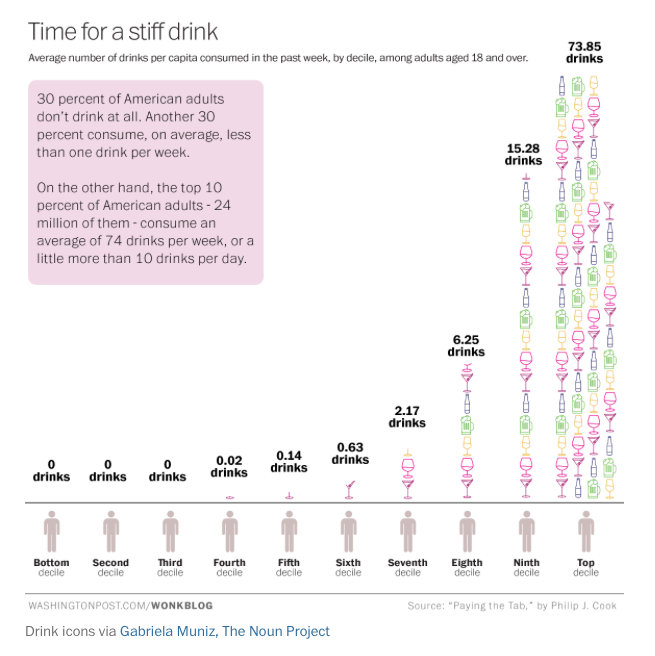
In Forbes, Trevor Butterworth looks at an odd data analysis piece where the “fix” for a discrepancy in reported drinks per capita is to just assume everyone under-reported and to double that number:
“Think you drink a lot? This chart will tell you.”
The chart, reproduced below breaks down the distribution of drinkers into deciles, and ends with the startling conclusion that 24 million American adults — 10 percent of the adult population over 18 — consume a staggering 74 drinks a week.
The source for this figure is “Paying the Tab,” by Phillip J. Cook, which was published in 2007. If we look at the section where he arrives at this calculation, and go to the footnote, we find that he used data from 2001-2002 from NESARC, the National Institute on Alcohol Abuse and Alcoholism, which had a representative sample of 43,093 adults over the age of 18. But following this footnote, we find that Cook corrected these data for under-reporting by multiplying the number of drinks each respondent claimed they had drunk by 1.97 in order to comport with the previous year’s sales data for alcohol in the US. Why? It turns out that alcohol sales in the US in 2000 were double what NESARC’s respondents — a nationally representative sample, remember — claimed to have drunk.
While the mills of US dietary research rely on the great National Health and Nutrition Examination Survey to digest our diets and come up with numbers, we know, thanks to the recent work of Edward Archer, that recall-based survey data are highly unreliable: we misremember what we ate, we misjudge by how much; we lie. Were we to live on what we tell academics we eat, life for almost two thirds of Americans would be biologically implausible.
But Cook, who is trying to show that distribution is uneven, ends up trying to solve an apparent recall problem by creating an aggregate multiplier to plug the sales data gap. And the problem is that this requires us to believe that every drinker misremembered by a factor of almost two. This might not much of a stretch for moderate drinkers; but did everyone who drank, say, four or eight drinks per week systematically forget that they actually had eight or sixteen? That seems like a stretch.
We are also required to believe that just as those who drank consumed significantly more than they were willing to admit, those who claimed to be consistently teetotal never touched a drop. And, we must also forget that those who aren’t supposed to be drinking at all are also younger than 18, and their absence from Cook’s data may well constitute a greater error.
Comments Off on Something is wrong when your “data adjustment” is to literally double the reported numbers


