
Tasting History with Max Miller
Published 23 May 2023
(more…)
May 24, 2023
The Original PB&J from 1901
Comments Off on The Original PB&J from 1901
QotD: Impostor Syndrome in academia
Trust me on this: “impostor syndrome” is very real. It is, in fact — and obviously — the source of the benzo bottle in every egghead’s medicine cabinet. And the reason all eggheads feel like frauds is equally obvious: Nothing you do can possibly justify your paycheck.
There are no Dead Poets Society teachers in real life in any case, and even if there were, and even if you were one of them, well … congrats, buddy, you’ve managed to reach one student, one time, out of the hundreds, thousands, tens of thousands you taught before reaching tenure, the hundreds, thousands, tens of thousands more who will drift through your classroom, fish-eyed and phone-addled, for the rest of your academic career. One kid, one time, and meanwhile you live a life that 90% of Americans would be ecstatic to have. (As for your “research”, […] please. Unless your book revolutionizes a field — good luck with that — maybe twenty people will read it, and fifteen of them will hate it). You’re a fucking fraud, pal, that’s all there is to it …
Which leaves you with two options, if you want to avoid the kind of crushing cognitive dissonance that turns a guy like Todd into a gutter drunk: You embrace the make-believe, or you quit. Todd quit. Becoming a gutter drunk was a spectacularly gaudy, self-destructive way of quitting, but it was quitting nonetheless. I quit too, as y’all know … but the funny thing was, I didn’t quit drinking until I did. I didn’t go out and get wrecked every night like I used to do with Todd, but I was still a drinker, often quite a heavy one. I just did it in private. It was only when I quit the ivory tower for good that I stopped drinking.
This, I suggest, is the ultimate source of the Poz: The crushing impostor syndrome that all Americans feel, who haven’t built their lives up from scratch. Unless your day-to-day is a struggle, a real one — a “need to choose between buying food and making rent” one — you can’t help but feel, at some level, that you’re a fraud, a sham. You don’t deserve this, because no one deserves this who didn’t earn it, didn’t hew it out of the wilderness himself. And the more “white collar” you are, the stronger your latent impostor syndrome. Is it any surprise that Karen, who has never earned anything in her entire life, is the most pozzed? That “Human Resources” is just the Poz Gestapo?
Severian, “On the Poz”, Rotten Chestnuts, 2020-11-16.
Comments Off on QotD: Impostor Syndrome in academia
May 23, 2023
The Diamond Princess – the “worst case virus mill” during the Covid-19 pandemic
Dr. Todd Kenyon looks at the data from the situation onboard the Diamond Princess early in the pandemic:

Diamond Princess is a cruise ship owned and operated by Princess Cruises. She began operation in March 2004 and primarily cruises in Alaska during the summer and Asia in the winter along with Australia cruises. Diamond Princess and Sapphire Princess were both were built in Nagasaki, Japan by Mitsubishi Heavy Industries.
Photo by Bernard Spragg, NZ via Wikimedia Commons.
The Diamond Princess cruise ship departed Japan on January 20, 2020. Five days later a passenger disembarked, later became ill and tested positive for SARS-CoV-2 infection. On board this ship were 3,711 persons, of which 2,666 were passengers (median age of 69) and 1,045 were crew (median age of 36). Nearly half (48%) of the passengers were said to have underlying disease(s). Passengers and crew began testing positive with some becoming ill, but the passengers were not quarantined in their cabins until Feb 5. Until that time they had been engaging in a variety of typical social activities including shows, buffets and dances. Once quarantined (confined to cabins), most passengers shared cabins with 1 to 3 other passengers. Cabins used unfiltered ventilation and the crew continued their duties and mixed with passengers. Evacuation began in mid February and was completed by March 1.
A total of 712 individuals (19%) tested positive via PCR, and as many as 14 passengers were said to have died, though there are differing opinions as to how many of these deaths should be attributed to Covid. Except for one person in their late 60s, all deaths occurred in those over 70. Not one crew member died. Half of the deaths occurred several weeks after leaving the ship, so it is unclear if they actually died from infections caught onboard. Three ill passengers were given an experimental treatment of Remdesivir once hospitalised on shore; apparently all survived.
The Diamond Princess was termed a “virus mill” by one expert while another remarked that cruise ships are perfect environments for the propagation and spread of viruses. The quarantine procedures inflicted much duress on an already frail passenger base and may have done more harm than good. There was panic and confusion both among passengers and crew, and densely packed passengers sharing unfiltered ventilation were only allowed out of cabins every few days for an hour. Meanwhile the crew continued to prepare meals and mix with passengers, but otherwise were kept confined below the waterline in their cramped multi-resident quarters. Some passengers ignored the quarantine entirely. The so-called “Red Dawn” email discussions among government researchers in early 2020 described the DP as a “quarantine nightmare”. The DP was also termed by this group as representative of a large elderly care home (passengers). Based on all these observations, the DP event should provide a nearly worst case scenario for the first wave of Covid. The question is, how did New York City (NYC) fare versus this “worst case”, and what can we learn from the comparison?
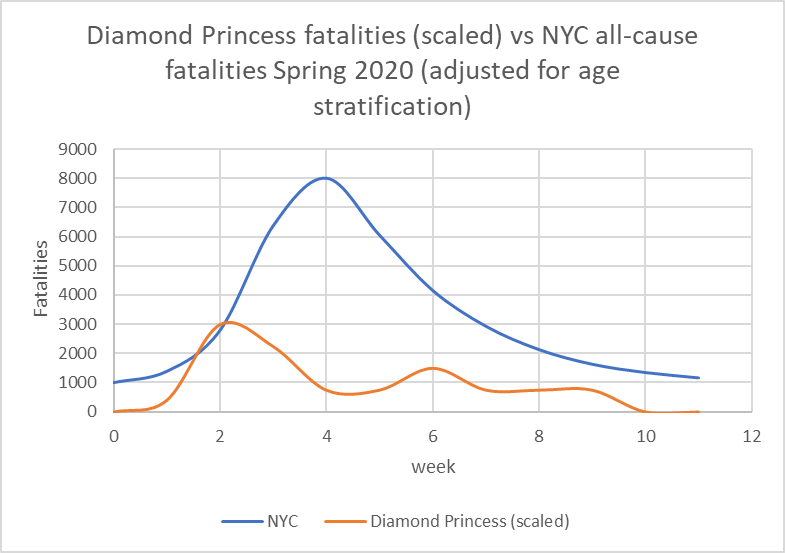
We can start by looking at the infection rate on the DP: 25% of those over 60 and 9% of those under 60 were reportedly infected. On the DP, the case fatality rate (CFR) for those over 60 was 2.6%. This assumes that all 14 deaths of passengers were caused by a Covid-19 infection contracted while on the DP. On the other hand, the CFR for those under 60 years of age was 0.0%, since none in this age bracket died.
Diamond Princess mortality (scaled) compared to New York City all cause mortality. DP week 1 = first week quarantine imposed while NYC week 1 = first week of lockdown orders (week 12, 2020). DP fatalities are scaled based on relative populations of individuals over 65. It is unclear whether the DP fatalities at the tail end of the curve are attributable to C19 infection contracted months prior on the DP. NYC data: www.mortality.watch
Mustard: A Spicy History
The History Guy: History Deserves to be Remembered
Published 15 Feb 2023In 2018 The Atlantic observed “For some Americans, a trip to the ballpark isn’t complete without the bright-yellow squiggle of French’s mustard atop a hot dog … Yet few realize that this condiment has been equally essential — maybe more so — for the past 6,000 years.”
(more…)
Comments Off on Mustard: A Spicy History
May 12, 2023
The crusade against (insert scare quotes here) Ultra-Processed Food
In The Critic, Christopher Snowden traces the orthorexist journey from warning about the dangers of saturated fat, to protesting against sugar content in foods, through an anti-carbohydrate phase to today’s crusade against “Ultra-Processed Food”:
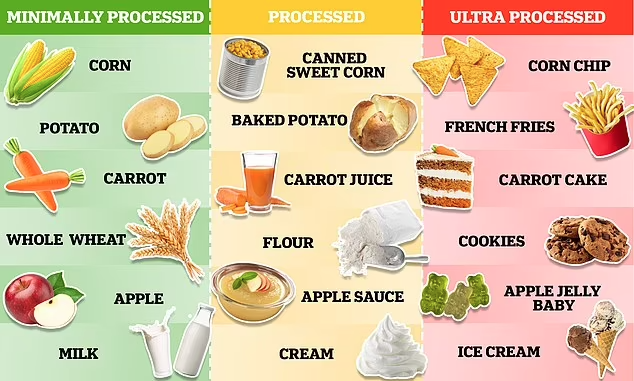
How the Daily Mail represented the three categories of processed food.
https://www.dailymail.co.uk/health/article-11286753/What-ultraprocessed-food-MailOnlines-guide-help-tell-apart.html
It is barely ten years since Denmark repealed its infamous “fat tax”. It was supposed to be a world-leading intervention to tackle obesity but it proved to be hugely unpopular and lasted just 15 months.
It seems almost strange now that it targeted saturated fat. In hindsight, it was the last gasp of the crusade against fat before all eyes turned to sugar. The anti-sugar crusade seemed to come out of nowhere in 2014 with the emergence of the tiny but phenomenally successful pressure group Action on Sugar. Within three years, the British government had announced a tax on sugary drinks, but by then the anti-sugar movement was morphing into a campaign against carbohydrates. That began to run out of steam a couple of years ago when many of the leading anti-carb personalities found that they could get more attention — and, dare I say, money — from being “sceptical” about COVID-19 vaccines.
They come and go, these food fads, but they all rely on the belief that there is something in the food supply that is uniquely dangerous, something hitherto unknown that only independent free thinkers can see is the cause of all our problems.
The new dietary villain is “ultra-processed food” (UPF), a concept that didn’t even exist until a few years ago but is now everywhere. There have been two books about UPF published in recent weeks and a third — Henry Dimbleby’s Ravenous — dedicated a lot of space to it.
The simple definition of ultra-processed food as used by those who are concerned about them (I am not making this up to make them sound silly) is anything that is “wrapped in plastic and has at least one ingredient you wouldn’t find in a home kitchen”. Since you probably don’t have emulsifiers, preservatives and artificial sweeteners in your kitchen, this rules out a lot of products.
The argument is that these products make you fat and should be avoided. The evidence for this comes from a study published in 2019. In a randomised controlled trial, ten people were given an ultra-processed diet and ten other people were given an unprocessed diet. Both diets were similar in their overall sugar, fat, protein and salt content, although the meals themselves were very different.
The participants were given all the food for free and they could eat as much as wanted. The people on the ultra-processed diet ended up eating 500 calories per day more than the other group and, after two weeks, had put on nearly a kilogram of weight. By contrast, the people on the unprocessed diet lost weight.
If you look at the food that was offered to the two groups, the explanation is obvious. The meals and snacks available to the UPF group were delicious whereas the food given to the other group was rather Spartan and was unlikely to make anybody ask for a second helping. If you give people tasty food for free, they will tend to eat more of it.
Comments Off on The crusade against (insert scare quotes here) Ultra-Processed Food
May 10, 2023
From Thomas Szasz to Jordan Neely – how noble ideals can lead to terrible results
At Samizdata, Natalie Solent remembers how her early discovery of Ideology and Insanity by Thomas Szasz helped to shape her philosophical views in a generally libertarian direction. On the other hand, as the death of Jordan Neely shows, one of the long-term results of Szasz’s denunciation of the institutionalization of the mentally ill has been a vast increase in violence, vandalism, and anti-social behaviour in urban areas:
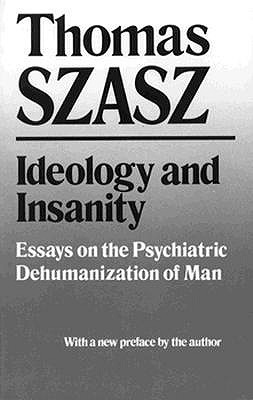
Szasz believed that if we accept that “mental illness” is a euphemism for behaviors that are disapproved of, then the state has no right to force psychiatric “treatment” on these individuals
Great stuff. I think Szasz still has much to teach us… but I suppose by now you have all heard of the killing of Jordan Neely on a New York subway train?
I have linked to the Wikipedia account for convenience, but I do not trust Wikipedia. There are very few media outlets I do trust on subjects like this. The magazine USA Today initially called Neely a “beloved subway performer”. USA Today has changed the article since, but I saw it when it still had the original wording. The article was right to say that Jordan Neely was a human being with a tragic past, but he was not beloved by users of the New York subway. Back in 2013, a Reddit post on /r/nyc warned passengers, “Try to stay away from the Michael Jackson impersonator if you see him … Just avoid the guy at all costs, try not to look at him at all. Stay safe.” That was Neely. By the time of his death, he had been arrested more than forty times, including for crimes of violence.
There are thousands of Americans like Neely who still live as he lived, exercising the right Thomas Szasz helped gain them to be mentally ill (or whatever you want to call it) drug addicts living on the subways and roadside verges of America. It is not going well for them or for others. A viral graph shows the declining proportion of Americans held in mental hospitals and the rising proportion of Americans held in prisons forming a neat “X” over the course of the twentieth century. Liberals in the U.S. sense have a prodigious capacity to not see inconvenient facts, but even they are being forced to notice that the presence of the crazies and junkies is causing their beloved public spaces and public facilities to become dirty, frightening places to which much of the public only goes when it must.
There is a libertarian solution of course: fewer public spaces. This would increase, not decrease, the number of places where the public could happily go. Junkies and crazies are much less of a problem in shopping malls, because the owners still retain some power to eject them. I feel no shame in saying that a further benefit would be that said junkies and crazies would be under more pressure to seek treatment if the state no longer facilitated them sleeping on the sidewalks and the subway trains.
Unfortunately for everyone, this solution is politically impossible in the current climate. Even in the miraculous event that the public transport systems and the streets of New York, San Francisco and Chicago were privatised tomorrow, anti-discrimination law would ensure that practically no one could be excluded.
Thomas Szasz had a noble ideal. Sadly, the way it combined with the dominant ideals of our time has produced very bad results. I know what should and could be done to make things better in a sane society, but the US in 2023 is not that society. So what can be done?
May 5, 2023
JunkScientific American
Stephen Knight calls out the woke editors of once-proud publication Scientific American for their anti-scientific support of the gender warriors:
A dangerous strain of utopian thinking has taken hold of the “progressive” left. Many now share the delusion that if we pretend certain falsehoods are true, then various forms of oppression and bigotry will magically disappear. Worse still, the proponents of these falsehoods demand their unequivocal affirmation from the rest of us.
Today’s leftists rightly insist on the importance of scientific truth when it comes to questions like climate change, vaccine safety and evolution. But they will discard scientific facts the moment they become inconvenient to their own worldview. Nowhere is this hypocrisy more pronounced than on the issue of gender, where transgender ideology has almost entirely supplanted scientific truth among the left. More alarming still is the fact that many scientists and scientific institutions, which really should know better, are colluding in this deception.
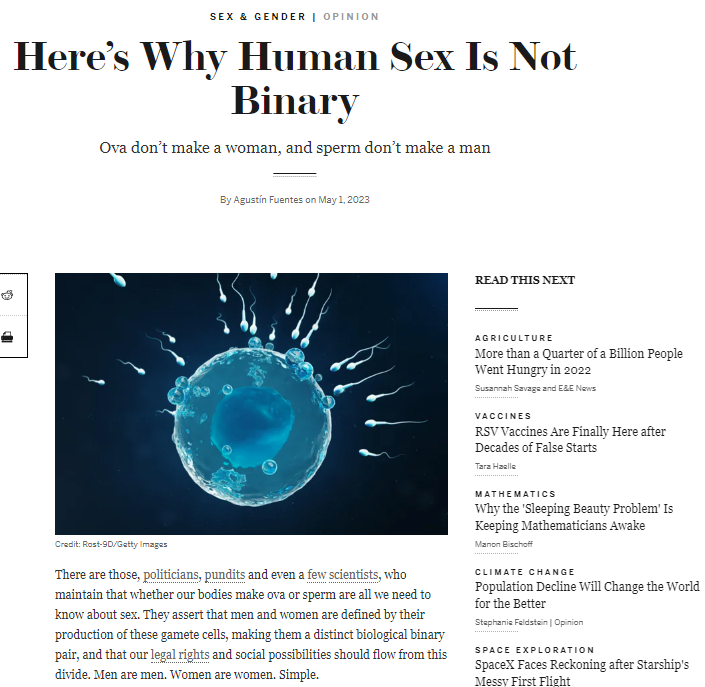
The latest scientific institution to promote gender pseudoscience is the once-venerable Scientific American magazine, which this week published an article headlined “Here’s why human sex is not binary”.
Make no mistake, sex in human beings really is binary and immutable. There are few things more emphatically true in our scientific understanding of the world than the human sex binary. Human beings cannot change their sex – we are either male or female, as determined by which type of gametes our biology is organised to produce (sperm or eggs). These are observable, testable scientific facts. And this objective truth matters in very real and consequential ways – to our society, to law, to healthcare and to the safety of women and children.
Trans ideologues claim that the categories of male and female are on a “spectrum”, or that they represent nothing more than a subjective feeling. These ideas have already had disastrous consequences for society. It is thanks to these ideas that male rapists have been placed in women’s prisons in the UK. It is why, just this weekend, a biological man won an elite women’s cycling race in America – finishing 89 seconds ahead of the closest female competitor and netting $35,350 in prize money. We would simply recognise this as “cheating” were it not for the hold that gender ideology has over our institutions – and for the opprobrium that is visited on anyone who dissents.
After some silly and irrelevant trivia about the biology of lizards and fish (humans are neither fish nor lizards), the Scientific American article concludes by claiming that anyone who upholds the human sex binary is “trying to restrict who counts as a full human in society”. This single claim inadvertently reveals a great deal about what is wrong with the trans movement. Unable to refute the truth of the human sex binary, gender ideologues resort to demonising those who notice it as having ulterior, sinister motives.
This isn’t the first time Scientific American has lent its (now waning) credibility to gender nonsense. Back in 2018, it published an article titled “Sex redefined: the idea of two sexes is overly simplistic”. To this day, this piece is gleefully shared around by gender activists, emboldened by this apparent vindication of their ideology from a credible, scientific publication. However, the author of the piece has since clarified that reality actually is as simplistic as humans having only “two sexes”.
Comments Off on JunkScientific American
May 4, 2023
British civil servants apparently need to have training on BDSM theory and practice
In Spiked, Malcolm Clark outlines the proposal to be discussed at a civil service union conference next month:

“Cologne BDSM 07” by CSD2006 is licensed under CC BY-SA 3.0 

 .
.
For years, the LGBT lobby has wreaked havoc across the UK’s civil service. It has helped to turn the machinery of government into a crèche for the kind of people who can’t remember what pronouns they’re using that day. But this may have just been a taster of what’s to come. Kink, it seems, is the new frontier in identity politics. Get ready to meet the “BDSM” lobby.
Next month, at its annual conference, the biggest civil-service union, PCS, will discuss a motion calling on Whitehall to set up a network for staff who are into bondage, domination and sado-masochism (BDSM). I suppose there’s one thing to be said for this daft idea. The more time these jobsworths spend slapping each other around, the less time they’ll have to humiliate and torment members of the taxpaying public.
There are a few obvious problems with this proposed BDSM staff network. For one, its advocates have called for workplace training courses about BDSM. No, I’m not making this up. The suggested courses would explain that “mutual informed consent … is needed before erotic activity is carried out”. This is a statement of the obvious to most of us. Who says entry standards for the civil service are slipping?
You may have assumed that the priority of our civil service should be carrying out the business of government, rather than BDSM advocacy. Perhaps it should be getting on top of the fact that only three per cent of hospital trusts in England hit cancer waiting-time targets in 2022? Or the fact that 360,000 people had to wait more than 10 weeks for their passport last year?
One strange thing about this demand for training courses for kink-meisters is that it flies in the face of other recent staff demands. Across Whitehall, as in private industry, advocacy groups have long insisted that Britain’s workplaces have developed a toxic culture that does not respect sexual boundaries. Reams of new guidelines have been drawn up in response. Many of these guidelines consider asking questions about someone’s sex life to be, in itself, a form of sexual harassment. Yet now we could soon have staff networks based solely around people’s private sex lives. And what would a meeting of sexual fetishists discuss if not their sex lives? The weather?
Even twenty years ago, it was a common witticism to refer to workplace meetings as “beatings”, but this is a long way past a casual joke (that yes, is probably risky to make in most modern workplaces, as someone is bound to find offence).
While looking for an appropriate image to accompany this post, I was quickly reminded why most search engines now offer varying levels of “safe” viewing.
Comments Off on British civil servants apparently need to have training on BDSM theory and practice
May 3, 2023
The virtue-signallers work hard to keep Canada’s First Nations people in poverty
Elizabeth Nickson touches one of the real third rails of Canadian politics — the plight of far too many Canadians who happen to be trapped in a historical bind that immiserates and impoverishes them yet somehow provides a lucrative and comfortable living for their self-appointed political advocates and the bureaucrats who work hard to keep them “on the rez”:
Today, if you protest the current catastrophic regime and have anything that can be taken away, it is taken away, and your family are labelled racists. Tenured professors who raise any objection are disgraced. Any journalist who asserts inconvenient facts is slimed. Any public intellectual who attempts to turn the tide is sent to the margins and silenced.
Many of the current activists for native rights are relatively new to the country, and have little grasp of history other than the straight-up Marxism taught in schools. Because Canada is so thoroughly anti-business, agitating for government money is pretty much the only growth industry, and Canada’s natives are a rich fat pie that seems unending in its ability to feed the bureaucracy and the advocacy outfits – there are hundreds – that seek more and more and more guilt money from the Canadian people.
Not one of them seemingly ventures into a native reserve to experience the results of fifty years of Trudeau Sr’s native policy and talks to the people there. Of the 700 or so Indian “nations” — this moniker a laughably Marxist ploy in itself — few of them even have vegetables. I have spent nights on a reserve up in the north where stodge is the only food. Potatoes fired in oil that has been in use for weeks. Gristly meat. Stale Wonderbread. Recently $8 billion was given to natives because despite the budgeted $200 Billion over five years given to Indian Affairs, in a country with more water than any other country on earth times ten, Indian reserves have no clean water.
Stories are told in my family, of Mohawk camping on the kitchen floor, leaving in full dress and full war cry in order to thrill the children. We have lost this connection to a great and fascinating people, marooned on rotting reserves, a crime caused by a vicious socialist government using vulnerable people to steal the nation’s wealth.
I have been on a reserve where the houses are rotting from the inside. Everyone is sick with mold illnesses. Because Canada’s socialists have deemed that natives have no property rights and are therefore not, in fact, fully people, they can’t even legally fix their own houses, not that they have any money but from whoring and working as check-out clerks. You cannot start a business. You have no equity to borrow even $1,000 to start a business. Canada’s socialists have decided that Canada’s natives are the ideal citizenry, passive, dependent, degraded.
Other reserves I’ve visited abut enormous wealth, from which Indians are constrained. Every activity they undertake requires a permission slip and money from whatever sleazy bureaucrat supervises them, owns them, farms them. Their reserves run to brush and fire fodder, while across the road, fields and forests produce incredible riches.
It is de rigueur for any visiting dignitary, like the current Marxist pope, to apologize for the legacy of the residential schools. Two summers ago a graduate student found what she claimed was evidence of 200 buried bodies near a decommissioned school and the news rocketed around the world. Her science was called into question. The native tribe near the school refused to exhume the “bodies”, largely because if the bodies did not exist, and finding nothing would stop the current shake-down. The actual legacy of the schools was mixed, but entire generations were educated, and there are many successful graduates, who attempt to moderate the madness. They are silenced.
Crime, alcoholism, prostitution, murders, child deaths abound on the reserves. Activists have seeded so much anger and hatred that virtually no clear path out of endemic poverty exists. An ersatz democracy means there are elections, but they are clan based, which means the biggest clan always wins and then it seeks to disempower its rivals. On reserves you can tell who the Chief is: he has the big house, the $100,000 truck. His people? Rotting shacks and bangers. If you aren’t in the right clan, you have to hitchhike to the city for cancer treatments, as the uncle of a Salish friend of mine did until he died.
There is, of course, a solution. I have spoken to native chiefs in the Oil Sands and in Alaska’s Prudhoe Bay, where the tribe or band has been woven into the oil extraction process. Success is immediate, and ongoing. These men are so enthusiastic, they are giddy, which, if you know a native, is … unusual. They crow about the young people on their reserves that go on to serious graduate degrees, to hope, to family formation, to their own houses. There are such success stories across the continent, depending on an enlightened chief, a non-vulture enlightened capitalist enterprise. And courage to face down the blight of government.
Comments Off on The virtue-signallers work hard to keep Canada’s First Nations people in poverty
April 30, 2023
Sarah Hoyt – “I told you so”
At According to Hoyt, Sarah reminds us that she was right and won’t apologize for being right … and will say “I told you so” as often as necessary:

Only infants and the mentally incompetent could look at locking up the vast majority of the population and think it would have NO effect on the economic well being of this country. Worse, only infants, the mentally incompetent and indoctrinated Marxists (BIRM) could think — after the numbers from the Diamond Princess were out there for everyone to read — that either COVID-19 was the end of the world, or that we should put the entire population under house arrest to prevent people dying of it. As though it wouldn’t become endemic anyway.
And it took a particular level of bizarre insanity to believe that COVID-19 would kill you at your favorite restaurant or church but not in Walmart.
We won’t even get into the specialness that caused a bunch of you to tell me that it was okay for the homeless to be congregating in every street corner (and in Denver in proliferating encampments EVERYWHERE with all the shared needles, trash, etc. of such encampments) WITHOUT dropping like flies, because they lived outdoors and were “particularly hardy”. Dudes, if you ever work in any emergency room, you’ll learn that not only aren’t the homeless “particularly hardy” but that they have the most bizarre medieval diseases. Yes, there are jokes about “tooth to tattoo ratio” and that low/high means they live forever, but in truth if you see before and after pictures, you know homeless people tend to die early and hard and not just because most of them are crazy and drug addicted (though that’s a contributing factor.) IF THIS HAD BEEN A REALLY DANGEROUS PANDEMIC, the kind those videos from China — some of which were manifestly fakes, like where people put out their hands to break the fall when they “drop dead” in the street — suggested, the homeless would have first been very sick, then dead.
Also, note the same people then said it was very important to wear masks OUTSIDE WHILE JOGGING because this virus was some kind of magical and could hang suspended in the air outside in a “cloud” so that if you walked through it hours later, you could catch the dread disease.
AND let’s not forget treating us like lunatics when we explained that the masks did nothing, and that yes, they’re used in operating rooms — where they’re changed every few minutes, btw — to PREVENT THE SURGEON from coughing on an open wound.
And I want to award no prizes, and may G-d have mercy on your souls to those that told me that the Diamond Princess‘s numbers were as low as they seemed to be because “They have the best of care in cruise ships”. This when cruise ships are known as floating illness barges and the population aboard is the oldest of any gathering in the nation.
Oh, oh, oh, and a special mention goes to everyone who ran around with their heads on fire because “the ER is at 95% capacity” when it is at 100% capacity every flu season, AND also all the “special wards” built for “overflow” patients saw not ONE patient. All these facts were available and easily looked up.
Comments Off on Sarah Hoyt – “I told you so”
April 23, 2023
There’s a spectre haunting your pantry – the spectre of “Ultra-Processed Food”
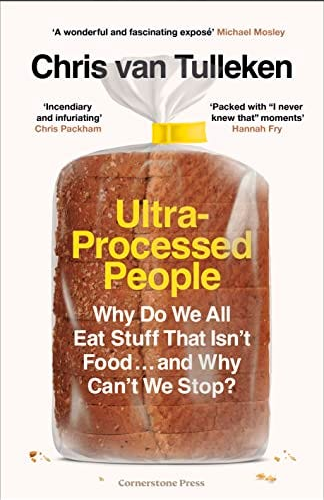
Christopher Snowden responds to some of the claims in Chris van Tulleken’s book Ultra-Processed People: Why Do We All Eat Stuff That Isn’t Food … And Why Can’t We Stop?:
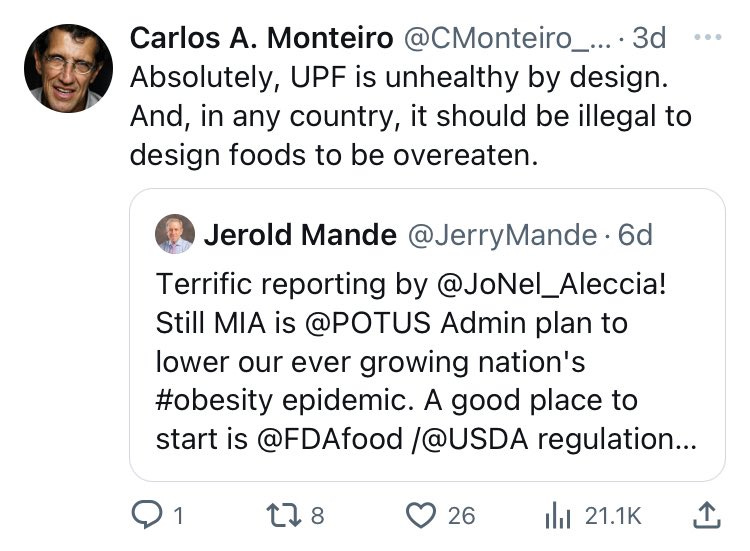
Ultra-processed food (UPF) is the latest bogeyman in diet quackery. The concept was devised a few years ago by the Brazilian academic Carlos Monteiro who also happens to be in favour of draconian and wildly impractical regulation of the food supply. What are the chances?!
Laura Thomas has written some good stuff about UPF. The tldr version is that, aside from raw fruit and veg, the vast majority of what we eat is “processed”. That’s what cooking is all about. Ultra-processed food involves flavourings, sweeteners, emulsifiers etc. that you wouldn’t generally use at home, often combined with cooking processes such as hydrogenation and hydrolysation that are unavailable in an ordinary kitchen. In short, most packaged food sold in shops is UPF.
Does this mean a cake you bake at home (“processed”) is less fattening than a cake you buy from Waitrose (“ultra-processed”)? Probably not, so what is the point of the distinction? This is where the idea breaks down. All the additives used by the food industry are considered safe by regulators. Just because the layman doesn’t know what a certain emulsifier is doesn’t mean it’s bad for you. There is no scientific basis for classifying a vast range of products as unhealthy just because they are made in factories. Indeed, it is positively anti-scientific insofar as it represents an irrational fear of modernity while placing excessive faith in what is considered “natural”. There is also an obvious layer of snobbery to the whole thing.
Taken to an absurd but logical conclusion, you could view wholemeal bread as unhealthy so long as it is made in a factory. When I saw that CVT has a book coming out (of course he does) I was struck by the cover. Surely, I thought, he was not going to have a go at brown bread?
But that is exactly what he does.
During my month-long UPF diet, I began to notice this softness most starkly with bread — the majority of which is ultra-processed. (Real bread, from craft bakeries, makes up just 5 per cent of the market …
His definition of “real bread” is quite revealing, is it not?
For years, I’ve bought Hovis Multigrain Seed Sensations. Here are some of its numerous ingredients: salt, granulated sugar, preservative: E282 calcium propionate, emulsifier: E472e (mono- and diacetyltartaric acid esters of mono- and diglycerides of fatty acids), caramelised sugar, ascorbic acid.
Let’s leave aside the question of why he only recently noticed the softness of fake bread if he’s been eating it for years. Instead, let’s look at the ingredients. Like you, I am not familiar with them all, but a quick search shows that E282 calcium propionate is a “naturally occurring organic salt formed by a reaction between calcium hydroxide and propionic acid”. It is a preservative.
E472e is an emulsifier which interacts with the hydrophobic parts of gluten, helping its proteins unfold. It adds texture to the bread.
Ascorbic acid is better known as Vitamin C.
Caramelised sugar is just sugar that’s been heated up and is used sparingly in bread; Jamie Oliver puts more sugar in his homemade bread than Hovis does.
Hovis Multigrain Seed Sensations therefore qualifies as UPF but it is far from obvious why it should be regarded as unhealthy. According to CVT, the problem is that it is too easy to eat.
The various processes and treatment agents in my Hovis loaf mean I can eat a slice even more quickly, gram for gram, than I can put away a UPF burger. The bread disintegrates into a bolus of slime that’s easily manipulated down the throat.
Does it?? I’ve never tried this brand but it doesn’t ring true to me. It’s just bread. Either you toast it or you use it for sandwiches. Are there people out there stuffing slice after slice of bread down their throats because it’s so soft?
By contrast, a slice of Dusty Knuckle Potato Sourdough (£5.99) takes well over a minute to eat, and my jaw gets tired.
Far be it from me to tell anyone how to spend their money but, in my opinion, anyone who spends £6 on a loaf of bread is an idiot. Based on his description, the Dusty Knuckle Potato Sourdough is awful anyway. Is that the idea? Is the plan to make eating so jaw-achingly unenjoyable that we do it less? Is the real objection to UPF simply that it tastes nice?
Comments Off on There’s a spectre haunting your pantry – the spectre of “Ultra-Processed Food”
Dylan Mulvaney’s “triumph of performance and marketing”
Andrew Sullivan weighs in on the Dylan Mulvaney phenomenon:

Bud Light’s latest brand ambassador, Dylan Mulvaney
I’ve largely ignored the entire Bud Light tempest in a toxic teacup because social media outrages and brand boycotts come and go and tend to leave little trace behind. But the fuss over the beer brand’s brief commercial dalliance with trans newbie Dylan Mulvaney — with her 10.8 million TikTok followers — nonetheless fascinates. It shows, it seems to me, just how much everyone is projecting, and how (almost) everyone is getting it wrong.
There are, it seems, many layers to Dylan. To countless straight people, left and right, Dylan is a transgender star — because she is biologically male, and yet has been saying she is a girl now for more than a year, wears women’s clothes and is pretty and charming and full of manic energy. (I’m mostly using her preferred pronouns here, the least clumsy option). The woke left therefore loves her, and the Matt Walsh right has had a collective aneurysm. But for many gay men, including yours truly, Dylan’s latest, year-long performance as a “girl” looks and sounds like something much more familiar.
Dylan, to us at least, is a pretty classic, child-actor, musical theater queen — an effeminate gay man who finds great joy and relief in Broadway camp and drama, and is liable to burst into song at any moment. (I used to wonder if this very specific manifestation would die out as gays integrated more. But no! It seems to be in our collective DNA. Every generation mints a new variety.) And she’s managed to bait both the woke left and the anti-woke right into making her very famous and a lot richer than a year ago.
It’s a triumph of performance and marketing. It can be frustrating for a young actor among so many. You can do your best, become a finalist in Campus Superstar in 2018, wear only briefs for a performance at Joe’s Pub, perform, however well, in the cast of Book Of Mormon, camp it up for Ellen, or do the exact same ditzy-girl act on The Price Is Right as a man (Dylan’s previous attempts at fame). But become a parody of a “girl” and provide breathless, daily updates on your transition — and nearly 11 million people on TikTok will follow. At the same time brand yourself as a pioneer for greater understanding, love, and civil rights … and you can get an extended interview on The Today Show and an audience at the White House.
The gimmick was simple: a TikTok clip for every day of “becoming a girl.” As Dylan explained:
When the pandemic hit, I was doing the Broadway musical Book of Mormon. I found myself jobless and without the creative means to do what I loved. I downloaded TikTok, assuming it was a kids’ app. … [R]ight before I started creating content with “Days of Girlhood”, I thought, “What am I going to do to afford my rent this month?”
Well, she no longer has to worry about that. Dylan has brand partnerships with Anheuser-Busch, Nike, Crest, Instacart, Ulta Beauty, Kate Spade and many more. And here is what Dylan means by “becoming a girl” in his/her own words. Trigger warning for feminists:
Day One of being a girl and I’ve already cried three times, I wrote a scathing email that I did not send, I ordered dresses online that I couldn’t afford, and then, uh, when someone asked me how I was, I said I’m fine — when I wasn’t fine [applies lip gloss]. How’d I do, ladies? Good? Girl power!
If you think this has to be a joke, a parody making fun of sexist ideas about women, you’re not the only one. (Trans YouTuber Blaire White also assumed it was a spoof at first, and her video on Dylan’s “womanface” is well worth a watch.) But no! Here’s more:
“Hangin with the girlieeees, woohoo! [The camera pans across a series of dolls sitting in chairs] … I almost bought this Audrey [Hepburn] portrait. I just love her, she’s everything I want to be.”
“Day Three of being a girl and I’ve already become a bimbo. … I think it’s a good fit for me. What do you think, ladies?”
“Day Four of being a girl and I’m exhausted — the hair, the makeup, the clothes, the high heels. It’s a lot to keep up with!”
“Day 12 of being a girl and I just picked up some tampons.”She never subsequently seems to put them down. At one point, we see Dylan hiking in high heels, and running hysterically away from a flying bug. In another clip, she dresses up in a skimpy evening gown and fantasizes about her future husband:
I want them to know I’ll be their cheerleader on and off the field. So they can picture me walking down the aisle to be their trophy bride, or trophy wife. I would totally be good at that, don’t you think? “Dinner’s ready! Yoo-hoo!”
Call me a transphobe, but I just don’t think that someone who has been struggling with gender identity her whole life and found a pathway to womanhood … would ever celebrate it quite like that. Yet this firehose of misogynistic tropes was one of a handful of people who were invited to the White House to interview Biden personally.
The only thing more absurd than this was the far right falling for the whole schtick as well. After the Bud Light ad, Kid Rock filmed himself shooting cases of beer with a semi-automatic rifle; a businessman opted for a baseball bat in an ad to promote his new “Ultra Right” beer; bomb threats rattled some Bud factories; countless tweets popped up alleging a collapse in sales of Bud Light; then the Trumps went to war with Matt Walsh because Anheuser-Busch is a major GOP donor; then the former cover-girl, current Fox News star Caitlyn Jenner called Dylan’s act an “absurdity“; and so on. Good times.
Comments Off on Dylan Mulvaney’s “triumph of performance and marketing”
April 22, 2023
“I’d stock every preschool classroom with The Anarchist’s Cookbook if I could”
I’m also a libertarian, but I might not go quite as far as Freddie deBoer in the quote in the headline:
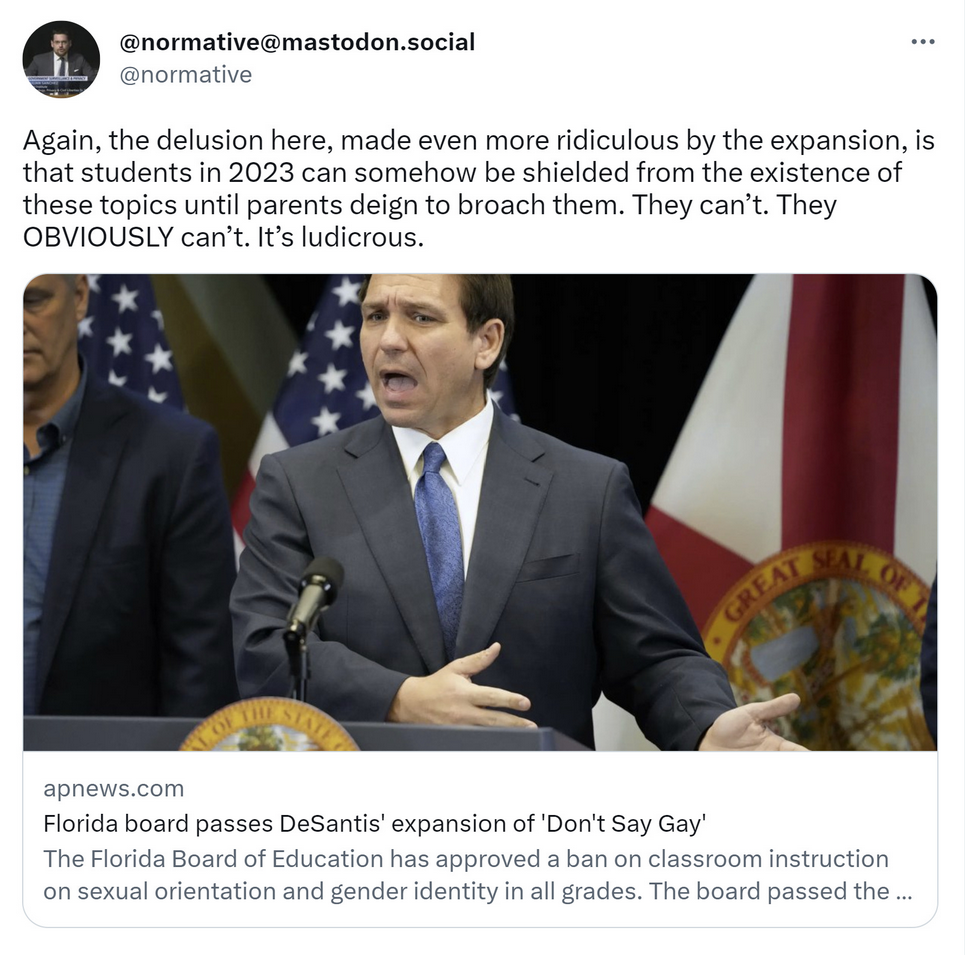
Julian Sanchez makes good sense here on recent bills in Florida designed to regulate and censor LGBTQ content in schools:
Yes, indeed. Kids will learn about LGBTQ issues sooner or later. It’s pointless to try and keep them from finding out about the existence of homosexuality, of gay love, of gay marriage, of trans people and gender nonconformity. They’re gonna find out. They have smartphones, usually much younger than they should. They’re curious and the world is always a click away. It’s foolish to try and prevent them from learning about this stuff. And, in fact, the more that you try to restrict what they learn, the more likely they are to explore this world in a way that openly defies your efforts. LGBTQ people, politics, art, and culture exist. You’re entitled to object to LGBTQ rights, in a free society, but you’re not entitled to (or able to) create a bubble in which others are kept hidden from knowledge of the existence of LGBTQ people. People love that I’m forever tweaking liberals about their attachment to various forms of unreality, to thinking that they can wish away facts of life that they’re uncomfortable with. But it’s the same deal here.
Look, I will acknowledge that some of the reporting on the “Don’t Say Gay” bill has distorted and exaggerated what the bill calls for, and I also think there’s a lot of motivated dismissal about the nature of some of the content that’s being debated. For example, some people have gone to the ramparts to defend access to the book This Book is Gay, which explicitly advertises itself as a guide to sex, despite the fact that the author herself says it’s not for children. (Pictures of the book that are routinely circulated are typically dismissed as conservative fabrications, but you just have to look at the book to know that isn’t true.) Probably that particular example is a matter of some groups being lazy when putting together reading lists, but of course there are always going to be debates and edge cases.
Would I ban that book? Of course not. Personally, I’m completely libertarian about this stuff; I’d stock every preschool classroom with The Anarchist’s Cookbook if I could. But there’s a difference between holding that position and believing it’s credible to pretend that there’s literally nothing to debate there. It’s pointless to pretend that books in a public school classroom are going to remain untouched by these disagreements. The views of parents will inevitably be expressed through the democratic apparatus that presides over those schools. Of course people are going to debate this stuff. Vociferously.
Still, the objections are ultimately misguided for the reasons Sanchez says. Plenty of kids in extremely repressive conservative environments dreamed of a future as an openly gay person in a liberal city, before the internet. I’ve always had qualms about the “born this way” framing — if being gay was a choice, would society have any legitimate right to refuse people from making it? — but the simple reality is that gay people and trans people etc have always transcended restrictive social and religious environments in their interior life, even if it was too dangerous for them to express it. If a kid is gay, they’re gonna figure that out. You don’t have to speed along the process, but trying to artificially impede their progress won’t work. That’s an “is” statement, not an “ought” statement.
April 21, 2023
The Neo-Prohibitionists have taken over the World Health Organization
Christopher Snowden illustrates some of the deliberate lies promulgated by the World Health Organization’s anti-alcohol activists:
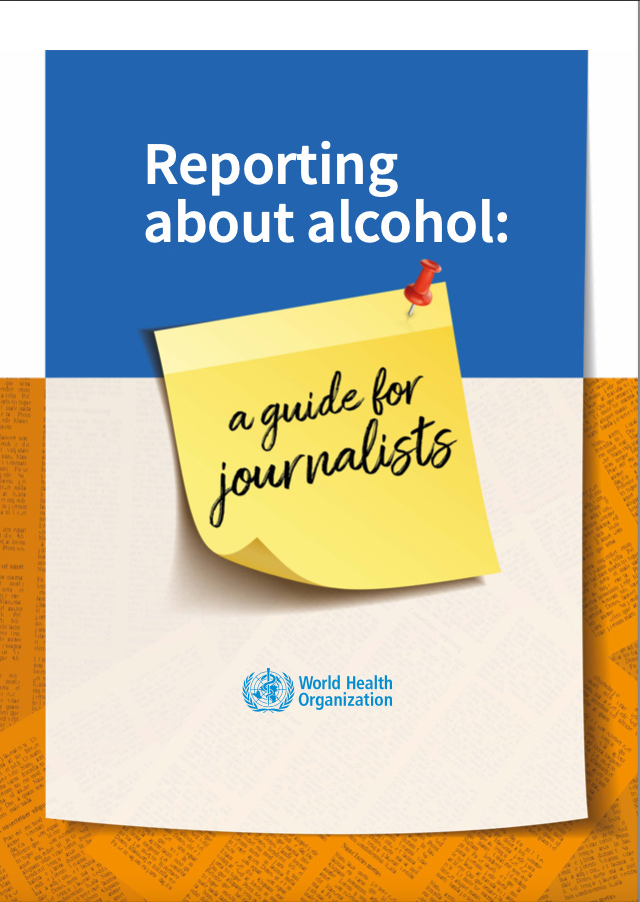
The incompetent and corrupt World Health Organisation has produced a “guide for journalists” to help hacks report on issues related to alcohol accurately. Not entirely unpredictably, it is a catalogue of anti-drinking tropes, half-truths and brazen lies. The very first words are “No amount of alcohol is safe to drink” and it doesn’t get any better thereafter.
The health benefits of moderate alcohol consumption really stick in the craw of the neo-temperance lobby and so that is where the WHO starts:
Isn’t drinking some alcohol good for your health?
No, there is no evidence for the common belief that drinking alcohol in moderate amounts can help people live longer by decreasing their risk of heart disease, diabetes, stroke or other conditions.
No evidence?! Even a casual follower of the science knows that there is at least some evidence. Those who are more familiar with the literature know that there is a huge amount of evidence built up over decades, tested and re-examined from every angle precisely because so many people in ‘public health’ don’t want to believe it.
It is inaccurate to say that “experts are divided” on whether there is no amount of healthy alcohol drinking. The scientific consensus is that any level of alcohol consumption, regardless of the amount, increases risks to health.
This is just a lie. That is not the consensus, and the only reason there isn’t unanimous agreement that moderate drinking is beneficial to health is that anti-alcohol academics such as Tim Stockwell have made it their life’s work to cast doubt on the evidence.
While several past studies did suggest that moderate consumption could, on average, promote health benefits …
Note that this immediately contradicts the claim that there is no evidence.
… newer research (1) shows that those studies used limited methodologies and that many of them were funded by the alcohol industry (2).
The first reference is a short commentary by some WHO staffers which doesn’t discuss methodologies at all. The second reference is a study which found that only 5.4 per cent of research papers in this area were funded by the alcohol industry and concluded that “the association between moderate alcohol consumption and different health outcomes does not seem to be related to funding source.”
The WHO must hold journalists in low esteem if it thinks they won’t check up the citations like this.
The dicussion [sic] about possible so-called protective effects of alcohol diverts attention from the bigger picture of alcohol harm; for example, even though it is well established that alcohol can cause cancer, this fact is still not widely known to the public in most countries (3).
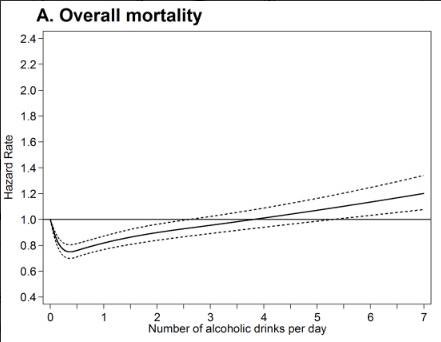
The “bigger picture” is overall mortality. When all the risks are taken into account, including the small risks from a few rare cancers, do moderate drinkers live longer than teetotallers? Yes. Yes, they do.
Comments Off on The Neo-Prohibitionists have taken over the World Health Organization
April 20, 2023
We strongly believe in academic freedom, except when research turns up “inconvenient” results
Tom Knighton on a sad situation at a London university with publicly funded research having arrived at a politically unwelcome result:
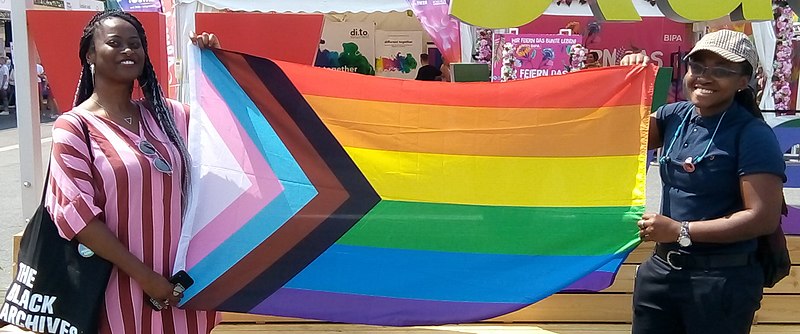
Two people at EuroPride 2019 in Vienna holding an LGBTQ+ pride rainbow flag featuring a design by Daniel Quasar; this variation of the rainbow flag was initially promoted as “Progress” a PRIDE Flag Reboot.
Photo by Bojan Cvetanović via Wikimedia Commons.
In the UK, one academic decided to look at the “gender wars”, particularly how academics feel silenced on the whole trans issue.
It sounds to me like both an interesting subject for study and one that might be very necessary in this day and age.
It seems that while the researcher in question was approved to study it, her findings are problematic and that got her canned.
From The Telegraph:
A university has “confiscated” the findings of an academic studying Britain’s gender wars in a row over her “dangerous” research data, The Telegraph can reveal.
Dr Laura Favaro began the first ever taxpayer-funded study into whether social scientists at universities feel censored over their views on transgender issues in March 2020 at City, University of London.
But it has descended into chaos, with the study’s author allegedly hounded out of the university, stripped of the findings she collected and barred from publishing them amid claims of transphobia.
[…]
Her study involved 50 individual interviews with academics in gender studies who identified as feminists, a representative survey of social scientists with 650 responses and hundreds of documents and tweets.
Scholars told her that they had threats of violence in the gender debate, hostility from colleagues, and others said they felt their careers “can’t survive that sort of backlash”, and that they have to have “secret conversations” to avoid reprisal and because “we are all so afraid”.
Her final work has not been published, as it was derailed by complaints about an article for Times Higher Education in which she warned that “a culture of discrimination, silencing and fear has taken hold”.
Following this, she says, her line managers told her that the study had “become an institutionally sensitive issue” and that “City considers my data to be dangerous” and is “frightened of making it public”.
So, what Favaro was finding was accurate.
That’s the big takeaway for me here. She said that academics were concerned about being attacked or that they had been because they didn’t play along with the trans agenda, and she was attacked and basically canceled because of it.
What’s even dumber is that Favaro was lured to City University from Spain so that she could conduct this research. She received roughly £28,000 from the British government via two different governmental entities to conduct the research.
Then she was silenced because the research found inconvenient truths.
That’s not what academia is supposed to be about. That’s not what academic freedom is about.
Freedom of any kind requires one to accept things that we would rather not have to accept. If you’re not free to say or do something that doesn’t actually harm a specific person but is otherwise objectionable, you don’t really have any freedom.
Comments Off on We strongly believe in academic freedom, except when research turns up “inconvenient” results


