Quotulatiousness

September 24, 2020

That Prometheus dude has a lot to answer for…

Filed under: Australia, Environment, USA — Tags: , , — Nicholas @ 05:00

Arthur Chrenkoff on the surprisingly high percentage of wildfires that don’t have a natural origin:

The Green Wattle Creek bushfire moves towards the Southern Highlands township of Yanderra as police evacuate residents from Yanderra Road, 21 December, 2019.
Photo by Helitak430 via Wikimedia Commons

Whatever your position on climate change – majority of experts believe that higher temperatures and drier conditions exacerbate wildfires, both in Australia and America – there is no immediate solution to be found on the global level. If you agree that man-made emissions are driving up temperatures, there is no course of action that will in any substantial way change the climatic conditions for the better over the next few decades (the most ambitious climate change plans talk in terms of slowing down temperature increases, not reversing the trend). Shut down the whole industrial civilisation tomorrow, and the present climate would still lag behind. Talking about wildfires and climate change (as Pelosi, Newsom and many others do) might be a good propaganda for climate action, but it will do nothing for this or any future fiery disasters.

Fortunately, there are much more immediate factors and solutions than shutting down coal and transitioning to renewable energy (themselves decades-long projects). Wildfires are almost exclusively man-made calamities, but not in the way the climate change activists think. Changing climate might indeed be making fires more difficult to contain and extinguish, but it neither starts nor fuels them. We do. Herein, therefore, lie the opportunities to mitigate such disasters as we are witnessing at the moment.

Almost all fires are started by humans

Forests don’t spontaneously combust. And while lightning can often set trees on fire, this accounts for only a very small proportion of all fires.

In Australia, it has been estimated that 87 per cent of 113,000 fires that occurred “in nature” between 1997 and 2009 have been man-made.

In the United States, the latest study from the University of Colorado at Boulder calculates that 97 per cent of fires between 1992 and 2015 that threatened homes (i.e. those happening in the so called “wildland-urban interface”) were started by humans (as were 85 per cent of all fires in “very-low-density housing” areas and 59% of all wildfires in the wild).

A word of caution: man-made does not automatically mean intentional. The scenarios range from broken glass acting as lenses for sun rays or sparks from power lines and machinery, through carelessly discarded cigarette butts and incompletely extinguished bonfires, to amateur back burn attempts getting out of control and – yes – deliberate arson.

During the Australian bushfire crises, I have compiled media reports of around 200 individuals who have been arrested and/or charged in connection with starting fires – many, though not all, on purpose.

In the United States, the cases of arsonists caught by the authorities are mounting, though nowhere near the Australian numbers yet. In Portland, a man was arrested for starting a fire, released, and started another six fires – at this rate, the US might quickly catch up to Down Under.

September 17, 2020

Why Does Road Construction Take So Long?

Filed under: Environment, Technology — Tags: , , — Nicholas @ 02:00

Practical Engineering
Published 3 Jun 2020

Explaining how earthwork works, and why road construction often takes so long.

Sign up for Brilliant for free at www.brilliant.org/PracticalEngineering and get 20% the annual premium subscription!

Like it or not, roads are part of the fabric of society. Travel is a fundamental part of life for nearly everyone. Unfortunately, that means road construction is too. But, I hope I can give you a little more appreciation for what’s going on behind the orange cones.

-Patreon: http://patreon.com/PracticalEngineering
-Website: http://practical.engineering

Writing/Editing/Production: Grady Hillhouse
Editing and Direction Help: Wesley Crump

This video is sponsored by Brilliant.

August 23, 2020

Trudeau’s hopes for re-election hinge on promising “an organic chicken in every pot and a solar panel on every shed”

The Line wonders who the hell the Liberals think they are:

It may have been easy to miss amid the news coming out of Ottawa, but as the government lost its finance minister, appointed Chrystia Freeland to yet another job, prorogued parliament, halted testimony into its latest scandal, prepared for the announcement of a new Conservative Party of Canada leader and braced for a likely second wave of COVID-19, the prime minister promised to announce a transformative agenda. One that promises sweeping social change, and a wholesale re-invention of our economy in line with the greenest ambitions. We here at The Line have but one question.

Who the hell do these people think they are?

It is obvious to anyone who has been reading the news and possesses even residual brain function why the prime minister would like to be talking about a plan for transformative change. Talking about all the amazing things he could do for Canadians with borrowed money beats talking about his government’s bumbling of the WE file and the departure of now-former finance minister Bill Morneau.

Promising an organic chicken in every pot and a solar panel on every shed is obviously more appealing to Trudeau than repeating the last month. But it is astonishing to us — as jaded as we have undeniably become — that the government is talking about this instead of the necessary steps needed to shore up this country ahead of a likely second wave of COVID-19.

This government has a mandate to respond to the emergency, by mere unlucky virtue of being in power at the moment the virus hit. It is the duty of every Canadian government to safeguard the wellbeing of the population, full stop. But the emergency, contrary to what you may believe if you’ve been reading Liberal Party HQ memos, is not over. We have an urgent need to secure more medical equipment, to harden our long-term care facilities, to prevent any further lockdowns from derailing a fragile economic recovery, to ensure the resiliency of critical supply chains, and to shore up our health-care system. This is what every Canadian official should be focused on right now.

[…]

But can anyone maintain faith that the Liberals will stick to their knitting when we hear buzzwords like “transformative” social change? Sweeping climate-change reforms? Engineering a new green economy? They are all fine notions — let’s put them to the people and vote on them. Until calling that election is feasible (mid-pandemic, it is not) this government simply does not have the mandate to undertake such far-reaching efforts.

It’s easy to forget now, but only nine months ago this government was reduced to a minority of seats in parliament. The Liberals lost the popular vote, and saw one million of their own prior voters abandon them. They are only in government because the Conservatives, to the surprise of no one, found several novel and exciting new ways to fail.

August 12, 2020

QotD: The circle of recycled life

Filed under: Business, Economics, Environment, Quotations, USA — Tags: , — Nicholas @ 01:00

1. Somewhere in this great land, a concerned and responsible corporation is having their twice-weekly colorful and compelling advertising supplement printed on 100% recycled paper.

2. As soon as they are completed millions of these colorful and compelling 100% recyclable advertising supplements are shipped by truck to the various regional receiving centers of the U.S. Post Office.

3. From those centers, any number of allocated pallets of these colorful and compelling 100% recyclable advertising supplements are broken out, put on U.S. Post Office trucks and delivered to local postal carrier destinations inside northern California.

4. My personal Paradise postal carrier and hundreds of others report for work at local postal carrier centers throughout northern California and load up their vans with enough of these colorful and compelling 100% recyclable advertising supplements to deliver one or more to each and every house on their route.

5. My very polite personal Paradise postal carrier parks her van at the end of my block and loads her sack with these colorful and compelling 100% recyclable advertising supplements.

6. She comes up my walk, up the porch stairs, and deposits my full share of these colorful and compelling 100% recyclable advertising supplements into my mailbox with a clang every day between one and three in the afternoon.

7. Hearing the clang I sigh and wend my weary way to the front door and open my mailbox and pluck out said colorful and compelling 100% recyclable advertising supplements.

8. With a heavier sigh I go back in, trudge through my house, out my back door to the alley, and place the colorful and compelling 100% recyclable advertising supplements into my Recycling bin with the rest of the week’s mound.

9. Tomorrow the huge, lumbering Paradise Waste Management Recycling garbage truck will stop and empty my Recycling bin into its maw and haul all the colorful and compelling 100% recyclable advertising supplements off to the Chico California Recycling and Brand New Mountain of Garbage center.

10. The collected colorful and compelling 100% recyclable advertising supplements will then be shipped, by truck, to the center for turning recyclable paper into … recycled paper which will then be used by a concerned and responsible corporation for their twice-weekly colorful and compelling advertising supplements printed on 100% recycled paper.

Wash. Rinse. Repeat. Next year, as sure as spring brings septic system failures to Paradise, postage will increase because the U.S. Postal Colorful and compelling 100% recyclable advertising supplements “Service” will need more money to keep The Recycled Circle of life going.

Gerard VanderLeun, “The Circle of Recycled Life”, American Digest, 2018-06-01.

August 11, 2020

The Vanishing Aral Sea

The History Guy: History Deserves to Be Remembered
Published 22 May 2017

The History Guy examines the Aral Sea and the confluence of geography and history.

The History Guy uses images that are in the Public Domain. As photographs of actual events are often not available, I will sometimes use photographs of similar events or objects for illustration.

Patreon: https://www.patreon.com/TheHistoryGuy

The History Guy: Five Minutes of History is the place to find short snippets of forgotten history from five to fifteen minutes long. If you like history too, this is the channel for you.

Awesome The History Guy merchandise is available at:
teespring.com/stores/the-history-guy

The episode is intended for educational purposes. All events are presented in historical context.

#history #thehistoryguy #worldhistory

August 3, 2020

Recycling is a SCAM!

Filed under: Asia, Business, Cancon, China, Economics, Environment, USA — Tags: , — Nicholas @ 06:00

J.J. McCullough
Published 29 Jun 2019

Recycling is a disaster. This video was sponsored by Loonie Politics! Sign up using the code word “McCullough” for 25% off! https://looniepolitics.com/register/

Visit the channel of guest star Demetrios: https://www.youtube.com/channel/UCNKV…

An in-depth look at Canadian recycling:
https://globalnews.ca/news/5199883/ca…

The Vice video I mentioned:
https://www.youtube.com/watch?v=Pv1UP…

FOLLOW ME:

🇨🇦Support me on Patreon! https://www.patreon.com/jjmccullough
🤖Join my Discord! https://discord.gg/3X64ww7
🇺🇸Follow me on Instagram! https://www.instagram.com/jjmccullough/
🇨🇦Read my latest Washington Post columns: https://www.washingtonpost.com/people…
🇨🇦Visit my Canada Website http://thecanadaguide.com

July 30, 2020

“Muzzling” scientists only ever happens under Conservative governments…

… so even though the circumstances might look remarkably similar to the layman’s eyes, Justin Trudeau can’t possibly be accused of doing the same thing as that evil, anti-science Stephen Harper:

Prime Minister Stephen Harper speaking at the Annual Meeting 2012 of the World Economic Forum at the congress centre in Davos, Switzerland, January 26, 2012.
World Economic Forum photo via Wikimedia Commons.

In fact, Grant Robertson reports, the Trudeau regime effectively shuttered a small, cheap (less than $3 Million dollars ~ petty cash in Canada’s government) research and early warning team called the Global Public Health Intelligence Network (GPHIN) which

    was among Canada’s contributions to the World Health Organization, and it operated as a kind of medical Amber Alert system. Its job was to gather intelligence and spot pandemics early, before they began, giving the government and other countries a head start to respond and – hopefully – prevent a catastrophe. And the results often spoke for themselves.

Unfortunately, by the time the COVID-19 pandemic was getting started, just when the GPHIN should have provided “early warning,” it had been told, by the Trudeau regime, to focus on domestic issues. But global pandemics don’t often start in Canada, do they? The GPHIN sifted through data from around the world, often from places like China, Iran and Russia which hide or manipulate medical information, conducting something akin to military reconnaissance so that Canadian (and global (WHO)) officials could “see” what might be headed our way.

Did Justin Trudeau give the order to “muzzle” the GPHIN scientists? No, of course not … no more than Stephen Harper gave the order to “muzzle” scientists in Environment Canada. The decision to “refocus” the GPHIN on useless, domestic busywork was likely made by an Assistant Deputy Minister who was acting on yet another demand from the Treasury Board Secretariat to justify every programme dollar … again.

You should be glad that the Treasury Board Secretariat casts a sceptical eye on every single government programme and is a constant thorn in the side of operational people (like I was when I was serving and like the GPHIN folks were, too). They, skilled, hard-working civil servants, are just trying to ensure that your tax dollars are not being wasted. They are good people doing good work. But sometimes the wheat gets tossed away with the chaff. That appears to have been the case with the GPHIN. In retrospect, it seems almost criminally stupid to have deprived Canada of a valuable medical reconnaissance agency just because there had not been an “attack” recently. But that appears to have been the bureaucratic justification ~ it’s like me saying that since my house hasn’t burned down recently we should disband the fire department.

Did Justin Trudeau muzzle scientists? No.

Did Justin Trudeau’s government disable a valuable (and cheap) “early warning” system just to make its own wild spending look a little less careless? Yes, that’s what the Globe and Mail‘s investigation says ~ and we have paid a horrendous price in lives for that decision.

This story, it seems to me, is very much like the “Harper muzzles scientists” stories from a few years ago … but minus the massive media attention. It appears very evident, from Mr Robertson’s investigations that bureaucrats, acting on their own, internal priorities, emasculated the GPHIN just when we needed it most. That, bureaucratic action, was I believe what was, mainly, behind the “Harper muzzles scientists” stories, too. But in the 2010s much of the mainstream media was in a sort of undeclared war against Stephen Harper and so the claims of climate activists became “news” and opinions were treated as facts.

July 28, 2020

How Matt Ridley stopped being an “Enviro-Pessimist”

Filed under: Economics, Environment, India — Tags: , , , , , , — Nicholas @ 05:00

It was human ingenuity that did it for him:

Spiti Valley in the Great Himalayan National Park. (The little blue speck in the middle of the photo is a truck, for scale.)
Photo by Sudhanshu Gupta via Wikimedia Commons.

If you had asked me in 1980 to predict what would happen to that bird and its forest ecosystem, I would have been very pessimistic. I could see the effect on the forests of growing human populations, with their guns and flocks of sheep. More generally, I was marinated in gloom by almost everything I read about the environment. The human population explosion was unstoppable; billions were going to die of famine; malaria and other diseases were going to increase; oil, gas, and metals would soon run out, forcing us to return to burning wood; most forests would then be felled; deserts were expanding; half of all species were heading for extinction; the great whales would soon be gone from the oil-stained oceans; sprawling cities and modern farms were going to swallow up the last wild places; and pollution of the air, rivers, sea, and earth was beginning to threaten a planetary ecological breakdown. I don’t remember reading anything remotely optimistic about the future of the planet.

Today, the valleys we worked in are part of the Great Himalayan National Park, a protected area that gained prestigious World Heritage status in 2014. The logo of the park is an image of the western tragopan, a bird you can now go on a trekking holiday specifically to watch. It has not gone extinct, and although it is still rare and hard to spot, the latest population estimate is considerably higher than anybody expected back then. The area remains mostly a wilderness accessible largely on foot, and the forests and alpine meadows have partly recovered from too much grazing, hunting, and logging. Ecotourism is flourishing.

This is just one small example of things going right in the environment. Let me give some bigger ones. Far from starving, the seven billion people who now inhabit the planet are far better fed than the four billion of 1980. Famine has pretty much gone extinct in recent decades. In the 1960s, about two million people died of famine; in the decade that just ended, tens of thousands died — and those were in countries run by callous tyrants. Paul Ehrlich, the ecologist and best-selling author who declared in 1968 that “[t]he battle to feed all of humanity is over” and forecast that “hundreds of millions of people will starve to death” — and was given a genius award for it — proved to be very badly wrong.

Remarkably, this feeding of seven billion people has happened without taking much new land under the plow and the cow. Instead, in many places farmland has reverted to wilderness. In 2009, Jesse Ausubel of Rockefeller University calculated that thanks to more farmers getting access to better fertilizers, pesticides, and biotechnology, the area of land needed to produce a given quantity of food — averaged for all crops — was 65 percent less than in 1961. As a result, an area the size of India will be freed up by mid-century. That is an enormous boost for wildlife. National parks and other protected areas have expanded steadily as well.

Nor have these agricultural improvements on the whole brought new problems of pollution in their wake. Quite the reverse. The replacement of pesticides like DDT with much less harmful ones that do not persist in the environment and accumulate up the food chain, in addition to advances in biotechnology, has allowed wildlife to begin to recover. In the part of northern England where I live, otters have returned to the rivers, and hawks, kites, ospreys, and falcons to the skies, largely thanks to the elimination of organochlorine pesticides. Where genetically modified crops are grown — not in the European Union — there has been a 37 percent reduction in the use of insecticides, as shown by a recent study done at Gottingen University.

One of the extraordinary features of the past 40 years has been the reappearance of wildlife that was once seemingly headed for extinction. Bald eagles have bounced back so spectacularly that they have been taken off the endangered list. Deer and beavers have spread into the suburbs of cities, followed by coyotes, bears, and even wolves. The wolf has now recolonized much of Germany, France, and even parts of the heavily populated Netherlands. Estuaries have been cleaned up so that fish and birds have recolonized rivers like the Thames.

July 27, 2020

The Bronze Age Collapse (approximately 1200 B.C.E.)

Historia Civilis
Published 25 Jul 2020

Just casually thinkin bout the end of the world. No, no reason, why?

Patreon | http://patreon.com/HistoriaCivilis
Donate | http://www.paypal.com/cgi-bin/webscr?…
Merch | teespring.com/stores/historiacivilis
Twitter | http://twitter.com/HistoriaCivilis
Website | http://historiacivilis.com

Sources:
The Medinet Habu Inscription | https://bit.ly/2Ba2Lvf
David O’Connor & Stephen Quirke, Mysterious Lands | https://amzn.to/3jdQOWu

Eric H. Cline, 1177 B.C.: The Year Civilization Collapsed | https://amzn.to/2ClWgpO
Robert Drews, The End of the Bronze Age: Changes in Warfare and the Catastrophe ca. 1200 B.C. | https://amzn.to/2CkJ7NC
Paul Kriwaczek, Babylon: Mesopotamia and the Birth of Civilization | https://amzn.to/2Wra8G4
Oliver Dickinson, The Aegean From Bronze Age to Iron Age: Continuity and Change Between the Twelfth and Eighth Centuries B.C. | https://amzn.to/3h8ar0r

Music:
“Mell’s Parade,” by Broke For Free
“Sad Cyclops,” by Podington Bear
“Infados,” by Kevin MacLeod
“Heliograph,” by Chris Zabriskie
“Deluge,” by Cellophane Sam

We are a participant in the Amazon Services LLC Associates Program, an affiliate advertising program designed to provide a means for us to earn fees by linking to Amazon.com and affiliated sites.

From the comments:

ka v
1 day ago
I got Sea People Return in the December slot of my 2020 Apocalypse bingo card.

July 9, 2020

QotD: Energy return on energy invested

The modern world stands on a cairn built by energy conversions in the past. Just as it took many loaves of bread and nosebags of hay to build Salisbury Cathedral, so it took many cubic metres of gas or puffs of wind to power the computer and develop the software on which I write these words. The Industrial Revolution was founded on the discovery of how to convert heat into work, initially via steam. Before that, heat (wood, coal) and work (oxen, people, wind, water) were separate worlds.

To be valuable, any conversion technology must produce reliable, just-in-time power that greatly exceeds — by a factor of seven and upwards — the amount of energy that goes into its extraction, conversion and delivery to a consumer. It is this measure of productivity, EROEI (energy return on energy invested), that limits our choice.

By the EROEI criterion, biofuel is a disastrous choice, requiring about as much tractor fuel to grow as you get out in ethanol or biodiesel. Wind power has a low energy return, because its vast infrastructure is energetically costly and needs replacing every two decades or so (sooner in the case of the offshore turbines whose blades have just expensively failed), while backing up wind with batteries and other power stations reduces the whole system’s productivity. Geothermal too may struggle, because turning warm water into electricity entails waste. Solar power with battery storage also fails the EROEI test in most climates. In the deserts of Arabia, where land is nearly free, sunlight abundant and gas cheap, solar power backed up with gas at night may be cheap.

Fossil fuels have amply repaid their energy cost so far, but the margin is falling as we seek gas and oil from tighter rocks and more remote regions. Nuclear fission passes the EROEI test with flying colours but remains costly because of ornate regulation.

Matt Ridley, “Nuclear Fusion Could Provide Unlimited Energy”, HumanProgress, 2018-04-09.

June 26, 2020

Progressive hate for nuclear power

In Quillette, Michael Shellenberger discusses the demands of some climate activists who also reject the best solutions to the problems they foresee:

For the last decade I have been obsessed with a question: Why are the people who are the most alarmist about environmental issues also opposed to all of the obvious solutions?

Those who raise the alarm about food shortages oppose expanding the use of chemical fertilizers, tractors, and GMOs. Those who raise the alarm about Amazon deforestation promote policies that fragment the forest. And those who raise the alarm about climate change oppose nuclear energy, the largest source of zero-emissions energy in developed nations. Why is that?

It is not an academic question for me. I have been a climate activist for 20 years and an energy expert for 10 of them. I was adamantly against nuclear energy until about a decade ago when it became clear renewables couldn’t replace fossil fuels. After educating myself about the facts, I came to support the technology.

Over the last five years, I have campaigned, as founder and president of my small and independent nonprofit research organization, Environmental Progress, to expand the use of nuclear energy. During that time our main opponents have not been climate skeptics or even the fossil fuel industry but rather other climate activists.

This is the case around the world. It is climate alarmist Democrats and Greens who are seeking to shut down nuclear plants in the US and Europe. Greta Thunberg last year condemned the technology as “extremely dangerous, expensive, & time-consuming,” which is false. And Green New Deal architect Rep. Alexandria Ocasio-Cortez (AOC) has advocated closing the Indian Point nuclear plant in New York, which is now being replaced with natural gas.

In nearly every situation around the world, support for nuclear energy from climate activists like Thunberg and AOC would make the difference between nuclear plants staying open or closing, and being built or not being built. Had Thunberg spoken out in defense of nuclear power she likely could have prevented two reactors in her home nation of Sweden from being closed. Had AOC advocated for Indian Point rather than condemned it as dangerous, it could likely keep operating, for at least 40 years longer.

That’s because the main problem facing nuclear energy is that it’s unpopular — and far more among progressives than conservatives, and far more among women than men. There are no good technical or economic reasons that nations from the US and Japan to Sweden and Germany are closing their nuclear plants. Center-left governments are closing them early in response to the demands of progressives and Greens — the very same people who are claiming climate change will kill billions of people.

Darlington Nuclear Generating Station in Clarington, Ontario.
Photo by Óðinn via Wikimedia Commons.

Some prominent environmental groups have a pecuniary interest in replacing existing nuclear generating stations with natural gas and “renewable” energy sources, but money isn’t the only reason for the widespread opposition to nuclear power:

Sierra Club, NRDC, and EDF have worked to shut down nuclear plants and replace them with fossil fuels and a smattering of renewables since the 1970s. They have created detailed reports for policymakers, journalists, and the public purporting to show that neither nuclear plants nor fossil fuels are needed to meet electricity demand, thanks to energy efficiency and renewables. And yet, as we have seen, almost everywhere nuclear plants are closed, or not built, fossil fuels are burned instead.

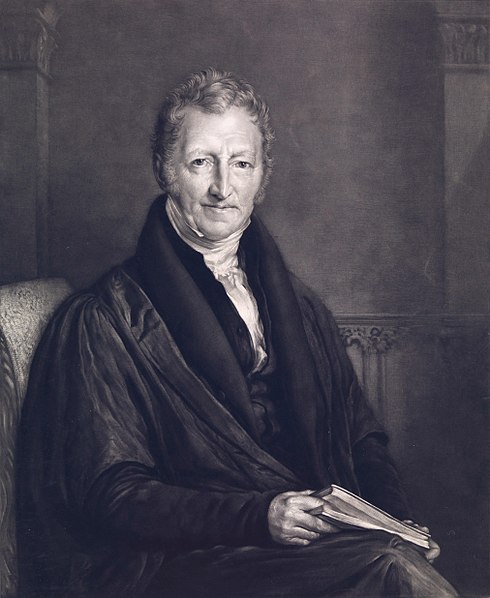
Thomas Malthus.
Portrait by John Linnell, 1834, via Wikimedia Commons

But it’s not just about money. It’s also about ideology. Anti-nuclear groups have long had a deeply ideological motivation to kill off nuclear energy.

Policymakers, journalists, conservationists, and other educated elites in the ’50s and ’60s knew that nuclear was unlimited energy and that unlimited energy meant unlimited food and water.

We could use desalination to convert ocean water into freshwater. We could create fertilizer without fossil fuels, by harvesting nitrogen from the air, and hydrogen from water, and combining them. We could create transportation fuels without fossil fuels, by taking carbon dioxide out of the atmosphere to make artificial hydrocarbons, or by splitting water to make pure hydrogen gas.

Nuclear energy thus created a serious problem for Malthusians — followers of widely-debunked 18th-century economist, Thomas Robert Malthus — who argued that the world was on the brink of ecological collapse and resource scarcity. Nuclear energy not only meant infinite fertilizer, freshwater, and food but also zero pollution and a radically reduced environmental footprint.

In reaction, Malthusians attacked nuclear energy as dangerous, mostly by suggesting that it would lead to nuclear war, but also by spreading misinformation about nuclear “waste” — the tiny quantity of used fuel rods — and the rapidly decaying radiation that escapes from nuclear plants during their worst accidents.

There is a pattern: Malthusians raise the alarm about resource depletion or environmental problems and then attack the obvious technical solutions. In the late 1700s, Thomas Malthus had to reject birth control to predict overpopulation. In the 1960s, Malthusians had to claim fossil fuels were scarce to oppose the extension of fertilizers and industrial agriculture to poor nations and to raise the alarm over famine. And today, climate activists reject nuclear energy in order to declare a coming climate apocalypse.

June 15, 2020

African History Disproves Guns Germs and Steel by Jared Diamond

Filed under: Africa, Books, Economics, Environment, History, Technology — Tags: , , , , — Nicholas @ 06:00

The Cynical Historian
Published 26 Oct 2019

There’s a question in the history profession that if sufficiently answered could not only reshape how we conceive ourselves, but reveal the best course of action for politics around the world. What makes the West strong? While there are many answers, the most popular of these has been Jared Diamond’s Guns Germs and Steel. You’ll see his argument all over the place, including a NatGeo documentary. But of course it has its detractors, to the point that some historians consider it pseudo-history. Now I think that’s going too far, but there are enough problems with his thesis that we can’t take it as the final answer to these questions. So let’s talk about that.

————————————————————
errata
10:32 – not “Blaut’s theory” but “Diamond’s theory” (thx PunkSci)
————————————————————

references:
James M. Blaut, Eight Eurocentric Historians: The Colonizer’s Model of the World, Volume Two (New York: The Guilford Press, 2000), 149-172. https://amzn.to/2YFt0iQ

Michael C. Campbell and Sarah A. Tishkoff, “African Genetic Diversity: Implications for Human Demographic History, Modern Human Origins, and Complex Disease Mapping,” Annual Review of Genomics and Human Genetics 9 (22 September 2008): 403-433.

Jared Diamond, Guns Germs and Steel: The Fates of Human Societies (New York: WW Norton, 1997). https://amzn.to/2GK6AqI

Martin W. Lewis and Karen E. Wigen, The Myth of Continents: A Critique of Metageography (Berkeley: University of California Press, 1997). https://amzn.to/2H0ylv7

Richard York and Philip Mancus, “Diamond in the Rough: Reflections on Guns, Germs, and Steel,” Human Ecology Review 14, no. 2 (2007): 157-162.

https://thetruesize.com
————————————————————
Support the channel through PATREON: https://www.patreon.com/CynicalHistorian

LET’S CONNECT:
Subreddit: https://www.reddit.com/r/CynicalHistory/
Discord: https://discord.gg/Ukthk4U
Twitter: https://twitter.com/Cynical_History

June 3, 2020

Fanatics gonna fanatic … they can’t help it

It’s funny that no matter what the claimed crisis, the answers always go in the same direction, as Kristian Niemietz points out with the demands to turn our still unending lockdown toward “protecting the environment”:

The change, superficially, is to encourage “a safe return to work” allowing more social distancing between pedestrians, but more substantially in order to preserve the cleaner air that has resulted from the lockdown.

The health and safety excuse for the policy change can be largely dismissed. The simple truth of the pandemic and national policy is that if social distancing matters, the centre of London is not safe to return to work. It is too densely populated and almost entirely reliant on mass transit which cannot operate above 10-15% capacity with 2m exclusion rules. With average commutes over 9 miles each way, substitution effects to walking and cycling will be extremely limited and temporary.

It is then hard to see then how the policy’s architects imagine the streets will fill up to the extent urgent measures are needed. Conversely, if social distancing does not matter (and it will cease to matter eventually), then a policy to enable more social distancing outside by widening the pedestrian streetscape is redundant. If it is safe to sit on a crowded train, it is safe to walk on a crowded pavement. It is not hard then to cut through the pandemic packaging to note that the motive for this policy is opportunistic, to accelerate a pedestrianisation plan that is the dream of many an urban planner.

Many will see this as self-evidently a good thing. Removing vehicle traffic from densely populated narrow streets will reduce air pollution, congestion and road traffic accidents. As a policy it will have more supporters than opponents; very few people drive into the centre of London to commute and there is very little capacity for parking. London’s leaders are not wrong to think that this is the future, the question is really one of timing and how they go about it, which is far more difficult and does not have anything to do with managing a coronavirus.

What the pandemic allows is the ability to use emergency powers for something that is not an emergency. This matters, in normal times it took several years to close one dangerous junction at Bank to most traffic, and this under a hail of protests from local businesses and taxi drivers. The same result can now be achieved in a few weeks across many streets. The democratic checks and balances that differentiate the UK from authoritarian states can be ditched and London officialdom granted extraordinary powers to do as they please. If the protestors don’t like it this time, they should note the right to protest has also been suspended, at least for now.

May 2, 2020

Drawing some conclusions from our Wuhan Coronavirus experiences

At Catallaxy Files, Justinian the Great provides an expanded list of nine lessons we should learn from our still ongoing Wuhan Coronavirus (aka “Chinese Batflu”, “Kung Flu”, “Bat-biter Bronchitis” and other names our betters insist we not use):

1. Models are not infallible.

When dealing with complex subject matter involving lots of uncertainties, unknowns and data gaps, modelling will almost certainly be wrong. That doesn’t make them worthless but nor does it mean they should be elevated to infallible status and acted upon as though they constitute proof of something.

If we can’t get epidemiological models right involving trajectories of months what is the chance of climate models being correct considering they involve substantially greater uncertainty, unknowns and data problems involving trajectories of decades to centuries?

[…]

2. Experts can get it wrong.

The pandemic has shown that epidemiologists and health experts the world over have got COVID-19 wrong at one stage or another.

The most famous example is the Imperial College model that forecast 2.2m deaths in the United States and over 500,000 deaths in the UK. Critics have argued this was never plausible but it was the catalyst for UK lockdown policy.

[…]

3. Experts can disagree

Experts can disagree and this is normal in science (and policy making).

During the pandemic, health experts across the world have disagreed over epidemiology models (e.g. R0) ranging from thousands of deaths to millions, over treatments (i.e. the efficacy of anti-virals and anti-malarials), over who and how to test (targeted (symptomatic) versus broad based (even antibody testing), how to record cases and fatalities (e.g. Italy counting deaths with COVID the same as due to COVID, Belgium recording deaths suspected to be COVID related but not verified), the origin and nature of the virus (laboratory/synthetic or wet market/natural), over what the public health response should be (full lockdowns, targeted lockdowns, Sweden (minimal) or something in-between), and the susceptibility of children to the virus, leading to divergence on school closures.

[…]

4. The Precautionary Principle – No such thing as a free lunch

The COVID-19 crisis is a classic case of the precautionary principle in action. The policy measures put in place have been justified by the worse case scenarios of epidemic models forecasting mass deaths and hospital systems in collapse. These scenarios have been hyped up by an alarmist media presenting such scenarios / predictions as established fact.

Part of the problem stems from politicians abdicating responsibility for decision-making and hiding behind health experts as human shields. These experts have nothing to gain and everything to lose from underestimating the epidemic. No-one wants to be blamed for hundreds of thousands of preventable deaths.

[…]

5. If you can’t trust the WHO in a pandemic why would you trust the IPCC on climate change?

The neo-liberal (in international relations terms) notion that the UN (and other international institutions) are independent actors working altruistically for the global good has been blown to bits during the COVID-19 pandemic.

The conduct of the WHO and its complicity with China throughout the pandemic has demonstrated what realists have always known, i.e. international institutions are not independent actors, but instead reflect the interests of great powers in the international system.

[…]

6. If you can’t trust the Chinese in a pandemic how can you trust them on climate?

The COVID crisis also demonstrates why should not trust a communist dictatorship to act truthfully, transparently or ethically, much less put global interests above national interests even in times of an international crisis.

If we can’t believe China about infection rates, how can we believe their carbon accounting? If we can’t trust China to reduce the spread of a virus, how can we trust China to reduce the growth in CO2 emissions? If we believe China has captured/corrupted the WHO how do we know it hasn’t captured/corrupted the IPCC? If China will prioritise national interest in a health crisis, why won’t China prioritise national interest in a climate crisis? If we don’t believe China action/excuses in a pandemic why would we believe China action/excuses on climate change? If we can acknowledge China is trying to exploit the health crisis geo-strategically (i.e. South China Sea military manoeuvres) and geo-economically (belt and road and coercive threats), why will it not exploit climate change in the exact same way?

April 14, 2020

Socialism and the environment

Filed under: Environment, History, Russia — Tags: , , , , — Nicholas @ 05:00

Luke Warren on the vast gulf between the “environmental consciousness” of fans of the socialist worldview and the real-world environmental impact of socialist policies:

Modern environmentalists often identify as socialists. Members of Extinction Rebellion, for example, often advocate tearing down capitalism and supplanting it with “eco-socialism”. Go to any “climate strike” or similar type of event, and you will see more hammer and sickle flags, raised fist symbols and Socialist Workers party posters than you can count.

Indeed, socialism and environmentalism are perceived by many as two sides of the same coin, and the idea that climate change is a “crisis of capitalism” has become conventional wisdom. It is now seemingly a contradiction to be both a capitalist and an environmentalist. This is not just a matter of rhetoric, but it is also reflected in the policy prescriptions of both environmentalists and socialists. Look at proposals for a “green new deal”, calls for large-scale nationalisation in the name of the environment.

Animated map of the shrinking of the Aral Sea between 1960 and 2008 (via Wikipedia)

But what is the story of socialism and environmentalism?

One only has to look back at the failed experiments of socialism to see just how environmentally catastrophic it has been. As the Soviet Union collapsed and the iron curtain was torn down, the rest of the world finally saw the environmental damage caused by socialist command economies. Economist Jeffrey Sachs stated that the socialist states had “some of the worst environmental problems on the entire globe” All of this, it is worth noting, occurred against a backdrop of a wide array of environmental laws and regulations that supposedly protected the public interest.

Air pollution provides an excellent example. Total greenhouse gas emissions in the USSR in 1988 equated to 79 per cent of the US total. However, the Soviet Union’s gross national product (GNP) was only 54 per cent of the USA’s, according to one very generous estimate (it was, in all likelihood, far less than that). This means that the USSR generated at least one and a half times as much pollution as the USA per unit of GNP (and again, in all likelihood, far more than that).

Accounts of those who travelled across the Soviet Union post-collapse recall swathes of the country where smog clung to the air. An article from Multinational Monitor in 1990 highlighted that 40 per cent of the Soviet people lived in areas where air pollutants, such as carbon dioxide, sulphur dioxide and nickel dioxide, were three to four times the maximum allowable levels.

The destruction of the Aral Sea, perhaps one of the worst environmental disasters, can be directly blamed on the process of socialist planning. In an attempt to make the USSR self-sufficient in cotton production, vast amounts of water were diverted to arid areas for irrigation. Much of the Aral Sea dried up, leaving port cities, Muynak for example, and fishing villages marooned miles from the shore. Worse, the exposure of the salty sea bed and extensive use of pesticides had catastrophic impacts on the health of the local population. Respiratory problems and lung diseases became widespread as people inhaled pollutants.

The Aral Sea in 2000 on the left and 2014 on the right. Photograph: Atlas Photo Archive/NASA

« Newer PostsOlder Posts »

Powered by WordPress