Quotulatiousness

April 14, 2020

The role of disease and climate change in the fall of the western Roman Empire

Filed under: Books, Environment, Europe, Health, History — Tags: , , — Nicholas @ 03:00

In Quillette, Jaspreet Singh Boparai reviews a new book by Kyle Harper that tries to incorporate what we have learned about epidemics and climate change into the narrative on the decline of Rome:

Why did the Roman Empire fall? The classic answer is given by Edward Gibbon (1737 — 1794), in chapter 38 of the third volume of The History of the Fall and Decline of the Roman Empire (1776 — 1789):

    The decline of Rome was the natural and inevitable effect of immoderate greatness. Prosperity ripened the principle of decay; the causes of destruction multiplied with the extent of conquest; and as soon as time or accident had removed the artificial supports, the stupendous fabric yielded to the pressure of its own weight.

Kyle Harper, Senior Vice President and Provost of the University of Oklahoma, seeks to complement Gibbon’s account by emphasising the role of nature, and specifically climate change and infectious disease, in the fall of Rome in his provocative, exceptionally well-written book The Fate of Rome: Climate, Disease and the End of an Empire. Is Harper correct? Were plagues and climate events fatal for Rome?

Harper accepts the conventional view that Rome’s civilizational collapse began in the later second century AD, accelerated amidst chaos and bloodshed during the third century, and culminated in the humiliations of the fifth century, when Rome was famously sacked by barbarians, and the last, weak, insignificant Roman Emperor was pushed off the throne in AD 476.

[…]

Harper begins The Fate of Rome with a description of Rome as it advertised itself in AD 400. Contemporary inventories record: 28 libraries, 19 aqueducts, two circuses, 37 gates, 423 neighborhoods, 46,602 blocks of flats, 1,790 grand houses, 290 granaries, 856 public baths, 1,352 cisterns, 254 bakeries, 46 brothels, and 144 public latrines. The population is estimated at 700,000 or so. This figure diminished rapidly after August 24th, AD 410, when Rome was sacked by an army of Goths.

The traditional date of Rome’s fall is September 4th, AD 476, when the 16-year-old Emperor Romulus Augustus, the son of a former secretary to Attila the Hun, was forced to abdicate the throne by a barbarian warlord, and dismissed to spend the rest of his days at a seaside villa near Naples. His date of death is not recorded; he was too unimportant to fear assassination. At this point, the city of Rome’s population was still as high as 400,000.

Rome was invaded and sacked a few times over the centuries; more and more of it was abandoned; by the 10th century it was a suburb to nowhere surrounded by malarial swamps, and may have had only 9,000 inhabitants. Most of the economy was related to religious pilgrimages; the city was controlled by gangsters and petty warlords. What was left amidst the ruins was sacked again in AD 1084 by an army that outnumbered residents by as much as three to one.

“The Course of Empire – Desolation” by Thomas Cole, one of a series of five paintings created between 1833 and 1836.
Wikimedia Commons.

April 8, 2020

If the Wuhan Coronavirus panic feels oddly familiar … there’s a good reason for it

Warren Meyer explains why his skepticism about the dangers of the Wuhan Coronavirus epidemic kicked in quickly because it followed a very familiar pattern:

I have been skeptical about extreme global warming and climate change forecasts, but those were informed by my knowledge of physics and dynamic systems (e.g. feedback mechanics). I have been immensely skeptical of Elon Musk, but again that skepticism has been informed by domain knowledge (e.g. engineering in the case of the hyperloop and business strategy in the case of SolarCity and Tesla). But I have no domain knowledge that is at all relevant to disease transfer and pathology. So why was I immediately skeptical when, for example, the governor of Texas was told by “experts” that a million persons would die in Texas if a lock-down order was not issued?

I think the reason for my skepticism was pattern recognition — I saw a lot of elements in COVID-19 modelling and responses that appeared really similar to what I thought were the most questionable aspects of climate science. For example:

  • We seem to have a sorting process of “experts” that selects for only the most extreme. We start any such question, such as forecasting disease death rates or global temperature increases, with a wide range of opinion among people with domain knowledge. When presented with a range of possible outcomes, the media’s incentives generally push it to present the most extreme. So if five folks say 100,000 might die and one person says a million, the media will feature the latter person as their “expert” and tell the public “up to a million expected to die.” After this new “expert” is repetitively featured in the media, that person becomes the go-to expert for politicians, as politicians want to be seen by the public to be using “experts” the public recognizes as “experts.”
  • Computer models are converted from tools to project out the implications of a certain set of starting hypotheses and assumptions into “facts” in and of themselves. They are treated as having a reality, and a certainty, that actually exceeds that of their inputs (a scientific absurdity but a media reality I have observed so many times I gave it the name “data-washing”). Never are the key assumptions that drive the model’s behavior ever disclosed along with the model results. Rather than go on forever on this topic, I will refer you to my earlier article.
  • Defenders of alarmist projections cloak themselves in a mantle of being pro-science. Their discussions of the topic tend to by science-y without being scientific. They tend to understand one aspect of the science — exponential growth in viruses or tipping points in systems dominated by positive feedback. But they don’t really understand it — for example, what is interesting about exponential growth is not the math of its growth, but what stops the growth from being infinite. Why doesn’t a bacteria culture grow to the mass of the Earth, or nuclear fission continue until all the fuel is used up? We are going to have a lot of problem with this after COVID-19. People will want to attribute the end of the exponential growth to lock-downs and distancing, but it’s hard to really make this analysis without understanding at what point — and there is a point — the virus’s growth would have turned down anyway.
  • Alarmists who claim to be anti-science have a tendency to insist on “solutions” that have absolutely no basis in science, or even ones that science has proven to be utterly bankrupt. Ethanol and wind power likely do little to reduce CO2 emissions and may make them worse, yet we spend billions on them as taxpayers. And don’t get me started on plastic bag and straw bans. I am willing to cut COVID-19 responses a little more slack because we don’t have the time to do elaborate studies. But just don’t tell me lockdown orders are science — they are guesses as to the correct response. I live in Phoenix where it was sunny and 80F this weekend. We are on lockdown in our houses. I could argue that ordering everyone out into the natural disinfectant of heat and sunlight for 2 hours a day is as effective a response as forcing families into their houses (initial data, though it is sketchy, of limited transfer of the virus in summertime Australia is interesting — only a small portion of cases are from community transfer. By comparison less than a half percent of US cases from travel).

March 29, 2020

For dedicated progressives, the answer to every question is always “more government”

Arthur Chrenkoff on the constant demand from the left for expanding the role of government in, basically, everything:

But even in more developed and democratic countries of Europe, while not leading to the overthrow of the political and economic system, World War One had contributed to a significant increase in the size and the power of the state. Even more so World War Two, where the war experience translated into post-war Keynesian-inspired social democratic welfare states, ironically nowhere more so than in the United Kingdom where the Tories won the war but the Labour won the peace. In some ways, the mobilisation of the state to fight a total war was merely the continuation of the mobilisation to fight the Great Depression, an economic upheaval like none before, which helped bring national socialism to power in Germany and realigned the American politics for the next half a century around a New Deal consensus. The GFC did not leave as extensive a legacy, except perhaps in the right’s surrender on government spending, budget deficits and public debt. If you are no longer restricted by the existing revenue, there is really no limit how big the government can grow.

Over the last two decades the left has been trying to use climate change as another crisis not be wasted. If the problem was CO2, bigger state and smaller market were always the answers if you listened to Bernie Sanders and AOC with their Green New Deal or to Extinction Rebellion, or Greta Thunberg or any number of other high profile individuals and groups. By and large, this has not worked because the threat of a hotter planet and a more extreme weather has never been immediate enough, despite all the 10 and 12 year deadlines until a “point of no return” and all the overheated, panic-mongering rhetoric about the end of the world.

Enter stage left Coronavirus. What opportunities have been missed or simply impossible to seize as a result of the GFC (because the economic crisis wasn’t in the end deep enough) or the “climate emergency” (because the threat was never urgent enough) are here to be seized during the pandemic, even more so if the pandemic (or the responses to) leads to a genuine global economic depression, perhaps worse than the one 90 years ago. No sane person wishes deadly pandemics on the world, but since it’s already here might as well act. The pretty sober and comfortably elite Economist calls what has already occurred around the world “the most dramatic extension of state power since the second world war.”

It has been noticeable to me, as I’m sure it has been to many others, how large sections of the left seem to be salivating at the prospect of complete and prolonged lock-downs and martial law-type situations. Such measures might possibly be in the end necessary to finally halt and contain the spread of the contagion (or, then again, they might not be), but the sheer rush towards them and enthusiasm by people, many of whom have spent the last five years decrying Donald Trumps of the world as dictators-in-waiting, leads me to believe that for many progressive and radical people authoritarianism is like rape: the public fear of it often masks the secret fantasies about it. It’s not a question of what, and not even of who’s in charge, even though they would prefer to be the ones at the helm, as long as it actually happens, because the state, being the left’s domain, will be the ultimate beneficiary and in time so will they. The left loves power, no matter how much they protest it’s all for the greater good. That’s why everyone wants to be a commissar and no one actually wants to be the proletarian.

But never mind COVID martial law; even if it were to last a few months, people need to be let out of their houses eventually and life has to return to some semblance of normality. What the left is more interested and more passionate about are the long lasting consequences, the fruit of power shifts in the world upended by a bat virus. The current crisis presents an almost unparalleled opportunity to expand the scope of governments at the expense of the private sector and the peoples and institute far-reaching changes to just about every aspect of life.

March 2, 2020

The Trouble With Tumbleweed

Filed under: Environment, Government, History, Russia, USA — Tags: , — Nicholas @ 06:00

CGP Grey
Published 1 Mar 2020

Director’s commentary: https://www.youtube.com/watch?v=rbHQO…

## Crowdfunders:

Bob Kunz, Steven Snow, John Buchan, Nevin Spoljaric, Donal Botkin, Phil Gardner, Chris Chapin, Richard Jenkins, Martin, Steven Grimm, سليمان العقل, Colin Millions, Michael Mrozek, Saki Comandao, Jason Lewandowski, Andrea Di Biagio, David F Watson, rictic, Ben Schwab, Marco Arment, Elliot Lepley, Shantanu Raj, emptymachine, Bobby, Chris Amaris, George Lin, Mikko, Derek Bonner, Derek Jackson, Orbit_Junkie, Ron Bowes, Tómas Árni Jónasson, Henry Ng, Jordan Earls, Joshua Jamison, Nick Fish, Nick Gibson, Robert Webb, Jeffrey Podis, Thunda Plum, Awoo, David Tyler, Fuesu, iulus, Kevin Costello, Michael Reilly, Tyler Bryant, Kermit Norlund, chrysilis, David Palomares, Erik Parasiuk, ken mcfarlane, Leon, Tristan Watts-Willis, Veronica Peshterianu, Bear, Emi, Esteban Santana Santana, Freddi Hørlyck, John Rogers, Maarten van der Blij, Peter Lomax, Rhys Parry, ShiroiYami, Dag Viggo Lokøen, John Lee, Maxime Zielony, Elizabeth Keathley, Frederick The Great, Luxe Gifts, Rebecca Wortham, Bryan McLemore

Music by Music by: http://www.davidreesmusic.com

Wikipedia says:

A tumbleweed is a structural part of the above-ground anatomy of a number of species of plants, a diaspore that, once it is mature and dry, detaches from its root or stem, and rolls due to the force of the wind. In most such species, the tumbleweed is in effect the entire plant apart from the root system, but in other plants, a hollow fruit or an inflorescence might serve the function. Tumbleweed species occur most commonly in steppe and arid ecosystems, where frequent wind and the open environment permit rolling without prohibitive obstruction.

Apart from its primary vascular system and roots, the tissues of the tumbleweed structure are dead; their death is functional because it is necessary for the structure to degrade gradually and fall apart so that its seeds or spores can escape during the tumbling, or germinate after the tumbleweed has come to rest in a wet location. In the latter case, many species of tumbleweed open mechanically, releasing their seeds as they swell when they absorb water.

The tumbleweed diaspore disperses seeds, but the tumbleweed strategy is not limited to the seed plants; some species of spore-bearing cryptogams — such as Selaginella — form tumbleweeds, and some fungi that resemble puffballs dry out, break free of their attachments and are similarly tumbled by the wind, dispersing spores as they go.

[…]

In the family Amaranthaceae (i.e. broadly defined to include Chenopodiaceae), several annual species of the genus Kali are tumbleweeds. They are thought to be native to Eurasia, but when their seeds entered North America in shipments of agricultural seeds, they became naturalized in large areas. In the cinema genre of Westerns, they have long been symbols of frontier areas. Kali tragus is the so-called “Russian thistle”. It is an annual plant that breaks off at the stem base when it dies, and forms a tumbleweed, dispersing its seeds as the wind rolls it along. It is said to have arrived in the United States in shipments of flax seeds to South Dakota, perhaps about 1870. It now is a noxious weed throughout North America, dominating disturbed habitats such as roadsides, cultivated fields, eroded slopes, and arid regions with sparse vegetation. Though it is a troublesome weed, Kali tragus also provides useful livestock forage on arid rangelands.

February 23, 2020

QotD: Go eat bugs, plebs!

Filed under: Environment, Food, Health, Media, Quotations — Tags: , , , , — Nicholas @ 01:00

What is this creepy obsession with the elite telling us to eat bugs? Every few weeks, some mainstream media outlet has one of its gooey writers go off on how delicious and nutritious insects supposedly are, and it’s downright bizarre. The latest piece of pro-pillbug propaganda is from the formerly prestigious Economist, “Why Eating Bugs Is So Popular In Congo,” where the author assures us that “The creepy superfood is rich in protein and magnesium.” Thanks, but I think I’ll get my protein and magnesium in a manner that does not involve gobbling grubs.

What is with these people?

This bug bingeing is a running theme in the mainstream media. The New York Times, taking a break from passively aggressively correcting its garbage takes, asks “Why Aren’t We Eating More Insects?” The answer is, of course, “Because they are insects, you weirdos.”

CNN goes on about “Bugs: The Food That Can Feed, And Maybe Save, The Planet,” as if Brian “Tater” Stelter is going to give up stuffing Cheetos in his talk-hole in exchange for caterpillars.

And National Geographic manages to do the impossible and make us hate the United Nations even more by informing us that the “U.N. Urges Eating Insects,” and offering us “8 Popular Bugs to Try.” Popular with whom?

The Economist is talking about people munching millipedes in Congo, and you have to wonder why we would take Congo’s lead in anything. It’s the Congo – you should carefully examine what the Congo does, then do the opposite. That goes for other strange countries too. Frankly, foreign countries are generally terrible and there is not a lot that other countries have to teach us – I lived on two other continents and this bizarre notion liberal Americans have about other countries being better than us is grossly misplaced. Other countries are mostly terrible.

Exhibit A: They eat bugs.

Do you think the people of Congo are saying, “Beef? Pass. Hand me that plate of maggots!” You don’t eat grasshoppers because you have other options. No one’s first choice is fruit flies.

Kurt Schlicter, “Tell The Nags To Go Pound Sand”, Townhall.com, 2019-11-19.

February 15, 2020

Disrupting railways as an activist tactic appears to work really, really well

As Colby Cosh writes, for all the issues Alberta has with the government in Ottawa, nobody seriously suggested messing up the railways to get attention. Perhaps they should have:

“DSC02285” by Bengt 1955 is licensed under CC BY-NC 2.0

It never occurred to us to mess with the rail network in Eastern Canada — to inconvenience the precious commuters of the Golden Horseshoe — as a means of gaining negotiating leverage. Actually, I’m sure some people must have suggested it, but they would have been written off as selfish, dangerous idiots advocating counterproductive tactics.

The economic impact of the rail protests is big, but surely comparable, at the moment, to that of a big storm. Yet because a B.C. Aboriginal community is carrying its fight with the B.C. government to the guts of Canada, the clamour over whether large public works are now possible at all in Canada has instantly achieved new and unfamiliar volume levels.

The Coastal GasLink that is the source of the strife is a provincially regulated work running from Dawson Creek to the coast; unlike the vastly more expensive problems Alberta has encountered, this technically isn’t an issue for the wider federation at all. Except, whoops, it is! Because someone decided to make it one!

The levels of irony dazzle the imagination. The Canadian West was settled by means of passenger rail, which is supposedly one reason it was chosen as a target by the radicals supporting the Wet’suwet’en hereditary chiefs in their pipeline fight. But intercity commuter rail no longer really exists between the West Coast and Hamilton. The West is ultimately as dependent on rail freight as the East, and maybe more so, but it was that commuter inconvenience that gave rise to an immediate sense of national crisis, while Calgary and Saskatoon and Winnipeg snoozed.

And climate-change activists found themselves blocking rail lines in “solidarity” with the Wet’suwet’en, even though the chiefs’ fight is a question of territorial principle rather than carbon sins. This put the greenies in the position of opposing and thwarting actual rail travel. They admit this is anomalous; nobody likes to attach the word “hypocritical” to himself.

One of the protesters pointed out to the Star‘s Alex Boyd how dependence on rail — dependence of the sort that they spend 364 days a year advocating for intra-city commuters — facilitates unlawful, obstructive protest as a means for the self-anointed to “put pressure on decision-makers.” It is a little harder to block paved roads than railroads, and much harder to sabotage them, if it comes to that — which it might have if the police had used force to immediately disperse the protests. For some, this counts as a feature of rail, not a bug.

February 9, 2020

The lightbulb conspiracy again

I’ve banged on a few times over the years about lightbulbs, specifically about our government’s passionate desire for us to abandon the tried-and-tested (and cheap) incandescent bulbs to move first to (ultra-expensive, dim, and potentially dangerous) compact fluorescent bulbs and now to (cheaper, but still not living up to longevity promises) LED bulbs instead. Tim Worstall explains how governments were persuaded to enforce this crony capitalist plot over the years (he’s discussing the European market, but Canadian regulators were doing exactly the same thing):

We all recall when we used to use incandescent light bulbs. Simple, cheap, the result of a century’s worth of fiddling with the basic technology to make it around and about right for the use to which it was put.

A spiral compact fluorescent bulb (CFL).
Image by Sun Ladder via Wikimedia Commons.

Then they were banned. Sure, there was that energy and thus planet saving argument but that was always very weak indeed. It was an excuse, not the actual reason itself. The reason was that the big three manufacturers, Phillips, Osram and GE, had invested heavily in the next generation of technology, compact fluorescents. These cost not pennies per bulb but pounds. Rather better profit margins that is. Oh, and also, not subject to that crippling competition from China.

So, we get the EU ban on incandescents, driven entirely by the manufacturers. There’s a lot of the Baptist and Bootlegger in here given the environmentalist support for it.

The problem with the technology being the use of mercury in those bulbs.

An aside, I made my living for a number of years selling weird metals that are added to that mercury. I do actually know quite a bit about the nuts and bolts here. I’m also out of the business and have been for a decade and more. So it’s knowledge driving this, not knife sharpening.

Mercury’s not good stuff to have floating around. So, what happens next? Yep, a decade or a bit more after the incandescents were banned so now they’re coming for the CFLs.

The mercury issue was not as well publicized here in Canada as it was in Australia, for example:

How many of them have looked up the Environment Department’s website to find what its bureaucrats falsely describe as the “simple and straightforward” precautions to take against poisoning should one of these lamps smash:

  • Open nearby windows and doors to allow the room to ventilate for 15 minutes before cleaning up the broken lamp. Do not leave on any air conditioning or heating equipment which could recirculate mercury vapours back into the room.
  • Do not use a vacuum cleaner or broom on hard surfaces because this can spread the contents of the lamp and contaminate the cleaner. Instead scoop up broken material (e.g. using stiff paper or cardboard), if possible into a glass container which can be sealed with a metal lid.
  • Use disposable rubber gloves rather than bare hands.
  • Use a disposable brush to carefully sweep up the pieces.
  • Use sticky tape and/or a damp cloth to wipe up any remaining glass fragments and/or powders.
  • On carpets or fabrics, carefully remove as much glass and/or powdered material using a scoop and sticky tape; if vacuuming of the surface is needed to remove residual material, ensure that the vacuum bag is discarded or the canister is wiped thoroughly clean.
  • Dispose of cleanup equipment (i.e. gloves, brush, damp paper) and sealed containers containing pieces of the broken lamp in your outside rubbish bin – never in your recycling bin.
  • While not all of the recommended cleanup and disposal equipment described above may be available (particularly a suitably sealed glass container), it is important to emphasise that the transfer of the broken CFL and clean-up materials to an outside rubbish bin (preferably sealed) as soon as possible is the most effective way of reducing potential contamination of the indoor environment.

February 8, 2020

Switching over from internal combustion vehicles to electric won’t be cheap … it really won’t be cheap!

Filed under: Britain, Economics, Environment, Government, Technology — Tags: , , , — Nicholas @ 03:00

At Spiked, Rob Lyons looks at the British government’s recent decision to ban sales of internal-combustion cars in 2035 rather than the earlier target date of 2040:

Nissan Leaf electric vehicle charging.
Photo by Nissan UK

First, at present, electric vehicles cost a lot more than those with internal-combustion engines. For example, one car-buying advice website notes that the Peugeot e-208 is as much as £6,200 more than the standard 208 model. There are government subsidies to help with the cost of electric cars (currently £3,500), but can this be sustained if we all switch? It has already been cut from £4,500 in 2018.

That said, while the purchase price of an electric car may be higher, charging is a lot cheaper than fuelling a regular car. Electric vehicles cost between £4 to £6 per 100 miles to charge at home and £8 to £10 using public charge points, while petrol and diesel cars cost £13 to £16 per 100 miles in fuel (although 60 per cent of the fuel cost is tax).

In theory, maintenance should be cheaper, too, given that electric motors have fewer moving parts than petrol or diesel engines. But to further complicate matters, batteries gradually lose their capacity to hold charge over time. They have to be replaced at the cost of thousands of pounds every few years. (The warranties covering battery replacement varies by manufacturer: Tesla, for instance, offers an eight-year warranty, but the Renault Zoe is covered for just three years.)

Electric cars may be cheaper to own overall, but this is largely down to subsidies and tax breaks, including lower vehicle duties and not having to pay charges in low-emission zones. Still, with the entire car industry throwing its efforts into making electric cars cheaper and increasing battery capacity, costs may well come down somewhat, reducing the need for such breaks. Fingers crossed.

The cost to individual owners will be higher, but the costs to build up the electric charging infrastructure will be distributed among all consumers, not just the owners of vehicles:

This brings us to perhaps the biggest problem: where will the power come from and how will it reach us? Eventually shifting all the energy for cars from oil to electricity means producing much more electricity. Greens are pleased that electricity use is currently decreasing, and a greater proportion of electricity is coming from renewable sources. But the arrival of electric cars en masse would demand a whole lot more electricity, mostly to be used at night.

Unless we want to coat the landscape in wind turbines, which are unreliable in any event, we’ll need other sources of power. More nuclear? Fine by me. But will eco-warriors stand for that? Even if we can produce the juice, having lots of cars charging in the same area may overwhelm the local electricity networks. Who is going to pay for the upgrade?

When all of these factors are considered we have to ask if all this effort will really reduce greenhouse-gas emissions anyway. Digging up the resources required to create all those batteries will be hugely carbon-intensive. Perhaps the most likely outcome of banning sales of new petrol and diesel vehicles is that demand for second-hand vehicles will go up. We could end up like Cubans, nursing venerable old cars for years, way beyond their intended lifespans.

January 22, 2020

Australian tourism, RIP

Filed under: Australia, Environment, Media — Tags: , , , , , , — Nicholas @ 05:00

As we’ve all been inundated with the shocking images of almost the entire inhabited area of the Australian mainland burning, like this one, for example, claimed on social media to be a “satellite image”:

… it’s not surprising that anecdotal evidence of the decline in bookings from foreign tourists implies that there will be few visitors to the burned-out wasteland that used to be a thriving first-world nation. This, on top of the widely reported “death” of the Great Barrier Reef, means the few dozen dazed survivors will be reduced to cannibalism shortly. Or, as Arthur Chrenkoff suggests, we’ve been sold another bill of goods and things are not quite as desolate and post-apocalyptic as all that:

Just like many other people I know, I have been inundated by messages from family and friends overseas, inquiring about my safety, having been terrified by the media reports of what seemed like an environmental armageddon engulfing the entire country. I had to explain time after time that while the fires have been savage and extensive, they have largely burned through relatively sparsely populated areas (if it all, considering the vast extent of our national parks). No significant town has been threatened and destruction and loss of life, while tragic, have been pretty small in proportion to the area affected.

Yet, watching the hysterical and over-sensationalised coverage overseas has convinced many that the very existence of the nation is at stake. And the social media, if anything, has been even worse, with a number of completely misleading maps and photos exaggerating the extent of the affected areas by two-figure factors. As I pointed out, indeed the area the size of the state of Kentucky has been burned out, but unlike most other places on Earth, certainly in the developed world, Australia fits in nearly eighty Kentuckys, most of them pretty empty of human presence and activity.

Media sensationalises at the best of times in a never-ending quest for more eyeballs (“if it bleeds it leads”, or, in this case, “if it’s on fire, we’re on fire”) but the intersection of a large scale natural disaster with the “climate crisis” activism has generated a truly terrifying inferno of human passions where news becomes propaganda and the narrative trumps the objectivity. A significant proportion of the population — and the majority in the media — want to see the fires as Gaia’s wrath, with the disaster turning into green porn to terrify, titillate and agitate. Tourism has now become one of the casualties of this rhetorical excess, a collateral damage to the pursuit of a political agenda. This crisis is very much man-made and the economic pain unnecessarily inflicted on a whole industry because you wanted to make as terrible a point as possible will hang around your necks like a charred albatross, dear green activists on the streets and those masquerading as journalists.

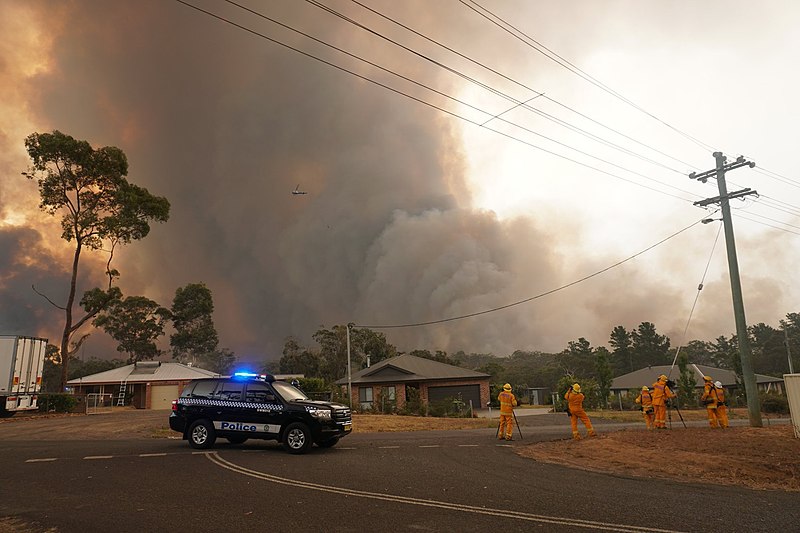
The Green Wattle Creek bushfire moves towards the Southern Highlands township of Yanderra as police evacuate residents from Yanderra Road, 21 December, 2019.
Photo by Helitak430 via Wikimedia Commons

January 19, 2020

“… if the Constitution is a threat to killer whales, why, then, to hell with the Constitution”

Filed under: Cancon, Environment, Government, Law, Politics — Tags: , , , , — Nicholas @ 03:00

Colby Cosh reviews the sad tale of the British Columbian government’s defeat before the Supreme Court of Canada over pipelines:

So … yeah, that didn’t go real well. On Thursday the province of British Columbia sent its chosen representative, lawyer Joseph Arvay, to the Supreme Court to plead the oral case for B.C.’s law regulating bitumen in pipelines. John Horgan’s government had attempted to establish its own permit regime for pipeline contents, which are, under accepted constitutional doctrine, a federal responsibility. The B.C. Court of Appeal had wiped out the provincial law unanimously last summer.

Arvay’s task was widely recognized as a Hail Mary pass. But things got even more awkward as the hearing commenced and the justices of the Supreme Court interrogated him on his province’s logical, environmental, and even economic premises. An appellate court’s disposition is sometimes hard to ferret out in its hearings, but this one was so rough that Arvay was reduced to grumbling “If I’m not going to win the appeal, then I don’t want to lose badly.” Alas, the judges did not even see the need to deliberate over their reasons: they at once, and as one, ruled against B.C.

Which is not to suggest that Mr. Arvay didn’t do the best possible job. If we’re sticking with the football metaphor, the problem all along was the game plan. Given the clear federal responsibility for interprovincial pipelines, as “Works and Undertakings connecting … Provinces,” the B.C. government had no choice but to downplay the conflict between the purpose of its proposed environmental permits and the purpose of the ones the federal government hands out. Arvay had to try to convince the ermine gang that a law applying exclusively to the contents of a pipeline wasn’t a regulation of the pipeline.

“The only concern the premier, the attorney general and the members of the government have had is the harm of bitumen,” Arvay protested. “It’s not about pipelines. They’re not anti-pipelines, they’re not anti-Alberta, they’re not anti-oilsands, they’re not anti-oil.”

It’s enough to almost make one sympathetic to the more radical strategy of argument pursued at the hearing by Harry Wruck, a lawyer for Ecojustice Canada who appeared as an intervener supporting B.C. Wruck put before the Supreme Court the same idea he had presented to the BCCA: if the Constitution is a threat to killer whales, why, then, to hell with the Constitution.

January 4, 2020

Australia, the firebug country

Filed under: Australia, Environment, Law, Media — Tags: , , — Nicholas @ 05:00

Arthur Chrenkoff rounds up the surprisingly numerous reports of arson over the last few months in Australia:

The Green Wattle Creek bushfire moves towards the Southern Highlands township of Yanderra as police evacuate residents from Yanderra Road, 21 December, 2019.
Photo by Helitak430 via Wikimedia Commons

According to my calculations and estimates, the number of individuals around Australia whose arson has contributed to the current bushfire crisis has now passed 200.

This figure is not presented as a counter-argument to those who blame the fires on climate change. Most people (I hope) understand that trees tend not to spontaneously combust, no matter what the air temperature is; when we talk about bushfires starting naturally, we are talking about lightning strikes igniting tinder. The climate change argument posits that the more extreme weather conditions – higher temperatures, drought, etc. – make fires, however started, much more destructive and much more difficult to control and extinguish. These are debates to be had between climatologists, forestry experts and fire fighters. What is painfully clear, however, that Australia has a firebug crisis. It will no doubt be up to future royal commissions and inquiries to calculate exactly what proportion of the current loss and destruction can be attributed to human action, but I suspect it will be a significant one. Man might be making climate change, but man is most definitely making fires start.

Below, a sample of news reports from around the country for the past several months.

[…]

There are no conspiracies here. Though arson has been tried and called for before as a tool of terror, the Australian fires seem to result from the actions of unconnected individuals who are either disturbed or reckless. This is nothing new; as ecological criminologist Paul Read wrote back in November:

    A 2015 satellite analysis of 113,000 fires from 1997-2009 confirmed what we had known for some time — 40 per cent of fires are deliberately lit, another 47 per cent accidental. This generally matches previous data published a decade earlier that about half of all fires were suspected or deliberate arson, and 37 per cent accidental. Combined, they reach the same conclusion: 87 per cent are man-made …

    If I had to guess, I’d say about 10,000 arsonists lurk from the top of Queensland to the southern-most tip of Victoria, but not all are active and some light fires during winter. The most dangerous light fires on the hottest days, generally closer to communities and during other blazes, suggesting more malicious motives. Only a tiny minority will gaze with wonder at the destruction they have wrought, deeply fascinated and empowered. Others get caught up with the excitement of chaos and behave like impulsive idiots.

    As for children, they are not always malicious. Children and youths follow the age-crime curve where delinquency peaks in their late teens. Fire is just one of many misbehaviours. The great majority grow out of it. Four overlapping subgroups include: accidental fire-play getting out of control; victims of child abuse — including sexual abuse — and neglect; children with autism and developmental disorders; and conduct disorder from a younger age, which can be genuinely dangerous.

The more fires, proportionally the more arsonists. And the recent mega-fires are really bringing out all the fire bugs out of the woodwork (or into the woodwork to be more accurate). It is disturbing, but sadly not surprising or unexpected. As some have suggested already, the current crisis, with its large sample of arsonists, provides a good opportunity for more research into the psychology, motivation and behaviour of fire-starters. This might help in the future, but clearly arsonists will always be with us. The task is to make their work more difficult, for example through better management of our forests to make them less combustible. But as much as bushfires are an environmental and land management problem, as we search for solution we can’t forget that they are also a criminal one.

January 2, 2020

The 2010s … the best decade (so far) in human history

Matt Ridley explains why, despite all the doom and gloom in the daily headlines, the last ten years have been the best by almost any measure:

Let nobody tell you that the second decade of the 21st century has been a bad time. We are living through the greatest improvement in human living standards in history. Extreme poverty has fallen below 10 per cent of the world’s population for the first time. It was 60 per cent when I was born. Global inequality has been plunging as Africa and Asia experience faster economic growth than Europe and North America; child mortality has fallen to record low levels; famine virtually went extinct; malaria, polio and heart disease are all in decline.

Little of this made the news, because good news is no news. But I’ve been watching it all closely. Ever since I wrote The Rational Optimist in 2010, I’ve been faced with “what about …” questions: what about the great recession, the euro crisis, Syria, Ukraine, Donald Trump? How can I possibly say that things are getting better, given all that? The answer is: because bad things happen while the world still gets better. Yet get better it does, and it has done so over the course of this decade at a rate that has astonished even starry-eyed me.

Perhaps one of the least fashionable predictions I made nine years ago was that “the ecological footprint of human activity is probably shrinking” and “we are getting more sustainable, not less, in the way we use the planet”. That is to say: our population and economy would grow, but we’d learn how to reduce what we take from the planet. And so it has proved. An MIT scientist, Andrew McAfee, recently documented this in a book called More from Less, showing how some nations are beginning to use less stuff: less metal, less water, less land. Not just in proportion to productivity: less stuff overall.

This does not quite fit with what the Extinction Rebellion lot are telling us. But the next time you hear Sir David Attenborough say: “Anyone who thinks that you can have infinite growth on a planet with finite resources is either a madman or an economist”, ask him this: “But what if economic growth means using less stuff, not more?” For example, a normal drink can today contains 13 grams of aluminium, much of it recycled. In 1959, it contained 85 grams. Substituting the former for the latter is a contribution to economic growth, but it reduces the resources consumed per drink.

As for Britain, our consumption of “stuff” probably peaked around the turn of the century — an achievement that has gone almost entirely unnoticed. But the evidence is there. In 2011 Chris Goodall, an investor in electric vehicles, published research showing that the UK was now using not just relatively less “stuff” every year, but absolutely less. Events have since vindicated his thesis. The quantity of all resources consumed per person in Britain (domestic extraction of biomass, metals, minerals and fossil fuels, plus imports minus exports) fell by a third between 2000 and 2017, from 12.5 tonnes to 8.5 tonnes. That’s a faster decline than the increase in the number of people, so it means fewer resources consumed overall.

H/T to Damian Penny for the link.

December 26, 2019

“Make Gas Cans Great Again”

Filed under: Bureaucracy, Environment, Government, USA — Tags: , , — Nicholas @ 03:00

At Ace of Spades H.Q., Buck Throckmorton offers a simple, yet fiendishly clever policy for Donald Trump to secure millions of votes in the next election:

If Donald Trump wants to ensure he recaptures the 2020 electoral votes in the Great Lakes states he won in 2016 — and possibly add Minnesota, New Hampshire, and Maine — there is one simple thing he could do that would make him a hero to every snow-blowing American — issue an executive order to restore functioning gas cans.

To be clear, this would also make him a hero to tens of millions of other Americans throughout the country who use lawn mowers, power tools, etc around their homes or in their jobs. In 2009 the EPA banned the sale of gas cans that functionally pour gas. To be specific, the scientifically illiterate bureaucrats at the EPA outlawed gas cans with vents, mandating that all new gas cans must have crazy contraptions that require three hands to operate. Unlike the old gas cans, the new ones spill gas all over the user and onto the ground. The result of the EPA’s incompetence is a new gas can that is much worse for the environment than the one it replaced. The incompetent regulators at the EPA are so scientifically illiterate that they honestly believed that the vents on gas cans were there to allow gas fumes to escape, rather than the actual purpose of allowing air to flow in to the can so that gas can be poured out. Having received their “science” education in Oppression Studies classes at Grievance State University, these morons making rules for how we gas up our power tools have likely never handled a tool more powerful than their own personal groomers.

The government-mandated non-functioning gas can may be the most unpopular government-imposed regulatory rule since the 55 mile per hour speed limit. If you don’t know someone who mocks and despises these stupid red canisters, then you are living a very sheltered urban or upscale lifestyle. Most all working-class and middle-class Americans deal with these awful containers, and they mock the government for imposing them on us.

December 19, 2019

QotD: The “fitness club” scam

Filed under: Business, Environment, Health, Quotations — Tags: , , — Nicholas @ 01:00

As any good cult leader knows, the real money in running a cult doesn’t come from the cultists themselves. It comes from the hangers-on who buy your products and vote for you. Think of it like the gym. Notice how all the gyms these days are called “fitness clubs?” It’s a brilliant marketing move, straight out of the UFO cult playbook. Gyms fitness clubs don’t make their money off the small hard core of people who work out every day. Rather, it’s the people who sign up — who join the club — but never actually go.

Here’s how you talk yourself into a gym fitness club membership: “I need to get in shape. So I’ll buy a club membership. That way, I can go whenever I want.” In Festinger’s taxonomy […] you’re at step 2: You’ve taken a significant action in line with your belief. Gyms fitness clubs add a further refinement of late-20th century marketing, in that they offer you a yuuuuge “discount” off the outrageously-high signup fee, but the underlying psychological process is the same.

And now you’re set up for the disconfirmations — that is, all those times you think about going to the gym, but don’t actually go. Objectively you’re wasting your money, but psychologically you’re committed to the idea of yourself as someone who does “fitness” — you’re in a fitness club, after all! And since everyone you know is doing the same thing — fully 75% of conversations one overhears at Starbucks are soccer moms griping about how they need to work out, but just can’t find the time — you’re in, all the way, […].

The “climate change” scam works the same way. When she’s on the campaign trail pimping the “Green New Deal,” Fauxcahontas Warren knows she doesn’t have to pitch it to the eco-freaks; they’d vote for her no matter what. She has to pitch it to the normies, fitness club-style. That’s where the “climate change” nomenclature really pays off. It’s shockingly easy to get people convinced of a lunatic belief. All you have to do is a) get ’em early, and b) overload them with “evidence.” You know the drill: These days, we’re lectured practically from birth that we must Do Something! for The Environment! … and the “evidence” for this, of course, is the ceaseless, dramatic variation in daily temperature the un-indoctrinated call “weather,” plus all the other dramatic variations in climate that didn’t happen. So long as you pitch it with complete self-righteousness, people with the critical thinking skills of five year olds will fall in line every time.

Then all you have to do is get people to take action … which the government, in all its wonderful helpfulness, has already done: Low-flow toilets, those stupid twisty “light” bulbs, toilet paper that either shreds on contact with skin or sandpapers your asshole off, plastic straw bans, mandatory recycling, you name it. And I’m sure y’all realize by now that the fact that none of this stuff actually works is a feature, not a bug. Since it’s the disconfirmations that get you. That’s the pitch to the normies — you obviously care about “the environment,” in the same way you care about “fitness.” Just as the “fitness club” owners will happily keep cashing your checks while you remain a diabetic lardass, so Fauxcahontas will keep cashing your checks while the weather stubbornly remains the weather …

Severian, “What Happens if the UFO Actually Comes?”, Rotten Chestnuts, 2019-09-25.

December 17, 2019

“Oh, shut-up. Pound sand, you scowling urchin”

Filed under: Economics, Environment, Politics — Tags: , , , — Nicholas @ 03:00

I don’t often find myself nodding along with Kurt Schlicter‘s writings, but I have to agree that Greta Thunberg’s fifteen minutes must surely be up by now?

Clearly Greta Thunberg is being exploited by her cynical puppetmasters, but equally clearly she’s a tiresome, bizarre Marxist scold whose exploitation of the hapless dummies who buy into the climate change hoax is part of what is an increasingly violent plot to undermine capitalism and freedom. Recently, the cretins at TIME, which shockingly still exists in 2019, named her “Person of the Year.” That’s appropriate, since 2019 has been a very annoying year.

In 2029, after the world hasn’t ended but her usefulness has, she’ll be a Jeopardy question and probably shacked up with an unemployed performance artist named Björn in an Oslo suburb. Fun fact: “Greta Thunberg” is Swedish for “Cindy Sheenhan.”

But today, we’re all supposed to fall over ourselves over Pippi Longnagging – at least that’s what our betters command – yet it’s unclear why. Teenagers are notoriously ignorant, and ones spewing recycled Marxism are the worst of all. But the idea is not that this tiresome truant is some visionary thinker. The idea is to leverage her youth and awkwardness to keep you from speaking the indisputable truth that she’s a weird brat who presses for an ideology that butchered 100 million people in the last century. And now, she is hinting she wants to run up that score.

Trump mocked her and a zillion pearls were clutched. How dare you … criticize the Luddite pest who presumes to tell you how to live, leveraging the full benefit of her nearly 17 years of experience to explain to you how stuff should be. How dare you!

Oh, shut-up. Pound sand, you scowling urchin.

The kid is a fanatic, and though that’s no fault of her own – she’s a victim of her pinko exploiters – she is still spewing bloodstained poison.

Bloodstained poison, really? Isn’t she just a nice Eastern Norwegian who wants a better world with love and hugging? Or is she yet another aspiring fanatic ready to kill for the kreepy kommie climate kult?

The other day, this malignant muppet “told cheering protesters … ‘we will make sure we put world leaders against the wall’ if they fail to take urgent action on climate change.” Now, maybe her English is bad, or maybe she’s just ignorant, but then again the murder of opponents is the Marxist way.

« Newer PostsOlder Posts »

Powered by WordPress