
Fort Wayne Railroad Historical Society
Published on 26 Oct 2016Watch as our volunteer crew made up of veteran railroaders, experienced mechanics and new recruits wrangle our 200-ton steam locomotive back on the rail. This was no easy way to spend a Saturday. For those curious, the boiler was filled with compressed air to help move the locomotive and the 765 was temporarily renumbered “767” to honor the engine’s unique place in history: http://fortwaynerailroad.org/2016/08/…
January 14, 2019
Rerailing a Steam Locomotive
Comments Off on Rerailing a Steam Locomotive
January 10, 2019
What Happened to America’s Passenger Trains?! The Truth – from Class to Crap!
American Rail Club
Published on 1 Jul 2017Did America’s once industrious and world-famous passenger rail system fall because of “fair and equal” competition – or did the federal government tax it to death? Did America’s shift from rails to roads come out naturally – or from lobbying from General Motors? We visit two of America’s passenger rail cars from a bygone era to reminisce and then dive into the history and truth behind the decline of America’s passenger railroad system.
Comments Off on What Happened to America’s Passenger Trains?! The Truth – from Class to Crap!
January 8, 2019
A typical commute
I had to go into Toronto on Monday, and the address was near Queen and Yonge, so I could take the GO train most of the way (which means I could at least get some reading done during the train trip). Getting there wasn’t as easy as I’d hoped, as the traffic on the 401 was slow-to-stopped as I got on, but the sliproad to the next exit was moving even slower than the main highway. Once we got past the turnoff, the speed increased up to slow-but-steady for a few kilometres. Up ahead, there were flashing red and blue lights. I figured there was an accident, so I switched lanes away from what appeared to be the accident site. But it wasn’t an accident, at least not by most definitions. In the eastbound lanes, there were what appeared to be a full dozen police vehicles, surrounding a black car that looked like it’d pinballed against the concrete lane dividers a few times before coming to a stop. Just as I was passing the epicentre, I saw a police officer escorting a handcuffed man from the vehicle toward one of the police cars.
With that delay, we’d pretty much missed the chance to catch the original GO train we’d planned on, but there was another scheduled to arrive about fifteen minutes later which we could still catch.
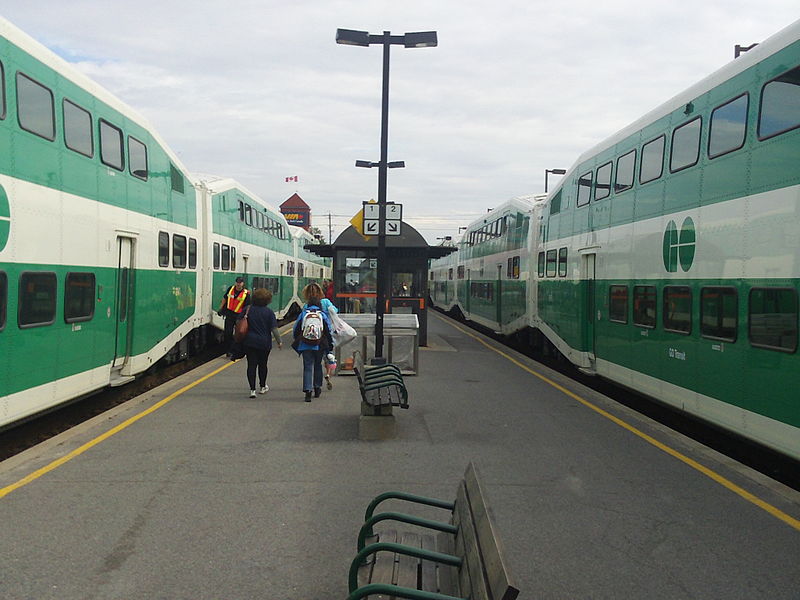
The platform at Oshawa GO station. The parking situation is insane at Oshawa, so I usually drive one stop west and park at Whitby GO instead.
Photo by Anthony Easton via Wikimedia Commons
Nearing the end of our journey, the lights in the car went out and the train coasted to a stop right in the yard throat of Toronto’s Union Station. For several minutes, there was no information from the conductor — sorry, the “Customer Service Ambassador” — but then he announced that we all needed to move along the train “in the opposite direction the train is travelling” to car number 2xxx. We all got up and shuffled through the train passing through several bilevel cars until we started to smell smoke … the conductor had sent us in the wrong direction and we’d been walking toward the fire, not away from it. We could also see some grey smoke being blown toward us from the locomotive end of the train, so it didn’t take much to persuade everyone that we needed to walk to the front of the train instead.
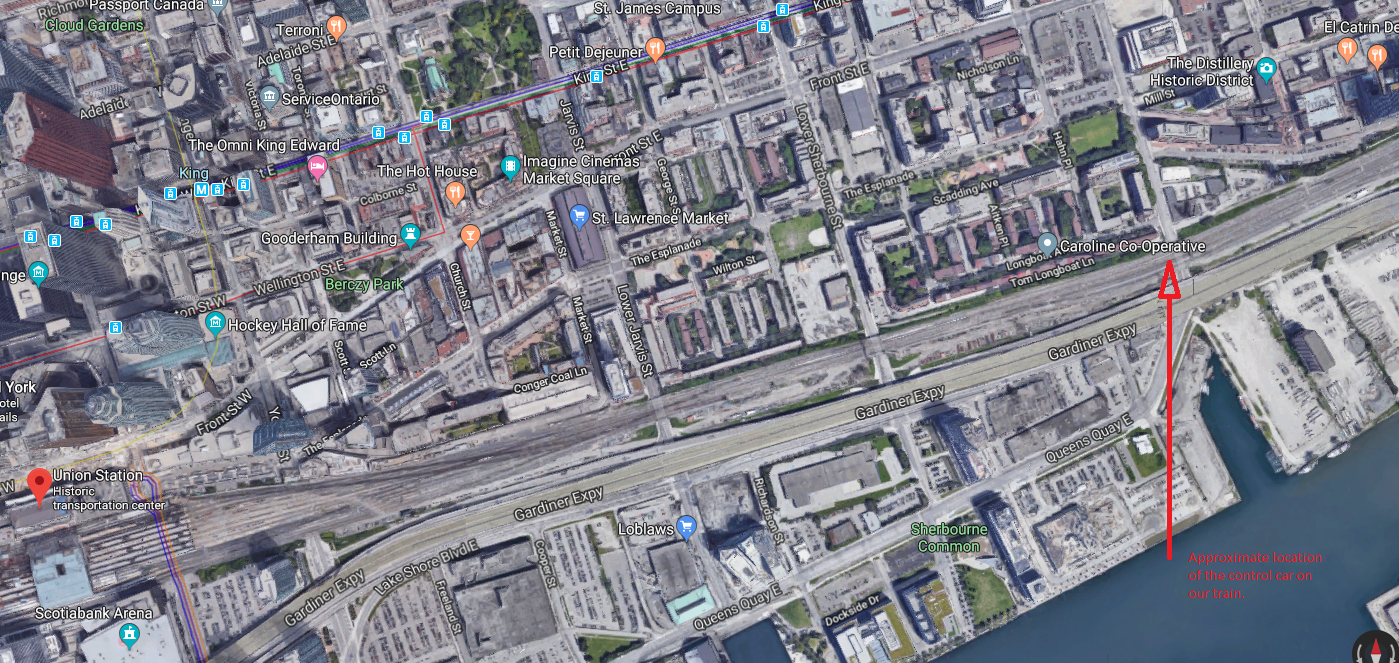
There seemed to be a lot of sirens approaching the train, as the emergency services were dispatched, and no other trains could get into or out of the east end of Union Station for over an hour while we sat in the slowly cooling control car at the west end of the train. Eventually, they were able to get a crew to bring out another train for us to transfer into and they took us the kilometer or so into Union, ninety minutes late.
blogTO had a few photos of the end of the train we couldn’t see:
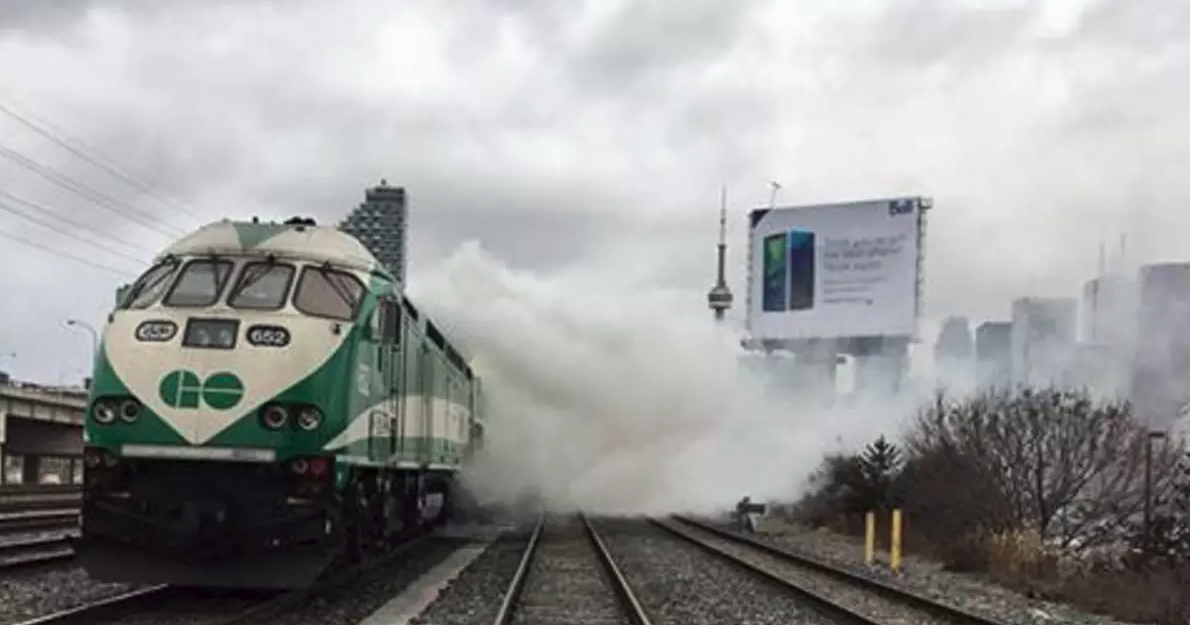
Image of locomotive fire posted by blogTO.
A GO Train was on fire in #Toronto earlier today https://t.co/EgkEmBPyHx – Video by Ali Al Astarabadi pic.twitter.com/BIGUitgflZ
— blogTO (@blogTO) January 7, 2019
After those two incidents, I was wondering if the universe was trying to tell us we shouldn’t have gone into Toronto after all…
Comments Off on A typical commute
January 6, 2019
The demands to re-nationalize British passenger railways
In the Continental Telegraph, Tim Worstall points out the mutually exclusive claims about the state of British passenger rail services and the counter-productive demand to shuffle it all back into the state’s tender mercies:
Wikimedia caption – “This is the Bring Back British Rail, a reverse image of the old BR logo, (now used by the TOC’s) to show we are heading the wrong way with Rail in the UK”
A standard whinge in Britain today is that rail privatisation has failed – just look, the trains are so crowded! The thought that people flocking to use something proves failure being a most odd one of course. That more people use the train sets to travel longer distances more often should be seen as a triumph of privatisation, not a proof of its failure. And we should note that the last few decades of British Rail did show – population adjusted – falling ridership.
There’s also a certain puzzlement at the next cry of outrage – that ticket prices are too high. If people are flocking to use something etc then it’s difficult to insist that prices are too high. […] Popularity both proves that the basic system is wrong and also that prices are too high. Tough this economics stuff, isn’t it?
As to the congestion part, well, on those popular lines and routes the route itself is running at capacity. It’s just not possible to squeeze more trains onto the tracks without them running into each other. Ah, but goes the cry, government should do something! But the tracks are already run by government, that we’re not getting more track capacity is government’s fault. Giving us a good guide to how it would be if government ran it all – as history tells it was like when government did.
As to the prices, well, that overcrowding shows us that prices are too low. We need some method of rationing that access to something being over-used. Price is always the best method of rationing. Thus prices should be higher to relieve that over-crowding – while we wait a few decades for government to pull thumb out and provide more track capacity.
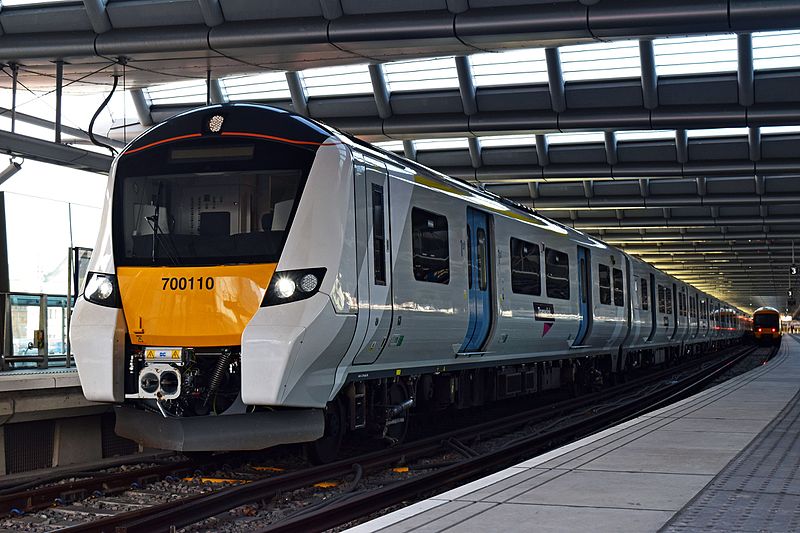
Thameslink Class 700 Desiro City at London Blackfriars in 2016.
Photo by Alex Nevin-Tylee via Wikimedia Commons.
Comments Off on The demands to re-nationalize British passenger railways
January 5, 2019
We may already have passed the peak of High Speed Railways
Hans Bader looks at the mass transit mess, including a brief glance at the state of high speed passenger rail:
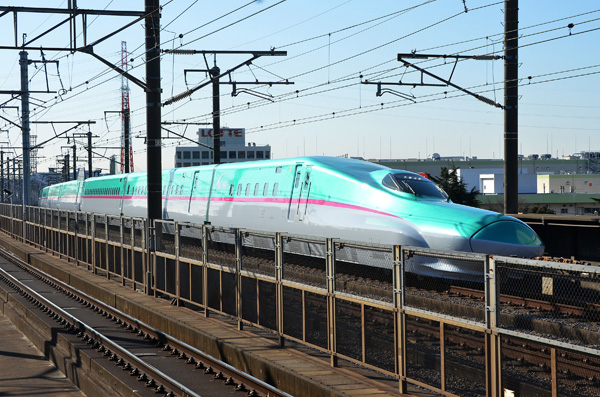
So-called bullet trains generally turn out to be white elephants. South Korea is abolishing its celebrated high-speed rail line from its capital, Seoul, to a nearby major city because it can’t cover even the marginal costs of keeping the trains running. Most people who ride trains don’t need maximum possible speed, and most of those who do will still take the plane to reach distant destinations.
Despite Japan’s much-vaunted bullet trains, most Japanese don’t take the bullet train either; they take buses because the bullet train is too expensive. Bullet trains do interfere with freight lines, so Japanese freight lines carry much less cargo than in the United States, where railroads—rather than trucks—carry most freight, thereby reducing pollution and greenhouse gas emissions.
California’s so-called bullet train is vastly behind schedule and over budget, and will likely never come close to covering its operating costs once it is built. As Reason magazine noted, transportation officials have warned that California’s misnamed “bullet train” is a disaster in the making. California is drastically understating the costs of its high-speed rail project. Just the first leg of this $77 billion project will cost billions more than budgeted. And the project is already at least 11 years behind schedule.
Comments Off on We may already have passed the peak of High Speed Railways
December 5, 2018
The Alberta government must be getting a heck of a deal on those tank cars and locomotives
Alberta Premier Rachel Notley grabbed headlines recently with her pledge to buy additional railway locomotives and tank cars to help move some of Alberta’s excess crude oil to market. Brian Zinchuk says those numbers don’t make sense, given the amount of money the province is to pay:
On Nov. 28, Alberta Premier Rachel Notley announced her province is going to be acquiring unit trains to get her province’s landlocked oil moving. Not only has she committed money to Trans Mountain Expansion, but now rail, too. This premier is serious.
However, there’s a big problem with her numbers. She spoke of $350 million to purchase up to 7,000 rail cars and 80 locomotives. That $350 million doesn’t come even close. It might be enough to lease those units for a few years. Her stated intention was this was a short-term solution, and the life expectancy of a locomotive and tanker cars is easily into three or four decades.
However, she said, “Alberta will buy rail cars ourselves in our fight to get top dollar for the resources that belong to every Albertan.”
I never saw “lease” mentioned once.
Notley spoke of 120,000 barrels per day (bpd) of capacity. Her initial statements weren’t very clear, as someone with little knowledge of the business might think she just meant two sets of 100 or 120 car trains. That wasn’t at all what she meant.
She meant enough trains to keep 120,000 barrels per day in motion, each and every day. That’s a lot of rail cars, and a lot of locomotives.
[…]
There’s a problem with her numbers, however. The current standard locomotives used by Canadian railways cost US$3 million each as of December 2017, when CN bought 200 locomotives for US$600 million. That’s $3.859 million Canadian, each, at the exchange rate at that time. Notley spoke of 80 locomotives – that’s $308.7 million. That only leaves $41.3 million for 7,000 rail cars, or $5,897 each. That’s obviously way too low. So either there’s some leasing considerations involved here, perhaps on the locomotives, or the $350 million is way too low. Remember they were asking the feds for half? Even if the feds coughed up an additional $350 million, that still leaves only $55,900 per car.
My math shows, on the low end, a price tag of $945 million for new rail cars alone. Coupled with ~$309 million for locomotives, and you come in at $1.254 billion. At the high end, it would be $1.484 billion for cars, totalling $1.793 billion including locomotives. Either way, it’s a heck of a lot more than the $350 million announced. Unless she’s leasing, Notley’s $350 million is only one-third to one-fifth of the money required to buy all these new trains, and no consideration has been given to staffing or operational costs.
H/T to Small Dead Animals for the link.
Comments Off on The Alberta government must be getting a heck of a deal on those tank cars and locomotives
November 28, 2018
The bitter economics of North American passenger railways
Earlier this month, I posted an excerpt from The Romance of the Rails, by Randal O’Toole. It’s a book I haven’t yet read, but based on what I’ve heard, his analysis of the state of US and Canadian passenger rail is both savage and accurate — as in, we’re insane to subsidize long-distance or high-speed rail for the wealthy out of the taxes levied on the poor. Recently, Trains columnist Fred Frailey got a chance to chat with O’Toole about his work:
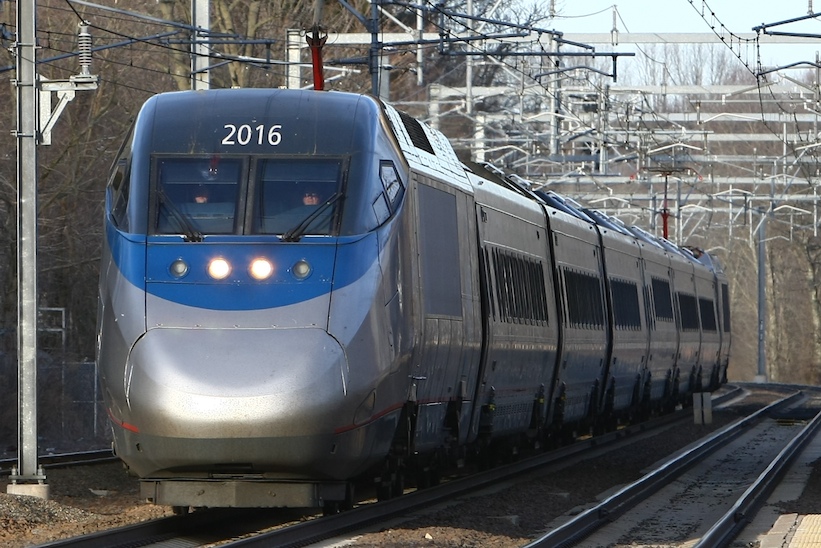
Amtrak Acela passing through Old Saybrook, CT
Photo by Chasesmith via Wikimedia Commons
That was one of the pleasures of reading your book, to discover you are a lover of trains and railroads, and that you marry this with a contrarian way of thinking. Do you take perverse pleasure in that combination? Oh, not at all. To me, it’s really sad. I wish I could support passenger trains, and I do support them as far as riding them and things like that. But I know enough about government subsidies to know that they reduce overall productivity and usually end up taking from the poor and giving to the rich. The people who are riding the Acela are not people in need of government handouts. The people who are riding light rail and things like that are not the poor, by and large.
What is the future of the long-distance trains? The role they fulfill is giving people access to scenery they can’t see in any other way, and really, it ends up being something for the wealthy. I think the Rocky Mountaineer model is the future of long-distance trains, and if you look at the United States, where can we have a Rocky Mountaineer? Certainly, Oakland to Denver, probably Oakland to Los Angeles, and after that, it gets pretty iffy. They would become cruise trains.
You seem almost as uncharitable towards the short-distance passenger trains. Amtrak does its best to deceive people about how well these trains do, for example, counting state subsidies as “passenger revenues,” in order to make itself eligible for more subsidies. I wouldn’t mind short-distance trains if they worked, but the Cascades, the California service, those trains aren’t really doing anything. A lot of money is spent carrying not that many people.
[…]
Statistics of yours that struck me are that public transit paid 90 percent of operating costs in 1964 from fares and just 32 percent today. Why not try to make the rail part of public transit more viable? You don’t address that in your book. You can’t make it more economically viable, simply because buses are so much better in every respect than rails. If you take the rail lines, and pave them over, and turn them into busways, you’ll be able to move more people, faster and cheaper and with far lower maintenance costs. Even if you could make the rails pay for themselves, since the buses are so much cheaper, why would we bother?
You seem most upset at places like Orlando and Dallas and Nashville, where commuter rail or light rail began but so few seem to ride. It this money thrown to the wind? I think so. Why is it that we allowed steam to change to diesel, sailing ships to steam ships — all these different technological evolutions to take place — but when it came to passenger rail, we said, “Halt, we don’t want more technological change.” The answer is threefold. It’s nostalgia. It’s people who are making money from wasting money, such as contactors — crony capitalism. And it’s accidents of history. The accident of history affecting urban rail transit was in 1973. Governor Francis Sargent of Massachusetts asked Congress to let cities substitute capital investments in transit for interstate highway grants. Congress said yes, but you can’t spend that amount of money on new busses. Instead, cities such as Buffalo, Portland, and San Jose built new rail lines with money from cancelled freeways because they are expensive and could use up those federal dollars. That’s what started the light-rail revolution, not because it was cheap, but because it was expensive.
Comments Off on The bitter economics of North American passenger railways
November 15, 2018
The Romance of the Rails
Randal O’Toole’s new book on North American railways goes straight to my “wish list”. He’s also a long-time fan of railways, but has been forced to admit that attempts to bring back the golden age of rail are wasted effort because railways — especially US and Canadian lines — are built to carry bulk freight efficiently and economically but attempts to also carry large numbers of passengers quickly cannot be successful without building entirely separate (high-speed) lines. This is from the introduction to The Romance of the Rails [PDF]:

Amtrak’s
Eastbound Empire Builder crossing Two Medicine Trestle at East Glacier MT on 20 July 2011.
Photo by Steve Wilson via Wikimedia Commons.
Early in my career, I joined the National Association of Railroad Passengers (NARP) and supported more funding for Amtrak. Later, I realized Amtrak was poorly managed and supported Amtrak reform. More recently, along with NARP founder Anthony Haswell — who is sometimes called the Father of Amtrak — I became completely disillusioned with the idea of government-run trains and have argued for abolishing the heavily subsidized federal passenger rail corporation.
My attitudes toward urban transit have also undergone a transition. In 1972, as an undergraduate student, I wrote a paper for the Oregon Student Public Interest Research Group (OSPIRG) advocating low-cost transit improvements in Portland aimed at attracting people out of their automobiles and reducing air pollution. When the director of OSPIRG later became general manager of TriMet, Portland’s transit agency, he implemented some of those improvements, and transit ridership surged. To be honest, I didn’t propose rail transit reform in 1972 simply because I didn’t think there was much chance of that happening. However, I later became more skeptical of rail transit when Portland built an expensive light-rail line, followed by more lines that were even more expensive.
That skepticism has led some people to call me “anti-transit” and “anti-passenger train.” But I’m not. If someone could design a rail system that attracted riders and efficiently moved them from place to place, I’d be the first to endorse it. As this book will show, however, this is no more likely to happen than the freight railroads converting back to steam power. The next technology replacement will not be people trading in their cars for high-speed trains and light rail. Rather, it will be people trading in their human-driven cars for increasingly autonomous cars that drive themselves.
The short answer to the question of why passenger trains and streetcars have been replaced by planes, cars, and buses is that rails are more expensive and less flexible than the alternatives. To understand why, the first 10 chapters of this book will delve deep into the history of rail to show how passenger rail transportation once worked, who it worked for, and what has changed so that it no longer works today. This history demonstrates why statements such as, “High-speed trains have faster downtown-to-downtown times than flying” or “Light rail provides an alternative to congested roads going to work” are not relevant. Chapter 11 discusses the question of why passenger rail seems to work in Europe and Asia but not in North America.
Chapters 12 through 17 will each focus on a different kind of passenger rail, from streetcars to high-speed rail. Finally, Chapter 18 will demonstrate why we love trains, but also why we can’t expect them to do for us what they did in the 19th century.
Passenger rail was once an important part of our history, but today it represents a drag on our economy. I still love passenger trains, but I don’t think other people should have to subsidize my hobby.
Comments Off on The Romance of the Rails
November 14, 2018
Ronnie Barker – British Rail
T.V Allsorts
Published on 13 Apr 2016
Comments Off on Ronnie Barker – British Rail
November 1, 2018
Change appears to be inevitable for North American railways
In a recent column in Trains, Fred Frailey examines the long-term impact of the late Hunter Harrison’s railway management reforms:
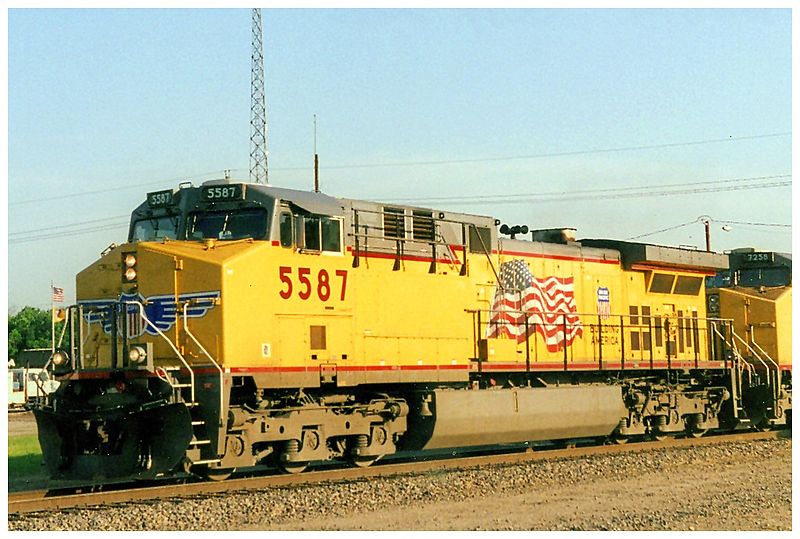
Union Pacific locomotive 5587, a General Electric AC4400CW-CTE(AC44CWCTE)
Photo by Terry Cantrell via Wikimedia Commons.
In the year since Hunter Harrison’s death, Precision Scheduled Railroading, or PSR, has progressed from crackpot railroading (in the eyes of some railroaders and shippers) to the gold standard. And it happened so fast we are still trying to wrap our arms around what it means for the future of this industry.
The facts are these: Canadian National, Canadian Pacific, and CSX Transportation have been put through Harrison’s PSR wringer, emerging in every case much leaner in terms of productive assets — cars, locomotives, trackage, and employees. That meant tons of savings to hand to investors. Interesting to me is what happened after that. CN, which Harrison ran as president or CEO from 1998 through 2009, went on a growth spurt in that period that continues to this day. Revenue ton miles at CN — the most basic measure of what a railroad does — rose 48 percent between Harrison’s retirement in 2009 and 2017. So it’s clear that downsizing the railroad’s assets didn’t inhibit Canadian National’s growth, because no other railroad even approaches what it accomplished during this period. Revenue ton miles rose slightly during Harrison’s tenure at Canadian Pacific and are now rising faster. His successor there, Keith Creel, says CP is game to grow. That’s the same story coming from Jim Foote, who succeeded Harrison late in 2017 at CSX.
Harrison’s impact on the other railroads of North America is palpable. The man was scarcely buried before financial analysts forgot the chaos he unleashed in his hurry to implement PSR at CSX and began asking other railroads why they weren’t more like CN, CP and CSX. Union Pacific, the oldest surviving nameplate in American railroading, capitulated and began implementing PSR practices last October on the eastern part of the railroad, with a goal of expanding the transformation to the entire system within several years. Chief Executive Lance Fritz insists this isn’t a case of PSR Lite.
[…] To change the railroad, you must change the culture. Harrison did it in every instance by force majeure — if you didn’t embrace his plan, goodbye. Who will change the culture at Union Pacific? I am at a loss to know. My sources say the impetus for PSR came not from within the railroad, but from the board of directors, which puts Lance Fritz in a thankless position. He must lead the effort, but this isn’t his idea, and morale in management ranks is low to begin with. His chief operations officer is new to the job, and nothing in the man’s background shouts to me that he is up to this.
Yet there are a lot of smart people at Union Pacific, and no company of its stature launches something of this magnitude with a will to fail. I am heartened that UP began by pruning its management ranks — in 2017 it counted 3,678 executives, officials and staff assistants, versus BNSF’s 1,511. (In fairness, BNSF outsources its information technology, whereas UP does not, accounting for some of the difference.) UP revealed in late 2018 it would eliminate 500 nonunion jobs by year’s end, plus 200 contract workers.
But let’s face it: As done by Harrison, you begin the PSR process by stripping a railroad to its underwear. At CSX it meant cutting every conceivable cost, denuding the railroad of field supervisors and just about everything else, until it began to be dysfunctional. That’s when he knew he had cut enough and could add back assets to make the railroad workable. This method is like becoming pregnant; there is no half way. Union Pacific began Precision Scheduled Railroading with a go-slow approach, not wanting to punish shippers and arouse regulators. Hmm. The way to looks to me now, UP may achieve some good financial results but not the sort that Hunter Harrison could or that its directors might expect. It would be a lot easier for UP to simply buy Canadian Pacific and let Keith Creel, a Harrison acolyte who knows PSR inside and out, come in as an outsider and do the dirty work. And if the process will be hard for Union Pacific, imagine the barriers to PSR in front of BNSF, KCS, and NS, all under pressure to walk the walk but so far unwilling to do so.
Comments Off on Change appears to be inevitable for North American railways
October 28, 2018
The actual science behind the “leaves on the line” excuse for late trains
While it doesn’t explain the “wrong type of snow” excuse also deployed by announcers when Britain’s trains run inexplicably slow in winter, here’s the scientific facts about the “leaves on the line” excuse:
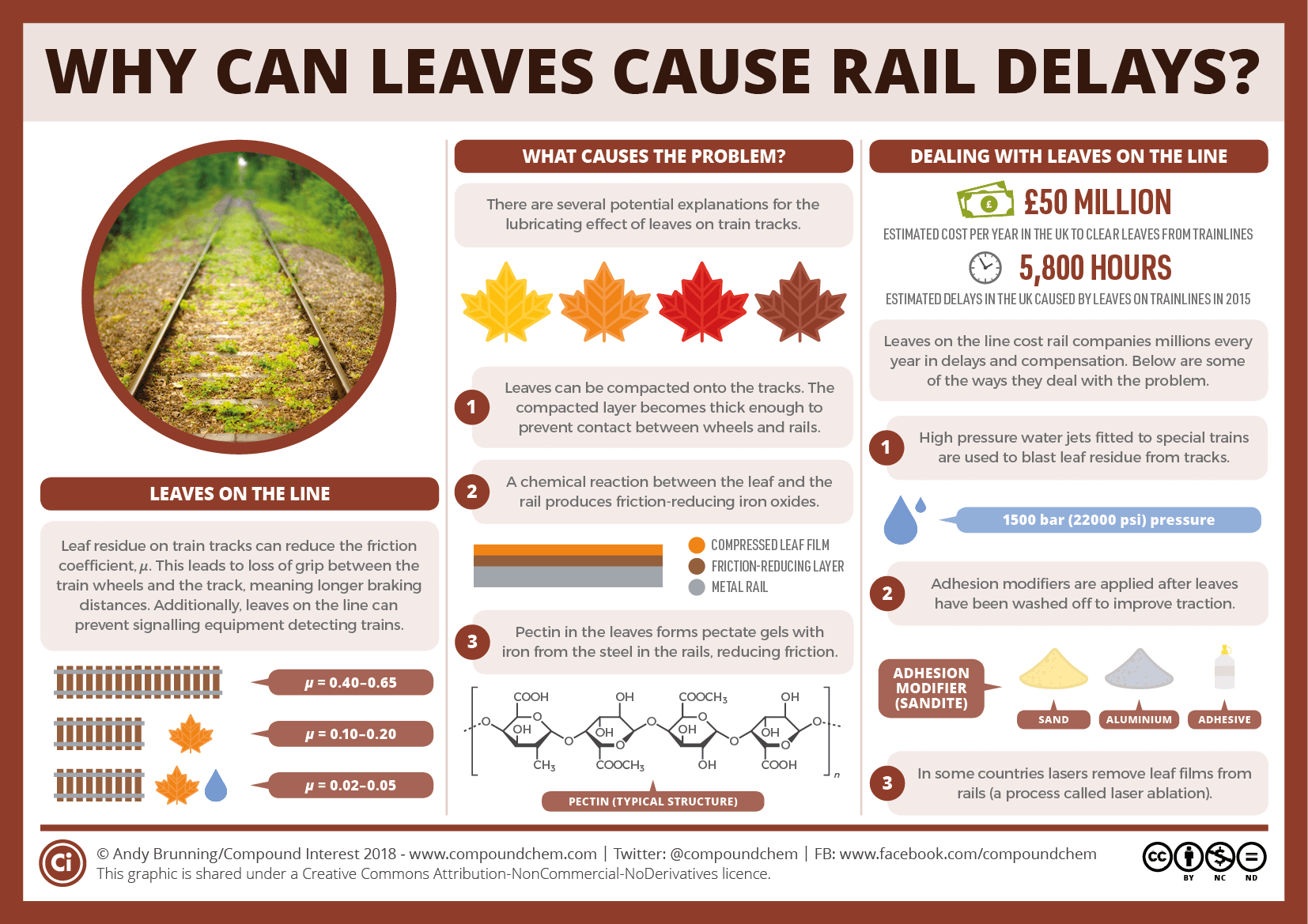
Autumn is here, and for most of us, it’s a time of beauty as the leaves cascade through an array of hues before pirouetting down from the trees. If you have to travel by train, however, you might tire of ‘leaves on the line’ being the supposed cause of train delays. It turns out to be more than just a flimsy excuse – and particular chemical reactions are partly to blame.
We’ve previously looked at the chemical cause of the colours of autumn leaves. By the time they make their descent from trees to the ground, most of these colours have passed. What remains is a brown husk, mainly made up of cellulose. Cellulose is the biological polymer that is the main component of plant cell walls.
Once leaves have fallen from trees, they simply decompose over time. Their presence isn’t usually a problem until it comes to the train network. When leaves fall on train lines, they can reduce the grip between the train wheels and the track. This, in turn, can lead to longer braking distances for trains. By disrupting the contact between the train wheels and the track, the leaves also prevent signalling equipment detecting trains. This can then cause train delays.
What makes leaves affect train tracks in this way? Scientists have a few suggestions, and it’s likely that they all contribute to the problem to some extent.
Comments Off on The actual science behind the “leaves on the line” excuse for late trains
October 10, 2018
Riding the Rocky Mountaineer
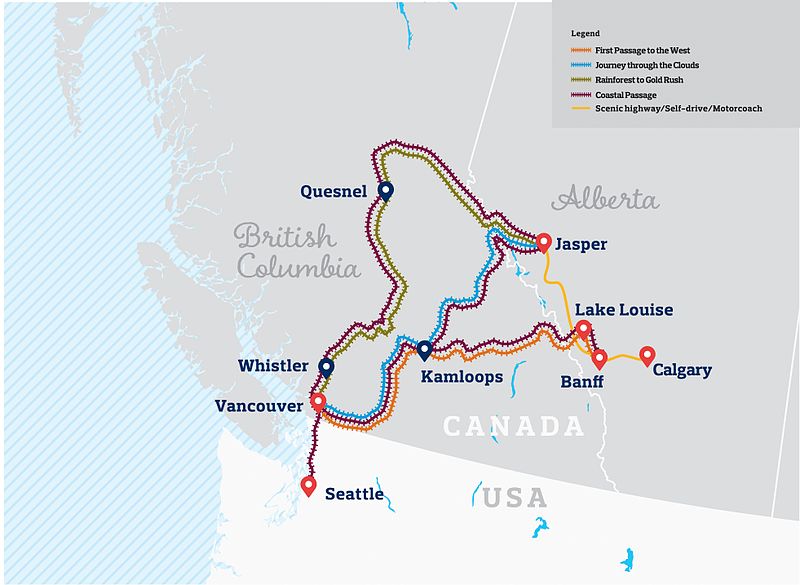
Fred Frailey just got back from a trip on the Rocky Mountaineer and he’s enthusiastic about the train and the experiences it offers (for a price):
I’m just back from railing from Banff, Alta., to Vancouver, B.C., aboard the Rocky Mountaineer … my first such trip in 23 years. Then, it was eight or nine Silver Leaf coaches and a single Gold Leaf bilevel first-class car. This time, it was two coaches and five packed Gold Leaf cars. From the rail trip alone, I figure that Armstrong Group grossed a minimum of $600,000.
Usually (but not this time) there’s a section of roughly equal length out of Jasper, Alta., that joins the Banff train at Kamloops, B.C., so this train can easily be a $2 million-dollar baby when the passenger count tops 1,000 (we had 350). But my sense is that Armstrong Group brings in a at least a much money booking people on pre-train and post-train tours and luxury hotel stays.The Rocky Mountaineer in the Rockies.
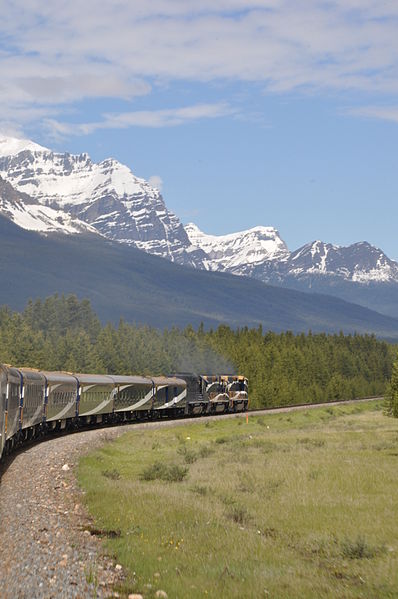
Photo by The Land via Wikimedia Commons.I’ve always sensed a lot of railfan resentment of Peter Armstrong. The beef is that he “stole” from VIA Rail Canada the idea of an all-daylight trip along the Rocky and Selkirk mountains and the Thompson and Fraser rivers. For sure, the man plays for keeps; he is forever wishing to axe VIA’s Toronto-Vancouver Canadian as a government-funded competitor west of Jasper or to have the train sold to his company to redo in some Rocky Mountaineer manner.
But give the man his due. He created something lasting by becoming one of the few people to run passenger trains more than a few miles and make money at it. Who knows where the Canadian will be in a decade; it keeps losing fingers and hands as frequencies are trimmed and schedules lengthened. But the Rocky earns its way commercially, having proven its durability by weathering 2008-2009’s Great Recession.
In the latest issue of Trains, my colleague Bob Johnston writes an excellent capsule history of this service: “One factor driving the decision to move the Canadian over to [the Canadian National] route was lobbying by Vancouver entrepreneur Peter Armstrong to privatize VIA’s summer excursions to Banff, Alta., introduced in 1988. This came with the understanding that his fledging operation would get route exclusivity and some initial financial assistance from VIA to ensure the venture’s success. After a few shaky early years, Armstrong invested heavily in specialty dome cars to make Rocky Mountaineer a financial and creative success in a way the public funded operator never could.”
Comments Off on Riding the Rocky Mountaineer
September 26, 2018
Reforming Union Pacific
Fred Frailey explains why the vast Union Pacific system is due for some serious economic streamlining:
Union Pacific locomotive 5587, a General Electric AC4400CW-CTE (AC44CWCTE)
Photo by Terry Cantrell via Wikimedia Commons.
Union Pacific is the ideal lab rat for Precision Scheduled Railroading, practiced by the late Hunter Harrison on four Class I railroads, with great rewards for shareholders and mixed results for customers. UP, which will begin recasting itself October 1, is ideal for the role because it has too many employees, too many unproductive route miles, and too many expensive toys. Plus, it is less interested in increasing market share than in maximizing freight rates, which makes right-sizing the railroad easier. Let’s start by running the numbers.
Employees. At the peak of the last railroad cycle in 2006, Union Pacific had already been lapped by its western competitor, BNSF Railway, in both cars originated and revenue ton miles. Since then, through 2017, UP’s originations and revenue ton miles both fell 17 percent, while BNSF RTMs actually set a record in 2017. Yet at 44,146 employees last year, UP’s employee count was still 7 percent higher than that of BNSF. To put this another way, for UP’s productivity per employee (revenue ton miles per worker) to equal its competitor’s, it would need to slice the headcount by 16,000. A place to start might be headquarters in Omaha. UP counted 3,678 executives, officials and staff assistants in 2017 versus BNSF’s 1,511.
Barren route miles. Salina, Kan., to Provo, Utah, is becoming a traffic wasteland. That didn’t stop UP from laying welded rail and concrete ties and from covering the almost 1,000 miles with centralized traffic control. Meanwhile, one train a day (plus Amtrak) operates In Missouri between St. Louis and Poplar Bluff, Ark. And the railroad has effectively ceased freight service between Watsonville Junction and San Luis Obispo, Calif., and is close to doing so over the rest of the Coast Line to Los Angeles. All of these routes and perhaps many others you can identify contribute little revenue but buckets of costs, inflating the operating ratio (which is the percentage of revenues eaten up by operating costs). They would constitute Hunter Harrison’s first target.
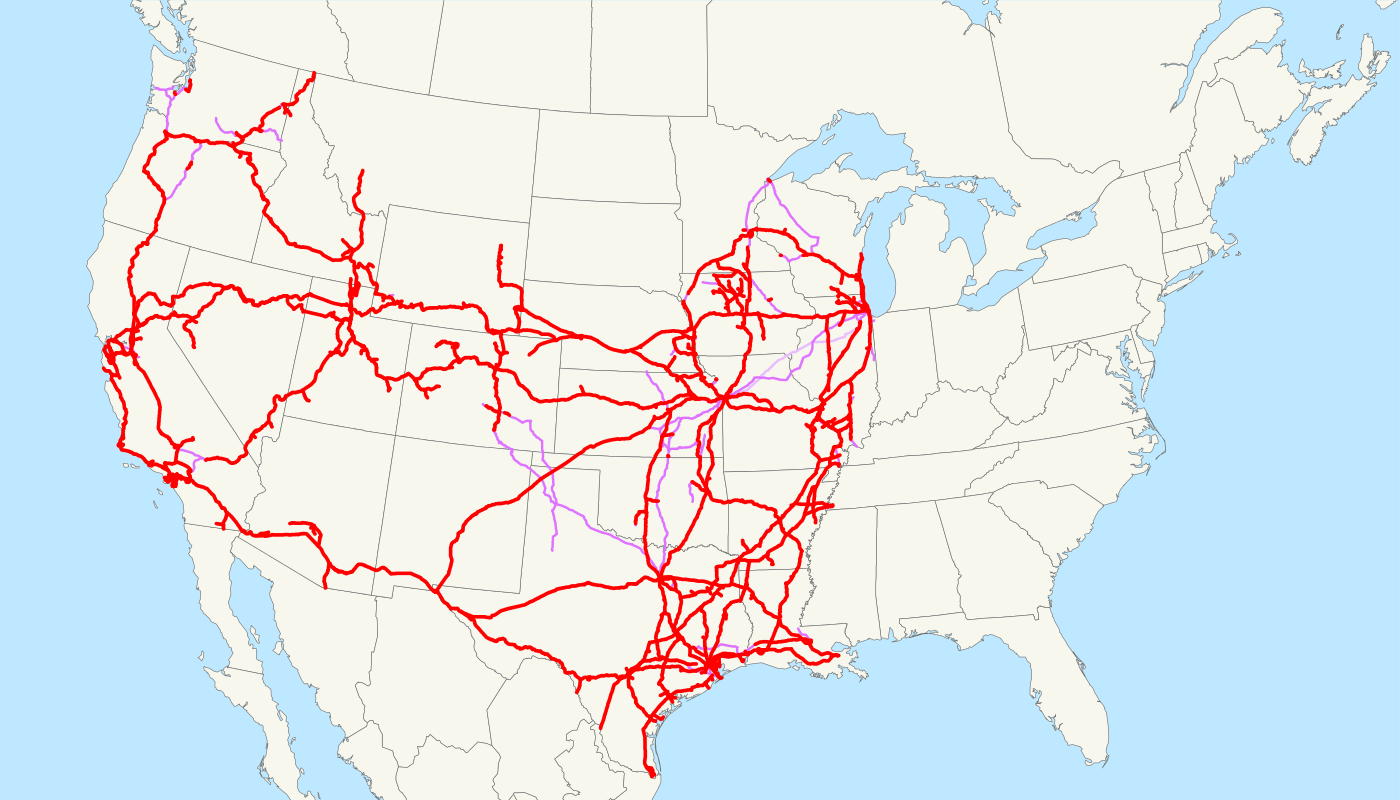
Map of the Union Pacific Railroad as of 2008, with trackage rights in purple (the special Chicago-Kansas City intermodal trackage rights are lighter).
Image via Wikimedia Commons.[…]
Moreover, there are aspects to PSR as practiced by Hunter Harrison that customers won’t like. At the core of Precision Scheduled Railroading is intense use of assets: Run as many trains every day one direction as you do the other, fill them to maximum designed length and operate them at similar speeds. This isn’t how the commercial world works, and the Hunter Harrison way to make customers ship seven days a week was to discount rates on slow days and slap on surcharges on busy days. This keeps your crews and equipment fleet in motion at all times, and those cars and locomotives not continually used can be retired. Goodbye to growth and increased market share, which is a messy process requiring you to accede to the needs of customers rather than the other way around. But it is efficient.
However, if Union Pacific is serious about serving its customers better and delivering individual cars rather than trains to their destinations on schedule, I have an idea that I guarantee will achieve that result: Base salaried bonuses and stock grants on UP’s success in getting cars to customers on the right day and time and on the right train. UP has scheduled individual cars for decades, but there have never been monetary consequences for achieving those plans. People do follow the money. And when Union Pacific does for customers what it says it will do, calling the process Precision Scheduled Railroading or whatever you wish, I will be leading the applause.
Comments Off on Reforming Union Pacific
September 3, 2018
Planes, Trains, and… Actually, just Trains
Knowing Better
Published on 18 Sep 2016The railroad has affected your life more than you may have realized. From starting the mail order business to creating some of America’s greatest landmarks, see how this simple transportation system shaped the country we live in today.
Patreon ► http://patreon.com/knowingbetter
Twitter ► https://twitter.com/KnowingBetterYT
Facebook ► https://facebook.com/KnowingBetterYT/
Reddit ► https://reddit.com/r/KnowingBetter/—
Why Trains Suck in America – Wendover Productions – https://youtu.be/mbEfzuCLoAQ
Photo Credits –
American Waterways/Canals are edits of images I used to teach in 2011 – The originals were from Wikicommons and have long since been removed or updated. No Copyright Information can be found.
The Three Proposed Railroad Routes are edits of images I used to teach in 2013 – The originals were from Wikicommons and have long since been removed or updated. No Copyright Information can be found.
I don’t normally add comments about the daily 2:00am videos, but there are a couple of things in this video that I think needed to be addressed. First, he rather casually skips over the vast increase in American railway building even before the enabling legislation for the transcontinental lines, and misses a great opportunity to explain how important they were in determining the outcome of the American Civil War. Second, and rather more irritatingly, he blithely asserts the common myth about the “Big Oil” conspiracy to buy up and shut down municipal light rail (streetcars, interurban railways, and radials). The various streetcar systems had almost all been economically shaky since the Great Depression (many had to be taken over by the municipalities involved to keep them out of bankruptcy), and the huge increase in private car ownership after World War 2 was the coup de grâce that finished off most of the rest. During the same time, bus routes were encroaching on the streetcar’s territory and had the huge advantage of not being tied to rails (allowing relatively easy re-routing without huge construction costs).
Comments Off on Planes, Trains, and… Actually, just Trains
September 2, 2018
Amtrak service and the “takings” clause
Back in August, Fred Frailey reluctantly came to the conclusion that at some point American freight railways are going to have to challenge in court Amtrak’s legislated ability to pre-empt freight traffic on their networks:
Amtrak’s
Eastbound Empire Builder crossing Two Medicine Trestle at East Glacier MT on 20 July 2011.
Photo by Steve Wilson via Wikimedia Commons.
We all know about “taking the Fifth.” It’s our right under the Fifth Amendment to the U.S. Constitution not to be compelled to testify against ourselves. In other words, a court cannot force us to admit to driving 60 mph in a 45-mph zone (or something worse). That amendment has another, less-well-known clause, which says government cannot take away our property without just compensation. Lawyers know this as the “Takings Clause.” The Fifth came to mind the other day as I rode Amtrak’s Empire Builder from Seattle to Chicago. I’ll get to my point, but first the experience.
[…]
All of this did terrible things to our schedule-keeping. By the third morning, as the train approached Devils Lake, N.D., we were more than eight hours late (the next day’s eastbound Builder was even later). But imagine what the Empire Builder does to BNSF’s freights every day. The Amtrak Improvement Act of 1973 reads: “Except in an emergency, intercity passenger trains operated by or on behalf of [Amtrak] shall be accorded preference over freight trains in the use of any given line of track, junction, or crossing.”
BNSF appears totally committed to obedience of this law but doing so devours the capacity of this route. It’s not just that freights give way; whizzing along at a 79 mph versus 55 or 60 for the freights, the Empire Builder eats capacity as if it were two or three freights, Six high-priority Z trains prowl the northern Transcon every day, and I don’t think a single one of them that I observed was moving as we went by. One Z train was sandwiched between two stopped manifest trains, all making way for our Builder.
Obviously, Amtrak pays BNSF for the right to run trains over the freight railroad. But whatever it pays is but a fraction of the cost in delays to its own trains incurred by BNSF. Were the northern Transcon double-tracked all the way, these delays would obviously be minimized. But at $3 million or more a mile, double tracking consumes capital like a dry sponge, and it’s not Amtrak’s capital, either.
So now to my point: Isn’t it fair to say that Amtrak, which the U.S. Supreme Court in 2015 decreed to be an arm of government, is confiscating the property (track capacity) of host railroads? And if it is, shouldn’t the freight railroads be fairly compensated for the delays to their freights caused by the loss of this capacity? Try as I might to say otherwise, I am forced to answer “yes” to both questions.
Comments Off on Amtrak service and the “takings” clause


