Quotulatiousness

May 21, 2019

Four “youths” vandalize model railway show

Filed under: Britain, Law, Railways — Tags: , , , — Nicholas @ 03:00

There don’t appear to be any details online about the four “youths” who were arrested then released, so I assume their anonymity is protected by a British equivalent of the “Young Offenders Act”. The Market Deeping Model Railway Club describes the crime on their website:

We were all immensely upset to discover that overnight the school where our show was to be held had been broken into and almost everything totally ruined. This has devastated not only our own members but those of other clubs and the traders who had already set up shop. In the circumstances we felt we had no option other than to cancel the show.

Some of the models destroyed were irreplaceable and while we will of course be seeking to replace and rebuild wherever possible, this will take time and money. We have been overwhelmed by the many messages of support we have received together with offers of financial assistance. Please do help raise funds via our Just Giving page.

Click the image to go to their Just Giving fundraising page.

More on the incident from Deepings Nub News:

Bill Sowerby, Market Deeping Model Railway Club exhibition manager, told Deepings Nub News: “I arrived at 7.30am to be met by one of our members who told me the terrible news.

“Four of the layouts were completely trashed – two of our club’s, one privately owned and one from St Neots club.

“Four demonstrator stands and one for Bourne U3A stall, which would have raised funds for their organisation, was also smashed.

“Fortunately five other layouts in another room were undamaged and we had nine more left to install early this morning.

“It’s really hurtful for us all, not just because of the thousands of pounds we have lost in income – we were expecting between 400 and 500 visitors – and have paid out a lot of money to put on what is the club’s main fundraising event. Demonstrators and trade stands have also lost income.

“But it’s also the time and effort that members put into building the layouts. The St Neots layout took 25 years to construct and our Woodcroft layout took 26 years and involved more than 100 people over those years spending thousands of hours.

“Woodcroft will be repaired, but it’s so sad because a large number of the people who dedicated their time to build it are no longer with us. It has real sentimental importance to the club.

“Although our Knowl End – a children’s layout – was completely destroyed.”

May 20, 2019

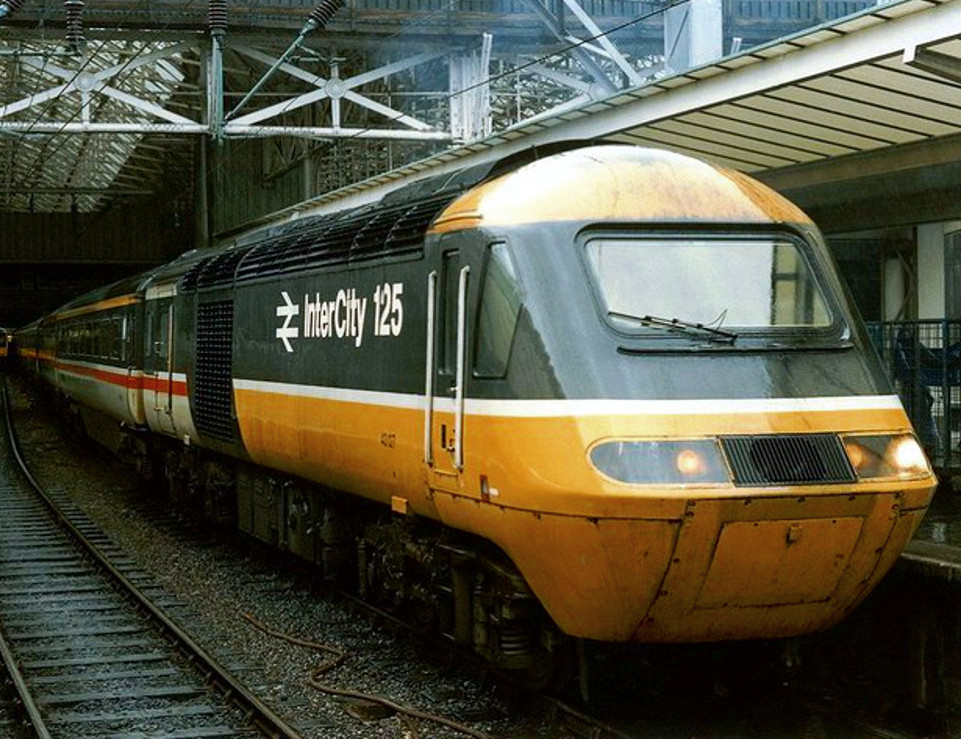
Britain’s InterCity 125 has run its last revenue miles

Filed under: Britain, Railways — Tags: — Nicholas @ 05:00

Tim Worstall explains why the withdrawal of the InterCity 125 has struck a chord in commuters and railfans alike:

An InterCity 125 power car in British Rail livery at Manchester Piccadilly in October 1976.
Photo by Dave Hitchborne via Wikimedia Commons.

The last run was between London’s Paddington Station and Exeter St. Davids. There’s an amusing anecdote about the development and testing of the locomotives that I thought I’d blogged, but better late than never:

There’s something called the chicken gun. If you’ve a jet engine then you want to make sure that it doesn’t fall apart in a bird strike. Shards of sharp metal flying around at hundreds of miles an hour are not known to be good for aluminium skinned modes of transport hundreds or thousands of feet off the ground.

So, you set up a cannon, spin the jet engine up and fire a chicken into it. […] Great. So, bright sparks at British Rail noted that their train was going to be hurtling through the countryside at 125 miles per hour. There would be cuttings and embankments and birdies flying around and the possibility of bird strikes. Better test this out.

So, borrow the chicken gun. Load chicken, fire. The carcass goes straight through the reinforced glass, through the steel back of the driver’s seat and embeds itself in the back wall of the engine compartment.

Umm, is it supposed to do that? No, it bloody well isn’t.

So, long pondering, they enlist the help of the Americans they’d borrowed the chicken gun from. Big report finally arrives, hundreds of pages of analysis, tensor strengths, bits of Fortran coding, the lot.

On the first page it reads

“In order to use the chicken gun, first defrost your chicken”.

May 19, 2019

Malcom McLean’s container shipping revolution

Filed under: Business, Economics, History, Railways, USA — Tags: , — Nicholas @ 03:00

At the Foundation for Economic Education, Alexander Hammond recounts the tale of a former truck driver who was instrumental in revolutionizing the way we ship products around the world:

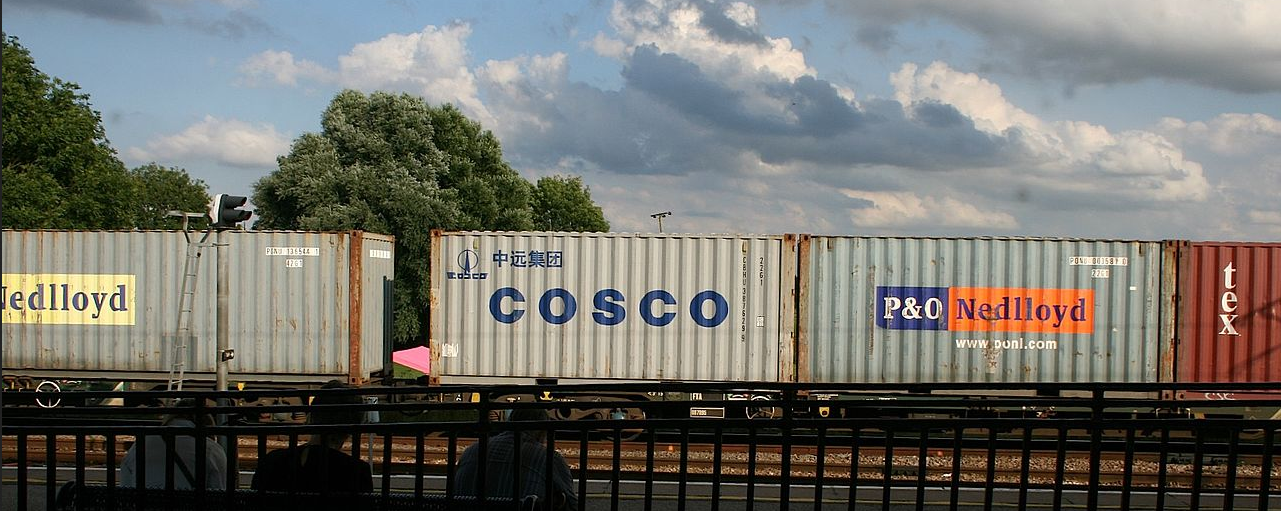
Deep-sea containers from China at Ely, Cambridgeshire
Via Wikimedia Commons.

In 1937, McLean made a routine delivery of cotton bales to a port in North Carolina for shipment to New Jersey. As McLean couldn’t leave until his cargo had been loaded onto the ship, he sat for hours watching dozens of dockhands load thousands of small packages onto the ship. McLean realized that the current loading process wasted enormous amounts of time and money, and he began to wonder if there could be a more productive alternative.

In 1952, McLean thought of loading entire trucks onboard a ship to be transported along the American Atlantic coast (i.e., from North Carolina to New York). Although this idea would dramatically reduce loading times, he soon realized that these “trailer ships” would not be very efficient due to the large amount of wasted cargo space.

Mclean modified his original design so that just the containers—and not the trucks’ chassis—were loaded onto the ship. He also developed a way for the containers to be stacked on top of one another. That was the origin of the modern-day shipping container.

In 1956, McLean secured a bank loan for $22 million. He used the money to buy two World War II tanker ships and convert them to carry his containers. Later that year, one of his two ships, the SS Ideal-X, was loaded with 58 containers and sailed from New Jersey to Houston, Texas. At the time, McLean’s shipping company offered transport prices that were 25 percent lower than those of his competitor as well as the ability to lock the containers in order to prevent cargo theft, which also appealed to many new customers.

By 1966, McLean launched his first transatlantic service and three years later, McLean had started a transpacific shipping line. As the advantages of McLean’s container system became clear, bigger ships, more sophisticated containers, and larger cranes to load cargo were developed.

Update 21 May: Here’s a breathtaking example of just how much McLean’s containers changed the world:

April 12, 2019

Premier Ford “could go down in history as the premier who landed downtown Torontonians their white whale subway”

Filed under: Cancon, Government, Railways — Tags: , , , , — Nicholas @ 03:00

Chris Selley finds himself surprised at how sane Doug Ford’s GTA subway-and-light-rail expansion plans sound:

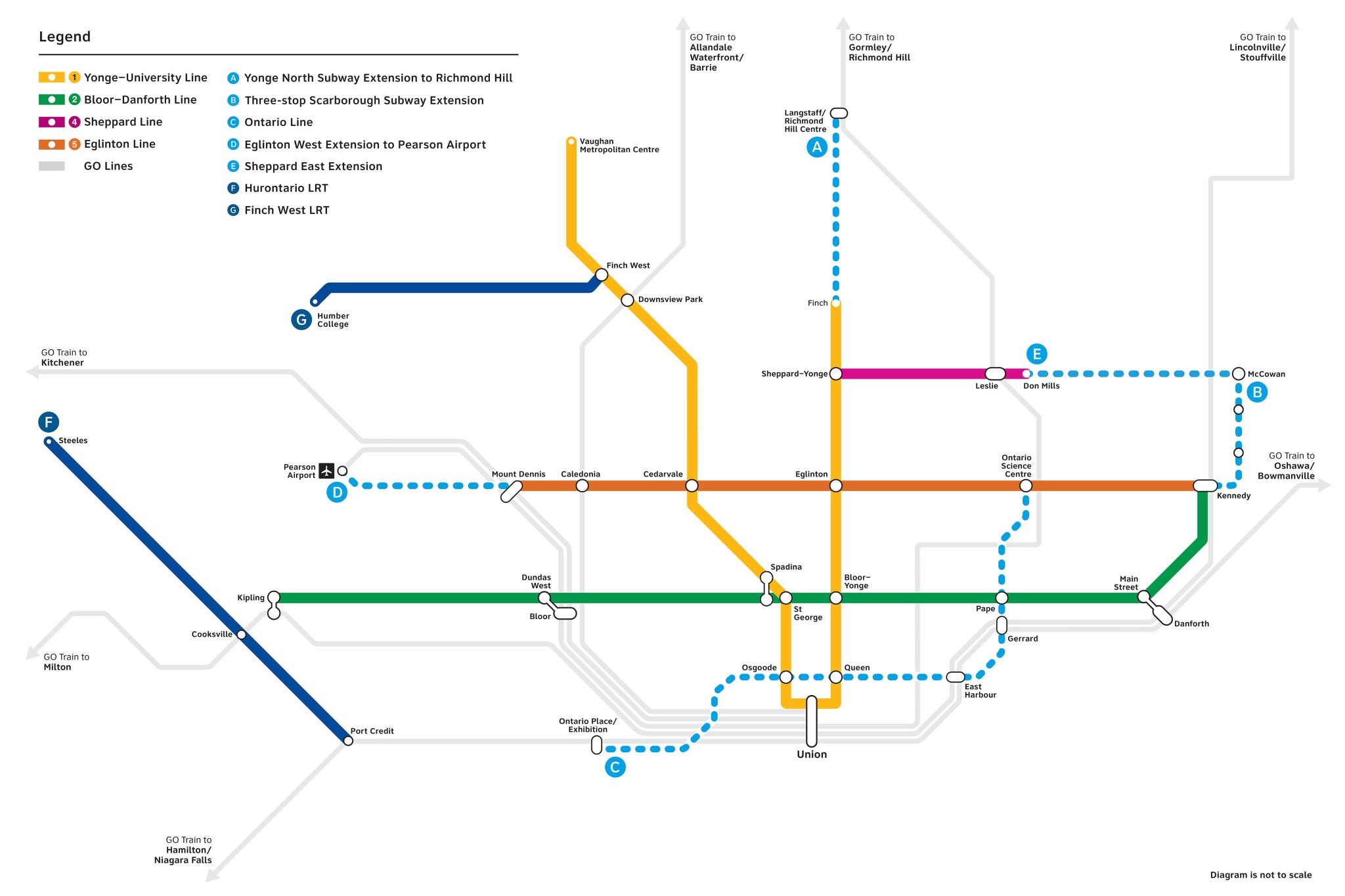
Click map to embiggenate

I’ll say this much at least about Premier Doug Ford’s big $28.5 billion transit announcement on Wednesday morning ($11.2 billion if you only count provincial money): I never thought I would see him so enthusiastically tout a much-needed transit line to and through enemy territory in downtown Toronto. Faint praise, perhaps, but when Ford said he wanted to upload Toronto’s subways to the province, I never imagined a plan even half this superficially sane.

Crowding on the Yonge line at Bloor Street presents “a clear health and safety problem,” Ford told reporters in Etobicoke, “and without action it is only going to get worse.” Thus his number-one transit priority is the same as everyone else’s: the Downtown Relief Line, which the PC government has wisely redubbed the Ontario Line.

The most basic and essential piece of that line, which Toronto city staff are already working on, would connect City Hall with Pape station on Danforth. Passengers who live in the east end and work downtown could thus avoid the bottleneck at Yonge and Bloor, relieving the alarming rush hour situation on platforms there and — assuming new TTC signalling technology works as promised — freeing up southbound capacity for folks from York Region: Ford vows to extend the Yonge line to Richmond Hill (cost: $5.6 billion).

The order here matters more than the timeline (2027, supposedly). It is undisputed that the DRL has to happen before the extension. That’s basic knowledge. But Ford is capable of ignoring or fouling up very basic knowledge when stumping for subways. This is a man who nearly promised Pickering one. On Wednesday, he sounded remarkably well briefed.

Ford’s Ontario Line wouldn’t stop at Danforth and City Hall, either. In the east it would head north across the Don Valley, through Thorncliffe Park and up to Eglinton. This idea is nearly as old as the DRL itself. And it would jog southwest from downtown to Ontario Place — a novelty, but again, not crazy. Total cost for the line: an at least semi-plausible $11.2 billion.

April 11, 2019

Ontario government unveils massive subway and light rail expansion for the GTA

Filed under: Cancon, Government, Railways — Tags: , , , , , — Nicholas @ 05:00

Doug Ford has always been a fan of subways, but now that he’s the Premier of Ontario, he’s getting to indulge his subway fetish in a vast expansion to heavy and light rail transit in and around Toronto:

Click map to embiggenate

The plans include:

  • An expanded downtown relief line, now to be called the Ontario line, running from Ontario Place on the lakeshore through downtown along Queen Street then crossing the Bloor-Danforth subway line at Pape station and running north to the Ontario Science Centre on the Eglinton Crosstown LRT line. This line is optimistically to be ready for opening by 2027.
  • The existing Sheppard Line will be extended east from Don Mills to McCowan, where it will intersect with the planned Scarborough subway extension (now to include three stops, not just the one originally announced, and to be completed by 2030).
  • The Yonge-University line will be extended north from current terminus at Finch to the Richmond Hill Centre with a hoped-for completion date soon after the Ontario line.
  • The Eglinton Crosstown line will be extended west to Pearson airport, with a target completion date of 2031.
  • New light rail lines will be created between Finch West on the Yonge-University subway to Humber College, and along Hurontario Street in Mississauga from Port Credit on the lakeshore to Steeles Avenue in Brampton.

To accomplish all of this will require financial contributions from the City of Toronto, York Region, and the federal government, as the province is only funding just over one third ($11.2 billion) of the estimated $28 billion price tag.

Of course, it’s a Doug Ford plan, so none of the usual suspects in Toronto are happy about any of it.

April 8, 2019

Why Don’t Trains Have Cabooses Anymore?

Filed under: Cancon, History, Railways, USA — Nicholas @ 02:00

Today I Found Out
Published on 7 Sep 2016

Never run out of things to say at the water cooler with TodayIFoundOut! Brand new videos 7 days a week!

In this video:

Carrying a brakeman and a flagman back when brakes were set by hand, when it was time to slow the train, the engineer would blow the whistle. This signaled to the brakemen, and one would emerge from the caboose and work his way toward the engine, while another would leave the engine and work his way back toward the caboose. At each car, the brakemen would stop and turn its brakewheel with a club. Once the train stopped, the flagman would leave the caboose with a flag, lantern or other visual display and walk back down the track to warn any approaching trains.

Want the text version?: http://www.todayifoundout.com/index.p…

April 2, 2019

How Trains Changed China | Stuff That I Find Interesting

Filed under: China, Economics, Government, History, Military, Railways — Tags: , — Nicholas @ 02:00

Jabzy
Published on 27 Mar 2016

Thanks to Xios, Alan Haskayne, Lachlan Lindenmayer, William Crabb, Derpvic, Seth Reeves and all my other Patrons. If you want to help out – https://www.patreon.com/Jabzy?ty=h

Music by Derek Fiechter – https://www.youtube.com/channel/UCVRJ…

February 15, 2019

European-style passenger railways don’t scale to North American distances

Filed under: Economics, Europe, Railways, USA — Tags: , , — Nicholas @ 03:00

At PJ Media, Charlie Martin does a good job of showing why the fast, efficient passenger railways of Europe are not replicated in the US and Canada:

… the usual story is something like “the United States should have a world-class passenger train system, with high-speed rail like the French and Japanese have.” @AOC’s official-no-fake-no-just-a-draft-Republican-conspiracy-theory-why-are-you-all-being-mean? Green New Deal FAQ wanted one so good that air travel would become “unnecessary.”

Sounds great, and I love the covert “MAGA” aspect of the pitch, but it has one great big, pretty much insurmountable problem: America.

Not the country, the geography. People living on the coasts just don’t realize how big this country is. I was discussing it on Twitter with a Swiss who lives in Zürich who was telling me how great the Europeans trains are — and they really are comfortable, pretty fast, have great scenery to look at — but, well, let’s compare Colorado and Switzerland. Similar climate, mountains, pretty scenery, cranky natives who are suspicious of newcomers. But let’s go to the maps:

Colorado is 6.5 times as big, has 60 percent of the population — and, it happens, about two-thirds of the gross “national” product per capita.

Compare the lower 48 states with all of Western Europe:

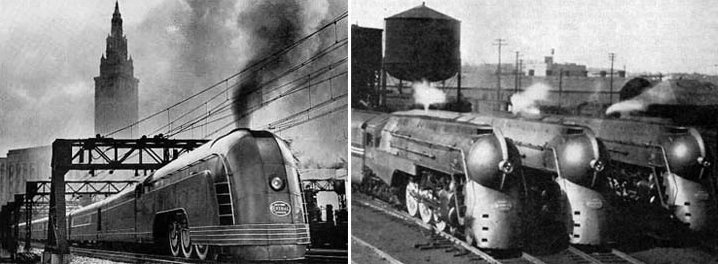
The truth is, we’re in flyover country out here. The coastal clerisy don’t realize that on their five-hour flight from LAX to LGA they’re traveling 2,500 miles. Now, back in the days of the Super Chief and the 20th Century Limited, you could make that trip by train in only 76 hours, not counting changing trains in Chicago. (It takes longer on Amtrak.)

So, let’s say we could get high-speed trains for the whole trip that averaged 200 miles per hour, and could travel as the crow flies: that’s 12.5 hours.

Except of course you couldn’t because the crow is flying over some of the highest mountains in the country. You’re going to need rights of way, and you can’t use the rights of way that exist because they’re not suited for that kind of speed and they’re pretty full anyway. Also, it wouldn’t do to interrupt the existing freight lines, which actually are about as good as anywhere in the world.

February 14, 2019

Even train nerds don’t want “people who know absolutely nothing about rail, high-speed or otherwise, jumping on our bandwagon”

Filed under: Railways, USA — Tags: , , — Nicholas @ 05:00

John C. Wright shares a communication he received from a train enthusiast:

The comments on your blog post today about the Sickly-Green New Deal were coming thick and fast, so I didn’t really have an opportunity to say anything, but I did want to throw in my two cents.

Along with the other basic reason not to like this whole plan (namely, that it’s lunacy), I am personally frustrated by its emphasis on high-speed rail.

By now you know that I’m a train nerd (and I emphasize “nerd”: by my wife’s estimation, the attendees at a National Model Railroad Association convention are even more undateable than the folks at a typical Comic Con).

It’s precisely for that reason that I am so frustrated by these people: they give rail advocates a bad name.

The last thing we need are people who know absolutely nothing about rail, high-speed or otherwise, jumping on our bandwagon because “trains are neat-o!”

Among other things, this false enthusiasm on the part of the left leads to conservatives opposing trains qua trains, simply because they reason that anything liberals are so fond of must by definition be awful (a reasonable argument, I grant you). It’s a bit like having a crazy stalker woman being obsessed with you. Far from being flattered, you want to get a restraining order.

Now, of course, in MY utopia, railroads would dominate the travel scene, much like they did at the end of World War II, though not to the exclusion of other forms of travel.

(Envision the travel scene as it looked in 1945, but with current technology, and you pretty much have the picture.) People would simply use trains more and other modes less, and we would be able to manage without any more freeways or airports than we had in the late 1940s.

When I imagine this utopia, I run into the same problem anyone who tries to envision a utopia runs into: how does one make people like what you like? Since I would never want to force people to do things against their wishes, I can only overcome this by imagining a utopia where everyone just happens to agree with me about trains (along with anything else I consider important, like belief in God, or that bank tellers should still wear jackets and ties or dresses to work as appropriate).

Because this is obviously impossible, it serves to remind me that utopias can only exist in one’s mind and cannot be brought into reality – and that one should never attempt to do so.


February 13, 2019

California mercifully kills the High Speed Train project

Filed under: Economics, Politics, Railways, USA — Tags: , , , — Nicholas @ 05:00

In Reason, Scott Shackford reports on the sudden acceptance that California’s high speed train dream is dead:

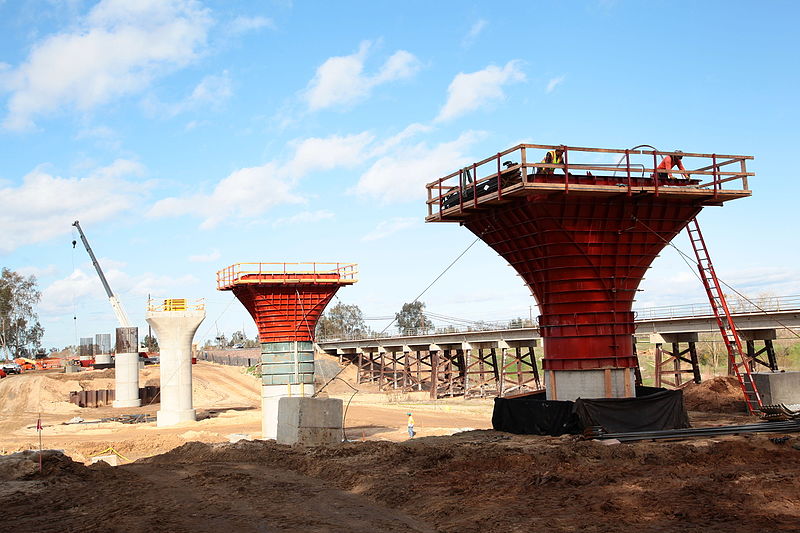
Construction of the Fresno River Viaduct in January 2016. The bridge was the first permanent structure constructed as part of California High-Speed Rail. The BNSF Railway bridge is visible in the background.
Photo by the California High-Speed Rail Authority via Wikimedia Commons.

California’s wasteful, expensive, and likely doomed-to-fail statewide bullet train project is getting killed. Today, Democratic Gov. Gavin Newsom said he’s abandoning the plan as “too costly.”

Newsom made the announcement in his State of the State address this morning. As the Associated Press reports:

    Newsom said Tuesday in his State of the State address it “would cost too much and take too long” to build the line long championed by his predecessor, Jerry Brown. Latest estimates pin the cost at $77 billion and completion in 2033.

    Newsom says he wants to continue construction of the high-speed link from Merced to Bakersfield in California’s Central Valley. He says building the line could bring economic transformation to the agricultural region.

    And he says abandoning that portion of the project would require the state to return $3.5 billion in federal dollars.

    Newsom also is replacing Brown’s head of the board that oversee the project and is pledging to hold the project’s contractors more accountable for cost overruns.

Newsom actually turned against the bullet train project years ago but then went quiet about it when he began his plans to run for governor. He declined to discuss what he saw as the train’s future on the campaign trail, but after he was elected he suggested some sort of cutback was coming, possibly eliminating the bottom half of the project, making it a train from San Francisco to the Central Valley of California.

Now it looks like he’s scaling even that back. Californians are just going to be left with a train in the middle of some of the more rural parts of the state because the Newsom administration doesn’t want to have to repay the federal funding.

Whatever may come next, this is happy news for most California citizens. Voters approved a ballot initiative in 2008 that set aside a $10 billion bond to begin the project of building a high-speed rail line from Los Angeles to San Francisco with the promise that more funding would come through from the feds or from private sources, that the train would not require subsidies to operate, and that it would help fight climate change.

January 14, 2019

Rerailing a Steam Locomotive

Filed under: Railways — Tags: — Nicholas @ 02:00

Fort Wayne Railroad Historical Society
Published on 26 Oct 2016

Watch as our volunteer crew made up of veteran railroaders, experienced mechanics and new recruits wrangle our 200-ton steam locomotive back on the rail. This was no easy way to spend a Saturday. For those curious, the boiler was filled with compressed air to help move the locomotive and the 765 was temporarily renumbered “767” to honor the engine’s unique place in history: http://fortwaynerailroad.org/2016/08/…

January 10, 2019

What Happened to America’s Passenger Trains?! The Truth – from Class to Crap!

Filed under: Economics, Government, History, Railways, USA — Tags: , , — Nicholas @ 02:00

American Rail Club
Published on 1 Jul 2017

Did America’s once industrious and world-famous passenger rail system fall because of “fair and equal” competition – or did the federal government tax it to death? Did America’s shift from rails to roads come out naturally – or from lobbying from General Motors? We visit two of America’s passenger rail cars from a bygone era to reminisce and then dive into the history and truth behind the decline of America’s passenger railroad system.

January 8, 2019

A typical commute

Filed under: Cancon, Personal, Railways — Tags: , — Nicholas @ 03:00

I had to go into Toronto on Monday, and the address was near Queen and Yonge, so I could take the GO train most of the way (which means I could at least get some reading done during the train trip). Getting there wasn’t as easy as I’d hoped, as the traffic on the 401 was slow-to-stopped as I got on, but the sliproad to the next exit was moving even slower than the main highway. Once we got past the turnoff, the speed increased up to slow-but-steady for a few kilometres. Up ahead, there were flashing red and blue lights. I figured there was an accident, so I switched lanes away from what appeared to be the accident site. But it wasn’t an accident, at least not by most definitions. In the eastbound lanes, there were what appeared to be a full dozen police vehicles, surrounding a black car that looked like it’d pinballed against the concrete lane dividers a few times before coming to a stop. Just as I was passing the epicentre, I saw a police officer escorting a handcuffed man from the vehicle toward one of the police cars.

With that delay, we’d pretty much missed the chance to catch the original GO train we’d planned on, but there was another scheduled to arrive about fifteen minutes later which we could still catch.

The platform at Oshawa GO station. The parking situation is insane at Oshawa, so I usually drive one stop west and park at Whitby GO instead.
Photo by Anthony Easton via Wikimedia Commons

Nearing the end of our journey, the lights in the car went out and the train coasted to a stop right in the yard throat of Toronto’s Union Station. For several minutes, there was no information from the conductor — sorry, the “Customer Service Ambassador” — but then he announced that we all needed to move along the train “in the opposite direction the train is travelling” to car number 2xxx. We all got up and shuffled through the train passing through several bilevel cars until we started to smell smoke … the conductor had sent us in the wrong direction and we’d been walking toward the fire, not away from it. We could also see some grey smoke being blown toward us from the locomotive end of the train, so it didn’t take much to persuade everyone that we needed to walk to the front of the train instead.

There seemed to be a lot of sirens approaching the train, as the emergency services were dispatched, and no other trains could get into or out of the east end of Union Station for over an hour while we sat in the slowly cooling control car at the west end of the train. Eventually, they were able to get a crew to bring out another train for us to transfer into and they took us the kilometer or so into Union, ninety minutes late.

blogTO had a few photos of the end of the train we couldn’t see:

Image of locomotive fire posted by blogTO.

After those two incidents, I was wondering if the universe was trying to tell us we shouldn’t have gone into Toronto after all…

January 6, 2019

The demands to re-nationalize British passenger railways

Filed under: Britain, Business, Economics, Government, Railways — Tags: , , — Nicholas @ 05:00

In the Continental Telegraph, Tim Worstall points out the mutually exclusive claims about the state of British passenger rail services and the counter-productive demand to shuffle it all back into the state’s tender mercies:

Wikimedia caption – “This is the Bring Back British Rail, a reverse image of the old BR logo, (now used by the TOC’s) to show we are heading the wrong way with Rail in the UK”

A standard whinge in Britain today is that rail privatisation has failed – just look, the trains are so crowded! The thought that people flocking to use something proves failure being a most odd one of course. That more people use the train sets to travel longer distances more often should be seen as a triumph of privatisation, not a proof of its failure. And we should note that the last few decades of British Rail did show – population adjusted – falling ridership.

There’s also a certain puzzlement at the next cry of outrage – that ticket prices are too high. If people are flocking to use something etc then it’s difficult to insist that prices are too high. […] Popularity both proves that the basic system is wrong and also that prices are too high. Tough this economics stuff, isn’t it?

As to the congestion part, well, on those popular lines and routes the route itself is running at capacity. It’s just not possible to squeeze more trains onto the tracks without them running into each other. Ah, but goes the cry, government should do something! But the tracks are already run by government, that we’re not getting more track capacity is government’s fault. Giving us a good guide to how it would be if government ran it all – as history tells it was like when government did.

As to the prices, well, that overcrowding shows us that prices are too low. We need some method of rationing that access to something being over-used. Price is always the best method of rationing. Thus prices should be higher to relieve that over-crowding – while we wait a few decades for government to pull thumb out and provide more track capacity.

Thameslink Class 700 Desiro City at London Blackfriars in 2016.
Photo by Alex Nevin-Tylee via Wikimedia Commons.

January 5, 2019

We may already have passed the peak of High Speed Railways

Filed under: Economics, Japan, Railways, USA — Tags: , , , , — Nicholas @ 03:00

Hans Bader looks at the mass transit mess, including a brief glance at the state of high speed passenger rail:

So-called bullet trains generally turn out to be white elephants. South Korea is abolishing its celebrated high-speed rail line from its capital, Seoul, to a nearby major city because it can’t cover even the marginal costs of keeping the trains running. Most people who ride trains don’t need maximum possible speed, and most of those who do will still take the plane to reach distant destinations.

Despite Japan’s much-vaunted bullet trains, most Japanese don’t take the bullet train either; they take buses because the bullet train is too expensive. Bullet trains do interfere with freight lines, so Japanese freight lines carry much less cargo than in the United States, where railroads—rather than trucks—carry most freight, thereby reducing pollution and greenhouse gas emissions.

California’s so-called bullet train is vastly behind schedule and over budget, and will likely never come close to covering its operating costs once it is built. As Reason magazine noted, transportation officials have warned that California’s misnamed “bullet train” is a disaster in the making. California is drastically understating the costs of its high-speed rail project. Just the first leg of this $77 billion project will cost billions more than budgeted. And the project is already at least 11 years behind schedule.

« Newer PostsOlder Posts »

Powered by WordPress