Quotulatiousness

December 5, 2019

Fallen flag – the Denver & Rio Grande Western

Filed under: History, Railways, USA — Tags: , , , , , , , — Nicholas @ 03:00

The origins of the Denver & Rio Grande Western by Mark Hemphill for Trains magazine:

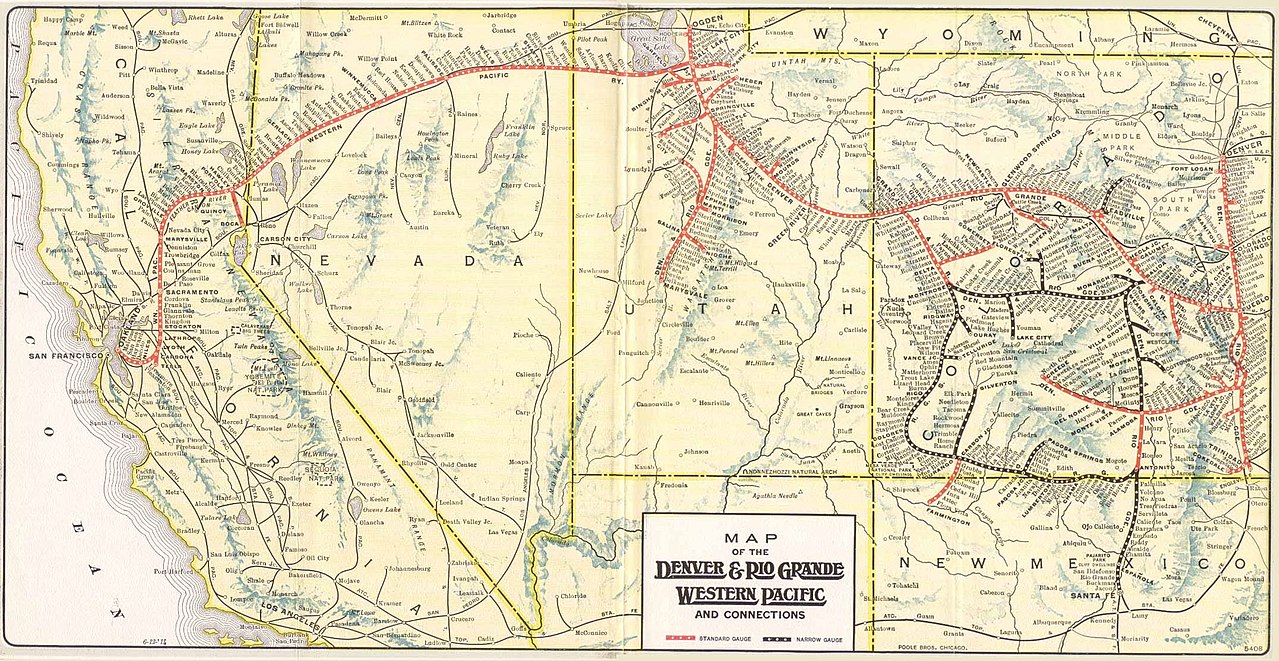
1914 route map of the Denver & Rio Grande Western and Western Pacific railroads.
Map via Wikimedia Commons

In the American tradition, a railroad is conceived by noble men for noble purposes: to develop a nation, or to connect small villages to the big city. The Denver & Rio Grande of 1870 was not that railroad. Much later, however, it came to serve an admirable public purpose, earn the appreciation of its shippers and passengers, and return a substantial profit.

The Rio Grande was conceived by former Union Brig. Gen. William Jackson Palmer. As surveyor of the Kansas Pacific (later in Union Pacific’s realm), Palmer saw the profit possibilities if you got there first and tied up the real estate. Palmer, apparently connecting dots on a map to appeal to British and Dutch investors, proposed the Denver & Rio Grande Railway to run south from Denver via El Paso, Texas, to Mexico City. There was no trade, nor prospect for such, between the two end points, but the proposal did attract sufficient capital to finish the first 75 miles to Colorado Springs in 1871.

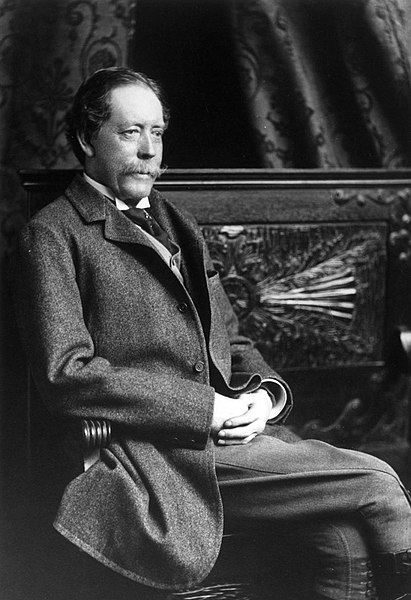
William Jackson Palmer 1836-1909, founder of Colorado Springs, Colorado, builder of several railroads including the D&RGW.
Photograph circa 1870, photographer unknown, via Wikimedia Commons.

Narrow-gauge origins
Palmer chose 3-foot gauge to save money, assessing that the real value lay in the real estate, not in railroad operation. At each new terminal, Palmer’s men corralled the land, then located the depot, profiting through a side company on land sales. Construction continued fitfully to Trinidad, Colo., 210 miles from Denver, by 1878. Above Trinidad, on the ascent to Raton Pass, Palmer’s engineers collided with the Santa Fe’s, who were building toward California. Realizing that a roundabout narrow-gauge competing with a point-to-point standard-gauge would serve neither the fare box nor the next prospectus, Palmer changed course, making D&RG a supply line to the gold and silver bonanzas blossoming all over Colorado and Utah. Thus the Rio Grande would look west, not south, and would plumb so many canyons in search of mineral wealth that it was a surprise to find one without its rails.

Turning west at Pueblo, Colo., and outfighting the Santa Fe for the Royal Gorge of the Arkansas River — where there truly was room for only one track — D&RG entered Leadville, Colorado’s first world-class mining bonanza, in 1880. Three years later, it completed a Denver–Salt Lake City main line west from Salida, Colo., via Marshall Pass and the Black Canyon of the Gunnison River. The last-spike ceremony in the desert west of Green River, Utah, was low-key, lest anyone closely examine this rough, circuitous, and glacially slow “transcontinental.” Almost as an afterthought, D&RG added a third, standard-gauge rail from Denver to Pueblo, acknowledgment that once paralleled by a standard-gauge competitor, narrow-gauge was a death sentence.

New owners, new purpose
Palmer then began to exit. The company went bust, twice, in rapid succession. The new investors repurposed the railroad again. Instead of transient gold and silver, the new salvation would be coal. Thick bituminous seams in the Walsenburg-Trinidad field fed beehive coke ovens of a new steel mill near Pueblo and heated much of eastern Colorado and western Kansas and Nebraska.

The New York Central in 1928-1929

Filed under: History, Railways, USA — Tags: , , — Nicholas @ 02:00

Speed Graphic Film and Video
Published 22 Dec 2017

More early sound film from the Fox Movietone News archives in the University of South Carolina’s Moving Image Resource Collection.

It shows New York Central trains in the Hudson River valley in 1928 and 1929. Scenes include:
0:10 K3 Pacifics passing through Peekskill station.
1:10 View from the tender as a fast freight crosses the bridge at Castleton.
2:30 Looking up at the bridge as a train passes over.
2:42 Another ride over the bridge at Castleton, this time seen from the caboose. There is a brief glimpse of NYC 0-6-6-0 No. 1300, the only locomotive with that wheel arrangement on the railroad.
4:54 View from a bluff above the Weehawken yards. (Thanks to Vincent Zablocki for the ID.)
5:30 Street operations on the West Side Line in Manhattan when it still ran at street level. Locomotives seen include No. 595 and dummy No. 1904.
7:33 A look at the drivers as a K3 Pacific passes by the camera.
8:21 Passenger trains on the main line, seen at a distance. These are editing “trims,” so the shot ends just as the train gets near the camera. These were probably taken at Breakneck Mountain.
11:19 Departing passenger train at a grade crossing. Again, this is a “trim,” so the beginning of the shot is missing.

November 28, 2019

Deltic Diesel Powered Train (1962) | British Pathé

Filed under: Britain, History, Railways — Tags: , , — Nicholas @ 06:00

British Pathé
Published 13 Apr 2014

Catch a glimpse of Finsbury Park and Kings Cross station back in the day in this remarkable footage of diesel powered trains in 1962.

For Archive Licensing Enquiries Visit: https://goo.gl/W4hZBv
Explore Our Online Channel For FULL Documentaries, Fascinating Interviews & Classic Movies: https://goo.gl/7dVe8r

#BritishPathé #History #London #KingsCross #FinsburyPark #Trains

(FILM ID:165.08)

Finsbury Park and Kings Cross, London.

L/S of a row of steam train engines on a set of tracks, M/S of steam coming out of the engine. M/S of the driver and fireman in overalls climbing down from the cabin of the engine. M/S of a diesel train in a station, two staff climb into the train, they are a lot cleaner than the steam men.

Interior of the engine, one of the men turns a couple of taps before the journey. C/U of a set of gauges, C/U of another part of the engine. M/S of the driver washing his hands, he closes the folding washbasin and dries his hands. C/U of the sign ‘Max. Speed 100 M.P.H.’ M/S of the driver pouring water from a kettle into a coffee pot. He places the pot on a hot plate and sits down. C/U of his feet on the footrest. M/S of the train pulling out of Kings Cross Station. M/S from the driver’s viewpoint as the train comes out of a tunnel. M/S of two shafts rotating in the engine. M/S of the driver in the cabin, M/S from his viewpoint as the train travels down the track. M/S as the train passes through a station. Various shots of the train and driver, and various point of view shots from inside the cabin of the track as it speeds along. C/U of the speed dials. M/S from the point of view of the driver as the train speeds down the track under bridges and past a steam train going in the opposite direction.

BRITISH PATHÉ’S STORY
Before television, people came to movie theatres to watch the news. British Pathé was at the forefront of cinematic journalism, blending information with entertainment to popular effect. Over the course of a century, it documented everything from major armed conflicts and seismic political crises to the curious hobbies and eccentric lives of ordinary people. If it happened, British Pathé filmed it.

Now considered to be the finest newsreel archive in the world, British Pathé is a treasure trove of 85,000 films unrivalled in their historical and cultural significance.

British Pathé also represents the Reuters historical collection, which includes more than 136,000 items from the news agencies Gaumont Graphic (1910-1932), Empire News Bulletin (1926-1930), British Paramount (1931-1957), and Gaumont British (1934-1959), as well as Visnews content from 1957 to the end of 1984. All footage can be viewed on the British Pathé website. https://www.britishpathe.com/

October 30, 2019

Defending the work of Dr. Beeching

Filed under: Britain, Economics, Government, Railways — Tags: , , , , — Nicholas @ 09:20

Ever the contrarian, Tim Worstall responds to an article calling for the “Beeching Axe” cuts to the British passenger railway network in the 1960s to be reversed:

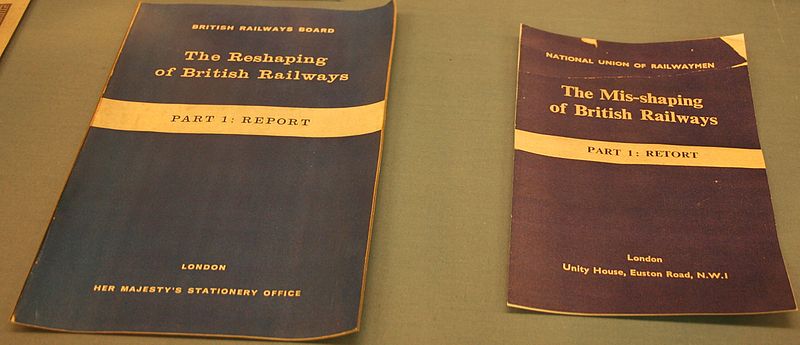
The British Railways Board’s publication The Reshaping of British Railways, Part 1: Report, Beeching’s first report, which famously recommended the closure of many uneconomic British railway lines. Many of the closures were implemented. This copy is displayed at the National Railway Museum in York beside a copy of the National Union of Railwaymen’s published response, The Mis-shaping of British Railways, Part 1: Retort.
Photo by RobertG via Wikimedia Commons.

For background, as the “Beeching Axe” is far less well-known today than it used to be, here’s Wikipedia’s introduction:

The Beeching cuts (also Beeching Axe) were a reduction of route network and restructuring of the railways in Great Britain, according to a plan outlined in two reports, The Reshaping of British Railways (1963) and The Development of the Major Railway Trunk Routes (1965), written by Dr Richard Beeching and published by the British Railways Board.

The first report identified 2,363 stations and 5,000 miles (8,000 km) of railway line for closure, 55% of stations and 30% of route miles, with an objective of stemming the large losses being incurred during a period of increasing competition from road transport and reducing the rail subsidies necessary to keep the network running; the second identified a small number of major routes for significant investment. The 1963 report also recommended some less well-publicised changes, including a switch to containerisation for rail freight.

Protests resulted in the saving of some stations and lines, but the majority were closed as planned, and Beeching’s name remains associated with the mass closure of railways and the loss of many local services in the period that followed. A few of these routes have since reopened; some short sections have been preserved as heritage railways, while others have been incorporated into the National Cycle Network or used for road schemes; others now are lost to construction, have reverted to farmland, or remain derelict.

Worstall says:

[Dr. Richard] Beeching is one of the most universally hated figures in British politics, yet I have no doubt that he was that rare creature, someone working for the state who actually got things about right.

What Dr Richard Beeching mostly did was a cold, analytical report into the railways and recommended cutting large chunks of it that no-one was using. This was done because the railways were losing a fortune every year. And he mostly got it right. He assumed that we would replace trains with buses, which isn’t a bad idea at all. […]

One of the reasons I think Beeching ended up more right than he thought was the arrival of the car. Yes, cars can be environmentally damaging, cause deaths and so forth. Personally, I lean towards the bus or train as a preference. But you can’t ignore the upsides of cars.

The biggest problems with trains are connection time, flexibility and that there’s no market in there. Rail is quite poor at doing their one job: getting a train from A to B. You’d think after 150 years, they’d have it going pretty good, but crew not turning up, signal failures, electrical failures, doors not closing properly. industrial action are not that rare. The problems are certainly more common than if you drive a Toyota Corolla on the motorway to work. Your driver will turn up (because it’s you), the doors will close, the car will run pretty much perfectly. You also have no connection time in that Corolla. You turn off one road straight onto another. You can also go when you please. Middle of the night, middle of the day.

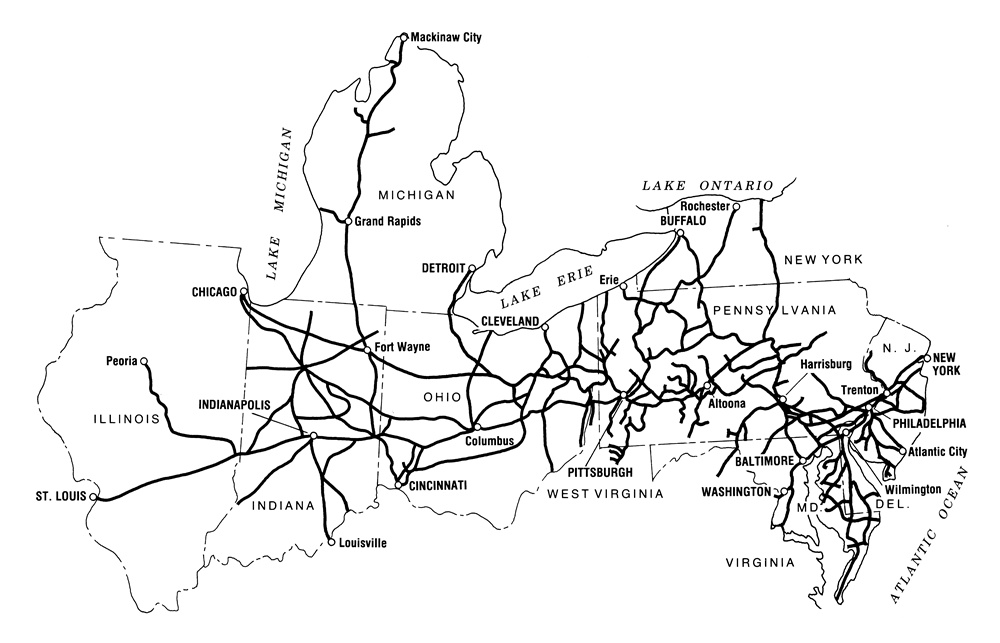
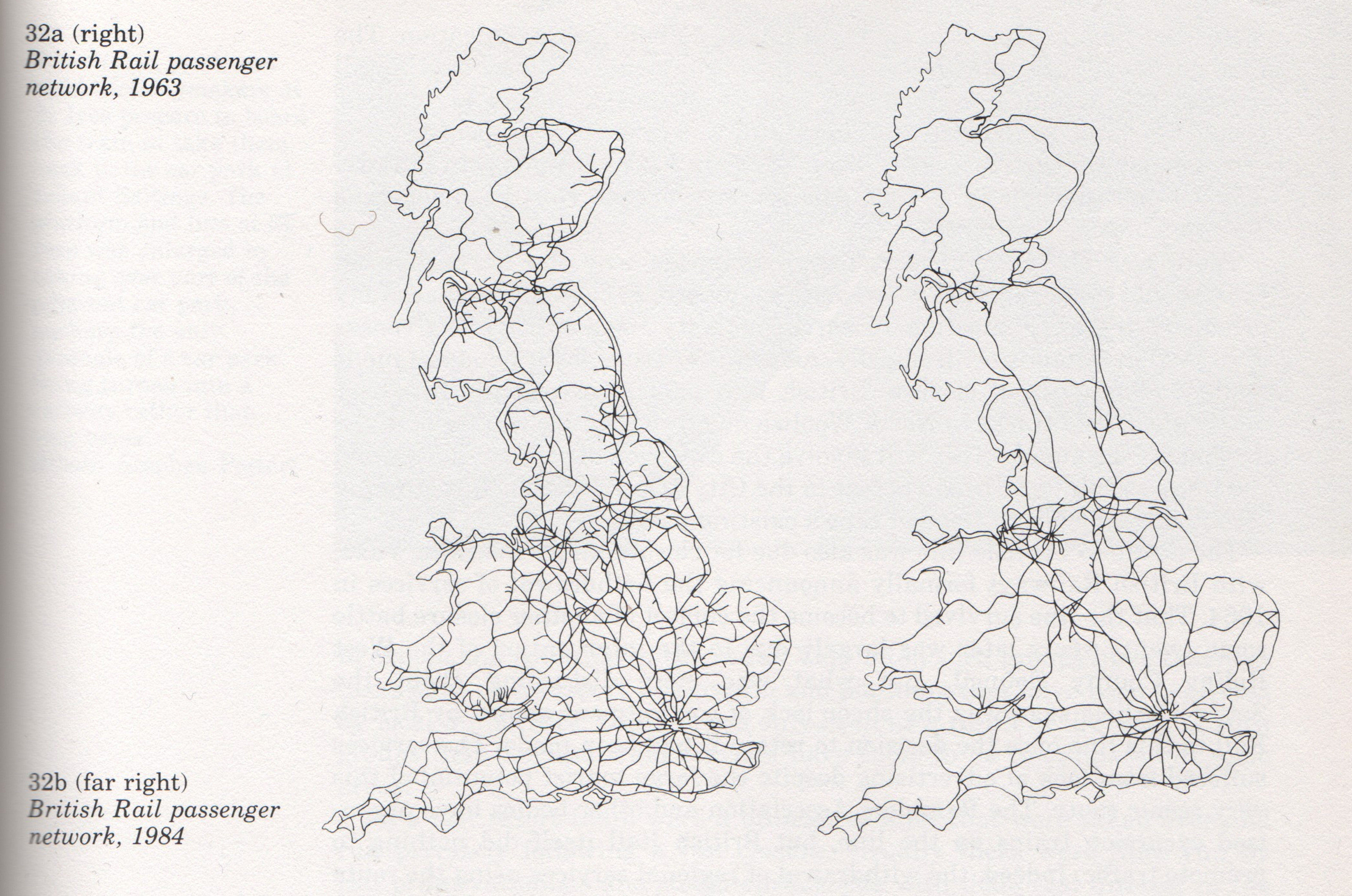
Maps originally from Losing Track by Kerry Hamilton and Stephen Potter (1985), by way of Is Your Journey Really Necessary?, 2012-12-31.
https://isyourjourneyreallynecessary.wordpress.com/2012/12/31/nice-work-if-you-can-get-there/
Click map to enlarge.

October 7, 2019

The History of The London Underground

Filed under: Britain, History, Railways, Technology — Tags: , , , — Nicholas @ 02:00

Real Engineering
Published on 29 Dec 2017

Patreon:
https://www.patreon.com/user?u=282505…

September 24, 2019

1963 – The Beeching Report

Filed under: Britain, Economics, History, Railways — Tags: , , — Nicholas @ 02:00

LMS4767
Published on 27 Mar 2019

September 16, 2019

This is York – British Transport Film

Filed under: Britain, History, Railways — Tags: , — Nicholas @ 02:00

LMS4767
Published on 30 May 2019

August 31, 2019

General Motors Diesel: The Modern Power (1937 and 1942)

Filed under: History, Military, Railways, Technology, USA, WW2 — Tags: , , — Nicholas @ 02:00

PeriscopeFilm
Published on 6 May 2016

Support Our Channel: https://www.patreon.com/PeriscopeFilm

First made in 1937 by General Motors and then repackaged for the WWII war effort, DIESEL THE MODERN POWER tells the story of the development and principles of the diesel engine. The film uses live action and animation to show how the diesel engine works, and live action footage of Sherman tanks, streamlined locomotives, switching engines, ships, and more.

The film begins with an historical overview that includes a brief lesson on how to make fire, including two stones, rubbing pieces of wood, and even the “fire syringe” that was used by the people of Southeast Asia. The syringe is used to demonstrate the operation of a piston in an engine.

At 14:30, 600 hp diesel engine are seen at the Century of Progress Exposition in Chicago. At 14:46, the Burlington Pioneer Zephyr is seen running from Chicago to Denver. Mainline passenger locomotives are seen, providing up to 6000 hp. Diesel switch engines are seen at the 15:30 mark.

At 18:40, lumber equipment, oil pumps, and earth moving equipment are seen — all driven by diesel engines.

The Detroit Diesel works is seen at the 19 minute mark. Diesel powered submarines, mine sweepers and coast patrol boats as well as fleet tugs, are also seen.

A two-stroke diesel engine is a diesel engine that works in two strokes. A diesel engine is an internal combustion engine that operates using the Diesel cycle. Invented in 1892 by German engineer Rudolf Diesel, it was based on the hot-bulb engine design and patented on February 23, 1893. During the period of 1900 to 1930, four-stroke diesel engines enjoyed a relative dominance in practical diesel applications. Charles F. Kettering and colleagues, working at the various incarnations of Electro-Motive and at the General Motors Research Corporation during the 1930s, advanced the art and science of two-stroke diesel technology to yield engines with much higher power-to-weight ratios than the two-stroke diesels of old. This work was instrumental in bringing about the dieselisation of railroads in the 1940s and 1950s.

All diesel engines use compression ignition, a process by which fuel is injected after the air is compressed in the combustion chamber, thereby causing the fuel to self-ignite. By contrast, gasoline engines utilize the Otto cycle, or, more recently, the Atkinson cycle, in which fuel and air are mixed before entering the combustion chamber and then ignited by a spark plug.

August 15, 2019

Amtrak is considering reviving at least one Chicago-Toronto passenger train

Filed under: Cancon, Railways, USA — Tags: , , , — Nicholas @ 03:00

Lauren O’Neill reports on an Amtrak service extension proposal:

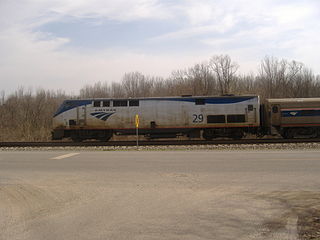
Amtrak P42DC locomotive #29 with a Blue Water or Wolverine train waits on a siding for a train in the opposite direction to pass in Comstock, Michigan.

The largest passenger railroad service in U.S. is considering a proposal that, if approved, would see trains running directly from Chicago to Toronto and back.

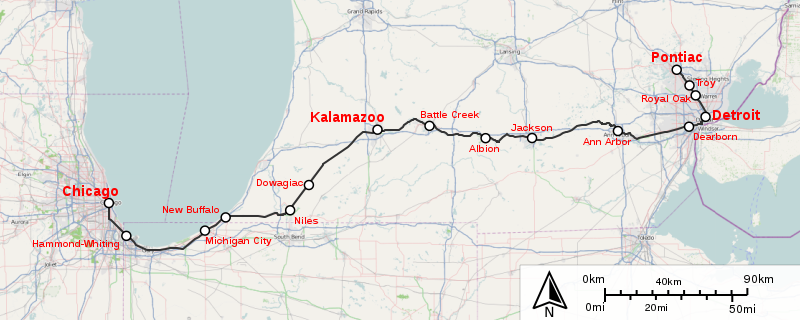
As discussed at the Michigan Rail Conference in East Lansing last week, Amtrak wants to extend its Wolverine line — which currently sees trains moving back and forth between Pontiac, MI, and Chicago, IL, three times per day — all the way up to Canada’s largest city.

A presentation slide shared by an official Michigan Department of Transportation Twitter account on Thursday shows that Amtrak wants to extend “at least one” Wolverine train into Ontario, “where it could continue as a VIA Rail Canada corridor service from Windsor/Walkerville to Toronto.”

It won’t happen overnight, and there’s plenty of work to be done in order for the train service to work, including the construction of a new border processing facility.

July 17, 2019

VIA Rail’s “High Frequency Rail” proposal

Filed under: Cancon, Railways — Tags: , , , , — Nicholas @ 03:00

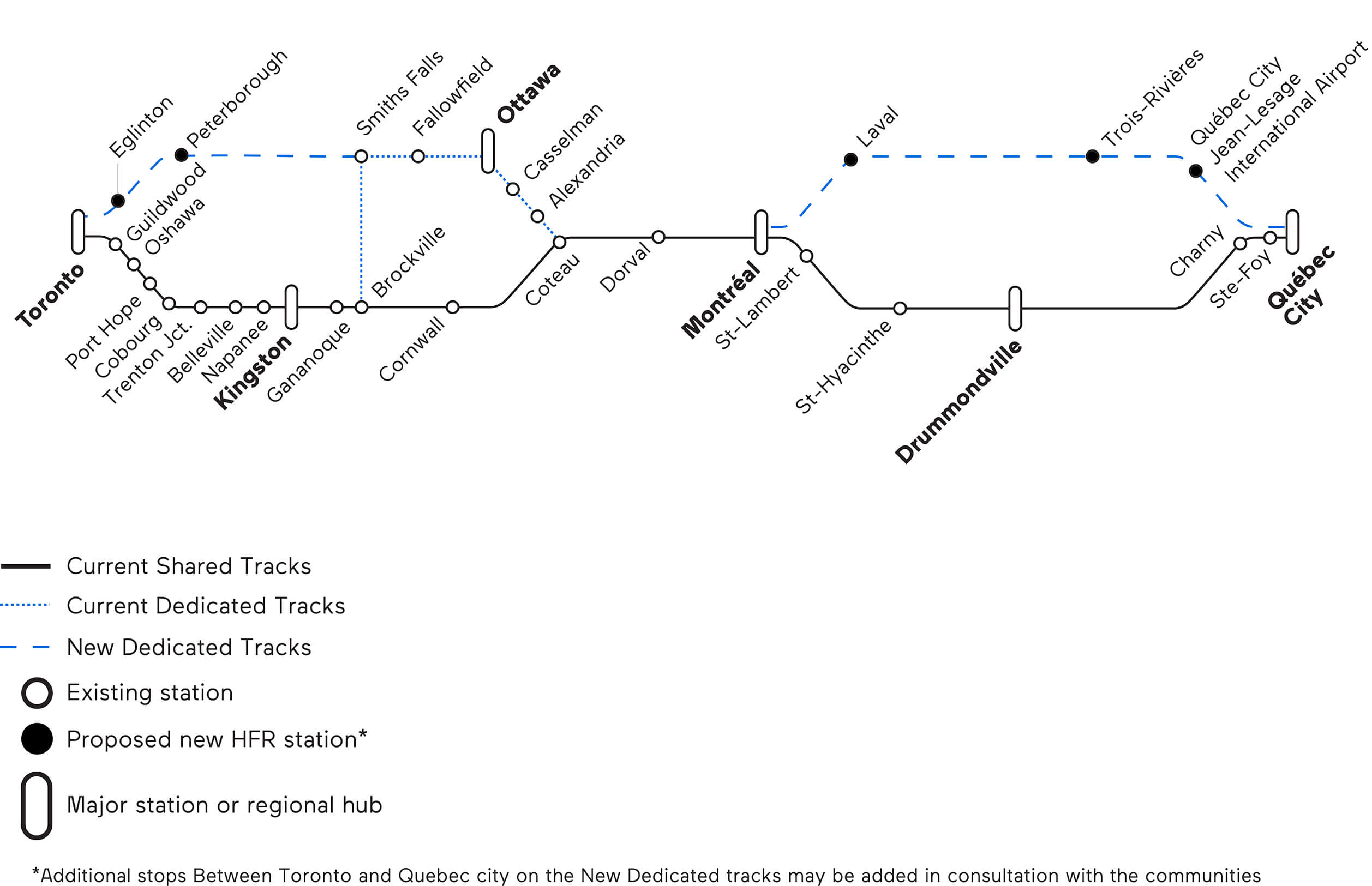
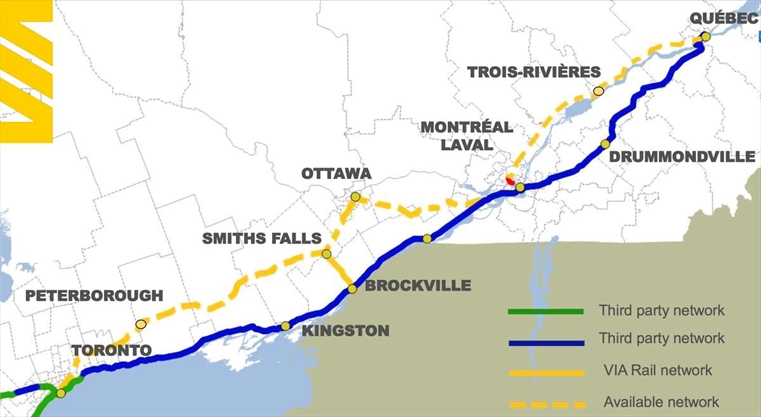
In Trains, Bill Stephens outlines some of the strikes against VIA Rail Canada’s hopes for a dedicated passenger-train-only route between Toronto and Quebec City:

Last month VIA’s $4 billion plan got a $71 million boost that will fund additional feasibility studies. It shouldn’t take $71 million to figure out the plan is fatally flawed. Why? Because it won’t accomplish its chief aim: Eliminating the mind-boggling delays related to sharing tracks with Canadian National freight trains.

To be successful, passenger service needs to be fast, frequent, and dependable. VIA’s current service is faster than driving between Canada’s two biggest cities, Toronto and Montreal. It’s fairly frequent, too, with seven weekday departures between Toronto and Montreal. But it’s not dependable. On-time performance is in the low 70% range for the entire Toronto-Ottawa-Montreal-Quebec City corridor. VIA blames the late trains on interference from CN freights, primarily on the double-track route linking Toronto and Montreal.

So you can understand why VIA would lobby the Canadian government for a dedicated passenger route. Last year VIA’s Eastern Corridor, the Canadian equivalent of Amtrak’s Northeast Corridor, carried three-quarters of VIA’s entire ridership. It stands to reason that you can fill more seats with service that’s faster, more frequent, and more reliable.

[…]

Keeping passenger and freight trains on time takes a combination of operational discipline, the right track capacity, and a willingness to make it work. CN takes pride in its operational discipline, and executives say the Eastern portion of the railroad, between Chicago and Halifax, is underutilized. What’s missing, it seems, is a willingness to expedite VIA trains.

VIA needs a cooperative host railroad more than it needs a new route that would bypass intermediate population centers, face opposition from the not-in-my-backyard crowd, take years to build, and in the end would still have to rely on shared trackage in key areas.

Also a monumental problem without an apparent solution: Squeezing extra trains into Toronto Union Station and Central Station in Montreal on new approaches that would only complicate operations and increase conflicts with freight and commuter traffic.

TAB Short: US Military Railway Guns In Action

Filed under: History, Military, Railways, Technology, USA, Weapons, WW1 — Tags: , — Nicholas @ 02:00

The Armourer’s Bench
Published on May 19, 2019

During World War One massive railway guns were used to reach deep behind enemy lines and attack enemy infrastructure with both sides using the massive artillery pieces. In this episode Matt takes a look at some archival footage of America’s massive railway guns ranging from 10 to 16 inches.

Check out our accompanying article for more information and sources at:
https://armourersbench.com/2019/05/19/us-military-railway-guns-in-action/

If you enjoy our work please consider supporting us via Patreon, TAB is a viewer supported, non-monetised channel and any help is very much appreciated!

We have some great new perks, check out our Patreon page here: https://www.patreon.com/thearmourersb…

The Answer:
According to the original footage notes the mystery item is a 60-feet tall captured German field periscope ‘claimed to have been used by the German Crown Prince during the war’.

Footage:
https://catalog.archives.gov/id/24749

July 9, 2019

“Why can’t America have great trains?”

Filed under: Economics, History, Railways, USA — Tags: , , — Nicholas @ 05:00

At the very end of his recent book Romance of the Rails, Randal O’Toole regretfully (he really, genuinely is a train fan) answers the question three ways … none of which bolster the hopes that the United States will go back to great passenger railway service:

First, when we had great trains, they were used mainly by the elite, and that remains true of great trains in other countries today. Before 1910, it is likely that a majority of Americans had never traveled more than 50 miles from home, and most had never been on a train, while many others had taken only one or two train trips in their life. As James Hill observed, “the so-called ‘travelling public’ forms in reality but a small, and the more fortunate class of the community.” If he was prejudiced against passenger trains, as some claim, it may have been for altruistic reasons, as the people who relied on freight trains “direct and indirect, include all. Hence justice requires that railway systems … should be cautious not to favor passenger traffic at the necessary expense of freight payers.” It is neither sensible nor fair fo the government to subsidize transportation catering mainly to the wealthy.

Second, new transportation technologies have replaced trains and streetcars. Planes are faster and less expensive for long distances; cars and buses are more convenient and less expensive for short distances; and there is no midrange distance at which passenger rail has an advantage over both cars and planes.

Third, and just as important, other new technologies, including the moving assembly line, telecommunications and the electrical grid, have reshaped our cities so the urban patterns that once made rail convenient to large numbers (though never a majority) of people have been replaced by patterns in which rail makes no sense for passenger travel.

Although we might want great trains in our fantasy of what the world should be like, the reality is we don’t need trains. Most Americans don’t ride the trains we have, nor would they ride them even if they met some arbitrary devinition of “great.” We love passenger trains, and we will remember them in museums and tourist lines. But if the government stays involved in transportation at all, it should be to prepare for the next revolution in transportation, not to try to reverse the previous one.

June 14, 2019

How Streamlining Changed Trains Forever | Spark

Filed under: Britain, History, Railways — Tags: , , — Nicholas @ 02:00

Spark
Published on 25 Jun 2018

Steam trains leapt forward in speed once Nigel Gresley decided to make them slick, sexy and streamlined.

In the 1930’s, Britain had a railway network that was envied around the world. The East and West Coast railway companies fought to transport passengers from London to Scotland in the shortest time possible.

Originally broadcast in 2003. Content licensed by DRG Distributions. Any queries, contact us at hello@littledotstudios.com

June 4, 2019

Railroad Town

Filed under: Cancon, History, Railways — Tags: , , , — Nicholas @ 04:00

NFB
Published on 7 Aug 2017

This short documentary is a delightful trip back to an era in which railroad was king.

Directed by Don Haldane

About the NFB
The National Film Board of Canada produces and distributes documentary films, animation, web documentaries and fiction. Our stories explore the world we live in from a Canadian point of view.

Watch over 3,000 films for free on NFB.ca – http://bit.ly/YThpNFB
Want more? Sign up for our newsletter – http://bit.ly/YTnwNFB

Connect with the NFB online:
Twitter: http://bit.ly/yttwNFB

May 24, 2019

Ottawa chooses boring names for their new light rail trains

Filed under: Bureaucracy, Cancon, Railways — Tags: , , — Nicholas @ 03:00

OC Transpo, the Ottawa area transit authority, ran a contest for children to suggest names for their new light rail trains. Being bureaucrats, they carefully avoided choosing some rather clever names the kids suggested:

Ottawa O-Train leaving St.Laurent Station tunnel, January 2018
Photo by “Saboteurest” via Wikimedia Commons.

When commuters and tourists finally do step on to the $2.1 billion light-rail system – already more than two years behind schedule – they’ll ride Maple Taffy, Snowbird or Northern Lights, when they could’ve boarded Shania Train or Roberta Bondcar, a witty nod to Canada’s first female astronaut.

Culled from entries restricted to children 16 and under, winning selections that consisted largely of Canadian clichés favoured by the City of Ottawa, was not due to a lack of overall creativity from the youth who participated.

Zooming Poutine, The Queensway Cruise and Sir Chuggsalot were overlooked for winning selections Poppy, Totem and Tundra. Galloping Goose, Tunnel Beaver and The Speed Beaver were also overlooked by judges, who preferred The Canada Goose, Majestic Moose and Nanuq/Polar Bear.

Even Ottawa professional sports teams and fan-favourites like former Senators’ stars Daniel Alfreddson and Erik Karlsson – The Alfie and Karlsson Express – didn’t make the cut, while Rocket Richard, the Montreal Canadiens legend, will rub this in at every stop his train makes.

[…]

But perhaps the most glaringly overlooked multiple-entry from the more historically-minded youth was Thomas Ahearn, a local inventor and founder of the Ottawa Electric Railway Company which built the city’s original streetcar system.

Judges also denied Justin Traindeau and The Jimmy Wagon (a wink at current Ottawa Mayor Jim Watson), and weren’t keen on Sorry, NIMBY Express, Taxed To Death and Da Sink Hole from the more politically sardonic kids; the latter a jab at the huge pit rail construction opened up on Rideau Street.

« Newer PostsOlder Posts »

Powered by WordPress