
It’s interesting to contrast today’s mainstream porn actresses, with their breast augmentations and Brazilian waxes, with the variety of natural bodies from earlier years. These women have breasts, bellies and hips. They have body hair. Some are skinny, some are fat, most are somewhere in between.
And they’re beautiful.
They pose nude or in skivvies, alone and in groups, as pinups and in hard-core activities that prove the internet generation didn’t invent kink — our great-grandparents did.
Regina Lynn, “This Old Porn Is New Again”, Wired News, 2005-09-09.
May 31, 2026
QotD: Pornography, old school
Comments Off on QotD: Pornography, old school
May 30, 2026
QotD: Winnipeg
But Winnipeg is a place unto itself, a place that reflects the vast space and isolation one feels in countless Canadian communities from the Maritimes to northern Ontario to the interior of B.C.
In such communities, the glue is neighbourliness, a thirst to find a middle ground, a place where everyone has something in common.
David Lawrason, “Canada’s Middle Ground”, Wine Access, September, 2005.
Comments Off on QotD: Winnipeg
May 29, 2026
QotD: What is volley fire and what is it for?
Volley fire can cover for the slow reload rate of guns or crossbows in two ways. The first are volley fire drills designed to ensure a continuous curtain of fire; the most famous of these is the “counter-march”, a drill where arquebuses or muskets are deployed several ranks deep (as many as six). The front rank fires a volley (that is, they all fire together) and then rush to the back of their file to begin reloading, allowing the next rank to fire, and so on. By the time the last rank has fired, the whole formation has moved backwards slightly (thus “counter” march) and the first rank has finished reloading and is ready to fire. The problem this is solving is the danger of an enemy, especially cavalry, crossing the entire effective range of the weapon in the long gap between shots. This, by the by, was the volley fire tactic that was being used in China with crossbows before gunpowder; I don’t know that anyone ever did volley-and-charge with crossbows, which lack the lethality of muskets.
The other classic use is volley-and-charge. Because firearms are very lethal but slow to reload, it could be very effective to march in close order right up to an enemy, dump a single volley by the entire unit into them to cause mass casualties and confusion and then immediately charge with pikes or bayonets to try to capitalize on the enemy being demoralized and confused. You can see variations on this tactic in things like the 17th century Highland Charge or the contemporary Swedish Gå–På (“go on”). By charging rather than waiting to reload, the attacker could take advantage of the high lethality of firearms without suffering the drawback of long reload times.
Crucially, note that volley-and-charge works because it compresses a lot of lethality into a very short time, which I suspect is why we don’t see it with bows or crossbows (but do see it with javelins, which may have shorter range and far fewer projectiles, but seem to have had higher lethality per projectile). As we’re going to see in a moment, the lethality of bows or crossbows against armored, shielded infantry – even in close order – was pretty low at any given moment and needed to add up over an extended period of shooting. By contrast, muskets were powerful enough to defeat most armor and thus to disable or kill basically anyone they hit, limited of course by reload time: with a reload time of as much as 30 seconds for earlier matchlocks, a line of musketeers might only be able to fire a few times at an advancing infantry unit (which might take two or three minutes to walk through effective range) and given the limited accuracy of smoothbore muskets, only the last shots would hit at a high level. By contrast, a unit doing volley-and-charge is compressing probably close to 50% of the lethality of sustained shooting, devastating moment and then immediately charging.
Putting that much lethality into a singular instant was valuable from a morale perspective and of course it enabled a unit to quick march through the enemy’s effective range, stopping only briefly to fire and charge, limiting losses from steady enemy fire. But as we’re going to see, the lethality of bows (and, to a significant extent, crossbows) was much lower and so couldn’t be effectively compressed into that single, devastating, confusing moment.2
Bret Devereaux, “Collections: Why Archers Didn’t Volley Fire”, A Collection of Unmitigated Pedantry, 2005-05-02.
- On drill and in particular, counter-march volley fire with crossbows, see Andrade, The Gunpowder Age (2016), 149-160.
- It also didn’t generate a smokescreen to help with the final rushing charge, whereas a musket-and-bayonet unit might benefit significantly from firing and then charging through and out of its own obscuring smoke into a terrified and confused enemy.
May 28, 2026
QotD: Re-defining economic liberalism
A liberal “rhetoric” explains the good features of the modern world compared with earlier and later illiberal régimes — the economic success of the modern world, its arts and sciences, its kindness, its toleration, its inclusiveness, and especially its massive liberation of more and more people from violent hierarchies ancient and modern. Its enemies claim that it also explains alleged evils, such as the reduction of everything to money or the loss of community or the calamity of immigration by non-Christians. But they are mistaken.
Dierdre McCloskey, “The power of liberalism can combat oppression in all its forms”, The Economist, 2020-01-08.
Comments Off on QotD: Re-defining economic liberalism
May 27, 2026
QotD: “Bring your whole self to work”
Organisations and institutions are formalised teams. Due to past ruthless selection — see the Neolithic y-chromosome bottleneck — the male expression of Homo sapien genes is much better at teams than is the female expression of the same. This does turn out to matter.
We have spent centuries, millennia, dealing with the bad traits of men in power. We better start wrestling seriously and quickly with the bad traits of women in power, or we could end up with a cascading collapse of complex systems (see the LA fires for an example). We are already seeing some serious institutional degradation.
But if we remain stuck in “if you criticise men, it’s feminism; if you criticise women, it’s misogyny”, we have a potentially terminal problem.
Lorenzo Warby, Substack Notes, 2026-02-21.
Comments Off on QotD: “Bring your whole self to work”
May 26, 2026
QotD: Entropy versus Revolution
They’re simply nihilists, and their nihilism is just a way station to suicide. Their “program”, such as it is, aims at absolute stasis — they want everyone and everything to be exactly one thing, now and forever, because this is the closest to annihilation they can get without being forced to admit to themselves that what they’re really longing for is the sweet release of death. The purpose of all those bespoke sexualities, for instance, clearly isn’t “to find a likeminded person to have sex with”; rather, it’s to make sure you can never have sex with anyone at all.
Ooops, sorry, you only fulfill 459 of the 462 bullet points on the checklist.
Which is weird, I realize, because the “Left” (for rhetorical convenience) are always in frantic motion. But it’s displacement activity. As I’ve written before, you can call it “permanent revolution”, but it’s Isaac Newton’s version, not Leon Trotsky’s — forever spinning in place, going nowhere. So long as they never stop spinning, they’ll never hear the vast emptiness of their own lives. They’ll never have to look their death wish straight in the eye.
The “Right” (again for rhetorical convenience) seems to be locked in a never-ending battle against entropy. That’s what it seems to boil down to. Things fall apart and pass away, and in their breakdown we are robbed of our fundamental dignity. In the end, that’s the only thing worth “conserving” — your fundamental dignity; the only “right” that matters is the right not to be a clown.
One always loses the battle against entropy eventually, but the dignity is in the fight. For the “left”, who have no dignity, the fight is just a distraction, sound and fury to distract from the nothingness that always threatens to overwhelm them … and that they secretly long for.
Severian, “Entropy vs. Revolution”, Founding Questions, 2022-06-21.
Comments Off on QotD: Entropy versus Revolution
May 25, 2026
QotD: Modern movie casting
For a long time now, Hollywood has been taking great care to make the good characters black and the bad ones white. For a short while, the bad guys could be Arab terrorists, but now bad guys are white again. If they need to be foreign baddies, then they are neo-Nazis from eastern Europe or Russian gangsters. Of course, the smartest characters are black or female. If we’re lucky, the brainiac is a black lesbian. Every computer hacker is now non-white or female.
On occasion the blackwashing gets ridiculous. Some figure from white history is played by a black actor. A black guy in a show about medieval Europe could be amusing, but that’s not how it is done. Instead, we get black cowboys saving a white town or a black playing King Lear. It will not be long before we have historical dramas in which well-known figures from white history are played by black actors as black people. Imagine Ben Franklin played by Morgan Freeman.
The Z Man, “Blackwashing”, The Z Blog, 2020-10-02.
Comments Off on QotD: Modern movie casting
May 24, 2026
QotD: Historians, past and present
Meanwhile Xenophon was an Athenian student of Socrates who joined a Greek mercenary group that marched 1000 miles into Persia to overthrow the King of Kings on behalf of the King’s brother. When the King’s brother died and the group’s commanders were all killed by Persian treachery, he led the troops 1000 miles home himself while being constantly harried by hostile armies. He then tried to establish a colony on the Black Sea, survived a mutiny, raided the Thracians, fought for the Spartans, was exiled by Athens, and settled down to manage an estate and write it all up.
Contrast Xenophon with Mary Beard, who studied at Cambridge and now teaches at Cambridge. She holds the same opinions as everyone else at Cambridge. She’s remarked before that, “I actually can’t understand what it would be to be a woman without being a feminist”. This seems like a peculiar failing for an ancient historian. After 9/11, she wrote an article saying that many people thought “the United States had it coming”, and that “world bullies, even if their heart is in the right place, will in the end pay the price”. That caused some controversy on the world stage, but earned her a promotion at Cambridge. I don’t know if she’s ever talked publicly about religion or democracy or climate change or immigration, but I could tell you exactly what she thinks about these things anyway. So why would you bother reading what she thinks about Rome? The answers are just as predictable.
Roman Helmet Guy, “New Books Aren’t Worth Reading”, Atlas Press, 2026-01-13.
Comments Off on QotD: Historians, past and present
May 23, 2026
QotD: Egypt within the Roman Empire
A lot of that comes from how Tacitus represents the structure of Roman rule in Egypt: he describes Augustus as having “kept in the [imperial] house” (retinere domi) the governance of Egypt, assigning it to an equestrian prefect. Egypt was a relatively late addition to Rome’s growing Empire; the Ptolemaic dynasty had ruled it since the death of Alexander the Great in 323. From the 160s that Ptolemaic kingdom had become effectively a client of Rome, its independence maintained by the threat of Roman arms (demonstrated vividly in 168 when Rome turned back a Seleucid invasion of Egypt with nothing more than a consultum of the Senate), but had remained independent until Cleopatra‘s disastrous decision to back Marcus Antonius (Mark Antony) in the last phase of Rome’s civil war. After their defeat, Octavian (soon to be Augustus) had in 30 BC after the suicide of Cleopatra, annexed the kingdom, creating the province of Roman Egypt.
Tacitus’ description of Augustus keeping the rule of Egypt “in the house” led early scholars to assume that Egypt was taken essentially as the private property of the emperors. This is less crazy than it initially sounds; later emperors administered massive estates through a parallel state treasury called the fiscus (distinct from the main treasury of the Roman state, the aerarium Saturni; the fiscus was the private accounts and property of the emperor) administered in some cases by equestrian officials, so the idea of running an entire province effectively out of the fiscus, with the whole of Egypt effectively the private property of the emperor administered by an equestrian official wouldn’t have seemed impossible and it certainly seems to be what Tacitus is describing.
But as our evidence for the activity of these prefects has improved, what we see are officials who act quite a lot like other provincial governors, despite their non-senatorial origins. Praefecti Aegpyti typically served around three years (fairly typical), where generally not from the province they oversaw (also typical), and wouldn’t be reassigned to a post back in that province (also typical). Unlike with the earlier Ptolemaic government, there was no royal court in Egypt, the prefect’s entourage more nearly resembling that of a Roman governor, nor was the emperor personally present. Residents of Egypt who wished to petition the emperor had to do it through the same channels as any other resident of the Roman Empire. The military enforcement forces in the province, too, were typically Roman, drawn (as was normal) from provinces other than where they served. Consequently, as Dominic Rathbone (op. cit.) notes, local elites looking to operate with this new form of government found that they had to adjust themselves to a system of rule, quintessentially Roman, rather than the more personalistic Ptolemaic regime where favor might be curried with important local figures or the royal court itself.
That said, while we’ve increasingly found that the Praefectus Aegypti was more of a normal governor than we thought, vision into the lower levels of the Roman administration in Egypt reveal a complex and in some cases peculiar system. In most of the Roman Empire, Roman governors oversaw largely self-governing communities, run by local elites, which handled most local affairs. Those communities generally delegated governing functions to elected or appointed magistrates who were amateur part-timers drawn from the elite (the curiales, we’ve mentioned these fellows before).
In Egypt, by contrast, while the Romans disassembled the royal Ptolemaic court, they initially seem to have left much of its administrative apparatus of salaries administrators in place. The division of Egypt into administrative districts – called nomes – was kept and the seat of government in the province was firmly entrenched in Alexandria (whereas at least in the first two centuries, most Roman provinces had no clearly established “capital”). Each of the nomes was governed by a strategos (while the word means “general” these were purely civilian officials), typically drawn from the Alexandrian upper-class (rather than being truly local elites), assisted by a salaried basilikos grammateus, “royal scribe”. Villages also generally had a komogrammateus, village scribe, who reported to the strategos; these fellows also seem to have initially been salaried officials. Some of these positions gradually became truly liturgic in nature, mirroring more closely systems of local governance in much of the rest of the Roman world, but perhaps only in the late second century.
Similarly, it was often assumed early on that land ownership and tenure would look very different with the emperor maintaining a lot of direct control and nearly all of the land in Egypt being effectively public land. That perspective was potentially reinforced by the evidence out of the Arsinoite nome (again, modern el-Fayyum) because most of the land there under the Ptolemies belonged to military settlers and thus had special obligations placed on it and was thus not truly private land. But what we see under the Romans is that first this military settler (cleruchic or katoikic; the distinctions here are a post for another day) land is fully privatized and taxed like it would be anywhere else. Meanwhile, the evidence from the other nomes on the Nile itself suggest that private land was more common there even under the Ptolemies. That said, the expansion of private land holdings seems to have been a process taking place mostly under Roman rule, which in turn meant that in many cases land tenure might look quite different in Egypt (where much land was either public or held by temples) than in the rest of the empire where most land was in private hands (although public and temple lands were also common), though it tended to look more and more like the rest of the empire over time, with the process supposed to be substantially complete by the end of the second century. Scholars broadly seem to still be very much divided on the degree to which late Ptolemaic and early Roman Egyptian landholding was exceptional, but it certainly had its substantial quirks.
Meanwhile the Romans did another odd thing in that they didn’t change: the currency system. While the Roman Empire minted its currency in a series of regional mints (not centrally), the Romans almost always brought new areas under their control into the existing Roman currency system (based principally around the gold aureus, the silver denarius and the copper-alloy sestertius). That was both a tool of Roman imperialism, a way to make physical Rome’s notional dominion over conquered lands, but it also served (probably unintentionally) to lower transaction costs and encourage economic interaction between provinces. But Egypt was not brought into the Roman currency system, instead maintaining the Ptolemaic currency system based on the silver tetradrachma (Egypt was already a very monetized economy under the Ptolemies). That barrier between the economy in Egypt and outside of it can make it tricky to know how representative prices within Roman Egypt were for the rest of the empire. Egypt is only brought into the broader Roman currency system with the currency “reforms” of Diocletian (r. 284-305).
At the same time, Egypt was hardly “cut off” from the broader Roman economy. We have good evidence of quite a lot of trade out of Egypt, particularly in agricultural staples. But here again, Egypt is strange: Egyptian grain was the foundation for the imperial era annona civilis, the distribution of free grain to select citizens in the city of Rome itself. That meant a massive, continuous state-organized transfer of grain, specifically wheat grain, from Egypt to Rome. Some of that grain was taxed in kind, but much of it seems to have been purchased in Egypt; in either case transport was essentially subcontracted by the state. Egypt was hardly the only source of grain for the annona (the province of Africa, modern Tunisia, was another major source), but few provinces likely saw the scale of state-organized goods transfer that Egypt did. And it’s striking that attested Egyptian agriculture is quite heavily dominated by wheat farming, rather more than we might normally expect, which both speak to the high yields the Nile could offer but also Egypt’s role as the breadbasket of the Roman Empire.
Bret Devereaux, “Collections: Why Roman Egypt Was Such a Strange Province”, A Collection of Unmitigated Pedantry, 2022-12-02.
Comments Off on QotD: Egypt within the Roman Empire
May 22, 2026
QotD: The cargo cults of New Guinea
You may remember that Guns, Germs, and Steel is framed as a reply to a man named Yali, a “remarkable local politician” whom Diamond encountered while walking on the beach in New Guinea in July of 1972. (Back before Diamond’s second career as a pop-science public intellectual, he was an ornithologist focusing on the birds of northern Melanesia.)1 They chatted for a while about the prospects for New Guinean independence, and local birds, and then Yali asked a question that Diamond spends a couple of paragraphs boiling down to something like, “Why did human development proceed at such different rates on different continents?” (Which is of course what Guns, Germs, and Steel tries to answer.) But that’s not actually the way Yali put it, and his real question — indeed, his whole story, which is fascinating in its own right — suggests a whole ‘nother set of answers
Yali should be better-known.2 He may have been from a backwards backwater, but he’s one of the true Player Characters of history. If we lived in a better world, he would be the subject of a prestige cable drama3 — or maybe a Robert Eggers film, because the values and assumptions of his society are incredibly foreign to a Western audience. And so to really understand and appreciate Yali’s story (and the question he asked an American ornithologist on the beach one day) you need some background about the tribal cultures of the New Guinea coast and their reaction to contact with Europeans. Which is to say, you need to understand cargo cults! Because what Yali actually asked (per Diamond’s recollection twenty-odd years later) was: “Why is it that you white people developed so much cargo and brought it to New Guinea, but we black people had little cargo of our own?”
“Cargo” is the catchall word for Western material culture in Pidgin English,4 the lingua franca of New Guinea’s many language isolates, and New Guineans were understandably obsessed: before European contact, they were living in the literal Stone Age. It would be an exaggeration to say that they hadn’t made any technological progress since their ancestors settled the island 50,000 years earlier, since they domesticated several local plants (taro, yams, and the cooking banana) and got pigs plus a little admixture from some passing Austronesians about 1500 BC, but they were solidly Neolithic and had been since time immemorial. So of course as soon as they encountered cargo — especially steel tools, tinned meat and dried rice, and cotton cloth — they wanted it desperately. And they almost universally believed they could get it by ritual activity.
The prescribed rituals varied. One set, recorded in secret by an American Lutheran missionary in the late 1930s, involved the locals setting up tables in front of the local cemetery and decorating them with flowers, food, and tobacco. Then they danced wildly until dawn in twitching, trembling fits so uncontrolled that some devotees continued to sway and shake for days or weeks afterward. Those lucky people were believed to have a special connection to the ancestors that would let them receive dream messages about the cargo shipments their tables and dancing would surely bring. A different cult was led by a man who had a long piece of iron he claimed brought him messages from the future. He told his followers that if they set out all their food in cemeteries as offerings to their ancestors, handed all their Western goods and money to him for safekeeping, and renamed Tuesday to Sunday, they could expect a god to send them airplanes full of cargo flown by the spirits of the dead disguised as Japanese servicemen. These spirits would bring them rifles, tanks, and other materiel and help them drive out the white people, and then the god would change the natives’ skin from black to white. Oh, and also there would be storms and earthquakes of unimaginable violence.
Forget everything you think you know about cargo cults. (Especially forget those pictures you may have seen of “decoy” airplanes or satellite dishes made out of straw and wood: one popular airplane photo is from a Japanese straw festival, another is a Soviet wind tunnel model, and the radio telescope is just one advertisement from a British ice cream company.)5 Nowadays we use “cargo cult” as a lazy shorthand for “copying what someone successful seems to be doing without really knowing why and hoping you get the same result,” but that’s not what was happening at all. If the New Guinea natives built airstrips, it wasn’t out of a belief that airstrips attract cargo planes like planting milkweed brings Monarch butterflies — that would be seem silly but basically understandable from our frame of reference. No, it’s much weirder than that. They built airstrips for exactly the same reason anyone else does: because they thought cargo planes were coming. They just thought the planes were coming because of the dancing.
This is a story about epistemology. And also about Jesus sending you a case of Spam in the mail.
Jane Psmith, “REVIEW: Road Belong Cargo, by Peter Lawrence”, Mr. and Mrs. Psmith’s Bookshelf, 2025-04-21.
- Okay, fine, it’s actually his third career — he was a specialist in cell membrane biophysics before he started publishing on birds.
- Kudos to commenter Gary Mar, who did his part in this project by alerting me to this book in the first place.
- Just in case anyone reading this has contacts in showbiz, my other idea for a cable drama is the story of Charles V, Philip II, and William of Orange. The emperor of half the known world, the son and heir raised far away, the beloved ward who betrayed him… It would win twelve Emmys.
- Which is not actually a pidgin but a creole! Nowadays it’s more often called Tok Pisin (etymologically, obviously, from “talk pidgin”). Most Tok Pisin vocabulary comes from English, but the grammar and pronunciation are very different and the orthography makes it hard to read. Still, if you try saying it out loud you can sometimes get the gist: “Wetman noken haitim samting moa” pretty easily becomes “white man no can hide’em something more”, and actually means something like “the white man will not keep anything secret from us any longer”.
- Credit for tracking down the sources of those images goes to Ken Shirriff in this blog post, which Gwern kindly sent me when I started talking about this book review.
Comments Off on QotD: The cargo cults of New Guinea
May 21, 2026
QotD: “Theory” in film interpretation
[Camille Paglia] What has been called “theory” since the arrival of deconstruction in elite U.S. universities in the 1970s is in my view one of the most pointless and pretentious movements in modern cultural history. The catastrophic results should be obvious by now: the humanities are in ruin and have lost public respect and even internal support in academe, where budget reduction has come to the fore. I would refer those seeking greater specifics to my long attack on poststructuralism, Junk Bonds and Corporate Raiders: Academe in the Hour of the Wolf, published by Arion in 1991. Seven years ago, I did a follow-up assessment of current “theory” when the Chronicle of Higher Education asked me to review three new academic books by women about the bondage and domination trend. My unhappy response was “Scholars in Bondage”, which laments the damage done to promising young professors by a tyrannical academic establishment still chained to the bleached-out corpse of “theory”.
My approach to art is grounded in the sensory. Art is not philosophy. Art by definition refracts meaning through some medium of the material world. Hence my interpretation of art is grounded in the five senses. Perhaps the only theorist who fully grasped this issue was Gaston Bachelard in his 1957 book, The Poetics of Space, animated by a phenomenology that partly aligns with my own practice. It is no coincidence that I have spent most of my teaching career at art schools, where the body remains front and center in most art forms. Digital genres are certainly spreading and flourishing, but dance, music, and theater remain grounded in physicality — which is partly why art schools are finding it so difficult to adapt to the harsh, distancing realities of the virus crisis.
Comments Off on QotD: “Theory” in film interpretation
May 20, 2026
QotD: “Gilded Age” Robber Barons didn’t have access to what even working-class Americans have now
… but the robber baron knew he needed the serfs. Their relationship was purely dialectical. Without his factory hands, no robber baron. And in a strange but very real way, the higher up the food chain your Gilded Age robber baron went, the more he was dependent on his serfs for his lifestyle. J.P. Morgan is usually credited as being the first guy to become a Robber Baron purely through finance. Carnegie, Rockefeller, all those guys had most of their wealth in financial instruments, of course, but those financial instruments rested on control of a physical product — Carnegie Steel, Standard Oil.
I’m probably being unfair to Jay Cooke, the Michael Milken of his day, but since more people have heard of J.P. Morgan let’s roll with it. Even though Morgan’s wealth was entirely on paper — he was nothing but a securities trader — his lifestyle utterly depended on a battalion of servants. In a very real way, you yourself, right now, live much better than J.P. Morgan did in his heyday. And not just because you have aspirin, antibiotics, and air conditioning, three taken-for-granted things ol’ J.P. would’ve given half his kingdom for. But because you have more time. If you’re hungry, you can open the fridge or the microwave and have all the food you need in a matter of minutes.
J.P. couldn’t. J.P. had to deploy an army of servants every time he wanted a snack, and those servants were constrained by things like “availability of ice” and “when is the fishmonger at his stall”. You’re hungry at 2am, you jump in your car and get some Taco Bell. It takes ten minutes. J.P.’s hungry at 2am and it’s tough titty, J.P., your ass is going hungry. Because even though you’re the richest man in the world and have legions of manservants at your beck and call, Taco Bell just isn’t there. Even if someone had had the brilliant idea to create a Gilded Age Taco Bell, it still would’ve taken hours:
Wake up the manservant. Wake up the groom and stableboy. Hell, wake up the horse, then saddle the horse, ride to the drive thru window … which in this case means “the house of the guy who runs Gilded Age Taco Bell”. At which point he has to fire up the oven, start pounding the tortillas, send his own legion of valets and stableboys and whatnot out to get the refried beans …
And that’s the other thing, J.P. — you’d best not pull that shit too often, because those people know where you live. Not only do they know where you live, they live with you. Literally under the same roof. You want to sleep easy? You’d best not beat the servants too often, buddy.
There’s only so much “class consciousness” one can develop in that world. Oh yeah, J.P. thought of himself as one of the Masters of the Universe, there’s no denying that. But J.P. lived in what was still a brutally physical world, in a way we PoMo people really can’t grasp. If you can’t imagine what it would take to get some Gilded Age Taco Bell, maybe geography will do the trick. Ever seen Gangs of New York? Even if you haven’t, you’ve probably heard the name “Five Points”. The worst slum in America in the 19th century, and 19th century American slums were world class …
That was right down the street from Wall Street. Literally. I am not in any way joking, and if I’m exaggerating a little for effect when I say “J.P. could’ve hit Five Points with a five iron from his swanky digs on Central Park West”, I promise you I’m not exaggerating much. You can look it up for yourself. The main reason the Union rushed troops straight from the Gettysburg battlefield, and no-shit shelled parts of the city with gunboats, during the Draft Riots was because Five Points (et al) was right fucking there, and they might’ve gotten it into their heads to lynch a few Masters of the Universe. Rich man’s war, poor man’s fight, right? Let’s see how you like it, you bankster bastards …
The PoMo “information economy” removes all that. The other day I joked about colleges like Bennington and Goucher. I cracked some jokes, yeah, but I wasn’t really joking. Those places aren’t for us. Wall Street is still a physical location, but it might as well be on the dark side of the moon for all any of us have access to it. J.P. couldn’t beat the servants too hard, or too often. The modern equivalent of J.P. isn’t even aware that he has servants. He just clicks on a website, and stuff appears at his door. Like magic. Hell, it IS magic for all he knows, and he surely doesn’t care, because all that shit is his by right. He went to Bennington, after all. He has achieved full class consciousness.
All of which suggests, of course, that while Marx was wrong about the end state — the State will not, in fact, wither away — he might well have been right about the solution to the “contradictions of capitalism”, if you follow me. And if that makes me some kind of godless pinko Commie subversive, well … I’ve been called worse by better.
Anybody got the lyrics to La Marseillaise in English?
Severian, “On Losing the Cold War”, Founding Questions, 2022-07-02.
Update, 21 May: Welcome, Instapundit readers! Have a look around at some of my other posts you may find of interest. I send out a daily summary of posts here through my Substack – https://substack.com/@nicholasrusson that you can subscribe to if you’d like to be informed of new posts in the future.
May 19, 2026
QotD: Software developers as wizards
A lot of software developers are feeling disoriented and threatened these days. Programming by hand is clearly going the way of the buggy whip and the hand-cranked auger. Which is how we’re finding out that a lot of people have their identities bound up in being good at hand-coding and how it feels to do that.
That’s not me. It’s not me at all. Rather to my surprise, I don’t miss coding by hand, not any more than I missed writing assembler when compilers ate the world and made that unnecessary. (That was in a couple years back around 1983, for you youngsters.)
Maybe the fact that I’m not feeling any of this disorientation disqualifies me from having anything to say to people who are. On the other hand … if you can learn to emulate my mental stance and be completely unbothered, maybe that would be a good thing?
So. If you’re a programmer, and you’re feeling disoriented, try this on for size:
I like being a wizard. I like being able to speak spells, to weave complex patterns of logic that make things happen in the world. Writing code is a way to manifest my will.
Yes, I’ve piled up a lot of arcane knowledge over the 50 years I’ve been doing this. But languages of invocation, they come and they go. Been a long time since I’ve had any use for being able to program in 8086 assembler, and that’s okay. I have better spells now, and these days some rather powerful familiars.
What I’m inviting you to do is think of yourself as a wizard. Not as a person who writes code, but as a person who is good at assuming the kind of mental states required to bend reality with the application of spells.
And if that’s who you are, does it matter if the spells are painstakingly scribed in runes of power, versus being spoken to an obedient machine spirit?
It’s all one; it’s all the manifestation of will. Arcane languages come and go, machine spirits appear and then diminish to be replaced by more powerful ones, but you? You are the magic-wielder. Without you, none of it happens.
Same as it ever was. Same is it ever was. And so mote it be.
ESR, the social media site formerly known as Twitter, 2026-02-17.
Update, 21 May: Welcome, Instapundit readers! Have a look around at some of my other posts you may find of interest. I send out a daily summary of posts here through my Substack – https://substack.com/@nicholasrusson that you can subscribe to if you’d like to be informed of new posts in the future.
May 18, 2026
QotD: Medical ads
Jonathan David Morris, “Thoughts On Health”, Libertarian Enterprise, 2005-09-18.
May 17, 2026
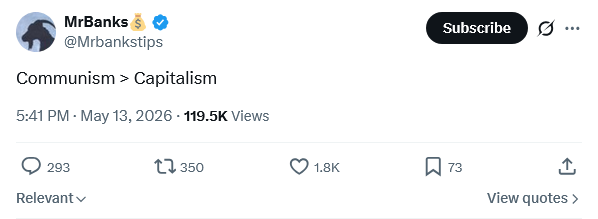
“Communism > Capitalism”
Once again, thanks to the auto-translation feature on the social media site formerly known as Twitter, Brivael Le Pogam responds to a fan of the most evil economic system yet devised by man:
“Communism > Capitalism”
Brother. You’re tweeting this from an iPhone. Designed in California. Made in a Chinese factory that only exists because Deng Xiaoping realized in 1978 that Maoism mostly produced corpses and decided to do capitalism in disguise.
The greatest reduction in poverty in human history (China 1980-2020) happened at the exact moment when China stopped doing communism. The greatest famine in human history (China 1958-62, 45M dead) happened at the exact moment when they started.
Same country. Same people. Same territory. Two systems. One built smartphones, the other built mass graves. Pick your side.
Communism’s trophy board:
USSR: collapsed
China: pivoted to capitalism, prospered
Vietnam: pivoted to capitalism, prospered
Cuba: still rationing soap in 2026
North Korea: eating tree bark
Venezuela: sitting on the world’s largest oil reserves, imports gasoline
Cambodia: killed 25% of its own populationCommunism isn’t an ideology. It’s a hiring program for people incapable of finding a real job, dressed up as economic theory. When you can’t build, you redistribute. When redistribution fails, you hunt for saboteurs. When you run out of saboteurs, you become someone else’s saboteur.
100 million dead. Zero examples that work. The most expensive LARP in human history.
But please, keep tweeting “Communism > Capitalism” from your capitalist phone, on your capitalist app, funded by capitalist ads. We need the comedy.
Comments Off on “Communism > Capitalism”


