
I’ve focused on game morale systems here, but of course this blends over into film as well, where the “mooks” often charge the heroes seemingly utterly heedless of their losses – frequently despite the fact that the last identical group of mooks to do so just got taken apart before their very eyes. And invariably they do this until they are so beaten that they switch to the other binary state, simply running away.
Actual armies have far more than two states of morale and behaved in far more dynamic, unpredictable and interesting ways!
The first problem with this “binary model” of morale is that it assumes just a single factor (“leadership” or “morale”) but in practice we ought to be thinking about at least two different ingredients here: morale and cohesion.
Morale is the commitment the combatants have to their leadership and their cause. To simplify a bit, we might say that soldiers with good morale believe three things: that their cause is a worthy one, that they are on the road to success and that their leaders have a good (enough) plan to achieve final victory. Poor morale can result from a breakdown in any of those three elements: troops might for instance believe both in their goal and its eventual possibility but not in their leaders to produce it (this seems to have been the case, for instance, in the French Mutiny of 1917). On the other hand, regardless of the charisma of leaders, few people come to a war intending to die in it; if the cause appears impossible, morale will sink regardless. And armies that do not believe in the cause at all are extremely difficult to motivate by other means.
On the other hand cohesion is the force that holds a specific unit together through the power of the bonds holding the individual combatants to each other and/or to their (generally junior or non-commissioned) officers. There are a lot of ways to build that cohesion: people are generally unwilling to abandon neighbors, close friends and relatives, for one. They are also reluctant to expose themselves to shame at home for having done so; shame is one of the few things people fear as much, if not more than, death. For armies that can’t rely on that sort of organic cohesion, it can be built by reconstructing the soldier’s unit as his primary social group. Drill can do this: it creates an experience of shared suffering and achievement which bonds the soldiers together creating strong “artificial” cohesion.
These two ingredients have different roots, but they also function differently. The formulation that has always stuck with me is one from James McPherson’s For Cause and Comrades: Why Men Fought in the Civil War (1998): morale (McPherson discusses it under the heading of “the Cause”) will get men into uniform, it will sustain them on large marches and cold nights and it will get them to the battle, but it will not get them through the battle. Instead, cohesion (the “comrades” of the title) gets men through the terror of actual combat, when fear has driven “the cause” far from mind. But of course cohesion isn’t enough on its own either, since it provides no reason to advance or attack or really to do anything at all except stick together.
Adding further complication to this, morale and cohesion are not, as they often exist in games, inherent properties of a unit, but rather emergent properties of the interactions of a whole bunch of individuals. In a strategy game, units exist primarily as extension of the player’s will; in film units typically exist as extensions of their commander’s or the main character’s will (note how common it is that right as the hero begins winning his duel with the villain, so too his army begins winning the battle). But of course actual armies are composed of lots of humans, each with their own individual will and agency.
Those humans are continually making calculations about risks, goals and survival. It’s not hard here to see why, by the by, morale won’t carry troops through high risk conditions: if your only goal is to survive to experience the end-state of the war, then it is always in your interest to let someone else do the dying; it doesn’t serve your end to stay in a high risk position. By contrast, if you are held there by the fear of shame if your close comrades see you run, that still applies. Thus these calculations get progressively more “primal” as the sense of danger rises (fear makes a mess of those higher brain functions), but they do not stop.
Bret Devereaux, “Collections: Total Generalship: Commanding Pre-Modern Armies, Part IIIC: Morale and Cohesion”, A Collection of Unmitigated Pedantry, 2022-07-01.
May 17, 2026
QotD: Battlefield morale and cohesion in movies/games versus real history
May 16, 2026
QotD: History doesn’t repeat, but sometimes it rhymes
Let me just quote a couple of passages that might be written with very slight alterations today:
My object is to relate all the follies of the day to their common origin. The committers of folly, the authors of the rubbish which I commit to my symbolical flames, have not, in all probability, the wit to understand any general principles of puerility. It needs reason to understand that the source of the trouble is a general flight from reason and from the legacy of civilised opinion in which past reason has been embodied. The world increasingly substitutes fisticuffs for argument, flags and symbols for facts and realities, belief in the omnipotence of the sub-conscious for faith in self-determination of the will by reason guided … it teaches its children that impulse is divine. Consequently it has no standards.
Brown asked a question nearly a century ago now that has surely occurred to many of us:
Why should all acquired knowledge, all human experience, all civilisation be cast aside? It needs sifting, that is acknowledged; but why scrap it? The passion for such root-and-branch abolition invades the arts as well as the schools.
Later, he provides the sketch of an explanation for the radical iconoclasm that he sees in his own time:
It is a commonplace that the person most easy to deceive is the recipient of a higher education that has failed to be high enough. The schooling system of Europe and America had just reached the stage at which it was creating the pseudo-intellectual in very considerable numbers.
This seems more than ever applicable now: the contemporary pullers-down of statues are educated enough to formulate simplistic generalisations, but not educated enough to appreciate the complexities and ironies of existence.
Theodore Dalrymple, “Sufficiently Educated to Embrace the Simplistic”, The Iconoclast, 2020-09-24.
May 15, 2026
QotD: Rediscovering Cræft
So why am I telling you about a book on how to do things by hand that you can do far more quickly and efficiently with a machine?
Well.
Langlands frames his book around the concept of cræft, which (as you can probably guess from that æsc) is the Old English origin of our modern “craft”. The ancestral word is richer and more complicated than the modern one, though, pointing to far more than handmade tchotchkes and beer with too much hops. The Dictionary of Old English explains:
“Skill” may be the single most useful translation for cræft, but the senses of the word reach out to “strength”, “resources”, “virtue”, and other meanings in such a way that it is often not possible to assign an occurrence to one sense in [modern English] without arbitrariness and loss of semantic richness.
Like the modern “craft”, it does convey a sense of ability, especially when it comes to one’s livelihood: the students in Ælfric’s Colloquy use cræft as well as weorc when discussing what they do all day. But it can also mean might or power: when the Old English Orosius tells us that the strength of the Medes failed them in battle, for example, it’s Meða cræft that gefeoll,1 and when Judah Maccabee’s foes join the fray, they begin to fight mid cræfte. Of course, there are semantic connections among these varied meanings: the ideas of physical strength and physical skill blend into one another at the edges, and a word for a thing you’re good at doing with your hands can also be used for a thing you’re good at doing with your mind. (After all, we still refer to writing as a “craft”.) And ideally you’re fairly talented at whatever set of things provide your livelihood! So we can say that Old English cræft broadly means something like “a person’s ability to bring his will to bear on the world, and his skill in doing so”.
There’s one more meaning, though, and it appears more or less exclusively in the writings of Alfred the Great: cræft as spiritual or mental excellence.2 Anglo-Saxon scholars had mostly used cræft as a way of rendering Latin ars, but when King Alfred translated Boethius into Old English he used cræft for Latin virtus, virtue as in moral excellence.3 A contemporary reader might be tempted to see this as merely an extension of the “mental skill” sense of the word (a virtuous person is one who is good at being good), but that would be misleading; the general meaning of cræft leaves the word freighted with powerful and inescapably physical implications. (Remember, too, that before the Reformation the Christian image of spiritual excellence universally emphasized asceticism, which necessarily involves the body a great deal.) Cræft as virtue is not an internal moral condition, it’s an internal activity, a kind of doing or making of the soul.
Or, as Langlands glosses his title, cræft is “a hand-eye-head-heart-body coordination that furnishes us with a meaningful understanding of the materiality of our world”.
Langlands is now a professor of archaeology at Swansea University, but he got his professional start as a circuit digger, the kind of “hired trowel” real estate developers pay to quickly catalog all the ancient remains they’re about to turn into the foundation of a new Tesco. It was not a fulfilling job — “crude and expedient” is the line he uses for his commercial excavations — and he was beginning to grow disillusioned with archaeology as a field. So naturally he did what any sensible person would do if he didn’t like his job: he applied to be on a TV show. This was in 2003, and BBC Two was advertising for people to spend a year in 1620, living on and running a historical farm using reconstructed period techniques and equipment. Langlands got the gig (along with Ruth Goodman and another archaeologist whose book I haven’t read), and had a wild year in the Stuart era and then a few more in the Victorian and Edwardian periods.
The shift from examining the archaeological record to experiencing how it was made was an eye-opener, and the success of that first program took him by surprise: “I’d often wondered to myself who on earth would want to watch a bunch of cranky, oddball re-enactors and archaeologists bimbling around in costume, pretending to be in the past”, he writes. “But I didn’t care too much because I was spending nearly every single hour of every day immersed in historical farming. I was tending, ploughing, scything, chopping, sweeping, hedging, sowing, walling, slicing, chiselling, digging, sharpening, thatching, shoveling; the list was almost endless.” And the longer he spent doing all these things (he was on three more shows), the more he realized that the skills, and the knowledge they required, were slipping away.
True cræft, in Langlands’s version, is a combination of know-how and make-do. It’s when you live on the Outer Hebrides and don’t have any trees, so you use whatever driftwood washes up as the ridgebeam for your roof. No timber for the rafters? No problem — a sufficiently strong rope, drawn tightly enough over the ridgeline and secured on both sides, makes something like a giant net on which you can lay your thatch. The straw left in the fields after harvest will do nicely for making both rope and thatch, but if (say) it’s the early twentieth century and you’ve abandoned cereal crops because cheap North American grain knocked the bottom out of the market, then you can make rope from heather and thatch with bunches of bracken. (On the Danish coast, they use seaweed.)
Or it’s when you’re an early Anglo-Saxon who wants to boil some water. A few generations ago, some Romano-Briton on the same spot would simply have bought a beautifully thrown pot from any one of a dozen proto-industrial centers across the Empire, but these days that production has slowed or stopped and the trade networks that would’ve brought them to you are kaput anyway. All you’ve got is some lousy local clay, too weathered to be easily worked. You don’t even have the fuel to fire it hot. So you add organic tempers like grass or chaff (or even dung) to make the clay more plastic, you shape it by hand without a wheel, and when you fire your pot the chaff burns away and leaves tiny voids in the ceramic. Your pot is soft, it’s brittle, it’s kind of lumpy, and fifteen hundred years from now Bryan Ward-Perkins is going to point to it as evidence that civilization collapsed when Rome fell — but it’s still a pot, and it still holds water. You’ve made ingenious use of the world around you to solve your problem. You are, in a word, cræfty.
So when Langlands says cræft, he means the way people behave under conditions of scarcity and resource constraint. And when you’re in that kind of situation, of course you have to be intimately familiar with all your materials — you have to squeeze every last drop of performance out of them! And while Langlands is interested in preindustrial techniques, this isn’t just a matter for drystone wallers and skep-making beekeepers; you can also be cræfty with machines or computers. Cræft is the Havana mechanics who keep 1950s cars running on an income of $40/month, or the engineers who fit all the computer code for the Apollo Guidance Computer into 80 kilobytes. It’s the defining feature of the Real Programmer who “tuck[ed] a pattern matching program into a few hundred bytes of unused memory in a Voyager spacecraft that searched for, located, and photographed a new moon of Jupiter”. We rightly admire these cræfty solutions for their elegance and their makers’ skills, but aside from a few weird hobbyists we don’t imitate them. You don’t spend days hauling rocks and building a wall to keep your sheep in when you have wire fencing. You don’t learn the skies so you can time your haymaking for clement weather when you can just wrap your machine-mown grass in plastic and make silage instead. And you don’t work in unreal mode when you have 64-bit processor. Technological advances have freed up our time precisely because they’ve freed us from the need for clever, thoughtful, material-aware solutions to our problems. No one is cræfty in the midst of abundance, because they don’t have to be.
Your reaction to that last paragraph reveals where you fall in the Wizard/Prophet divide: are you pumping your fist for humanity, or are you a little sad that a kind of mastery has been lost? Is our ability to simply throw more resources at the problem and go on with our day a blessed liberation from the bonds of brute necessity, or is it a tragic separation of our thinking, making, doing selves from our world? Are our practical limitations something to be defeated or innovated around, or are they something to embrace because they are, in some sense, good for us?
Langlands is, unsurprisingly, well over on the Prophet side. He warns that “while some machines are clever, the net result of our using them is that we become lazy, stupid, desensitized, and disengaged” — it’s not that a thing made by hand is better as an object than its mass-produced counterpart (although in some cases it is, and a stone wall does last longer than a wire fence), it’s that the making changes the maker. And while he likes to warn that climate change or Peak Oil or the fragility of international supply chains make our uncræftiness a serious survival risk (think of those poor imported-pot-dependent Britons when Rome withdrew!), that’s not really the point. Even if our technological society never falters — even if we soar to greater and greater heights of prosperity and can afford to automate and mechanize more and more of our interface with the world — Langlands argues that would just mean more missing out.
Jane Psmith, “REVIEW: Cræft, by Alexander Langlands”, Mr. and Mrs. Psmith’s Bookshelf, 2025-03-24.
- As in modern German and Dutch, Old English used the ge– prefix for past participles.
- For more on Old English cræft, especially in the Alfredian corpus, see here. Langlands quotes from the late Peter Clemoes, who wrote extensively on the topic, but no obliging Kazakh has put that online for me.
- This is a fascinating word choice, because virtus is also a complicated and interesting word; it’s derived from the Latin word for man, vir, and means things like “force” but also “manliness” or “bravery” (like Greek ἀνδρεία). In the classical world, it came to mean something like moral worth or excellence in a particularly masculine way, and though it was adopted as a western Christian term for something like spiritual ἀρετή, it retained some of those echoes.
May 14, 2026
QotD: Marx was right about “alienation”
No shit, I’ve seen it happen. And it’s even worse than that, because they think they’re being socially savvy. “Oh, Jayden is in the middle of a conversation with Brayden; I’ll just text him, so as not to interrupt.” But since people under forty are physically incapable of not checking their phone the minute it beeps at them, it’s not just an interruption, it’s an especially obnoxious one … and they have no idea. What we used to call the “soft skills” — the ability to come up to Jayden and Brayden, assess where the conversation’s going, and steer it in such a way as to get Jayden the info he needs organically — are totally gone.
You can test this for yourself. Just don’t answer the phone. Or a text. Seriously, try it. It’s tough, isn’t it? No matter where you are, the fucking thing dings, and you immediately grab for it. It takes real physical effort not to. It’s much, much easier to simply turn it off, and while I’m all for that — indeed, I’m for dropping it overboard in the Marianas Trench, or shooting it into deep space — try leaving it on, and only checking your text messages at a set time. It’ll keep until 3pm (your designated “check message” time), I promise. Or if it won’t — if it’s the wife asking you to pick up a gallon of milk on the way home — then you’ll learn a different lesson, the one about how we use crutches for some reason when we’ve got perfectly good legs.
That’s alienation, in the broadest and most significant sense. Since you are constantly available — since your time is now a commodity, that you’re constantly selling to the lowest bidder — your personal worth is zilch. You’re a message-answerer and milk-fetcher and all-purpose Guy Friday, to everyone, all the time. Even to — make that especially to — the people who supposedly love you, and respect you. Because who cares what you’re doing right now? The important thing is that milk, no?
Severian, “On Losing the Cold War”, Founding Questions, 2022-07-02.
May 13, 2026
QotD: The advertising business
That’s what makes the ads a useful window into the black soul of our rulers. The ad makers are all from the ruling class. Look at the team photo of an ad agency and it looks like the faculty of an Ivy League college. There may be a little color in there for show, but otherwise it is all men with small hats and people who still write “Episcopalian” when asked about their religion. The advertising agencies that produce these ads are the special forces of the Judeo-Puritan ruling class.
The Z Man, “Turn Off, Tune Out and Drop Out”, The Z Blog, 2020-09-04.
May 12, 2026
QotD: “… this pattern will be immune to all but the most draconian interventions, such as legally-imposed quotas”
[…] the achievement of social status and some degree of success in culturally-important domains are more strongly related to men’s than women’s reproductive prospects and success. The sex difference here is found in hunter-gatherer, pastoral, and agricultural societies, as well as in early empires, developing nations, and the modern world. One result is that men have an evolved motivation to increase their social status and to attempt to gain control of culturally-important resources, whether these resources are cows or cash. Women of course also benefit from improved status and resource control, but the evolutionary costs and benefits differ for each sex and have resulted in stronger status-related motivations and behaviors (e.g., long work hours) in men than women.
The expression of men’s status striving strongly contributes to the sex difference in occupational attainment that continually frustrates gender activists and thwarts policy edicts aimed at equality of outcomes. […] sex differences in status striving manifest in modern contexts and […] these are entirely consistent with broader patterns found across human cultures, human history, and in most species.
David C. Geary, “Sex Differences in Occupational Attainment are Here to Stay”, Quillette, 2020-11-02.
May 11, 2026
A tale of how the people lost faith in the Oracle
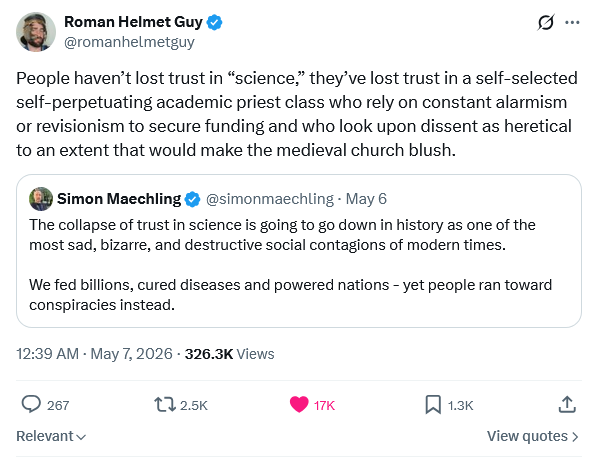
On the social media site formerly known as Twitter, Eve Keneinan tells a story about a people who once depended on the words of the Oracle and why they eventually stopped listening:
Once upon a time, the people of a certain land were blessed with an oracle of uncanny precision and depth in its predictions and information.
The people rose to prominence and prosperity thanks to consulting the oracle.
However, the people were never allowed to consult the oracle directly, but only through the priests that carried their questions to it, and brought the oracle’s responses back to them.
Eventually, the priests began to confuse the virtues and gifts of the oracle as their own, and began no longer to bother asking the oracle questions before deciding on what “its” answers would be.
Thus it transpired that, while the oracles was a reliable and beneficial as it ever was, since its true answers no longer reached the people, but merely the false and self-serving answers of the priests, the act of “consulting the oracle” became no longer beneficial.
So people stopped consulting the oracle.
The priests were mystified by this.
“The oracle is as reliable as ever,” they said amongst themselves. “Why do the people then no longer trust it?”
And yet they had done it themselves.
QotD: The cultural importance of the church in early Medieval Europe
The very first thing to note is that the Church (in this case, both the Latin West and the Greek East) pre-dated the Middle Ages themselves. The Church arrived in the Middle Ages as relic of the Roman Imperial past. It inherited Roman Imperial organization – the diocese, for instance, derived from the boundaries of Roman super-provinces called dioceses (Greek: διοίκησις). Unlike the new medieval aristocracy, which tended to rule from fortified estates in the countryside, the Church remained centered in towns and cities, many of which had been major centers under the Romans. As the Roman provincial administration collapsed, it largely fell to the Church – as one of the few surviving literate institutions – to replace some of the core functions, like record keeping and the preservation of literature and learning. This was less true [in] Scandinavia and Eastern Europe, places where the Church was a relative late-comer, but for most of Western Europe, the Church was not some new institution grafted on to a pre-existing society (as it had been under the Romans), but rather part of the bedrock cultural foundation upon which that new society was constructed (fellow pedants! – please note carefully the phrase part of in the previous sentence; I am aware there were other things).
That said, the institutional power of the Church (and here we really do mean what would be the Roman Catholic Church) begins to change dramatically in the 11th century, right as we enter the High Middle Ages, and continues for the next several centuries (keeping in mind that Game of Thrones and A Song of Ice and Fire really evoke the High and Late Middle Ages, rather than the Early period). In short, the institutional heft of the Church grows dramatically. Quite a few things begin happening which are linked together: the Popes begin trying to wrest control over the Church’s hierarchy (specifically, the investiture of bishops) from secular rulers. Clerical celibacy was more stringently enforced. The Church intruded into warfare (as we’ve discussed with the Peace of God / Truce of God movements). It began to more directly attempt to regulate marriage, especially among the powerful (marriage was a made a sacrament in 1184). By the 1300s, this included keeping detailed records in many parts of France about births, deaths and marriages, in part to ensure no one married a close relative.
(And, of course, for those of you thinking, “wait, isn’t this also the period of the Crusades – military expeditions called by and at least nominally (but not in practice) under the auspices of the Pope?” Yes, it is, and that’s not an accident either).
In my experience teaching this, it is the next step that baffles my students the most. This vast increase in the institutional power of the Church was made possible, not by armies or shrewd real-politic (though both were involved), but by belief. The primary weapon wielded by Popes in this effort was the threat of excommunication, which (under Catholic doctrine) cut off the excommunicated individual or community from salvation, potentially damning them for all eternity. But of course that threat is only real if you believe the Pope has that power. And therein is the key point: most of Europe did believe. As I tell my students, it is safe to assume, as a general matter, that people in the past believed their own religion. Of course there are exceptions, but the general rule remains.
In the conflicts that arose – because, as you might imagine, secular rulers were unwilling to give up their prerogatives – it did not actually much matter if the king or emperor believed in the power of excommunication, because no one rules alone. Thus when the Holy Roman Emperor Henry IV was excommunicated by Pope Gregory VII in 1076, the audience for this act wasn’t Henry himself (who had already declared Gregory illegitimate anyway). It was directed at all of Henry’s vassals and supporters, releasing them from their oaths of allegiance and essentially saying, “stick with this guy, and he’ll take you to hell with him”. It worked, sparking a major rebellion and forcing Henry to humiliatingly apologize the following year.
(History note: this would be “round 1” in a multi-round fight that wasn’t settled until 1122 with the Concordat of Worms; in the end the Papacy mostly won, sharply limiting the Holy Roman Emperors’ power over their bishops).
Bret Devereaux, “New Acquisitions: How It Wasn’t: Game of Thrones and the Middle Ages, Part II”, A Collection of Unmitigated Pedantry, 2019-06-04.
May 10, 2026
The “death of the reader” is how art stops being for people and becomes just for artists
When I first got interested in Jazz, I bought all sorts of music from multiple musicians and groups, liking some more and some less. But it seemed that at some point in the 1960s, I was finding less and less of the music to be interesting and entertaining. More and more from that point on, the music seemed to be deliberately less accessible, more intricate without being pleasant or compelling to hear, and (as I characterized it years ago on the old blog) more oriented to other musicians rather than the non-musician general listening audience. On the social media site formerly known as Twitter, Devon Eriksen shows that this happens in many artistic and creative pursuits and groups them all together in a phenomenon he calls “the death of the reader”:
This is what I call “The Death of the Reader”.
Authors write for readers, who aren’t authors. Artists paint for non-artists. Musicians play for non-musicians.
This keeps fiction, art, and music grounded.
But when any group stops creating for an external audience, and starts trying to impress only each other, they create a weird, self-reinforcing feedback loop.
This isn’t clothing, or even fashion. It’s a costume party. They’re all trying one-up each other with something weirder and more eye-catching.
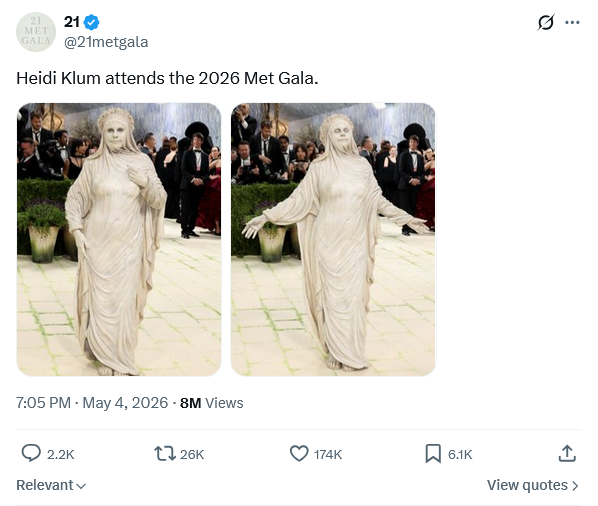
So when an athlete, of recent and topical celebrity, who isn’t a part of their Bored Billionaires’ Club, shows up in a dress that’s just a dress, of course they are going to mock her. She’s just revealed that she didn’t get the memo. That she’s not an insider.
How she looks to the world at large is not the point.
This is why 99.999…% of copies of Infinite Jest have never been read. This is why John Cage “wrote” four minutes of silence. This is why competitive bodybuilders from the 80s looked like Greek gods, and modern ones look like gargoyle freaks.
It’s all the Death of the Reader.
Hollywood doesn’t make movies for you now. They hate you. They make movies for each other.
And then cry about how you didn’t buy a ticket, because they think your only role is to pay for their onanistic circle of self indulgence.
This game isn’t going to stop. It’s just going to keep getting weirder until someone’s dress malfunctions and catches fire, and the rest of us all have a good laugh.

QotD: The cavalry
Combat Boot, “So, ‘capbadges’, what’s that all about then?”, combatboot.co.uk, 2020-11-13.
May 9, 2026
QotD: Morality and taxation
This has always been this way since America has had income taxes. There is endless court precedent. You pay what you legally owe. That’s it. If you pay less than you legally owe, then the government will fine or imprison you. If you pay more than you legal owe, the government will laugh and laugh, because you are an idiot, and you deserve to be poor.
Every single person who barks about how somebody else should be paying more? They themselves are paying the minimum they can get away with. As they should. As should you.
I remember when I was taking my first tax class back in college. This class was all accounting majors by this point. At the beginning of the semester the professor (who’d had a long career as a tax guy) gave us an imaginary family as our clients and had us do their taxes. One kid didn’t take advantage of all the obvious deductions for his clients. When the professor asked why, the kid said some mushy thing about how he didn’t think it was FAIR to keep that money from the government … Holy shit. The professor ripped this kid a new asshole. HOW DARE YOU!?! IT IS NOT THE GOVERNMENT’S MONEY! IT IS YOUR CLIENT’S MONEY. YOU OWE THEM YOUR BEST! IT IS YOUR SACRED DUTY TO SAVE THEIR MONEY! YOU DISGUST ME AND YOU SHOULD NEVER BE A CPA!
That class was one of my favorites.
Basically, you pay what you owe, no more, and anyone who claims otherwise is full of shit.
Larry Correia, “No, You Idiots. That’s Not How Taxes Work – An Accountant’s Guide To Why You Are A Gullible Moron”, Monster Hunter Nation, 2020-09-28.
May 8, 2026
QotD: North Vietnamese intelligence failures in the Tet Offensive
… and it didn’t happen, because they, the North Vietnamese, had faulty intel.
The Americans suffered from the “intel to order” problem too, of course, which we in the civilian world call “telling the boss what he wants to hear”. But the NVA had it much worse, since that’s a much greater structural problem among Commies. Indeed, the Americans got at least one high-level defector during Tet — a lieutenant colonel I think — who only defected because the units he was supposed to command in the “general uprising” didn’t exist. They were purely paper fantasies, straight out of some commissar’s head.
And that’s what made [US Army military analyst Joseph] Hovey’s report so easy to dismiss. Hovey himself said it — it looks like they’re planning to do X, Y, and Z, but that would only make sense if they’re making a big mistake about the balance of forces. The US had pretty good intel on the ARVN and the political mood of South Vietnam. But they for some reason assumed that the NVA had basically the same information, so all of the NVA’s calls for a general uprising — which the NVA absolutely meant, and indeed were counting on — were easy for US analysts to dismiss as mere propaganda.
Severian, “Book Rec: Tet, Intelligence Failure”, Founding Questions, 2022-06-30.
May 7, 2026
QotD: The loss of male spaces led to today’s epidemic of male loneliness
Places where men showed up without an agenda. Where conversation happened sideways, not face-to-face. Where no one asked men to perform vulnerability, explain themselves, or justify their presence.
Those places didn’t disappear because men rejected connection. They disappeared because our culture decided male-only spaces were no longer acceptable. And once they were gone, men were told that their resulting loneliness was a personal failure.
There has been a noticeable shift in recent months. A growing number of articles now
acknowledge male loneliness and even gesture toward men’s emotional needs. On the surface, this looks like progress — and in one narrow sense, it is. For decades, male loneliness was either ignored or mocked.But many of these pieces commit the same quiet betrayal.
After briefly acknowledging that men are lonely, many articles abandon subtlety altogether and place responsibility squarely on men themselves. Men don’t open up enough. Men don’t try hard enough. Men don’t build friendships properly. Men resist emotional growth.
What is missing is the most obvious factor of all: our culture systematically dismantled the spaces where men and boys once formed friendships.
Men Did Not “Forget” How to Connect, They Lost the Places Where Connection Happened
Male friendships have never primarily formed through structured emotional disclosure. They formed through shoulder to shoulder shared activity, regular presence, and low-pressure companionship. Men bonded by working alongside one another, not by facing one another across a table and “processing”.
For generations, this happened naturally in male-only spaces:
- Service clubs
- Fraternal organizations
- Trade guilds and apprenticeships
- Male sports leagues
- Scout troops
- Men’s religious groups
- Informal gathering places like barbershops and workshops
These environments weren’t about exclusion. They were containers — places where boys learned how to be men from men, and where adult men maintained connection without self-consciousness or surveillance.
Now consider what has happened.
- Barbershops are co-ed and transactional.
- Service clubs are now largely co-ed, and the informal freedoms that supported male bonding in male-only environments have largely disappeared.
- Community sports are co-ed or heavily regulated.
- Even the Boy Scouts are co-ed.
One by one, male spaces disappeared — not because men abandoned them, but because our culture increasingly viewed male-only environments as suspicious, outdated, or morally problematic.
The Asymmetry No One Wants to Name
At the same time male spaces were dismantled, female-only spaces proliferated.
- Women-only gyms are accepted.
- Women-only scholarships are celebrated.
- Women-only commissions exist at every level of government.
- Women-only networking events, parking, subway cars, retreats, and support groups are commonplace.
“Women-only” is understood as necessary, protective, and empowering.
“Men-only”, by contrast, is treated as exclusionary at best and dangerous at worst.
The result is an unspoken rule that everyone knows but few admit:
Women may gather without men. Men may not gather without women.
This is not equality. It is a double standard — and it has consequences.
Tom Golden, “The Quiet Lie Behind Male Loneliness”, Men Are Good, 2026-01-05.
May 6, 2026
QotD: Deskilling society through AI
Just like in the first one, we’ve figured out how to use machines to do a broad swathe of things people used to do, swapping energy and capital in for human labor. And just like in the first one, the output isn’t necessarily better (in fact, it’s often worse), but it’s so much cheaper in terms of human time and thought and effort that the quality almost doesn’t matter. Sometimes that’s wonderful: if you desperately need to put a roof for your barn right this moment, it’s a blessing to be able to slap on some corrugated tin instead of going to the effort of thatching. When you have to write your seventeenth letter to the insurance company explaining that no, they really ought to be covering this, it’s a relief to hand the composition off to Claude instead. But do that too much and you forget how to do it yourself — or more plausibly, you never learn.
The greatest risk of AI is probably “we all get turned into paperclips”, or maybe “someone uses it to design a novel and incredibly fatal pathogen”, but the most certain risk — the one that’s already here, at least on the edges — is a great deskilling. Just as the mechanization of physical labor lost us all those traditional skills that Langlands describes, the ability to automate cognitive tasks undermines their acquisition in the first place. Why pay any attention at all to word choice and metaphor and prosody when ChatGPT can churn out that essay in a few seconds? Why worry about drafting a convincing email when you’re pretty sure your recipient is just going to ask Grok for a summary?1 Why learn to code when a machine can do it faster?
I was recently informed that someone — “not anyone you know, Mom, someone at another school” — used ChatGPT to write his essay about the causes of the Civil War. This was obviously deeply upsetting to the congenital rule-follower who reported it to me, on account of THAT’S CHEATING (you must imagine this in the whiniest she-touched-my-stuff voice possible), but it was a good teachable moment — for me, if not for the history teacher at another school. What’s the point of an essay about the causes of the Civil War, anyway? It can’t be that the teacher wants to know the answer: she can find a dozen books on the topic if she cares to look, each more cogent and thorough than anything a middle-schooler is likely to produce.2 Heck, even the Wikipedia article will probably give her a better understanding. And if it’s not for the teacher’s benefit, it’s certainly not for the benefit of any other audience, since as soon as the essay is marked and graded it’ll probably be crumpled up and tossed into the recycling bin. No, it’s for the kid.
The point of writing an essay about the causes of the Civil War is not to have an essay about the causes of the Civil War, it’s to undergo the internal changes effected by the process of thinking through, planning, drafting, and editing the darn thing. Writing forces you to put your thoughts in order, to shape whatever mass of inchoate ideas is bouncing around in your head into something clear and reasoned you can pin to the page. The thinking is the hard part; putting words to it is simple by comparison. (This book review began life as about seven hundred words of stream-of-consciousness riffing, with only the vaguest kind of structure. When I experimentally pasted it into an LLM and asked for an essay, the result was terrible.) But even the putting of words is a valuable skill: what’s the right tone here? What’s the right word? Do I want to say “writing forces you to” or “when you write you have to”? How do they feel different? Asking a machine to do this for you is like bringing a forklift to the gym.
Of course, that kid who had ChatGPT write his essay was almost certainly thinking of the assignment not as one small step in the alchemical process of self-transformation that is education but as basically equivalent to an appeal letter to the insurance company: just another dumb hoop you have to jump through in your interactions with a vast impersonal machine that doesn’t particularly want to grind you to dust but wouldn’t mind it either. And since this was at another school, he might not even be wrong. Maybe the teacher was just pasting the rubric and the essays back into ChatGPT and asking it to assign a grade.3
But there’s an even bigger problem than lying about who (or what) has done the work, which is lying about whether the work has been done at all. LLMs make lying very easy indeed. Yes, yes, sometimes they hallucinate and tell you things that are patently untrue, and that’s a bigger danger for students and other people who don’t have the background to notice when something seems off — this is all true, but it’s not what I mean.
LLMs, when working exactly as intended, enable human falsehood — because our society relies on written records as proof of work. Until recently that was fine, because writing down lies actually used to be pretty hard: putting together a convincing false report from scratch — maintenance records for the airplane you’re about to board, say, or a radiologist’s report on your brain scan — was almost as time-consuming as actually checking the things that were supposed to checked and then documenting them, and the liar had to spend the whole time aware of their own dishonesty. (Not that this stops everyone, of course.) But now that it takes about two clicks to generate an inspector’s report for the house you’re considering buying, or the pathologist’s findings in your biopsy, how much are you going to trust that they actually looked?
LLMs can be useful tools,4 but all tools change what we make and how we make it. It’s often a good tradeoff! Sure, each individual example of simplification and automation in the name of efficiency is a tiny bit of alienation, removing the maker from the making, but it’s also a gift of time we can spend on other things: I couldn’t write this if I also had to sew my family’s clothes and wash our laundry by hand. And yet those bits pile up, and once it becomes possible to exist in the world without really needing to come into contact with it, once you can get by without ever really needing to make anything, some people just won’t. And that’s terrible! Being entirely without cræft — never bringing mind-body-soul into harmony with one another and then using them to master the world — means missing out on something deeply human.
Jane Psmith, “REVIEW: Cræft, by Alexander Langlands”, Mr. and Mrs. Psmith’s Bookshelf, 2025-03-24.
- All the “AI written/AI read” communication begins to resemble Slavoj Zizek’s perfect date:
“So my idea of a perfect date is the following one. We met. Then I put, she puts her plastic penis dildo into my … “stimulating training unit” is the name of this product. Into my plastic vagina. We plug them in and the machines are doing it for us. They’re buzzing in the background and I’m free to do whatever I want and she. We have a nice talk; we have tea; we talk about movies. What can be — we paid our superego full tribute. Machines are doing — now where would have been here a true romance. Let’s say I talk with a lady, with the lady because we really like each other. And, you know, when I’m pouring her tea or she to me quite by chance our hands touch. We go on touching. Maybe we even end up in bed. But it’s not the usual oppressive sex where you worry about performance. No, all that is taken care of by the stupid machines. That would be ideal sex for me today.”
- Well, okay, most of them.
- See footnote one again.
- Personally I’ve found them useful in three cases: (1) when I’m blanking on how to begin an email I will occasionally ask for a draft, which inevitably makes me so mad about how bad it is that I immediately rewrite it in a way that doesn’t suck; (2) when it’s Sunday night and I need a picture of a Japanese man in a business suit and a samurai helmet for a book review going up in the morning; and (3) when I can’t figure out the right search term for my question. (Turns out it was “sigmatic aorist”. Thanks, Claude.)
May 5, 2026
QotD: Why China never adopted war elephants
Trautmann (2015) finds the solution in land-use patterns: China had simply converted so much of its pasture and forest to crop-land, in a densely settled city-and-agriculture land-use pattern that incorporating large numbers of elephants was not just prohibitive, but also culturally foreign. And there’s something to this, though I don’t buy it completely. Absolutely, Chinese land-use patterns would make elephants a lot more expensive to maintain than in India or even Rome. Highly productive farmland would likely have to be turned over to elephant pasture. That said, Chinese rulers had embraced the chariot and cavalry, so such things could be done, if the military or political calculus made them worth doing. But they weren’t done.
Instead, I tend to think that the same basic calculus that applied for Rome applies neatly for China – elephants fare poorly in societies with access to large numbers of disciplined infantrymen who can be trained in anti-elephant tactics. And this was certainly true of China, which had disciplined infantry to spare. Also, Han armies seem to have relied on close integration of missile weapons and polearms, meaning that they had the same sort of integrated light infantry support that the legion of the Roman Republic did. Later Chinese armies, as Trautmann briefly notes, had no problem defeating elephants in battle.
As with Rome, in China, elephants seem to have been a military solution looking for a problem to solve – and never found it. For one Chinese dynasty after another, the major military threats were either peer competitors (during periods of political fragmentation) whose disciplined infantry armies were no more vulnerable to elephants than Rome’s, or else steppe nomads. Given the tremendous logistical difficulties of operating even small armies out on the open steppe, attempting to take war elephants there would have been the height of stupidity. Elephants weren’t going to stop the Mongols – to be fair, not much stopped the Mongols (we’ll get into India, Mughals and elephants next time).
Bret Devereaux, “Collections: War Elephants, Part II: Elephants against Wolves”, A Collection of Unmitigated Pedantry, 2019-08-02.


