Quotulatiousness

March 3, 2023

Progressives have steadily transitioned to the movement that denies that any personal conduct rules should apply

Filed under: Law, Liberty, Media, Politics, USA — Tags: , , , , , — Nicholas @ 05:00

Freddie deBoer challenges his fellow leftists to identify who were the theorists that introduced the notion that personal responsibility is an anti-socialist position:

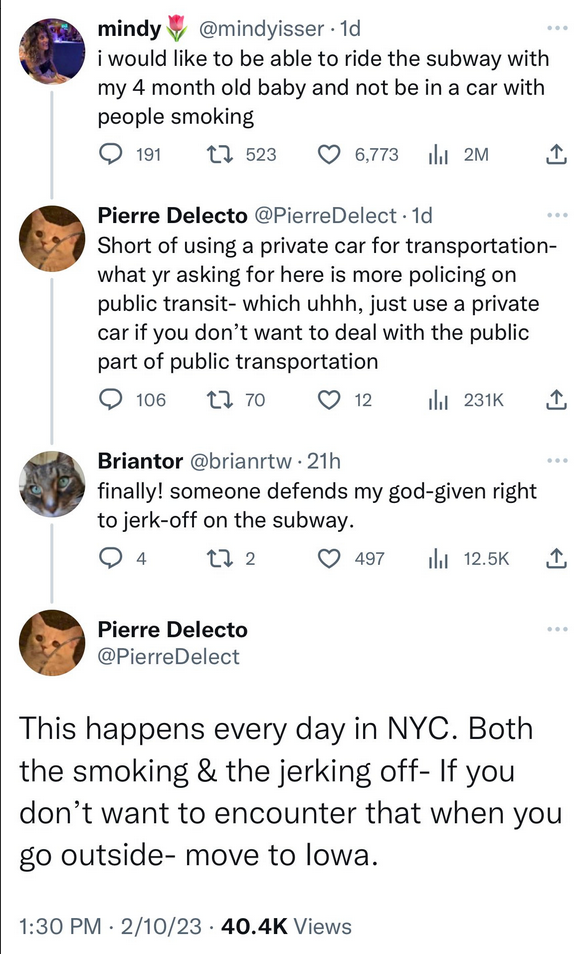
The woman whose account appears at the top of this picture started a Twitter storm, somehow, by publicly wishing that she could take her child onto the subway without exposing them to secondhand smoke. She was beset by a certain online species of ostensible leftist who is against ever trying to enforce any kind of rule, anywhere, ever. See, rules are the hand of oppression, or something, and since most of society’s rules are meant to be enforced by the police, trying to enforce them (merely wishing that they be enforced) is an endorsement of the police and their violence …

I find this attitude has become inescapable. It’s not just the attitude that the enforcement of societal rules and norms is bad, but that this is the default assumption of all right-thinking people — it’s not just a left-wing perspective but the left-wing perspective. Like so much else in contemporary left-of-center discourse, it demonstrates the total ideological poverty we’re working with. Nobody has read anything, so nobody knows anything, so you’re constantly getting yelled at by self-described radicals who have no solid footing in any systematic approach to left politics at all. Like I said before, we’re living in definitional collapse; the struggle right now is not merely that socialism can’t win but that so many self-described socialists have no deeper ideological moorings than whatever they’ve absorbed from Tumblr and “breadtube”. They think that to be a socialist means to disdain all rules because there is no substance to their socialism at all.

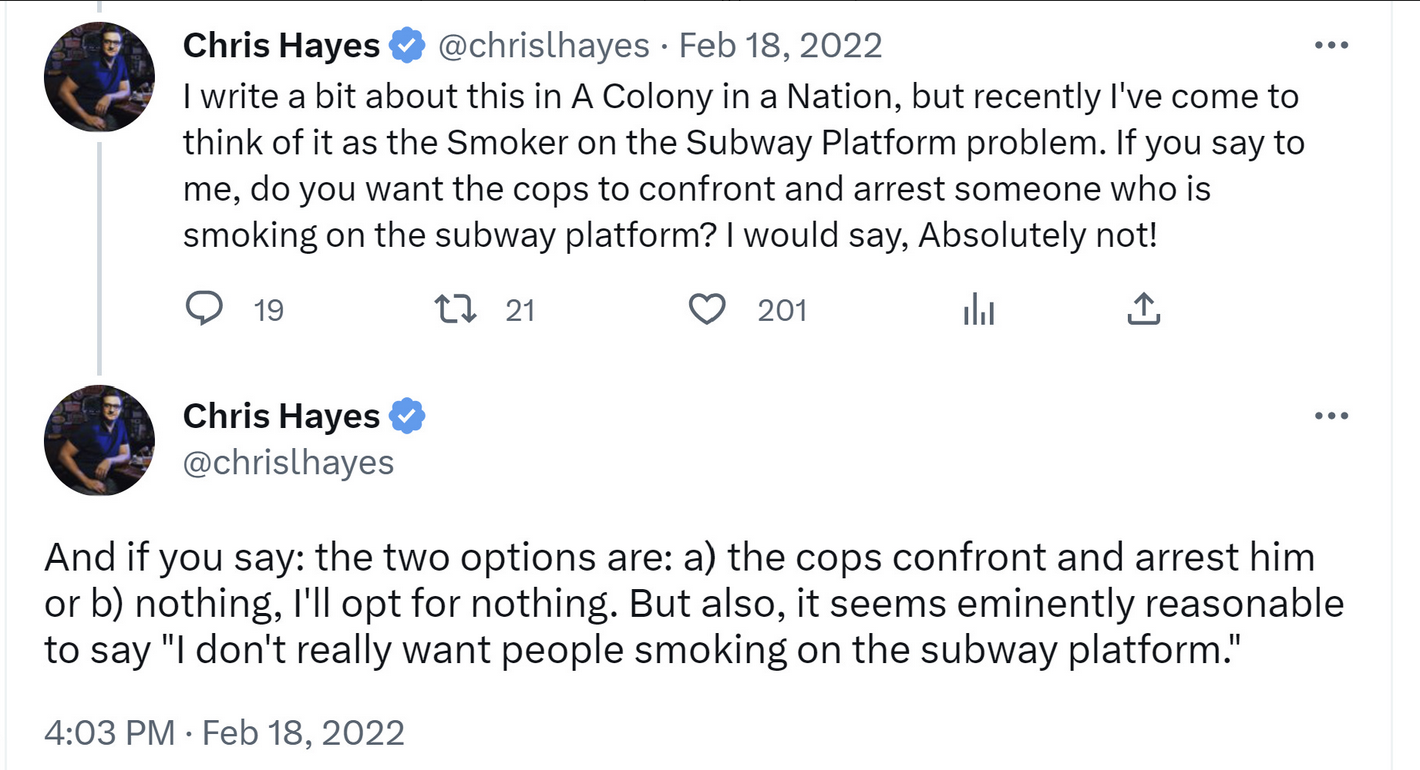
Chris Hayes considered the subway smoking problem last year.

Conceptually, I don’t think these problems are hard at all: the left, the socialist left, has never advocated for a system in which there are literally no expectations on personal behavior. It’s quite bizarre to suggest that this was ever a thing! Only certain extreme forms of anarchism have ever implied that society should have no rules. Go back through the history of socialist theorists and number all of the ones who believed that there should be no laws and no police to enforce them. You won’t find many! Instead you’ll find people who believed in the need for both laws that govern human behavior and constabulary forces to enforce those laws. That’s the solution to the conundrum, my friends — you have rules and you have police that enforce those rules. The belief, and the hope, is that a socialist society is one with far less need for aggressive policing, thanks to far greater economic equality, and maybe someday, after the end of material need, we can consider a policeless society. But not having any social rules or people who enforce those rules is not a socialist concept and never has been. What I would ask Chris Hayes and people like him is … what is the leftist tradition that you’re drawing from that implies that there should be no enforcement of behavioral norms? What thinker? What book? What philosophy? Or, could it be that you’ve developed this totally substance-free approach to basic order because you’ve been habituated to talking this way through exposure to people on social media who know nothing about anything in particular?

Of course, there’s big problems with American policing. Very big problems indeed. So what we do is reform policing. (I address this at length in my next book, coming this fall from Simon & Schuster.) Alternatively, if you’re really committed to this “no rules, no enforcement” thing, you become an anarchist of a very particular stripe — most versions of anarchism have both rules and enforcement mechanisms for them — and you and your compatriots can try to change the system. All twelve of you. In the house your wealthy parents bought for you.
Conservatives keep re-enacting the Charlie Brown “kick the football” scenario

Filed under: Media, Politics, USA — Tags: , — Nicholas @ 03:00

Theophilus Chilton on the evergreen Charlie Brown and Lucy impersonations of the conservatives and progressives in western political struggles:

If there is one thing that becomes apparent when you talk to a lot of normie conservatives, it is that they have absolutely no idea how or why they keep getting rolled over by the radical Left. They work and they work and they work to win elections, they invest their time and money to get “their guy” into office, only to find him selling them out on the first important issue within a month of taking office. They pass laws, only to be thwarted in the courts. When they win in the courts, they get thwarted by the bureaucracy. They try and try to force government to abide by the Constitution, but find that this document applies in one direction only. No matter what they do, they simply cannot keep Cthulhu from swimming left.

Why is this?

It’s because they fundamentally don’t understand how power actually works. In a sense, normie conservatives long for a world that never existed. They desperately want to “keep” a republic where politicians work for the public good and where government is truly restrained by its founding document. So it’s something of a bitter pill for them to swallow when they finally accept that such a thing doesn’t exist, and really hasn’t existed in any reasonable form in the United States since the Civil War. America has continued to move left for the past 150 years because the Left has been perfectly willing to do whatever it takes to win. The Left has become adept at “manipulating procedural outcomes,” by which is meant the ability to game the system to make an existing structure which is “supposed” to operate one way bring about outcomes which were never really intended (or even considered possible) by the people who put it into place.

How do you get around constitutional restraints on, say, gun laws or federal encroachments on state prerogatives? Well, one example would be to use fraud and deceit to subvert the Constitution’s provision for elections to get your people in office, who then use the Constitution’s provisions for nominating and approving judges to get friendly judges in power, who then use the (dubiously) constitutional provision for judicial review to decide that whatever laws you want to pass are “constitutional.” Other than the initial fraud (which, since you run the show now, isn’t going to be challenged in any substantive way), everything you did was “technically” in line with the Constitution, even though the results are quite the opposite of what was actually intended. Wanna pack the Supreme Court? Technically, it’s legal! Ban political speech you don’t like? Call it “hate speech” and enforce it under provisions in administrative law that have already been allowed to stand by your judges. The Left has become very adept at appearing to “follow the rules” while working the system to undermine that same system for its own ends.

So that’s “how” the Left always seems to beat conservatives, even when conservatives manage to win an election. But WHY does this happen?

It happens because conservatives ALLOW it to happen.

Let’s be brutally honest here – normie conservatives are saps. They continue to play a rigged game, no matter how often they lose. And they do so because they believe it is virtuous to hold onto “principles” which inevitably lead to failure after failure. They never consider that if “holding to their principles” means the destruction of everything they profess to hold dear, then those principles are terrible principles that should perhaps be reconsidered. If you pat yourself on the back for your virtue in “playing by the rules” even as your house burns down around you and the neighbours are making off with all your stuff, then you’re the source of the problem. Don’t blame somebody else for capitalising on your stupidity.

QotD: What’s the opposite of university? “Diversity”

Filed under: Education, Politics, Quotations, USA — Tags: , , — Nicholas @ 01:00

That was one of the things that made faculty meetings such joys, back in my professin’ days — no matter how trivial the issue at hand, the meeting couldn’t move forward until everyone had gotten up on xzyher soapbox and delivered xzheyr standard diatribe. “As a post-structuralist lesbian Maoist furry, I feel that …” The outside observer would see a room full of identical freaks, but the people inside saw a glorious rainbow of diversity. Real diversity. God help us, they really did. They really do. It’s one of the keys to understanding them.

Severian, “Advice to Young Dissidents”, Rotten Chestnuts, 2020-04-01.

March 1, 2023

Our modern age of “squishy totalitarianism”

Filed under: Media, Politics, USA — Tags: , , , , , — Nicholas @ 05:00

Chris Bray on the odd controlling habits of our “great and good”, our “moral and intellectual superiors” to urge us to follow their directives “for our own good” (or else):

The anarchist philosopher Crispin Sartwell describes our political culture as one of “squishy totalitarianism”, a term I like quite a bit. (See the third page of this document.) You can disagree and refuse to comply, and the secret police won’t show up at your door (with maybe a growing list of exceptions). We don’t have a gulag. We don’t have the “culture of the disappeared“. You just … maybe find yourself with fewer friends, and some family that stops talking to you, and maybe your employer lets you know that hey, you know what, this doesn’t seem to be working out.

It’s not the Great Terror, it’s just a kind of low-grade grind of social decredentialing that lets you know you’re not making the right choices. We need to rethink Thanksgiving this year, because we’re very disappointed in you. (Don’t you want to be safe?) The way Google searches are working these days is a pretty good example of squishy totalitarianism: Oh, I’m sorry, we have no results for that widely known piece of wrongthink, but here are some results that debunk the conspiracy theory you’re searching for. Wouldn’t you prefer to read a correct search result?

[…]

We can debate the origins and the motive force behind the constant parade of error that has plagued us over the last three years: useless mask mandates, aggressively harmful school closures, insanely damaging vaccine mandates, ludicrous closures of beaches and parks, the pearl clutching over all those conspiracy theories about a lab leak.

You know the terms of the debate: Is the world led by idiots who are screwing it all up, or is this a plan that they’re executing on purpose?

But whichever answer turns out to be correct, one thing that seems extremely clear to me is that this perpetual reign of error couldn’t possibly go on without the unthinking enforcement activity of a distributed commissariat, the slogan-repeating upper-middle-class-aligned cultural apparatus that endlessly lawn signs their compliance. No one has to tell journalists to scold Woody Harrelson: they already know. The moment the Woodster engaged in crimethink, the Rolling Stone writer Marlow Stern started salivating like a trained dog hearing a bell. Vast armies of professors and HR specialists and marketing executives and bureaucrats and Hollywood functionaries and school board wokescolds and on and on and on already know their roles without being assigned to them. It is not correct for you to fail to comply with Current Thing; you are spewing conspiracy theories.

    Doctor, the symptoms began shortly after I received the second dose of the Covid vaccine.

    No, that is not possible, vaccines do not cause injuries. Let us not discuss this conspiracy theory any further. Here are some pills.

We have an enforcement apparatus made up of people who volunteered for the job. In terms of social class, we have the lower class, the lower-middle-class, the middle class, the Stasi, and the upper class.

If the Freedom Convoy “actually was what it has often been portrayed as on social media — a horde of thousands of literal Nazis and Confederates set on violently overthrowing our democratically elected government — then [we’d] be living in the Confederate Republic of Nazi Canada by now”

In The Line, Matt Gurney explains how going through Justice Paul Rouleau’s Public Order Emergency Commission report in detail leads to some uncomfortable realizations about Canadian goverment and policing — at all three levels — failed to meet minimal expectations of competency and capacity:

A screenshot from a YouTube video showing the protest in front of Parliament in Ottawa on 30 January, 2022.
Photo via Wikimedia Commons.

The convoy crisis — and I’m mostly speaking here about the events in Ottawa, though the situation at the border crossings fit the same general pattern — forced Canadian police and political leaders to respond quickly to evolving circumstances. And Rouleau’s report is just a relentlessly brutal catalogue of the ways they failed.

Is it really necessary at this point to recap the failure of the Ottawa police? We at The Line have long maintained that the complete failure of the Ottawa police to plan for and control the protest not only allowed the convoy to entrench itself, but also established the psychological paradigm that would define the crisis for weeks: the convoyers held the initiative (not to mention the capital) and the Canadian state was befuddled and adrift. From that, a national crisis was born. Rouleau is just devastating. “The OPS [Ottawa Police Service]’s planning challenges,” he notes on page 56 of the first volume, “were compounded by a general breakdown of command and control.” Super.

He’s even more brutal on page 185 of the second volume: “The influx of Freedom Convoy vehicles and the disruptive behaviour by some protesters threw the OPS operational command at the NCRCC [a command centre] into a state of dysfunction. OPS Inspector Lucas described the atmosphere at the NCRCC as chaotic and explained that he and his team had neither the capacity to process the incoming information nor the resources to respond to the needs it was facing. In the late afternoon of January 29, the OPP’s [Ontario Provincial Police] representative at the NCRCC, Inspector Dawn Ferguson, reported to OPP Superintendent Abrams that OPS members in the NCRCC were panicked and were swearing and yelling orders at each other and at partner agencies.”

Huh.

Moving up a level of government, much has already been written about the cowardice of the Ford government. If any agency performed semi-well, it was the Ontario Provincial Police. The OPP was the force that was generating most of the critical intelligence used (or ignored) during the crisis. It was quick to realize that command-and-control had collapsed in Ottawa (see above), and to begin working with the RCMP on a plan — eventually a series of plans — to restore order. You can’t read POEC and conclude the OPP performed perfectly. Far from it. It was probably the best we had, though, but because Ford took a gander at the mess in Ottawa and decided to mosey on off to the cottage, it couldn’t do much.

Huh.

And that leaves us with the feds. I have maintained since last year that the federal government hasn’t received nearly enough attention in our understanding of what the hell went wrong last year. This has caused a fair degree of pushback, especially from Liberal supporters who read any reference to the “federal government” as “our beloved prime minister”. But no — while I don’t think the prime minister or the federal cabinet did particularly well during the crisis, the real federal failures were in the officials that supported the PM and his ministers.

Among the many other failures, the inability of the various government and police organizations to organize and properly share the information they were handling is perhaps the most disturbing:

If you want to see it yourself, check out pages 38 and 39 of the third volume. For those in a hurry, though, it turns out that even within the government, the flow of information was so bad that the clerk of the privy council, and the prime minister, noted that staff were learning about the convoy not via internal reports, but social media. The federal government had, as Juneau and Rigby have noted, “intelligence gaps” that “hampered the government’s ability to understand, anticipate, and respond to the situation, and to reconcile conflicting information such as contradictory reports about the size of the convoy”. The federal government didn’t have the software to process and analyze online posts, even public ones.

And then there was this (my emphasis added):

    [National Security and Intelligence Advisor] Thomas also described an information-sharing gap between law enforcement and government. Assistant Secretary to the Cabinet, Security and Intelligence, Michael MacDonald recalled a significant delay in receiving updates from the RCMP, due to the RCMP’s obligation to consult with each intelligence agency that has provided the RCMP with information prior to sharing that information further (known as the “third party rule”). The NSIA’s office did not receive situation reports, project reports, or other forms of information, such as Project Hendon reports, that the RCMP obtained from other law enforcement agencies. Prior to the events of the convoy, the NSIA was not aware of Project Hendon. …

    NSIA Thomas further stated that it was sometimes difficult to know how to interact with law enforcement agencies. She recognized that government must not interfere in operational matters, but thought that there was nonetheless useful information that could have been provided to decision makers without encroaching upon police independence. However, senior officials were uncertain how to obtain that information, and were concerned about “crossing the line” both in requesting information and in discussing solutions.

… huh.

And that doesn’t even cover our now-outgoing national commissioner of the RCMP being so clueless she decided to just not mention germane information during a critical meeting because … well, we never really got a good explanation for that one. Oh well. Enjoy your retirement, Commissioner Lucki!

February 28, 2023

QotD: Politicians respond to different economic incentives than the rest of us

Filed under: Britain, Economics, Politics, Quotations — Tags: , , , , , — Nicholas @ 01:00

Politicians in particular have a problem – in good times, people vote for them, and in tough times … not so much.

The temptation is to delay the tough times until your successor can carry the can.

Poor old Keynes inadvertently gave politicians the answer they were looking for – the idea that during the downturn, the government should spend money into the economy to keep it going along nicely. Making sure that those lifeguards sacked from the Skegness lido can swiftly get jobs working at a government Skegness lido prevents them claiming the dole, and keeps them in the economy earning and spending until the economy washes out all the malinvestment and starts growing again. At which point the government Skegness lido closes and the lifeguards go to work at a lido somewhere where the biting Easterly wind doesn’t sandblast your skin off. The government has bridged the gap.

There’s one problem.

The government has no money of its own, so where will it get the money for their lido?

Well, Keynes said it should run a surplus during the good times and stash that surplus money away so it can be used during the downturn – a national rainy-day fund, if you will.

But guess what? Politicians don’t run surpluses.

Why would they? Every penny spent making lives better for voters today makes it more likely they will vote for you. And every penny saved against a rainy day makes it possible for your rivals to win votes tomorrow, by doing the same once they are in power.

So politicians don’t ever HAVE a rainy day fund. But that doesn’t stop them wanting to bridge the gap.

So they borrow the money.

And now what they are doing is not Keynesian, or even neo-Keynesian, but pseudo-Keynesian

By bridging the current gap with borrowed money, they simply make sure that the next gap will be costlier to bridge. Because the interest on the borrowing means that the gap will be wider.

But that’s not even the biggest problem – the biggest problem is that the gap is intrinsically important. We NEED it, to give us pause.

Whereas bridging it enables us to carry on being silly and prevents the misallocations from being flushed out – a lido remains operating in Skegness despite having no customers, and the lifeguards continue to work. Their lifesaving skills (which should be fruitfully employed elsewhere) stagnate at a lido with no punters. Their customer service skills deteriorate as the customers disappear, and what they learn instead is how to sit in a chair and stare into space. Their skills are degrading. Hysteresis, technically.

And so by delaying the collapse of the Skegness lido in pursuit of benign conditions for the voters, the government destroys the skills of our workforce.

Sowell was right – the problems we battle today were caused by the government’s interventions yesterday.

Surely using government to solve our problems is like a man quenching his thirst with seawater?

Alex Noble, “Drinking Brine”, Continental Telegraph, 2019-06-14.

February 25, 2023

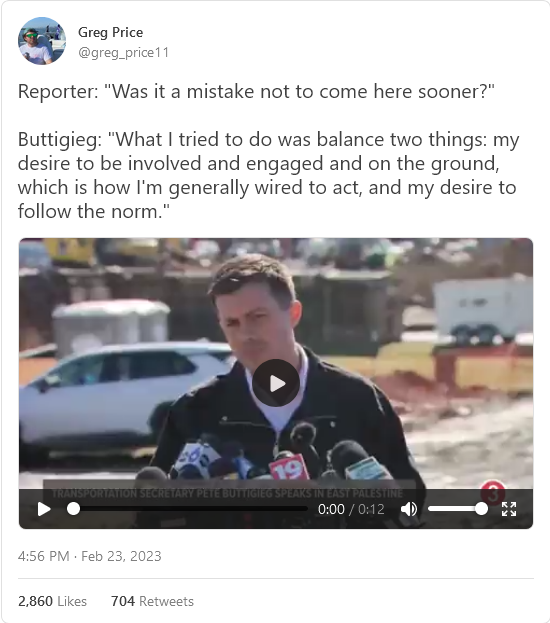
Buttigieg isn’t covering himself in glory over his belated East Palestine train derailment response

Filed under: Bureaucracy, Government, Media, Politics, Railways, USA — Tags: , , , , , — Nicholas @ 03:00

Jim Treacher is clearly trying to at least pretend some sympathy for Transportation Secretary Pete Buttigieg, but it’s a tough assignment:

Pete Buttigieg is the type of guy who walks into a job interview and says his biggest weakness is his perfectionism. As a kid he always had an apple for the teacher, and if she forgot to assign homework that day, he was the first with his hand up. He’s a repulsive little hall monitor, so all the other repulsive little hall monitors think he’s simply divine.

Mayor Pete and his fan club are having a really bad time right now, because for once he’s expected to actually do something. Producing results simply isn’t his specialty. After spending three weeks hoping the East Palestine, Ohio rail disaster would stop bothering him if he just ignored it, he finally showed up there yesterday.

And I’m starting to understand his reluctance:

What a visual, huh? He looks like a little kid playing Bob the Builder. It’s not quite Dukakis in the tank, but it’s close.

And then it got worse: He started talking.

He’s just so gosh-darn dedicated to his job, you see. His only mistake was listening to you people. He followed the norm. This is your fault!

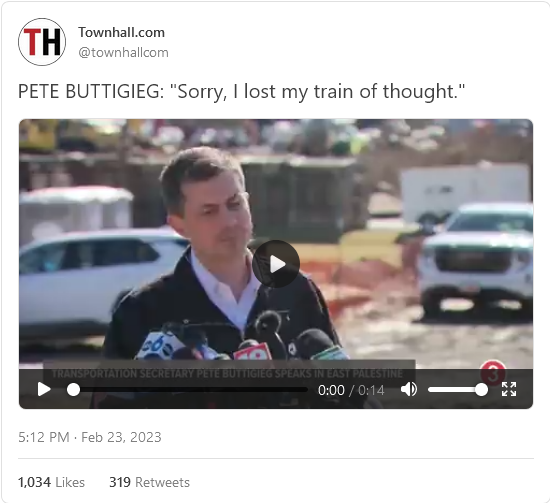
And then he blurted out this instant classic:

Now, which of those words should you try to avoid when you’re talking about a disastrous train derailment? I’m starting to suspect this guy isn’t the unparalleled megagenius the libs keep telling us he is.

[…]

Team Pete is more concerned about reporters asking about East Palestine than about the disaster itself. The rest of us are just an abstraction to them. If they accidentally manage to help some of us, that’s fine. If not, that’s also fine. Either way, we cannot be allowed to stand in the way of their political aspirations.

Mayor Pete really did think this gig would be a cinch, didn’t he? Like, he could just do all the reading the night before the final and ace it. He’s positively resentful at being expected to do what we’re paying him to do. He thinks he’s too good for this job, which is why he’s very bad at this job.

Will Buttigieg’s tenure as transportation secretary ruin his presidential prospects? After all, that’s what this is all about for him. Maybe, maybe not. It’s not as if politics is about solving problems. All you have to do is claim you solved the problems, and your team will cheer for you no matter what.

February 24, 2023

“… they are all weedy, weird sylphs who are essentially un-people, without any wisdom or sense”

Elizabeth Nickson on the current cohort of raised-in-a-vat, cloned “leaders” of most of the western world:

Easily the most destructive cohort in the culture is the financially secure, semi-educated female on the cultural left. She reads nothing but literary fiction, is a book and knitting club member and knows absolutely nothing about the real world. But she is “bold” and “powerful” and never shuts up. Her views are confirmed, amplified and imposed by corporate media, for whom she is the aspirational shopper from whom all wealth flows.

It is the opposite of a virtuous circle. Ignorant protected women of all colors are courted by corporations because she makes 90% of buying decisions (and less fortunate women emulate her). Corporations force the press to slavishly pander to her every stupid whim and deep feel of the month so their adverts work like charms.

All the above leaders [Jacinda, Trudeau, Nicola, Rishi, and Macron] are manufactured in some MKULTRA facility to appeal to her ignorance, her prejudices, her over-weening self-regard. With the exception of the vegetable in the White House, they are all weedy, weird sylphs who are essentially un-people, without any wisdom or sense. They’ve lived their lives in classrooms and meeting rooms. They serve as pretty, platitudinous ciphers on which to project a profound political ignorance and emotional immaturity.

Our girl, for she has never grown up, has abandoned adult responsibility to luxuriate in narcissism.

She is ruthlessly used by the vicious communist left (as described below) and she has no idea who or what they are. She is the stupidest person on the planet.

And Michelle Obama? If you are thinking of running, think again. Because the hell we will unleash on your ignorant self will make Jacinda tremble with PTSD.

Let someone far less impassioned and far more knowledgeable than me describe Ardern’s humiliating failures below. The damage she caused to her people, to her party, to her country’s economy was as titanic as her ego. Every single other leader listed in the head of this piece is following the same dictated-from-above public policy initiatives. Their fate and that of their citizenry will be the same.

By their fruits ye shall know them.

If you want to know more about the rise and fall of Justin Trudeau’s New Zealand counterpart, Elizabeth’s post includes an extensive discussion of Jacinda Ardern’s career from Dr Muriel Newman of the New Zealand Centre for Political Research.

February 23, 2023

Scottish First Minister Nicola Sturgeon had become “a marmite figure during her time in office, loathed and loved in equal measure”

Filed under: Britain, Media, Politics — Tags: , — Nicholas @ 03:00

In The Line, Andrew MacDougall looks at what caused the departure of Nicola Sturgeon despite the continued strong support for her party in Scotland:

Last week, Scotland’s most popular politician suddenly announced that she would retire. While Sturgeon’s popularity has dipped in recent days, she remains, by a long way, the most recognized and respected politician in the land. And she is leaving absent any obvious firing offense, nor any looming electoral deadline.

More importantly, Sturgeon is leaving without her raison d’être — Scottish independence — fulfilled, with the next election having already been framed as an (unofficial) referendum on that most cherished of prizes for any leader of the Scottish Nationalist Party. That Sturgeon would choose this moment to exit has prompted a flurry of speculation.

To Sturgeon’s credit, she was admirably clear with her reasons during the press conference announcing her decision to stand aside. She decried the “brutality” and “intensity” of modern political life, stating the job took everything she could give and that, like Jacinda Arden before her, she had come to the realization she didn’t quite have enough left to get independence over the line.

On that front, Sturgeon also said it would be unfair on her colleagues and her party to have her views on independence — and how best to achieve it — bind them if she no longer had the will or energy to contest the next election. And fair enough. Sturgeon has been First Minister for eight years, and was number two to former First Minister Alex Salmond for the eight years prior to that, having assumed the leadership after Salmond’s failed push for Scotland’s independence in the 2014 referendum.

And yet, with support for Scottish independence still fairly strong — a poll taken in late January had it at 52 per cent, an eight-point gap over the forces of unity — it still seems a strange time for someone whose entire life’s work has been ditching the UK to ditch the most powerful post to help usher it along.

So, what gives?

February 21, 2023

Larry Correia’s In Defense of the Second Amendment

Filed under: Books, Law, Media, Politics, USA, Weapons — Tags: , , — Nicholas @ 04:00

In the latest Libertarian Enterprise, Charles Curley reviews Larry Correia’s latest non-fiction book:

The name Larry Correia may ring a bell for Libertarian Enterprise readers. He has written fiction since 2008. He started with Monster Hunter, a self-published novel that later got a contract from Baen Books. He has since become a New York Times best selling author, and a finalist for the John Campbell award.

He also originated the Sad Puppies campaign, an effort to turn the Hugos away from their politically correct drift.

Yeah, guns and science fiction. TLE readers should appreciate that combination.

First off, this is not a scholarly exercise, nor does it break much new ground in the gun control arena. If you want scholarly language, look elsewhere, to, say, Don Kates, Stephen Halbrook, or David Kopel: in places this book is more of a rant than a treatise. So if you enjoy the snark of L. Neil Smith or H. L. Mencken, you’ll like this book. None the less, it has 12 pages of end notes and five pages of index. (But, oddly enough, no table of contents.)

Correia says so: “This book isn’t intended for policy wonks and pundits. I’m not an academic. I’m not a statistician. I’m a writer who knows a lot about guns.” (p. 23) And he’s tired of hearing the same tired old stuff trotted out again and again in any discussion about gun control. This book is his reply. “I won’t lie, I’d like this book to give ammo to the people on my side of the debate. To those of you who are on the fence, undecided, I want to help you understand more about how crime and gun control laws actually work.” (p. 23)

Chapter One is entitled Guns and Vultures. The vultures are the people who feed on every tragedy, trying to fit it into their agenda of more gun control and more dependence on the state. The people who heed Rahm Emmanuel’s famous dictum: “You never want a serious crisis to go to waste.” The people who wring their hands and say, we have to do something! even when the something has been tried before and found wanting, or even found impossible.

Much of the book is devoted to refuting the anti-gun arguments. I trust I needn’t outline those to TLE readers.

Note that while he’s confident that the book is well worth reading, he hasn’t actually read any of Larry’s fiction writing, so he can’t be dismissed as a fan who’d automatically recommend the book.

Smart people are at least as likely to fall for false beliefs as anyone else

Filed under: Education, Law, Media, Politics — Tags: , , , — Nicholas @ 03:00

Gurwinder explains why people well above average intelligence are actually more likely to adopt irrational ideas:

What causes delusion?

The prevailing view is that people adopt false beliefs because they’re too stupid or ignorant to grasp the truth. This may be true in some cases, but just as often the opposite is true: many delusions prey not on dim minds but on bright ones. And this has serious implications for education, society, and you personally.

In 2013 the Yale law professor Dan Kahan conducted experiments testing the effect of intelligence on ideological bias. In one study he scored people on intelligence using the “cognitive reflection test”, a task to measure a person’s reasoning ability. He found that liberals and conservatives scored roughly equally on average, but the highest scoring individuals in both groups were the most likely to display political bias when assessing the truth of various political statements.

In a further study (replicated here), Kahan and a team of researchers found that test subjects who scored highest in numeracy were better able to objectively evaluate statistical data when told it related to a skin rash treatment, but when the same data was presented as data regarding a polarizing subject — gun control — those who scored highest on numeracy actually exhibited the greatest bias.

[…]

Since we’re a social species, it is intelligent for us to convince ourselves of irrational beliefs if holding those beliefs increases our status and well-being. Dan Kahan calls this behavior “identity-protective cognition” (IPC).

By engaging in IPC, people bind their intelligence to the service of evolutionary impulses, leveraging their logic and learning not to correct delusions but to justify them. Or as the novelist Saul Bellow put it, “a great deal of intelligence can be invested in ignorance when the need for illusion is deep”.

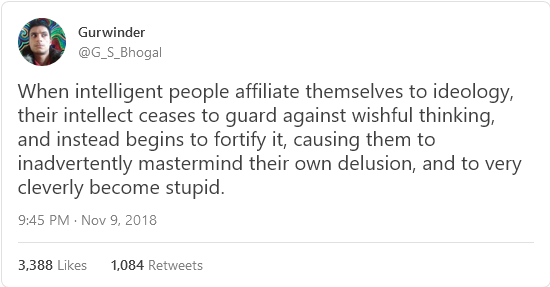
What this means is that, while unintelligent people are more easily misled by other people, intelligent people are more easily misled by themselves. They’re better at convincing themselves of things they want to believe rather than things that are actually true. This is why intelligent people tend to have stronger ideological biases; being better at reasoning makes them better at rationalizing.

This tendency is troublesome in individuals, but in groups it can prove disastrous, affecting the very structure and trajectory of society.

For centuries, elite academic institutions like Oxford and Harvard have been training their students to win arguments but not to discern truth, and in so doing, they’ve created a class of people highly skilled at motivated reasoning. The master-debaters that emerge from these institutions go on to become tomorrow’s elites — politicians, entertainers, and intellectuals.

Master-debaters are naturally drawn to areas where arguing well is more important than being correct — law, politics, media, and academia — and in these industries of pure theory, secluded from the real world, they use their powerful rhetorical skills to convince each other of FIBs. During their master-debatery circlejerks, the most fashionable delusions gradually spread from individuals to departments to institutions to societies.

Some of these FIBs can now be found everywhere. A particularly prominent example is wokeism, a popularized academic worldview that combines elements of conspiracy theory and moral panic. Wokeism seeks to portray racism, sexism, and transphobia as endemic to Western society, and to scapegoat these forms of discrimination on white people generally and straight white men specifically, who are believed to be secretly trying to enforce such bigotries to maintain their place at the top of a social hierarchy.

February 20, 2023

Monocultures are risky in agriculture … and even more so in politics

Filed under: Government, Politics, USA — Tags: , , , , — Nicholas @ 05:00

Unlike his usual bite-sized quips-with-links at Instapundit, Glenn Reynolds occasionally writes at length for his Substack page:

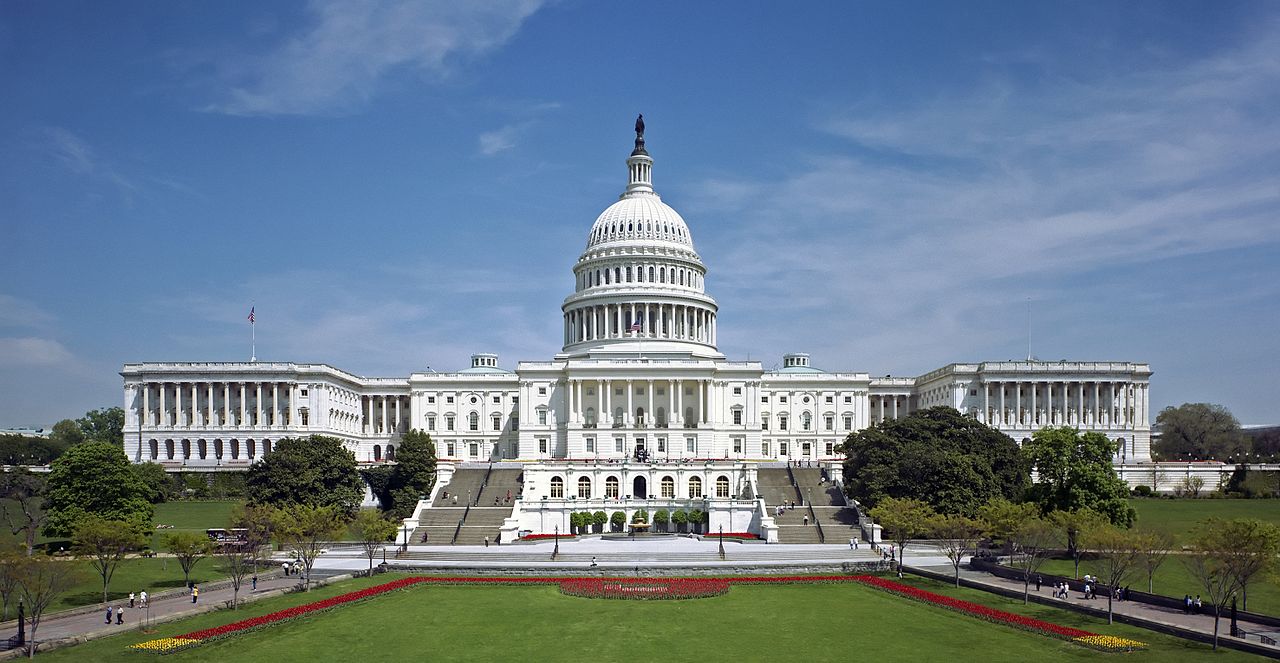
The western front of the United States Capitol. The Neoclassical style building is located in Washington, D.C., on top of Capitol Hill at the east end of the National Mall. The Capitol was designated a National Historic Landmark in 1960.
Photo via Wikimedia Commons.

Our modern ruling class is peculiar. One of its many peculiarities is its penchant for fads, and what can only be called mass hysteria. Repeatedly, we see waves in which something that nobody much cared about suddenly comes to dominate ruling class discourse. Almost in synchrony, a wide range of institutions begin to talk about it, and to be preoccupied by it, even as every leading figure virtue-signals regarding this subject which, only a month or two previously, hardly any of them even knew about, much less cared about.

There are several factors behind this, but one of the most important, I think, is that our ruling class is a monoculture.

In agriculture, a monoculture exists when just a single variety dominates a crop. “Monoculture has its benefits. The entire system is standard, so there are rarely new production and maintenance processes, and everything is compatible and familiar to users. On the other hand, as banana farmers learned, in a monoculture, all instances are prone to the same set of attacks. If someone or something figures out how to affect just one, the entire system is put at risk.”

In a monoculture, if one plant is vulnerable to a disease or an insect, they all are. Thus diseases or pests can rip through it like nobody’s business. (As John Scalzi observes in one of his books, it’s also why clone armies, popular in science fiction, are a bad idea in reality, as they would be highly vulnerable to engineered diseases.) A uniform population is a high-value target.

[…]

Codevilla wrote the essay [here] over a decade ago, and it has only grown more true in the interim. Despite its constant invocation of “diversity”, in many important ways our ruling class is much less diverse than it has ever been. And, as a monoculture, it is vulnerable to viruses of a sort. Including what amount to viruses of the mind.

When Elon Musk referred to the dangers of the “woke mind virus“, he knew exactly what he was talking about. Ideas can be contagious, and can be viewed as analogous to viruses, entities that reproduce by infecting individuals and coopting those individuals into spreading them to others. Richard Dawkins, in his The Selfish Gene, coined the term “meme” to describe these infectious ideas, though the term has since acquired a more popular meaning involving photos of cats, etc. with captions. And yet those pictures are themselves memes, to the extent they “go viral” and persuade others to copy and spread them.

Our ruling class is particularly vulnerable to mind viruses for several reasons. First, it is a monoculture, so that what is persuasive to one member is likely to be persuasive to many.

Second, it suffers from deep and widespread status anxiety – not least because most of its members have status, but few real accomplishments to rely on – and thus requires constant reassurance in the form of peer acceptance, reassurance that is generally achieved by repeating whatever the popular people are saying already. And third, it has few real deeply held values, which might otherwise provide guard rails of a sort against believing crazy things.

In a more diverse ruling class, ideas would not spread so swiftly or be received so uncritically. People with different worldviews would respond differently to ideas as they entered the world of discourse. There would be criticism and there would be debate. (Indeed, this is how things generally worked during the earlier, more diverse, era described by Codevilla, though intellectual fads – lobotomy, say, or eugenics – spread then, too, though mostly through the Gentry/Academic stratum of society that now dominates the ruling class.)

“There is no way Justin Trudeau won any of the last three elections”

Elizabeth Nickson on recent rather alarming confirmation of many things told by various “conspiracy theorists” and purveyors of “misinformation”:

Cracks are beginning to appear in the massive election fraud strategy prosecuted against western democracies. Berlin last week reversed its city election because it had been stolen by the left, and Berliner-Zeitung revealed that a team of reporters from The Marker, Haaretz and Radio France had gone undercover for six months as clients of a company that did nothing but election theft. That company, Jorge, had “intervened in 33 national election campaigns and votes. In 27 cases, it is said to have influenced the elections in favor of its clients. In order to control the opinion on the Internet, the secret company controls over 30,000 credible fake accounts on social media platforms”.

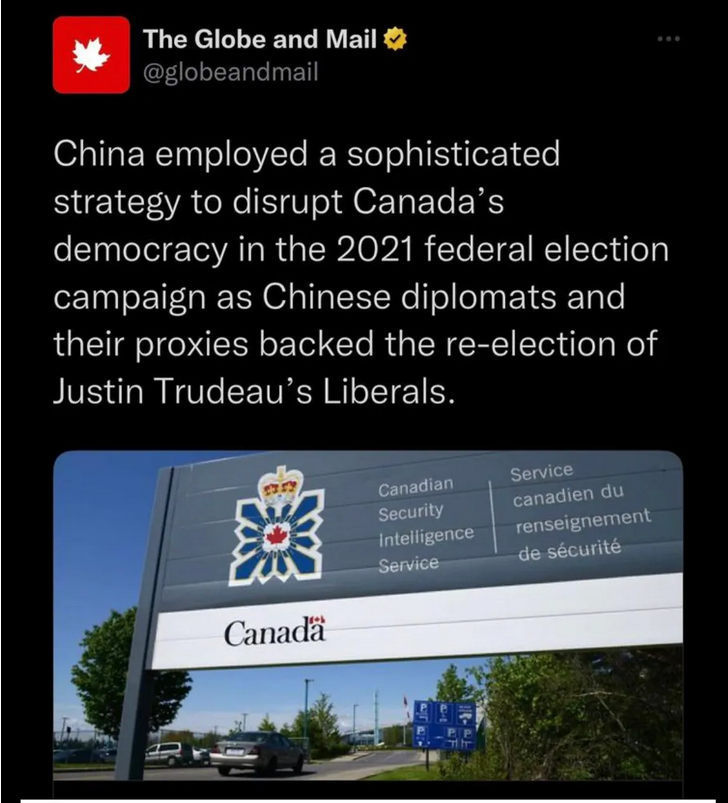
And in Canuckistan this morning, in the organ of the bien-pensant liberal establishment, there was this nugget.

There is no way Justin Trudeau won any of the last three elections. And, honey, this little story from Canada’s most prestigious newspaper is just the beginning.

But first, a story of my own …

When I turned right I had been hired to write an op-ed column for the above Globe and Mail, and what unfurled from my fingers was pure conservatism. I’d hold up my fingers and think, What the hell? Where did that come from? But I continued, and as I did, family and friends sheered away until, except for my mother, I was left virtually friendless.

I had moved back to Canada, you see, and we are 100% captured by the left. There are a handful of conservative writers in the country, but they are soft and weak and they prevaricate because otherwise they would not eat. Luckily I had spent most of my adult life out of the country, had a broader pool to draw from, and given my new thinking, mirable dictu for every friend I lost, I made five new ones. And they were smarter, more responsible, more interesting people. I missed the clothes, restaurants and parties for a while, then I gave up on those too. Essentially, sickening. Finally corrupting.

But it continues, since we live in a hard-left community. We are isolated. Even Jamie, because he lives with me, has lost friends and family. We have his sons, his ex-wife, one of my brothers. The rest are just cold, pitiless. Cruel.

This has happened to hundreds of thousands of people. It’s called “bad-jacketing” and is part of the Fifth Generation Warfare launched against malcontents large and small (like me) up and down the social ladder. Millions. Tens of millions. The competent are targeted, isolated and bad jacketed. It is meant to drive the competent out of the culture. Why is everything breaking? Why is the economy failing? Everyone left in the system is incompetent and vicious with it. It’s why Soviet Russia failed, why the Eastern Bloc collapsed, it is why China went for a capitalist hybrid. Everywhere socialism is tried it destroys the competent and then destroys everything else.

The left is implacable and they punish. They hurt you until you give up. They will break anything you have. Thinking about helping a young neighbor last month, which would require a week or more of brutal work, I finally thought: I have not helped or befriended one single socialist — and she was an avowed socialist — who hasn’t eventually stabbed me in the back. Not one.

When I was driven out of the profession, I spent ten years studying. Was I right? Was I wrong? I should have signed up for a remote doctoral program, because I worked. I study, therefore I am. I studied therefore I was, should be written on my cremation plaque in the family plot. Not that they’ll let me in.

We are all intimidated by that level of hate and exclusion. All of us, politicians, editors, bureaucrats, charities, all of us are terrified of being taken down in our personal lives. Bad-jacketed, rejected by those you love deeply. I know how that feels and I bet you do too.

February 19, 2023

Andrew Sullivan on the legacy media’s coverage of transgender issues

Filed under: Britain, Health, Media, Politics, USA — Tags: , , , , , , , , — Nicholas @ 05:00

In the free portion of his Weekly Dish, Andrew Sullivan looks at how the legacy media chooses to cover (or ignore) different aspects of pre-teen and teenage transgenderism:

Two people at EuroPride 2019 in Vienna holding an LGBTQ+ pride rainbow flag featuring a design by Daniel Quasar; this variation of the rainbow flag was initially promoted as “Progress” a PRIDE Flag Reboot.
Photo by Bojan Cvetanović via Wikimedia Commons.

One more criticism of the letter. It uses the terrible history of the [New York Times] on coverage of gay men and AIDS in the 20th century as equivalent to the reporting of Bazelon, Baker, et al, today. This is unhinged. Transgender people today are fully covered under the Civil Rights Act; in the 1980s, gays had nothing. In the 1980s and 1990s, the NYT opposed using the word “gay” because it legitimized homosexuality in some way; today the NYT prints “queer” or “trans” or LGBTQ+ in almost every other article.

Today, the paper has published a mountain of empathetic coverage of trans people — over 800 stories in the past year. Since January 1, the NYT has run a moving profile about a trans man in Mexico; a celebration of “queer” life in Alabama by a trans staffer; an exploration of nonbinary fashion; a critical orgasm over “queer” theater; and a news story explaining that “the flood of [trans-related] legislation is part of a long-term campaign by national groups that see transgender rights as an issue on which they can harness voter anger”. Comparing this with A.M. Rosenthal’s reign of homophobic terror and censorship is just obscene.

One historical analogy does seem salient to me, though: the drugs they now give to gender-dysphoric teens are very closely related to the drugs they used to “cure” Alan Turing of his gayness. Every time I think of that I shudder.

And this attempt to suppress reporting on the subject comes at a very strange time. Next week, a new book will be published about the Tavistock Centre, the place responsible for the medical and psychological treatment of children with gender dysphoria in Britain. It’s written by a liberal female journalist, Hannah Barnes, of a flagship British documentary show, Newsnight.

Her book exposes a huge medical scandal, in which countless children were put on puberty blockers with almost no psychological evaluation, and with rates of autism and domestic abuse that were already through the roof. It shows what happened when the new affirmation-only puberty-blocker experiment, only begun in the late 1990s, was left to run its course, with no opposition and no dissent allowed. Check out an extract here. Here’s where I sat up straight:

    Clinicians recall multiple instances of young people who had suffered homophobic bullying at school or at home, and then identified as trans. According to the clinician Anastassis Spiliadis, “so many times” a family would say, “Thank God my child is trans and not gay or lesbian.” Girls said, “When I hear the word ‘lesbian’ I cringe”, and boys talked to doctors about their disgust at being attracted to other boys.

    When Gids [the Gender Identity Development Service] asked adolescents referred to the service in 2012 about their sexuality, more than 90 per cent of females and 80 per cent of males said they were same-sex attracted or bisexual. Bristow came to believe that Gids was performing “conversion therapy for gay kids” and there was a bleak joke on the team that there would be “no gay people left at the rate Gids was going”.

Just think about that for a second. And remember that gay groups cheer this on; and several gay writers put their names to the letter. What a massive reckoning may be in store for them. If any of this pans out, and gay groups have endorsed it, it could easily be the greatest scandal in the history of the gay rights movement.

More than a third of the kids pushed onto the trans track had autism, sometimes severe. Others were victims of domestic abuse: “[A natal girl] who’s being abused by a male, I think a question to ask is whether there’s some relationship between identifying as male and feeling safe”, one clinician at the center said. No questions about other aspects of a child’s mental health were considered if the kid was identifying as the opposite sex. And this took place in a socialized system, with constant oversight, and no massive financial incentives to treat children. Just imagine what could be happening in the US private system where trans patients are among the most lucrative to have in your care, and are under treatment their entire life.

[…]

One obvious area for research: why have the sex ratios shifted so radically in the past decade or so — with girls now vastly outstripping boys in the young patients involved? Why the explosion in requests? It’s far more dramatic and skewed to one sex than it would be if merely a function of declining stigma. Yet for woke journalists, it’s all Principal Skinner: “Let’s have no more curiosity about this bizarre cover-up.”

Something is going on among teen girls more generally. The CDC just issued a frightening new report:

    Nearly 3 in 5 teen girls (57%) said they felt “persistently sad or hopeless”. That’s the highest rate in a decade. And 30% said they have seriously considered dying by suicide — a percentage that’s risen by nearly 60% over the past 10 years.

Now check out Jamie Reed’s and Tavistock’s overwhelmingly female, often deeply unhappy, clients. Is there a connection? I don’t know. What I do know is that it’s the job of the media to find out, and not to shut itself down.

The lobby groups and often well-intentioned doctors who have pioneered this massive experiment on children will naturally resist any idea they have been facilitating abuse, or concede any points — because as soon as they confess doubt, the whole house of cards can come tumbling down; and lawsuits alone could end the practice very quickly. The Democrats and the Biden administration have locked themselves to the idea that this kind of treatment is a no-brainer and never does any harm — and they just keep repeating that like a mantra and never address the recent restriction of these experimental practices in progressive Europe. The far right can use the issue to gin up homophobic tropes and cruel treatment of trans people.

“Enjoy the report”

When the Canadian federal government invoked the Emergencies Act in February 2022, it began a legal timer for the government to set up a formal inquiry into the situation that triggered the use of the act which was intended to provide some clarity on whether the government was justified to do so. This inquiry had no legal powers to punish wrongdoing, but was merely supposed to uncover what went on both in public and behind the scenes at this time last year. The head of the commision, Paul Rouleau, was a long-time Liberal who’d once worked for former Liberal Prime Minister John Turner and had been appointed to the judiciary during Jean Chrétien’s premiership. It was perhaps too much to hope that he might return a report that made Trudeau or his government look bad.

Donna Laframboise started the Thank You, Truckers! Substack to record the events of the Freedom Convoy and the reports of participants, supporters, and opponents of the protests. She clearly wasn’t surprised at this outcome from the commission:

“Enjoy the report”. Those were the last words Commissioner Paul Rouleau uttered before rising and leaving the room yesterday. The room in which he cheerfully announced that the Canadian government was justified when it invoked the Emergencies Act against festive, peaceful, working class protesters a year ago.

Which part did he imagine we’d enjoy? The knowledge that there’s absolutely no accountability in our political system? The knowledge that a vast network of supposed checks and balances (funded year in and year out by the sweat of working Canadians) offers us no protection from tyrannical, rogue politicians?

Three months ago I wrote: Let us fervently hope Commissioner Rouleau is a man of integrity. One who understands that this is his moment. History will judge him by what he does here.

[…]

Given the opportunity to help resuscitate the limp, battered carcass of public trust, this gentleman instead extended every benefit of the doubt to the government, to the establishment, to police goons who crossed lines that should never, ever be crossed.

This is very bad news. Because, as Martin Luther King Jr observed 60 years ago, when peaceful protests get shut down some individuals

    will seek expression through violence; this is not a threat but a fact of history.

Many Canadians predicted this result. They had few expectations. They said Commissioner Rouleau was hopelessly compromised by long association with the Liberal Party of Canada. They said that, because the Liberal government had sole discretion to select its own judge, real accountability was never on the table.

The cynics were correct.

In the preview to The Line‘s weekly dispatch, the editors take a less pessimistic view of their initial sampling of the report:

Justice Paul Rouleau’s report on the federal government’s decision to invoke the Emergencies Act was published Friday. It is thousands of pages long. We have not read it all yet. But we have tackled parts of it, with an eye to answering two questions, for ourselves and for our readers. What the hell happened last year — what went wrong? And: do we agree with Justice Rouleau’s decision that that the federal government’s decision to invoke the act was indeed appropriate?

We’ll get to those questions, but let’s say a few things first.

First: if you sat down to read the Rouleau report to find evidence for what you’d already decided, you’ll find it. We believe that Justice Rouleau has written a fair and balanced report. He is clearly struggling, as we were a year ago, to accurately describe and probably even to fully perceive and understand just what “the convoy” was. Line editor Gurney, in reading Rouleau’s efforts to describe how the protest was both a largely peaceful and lawful assembly and also a meeting place for radical extremists, including some dangerous ones, found himself nodding along in recognition of Rouleau’s thought process. This nuance and complexity was precisely what he tried to convey from Ottawa last year.

Second: the same very much applies to political blame. There’s some for everyone here, folks. The federal government comes in for less than some others, but we don’t see in that any bias, but instead a recognition that none of this should have been the federal government’s problem. If the convoy protests had been effectively handled by local and provincial officials, it wouldn’t have been a federal issue at all. This has long been The Line‘s position, but we have also been critical the Trudeau government’s nasty habit of seeing in moments of crisis not a threat to be defused, but instead, a wedge to be eagerly seized upon and exploited. Justice Rouleau is kinder to the Liberals than we are. Perhaps he is simply less cynical. But he did make a point of criticizing Justin Trudeau for inflammatory language, and we were glad of that.

[…]

Third: Justice Rouleau’s finding that the federal government acted appropriately is more conditional and guarded than we think the overall tone of the report, and much of the attendant media coverage, suggests. We’ll get into this in more detail in a minute, but we wanted this front and centre before we start doing the heavy lifting: Rouleau does indeed side with the government, but it’s a pretty nuanced and cautious alignment. A win is a win, and the Liberals got their win here, but Rouleau’s report isn’t an endorsement of how the feds handled anything last year. It would be better for literally all of us if we tried to remember that.

The legacy media’s ability to sway public opinion has waned, but it still has some strength and this was especially so during the lockdowns where people had less opportunity to see for themselves or to talk with others outside the curated gardens of sites like Facebook. If the media had given the Freedom Convoy coverage the same credibility it chose to give to the violent riots, uh, I mean “mostly peacful protests” after the death of George Floyd, the federal government would not have treated the convoy participants and supporters as cavalierly as they did.

Only one federal political party dared to show any significant support for the protest, and the other day PPC leader Maxime Bernier posted a retrospective on the Freedom Convoy to YouTube:

Individual Conservative MPs may have expressed a bit of timid support but were noteworthy by their unwillingness or inability to do anything in Parliament to force the government to at least talk to the protest leaders or give them any benefit of the doubt.

« Newer PostsOlder Posts »

Powered by WordPress