Quotulatiousness

January 24, 2010

The only surprise about this is that they’re admitting it

Filed under: Environment, Politics — Tags: , , , , — Nicholas @ 15:41

Glacier scientist: I knew data hadn’t been verified:

The scientist behind the bogus claim in a Nobel Prize-winning UN report that Himalayan glaciers will have melted by 2035 last night admitted it was included purely to put political pressure on world leaders.

Dr Murari Lal also said he was well aware the statement, in the 2007 report by the Intergovernmental Panel on Climate Change (IPCC), did not rest on peer-reviewed scientific research.

In an interview with The Mail on Sunday, Dr Lal, the co-ordinating lead author of the report’s chapter on Asia, said: ‘It related to several countries in this region and their water sources. We thought that if we can highlight it, it will impact policy-makers and politicians and encourage them to take some concrete action.

‘It had importance for the region, so we thought we should put it in.’

It was unverified, but so important that they couldn’t hold back? It would be funny, if trillions of dollars were not being forcibly redirected in useless, futile “green” directions, and the lives of billions of people may be negatively impacted by government and UN mandates on unproven technologies to curb global warming.

January 23, 2010

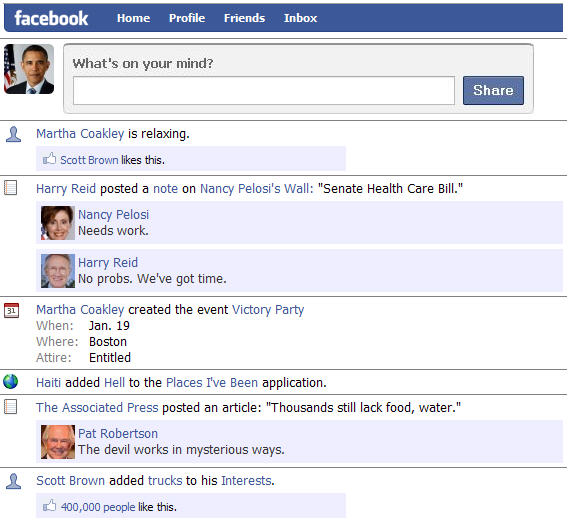
Slate peeks at Barack Obama’s Facebook feed

Filed under: Humour, Politics, USA — Tags: , — Nicholas @ 17:09

I thought Facebook had fixed the privacy settings, but Slate manages to show President Obama’s Facebook feed:

January 22, 2010

On the fight card today, RAF versus RN

Filed under: Britain, Military, Politics — Tags: , , , — Nicholas @ 08:54

No matter what the outcome of the next British general election, the military situation is going to be near the top of the agenda for the incoming government. Britain’s army is stretched very thin with overseas obligations, while the RN and the RAF are at daggers drawn over the future of British carrier aircraft. The RAF would love to sink the navy’s carrier plans, as it would free up huge amounts of budget room for them to buy new toys for themselves (if there are no carriers, there’s no need to buy carrier aircraft, which are much more expensive than similar non-maritime planes). If the RAF succeeds, the army would prefer more money for troops on the ground, helicopters, and unmanned drones. The Economist provides a state-of-play summary:

Even in a great seafaring nation, the remorseless logic of austerity forces admirals to plead for their budgets. It has long been clear that fixing the fiscal crisis would mean taking money from the already cash-strapped Ministry of Defence. Where to make the cuts is something military chiefs have started to argue about in public.

On January 19th Sir Mark Stanhope, Britain’s top admiral, defended long-standing plans to build two expensive new aircraft carriers. The country is bogged down now in an Afghan ground war, he said, but future conflicts may require projecting power by sea. Britain has flirted with phasing out its carriers before, only for the Falklands war to prove their indispensability.

The day before, Sir Mark’s opposite number in the army, Sir David Richards, said that Britain’s agonies in Afghanistan showed the need for more helicopters and unmanned drones, and for better-equipped troops. An “impressive” amount of this gear could be bought if money were redirected from expensive equipment intended for big state-on-state wars; the risk of such conflicts was small enough to be dealt with through NATO (ie, America). Though Sir Richard did not say carriers should be cut (he offered to get rid of some army tanks), they are an obvious target.

It has been an aspect of all British governments since 1945 to take on additional responsibilities while constantly looking for economies in the military budget. Neither the Conservative opposition nor the current Labour government wants to take the political heat for increased military spending (that’s not even in consideration: the debate is over how deep the cuts must be). During a recession, it’s understandable that the politicians would take this kind of stance, but this is true regardless of the state of the economy.

January 19, 2010

QotD: Time to panic

Filed under: Politics, Quotations, USA — Tags: , — Nicholas @ 13:11

Jonathan Cohn headlines his latest plea to ignore a Brown win and pass health care anyway “Pelosi Isn’t Panicking. Her Party Should Listen.” Umm, call me cynical, but maybe the reason Pelosi isn’t panicking is that Pelosi’s got one of the safest seats in the country? I mean, take this for what it’s worth but if Brown wins today, my advice to Blanche Lincoln, and Ben Nelson, and their counterparts in the house? You should panic. They’re coming for you next.

Hell, If I were Blanche Lincoln, anyone in the leadership who wanted to get me to the floor for a health care vote would have to pry me out of the darkened room where they’d find me huddled in the corner, rocking back and forth and crying. Maybe Cohn’s right and the thing’s too far gone to save, so you might as well vote for it anyway. But that’s not exactly soothing, is it?

Megan McArdle, “Time to Panic”, Asymmetrical Information, 2010-01-19

January 18, 2010

How much are the Vikings worth?

Filed under: Economics, Football, Politics — Tags: , , , — Nicholas @ 17:52

An interesting Wall Street Journal article tries to put a dollar value on the “intangible” value of a professional sports team to the fans . . . in this case, the Minnesota Vikings:

Christopher Slinde, a lifetime Minnesota Vikings fan who has endured decades of heartbreak and lots of overpriced beer in supporting his team, believes Vikings fandom is priceless. According to economists, it’s worth $530.65.

“This is deep,” said Mr. Slinde, a 33-year-old X-ray technician, outside the Park Tavern near Minneapolis on Sunday. He had been handed a recent economics paper that is tattooed with equations and attempts to value, in dollars, the joy and pain Minnesotans get from the Vikings.

“Don’t economists spend their time on more serious stuff?” he asked, after thumbing through the paper in the cold.

As fans pack stadiums and couches to watch the National Football League’s divisional playoffs this weekend, they care about victory. Economists are tackling a more abstract challenge: putting a price on the emotional benefits of having a pro sports team in town.

Interestingly, the one question that doesn’t come up is why non-fans (the rest of the taxpayers being asked to pay for a new Vikings stadium) should use their tax dollars to subsidize their sports-mad fellow citizens. The answer is, of course, that if Minnesota won’t then some other state or city will do. It seems reasonable to me to ask the billionaire owners of these sports franchises to pay for their own buildings . . . but there’s a long, inglorious history of these very well-off, well-connected folks being able to get politicians to pry the coffers open and paying public money to benefit private interests.

January 7, 2010

10 Downing Street: the coup that wasn’t

Filed under: Britain, Politics — Tags: , , — Nicholas @ 07:48

A rather odd week for Britain’s embattled Prime Minister, with members of his cabinet seeming to be working on his ouster, yet still publicly supporting him. I suspect it’s a case of timing — few expect Mr. Brown to win the next general election, but potential leadership contenders don’t want to push him out of the top spot until after the coming debacle. If he gets replaced before the election, the new leader will take a lot of blame for the polling results, while the Brown team can take Parthian shots at the new leader’s supporters.

This the most likely reason that the “coup” never happened. All the key players in the next act want this act over properly, with Gordon Brown facing his doom at the hands of the voters, and a new leader in place (theoretically) untainted by the outcome of the election.

Tracking the effectiveness of bloggers by arrests

Filed under: China, Media, Politics — Tags: , , , , , , — Nicholas @ 07:30

2009 was a tough year for journalists, with at least 76 killed and arrests and physical assaults increased over last year. In a back-handed way, the effectiveness of bloggers and other informal journalists could be measured by the ways in which they get harassed, intimidated, or otherwise interfered with as they tried to report on the news:

Meanwhile, the spotlight is increasingly falling on bloggers, as 2009 was the first year that more than 100 bloggers and cyber-dissidents were imprisoned.

In a number of countries online dissent is now a criminal offence: authorities have responded to the internet as pro-democracy tool with new laws and crackdowns. A pair of Azerbaijani bloggers were sentenced to two years in prison for making a film mocking the political elite.

China was still the leading Internet censor in 2009. However, Iran, Tunisia, Thailand, Saudi Arabia, Vietnam and Uzbekistan have all also made extensive use website blocking and online surveillance to monitor and control dissent. The Turkmen Internet remains under total state control. Egyptian blogger Kareem Amer remains in jail, while well-known Burmese comedian Zarganar has a further 34 years of his prison sentence to serve.

However, the Report also notes that democratic countries have not lagged far behind, instancing the various steps taken by European countries to control the internet under the guise of protection against child porn and illegal downloading. It also notes that Australia intends to put in place a compulsory filtering system that poses a threat to freedom of expression.

January 6, 2010

Behold the awesome power of Facebook groups

Filed under: Cancon, Government, Humour, Politics — Tags: , , — Nicholas @ 09:05

The editors at the National Post poke some fun at their opposite numbers over at the Toronto Star:

We know about the Star editors’ foray onto the big exciting Interweb because of the newspaper’s front-page headline on Monday: “Grassroots fury greets shuttered Parliament.” The breathless story suggests Canada is on the verge of some kind of violent 1917-style revolution — a “growing public uprising” no less, complete with “protest rallies” from coast to coast, and young activists full of unhinged, wild-eyed rage. The evidence for all this: 20,000 people joined a Facebook page called “Canadians Against Proroguing Parliament,” which urges Parliament to “Get back to work.”

[. . .]

For all we know, that 20,000 figure is up to 50,000 now, thanks to the Star publicity. Or maybe even 100,000. Who knows? But for the sake of context, let’s look at some other causes that also got a six-digit response: Almost 300,000 people have joined a group encouraging rocker John Mellencamp to quit smoking. Another hundred thousand people have joined a group encouraging random people to move to Finland. A whopping half-million people have used the power of Facebook to declare that they enjoy the television program 90210.

And then there’s our personal favourite: A group called “If 100,000 people join this group, Laura will name her son Megatron” recently met its goal. Congratulations, Laura, on the birth of your Transformer. We bet you didn’t know that he’d become the subject of — what does the Star call it? — oh yes, a “growing public uprising”!

I didn’t think that was what “tolerance” was supposed to mean

Filed under: Politics, Quotations, Religion — Tags: , , , — Nicholas @ 08:57

Rondi Adamson posted an interesting Martin Amis quote:

I just transcribed and edited a speech Martin Amis gave in Toronto recently. The whole thing was wonderful, but this — about Islamic fascism — was the best line:

I have to take my hat off to the left in that they have found something to defend in a movement that is racist, misogynist, homophobic, totalitarian, inquisitorial, imperialist and genocidal. Perhaps it’s their view on usury that is attractive to the left — low interest rates or non-existent interest rates.

December 31, 2009

Obama’s popularity continues to slide

Filed under: Media, Politics, USA — Tags: , — Nicholas @ 10:24

It must be a significant drop in approval ratings, as even The Economist is discussing it:

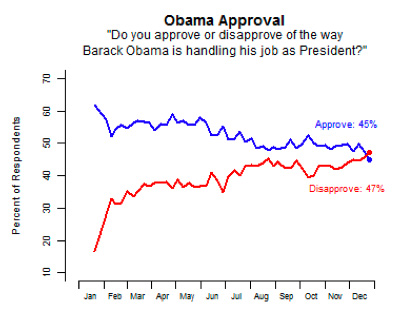
Obama_approval_20091230

Barack Obama’s approval rating at the end of 2009 marks an all-time low for him in the Economist/YouGov poll, and it is the first time more Americans disapprove than approve of the way he is handling his job. Mr Obama began his term with a 61% approval rating, while only 17% of Americans disapproved. As 2009 ends, only 45% approve of the way Mr Obama is handling his job, while 47% now disapprove.

The president has suffered a drop in approval from just about all groups, demographic and political. But perhaps most striking has been his loss of support from independents. In January’s poll, 64% of independents approved of how he handled the start of his presidency (and the days leading up to it). Now just 43% do.

December 29, 2009

Worst. Decade. Ever.

Filed under: Government, Humour, Politics, USA — Tags: , , , — Nicholas @ 18:30

December 24, 2009

Jonathan Kay in praise of Paul Martin

Filed under: Cancon, Middle East, Military, Politics — Tags: , , , — Nicholas @ 11:52

In a column ostensibly about the triumph of Canada’s conservatives, Jonathan Kay makes a pitch for both Paul Martin and former Governor General Adrienne Clarkson as unsung political heroes:

Paul Martin will forever be known primarily as the guy who fumbled Jean Chrétien’s dynasty away to Stephen Harper. But if there were more justice in the world — or at least among pundits — he would get his due for making the single most momentous prime ministerial decision of the decade: sending a Canadian combat mission to Kandahar in 2005.

At the time, it hardly seemed epic: Most Canadians didn’t know Kandahar from Kunduz. But the military wonks immediately could tell this was a game-changer. Putting our troops in Kandahar, at the ideological and political center of Taliban territory, meant the Liberals were shedding decades of peacekeeper posturing, and were putting the country on a very real war footing.

[. . .]

Martin didn’t throw a dart at a map of Afghanistan. He fought for Kandahar in the face of U.S. skepticism — even though he knew it would mean body bags, and even though he probably could have landed the Canadian Forces a relatively cushy Euro-style sentry-duty assignment in the northern part of the country.

Our deployment set the stage for many of the other, seemingly unrelated, changes in Canadian policy and politics that followed in the latter part of the decade. A nation at war doesn’t think about itself in the same way as a nation at peace. We got more respect in foreign capitals. We began to take care of our military. We even started to treat our country’s identity and history more seriously.

And equally surprising, the praise for Adrienne Clarkson:

Nor should we ignore the contribution of Adrienne Clarkson. Whatever her elitist, media pedigree, the Canadian Forces had no better friend than the former Governor General. She was a constant presence at Remembrance Day events at home, as well as WWII anniversary ceremonies in Europe. She spent New Year’s with CF members in Afghanistan — twice; and even celebrated Christmas with our naval forces in the Persian Gulf.

That she was a woman, a former CBC staffer, and a visible minority, only increased the symbolic importance of her outreach. It showed Canada that our military is fighting for all us, not just white guys with brush cuts in Shilo and Petawawa.

December 22, 2009

Wikipedia shows its biggest innate weakness

Filed under: Environment, Media, Politics, Technology — Tags: , , , — Nicholas @ 12:40

James Delingpole shows the built-in bias of the Wikipedia editing team presents a very restrictive view of AGW and the CRU hacking/leak:

If you want to know the truth about Climategate, definitely don’t use Wikipedia. “Climatic Research Unit e-mail controversy”, is its preferred, mealy-mouthed euphemism to describe the greatest scientific scandal of the modern age. Not that you’d ever guess it was a scandal from the accompanying article. It reads more like a damage-limitation press release put out by concerned friends and sympathisers of the lying, cheating, data-rigging scientists.

Which funnily enough, is pretty much what it is. Even Wikipedia’s own moderators acknowledge that the entry has been hijacked, as this commentary by an “uninvolved editor” makes clear.

Unfortunately, this naked bias and corruption has infected the supposedly neutral Wikipedia’s entire coverage of Anthropogenic Global Warming (AGW) theory. And much of this, as Lawrence Solomon reports in the National Post, is the work of one man, a Cambridge-based scientist and Green Party activist named William Connolley.

Wikipedia is a useful resource, but (as with the mainstream media) you have to take into account the built-in bias both on how issues are covered, but even the issues that are allowed to be presented.

Tim Worstall cheers the collapse of the Copenhagen circus

Filed under: Environment, Government, Politics, Science — Tags: , , — Nicholas @ 07:25

As Tim Worstall points out, the collapse of the Copenhagen talks is good news all around, regardless of your position on AGW:

Copenhagen is dead. Hurrah! And I say that as someone convinced that climate change is happening, we’re causing it, and we need to do something about it. However, what we don’t need to do is the ghastly mess that was being cooked up in Denmark.

They’ve essentially agreed to, um, well, try — and they’ll think a little bit more about what they’re going to try sometime later. And that’s the best result we could have hoped for. We already know what needs to be done, as the economists have worked it out. It is true that economists are not exactly the flavour of the month right now, but they are still the experts here.

We are trying to change people’s behaviour, and long experience tells us that the way to do that is to change the incentives people face. We might make it illegal to burn coal, for example — as we largely have done in British cities — and the motivation people would have for doing so would be an incentive not to.

Yet observation of humans over the past couple of centuries has shown that the carrot tends to provide a better incentive than the stick. Being shot for failing the Five Year Plan should concentrate minds more than the alternatives of bankruptcy or hot and cold running lingerie models which our own system provides for failure or success, but which has been better at producing economic growth? Quite.

What many had hoped would result from the Copenhagen meetings was an embryo form of world government . . . and the idea that it was being snuck into the discussions under cover of environmental concerns was a feature, from the point of view of those who favour supra-national controls. No democratic leader arrived in town with a mandate to give up national sovereignty, but many attending hoped that they could “do a fast one” regardless.

December 17, 2009

Judiciary to “fight back” against draconian Tory laws

Filed under: Cancon, Law, Politics — Tags: , , — Nicholas @ 09:03

It’s always nice when your secret opponents actually come out and say that they’re against you. Bob Tarantino shows how the Tories’ “draconian” penalties against criminals are opposed by the judiciary:

In the middle of an otherwise rote piece in a Toronto-area newspaper about how Stephen Harper is just too gosh-darn mean to criminals, there appeared this remarkable passage: “Judges are skilled at devising creative ways to fight back against laws they believe may skew the system. For example, Judge Cole said the elimination of two-for-one pre-trial credit has prompted judges to begin talking openly about forcing trials to be held more quickly. He said Canadian judges may also start compensating by intentionally lowering sentences: ‘That appears to have been the experience in other jurisdictions where Draconian sentencing policies have been forced upon the judiciary.’ ”

The passage is noteworthy for a number of reasons. Neither Justice Cole nor the newspaper’s justice reporter, both of whom can be assumed to have at least a glancing familiarity with the role of judges in our constitutional democracy, saw anything striking in characterizing the proper task of the judiciary as “fighting back” against laws they don’t like.

Nor do they find anything striking about a judge viewing duly enacted legislation as something being “forced upon” the judiciary — as if it were the judges who were being sent to jail.

And judges won’t just be “fighting back” against Parliament — in order to make good on the threat of handing down “intentionally” lower sentences, they will need to ignore case-law precedent. Evidently, neither Parliament nor the previous decisions of judges themselves will be allowed to stand in the way of the determination of certain members of the judiciary to treat convicted criminals lightly.

It’s no surprise that certain members of the judiciary think of themselves as being better able to determine what “appropriate” punishment might be . . . after all, within the statute and case law, that’s what they’re supposed to do. It’s the expansion of that notion that they know better and don’t feel they should be bound by the letter of the law. That’s several steps too far.

« Newer PostsOlder Posts »

Powered by WordPress