
The Soviets didn’t invent [transnational progressivism], but they promoted it heavily in a deliberate — and appallingly successful — attempt to weaken the Lockean, individualist tradition that underlies classical liberalism and the U.S. Constitution. The reduction of Western politics to a bitter war for government favor between ascriptive identity groups is exactly the outcome the Soviets wanted and worked hard to arrange.
Call it what you will — various other commentators have favored ‘volk-Marxism’ or ‘postmodern leftism’. I’ve called it suicidalism. It was designed to paralyze the West against one enemy, but it’s now being used against us by another. It is no accident that Osama bin Laden so often sounds like he’s reading from back issues of Z magazine, and no accident that both constantly echo the hoariest old cliches of Soviet propaganda in the 1930s and ’40s.
Another consequence of Stalin’s meme war is that today’s left-wing antiwar demonstrators wear kaffiyehs without any sense of how grotesque it is for ostensible Marxists to cuddle up to religious absolutists who want to restore the power relations of the 7th century CE. In Stalin’s hands, even Marxism itself was hollowed out to serve as a memetic weapon — it became increasingly nihilist, hatred-focused and destructive. The postmodern left is now defined not by what it’s for but by what it’s against: classical-liberal individualism, free markets, dead white males, America, and the idea of objective reality itself.
The first step to recovery is understanding the problem. Knowing that suicidalist memes were launched at us as war weapons by the espionage apparatus of the most evil despotism in human history is in itself liberating. Liberating, too, it is to realize that the Noam Chomskys and Michael Moores and Robert Fisks of the world (and their thousands of lesser imitators in faculty lounges everywhere) are not brave transgressive forward-thinkers but pathetic memebots running the program of a dead tyrant.
Brittingham and other have worried that postmodern leftism may yet win. If so, the victory would be short-lived. One of the clearest lessons of recent times (exemplified not just by kaffiyeh-wearing western leftists but by Hamas’s recent clobbering of al-Fatah in the first Palestinian elections) is that po-mo leftism is weaker than liberal individualism in one important respect; it has only the weakest defenses against absolutist fervor. Brittingham tellingly notes po-mo philosopher Richard Rorty’s realization that when the babble of conflicting tribal narratives collapses in exhaustion, the only thing left is the will to power.
Again, this is by design. Lenin and Stalin wanted classical-liberal individualism replaced with something less able to resist totalitarianism, not more. Volk-Marxist fantasy and postmodern nihilism served their purposes; the emergence of an adhesive counter-ideology would not have. Thus, the Chomskys and Moores and Fisks are running a program carefully designed to dead-end at nothing.
Eric S. Raymond, “Gramscian damage”, Armed and Dangerous, 2006-02-11.
October 4, 2017
QotD: Transnational progressivism
October 3, 2017
Jagmeet Singh wins the federal NDP leadership race
The NDP have finally selected a leader who may be able to recapture some of the “lightning in a bottle” phenomenon of the late Jack Layton’s time as party leader (and bring back some former NDP voters who plumped for Justin last time around). Jay Currie is enthusiastic about the new guy:
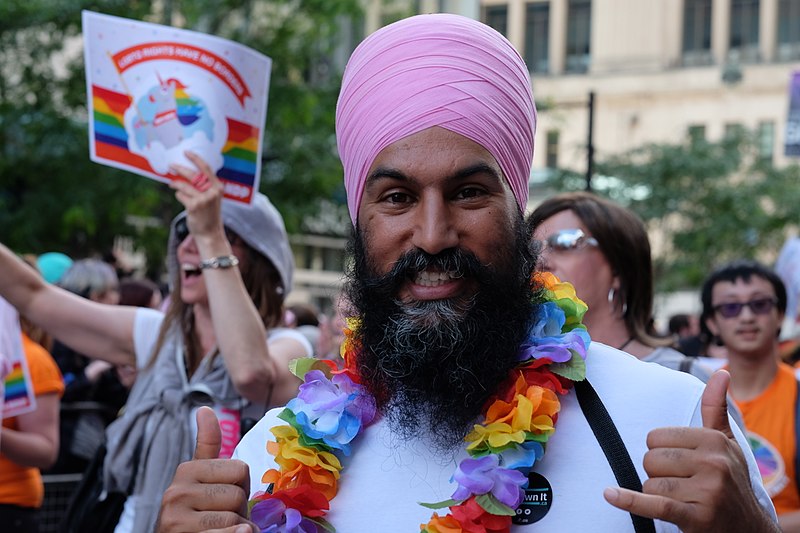
Federal NDP leader Jagmeet Singh taking part in a Pride Parade in June 2017 (during the leadership campaign).
Photo via Wikimedia.
… I was cheered to see the rollover victory of Jagmeet Singh for the NDP leadership. Singh seems to be from the pragmatic end of the NDP and will be relatively immune from identitarian and intersectional attack simply because he’s brown and wears brilliant turbans. He’s intelligent, well spoken and has a bit of charisma. And he is just going to kill Justin Trudeau in places Trudeau needs to win.
It is simplistic to say that the Sikh community in Canada will universally support one of its own, there will certainly be a temptation to defect from Trudeau to Singh. While that might have some effect in Tory ridings, it will be felt most strongly in seats which have traditionally swung from Liberal to New Democrat and back again.
I am not sure, however, that Singh’s ethnicity is his biggest threat to Trudeau. By 2019 the emptiness of much of the Liberal’s program will be apparent to all. The broken promises, the tepid policy initiatives and, above all, the fiscal incompetence on the revenue side and on expenditures will be pretty apparent. For small business owners and consumers with half a clue, the combination of the lunatic small business tax measures and the expensive, but pointless, carbon tax will pour votes into the Conservative column. But with Canada’s first past the post system, that may not be enough.
Singh’s real threat to Trudeau is in marginal seats where the Libs beat the Conservatives by a few thousand votes in the last election because a) people had had enough of Harper, b) Justin seemed bright and shiny. People who would have voted NDP in the past were so eager to get rid of Harper they voted for Trudeau. Mulclair simply lacked the appeal to keep the faithful in the pews. At a guess, the rank and file NDP voters, as well as the multi-culti virtue signallers, will be much more inclined to give Singh a go. Which means he has the capacity to bleed off Liberal voters in significant numbers.
October 2, 2017
Is it becoming time to let the NFL’s “chips fall where they may”?
 The modern NFL as we know it enjoys a legal privilege through an act of Congress, allowing the league to negotiate TV rights as a single organization and sharing the revenue equally among all the constituent teams. In City Journal, Steven Malanga recounts the history of how that privilege was granted:
Many sports fans know that Major League Baseball has a unique exemption from the nation’s antitrust laws, thanks to a 1922 Supreme Court decision, which perplexingly ruled that baseball teams do not engage in interstate commerce. Less well understood, however, is that the National Football League retains its own federal exemption through legislation that has allowed the league’s teams to cooperate on television contracts — a gift from Washington that has been crucial to the development of the modern NFL. Over the years, the exemption has proved controversial, though bipartisan calls to revoke or narrow it have never gained much traction. The exemption deserves a fresh look with the players’ extreme politicization of the league, in which they have been aided and abetted by the owners, who have allowed and even taken part in unprecedented partisan posturing — broadcast to the nation via Congress-approved TV deals.
According to NFL mythology, the league’s success is the result of the vision of its mid-1950s and 1960s leadership, including the marketing savvy of former commissioner Pete Rozelle. But the real cornerstone of the NFL’s rise was successful Washington lobbying by league leadership, after a court ruled in 1961 that NFL teams could not negotiate broadcasting rights as a group, because such power would violate antitrust laws against monopolization. Rozelle got a New York congressman, Emanuel Cellar, who chaired the House Judiciary Committee’s Subcommittee on Anti-Trust and Monopoly, to introduce what’s become known as the Sports Broadcasting Act of 1961, which provided limited antitrust exemption, allowing teams to pool their efforts for the sake of negotiating TV deals. When President Kennedy signed the legislation, it permitted a $4.65 million broadcast deal that the NFL had crafted with CBS for the rights to televise football games. The price of broadcasting packages quickly accelerated, especially after the merger of the NFL and the old AFL, and the antitrust exemption allowed for such singular NFL successes as Monday Night Football, introduced in 1970.
Though the act also applies to professional baseball, hockey, and basketball teams, its significance to the NFL came to outweigh the benefits to other leagues, because pro football—with many fewer games per season—exclusively and collectively sells all its TV rights through monopoly pooling, then distributes the revenues to teams equally. Without this exemption, each team would have to negotiate its television contracts individually, which would be fine for powerful teams like the Dallas Cowboys that could probably arrange to have all their games broadcast nationally, but less advantageous for weak teams such as the Cleveland Browns, which might struggle even for local coverage.
[…] The majority of companies in America would not, and do not, allow demonstrations at work by individual employees on political issues unrelated to their employment — just the sort of demonstrations begun last year by former San Francisco 49ers quarterback Colin Kaepernick, and carried on through this weekend by more than 200 players. That the owners have tolerated and lately even encouraged such protests over an issue — charges of police brutality — that divides many Americans is a business risk that they seem willing to take. But the league’s use of its platform — created by its federal antitrust exemption — to broadcast its message across the country is more than a simple business matter. It represents an improper use of resources made available to the NFL by special federal legislation. It’s past time to revoke the Sports Broadcasting Act — and let the “chips fall where they may.”
John Cleese: Political Correctness and Islam
Democracy In Name Only
Published on 11 Jan 2017John Cleese speaks frankly about political correctness, the right to offend and Islam.
September 30, 2017
Kathleen Wynne’s “War on Economics” is going great!
Giving people “free” stuff will always get you support from people who don’t understand TANSTAAFL (including the leader of the opposition), as Chris Selley explains:
Polls suggest Premier Kathleen Wynne’s ongoing war on economists is paying dividends. Fifty-three per cent approve of her Liberal government extending rent control to units built after 1991, according to a Forum Research poll conducted in May; only 25 per cent disapproved. In June, Forum found 53 per cent of Ontarians supported jacking up the minimum wage to $15 from $11.40 by Jan. 1, 2019, versus 38 per cent opposed. The move was hugely popular among Liberal voters (79 per cent) and NDP voters (28 per cent). Wynne’s approval rating is staggering back up toward, um, 20 per cent. But a Campaign Research poll released Sept. 13 had the Tories just five points ahead of the Liberals. That’s pretty great news for this beleaguered tribe.
The boffins still aren’t playing along, though.
Earlier this month, Queen’s Park’s Financial Accountability Office projected the hike would “result in a loss of approximately 50,000 jobs … with job losses concentrated among teens, young adults, and recent immigrants.” And it could be higher, the FAO cautioned, because there’s very little precedent for, and thus little evidence on which to judge, a hike as rapid as the one the Liberals propose — 32 per cent per cent in less than two years.
This week, TD Economics weighed in with a higher number: “a net reduction in jobs of about 80,000 to 90,000 positions by the end of the decade.” And the Canadian Centre for Economic Analysis paints the grimmest picture: “We (expect) that the Act will, over two years, put 185,000 jobs at risk” — that’s jobs that already exist or that would otherwise have been created.
It’s easy to see why raising the minimum wage is popular. Governments like it because it doesn’t show up in the budget. We in the media can pretty easily find victims of an $11.40 minimum wage, and reasonably compassionate people quite rightly sympathize. Forty hours a week at $11.40 an hour for 50 weeks a year is $22,800. You can’t live on that.
Of course, these Liberal policies are flying in the face of mainstream economic theory, so you’d expect the Ontario Progressive Conservatives to have lots of arrows in the quiver to fight … oh, wait. Tory leader Patrick “I’m really a Liberal” Brown supports both the rent control and the minimum wage hike, just not quite as much at Wynne does. There’s Canadian “conservatism” in a nutshell for you: we also want to get on the express to Venezuelan economic conditions, just not quite as fast as the government wants. There’s a reason Kathleen Wynne isn’t as worried about getting re-elected as she used to be…
September 29, 2017
Judge Roy Moore as a sign that worse is coming
ESR posted this to G+ yesterday:
Judge Roy Moore, a truly repellent creature who reifies every liberal’s fantasy of what fundamentalist conservatives are like (well, except for the racism – even Moore is not actually a racist), has won in Alabama against a candidate backed by the GOP establishment and Trump.
And I wonder if Democrats are too far gone to heed the warning.
You demonized the Tea Party, and you got Trump. If you neutralize or expel Trump as you dream of doing, worse is coming. Roy Moore is worse. Roy Moore is a sign. The conservative/populist revolt can no longer be contained even by Trump. The beast is loose.
Time to question your assumptions, Democrats (and establishment Republicans). The more painful and disruptive that self-questioning is, the more likely it is that your party might escape the destruction that is coming.
As the Instapundit often says, “Do you want more Trump? Because this is how you get more Trump.”
September 27, 2017
Stalin’s Great Purge – Effects on the Red Army 1936-1938
Military History Visualized
Published on 25 Aug 2017The Great Purge had a massive effect on Soviet Society and the Red Army. This video gives various insights in the numbers, effects and other aspects.
September 24, 2017
We Read Hillary’s Book So You Don’t Have To
ReasonTV
Published on 22 Sep 2017Hillary Clinton’s new book What Happened attempts to explain Trump’s upset victory in 2016 through a series of reasons which are not Hillary Clinton.
QotD: Libertarians and Conservatives
‘Who lost the libertarians?” It’s a question you hear a lot from conservatives of late. The reason should be obvious to anyone who has followed the conservative movement’s internecine intellectual frictions over the last decade — or decades. Self-described libertarians are a minority, even among the ranks of people one could properly describe as libertarian. On many, or even most, contentious public-policy issues — economics, gun rights, health care, free speech, regulation, constitutional interpretation — most support for the libertarian position actually comes from people who describe themselves as conservatives. In other words, conservatives tend to be libertarian, but libertarians tend not to be conservative.
And self-described libertarians are very keen on emphasizing that distinction. They justifiably point to the areas, many of them quite significant, where the bulk of libertarians depart from the conservative consensus: foreign policy, drugs, gay rights, etc. Of course, the demarcations between these different camps are not hard and clearly defined. Many conservatives now — and even more in the past — hold the same convictions as libertarians on foreign policy and drugs and, to a lesser extent, on issues such as gay rights. But as a generalization, libertarians want to have their own identity, separate and distinct from that of conservatism. They’re a bit like the Canadians you meet abroad who go to almost obsessive lengths to show everyone that they aren’t American.
Jonah Goldberg, “Fusionism, Sixty Years Later”, National Review, 2015-11-05.
September 23, 2017
Roger Scruton – On ‘Harry Potter’
Conservatism Archive
Published on Sep 4, 2017
The end of Andrew Scheer’s brief political honeymoon
Being the leader of Her Majesty’s Loyal Opposition isn’t quite the easy job some people seem to think it is. Paul Wells explains why Andrew Scheer’s brief time in office is already becoming much more of a grind than he may have anticipated:
There comes a time in every new opposition leader’s career when he discovers it’s a horrible job. This usually happens early.
The reasons why it seems like it shouldn’t be a horrible job are: (a) all you have to do is make fun of the government; (b) being an opposition leader, and therefore hating the government to your bones already, for reasons of ideology or team allegiance or both, it seems to you that everyone in the country will want to join you in making fun of the government; (c) it’s a nice job in general, with a suite of offices and an excellent seat in the House of Commons.
The reasons why it turns out to be a bad job anyway are: (a) you’re probably in opposition because your party has lost an election, and many Canadians haven’t yet forgotten why they wanted that to happen; (b) the rotten press corps will insist on poking and prodding the opposition’s behaviour, rather than focussing its wrath entirely on the government; (c) the job carries all of the perils of government — gaffes, caucus management, infighting — with none of the institutional clout.
And so hello to Andrew Scheer, who’s having a bit of a week.
Scheer (and his supporters) may have thought that just being not-Harper would be enough. It’s clearly not enough:
I don’t think Scheer’s performance on these files is determined solely by his temperament, either. It’s also structural. He sold himself to his party as a specific kind of cure to Harperism. It’s not clear he has the luxury to be that kind of cure.
By the time Scheer became Conservative leader, many Conservatives, probably most, were heartily sick of the Harper party’s oppressive message-control mechanisms. The forms you had to fill out, the layers of approval. Opinions diverged on whether the party needed to change its policy direction, but in its day-to-day communications and caucus management, the overwhelming consensus was that it needed a lighter touch.
Scheer’s selling proposition to Conservatives was that he could appeal to moderates by being a nicer guy than Harper, but that he could mollify the activist base by letting it act up a bit, without fear of reprisal. Blow off some steam. Have a few debates. The driving assumption seems to be that Harper brought the hammer down on his own people because Harper is the kind of guy who enjoys bringing the hammer down. And there’s some truth to that!
But there’s also the absolutely brutal purgatory the Canadian Alliance went through for two years before Harper became that party’s leader. Plummeting in the polls. Constant MP defections from caucus. Mockery in the news coverage. To some extent, this continued through the 2004 election, which Harper believed he lost because he could not trust his own candidates not to sound crazy. That’s why he clamped down.
Scheer will soon have to decide whether he can afford to let his caucus members say what they want. Until he does, the emerging pattern of his management style — laissez faire, followed by hasty backtracking — will come to define him.
Statuoclasm
ESR has some thoughts on what is really driving the “tear down the statues” mob:
It is 2017 and the wounds of the Civil War have not entirely healed. “Damnyankee” is still a single word in much of the South. Failing to understand the great settlement creates the risk that those wounds could re-open into divisive regionalism and eventual conflict.
This is especially so since Southerners already feel like victims in the red/blue conflict that now divides coastal urban elites from Middle America. Many Blue tribesmen talk as though they think everybody living more than 60 miles inland and outside a university town is a closet neo-Confederate. This is fantasy, but there is a possible future in which Southern resentment becomes the dominant symbology of the Red tribe in a way it is not today.
Some people are going to want to interject at this point “What about the insult to black people? Aren’t those statues symbols of white supremacy that should be smashed on that account alone?”
Brother, if I believed that I would be swinging a hammer myself. But the mission of the statue builders was to redeem the honor of the South in part by editing white supremacism and slavery out of our cultural memory of the war. They largely deceived themselves with Lost Cause romanticism. Making those statues into symbols of black subjugation would have undercut their whole project.
I do not want to see the post-Civil-War settlement undone. Thus, I’m in favor of letting Southerners keep their statues and their myths. We should let Southern heroes remain American heroes because that is what worked to pull the country back together – and because after the war so many of them really did argue for reconciliation.
There’s another reason I’m opposed to the statue-smashing that has nothing to do with the great settlement. That is: I believe the statue-smashers have a larger aim unrelated to any kind of justice.
Many of these people are, in effect, Red Guards. They don’t just want to erase icons of Confederate pride, they want to smash American pride. Statues of Columbus have already been defaced; I am pretty sure Washington and Jefferson will be next. The actual agenda is that Americans must be made to feel their nation was born in sin and cannot be redeemed – patriotism must be replaced with obsessive self-criticism and eternal guilt. Anything positive in our national mythos must be razed and replaced with Marxist cant.
If there were no other good reason for it, I’d defend our statuary just to oppose the Red Guards.
QotD: Political ideology
Ideological principle is the lifesblood of a political party. The more a party focuses on “electability” and “pragmatism”, the more it cuts its own wrists and drains its own blood. Eventually, the point is reached that the party exists for no reason but to profit the party elite, which is understandably not of interest to anyone outside that elite.
What do the Republicans stand for today?
Pragmatism in politics is like cocaine. A little bit goes a long ways. You not only win, but you feel like an all-conquering tiger. But gradually, you start needing more and more to achieve the same affect, until finally, you overdose and your heart stops.
Vox Day, “The impracticality of pragmatism”, Vox Popoli, 2015-10-24.
September 21, 2017
TV and Parliament
It’s an old visual joke: two photos of Parliament (Canadian, British, Australian, etc.) or Congress, one showing the attendance for debate on a bill the poster believes to be of utmost importance … with a bare dozen or so on either side of the aisle contrasted with a photo of a jam-packed chamber said to be a debate on politicians’ salaries. The joke works because very few of us have ever been (or wanted to be) in the visitor’s gallery during a session. Our impressions of what actually happens in Parliament are informed by the still photos in the newspapers and the incredibly misleading snippets of TV coverage on TV or on Youtube. In the National Post, Andrew Coyne calls for the TV camera to be allowed to record a non-stage-managed version of what actually happens in the chamber:
A great many things have contributed to Parliament’s decline, but I wonder if it is entirely coincidental that the age in which the Commons mattered, when a good speech could turn a debate and debates were of consequence and giants walked the Earth, predates its televisation.
Look at it from the point of view of a member of Parliament asking a question or giving a speech in the Commons. Before the television cameras were introduced in 1977, who was your audience? Who were you trying to persuade, or impress? Who graded you on your performance? It was the people within its walls — your fellow MPs, mostly, plus the press. That was your world: people who were committed to Parliament, and knowledgeable about its traditions, and who themselves believed in its importance. For it was their world, too.
Perhaps they were wrong to believe this. Perhaps it was no more important, objectively, than it is now. Except that they believed it was, and believing it to be so, acted accordingly. And as it was important to its participants, so that importance was communicated to the country, which after all had no evidence to the contrary. If it was a delusion, it was a shared delusion.
[…]
Worse, the world outside is not even watching. It would be one thing if there were millions of Canadians tuning in. But as in fact the audience is largely limited to journalists and other shut-ins, the effect is simply to reinforce the sense of pointlessness and insignificance. All of that posturing for the cameras, all that canned outrage, and for what? Maybe a few hundred views on YouTube, if you’re lucky.
But of course no one’s watching. Have you watched Parliament? It would be unexciting enough, without the help of the rules governing the parliamentary television service, which allow only a single, fixed camera on a speaker at a time — no cutaways or reaction shots. Not only does this drain the proceedings of any drama, but it presents a stilted, distorted version of what goes on. Witness the little charade wherein a platoon of a speaker’s colleagues are assigned to occupy what would otherwise be the empty chairs around him. The public has been given the pretence of a direct, unfiltered view of Parliament, one that is vastly less interesting than the real thing.
Should you decide to watch the bear pit live, you are not allowed to use a camera or recording device of any kind, and you’re explicitly not allowed to take notes during the session. Those privileges are reserved to the official representatives of the media alone (see the “Live Debates” section of the Parliamentary website.


