
Forgotten Weapons
Published on 15 Aug 2018More info: https://www.forgottenweapons.com/germ…
http://www.patreon.com/ForgottenWeapons
In the aftermath of World War One, every military force immediately began to assess what they thought was most important to improve in their arsenals for the next war. For Germany, one thing they felt lacking was a light howitzer that could be organic to infantry units, mobile enough to remain with the front lines in an advance to provide easy and immediate supporting fire. The Rheinmetall company would develop just such a gun and the German military adopted it in 1932 under the designation 7.5cm leichtes Infanteriegeschutz 18.
The 7.5cm le.IG 18 fired a roughly 12 pound (5.5-6 kg) 75mm high explosive shell out to 4,000 meters, and was capable of both direct and indirect fire (elevation maxed out at 90 degrees). These guns would see service on all fronts with the German military in World War Two, remaining inservice throughout the entire war.
The mechanical operation of the gun is rather unusual for an artillery piece, with a fixed breech and a barrel which tips up from the muzzle for loading and ejection. This did not really convey any particular advantage, but it also did not have any particular weakness and was quite satisfactory in action.
If you enjoy Forgotten Weapons, check out its sister channel, InRangeTV! http://www.youtube.com/InRangeTVShow
September 5, 2018
Germany’s New Light Howitzer: the 7.5cm le.IG 18
September 4, 2018
WW1 Trucks and Logistics I THE GREAT WAR On The Road
The Great War
Published on 3 Sep 2018Indy and David Willey of the Tank Museum talk a bit about trucks and logistics during WW1 while sitting in some sweet vintage World War 1 trucks.
September 3, 2018
WW2 – September 1 1939 – The Polish German War
World War Two
Published on 1 Sep 2018When Germany invades Poland on September 1 1939, the world is already at the brink of a new world war…
Between 2 Wars: https://www.youtube.com/playlist?list…
Written and Hosted by: Indy Neidell
Produced and Directed by: Spartacus Olsson and Astrid Deinhard
Executive Producers: Bodo Rittenauer, Astrid Deinhard, Indy Neidell, Spartacus Olsson
Research by: Indy Neidell
Edited by: Spartacus OlssonJoin us on Patreon: https://www.patreon.com/TimeGhostHistory
Or join The TimeGhost Army directly at: https://timeghost.tvA TimeGhost chronological documentary produced by OnLion Entertainment GmbH
Apologies for this going out a day later than usual … I was out of town on the weekend with very limited internet connectivity. Future TimeGhost/Between2Wars episodes will appear closer to their release days (usually the next day).
Montreal to host urban combat
… oh, sorry, that should be that Montreal will be hosting an experiment involving new technologies for urban combat:
Defence scientists from a number of countries will be in Montreal in mid-September to participate in an experiment to look at new technologies for fighting and conducting operations in cities.
The Contested Urban Environment 2018 experiment will take place from September 10 to 21, and involve Canadian defence scientists and Canadian Forces personnel conducting a series of technology research experiments in the city. They will be joined by participants from nations including Australia, New Zealand, the United Kingdom and the United States. The experiment is being conducted in support of advancing research around how to best conduct military operations in what is being called “complex urban environments,” according to the Department of National Defence.
Postmedia reported last year that Canada will contribute to specific areas of expertise in this field, including technologies in intelligence, surveillance, reconnaissance, communications and small arms.
Canada participated in a similar experiment last year in Australia. Approximately 80 scientists from the U.S, Australia, Canada, New Zealand and the UK took part in that experiment, which began Nov. 20 and ended Dec. 1. The Canadian contingent consisted of 10 staff from Defence Research and Development Canada. In addition, around 100 personnel from the Australian Defence Force were involved.
September 2, 2018
Adrian Carton de Wiart – WW1 Paratroopers? I OUT OF THE TRENCHES
The Great War
Published on 1 Sep 2018Chair of Wisdom Time!
HMS Eagle: Royal Aircraft Carrier (1969) | Extra! | British Pathé
British Pathé
Published on 13 Apr 2014This Pathé ‘Extra!’ segment depicts the carrier HMS Eagle in 1969, which was the 15th in a long line of Royal Navy ships to carry that name. This particular ship was an Audacious-class aircraft carrier that hosted all manner of planes from the de Havilland Sea Vixen to the McDonnell Douglas Phantom.
#BritishPathé #RoyalNavy #RAF #Ships #Navy #Military
(FILM ID:2221.15)
Extra ! HMS Eagle.Aerial shot of the aircraft carrier HMS Eagle of the Royal Navy. M/S of radar tower. Several shots of jet aircraft on the deck of the ship including Sea Vixens, Gannets and Phantoms. Shots of jet plane taxiing on runway. M/S to L/S of Sea Vixen taking off from the deck. M/Ss of three men working in the control tower. M/Ss of pilot sitting in cockpit of jet on the deck. Good shot of deck crew at work preparing jet plane for takeoff. L/Ss of Phantom aircraft taking-off. L/S and M/S of the aircraft in-flight. L/S of deck of ship. An aircraft lands on the deck of the ship. M/S of arrester wire. Another shot of plane landing. M/S of Westland Wessex helicopter hovering nearby. Air to air shot of phantom in-flight. M/S shots of plane landing. L/Ss of the aircraft carrier.
August 31, 2018
World War 2 in Real Time w. Indy Neidell Starts Tomorrow 1 Sep 2018
TimeGhost History
Published on 31 Aug 2018This is it! The moment we’ve been working up to all year is here – time for Indy and Spartacus to tell what has gone on and what will happen!
Join us on Patreon: https://www.patreon.com/TimeGhostHistory
Executive Producers: Bodo Rittenauer, Astrid Deinhard, Indy Neidell, Spartacus Olsson
A TimeGhost public announcement produced by OnLion Entertainment GmbH
The American First Army Gears Up – Germany Retreats I THE GREAT WAR – Week 214
The Great War
Published on 30 Aug 2018As the German Army withdraws along the Western Front, the Entente prepares for ever more offensives. This includes the newly founded American First Army which will have the task to attack the Germans in the Meuse-Argonnes area.
August 29, 2018
Out of Context: How to Make Bad History Worse | World War 2
Knowing Better
Published on 5 Mar 2018Churchill was a genocidal maniac. The Japanese were rounded up into concentration camps. FDR let Pearl Harbor happen. When you take history out of context, you can make it say whatever you want – including making bad things worse.
A long list of links to sources is included, but I’m too lazy to re-link ’em all, just go to YouTube to see them. Back in 2009, I did a short fisking of Pat Buchanan’s hit-piece on Churchill’s “reponsibility” for the outbreak of WW2.
August 28, 2018
Inside the Medium Mark A “Whippet” Tank I THE GREAT WAR On The Road
The Great War
Published on 27 Aug 2018Check out the Tank Museum’s YouTube Channel: http://youtube.com/thetankmuseum
The Medium Mark A “Whippet” Tank was a new kind of tank design for exploiting breakthroughs and wrecking havoc in the rear of enemy positions. It could could reach a, for the time pretty fast, top speed of 8 miles per hour. When looking at the tanks of the First World War it is often overlooked.
August 27, 2018
Critique of a retro-futuristic battleship design
At Naval Gazing, a bit of informed criticism of a September 1940 Popular Mechanics article on the future of battleships:
I recently ran across the following spread from a 1940 edition of Popular Mechanics. It’s an interesting study in the way that outsiders get warship design very, very wrong.
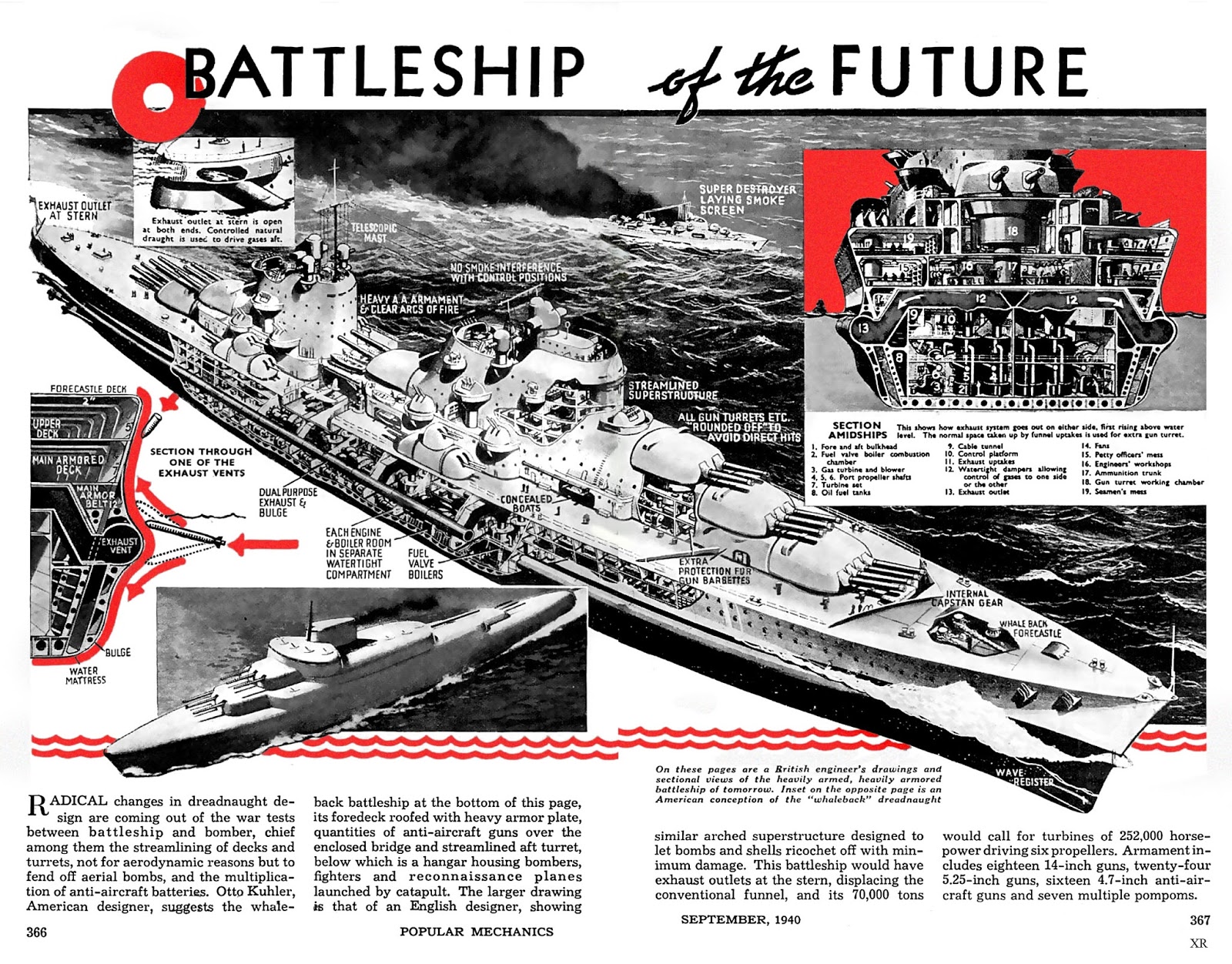
Click to see full-size image.
Upgrading Canada’s LAV III armoured fighting vehicles
From the LAV III Wikipedia page:
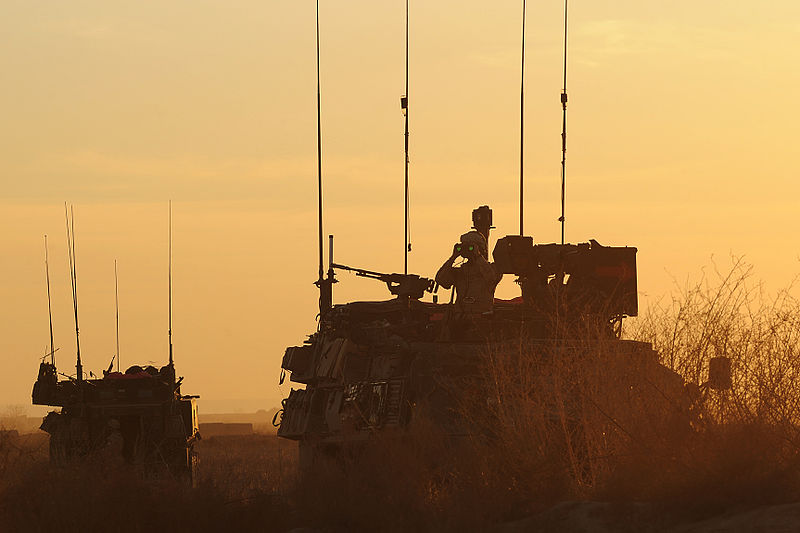
Canadian Army LAV III convoy near Khadan, Afghanistan – 2010-01-25
Photo by Staff Sgt. Christine Jones via Wikimedia Commons
The LAV III, originally named the Kodiak by the Canadian Army, is the third generation of the Light Armoured Vehicle (LAV) family of Infantry fighting vehicle built by General Dynamics Land Systems first entering service in 1999. It was developed in Canada and is the primary mechanized infantry vehicle of the Canadian Army and the New Zealand Army. It also forms the basis of the Stryker vehicle used by the US Army and other operators.
[…]
In July 2009, the Canadian Department of National Defence announced that $5 billion would be spent to enhance, replace and repair the army’s armoured vehicles. Part of the spending would be used to replace and repair damaged LAV III’s due to wear and tear from operations in Afghanistan. As much as 33 percent of the army’s light armoured vehicles were out of service. Furthermore, the LAV III’s will be upgraded with improved protection and automotive components. The Canadian Armed Forces has lost over 34 vehicles and 359 were damaged during the mission in Afghanistan. The Canadian army has lost 13 LAV’s and more than 159 were damaged by roadside bombs or enemy fire. Of the $5 billion announced, approximately 20% of it will be used to upgrade LAV III models. The upgrade will extend the LAV III life span to 2035. The remaining $4 billion is to be spent on a “new family of land combat vehicles”. The Department of National Defence considered the purchase of vehicles meant to accompany the Leopard 2 and to sustain the LAV III into combat. […]
On October 21, 2011 the Canadian government announced a $1.1 billion contract to General Dynamics Land Systems to upgrade 550 LAV III combat vehicles. The government said the upgrade is needed to improve protection against mines and improvised explosive devices (IEDs), which have been the cause of a number of Canadian deaths in Afghanistan. The improvements will also extend the service of the vehicles up to 2035 and will boost troop mobility. The upgrades include a new and more powerful engine, increased armour protection, steering and brake systems. The turret hatches on the LAV III would be made larger and improved fire control, thermal, day and low-light sights, and data displays. The weight of the vehicle would increase from 38,000 pounds (17,000 kg) to 55,000 pounds (25,000 kg). The first of 66 upgraded LAV IIIs was delivered on February 1, 2013. The success of the upgrade program and budget pressures led to the cancellation of the Close Combat Vehicle replacement program later that year.
In September 2012 the original contract valued to at $1.064 billion to upgrade the 550 LAV III’s variants, an infantry section carrier, a command post, an observation post and an engineer vehicle to the LAV 6.0 configuration, was modified. This included an additional $151 million to upgrade 66 LAV III’s to the LAV 6.0 reconnaissance variant or ‘recce’.
On February 10, 2017 General Dynamics Land Systems – Canada of London, Ont. was awarded a $404 million order to work on 141 LAV Operational Requirement Integration Task (LORIT) vehicles. This contract will upgrade the remaining LAV III fleet in the Canadian Army to the LAV 6.0 configuration. This brings the Canadian Army’s Light Armoured Vehicle III Upgrade (LAVUP) program to a total cost of $1.8 billion.
Final completion and delivery of the Canadian Army’s Light Armoured Vehicle III Upgrade (LAVUP) to upgrade the LAV III to the LAV 6.0 is expected to be completed by December 2019.
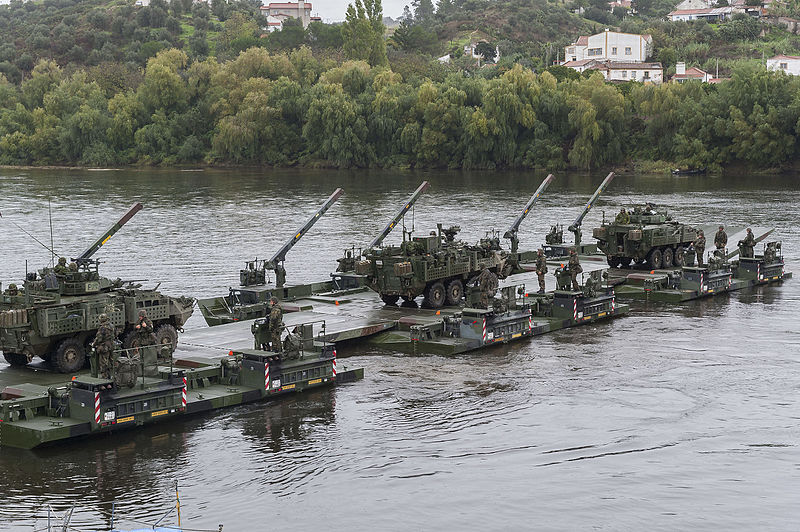
Canadian combat engineers in light armoured vehicules cross the river on a German floating bridge in Tancos, Portugal, during JOINTEX 15 as part of NATO’s exercise TRIDENT JUNCTURE 15 on November 2, 2015.
Photo by Sgt Sebastien Frechette via Wikimedia Commons
Ken Pole has more on the program at Canadian Army Today:
The LAV UP, also known as LAV 6.0, project is expected to push their operational life to 2035.
That effectively was set in motion in November 2008 when the Department of National Defence (DND) confirmed that it wanted to combine three programs into one general set of upgrades to all armoured vehicles. That led to a $1.064-billion contract award to GDLSC in October 2011 to modernize 550 LAV IIIs to enhance not only their survivability, but also their mobility and lethality.
Under the contract, 409 vehicles were to receive turret and chassis upgrades while 141 LAV Operational Requirement Integration Task (LORIT) variants were scheduled to receive only the turret upgrade. A contract amendment in February 2017 added $404 million to upgrade the LORIT chassis as well.
Now the focus within the Directorate of Land Requirements (DLR) is on the Light Armoured Vehicle Specialist Variant Enhancements (LAV SVE). Major Philippe Masse, the project director, brings operational chops from Afghanistan, although he’s quick to say that he’s had a lot to learn about the vehicles since he was assigned. He’s taken a clean-sheet approach, conducting extensive discussions with combat engineers, artillery officers, and gunners.
Masse’s career includes nine months as commander of a light infantry platoon tasked with force protection of the Kandahar Provincial Reconstruction Team and later as second-in-command of the Royal 22nd Regiment battlegroup’s parachute company for its final combat rotation on Operation Athena.
The LAV III infantry carrier and command post variants are the two largest elements of the fleet and are often tasked additional roles. However, the two specialist variants, the Engineer and the Observation Post Vehicle, used by Artillery’s forward detachments, will be “enhanced” under this project.
[…]
There is extra pressure on the LAV SVE package because it was specifically identified in the Strong, Secure, Engaged policy document. “We’re on track; the options are getting a lot of priority,” Masse said. “We’re already engaged with General Dynamics Land Systems because they basically own the intellectual property of the fleet…. When you want to integrate new stuff, they’re among the first phone calls you have to make.”
While integration of a complex system is always a challenge, one of the team’s considerations will also be ease of maintenance, especially for soldiers in the field. “We’re looking to align that, if possible, with existing in-service support contracts that we already [have],” he said. “The bottom line for us is reliability.”
Feature History – Peninsular War
Feature History
Published on 20 Aug 2017Hello and welcome to Feature History, featuring the Peninsular War and not much else. It’s not called Peninsular War and other stuff, just Peninsular War so really you can’t complain.
Help me defeat Napoleon (or not)
https://www.paypal.me/FeatureHistory
Patreon
https://www.patreon.com/FeatureHistory
https://twitter.com/Feature_History
Discord
https://discord.gg/Zbk4CvR
———————————————————————————————————–
I do the research, writing, narration, art, and animation. Yes, it is very lonely
August 26, 2018
Italians in AH Army – Military Missions I OUT OF THE TRENCHES
The Great War
Published on 25 Aug 2018Chair of Wisdom Time!
The Wolseley Expedition and the making of Canada
The History Guy: History Deserves to Be Remembered
Published on 2 May 2018In the early days of the Canadian confederation, one of the greatest officers of the British Victorian Army takes 1000 soldiers on an impossible march through the wilderness that helps to define modern Canada.
All events are described for educational purposes and are presented in historical context.
Patreon: https://www.patreon.com/TheHistoryGuy
The History Guy: History Deserves to be Remembered is the place to find short snippets of forgotten history from five to fifteen minutes long. If you like history too, this is the channel for you.


