
The Tank Museum
Published 27 Jan 2023In this episode of Tank Chats Reloaded, we are delighted to be joined by Stefan Karlsson, the director and curator of The Swedish Tank Museum. He shares his remarkable journey with the S-Tank, from his first experience driving it at the age of nine, to his later service in the Swedish Army. Stefan’s passion for the S-Tank is evident, and his story is sure to captivate and inspire.
(more…)
May 7, 2023
Tank Chats Reloaded | S-Tank | The Tank Museum
Comments Off on Tank Chats Reloaded | S-Tank | The Tank Museum
May 5, 2023
The kinder, gentler US Naval War College
CDR Salamander on a recent symposium at the U.S. Naval War College, showing just how much the American military has adapted itself to the Current Year:
Let’s take a look around the planet with a maritime national security lens, shall we?
- The largest land war in Europe since WWII is raging on the north shore of the Black Sea.
- The People’s Republic of China surpassed the United States of America as the world’s largest navy.
- The Iranians are hijacking oil tankers willy-nilly.
- The Western economy relies on undersea cables & pipelines we have allowed to go undefended and are now the subject of attention by mal-actors on the world stage.
- The Navy is experiencing readiness and recruiting problems not seen since the 1970s.
There’s my top-5 off the top of my head this AM, yours may differ.
It sure seems to differ in Newport.
So, in the last week of April there was a 2-day symposium at the U.S. Naval War College, an opportune time to examine the most critically important challenges in 2023 — hopefully from a maritime perspective — wouldn’t you think?
Any conference, especially a 2-day affair with both on and off campus event locations, sure cost a lot of money and even more stacked manhours to plan, attend, participate, and manage.
We sure want to make sure the juice is worth the squeeze, right?
If you’re a regular here, you know where this is going. I warned everyone about this back in 2017. If you’re a new reader not fully up to speed on the broader portfolio we manage here at CDRSalamander, well, take a red pill and a seat.
Our war colleges are not what you think they are.
With each passing year there is less focus on war, and more on college. At the Naval War College, just getting additional time, money, faculty, and leadership focus on the “naval” portion has become a challenge with all the other ancillary agendas trying to keep pace with the cool kids cross-town at Salve Regina University.
Here’s a perfect example.
The Naval War College (NWC) will host its 9th annual Women, Peace and Security (WPS) Symposium, 26-28 April 2023, in Newport, Rhode Island. This year’s theme is “Women, Peace, and Security in a Fragile World: Perspectives on Warfighting, Crisis Management, and Post-Conflict Transitions“.
Well, let’s go in with an open mind. Perhaps there’s something here. Hope isn’t a plan, but when the Party demands things of you, hope is often all you have.
If you voluntarily attended (I am reliably told that Party cadre informed the proles that attendance was required for staff, at least online), what kind of panel discussions would you be able to listen to? Let’s browse over the agenda.
In totally unrelated news, Brent Ramsey updates the odds on who will be promoted to be the US Navy’s next Chief of Naval Operations:
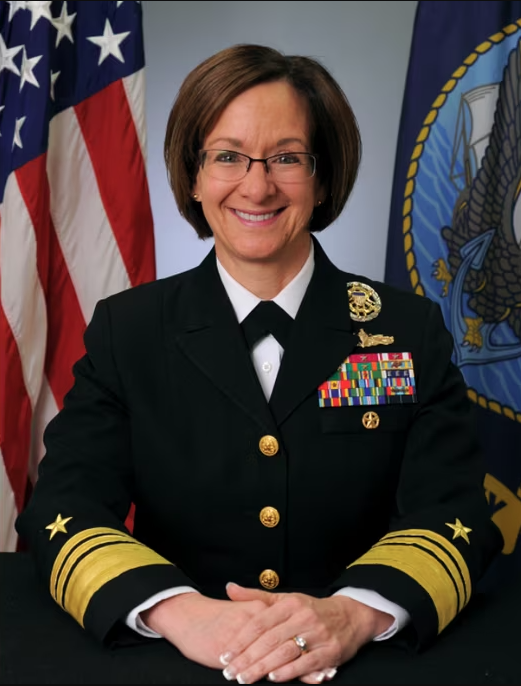
Admiral Lisa Franchetti, Vice-Chief of Naval Operations, US Navy.
Last September, the Navy promoted and installed a new Vice Chief of Naval Operations. Then Vice Admiral Lisa Franchetti got her 4th star and was appointed to the second-highest position in the Navy. Now after a scant seven months, the betting line going around D.C. is that she will likely be the next CNO based on the identity politics track record of President Biden. When President Biden had an opportunity to appoint to the Supreme Court, before assessing anyone’s qualifications, he announced that a black woman would get that seat, and he followed up on that promise. Would an identity-based selection for the Navy’s top leader be in the best interest of the Navy and the Nation? No, the nation needs and deserves the very best warrior to lead the Navy into our threatened future.
Admiral Franchetti is a journalism graduate of Northwestern University NROTC, a non-STEM degree which itself is unusual, as the Navy strongly favors STEM degrees for officers. She has a Master’s Degree in organizational management from the University of Phoenix, an online university. Her biography does not mention any war college credential. In contrast, her predecessor Admiral William Lescher had multiple commands in combat zones, was a test pilot, had multiple advanced degrees in naval technical fields and his commands won multiple combat zone merit awards. To naval professionals, for someone to have been promoted to the Navy’s highest rank and second highest position based on a NROTC commissioning source with a liberal arts degree, an online masters, no war college or combat zone credentials, would be considered inconceivable. Perhaps her success is based on a particularly spectacular service record?
Admiral Franchetti’s career path reveals sea tours on a tender, oiler, and three destroyers including command of the USS Ross (DDG-71) and command of a destroyer squadron. Her biography does not mention any of her commands received awards while she was in command.
I’m not a betting man, but if I was, I think I’d be putting down a few jellybeans on Admiral Franchetti’s next posting …
Comments Off on The kinder, gentler US Naval War College
Alligator Creek: America Learns to Fight the Japanese
Forgotten Weapons
Published 7 Jan 2023The Battle of Alligator Creek (aka Battle of the Tenaru) was a formative moment in the American World War Two psyche. After making an unopposed landing on Guadalcanal and taking its mostly-completed airfield at minimal cost, the US Marines had to defend their permitter on the night of August 21st, 1942.
Colonel Kiyonoa Ichiki was sent from the Japanese base at Truk with about 900 tough veteran soldiers to push the Marines off the airfield. These men had originally been slated to assault Midway Island, but the Japanese naval defeat there forced a change in plans. Ichiki was overconfident, and more concerned about retaking the islands of Tulagi, Gavutu, and Tanambogo across the straights, where Japan’s main base in the area had also been captured by Marine Raiders. Marching up the coastline towards Henderson Field, Ichiki’s men hit the thin single strand of Marine barbed wire about about 1:30am on the morning of there 21st. An intense firefight erupted, with the well dug-in Marine positions opening up with .30 caliber and .50 caliber machine guns, small arms, and 37mm canister rounds.
The fighting continued after daybreak, with Ichiki’s men digging in on the east bank of Alligator Creek. The Marines launched a two prong counterattack, with one force crossing the Creek inland and advancing down the east bank while a second group, including several Stuart light tanks, advanced across the sandbar. These two groups linked up in the early afternoon of the 21st, almost completely annihilating the Ichiki Detachment.
This was the first real land combat between American and Japanese forces in which American soldiers were able to report back on their experience. It was here that the US military as an institution learned that the Japanese would die rather than surrender, and this engagement set the American expectations for the rest of the Pacific campaign.
(more…)
Comments Off on Alligator Creek: America Learns to Fight the Japanese
May 4, 2023
Fierce fighting on Gallipoli … before WW1
Bruce Gudmundsson outlines the operations of Ottoman Empire forces defending “Turkey in Europe” against Greek and Bulgarian invasion (in alliance with Serbia and Montenegro) in 1913:
In the English speaking world, the name Gallipoli invariably evokes memories of the great events of 1915 and 1916. A location of such strategic importance, however, rarely serves as the site of a single battles. Two years before the landings of the British, Indian, Australian, and New Zealand troops on the south-west portion of the the peninsula (and the concurrent French landings on the nearby mainland of Asia Minor near the ruins of the ancient city of Troy), Ottoman soldiers defended the Dardanelles against the forces of the Balkan League.
By the end of January of 1913, the combined efforts of Greece, Serbia, Montenegro, and Bulgaria had driven Ottoman forces from most of “Turkey in Europe”. Indeed, the only intact Ottoman formations on European soil were those trapped in the fortress of Adrianople, those holding the fortified line just west of Constantinople, and those that had recently arrived at Gallipoli.
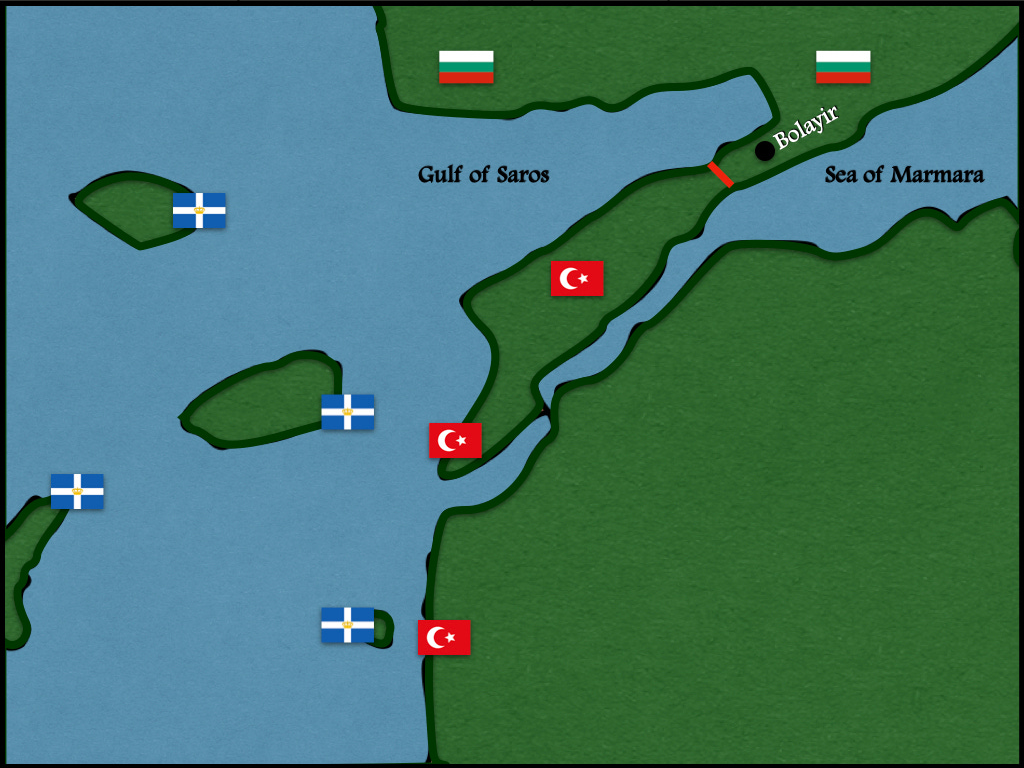
Soon after arriving, the Ottoman forces on Gallipoli began to build a belt of field fortifications across the narrowest part of the peninsula, a line some five kilometers (three miles) west of the the town of Bolayir. At the same time, they occupied outposts some twenty kilometers east of the line, at the place where the peninsula connected to the mainland.
The general situation in (and around) the Gallipoli Peninsula, 31 January 1913.
On 4 February 1913, the Bulgarians attacked. On the first day of this attack, they drove in the Ottoman outposts. On the second day, they broke through a hastily erected line of resistance, thereby convincing the Ottoman forces in front of them to evacuate Bolayir. However, rather than taking the town, or otherwise attempting to exploit their victory, they withdrew to positions some ten kilometers (six miles) east of the Ottoman earthworks.
While the Ottoman land forces returned to the earthworks along the neck of the Peninsula, ships of the Ottoman Navy operating in the Sea of Marmora located, and began to bombard, the Bulgarian forces near the coast. This caused the Bulgarians to move inland, where they took up, and improved, new positions on the rear slopes of nearby hills.
On 9 February, the Ottomans launched a double attack. While the main body of the Ottoman garrison of Gallipoli advanced overland, a smaller force, supported by the fire of Ottoman warships, landed on the far side of the Bulgarian position. Notwithstanding the advantages, both numerical and geometric, enjoyed by the Ottoman attackers, this pincer action failed to destroy the Bulgarian force. Indeed, in the course of two failed attacks, the Ottomans suffered some ten thousand casualties.
Though the Ottoman maneuver failed to dislodge the Bulgarians from their trenches, the two-sided attack convinced the Bulgarian commander to seek ground that was, at once, both easier to defend against terrestrial attack and less vulnerable to naval gunfire. He found this on the east bank of a river, thirteen kilometers (eight miles) northeast of Bolayir and ten kilometers (six miles) north of the place where the Ottoman landing had taken place.
Comments Off on Fierce fighting on Gallipoli … before WW1
May 3, 2023
Finland’s High Power Rig
Forgotten Weapons
Published 6 Jan 2023Finland used a variety of FN pistols prior to WW2, and had already evaluated the High Power when Russian invaded and the Winter War began. With an urgent need for more arms, Finland ordered a batch of High Power pistols, which FN was happy to include with the other arms orders already being delivered to Finland. In total, the Finns bought 2,400 of them, with 900 delivered in February 1940 and 1,500 in March 1940. All of them were bought as rigs with leather holsters riveted to flat board shoulder stocks (note that a Finnish pistol with a Finnish-contract original stock is exempted form the NFA in the US, and need not be registered as a short-barreled rifle).
This delivery schedule meant that only a few were available in time to be used in the Winter War, and they saw much greater use in the Continuation War. They were particularly appreciated by the Finnish Air Force as survival weapons. This is often misinterpreted to mean that they were exclusively used by the Air Force; in fact the quantity of Finnish aircraft was small enough that only a small fraction of the pistols were issued to pilots.
Finnish contract pistols have serial numbers falling between 11,000 and 15,000 (and not all guns in that range are Finnish). The stocks were marked in large numbers with the serial number of the gun, although matching rigs are quite scarce today. Some, but not all, were later marked “SA” by the Finnish Army. During the continuation War some of the holsters were separated from the stocks, and some of the pistols had new square front sights put on (a common Finnish preference, done to Lugers as well).
About 40% of the High Powers were lost or rendered unserviceable by the end of the Continuation War. The remainder were kept in service until the 1980s, when they were replaced by the Browning Double Action and slowly sold as surplus.
(more…)
Comments Off on Finland’s High Power Rig
May 2, 2023
Si vis pacem, para bellum
CDR Salamander suggests that the “War Gods of the Copybook Headings” are not happy with us, and he’s probably right:

Relief at the entrance of the Cultural Center of the Armies (formerly the Serviceman’s Casino) of Madrid (Spain), showing the Latin phrase Si vis pacem, para bellum (If you want peace, prepare for war).
Photo by Luis Garcia (Zaqarbal) via Wikimedia Commons.
Mindsets are universal.
Yes, no one can see the future. Of course, it is easy to play “got-cha” in hindsight. Yes to all the excuses … but that isn’t the point.
Two things to keep in mind as you read the below:
- Our “experts” may lack broad expertise. Always question. Defer only when earned.
- We have a horrible record of predicting even the predictable for a whole host of reasons, most bureaucratic.
- At peace, assume you have leaders who can only imagine peace unless they actively demonstrate otherwise, that they will plan and act in line with their priors. When war comes, it will be up to others to fix things (as they say in the movies, “When they get in trouble, they send for the sons of bitches“.). The harder peacetime leaders are pressed by those who understand the constants of history, the less difficult the fix will be when war comes.
This is one of the virtue/vice dualities of democratic states. In peacetime, there is no political appetite for military spending and no political party will be eager to provide the opportunity to be accused of warmongering. An opposition party might briefly call attention to defects in the standing military, but only to embarrass the governing party, not because they would address the problem if they were in power. There may be widespread passive support for the military, but this isn’t represented at the ballot box because there are always far more urgent issues that drive how the voters allocate their support … and military spending is a lot of money put into things that don’t fix the roads, improve public health, address law and order concerns, or clean the environment.
Peacetime military establishments are huge bureaucracies at the best of times, and those who want to rise through the bureaucracy need to learn how use the same tools, schemes, and stratagems as in every other civil service organization. The longer a country has been at peace, the less capable the military administration will be of transitioning to a war footing. If you haven’t seen war in twenty years or more, then every officer up to the very top of the chain of command got there not for being a good soldier/sailor/airman but for being a good peacetime manager and administrator. This is totally normal, as is the massive disruption when a real war is imminent. If you’re lucky, some of those administrators-in-uniform can make the transition to being combat leaders quickly, but many of them will not be able or willing (it’s just human nature to resent and resist sudden change of long-standing practice).
Well meaning people can be wrong. Just because they are well meaning and have tenure-reputation-rank should not mean that everyone has to defer to them or their plans.
Good leaders with sound ideas and well developed plans will welcome hard questions and informed challenges.
Bad leaders with weak ideas and compromised plans will be defensive, flinty, and more often than not will resort to appeals to authority or credentialism. Those are your warning signs.
Sadly, highly isolated decision nodes — think the Transformationalists in the first half of the ’00s — don’t think they are wrong. They have filtered their information sources and filled out their staffs with either clones or the obsequious — often found in the same person.
They are the ones who have a blinkered focus on usually something far on the horizon that can’t be measured right now — but is very attractive to them for reasons of either a broader ignorance, ego, or monetary.
They don’t fully accept “risk” – they dismiss it.
In the area of national security — such a mindset and practice can create an existential crisis and it comes from hubris.
Smart people who are so convinced of their wisdom without humility will filter out any concerns, and won’t allow questions that might challenge their wisdom.
They may be right as they didn’t, mostly, get to where they were by being wrong — and they don’t consider they may not be and hedge accordingly.
Comments Off on Si vis pacem, para bellum
Dad’s Army: What Was The Military Career of Lance Corporal Jones?
The History Chap
Published 25 Jan 2023Lance Corporal Jack Jones is one of the most loved characters in the classic British comedy Dad’s Army. Constantly referring to his exploits in the Sudan, the North West Frontier (India) and the First World War.
So I thought I would make a short video exploring his long (& fictitious) military career.
The local butcher, Jack Jones, is a member of Walmington-on-Sea Home Guard during World War Two. This fictitious Home Guard unit are the stars of the classic BBC comedy: Dad’s Army.
What I found amazing is that the BBC created a back story for the character of Lance Corporal Jones. researching the medal ribbons that Jones wears on his Home Guard uniform I have put together a timeline of his military career in the 1st battalion, Warwickshire Regiment.
The story starts when young Jack Jones joins the Royal Warwickshire’s in 1884 as a drummer boy. He is to spend 31 years serving in the British army where he participates in the Gordon Relief Expedition, the re-conquest of Sudan under General Kitchener, the Boer War, the North West Frontier of India, and the First World War.
Comments Off on Dad’s Army: What Was The Military Career of Lance Corporal Jones?
April 30, 2023
Germany’s Existential Crisis – WW2 – Week 244 – April 29, 1944
World War Two
Published 29 Apr 2023The fighting at Kohima is up close, personal, and vicious, as it is at Imphal. The Allies consolidate their gains at Hollandia, the Japanese are advancing in Central China, and it seems like the Chinese Nationalist Army has lost the support of the civilian population. This might not surprise you when we take a closer look.
(more…)
Comments Off on Germany’s Existential Crisis – WW2 – Week 244 – April 29, 1944
North Korean Type 70 Pistol
Forgotten Weapons
Published 8 Apr 2015The “Hermit Kingdom” of North Korea has a number of somewhat unusual military firearms that are not quite direct copies of anything else, but we very rarely get to see examples of them up close. The Type 70 was intended for high-ranking officers, replacing the Type 64 (which was a copy of the Browning 1900). The Type 70 shows features from the PPK and Makarov, as well as other elements not taken directly from existing designs. The hammer is an exposed single-action type, and the muzzle profile is very reminiscent of the Makarov. The action is simple blowback (in .32 ACP, despite the 7.62mm marking on the slide), but the barrel is set in the side and easily removed, instead of being fixed to the frame as is typical of blowback pistols. The safety is a cross-bolt button which doubles as the block holding the barrel in place. The Type 70 is quite comfortable in the hand, and probably nice to shoot given its .32ACP chambering.
Comments Off on North Korean Type 70 Pistol
April 29, 2023
What Was the Deadliest Day of the First World War?
The Great War
Published 28 Apr 2023What was the deadliest day of any nation in WW1? There are multiple candidates for that, but why should we even care? Well, the answer to this question highlights a challenge with popular memory that is often focused on the biggest battles of the war like the Somme or Verdun.
(more…)
Comments Off on What Was the Deadliest Day of the First World War?
Okinawa 1945: Planning Operation ICEBERG
Army University Press
Published 7 Dec 2021On 1 April 1945, U.S. forces invaded the Japanese home island of Okinawa. It was the largest joint amphibious assault mounted during World War II in the Pacific Theater. The invasion of Okinawa was the culmination of three years of operations in the Pacific against Imperial Japan. The film explores the planning and preparation for Operation ICEBERG from September 1944 to 1 April 1945.
“Okinawa 1945: Planning Operation ICEBERG” examines the U.S. Army operations process as well as planning by echelon from field army, corps, and division with special emphasis on current Joint doctrine. This film is the first in a two-part series covering Operation ICEBERG and the U.S. Tenth Army’s securing of Okinawa.
(more…)
Comments Off on Okinawa 1945: Planning Operation ICEBERG
QotD: The problem of war-elephants
The interest in war elephants, at least in the ancient Mediterranean, is caught in a bit of a conundrum. On the one hand, war elephants are undeniably cool, and so feature heavily in pop-culture (especially video games). In Total War games, elephants are shatteringly powerful units that demand specialized responses. In Paradox’s recent Imperator, elephant units are extremely powerful army components. Film gets in on the act too: Alexander (2004) presents Alexander’s final battle at Hydaspes (326) as a debacle, nearing defeat, at the hands of Porus’ elephants (the historical battle was a far more clear-cut victory, according to the sources). So elephants are awesome.
On the other hand, the Romans spend about 200 years (from c. 264 to 46 B.C.) mopping the floor with armies supported by war elephants – Carthaginian, Seleucid, even Roman ones during the civil wars (Thapsus, 46 B.C.). And before someone asks about Hannibal, remember that while the army Hannibal won with in Italy had almost no war elephants (nearly all of them having been lost in the Alps), the army he lost with at Zama had 80 of them. Romans looking back from the later Imperial period seemed to classify war elephants with scythed chariots and other failed Hellenistic “gimmick” weapons (e.g. Q. Curtius Rufus 9.2.19). Arrian (a Roman general writing in the second century A.D.) dismisses the entire branch as obsolete (Arr. Tact. 19.6) and leaves it out of his tactical manual entirely on those grounds.
This negative opinion in turn seeps into the scholarship on the matter. This is in no small part because the study of Indian history (where war elephants remained common) is so under-served in western academia compared to the study of the Greek and Roman world (where the Romans functionally ended the use of war elephants on the conclusion that they were useless). Trautmann, (2015) notes the almost pathetic under-engagement of classical scholars with this fighting system. Scullard’s The elephant in the Greek and Roman World (1974) remains the standard text in English on the topic some 45 years later, despite fairly huge changes in the study of the Achaemenids, Seleucids, and Carthaginians in that period.
All of which actually makes finding good information on war elephants quite difficult – the cheap sensational stuff often fills in the gaps left by a lack of scholarship. The handful of books on the topic vary significantly in terms of seriousness and reliability.
Bret Devereaux, “Collections: War Elephants, Part I: Battle Pachyderms”, A Collection of Unmitigated Pedantry, 2019-07-26.
Comments Off on QotD: The problem of war-elephants
April 28, 2023
Field Marshal Slim’s secret vice – he also wrote articles and short stories under pseudonym
It’s no secret that I have a very high regard for Field Marshal William Slim, so I’m quite looking forward to reading some of Slim’s pre-WW2 writings that have just been gathered together by Dr. Robert Lyman in a three-volume set:
Few people during his lifetime, and even fewer now, know that the man who was to become one of the greatest British generals of all time – and I’m not exaggerating – was in fact a secret scribbler. Now, many people know that he was the author of at least two best selling books. In 1956 he wrote his account of the Burma campaign, Defeat into Victory, described by one reviewer, quite rightly in my view, as “the best general’s book of World War II”. Then, in 1959, he published, under the title of Unofficial History, a series of articles about his military experience, some of which had been published previously as articles in Blackwood’s magazine. This was the first indication that there was an unknown literary side to Slim. The fact that he was a secret scribbler, or at least had been one once, was only publicly revealed on the publication of his biography in 1976 by Ronald Lewin – Slim, The Standard Bearer – which incidentally won the W.H. Smith Literary Award that same year. Lewin explained that Slim had written material for publication long before the war. In fact, between 1931 and 1940 he wrote a total of 44 articles, extending in length between two and eight thousand words – a total of 122,000 words in all – for a range of newspapers and magazines, including Blackwood’s Magazine, the Daily Mail, the Evening Express and the Illustrated Weekly of India. According to Lewin, he did this to supplement his earnings as an officer of the Indian Army. He didn’t do it to create a name for himself as a writer, or because he had pretensions to the artistic life, but because he needed the money. As with all other officers at the time who did not have the benefit of what was described euphemistically as “private means” he struggled to live off his army salary, especially to pay school fees for his children, John (born 1927) and Una (born 1930). Accordingly, he turned his hand to writing articles under a pseudonym, mainly of Anthony Mills (Mills being Slim spelt backwards) and, in one instance, that of Judy O’Grady.
With the war over, and senior military rank attained, he never again penned stories of this kind for publication. With it died any common remembrance of his pre-war literary activities. Copies of the articles have languished ever since amidst his papers in the Churchill Archives Centre at the University of Cambridge, from where I rescued them last year. They have been republished this week by Richard Foreman of Sharpe Books.
During the time Slim was writing these the pseudonym protected him from the gaze of those in the military who might believe that serious soldiers didn’t write fiction, and certainly not for public consumption via the newspapers. He certainly went to some lengths to ensure that his military friends and colleagues did not know of this unusual extra-curricular activity. In a letter to Mr S. Jepson, editor of the Illustrated Times of India on 26 July 1939 (he was then Commanding Officer of 2/7 Gurkha Rifles in Shillong, Assam) he warned that he needed to use an additional pseudonym to the one he normally used, because that – Anthony Mills – would then be immediately “known to several people and I do not wish them to identify me also as the writer of certain articles in Blackwood’s and Home newspapers. I am supposed to be a serious soldier and I’m afraid Anthony Mills isn’t.”
What do these 44 articles tell us of Slim? He would never have pretended that his writings represented any higher form of literary art. He certainly had no pretensions to a life as a writer. He was, first and foremost, a soldier. His writing was to supplement the family’s income. But, as readers will attest, he was very good at it. They demonstrate his supreme ability with words. As Defeat into Victory was to demonstrate, he was a master of the telling phrase every bit as much as he was a master of the battlefield. He made words work. They were used simply, sparingly, directly. Nothing was wasted; all achieved their purpose.
The articles also show Slim’s propensity for storytelling. Each story has a purpose. Some were simply to provide a picture of some of the characters in his Gurkha battalion, some to tell the story of a battle or of an incident while on military operations. Some are funny, some not. Some are of an entirely different kind, and have no military context whatsoever. These are often short adventure stories, while some can best be described as morality tales. A couple of them warned his readers not to jump to conclusions about a person’s character. Some showed a romantic tendency to his nature.
The stories can be placed into three broad categories. The first comprises seventeen stories about the Indian Army, of which the Gurkha regiments formed an important part. The second group are eleven stories about India, with no or only a passing military reference. The third, much smaller group, contains seventeen stories with no Indian or military dimension.
Comments Off on Field Marshal Slim’s secret vice – he also wrote articles and short stories under pseudonym
QotD: The high-water mark of the Panzerarmee Afrika
Even here, however, let us be honest. Smashing 8th Army at Gazala and taking tens of thousands of prisoners at Tobruk did little to solve the strategic problem. Unless the British were destroyed altogether, they would reinforce to a level the Axis could not match. Many later analysts argue that the Panzerarmee should have paused now, waited until some sort of combined airborne-naval operation had been launched against Malta to improve the logistics, and only then acted. Such arguments ignore the dynamic of the desert battle, however; they ignore the morale imperative of keeping a victorious army in motion; above all they ignore the personality of Rommel himself.
Pause? Halt? Wait? Anyone who expected Rommel to ease up on the throttle clearly hadn’t been paying attention. Instead, the Panzerarmee vaulted across the border into Egypt with virtually no preparation. To Rommel, to his men, and even to Hitler and Mussolini, it must have looked like a great victory lay just over the next horizon: Cairo, Alexandria, the Suez Canal, the British Empire itself.
In reality, it is possible today to see what the great Prussian philosopher of war Karl von Clausewitz once called the “culmination point” — that moment in every campaign when the offensive begins to lose steam, run down, and eventually stop altogether. The Panzerarmee was exhausted, its equipment was worn out and in desperate need of repair. Captured British stores and vehicles had become its life-blood, Canadian Ford trucks in particular. The manpower was breaking down. A chronic shortage of potable water had put thousands of soldiers on the sick rolls. Colonel Siegfried Westphal, the Panzerarmee‘s operations chief (the “Ia”, in German parlance), was yellow with jaundice. The army’s intelligence chief (the “Ic”), Colonel Friedrich Wilhelm von Mellenthin, was wasting away with amoebic dysentery. Rommel had a little of both, as well as a serious blood-pressure problem (no doubt stress-induced) and a chronic and bothersome sinusitis condition. While it would be easy to view all these illnesses as simple bad luck, they were, in fact, the price Rommel and all the rest of them were paying for fighting an overseas expeditionary campaign with inadequate resources.
The same might be said for the rest of the campaign. The Panzerarmee made an ad hoc attempt to break thought the British bottleneck at El Alamein in July. It failed, coming to grief against British defenses on the Ruweisat ridge. There was a second, more deliberate, attempt in August. After an initial breakthrough, it crashed into strong British defenses at Alam Halfa ridge and it, too, failed. After yet another long pause, a “third battle of El Alamein” began in late October. This time, it was the well supplied British on the attack, however, and they managed to smash through the Panzerarmee and drive Rommel and company back, not hundreds of miles, but more than a thousand, out of the desert altogether and into Tunisia. There was still fighting to be done in Africa, but the “desert war” was over.
Robert Citino, “Drive to Nowhere: The Myth of the Afrika Korps, 1941-43″, The National WWII Museum, 2012. (Originally published in MHQ, Summer 2012).
Comments Off on QotD: The high-water mark of the Panzerarmee Afrika
April 27, 2023
Spending more on defence requires more than just turning on the financial taps
In The Line, Philippe Lagassé explains why just pouring more money into the Department of National Defence won’t automatically improve our defence capabilities:
Canadian defence spending is back in the news, thanks to an open letter urging the government to spend two per cent of GDP on the military and a leaked document suggesting Canada won’t hit that NATO target. Like ending the monarchy, defence spending is one of those issues that gets lots of attention once or twice a year, only to fade away before any serious discussion takes place. It’s unlikely that this time will be any different.
[…]
Even if the government wanted to greatly increase defence spending, though, it would have trouble spending that money effectively in the short term. While more money is needed over the long term, the Department of National Defence (DND) and Canadian Armed Forces (CAF) have to first build up their capacity to spend a much larger budget. As they do so, however, our historical tendency to reduce defence expenditures after pivotal moments should always be kept in mind.
The DND and CAF are already straining to implement the capital equipment and infrastructure programs that were announced in the 2017 defence policy, Strong, Secure, Engaged. This reflects the fact that department’s capacity to manage procurements has to be built back up after decades of anemic capital spending. There aren’t enough people to move the programs that are currently planned, let alone new ones that could be added. Additional money could be funneled to existing projects, but that wouldn’t be enough to cause an increase to two per cent of GDP in the coming years. The capabilities Canada is currently buying will probably be far more expensive to maintain in the future than the government realizes, which strongly suggests that we do need to gradually get to that number, but this reinforces the need for caution and for managing expectations. If ministers insist that new money be attached to still more new capabilities, DND/CAF will not only have trouble acquiring them, but will be unable to afford them.
One could argue that DND/CAF could get around its capacity challenges by simply buying more equipment “off the shelf”. Instead of getting more people to tackle complex procurements and infrastructure projects, the defence department should focus on simpler acquisitions that require less management. It is important to note, though, that “off the shelf” procurements aren’t an obvious solution either — DND and the CAF don’t specify requirements for the hell of it. Many project requirements reflect the need to integrate new capabilities into the existing force, which is no small feat when mixing new and old technologies and operating from installations across a massive country. Projects that gravitate toward “off the shelf” solutions, moreover, can be challenged by competitors who contend that they can develop a new capability that better meets Canada’s needs. Bombardier‘s response to the government’s plan to buy Boeing’s P-8 Poseidon aircraft to fulfil the Canadian Multi-mission Aircraft (CMMA) project is a recent example.
Canada also tends to favour platforms that can perform various missions, which further complicates “off the shelf” procurements, since the equipment sitting on the shelf may not do everything the CAF needs it to do. Unless we want the CAF to be less capable, the way to address this issue is to acquire more platforms that do specific things. The problem is that the CAF would need more people to acquire, operate, and maintain these additional fleets, still more money to sustain this extra equipment, and yet more infrastructure to store it. This approach promises to exacerbate the very problems it’s supposed to solve.


