Sabaton History
Published on 28 Mar 2019You don’t generally think about Brazil when talking about World War Two. Still, they joined the Allied powers in 1942, after which the Brazilian Expeditionary Force played a role in the battle for Italy. The Sabaton song “Smoking Snakes” (from the Heroes album) is about the Brazilian effort during World War Two and especially about three Brazilian soldiers who wouldn’t surrender.
Support Sabaton History on Patreon: https://www.patreon.com/sabatonhistory
Watch more videos on the Sabaton YouTube channel: https://www.youtube.com/user/Sabaton?…
Listen to Sabaton on Spotify: http://smarturl.it/SabatonSpotify
Official Sabaton Merchandise Shop: http://bit.ly/SabatonOfficialShopHosted by: Indy Neidell
Written by: Markus Linke and Indy Neidell
Directed by: Astrid Deinhard and Wieke Kapteijns
Produced by: Pär Sundström, Astrid Deinhard and Spartacus Olsson
Creative Producer: Joram Appel
Executive Producers: Pär Sundström, Joakim Broden, Tomas Sunmo, Indy Neidell, Astrid Deinhard, and Spartacus Olsson
Maps by: Eastory
Edited by: Iryna Dulka
Sound Editing by: Marek KaminskiEastory YouTube Channel: https://www.youtube.com/channel/UCEly…
Archive by: Reuters/Screenocean https://www.screenocean.com
Music by Sabaton.
Research contribution: Leitura ObrigaHISTÓRIA – Check out their channel: https://www.youtube.com/obrigahistoria
The Mariners’ Museum and Park
Brazilian casualty chugs milk
https://catalogs.marinersmuseum.org/o…
P0003/01-#W-14256An OnLion Entertainment GmbH and Raging Beaver Publishing AB co-Production.
© Raging Beaver Publishing AB, 2019 – all rights reserved.
March 29, 2019
Smoking Snakes – Brazilian Expeditionary Force – Sabaton History 008
March 27, 2019
“This was the week it became necessary to destroy the village of good government in order to save it”
It may be hard to believe, but in his latest at Maclean’s, Paul Wells appears to be getting a little bit cynical about recent shenanigans in Ottawa:
We have learned so much. Within minutes Monday afternoon, two good reporters had stories (here and here) about the Chief Justice of Manitoba, who was a candidate to be Chief Justice of the Supreme Court of Canada and who, later, wasn’t. Both reporters unfurled similar yarns about a lone Prime Minister standing athwart the tide of conservatism by blocking — shudder — a Harper appointee from sitting on the top court. Jody Wilson-Raybould plays the role of villain in the piece.
Both reporters decorously neglect to mention that Trudeau’s choice for Chief Justice, Richard Wagner, was a Harper appointee.There are many things we can say about this story, working outward in concentric rings from the thing itself. First, Glenn Joyal’s views, as expressed in speeches that were said to alarm the prime minister, are almost comically orthodox. I first became aware of the notion that Charter litigation systematically airlifts important matters from the parliamentary arena and into the realm of jurisprudence in a Chantal Hébert column in the late 1990s. If I had paid more attention to literally any of my Canadian public administration profs a decade earlier I would have caught the argument then, because it is canvassed in every Canadian political science class. This is not wild-eyed Hayekism.
Second, perhaps the many thousands of Canadians who have applied for federal government appointments under what they thought was a confidential process, introduced by this prime minister, will want to contemplate a class-action suit against him. Because it is now radiantly clear to each of them that their CV is being held hostage by a claque of embattled sorcerers’ apprentices who will cheerfully wheel it over the transom to any waiting scribe if anything about them — their opinions, a fallen political star’s unfortunate decision to argue for their advancement — becomes politically inconvenient. This is the very stuff of the police state.
It was immediately fashionable to wonder on social media how everyone would react if Stephen Harper had done such a thing. It’s germane to note that Stephen Harper never did. Because he had more class. Welcome to the Tet offensive of Charter rights: This was the week it became necessary to destroy the village of good government in order to save it.
Third, Justice Joyal’s wife was in poor health. Apparently we are to believe that 9,000 jobs depended on your knowing that.
If the Trudeau government is not the source of the leak, I assume we will see spectacular efforts deployed in the next 36 hours to find the leaker. Mark Norman-scale efforts. But I’m pretty sure that we needn’t hold our breath, because the government is the source of the leak; that the amiable chap who currently sits in the office once occupied by the Attorney General of Canada will not bestir himself to question Monday’s sickening attack on due process; and that the leak will actually be roundly applauded by the ambient cloud of Liberal and Liberal-adjacent opinion, which became self-aware this weekend and decided Jody Wilson-Raybould and Jane Philpott are a virus endangering the party’s re-election chances and must therefore be stopped.

March 26, 2019
Matt Taibbi on “a death-blow for the reputation of the American news media”
A revised and updated chapter from his Hate, Inc.:
Note to readers: in light of news that Special Prosecutor Robert Mueller’s investigation is complete, I’m releasing this chapter of Hate Inc. early, with a few new details added up top.
[…]
Over the weekend, the Times tried to soften the emotional blow for the millions of Americans trained in these years to place hopes for the overturn of the Trump presidency in Mueller. As with most press coverage, there was little pretense that the Mueller probe was supposed to be a neutral fact-finding mission, as apposed to religious allegory, with Mueller cast as the hero sent to slay the monster.
The Special Prosecutor literally became a religious figure during the last few years, with votive candles sold in his image and Saturday Night Live cast members singing “All I Want for Christmas is You” to him featuring the rhymey line: “Mueller please come through, because the only option is a coup.”
The Times story today tried to preserve Santa Mueller’s reputation, noting Trump’s Attorney General William Barr’s reaction was an “endorsement” of the fineness of Mueller’s work:
In an apparent endorsement of an investigation that Mr. Trump has relentlessly attacked as a “witch hunt,” Mr. Barr said Justice Department officials never had to intervene to keep Mr. Mueller from taking an inappropriate or unwarranted step.
Mueller, in other words, never stepped out of the bounds of his job description. But could the same be said for the news media?
For those anxious to keep the dream alive, the Times published its usual graphic of Trump-Russia “contacts,” inviting readers to keep making connections. But in a separate piece by Peter Baker, the paper noted the Mueller news had dire consequences for the press:
It will be a reckoning for President Trump, to be sure, but also for Robert S. Mueller III, the special counsel, for Congress, for Democrats, for Republicans, for the news media and, yes, for the system as a whole…
This is a damning page one admission by the Times. Despite the connect-the-dots graphic in its other story, and despite the astonishing, emotion-laden editorial the paper also ran suggesting “We don’t need to read the Mueller report” because we know Trump is guilty, Baker at least began the work of preparing Times readers for a hard question: “Have journalists connected too many dots that do not really add up?”
The paper was signaling it understood there would now be questions about whether or not news outlets like itself made galactic errors by betting heavily on a new, politicized approach, trying to be true to “history’s judgment” on top of the hard-enough job of just being true. Worse, in a brutal irony everyone should have seen coming, the press has now handed Trump the mother of campaign issues heading into 2020.
Nothing Trump is accused of from now on by the press will be believed by huge chunks of the population, a group that (perhaps thanks to this story) is now larger than his original base. As Baker notes, a full 50.3% of respondents in a poll conducted this month said they agree with Trump the Mueller probe is a “witch hunt.”
March 24, 2019
So this is why we all know about “Florida Man” and “Florida Woman”
Now that it’s been explained … nope, I still think Florida is the home of the crazy.
Trust in scientific findings decreasing among the general public
In Scientific American, Louise Lief discusses the problem of rising public distrust of science:
We live in a moment when preventable infectious diseases like measles are spreading because parents distrust vaccines, and scientists at government agencies are being told not to use terms like “evidence-based.” The president dismisses the findings of a National Climate Assessment by more than 300 scientists and 13 federal agencies that warns of massive economic and environmental damage totaling hundreds of billions of dollars, crop failures, disrupted supply chains and multiple threats to human health, saying, “I don’t believe it.”
But when I argued in favor of the proposition (Resolved: “Science writers are responsible for building public trust in science”) during a debate at the National Association of Science Writers’ 2018 annual conference last fall, the majority of science writers and science journalists present voted that building public trust in science was not the responsibility of science writers.
[…]
Kathleen Hall Jamieson, director of the Annenberg Public Policy Center at the University of Pennsylvania’s Annenberg School for Communication also tackled the science trust question at the NASW conference, and researchers at Cardiff University have traced credibility and accuracy problems to press releases from scientists’ own academic institutions.
If a problem is discovered or a study is retracted, said Jamieson, the scientist or scientific journal needs to explain to journalists and the public how the error was discovered, what the problem is, and what steps are being taken to ensure it doesn’t happen again.
Scientists often make it hard for journalists to cover these three interrelated issues, she says. Scholarly journal publication protocols may cause scientists to write one article on the problem they’re investigating, and a second or third article on processes and solutions, resulting in coverage that emphasizes problems and shortchanges corrective action.
For their part, researchers at Cardiff University found that press releases from scientists’ own academic institutions about their work were a significant source of exaggerated claims and spin, even though most scientists can approve their wording.
Their study of press releases from 20 leading British universities on health-related science news found that when the press releases exaggerated, it was likely the news stories would too.
An analysis of 41 news articles on randomized controlled trials based on 70 press releases showed only four articles that contained exaggerated claims not included in the press release or journal abstract. Interestingly, they also found the hype and spin intended to tempt the media did not result in more news coverage.
H/T to Blazing Cat Fur for the link.
March 23, 2019
17 Million F*ck Offs – A Song About Brexit
Dominic Frisby
Published on Mar 5, 2019Please help take this song to number one by buying a copy of the single at iTunes/Amazon etc
Amazon – https://www.amazon.co.uk/17-Million-F… ITunes (ignore Apple Music and go to the iTunes store) – https://itunes.apple.com/gb/album/17-…I’ll put in other links as and when they come in.
Written and performed by Dominic Frisby
Music composed and played by Martin Wheatley (based on a traditional Devon folk song)
Video directed by anon
Audio mixed and recorded by Wayne McIntyre
Assistant director Mark “Yeti” CribbsLyrics
On the 23rd of June, 2016
The people of the United Kingdom – and Gibraltar – went to vote
On an issue that for some had been burning for years
The question in full – and unaltered – was – I quoteShould the United Kingdom remain a member of the European Union
or leave the European Union?It was the greatest democratic turnout in British history, I do not scoff
And when the time came to speak the British said f*ck off.
F*ck off.Campaigning had gone on for many a month
With debate and discussion on many a front
They’d argued they’d fought they’d smeared and pulled stunts
There was David Cameron. Theresa May. George Osborne.
Tony Blair. John Major. The BBC.
The British told them to f*ck off. The British told them to f*ck off.If you vote to leave, you’ll lose your job
Vote to leave, you’ll lose your home.
The ensuing recession will last for years
Said David Cameron. Theresa May. George Osborne.
And the Treasury. Tony Blair. John Major. The BBC.
The Bank of England. Mark Carney. The EU. The IMF. The US president. Saint Obama. Back of the queue. Loads of celebrities. Gary Lineker. JK Rowling. Benedict Cumbertwat. Lord Adonis. Who the fuck’s he anyway?
The British told them to f*ck off. Seventeen million f*ck offs.They wheeled in the experts to tell us what’s right
They gave us the benefit of their foresight
To leave is calamitous, that’s definite.
Food shortages. No medicine. Planes grounded. House price crash. ½ a million jobs lost. Cost of £4,300 to every home. Stock market collapse. Riots. No sandwiches.
There’d be an outbreak of super gonorrhea. They seriously said that. Donald Tusk at the EU said it would be the end of Western civilization as we know it. I’m not joking. And one more thing. If you vote to leave, that makes you racist.
The British told them to f*ck off. Seventeen million f*ck offs.The vote is final, there’s no going back
Although now they want to go back and re-vote
I think we know what the answer will be
To Gary Lineker. Alastair Campbell. Dominic Grieve. Chuka Umana. Keir Starma. Vince Cable. Anna Soubry (not a Nazi). Rory Bremner. Armando Ianucci. Delia Smith. Steve Coogan. David Lammy. Lord Adonis. Who the fuck’s he anyway?
The British will tell them f*ck off. 17 million f*cks offs.ISRC#: TCAED1904492
QotD: Pity the poor politicians
The first reason to pity them, however, is that someone, or rather some group of people, has to do politics, just as people have to do other unpleasant jobs, such as cleaning lavatories. If it were not for the politicians whom we actually have, there would only be others, not necessarily better. Politicians are like the poor: You have them with you always — except in Switzerland, that happy land where people do not even know who their president is, he being so profoundly unimportant.
But the second and more compelling reason to pity the poor politicians is that theirs is a dreadful life judged by normal standards. If it has its compensations, such as power, money, and bodyguards, they are bought at a dreadful cost. The other day I caught a glimpse of what that life must be like.
A television crew came to make a documentary about me. It will last about 45 minutes, will be watched (thank goodness) by only a small audience, and took two and a half days’ filming to make. The television crew was very nice, which is not my universal experience of television people, to put it mildly; but even so, two and a half days being followed by a camera is more than enough to last me the rest of my life.
I found the strain of it considerable, even though, really, nothing was at stake. It did not matter in the slightest, not even to me, if I made a fool of myself by what I said. There would be no consequences for my career, such as it is (it is almost over); there would be no humiliating exposures of my fatuity in the press, no nasty political cartoons as a consequence, and no insulting messages over the antisocial media. The television team was clearly not out to trip me up or perform a hatchet job on me. It was friendly and I could trust it not to distort what I said by crafty editing. But all the same, the attempt to act naturally while in the constant presence of a camera and a microphone with a furry cover was tiring. The order to be natural is a contradiction in terms. You might as well order someone to be happy.
Of course, one grows accustomed to anything in time. Just as a bad smell disappears from one’s awareness if one remains for long enough in its presence, so eventually one forgets about the presence of a camera and a microphone. No doubt politicians who live half their waking time within the field of these instruments learn to ignore their physical intrusiveness; but, of course, much more is at stake for them than it ever was for me. They are under constant surveillance; and just as the pedant reading a book pounces upon an error, even if it be only typographical, and marks it with his pen, so journalists and political enemies pounce upon a gaffe uttered by a politician and try to ruin him with it. And the more subjects come under the purview of political correctness, the easier it becomes to make a gaffe that will offend some considerable part of the eggshell population. In fact, much of that population actually wants to be offended; being offended is the new cogito that guarantees the sum. I am offended, therefore I am.
Theodore Dalrymple, “Pity the Poor Politicians”, Taki’s Magazine, 2017-04-01.
March 22, 2019
“Shiroyama” – The Satsuma Rebellion – Sabaton History 007
Sabaton History
Published on 21 Mar 2019What will you do when your traditional way of life is threatened by a powerful force in your native lands? The samurai didn’t hesitate to answer this question with: our swords. During the Satsuma Rebellion, the samurai and its leader Saigō Takamori fought the Japanese Imperial Government. Their rebellion ended with the Battle of Shiroyama, where in 1877 the samurai prepared for a last stand.
Support Sabaton History on Patreon: https://www.patreon.com/sabatonhistory
Watch the official music video for Shiroyama here: https://www.youtube.com/watch?v=oKW6g…
Listen to Sabaton on Spotify: http://smarturl.it/SabatonSpotify
Official Sabaton Merchandise Shop: http://bit.ly/SabatonOfficialShopHosted by: Indy Neidell
Written by: Markus Linke and Indy Neidell
Directed by: Astrid Deinhard and Wieke Kapteijns
Produced by: Pär Sundström, Astrid Deinhard and Spartacus Olsson
Creative Producer: Joram Appel
Executive Producers: Pär Sundström, Joakim Broden, Tomas Sunmo, Indy Neidell, Astrid Deinhard, and Spartacus Olsson
Maps by: Eastory
Edited by: Iryna Dulka
Sound Editing by: Marek KaminskiEastory YouTube Channel: https://www.youtube.com/channel/UCEly…
Archive by: Reuters/Screenocean https://www.screenocean.com
Music by Sabaton.An OnLion Entertainment GmbH and Raging Beaver Publishing AB co-Production.
© Raging Beaver Publishing AB, 2019 – all rights reserved.
From the comments:
Sabaton History
2 days ago (edited)
In the 19th century, Japan transitioned from a feudal society to a modern constitutional monarchy shaped after its western counterparts. A constitution was introduced which made every Japanese man equal under the law. This effectively ended the privileged status of the samurai in Japan. However, many samurai didn’t take this kindly. A group of them rebelled against the Imperial government, which is what the Sabaton song “Shiroyama” is all about.The fact that we can research, film and produce this with Indy and his team is only thanks to the people who support us on Patreon. If you don’t already, please do consider supporting us – which also gives you some cool rewards as well as early access to all our episodes!
March 21, 2019
Remy: “Affluenflammation”
ReasonTV
Published on 20 Mar 2019When quality of life improved, doctors discover a new affliction.
Reason is the planet’s leading source of news, politics, and culture from a libertarian perspective. Go to reason.com for a point of view you won’t get from legacy media and old left-right opinion magazines.
A parody of the Red Hot Chili Peppers’ “Californication” written by Remy.
Music tracks, mastering, and background vocals by Ben Karlstrom
Video produced by Austin Bragg.LYRICS
There’s a non-foregone phenomenon in any prosperous nation
When primal fears all disappear the brain then gets a sensation
The medical name we gave this pain is affluenflammationOl’ Bill Tub is chugging a jug of cold bovine lactation
When his eyes then realize that carton side’s got information
And since his life contains no strife it’s affluenflammationFor the better part of history diseases all were raging
Measles, mumps up on your junk like they were Kevin Spacey
Then came Jonas Salk
Makes you wonder what all for…Cuz we’ve got affluenflammation
We’ve got affluenflammationOl’ Chip Black is cracking the back of twelve live-steamed crustaceans
For the perks and glee of living free he starts to lose appreciation
And if you probe his frontal lobe — yep — affluenflammationThrough the course of human history each day we faced starvation
Rats and pox and chamber pots, streets filled with defecation
Free markets changed the norm
Makes you wonder what all for…Cuz we’ve got affluenflammation
We’ve got affluenflammation
We’ve got affluenflammation
We’ve got affluenflammation
March 20, 2019
Over-Analyzing The Iconic Duel in The Princess Bride: How Accurate is It?
Skallagrim
Published on 16 Feb 2019Support My Channel! Download Free ⚔️ Vikings War Of Clans Here
➤ IOS: https://bit.ly/2TQVxjY
➤ Android: https://bit.ly/2TMlMbm
And Get 200 💰 Gold, And a ⛨ Protective Shield for FREEHave you ever wondered what Inigo Montoya and Westley chatter about while dueling with swords? What is Bonetti’s Defense? Does Thibault really cancel out Capo Ferro? And how realistic is the fighting overall?
You’ll find out in this video.
From the comments:
Skallagrim
2 days agoYes, you caught me… Should have said Thibault’s treatise was published in 1630. He did not write it after his death…
Although that would be pretty badass. Imagine you’re so dedicated to the art of fencing that you become a lich just to finish your work.
March 19, 2019
QotD: Celebrity intellectuals
Tyler Cowen posted his latest Conversations with Tyler. His guest was Malcolm Gladwell, the famous gadfly and popularizer of the blank slate. Of course, Cowen slobbers all over him, because that’s what good thinkers are supposed to do when they get to meet someone like Gladwell. It’s a way of letting the other good thinkers know you are not the sort that colors outside the lines. Gladwell is one of those guys who is more famous for what he represents than anything he has said or written.
Celebrity intellectuals are not famous because they have offered up a great insight or discovery. There’s no money in that. New ideas challenge the orthodoxy. The people with the money to help an aspiring celebrity intellectual live the sort of life they deserve tend not to like challenges to the orthodoxy. Instead they gravitate to people who confirm that the current arrangements are as the heavens ordained. That’s Gladwell. His celebrity is rooted in his ability to flatter the Cloud People.
The typical path to celebrity for these guys is not much different than the way mediocre comics get rich and famous. The game is to flatter the right audience. Making a bunch of bad whites in the hill country feel good about themselves is not a path to the easy life. You can make a nice living, but you’re not going to be doing Ted Talks or getting five figures to do the college circuit. Figure how to let the Cloud People on the Upper West Side feel like champions and you have the golden ticket.
The Z Man, “The Fading Star”, The Z Blog, 2017-03-16.
March 15, 2019
“Talvisota” – The Winter War – Sabaton History 006
Sabaton History
Published on 14 Mar 2019This war is modern version of David versus Goliath. The Sabaton song “Talvisota” (from The Art of War album) is about the Winter War that took place in late 1939 till the early spring of 1940 between Finland and the Soviet union. Against all odds, and overwhelming numbers of Red Army soldiers, the Finnish army manage to hold off the Soviet advance for longer than anyone could have foreseen.
Support Sabaton History on Patreon: https://www.patreon.com/sabatonhistory
Hosted by: Indy Neidell
Written by: Markus Linke and Indy Neidell
Directed by: Astrid Deinhard and Wieke Kapteijns
Produced by: Pär Sundström, Astrid Deinhard and Spartacus Olsson
Creative Producer: Joram Appel
Executive Producers: Pär Sundström, Joakim Broden, Tomas Sunmo, Indy Neidell, Astrid Deinhard, and Spartacus Olsson
Maps by: Eastory
Edited by: Wieke Kapteijns
Sound Editing by: Marek KaminskiEastory YouTube Channel: https://www.youtube.com/channel/UCEly…
Archive by: Reuters/Screenocean https://www.screenocean.com
Music by Sabaton.An OnLion Entertainment GmbH and Raging Beaver Publishing AB co-Production.
© Raging Beaver Publishing AB, 2019 – all rights reserved.
QotD: Gender correctness
Five years ago, if someone had told you it would soon become tantamount to a speechcrime to say ‘There are two genders’, you would have thought them mad.
Sure, we live in unforgivably politically correct times. Ours is an era in which the offence-taking mob regularly slams comedians for telling off-colour jokes, demands the expulsion from campus of speakers who might offend students’ sensibilities, and hollers ‘Islamophobe’, ‘homophobe’ or ‘transphobe’ at anyone who transgresses their moral code on anything from same-sex marriage to respecting Islam. (A phobia, we should always remind ourselves, is a mental malaise, a disturbance of the mind. How very Soviet Union to depict your opponents essentially as mentally diseased.)
And yet for all that, surely it would never become a risky business to utter the opinion: ‘There are men and women and that’s all.’ Well, that has now happened. It is now looked upon as hateful, sinful and phobic, of course, to express a view that has guided humanity for millennia: that humankind is divided into two sexes, and they are distinctive, and one cannot become the other.
Say that today in a university lecture room packed with right-on millennials and watch their faces contort with fury. Write it in a newspaper column or blog post and witness the swift formation of a virtual mob yelling for you to be fired. Say it on TV and there will be protests against you, petitions, demands that you and your foul, outdated ideology be denied the oxygen of televisual publicity.
Brendan O’Neill, “It isn’t TERFs who are bigoted – it’s their persecutors”, Spiked, 2019-01-28.
March 14, 2019
How Hollywood Helped Hitler | Between 2 Wars | 1926 Part 2 of 2
TimeGhost History
Published on 13 Mar 2019The rise of the media superstar and the rise of Naziism had a lot to do with each other. The early death of one of the first media superstars, Rudolph Valentino in 1926 shows us exactly how and why.
Join us on Patreon: https://www.patreon.com/TimeGhostHistory
Hosted by: Indy Neidell
Directed by: Astrid Deinhard
Written by: Spartacus Olsson
Produced by: Astrid Deinhard
Executive Producers: Bodo Rittenauer, Astrid Deinhard, Indy Neidell, Spartacus Olsson
Creative Producer: Joram Appel
Post Production Director: Wieke Kapteijns
Edited by: Wieke Kapteijns
Research by: Spartacus OlssonColorized Pictures by Olga Shirnina
https://klimbim2014.wordpress.comVideo Archive by Screenocean/Reuters http://www.screenocean.com
A TimeGhost chronological documentary produced by OnLion Entertainment GmbH.
From the comments:
TimeGhost History
2 hours ago
After a week of radio silence, we’re back with another Between Two Wars episodes. We’re continuing in the spirit of where we left off, and enter the crazy and hyped-up world of superstars. We hope that you like our video! If you do, please consider supporting us on Patreon or via our website timeghost.tv. We are still only just managing to cover the minimum that is required to produce this content. Every dollar truly counts. -> https://www.patreon.com/TimeGhostHistory
March 13, 2019
Marie Kondo as a “Mr. Miyagi for the anxious, late-capitalist, consumerist age”
At Aeon, Amy Olberding is not impressed with the pseudo-philosophy of the Marie Kondo cult:
Inspired by an episode of Tidying Up with Marie Kondo on Netflix, I cleaned my dresser drawers this weekend. It was a generally satisfying way to shirk work duties (the reason I watched Netflix in the first place). Yet, despite my neater bureau, I find the popularity of Kondo’s ‘tidying’ unbearable. We are awash in stuff, and apparently so joyless that the promise of joy through house-cleaning appeals to us. The cultural fascination sparked by Kondo strikes me as deeply disordered.
As a scholar of East Asian philosophies, one pattern in the Kondo mania is all too familiar: the susceptibility of Americans to plain good sense if it can but be infused with a quasi-mystical ‘oriental’ aura. Kondo is, in several ways, a Mr Miyagi for the anxious, late-capitalist, consumerist age. Unlike the Karate Kid, we are bedevilled by our own belongings rather than by bullies – but just as Mr Miyagi could make waxing cars a way to find one’s strength and mettle, so too Marie Kondo can magically render folding T-shirts into a path toward personal contentment or even joy. The process by which mundane activities transmute into improved wellbeing is mysterious, but the mystery is much of the allure, part of what makes pedestrian wisdom palatable. Folding clothes as an organisational strategy is boring. But folding clothes as a mystically infused plan of life is alluring. It’s not about the clothes. It’s about everything, all at once.
Popular uses of East Asian philosophies often tend this way: toward making the circumscribed expansive, toward making small wisdoms carry water for all the wisdom. This is how the ancient military theorist Sun Tzu might end up guiding your retirement savings, coaching your kid’s football team, improving your marriage, or even raising your kids. Sun Tzu’s Art of War has been leveraged into self-help advice on all of these subjects and more. Superficially, and also for trained scholars of early Chinese military history, it might seem that Sun Tzu is in fact only really interested in managing violent conflict well. But at a deeper level – which is to say, at the level of what might be marketed to gullible Western consumers – he is actually addressing all of life’s mysteries. What reads like straightforward instruction on wartime espionage might yet have something to teach us about our children. To access this deeper meaning, we need to assume that ‘oriental’ wisdom is never about this or that, but always about everything. And importantly, at root, it is reassuring.
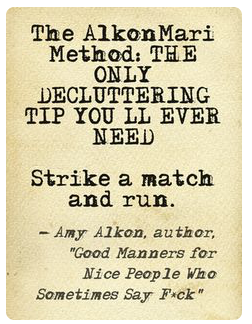
H/T to Amy Alkon, who offers her own take on tidying: