
“Privilege” is a term that’s overused and misused in modern political discourse. Too often it’s used like a crass “shut up, I win” button in an argument. But “privilege” is sometimes an apt descriptive term of a human phenomenon: a person’s evaluation of a situation (like interaction with law enforcement) is colored by his or her own experiences, and those experiences are usually circumscribed by that person’s cultural identity and wealth. Any criminal defense attorney who has served affluent clients is familiar with this: such clients often conclude that they are a victim of a conspiracy, or of a “rogue cop” or “loose cannon prosecutor,” because their life experiences lead them to assume that the system can’t possibly treat all people the way they are being treated. By contrast, clients who have lived in poverty (or clients who are African-American or Latino) tend to recognize outrageous conduct in their case as the system working the way the system typically works — business as usual. In my post about the prosecution and death of Aaron Swartz, I argued that Swartz’ community showed such privilege in its reaction to his prosecution, seeing some sort of singular conspiracy where others saw the banal grinding of the system’s unfeeling wheels.
My advice to shut up is colored, in part, by privilege. I was reminded of this yesterday when Los Angeles County Sheriff’s Deputies searched Justin Bieber’s house. I praised Bieber for shutting up and declining to talk to the cops, and joked that criminal defense attorneys could shame clients into better practices by asking why they aren’t smarter than Justin Bieber.
But Justin Bieber and I — and many of my clients — share a crucial quality: we’re affluent and fortunate. This privilege makes us better able to endure the potential downside risks of shutting up. If we get arrested on a petty or bogus charge by a pissed-off cop, we can make bail. We won’t spend weeks or months in custody on that bogus charge because we can’t scrape together a few thousand dollars. Maybe we’ll spend the weekend in jail, because cops love to arrest you Friday afternoon, but we’ll get out in a few days at most, and in the meantime we won’t lose our jobs. Because we have families and support systems, if we do get thrown in jail on a bogus job by an angry cop, the Department of Child and Family Services won’t take away our children, plunging us into another broken system we have neither the money nor the knowledge to navigate. If the cops tow or impound our car, we can afford to pay the few hundred to few thousand dollars to get it out, and we won’t lose our jobs for lack of transportation. Even if we do lose our jobs because of a bogus and retaliatory arrest, we have savings, and families with savings, and we won’t swiftly lose our homes. If the police choose to retaliate against our silence with petty tickets and infractions and fines rather than arrest, we can fight them or absorb them.
That’s a privilege. Poor people don’t have it. Poor people live on the razor’s edge, and a bogus retaliatory arrest can destroy them. Retaliatory and capricious enforcement of petty crimes and infractions can destroy them financially. Police wield disproportionate power over them, and the criminal justice system and its agendas (like the War on Drugs) disproportionately impacts them. Police are more likely to use force against poor people and for the most part can do so without any significant risk of discipline.
When you and I weigh the downside risks of shutting up against the downside risks of talking, our downside risks are milder, and can be endured. People without our resources face a must starker choice: talk, and incriminate themselves, or shut up, and face an array of consequences they may not be equipped to survive.
Ken White, “The Privilege To Shut Up”, Popehat, 2014-01-15
June 15, 2014
QotD: Shut up – it’s your right and (for some) your privilege
June 13, 2014
Supreme Court rules unanimously in favour of internet privacy
Some great news on the privacy front, this time a decision handed down by the Supreme Court of Canada, as reported by Michael Geist:
This morning another voice entered the discussion and completely changed the debate. The Supreme Court of Canada issued its long-awaited R. v. Spencer decision, which examined the legality of voluntary warrantless disclosure of basic subscriber information to law enforcement. In a unanimous decision written by (Harper appointee) Justice Thomas Cromwell, the court issued a strong endorsement of Internet privacy, emphasizing the privacy importance of subscriber information, the right to anonymity, and the need for police to obtain a warrant for subscriber information except in exigent circumstances or under a reasonable law.
I discuss the implications below, but first some of the key findings. First, the Court recognizes that there is a privacy interest in subscriber information. While the government has consistently sought to downplay that interest, the court finds that the information is much more than a simple name and address, particular in the context of the Internet. As the court states:
the Internet has exponentially increased both the quality and quantity of information that is stored about Internet users. Browsing logs, for example, may provide detailed information about users’ interests. Search engines may gather records of users’ search terms. Advertisers may track their users across networks of websites, gathering an overview of their interests and concerns. “Cookies” may be used to track consumer habits and may provide information about the options selected within a website, which web pages were visited before and after the visit to the host website and any other personal information provided. The user cannot fully control or even necessarily be aware of who may observe a pattern of online activity, but by remaining anonymous – by guarding the link between the information and the identity of the person to whom it relates – the user can in large measure be assured that the activity remains private.
Given all of this information, the privacy interest is about much more than just name and address.
Second, the court expands our understanding of informational privacy, concluding that there three conceptually distinct issues: privacy as secrecy, privacy as control, and privacy as anonymity. It is anonymity that is particularly notable as the court recognizes its importance within the context of Internet usage. Given the importance of the information and the ability to link anonymous Internet activities with an identifiable person, a high level of informational privacy is at stake.
Third, not only is there a significant privacy interest, but there is also a reasonable expectation of privacy by the user. The court examines both PIPEDA and the Shaw terms of use (the ISP in this case) and concludes that PIPEDA must surely be understood within the context of protecting privacy (not opening the door to greater disclosures) and that the ISP agreement was confusing at best and may support the expectation of privacy. With those findings in mind:
in the totality of the circumstances of this case, there is a reasonable expectation of privacy in the subscriber information. The disclosure of this information will often amount to the identification of a user with intimate or sensitive activities being carried out online, usually on the understanding that these activities would be anonymous. A request by a police officer that an ISP voluntarily disclose such information amounts to a search.
Fourth, having concluded that obtaining subscriber information was a search with a reasonable expectation of privacy, the information was unconstitutionally obtained therefore led to an unlawful search. Addressing the impact of the PIPEDA voluntary disclosure clause, the court notes:
Since in the circumstances of this case the police do not have the power to conduct a search for subscriber information in the absence of exigent circumstances or a reasonable law, I do not see how they could gain a new search power through the combination of a declaratory provision and a provision enacted to promote the protection of personal information.
Update, 7 July: A few weeks later, the US Supreme Court also made a strong pro-privacy ruling, this one mandating a warrant for police to search the contents of a cellphone.
SCOTUS ruling on cellphone searches “Get a warrant." RT @fordm: My God, this kicker. pic.twitter.com/8pNNa16vlA
— Julia Angwin (@JuliaAngwin) June 25, 2014
Politico‘s Josh Gerstein has more on the ruling in in Riley v. California:
The Supreme Court’s blunt and unequivocal decision Wednesday giving Americans strong protection against arrest-related searches of their cell phones could also give a boost to lawsuits challenging the National Security Agency’s vast collection of phone call data.
Chief Justice John Roberts’s 28-page paean to digital privacy was like music to the ears of critics of the NSA’s metadata program, which sweeps up details on billions of calls and searches them for possible links to terrorist plots.
“This is a remarkably strong affirmation of privacy rights in a digital age,” said Marc Rotenberg of the Electronic Privacy Information Center. “The court found that digital data is different and that has constitutional significance, particularly in the realm of [the] Fourth Amendment…I think it also signals the end of the NSA program.”
Roberts’s opinion is replete with rhetoric warning about the privacy implications of access to data in individuals’ smart phones, including call logs, Web search records and location information. Many of the arguments parallel, or are virtually identical to, the ones privacy advocates have made about the dangers inherent in the NSA’s call metadata program.
June 12, 2014
Repost: Ballot Box Irregularities
I first posted this article in 2004. I repost it every election:
Ballot Box Irregularities, Canadian Style
This article in Reason Hit and Run talks about the recent decision to allow partisan ballot-challengers to monitor the voting in Ohio. In Canada, these people are called “scrutineers” and they have a vital job.
No, I’m not kidding about the vital part. Each candidate has the right to appoint a scrutineer for every poll in the riding (usually only the Liberal, NDP, and Conservative parties can manage to field that much manpower). I was a scrutineer during a federal byelection in the mid-1980’s in a Toronto-area riding, but I had five polls to monitor (all were in the same school gymnasium). This was my first real experience of how dirty the political system can be.
The scrutineers have the right to challenge voters — although I don’t remember any challenges being issued at any of my polls — similar to the Ohio situation, I believe. They also have the right to be present during the vote count and to challenge the validity of individual ballots. Their job is to maximize the vote for their candidate and minimize the vote for their opponents.
Canadian ballots are pretty straightforward items: they are small, folded slips of paper with each candidate’s name listed alphabetically and a circle to indicate a vote for that candidate. A valid vote will have only one mark inside one of the circles (an X is the preferred mark). An invalid vote might have:
- No markings at all (a blank ballot)
- More than one circle marked (a spoiled ballot)
- Some mark other than an X (this is where the scrutineers become important).
After the polls close, the poll clerk and the Deputy Returning Officer (DRO) secure the unused ballots and then open the ballot box in the presence of any accredited scrutineers. The clerk and DRO then count all the ballots, indicating valid votes for candidates and invalid ballots. The scrutineers can challenge any ballot and it must be set aside and reconsidered after the rest of the ballots are counted.
A challenged ballot must be defended by one of the scrutineers or it is considered to be invalid and the vote is not counted. The clerk and DRO have the power to make the decision, but in practice a noisy scrutineer can usually bully the DRO into accepting all their challenges. I didn’t realize just how easy it was to screw with the system until I’d been a scrutineer and watched it happen over and over again.
This is the key reason why minor party candidates poll so badly in Canadian elections: they don’t have enough (or, in many cases, any) scrutineers to defend their votes. In my experience in that Toronto-area byelection, I personally saved nearly 4% of the total vote my candidate received (in the entire riding) by counter-challenging challenged ballots. We totalled just over 400 votes in the riding (in just about 100 polls) — 21 of them in my polls. I got 15 of those votes allowed, when they would otherwise have been disallowed by the DRO.
There was no legal reason to disallow those votes: they were clearly marked with an X and had no other marks on them; they were challenged because they were votes for a minor candidate. As it was, I had a heck of a time running from poll to poll in order to get my counter-challenges in (I probably missed a few votes by not being able to get back to a poll in time).
The Libertarians only had six or seven scrutineers, covering less than a third of the polls in this riding. If the challenge rate was typical in my poll, then instead of the 400-odd votes, we actually received nearly 2000 votes — but most of them were not counted.
Yes, even 2000 votes would not have swung the election, but 2000 people willing to vote for a “fringe” party would be a good argument against those “throwing away your vote” criticisms. Voters are weird creatures in some ways: they like to feel that their votes actually matter. Voting for someone who espouses views you like, then discovering that only a few others feel the same way will discourage most voters from voting that way again in future.
Another reason that minor party votes matter (that I neglected to mention in the original post) is that parties receive funding based on their vote totals in the previous election. Disallowing minor party votes also deprives those parties of the funding they would otherwise be entitled to next time around. For the bigger parties, this is trivial, but for minor parties, this may be critical to them being able to stay active — and visible to voters — between elections.
June 11, 2014
LA court delivers a major blow against tenure for teachers in California
The Los Angeles Times on yesterday’s decision:
Teachers union officials denounced a ruling Tuesday by a Los Angeles County Superior Court judge deeming job protections for teachers in California as unconstitutional as a misguided attack on teachers and students.
The ruling represents a major loss for the unions and a groundbreaking win by attorneys who argued that state laws governing teacher layoffs, tenure and dismissals harm students by making them more likely to suffer from grossly ineffective instruction.
If the preliminary ruling becomes final and is upheld, the effect will be sweeping across California and possibly the nation.
Judge Rolf M. Treu ruled, in effect, that it was too easy for teachers to gain strong job protections and too difficult to dismiss those who performed poorly in the classroom. If the ruling stands, California will have to craft new rules for hiring and firing teachers.
[…]
The Silicon Valley-based group Students Matter brought the lawsuit on behalf of nine students, contending that five laws hindered the removal of ineffective teachers.
The result, attorneys for the plaintiffs said, is a workforce with thousands of “grossly ineffective” teachers, disproportionately hurting low-income and minority students. As a result, the suit argued, the laws violated California’s constitution, which provides for equal educational opportunity.
The laws were defended by the state of California and the two largest teacher unions — the California Teachers Assn. and the California Federation of Teachers. Their attorneys countered that it is not the laws but poor management that is to blame for districts’ failing to root out incompetent instructors.
June 9, 2014
Indianapolis police “needed a mine-resistant vehicle to protect against a possible attack by veterans returning from war”
When you dress and act like an occupying army, eventually the citizenry will view you as just that:
Inside the municipal garage of this small lakefront city [Neenah, Wisconsin], parked next to the hefty orange snowplow, sits an even larger truck, this one painted in desert khaki. Weighing 30 tons and built to withstand land mines, the armored combat vehicle is one of hundreds showing up across the country, in police departments big and small.
The 9-foot-tall armored truck was intended for an overseas battlefield. But as President Obama ushers in the end of what he called America’s “long season of war,” the former tools of combat — M-16 rifles, grenade launchers, silencers and more — are ending up in local police departments, often with little public notice.
During the Obama administration, according to Pentagon data, police departments have received tens of thousands of machine guns; nearly 200,000 ammunition magazines; thousands of pieces of camouflage and night-vision equipment; and hundreds of silencers, armored cars and aircraft.
The equipment has been added to the armories of police departments that already look and act like military units. Police SWAT teams are now deployed tens of thousands of times each year, increasingly for routine jobs. Masked, heavily armed police officers in Louisiana raided a nightclub in 2006 as part of a liquor inspection. In Florida in 2010, officers in SWAT gear and with guns drawn carried out raids on barbershops that mostly led only to charges of “barbering without a license.”
[…]
The number of SWAT teams has skyrocketed since the 1980s, according to studies by Peter B. Kraska, an Eastern Kentucky University professor who has been researching the issue for decades.
The ubiquity of SWAT teams has changed not only the way officers look, but also the way departments view themselves. Recruiting videos feature clips of officers storming into homes with smoke grenades and firing automatic weapons. In Springdale, Ark., a police recruiting video is dominated by SWAT clips, including officers throwing a flash grenade into a house and creeping through a field in camouflage.
In South Carolina, the Richland County Sheriff’s Department’s website features its SWAT team, dressed in black with guns drawn, flanking an armored vehicle that looks like a tank and has a mounted .50-caliber gun.
Update: It’s not just Wisconsin or Indiana … even Maine feels the threat.
Cops must militarize because Maine foothills face previously unimagined threat from tourism — sorry, terrorism [NYT] http://t.co/gP3sxdhaco
— Walter Olson (@walterolson) June 9, 2014
June 4, 2014
It’s clearly time for The Something Must Be Done Act 2014
A post by David Allen Green from last year that prefigures the political landscape of today:
… all this statutory output is subject to the tiresome jurisdiction of the courts — the High Court will quash delegated legislation and use “human rights” jurisprudence to interpret the word of parliament out of recognition. Something must be done.
So this Act is a modest proposal for our legislators and public officials. Once it is passed, no other legislation will ever be necessary and the meddlesome courts will be neutered. This would be a Good Thing.
Let’s start with Section 1:
“The Crown shall have the power to do anything, and nothing a Minister of the Crown does will be ultra vires.”
That should shut up the High Court for a while with their judicial review decisions.
But adding a second section to the Act will make sure that Ministers will act in the interests of all of us. So for the avoidance of doubt, Section 2 provides:
“The power given by Section 1 of this Act shall include the banning of things by any Minister of the Crown.”
But what things can be banned? Well, here’s Section 3:
“The things to be banned referred to in Section 2 of this Act shall be the things which a Minister of the Crown says are bad for us.”
Which in turn leads us to Section 4:
“What is bad for us for the purposes of Section 3 shall be determined by a Minister of the Crown with regard either to (a) headlines in the tabloid press of the day and/or (b) the headlines the Minister of the Crown would like to see in the tabloid press tomorrow.”
Section 5 will then provide:
“Any person
(a) voicing opposition to a determination made under Section 4 of this Act; or
(b) acting in breach of a ban made under Section 1 of this Act, shall be deemed to not care about the children and/or to be soft on terrorism.”
The Act should also include the following power at Section 6 so that any emerging issues can be addressed:
“In the event something must be done, a Minister may at his or her discretion choose a thing to do, and the thing chosen shall be deemed as the something that must be done.”
This discretionary power, however, is subject to Section 7:
“The thing chosen under Section 6 shall not have any rational or proportionate relationship to any intended objective.”
The way a lot of ministers carry on, you’d think this act had already been promulgated…
June 2, 2014
Still no answers in the Miriam Carey case
Scott Greenfield at the Simple Justice blog wonders why there are still no answers to the questions about what happened at the south gate to the White House that day in 2013. The lawyer for Miriam Carey’s family is exasperated with the delay:
“It’s just bizarre. What’s so complex about this incident? It’s a police shooting. You know who the parties are. You know who discharged their weapons. I mean, c’mon, it’s not complex. We should have known within in a week or two. I don’t understand what’s taking so long,”
DC Metro police say the incident is still under investigation, and won’t answer any questions about it. Why is the story being withheld from the public?
That’s an excellent question, as the answer appears to be that Carey, with her daughter in the back seat, made a wrong turn into the south gate of the White House, panicked, u-turned and drove away. And so the police started firing.
When Mike Paar sent me a link to this story, it was because this otherwise “insignificant” story was curious, as it was now eight months old and there were no answers. But for the World Net Daily article, which billed the killing as “fascinating,” it would have easily fallen into obscurity, a one-day wonder story.
When it was included in a post here, it didn’t warrant any particular scrutiny. The ramming of a barricade was still the explanation du jour, and its interest was found in the need to shoot the fleeing car. Because they need to shoot at fleeing cars, which the Supreme Court says is fine.
Once the story is stripped of its ramming the barricade myth, however, there is no justification under Tennessee v. Garner as there was no fleeing felon. There was only an embarrassed dental hygienist. With her one-year-old in the back seat.
Now knowing that there was no barricade ramming, no drugs, no mental illness, the story of Miriam Carey’s death becomes even less interesting, and yet more a story of importance. If, as believed, this was an overreaction by police to a woman who made a wrong turn, who then shot her to death and is now burying their mistake by invoking excuse number 4, and no one cares, we’ve got another problem.
May 30, 2014
“Historical” High Court judgment that ignores history
Last week, the High Court decided that the remains of King Richard III will be re-buried in Leicester, not in York. As you might expect, that leaves a lot of people unhappy.
When Richard III was hacked to death in rural Leicestershire in 1485, the royal House of York fell, bringing an end to the Plantagenet line that had lasted for 16 kings and 331 years. Many people see his death as the end of the English middle ages.
Despite this country’s ancient legal system, the courts do not often get to deal with real history, although they make many historic decisions. Yet the ruling of the High Court last Friday truly made history, as three judges decided that Richard III should be buried at the scene of his violent defeat, and not in York.
One side is always unhappy after a court hearing. And in this case those who sponsored York Minster may have more to be sore about than most.
The High Court acknowledged the case has “unprecedented” and “unique and exceptional features,” but nevertheless went on to give a rather bland ruling supporting Chris Grayling’s decision to leave the matter of reburial in the hands of the University of Leicester team running the excavation. In doing so, the court treated the hearing as a straightforward matter of public law, and affirmed that the government had been under no duty to consult widely before handing the responsibility over to the University of Leicester.
[…]
History and legacy mattered to medieval monarchs. Their actions, even the less obvious ones, were intended to make statements to reinforce their dynastic power. York Minster is an ancient foundation, home to the throne of the second most senior churchman in England. There has been an Archbishop of York since at least the seventh century. For Richard, a scion of the house of York, the Minster was an obvious place to fuse the sacred and secular, binding royal and church power together in one of England’s most venerable religious buildings. By contrast, Leicester Cathedral, although a lovely building with a long tradition of worship on the site, was a parish church until 1927 when it became the city’s cathedral. Although there was a church there in Richard’s day, it does not have the dynastic associations that Richard was clearly building with York.
And there’s always the religious aspect to consider (which would have been true regardless of the High Court’s decision):
And finally, the question of the liturgy is also set to run. As the old joke goes: Q. What is the difference between a terrorist and a liturgist? A. You can reason with a terrorist. Leicester cathedral has diligently teamed up with an expert medieval musicologist, who has painstakingly uncovered and proposed the finer details of prayers and music appropriate to a 15th-century reburial. However, strong feelings which go beyond the musical arrangements have been expressed in many quarters, including in an online petition, and by Dr John Ashdown-Hill, the historian who led the excavations. These views reflect a conviction that Richard should have a Roman Catholic ceremony that respects the faith in which he grew up and died, and which is honest to what his wishes would have been. Leicester Cathedral will certainly have their hands full trying to reconcile Richard’s pre-Reformation religious beliefs with the Church of England ceremonies they are permitted to conduct.
May 29, 2014
A state legislative session devoted to “unlegislating”
Our elected officials at all levels of government spend much of their time passing new laws … to the extent that it is no longer possible for an average citizen of a state or province to know what their legal status is on any given issue — it’s been estimated that you’ll commit three felonies a day without ever knowing it. Given that, this session of the Minnesota state legislature has a huge natural attraction:
It’s no longer a crime in Minnesota to carry fruit in an illegally sized container. The state’s telegraph regulations are gone. And it’s now legal to drive a car in neutral — if you can figure out how to do it.
Those were among the 1,175 obsolete, unnecessary and incomprehensible laws that Gov. Mark Dayton and the Legislature repealed this year as part of the governor’s “unsession” initiative. His goal was to make state government work better, faster and smarter.
“I think we’re off to a very good start,” Dayton said Tuesday at a Capitol news conference.
In addition to getting rid of outdated laws, the project made taxes simpler, cut bureaucratic red tape, speeded up business permits and required state agencies to communicate in plain language.
“We got rid of all the silly laws,” said Tony Sertich, the Iron Range Resources and Rehabilitation Board commissioner who headed Dayton’s effort.
Well, not quite all of them. They kept a law on the books that requires state Agriculture Commissioner Dave Frederickson to personally capture or destroy any wild boar that gets loose in Minneapolis or St. Paul. Sertich said it’s conceivable that such a critter could wander into the cities.
It would be a good use of any legislature’s time to trim old laws from the books, but that’s not how most politicians view their job, unfortunately.
H/T to Doug Mataconis for the link.
May 24, 2014
Michael Geist – Who’s Watching Whom?
Published on 22 May 2014
One of the most talked about technology tradeoffs today is the question of how much privacy we give up to live in a world of convenience, speed and intelligence. We’re now less anonymous than many people are aware of or comfortable with, and headline-grabbing stories like the Heartbleed Bug don’t provide much reassurance for those of us seeking comfort around data privacy. How can we balance our need for anonymity with the incredible benefits of our connected world? World class Internet privacy expert Dr. Michael Geist helps us understand which current surveillance and privacy issues should be on your mind.
Dr. Michael Geist is a law professor at the University of Ottawa where he holds the Canada Research Chair in Internet and E-commerce Law. He has obtained a Bachelor of Laws (LL.B.) degree from Osgoode Hall Law School in Toronto, Master of Laws (LL.M.) degrees from Cambridge University in the UK and Columbia Law School in New York, and a Doctorate in Law (J.S.D.) from Columbia Law School. Dr. Geist is an internationally syndicated columnist on technology law issues with his regular column appearing in the Toronto Star and the Ottawa Citizen. Dr. Geist is the editor of From “Radical Extremism” to “Balanced Copyright”: Canadian Copyright and the Digital Agenda (2010) and In the Public Interest: The Future of Canadian Copyright Law (2005), both published by Irwin Law, the editor of several monthly technology law publications, and the author of a popular blog on Internet and intellectual property law issues.
Dr. Geist serves on many boards, including the CANARIE Board of Directors, the Canadian Legal Information Institute Board of Directors, the Privacy Commissioner of Canada’s Expert Advisory Board, the Electronic Frontier Foundation Advisory Board, and on the Information Program Sub-Board of the Open Society Institute. He has received numerous awards for his work including the Kroeger Award for Policy Leadership and the Public Knowledge IP3 Award in 2010, the Les Fowlie Award for Intellectual Freedom from the Ontario Library Association in 2009, the Electronic Frontier Foundation’s Pioneer Award in 2008, Canarie’s IWAY Public Leadership Award for his contribution to the development of the Internet in Canada and he was named one of Canada’s Top 40 Under 40 in 2003. In 2010, Managing Intellectual Property named him on the 50 most influential people on intellectual property in the world.
May 22, 2014
Dickens 2.0 – debt prisons of the 21st century
At Outside the Beltway, James Joyner calls attention to the widespread practice of sending minor offenders to prison for failing to pay minor fines:
NPR’s “Morning Edition” has been running a series called “Guilty and Charged,” chronicling the plight of Americans forced to go to jail because they’re unable to pay the court fees and fines associated with very minor infractions. The Supreme Court ostensibly outlawed the practice three decades ago but left the determination as to whether defendants are truly to poor to pay or simply unwilling to trial court judges. Not shockingly, perhaps, they almost invariably presume the latter.
You can listen to Tuesday’s segment, “Unpaid Court Fees Land The Poor In 21st Century Debtors’ Prisons,” at the link. Unfortunately, they only have the audio and not a transcription. Aside from what I’ve already written in the introduction above, what really stood out to me was the sheer contempt judges displayed to indigent defendants. Despite being highly educated professionals supposedly trained in the law and selected for their ability to dispassionately way evidence and reach just results, those featured on the program were positively knee-jerk and sneering. It was as if they’d plucked some random yahoo from a Denny’s, dressed him in a black robe, and had him preside over the trial.
Today’s follow-up, “Supreme Court Ruling Not Enough To Prevent Debtors’ Prisons,” was if anything more infuriating. It dove deep into the case of Kyle Dewitt, an Iraq War vet who went to jail and got caught up in an unending series of problems with the law over catching the wrong species of bass at the wrong time of year.
[…]
I’ve long been of mind that we ought to do away with fines as a means of punishment altogether. Whether paying $150 for exceeding the speed limit (almost always some nominal fine for the offense and a much higher amount for “court costs,” owed even if one just mails in the fine and never goes to court) is a deterrent depends entirely on one’s financial circumstances. It was a big deal when I was in college; it’s a nuisance now. Further, those with the means will often spend far more than the fine plus court costs to hire an attorney to plead it to an offense that doesn’t come with points that go against their license or their insurance record. It’s incredibly inequitable.
May 20, 2014
Scotland ratchets up the Nanny State
Last year, the Scottish government introduced legislative proposals to nominate state guardians for all Scottish children, to be called “named persons” and to exercise rather Orwellian powers over the child and the child’s parents. The legislation is now in force, and Stuart Waiton explains why it’s such an intrusive step:
The children’s minister, Aileen Campbell, has been dismissive of those people who have criticised the act as state snooping, or, as many Christian groups have put it, an ‘attack on the family’. For Campbell, the new powers and duties being given to the state guardians are simply another service to help families in trouble and further ensure that children are protected in society. Indeed, Aileen Campbell at times appears to be nonplussed by her critics, incapable of seeing why her caring approach is not instantly celebrated. The claims of state snoops undermining the family, she argues, are simply ‘misunderstandings’ and ‘misrepresentations’ of the new law. When someone raised the point that this act undermined the role of parents in child-rearing, Campbell, somewhat comically, replied, ‘we recognise that parents also have a role’.
However, given the increasing ways in which all children are being categorised as ‘vulnerable’, the way in which all professionals are being educated to put child safety at the top of their agenda, and at time in which ‘early intervention’ is promoted as the only rational approach to solving social problems, there is a serious risk that the relationship between the ‘named person’ and parents will become one predicated on suspicion. Given that the red line for when it is appropriate to intervene in a child’s life is also being downgraded, from the child being seen as at serious risk of harm to mere concerns about their ‘wellbeing’, the potential for unnecessary and potentially destructive state intrusion into family life with this law is significant.
[…] There is also a great danger here that by incorporating every single child in the child-safety rubric, the few children who need state intervention in their lives will get lost in this vast system and not get the support they need. As one concerned parent has noted, when you are looking for a needle in a haystack, why make the haystack bigger?
May 17, 2014
Weird NFL lawsuit – “remember that anyone can file a lawsuit for almost anything”
A very unusual lawsuit has been filed against Jacksonville Jaguars first round pick Blake Bortles by David Rothrock and “Theodore Bridgewater”, from a prison in Pennsylvania:
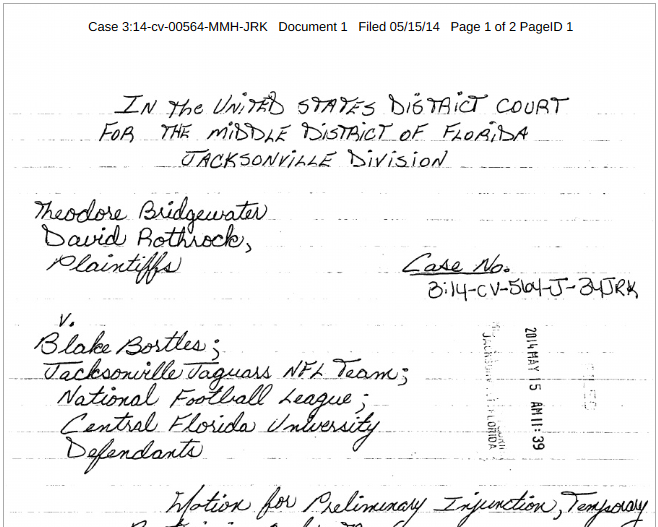
A bizarre, handwritten restraining order has been filed against Jacksonville Jaguars first-round pick Blake Bortles and the NFL in a Central Florida court in what appears to be an attempt to bar Bortles from playing for the Jaguars and in the National Football League.
The plaintiffs, listed as “Theodore Bridgewater” and David Rothrock, allege that Bortles is under the influence of steroids and also HIV positive. The lawsuit was filed from a Pennsylvania prison, presumably where Rothrock is incarcerated, and lists the co-plaintiff as “Theodore Bridgewater,” with a P.O. Box in Louisville, Ky., as the address. The plaintiff named on the suit is surely not Minnesota Vikings quarterback Teddy Bridgewater, despite a P.O. Box in Louisville, KY being listed as the address.
The filing not only accuses Bortles of taking steroids and HGH, but also alleges he’s been involved in some other nefarious dealings including an allegation that Bortles framed Rothrock for a crime so he would be jailed and unable to talk to the Federal Bureau of Investigation, who approached Rothrock about the distribution of steroids and HGH.
The plaintiff in the case is representing himself “pro se,” which means he is advocating on his own behalf.
H/T to Vikings Territory for the link.
Update, 23 May. Further proof that anyone can file a lawsuit for almost any reason. This one is against Cleveland Browns first round draft pick Johnny Manziel:
A person has filed for a restraining order against Cleveland Browns quarterback Johnny Manziel and is seeking $25 million in damages, claiming he has sexually harassed a woman for more than a year.
The document, filed in federal court in Florida on May 16, makes numerous salacious allegations against Manziel centered on him allegedly sending nude photos of himself to a woman. It lists a woman’s name on the complaint, but a deputy court clerk in Tampa said the complaint arrived by mail and the court has no way of confirming who sent it. The court clerk, who did not wish to be named, said the filing was mailed in Trenton, N.J.
The document also does not list an attorney, and no other supporting documents could be found in the record in a search by USA TODAY Sports on Friday.
Manziel’s agent, Erik Burkhardt, immediately wrote on Twitter that the complaint is “fake” and “frivolous.”
“It’s insanity,” Burkhardt told USA TODAY Sports. “You can read the thing for yourself.
“What some people will do for publicity is just embarrassing. That’s all I’ve got to say.”
May 9, 2014
The 1964 trial of Jack Ruby
The Toronto Sun shares a portion of Peter Worthington’s Looking for Trouble (now available as an e-book) dealing with the trial of Jack Ruby. Worthington had been in the room when Ruby gunned down Lee Harvey Oswald.
The Ruby trial was pure showbiz. While the witnesses and characters who surfaced during the trial were Damon Runyon, the judge and lawyers seemed straight out of Al Capp and Dogpatch. Judge Joe B. Brown’s legal education before he was elected to the bench consisted of three years of night school 35 years earlier. In Dallas he was known as Necessity – “because Necessity knows no law.”
[…]
One day as a stripper who worked at Ruby’s nightclub called Little Lynn (who was over nine months pregnant at the time), was waiting to testify, seven prisoners in the connecting county jail grabbed a woman hostage and fled. They had fashioned a pistol of soap, pencils and shoe polish, persuaded guards that it was real, and made their break, witnessed by some 100 million viewers.
Little Lynn fainted and Belli prepared to play midwife. A BBC reporter on the phone to his office was describing the action and repeatedly swore to his editors that he was neither kidding, nor had he been drinking. “Listen, you bloody fools, this is America, this is Texas … any bloody insane thing is possible here!”
The next day, the New York Daily News ran an eloquent black headline: “Oh, Dallas!”
The jury returned in 140 minutes with a guilty verdict. In Texas, where the juries set the penalty, they opted for the electric chair.
Belli returned to San Francisco in disgust. “I shall never return here; it’s an evil, bigoted, rotten, stinking town.”
As it happened, Ruby died three years later and won a form of immortality and a place in criminal and political legend.
And as for conspiracy theories, the flaw is that Oswald was an ideologue, a semi-literate left-wing extremist, while Ruby wouldn’t know what an ideologue was unless he did a strip-tease for him.
To choose two such perfect foils on which to base a presidential murder plot challenges credulity. There has been so much official deceit, perjury, rationalization and cover-up that the deeds seem […] more sinister than they actually have been.
We will probably never know the truth.
May 8, 2014
Weighty injustice
Scott Greenfield discusses something most of us have never given any though to:
In a New York Times op-ed. former AUSA turned Minnesota lawprof Mark Osler did a mitzvah by explaining the game played in drug sentencing. After noting some of the problems recently raised about mandatory minimums, the pardon game and absurdly long Guidelines sentences, he goes on:
Unfortunately, none of this addresses a very basic underlying problem: We continue to use the weight of narcotics as a proxy for the culpability of an individual defendant, despite this policy’s utter failure. If a kingpin imports 15 kilograms of cocaine into the country and pays a trucker $400 to carry it, they both face the same potential sentence. That’s because the laws peg minimum and maximum sentences to the weight of the drugs at issue rather than to the actual role and responsibility of the defendant. It’s a lousy system, and one that has produced unjust sentences for too many low-level offenders, created racial disparities and crowded our prisons.
[…]
But when a person is prosecuted based upon an arbitrary distinction, that he carried a certain number of grams of dope (because we can all distinguish between the weight of 7 grams and 8, right?) it should reflect a significant difference in crime and sentence.
[Radley Balko] goes on to discuss a related, but separate, issue, that drug weight is aggregate rather than pure. In other words, ten kilos of cocaine can contain 9 kilos of baby laxative, cut as it’s called in the trade, and only one of active narcotic, but it’s still ten kilos for the purpose of charging and sentence. This is a policy decision, that the purity of the drug is not considered, even though it tells a great deal about where the defendant is on the food chain of drugs. The higher the purity, the higher on the food chain, as drugs get “stepped on,” or diluted, at each level down the chain.
This applies even with less applicable concepts, such as marijuana, where the weight of stalks and stems of seized marijuana plants can be included in aggregate weight even though they are useless as drugs. The message is, you pay by the pound, regardless. It simplified the police and prosecutorial function, even as it undermines any doctrinal justification for the charge and sentence.


