
Such were the arts of war, by which the Roman emperors defended their extensive conquests, and preserved a military spirit, at a time when every other virtue was oppressed by luxury and despotism. If, in the consideration of their armies, we pass from their discipline to their numbers, we shall not find it easy to define them with any tolerable accuracy. We may compute, however, that the legion, which was itself a body of six thousand eight hundred and thirty-one Romans, might, with its attendant auxiliaries, amount to about twelve thousand five hundred men. The peace establishment of Hadrian and his successors was composed of no less than thirty of these formidable brigades; and most probably formed a standing force of three hundred and seventy-five thousand men. Instead of being confined within the walls of fortified cities, which the Romans considered as the refuge of weakness or pusillanimity, the legions were encamped on the banks of the great rivers, and along the frontiers of the barbarians. As their stations, for the most part, remained fixed and permanent, we may venture to describe the distribution of the troops. Three legions were sufficient for Britain. The principal strength lay upon the Rhine and Danube, and consisted of sixteen legions, in the following proportions: two in the Lower, and three in the Upper Germany; one in Rhaetia, one in Noricum, four in Pannonia, three in Maesia, and two in Dacia. The defence of the Euphrates was intrusted to eight legions, six of whom were planted in Syria, and the other two in Cappadocia. With regard to Egypt, Africa, and Spain, as they were far removed from any important scene of war, a single legion maintained the domestic tranquillity of each of those great provinces. Even Italy was not left destitute of a military force. Above twenty thousand chosen soldiers, distinguished by the titles of City Cohorts and Praetorian Guards, watched over the safety of the monarch and the capital. As the authors of almost every revolution that distracted the empire, the Praetorians will, very soon, and very loudly, demand our attention; but, in their arms and institutions, we cannot find any circumstance which discriminated them from the legions, unless it were a more splendid appearance, and a less rigid discipline.
Edward Gibbon, “Chapter I: The Extent Of The Empire In The Age Of The Antonines — Part III”, History of the Decline and Fall of the Roman Empire, 1782.
November 2, 2015
QotD: The Imperial Roman army
November 1, 2015
QotD: Germany’s class system
As a trader, I am inclined to think the German will, unless his temperament considerably change, remain always a long way behind his Anglo-Saxon competitor; and this by reason of his virtues. To him life is something more important than a mere race for wealth. A country that closes its banks and post-offices for two hours in the middle of the day, while it goes home and enjoys a comfortable meal in the bosom of its family, with, perhaps, forty winks by way of dessert, cannot hope, and possibly has no wish, to compete with a people that takes its meals standing, and sleeps with a telephone over its bed. In Germany there is not, at all events as yet, sufficient distinction between the classes to make the struggle for position the life and death affair it is in England. Beyond the landed aristocracy, whose boundaries are impregnable, grade hardly counts. Frau Professor and Frau Candlestickmaker meet at the Weekly Kaffee-Klatsch and exchange scandal on terms of mutual equality. The livery-stable keeper and the doctor hobnob together at their favourite beer hall. The wealthy master builder, when he prepares his roomy waggon for an excursion into the country, invites his foreman and his tailor to join him with their families. Each brings his share of drink and provisions, and returning home they sing in chorus the same songs. So long as this state of things endures, a man is not induced to sacrifice the best years of his life to win a fortune for his dotage. His tastes, and, more to the point still, his wife’s, remain inexpensive. He likes to see his flat or villa furnished with much red plush upholstery and a profusion of gilt and lacquer. But that is his idea; and maybe it is in no worse taste than is a mixture of bastard Elizabethan with imitation Louis XV, the whole lit by electric light, and smothered with photographs. Possibly, he will have his outer walls painted by the local artist: a sanguinary battle, a good deal interfered with by the front door, taking place below, while Bismarck, as an angel, flutters vaguely about the bedroom windows. But for his Old Masters he is quite content to go to the public galleries; and “the Celebrity at Home” not having as yet taken its place amongst the institutions of the Fatherland, he is not impelled to waste his, money turning his house into an old curiosity shop.
Jerome K. Jerome, Three Men on the Bummel, 1914.
October 30, 2015
Russia Stems The Tide – Winter Is Coming I THE GREAT WAR Week 66
Published on 29 Oct 2015
After the Great Retreat during the summer, the Russians are finally able to fight back the Germans at Dvinsk. With a new type of trench warfare, they are able to render August von Mackensen’s artillery useless and only take on small numbers of Germans at the same time. The German army is successful in Serbia though and so the situation for the Serbs looks grim. Meanwhile Benito Mussolini writes in his diary that the worst enemy is not Austria-Hungary, but lice. All of the soldiers and generals know one thing: Winter is coming.
QotD: Maybe the Minnesota Vikings should also change their name
After the fiancée-punching scandal the NFL suffered this fall, the league is working on an anti-domestic-violence campaign; a new public-service announcement featuring about two dozen pro footballers debuted this Thursday during the Chargers–Broncos game. But the question persists: How can the NFL paint itself as progressive while it permits one of its franchises to use a patently offensive team name? Calling a team “the Vikings” is grotesquely insensitive to everyone concerned about domestic abuse. Minnesota might as well call its team “the Pillagers” or “the Rapists.”
Of course, the public’s attitude toward Vikings has changed over the years. According to a piece in The Spectator by Melanie McDonagh, “the Vikings-as-peaceful-traders approach has now been academic orthodoxy for two generations.” But according to an Aberdeen University historian named David Dumville, whom the piece quotes, “We’re being invited to forget vast amounts.” Dumville “puts the fashion for cuddly Vikings squarely down to ‘Swedish war guilt about not participating in the [second world] war and American political correctness.’” In fact, McDonagh writes, “the Vikings’ cruelty and joy in battle put them in a class of their own.” Per the article’s title, “the Vikings really were that bad.” And according to the Huffington Post, new research done at the University of Oslo suggests that Vikings’ slaves and sex slaves would be beheaded and buried with their deceased masters. Is the NFL promoting rape culture?
Josh Gelernter, “Cleaning up the NFL”, National Review, 2014-10-25.
October 29, 2015
An unfortunate side-effect of popular sword-and-sorcery novels/movies/TV shows
Far too many people have incredibly unrealistic views of what a “sword fight” actually looked like, thanks to fantasy novels, big-budget Hollywood movies, and TV shows. For example, one of the quickest ways to lose a swordfight? The stereotypical “spin move”. It may not get you killed every time, but it gives your opponent a great opportunity to finish the fight before you get fully turned around. Cédric Hauteville does his best to bring a bit of reality into modern day understanding about what was really involved in face-to-face combat with swords in his new documentary Back to the Source:
October 28, 2015
Europe: The First Crusade – Lies – Extra History
Published on 19 Sep 2015
Time to look back on the First Crusade and talk about errors and stories that didn’t make the final cut! The religious nature of the First Crusade meant that many of the primary sources for it (certainly on the Christian side) had a vested interest in reinforcing the idea that the crusaders had the blessing of God. Untangling the truth from their stories reminds us that there is no such thing as “the real story” when it comes to history: our modern perspective cannot help but shape the way we see these events also, and even to the extent that we try to set aside our bias, the conflicting accounts mean we still have to conjecture about what’s most correct. This episode also features answers to questions posed by our supporters on Patreon!
October 27, 2015
Recap 3: August – October 1915 – Global Escalation I THE GREAT WAR – Summary
Published on 26 Oct 2015
Every three months we publish recap episodes that summarises the events of the First World War 100 years ago. In late summer and autumn 1915 the Russians were still on their Great Retreat on the Eastern Front. The Western Front was suffering from the Fokker Scourge and erupted with the Battle of Loos and a new Champagne offensive. At the same time, Gallipoli was still in dire straits and on the Isonzo Front, Luigi Cardona could still not gain any territory against Austria-Hungary.
October 26, 2015
Why Didn’t They Learn Anything From the American Civil War? I OUT OF THE TRENCHES
Published on 24 Oct 2015
Indy is sitting in the Chair of Madness again to answer your questions. And this time we are answering one big question that we get a lot: Why didn’t they learn anything from the American Civil War and its carnage?
Going price for a working Enigma machine – $365,000
Lester Haines reports on a recent record auction price for an Enigma machine:
A fully-functioning four-rotor M4 Enigma WW2 cipher machine has sold at auction for $365,000.
The German encryption device, as used by the U-Boat fleet and described as “one of the rarest of all the Enigma machines”, went under the hammer at Bonham’s in New York last night as part of the “Conflicts of the 20th Century” sale.
The M4 was adopted by the German Navy, the Kriegsmarine, in early 1942 following the capture of U-570 in August 1941*. Although the crew of U-570 had destroyed their three-rotor Enigma, the British found aboard written material which compromised the security of the machine.
The traffic to and from the replacement machines was dubbed “Shark” by codebreakers at Bletchley Park. Decryption proved troublesome, due in part to an initial lack of “cribs” (identified or suspected plaintext in an encrypted message) for the new device, but by December 1942, the British were regularly cracking M4 messages.
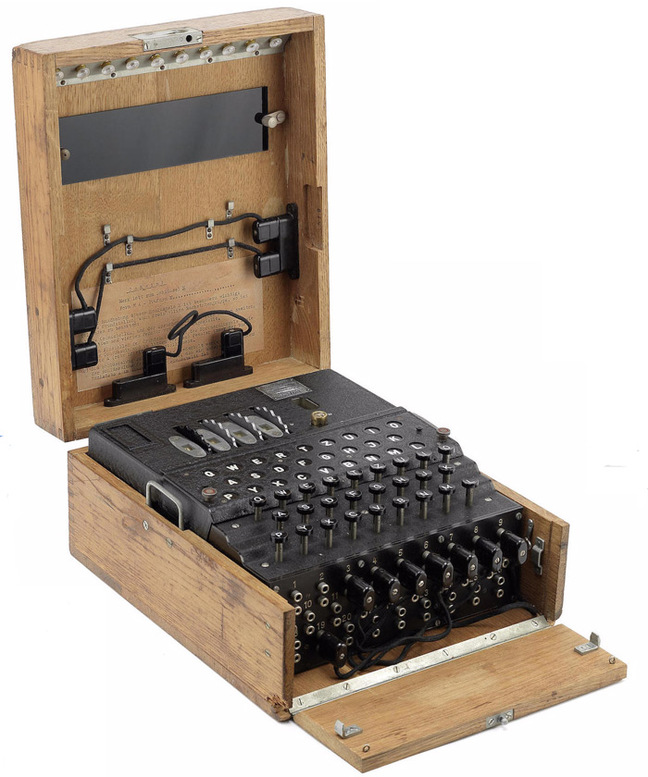
I recently read David O’Keefe’s One Day in August, which seems to explain the otherwise inexplicable launch of “Operation Jubilee”, the Dieppe raid … in his reading, the raid was actually a cover-up operation while British intelligence operatives tried to snatch one or more of the new Enigma machines (like the one shown above) without tipping off the Germans that that was the actual goal. Joel Ralph reviewed the book when it was released:
One Day in August, by David O’Keefe, takes a completely different approach to the Dieppe landing. With significant new evidence in hand, O’Keefe seeks to reframe the entire raid within the context of the secret naval intelligence war being fought against Nazi Germany.
On February 1, 1942, German U-boats operating in the Atlantic Ocean switched from using a three-rotor Enigma code machine to a new four-rotor machine. Britain’s Naval Intelligence Division, which had broken the three-rotor code and was regularly reading German coded messages, was suddenly left entirely in the dark as to the positions and intentions of enemy submarines. By the summer of 1942, the Battle of the Atlantic had reached a state of crisis and was threatening to cut off Britain from the resources needed to carry on with the war.
O’Keefe spends nearly two hundred pages documenting the secret war against Germany and the growth of the Naval Intelligence Division. What ties this to Dieppe and sparked O’Keefe’s research was the development of a unique naval intelligence commando unit tasked with retrieving vital code-breaking material. As O’Keefe’s research reveals, the origins of this unit were at Dieppe, on an almost suicidal mission to gather intelligence they hoped would crack the four-rotor Enigma machine.
O’Keefe has uncovered new documents and first-hand accounts that provide evidence for the existence of such a mission. But he takes it one step further and argues that these secret commandos were not simply along for the ride at Dieppe. Instead, he claims, the entire Dieppe raid was cover for their important task.
It’s easy to dismiss O’Keefe’s argument as too incredible (Zuehlke does so quickly in his brief conclusion [in his book Operation Jubilee, August 19, 1942]). But O’Keefe would argue that just about everything associated with combined operations defied conventional military logic, from Operation Ruthless, a planned but never executed James Bond-style mission, to the successful raid on the French port of St. Nazaire only months before Dieppe.
Clearly this commando operation was an important part of the Dieppe raid. But, while the circumstantial evidence is robust, there is no single clear document that directly lays out the Dieppe raid as cover for a secret “pinch by design” operation to steal German code books and Enigma material.
October 23, 2015
The Crime That Shook the World – The Execution of Edith Cavell I THE GREAT WAR Week 65
Published on 22 Oct 2015
Edith Cavell was a British nurse serving in a nursing school in occupied Belgium. She was executed by the Germans for treason and espionage in Brussels. Her death and the surrounding atrocity propaganda caused a public outcry all over the world. At the same time the First World War continued like never before. The Third Battle of the Isonzo didn’t bring a decision between Austria-Hungary and Italy, in Gallipoli the troops were slowly withdrawn and the the Champagne offensive of the French army was still in full swing.
October 22, 2015
Europe: The First Crusade – VI: On to Jerusalem – Extra History
Published on 12 Sep 2015
The Crusaders now held Antioch, but not securely. The Turks still control the citadel atop the mountain and had a massive army coming to reinforce them. The situation grew worse when Stephen of Blois deserted from the Crusades, and told the Byzantine reinforcements not to bother: he believed Antioch would fall immediately. Now entirely on their own, the Crusaders held the wall in constant vigil until a mystic named Peter Bartholomew claimed to have received a vision from Saint Andrew. Guided by his vision, he discovered metal which he claimed to be the holy lance of Longinus – nevermind that the church already had the holy lance in its possession. Though the Crusade leaders had doubts, the soldiers were inspired so they launched an assault on the Turkish armies. Surprisingly, they won the day: the Turks did not fully support their leader, Kerbogha, and many took the Crusade counter-attack as an excuse to abandon the siege. Bohemond now kept Antioch, while Raymond of Toulouse – after the disastrous Siege of Maarat led the soldiers to commit acts of cannibalism – took the remains of the army south to Jerusalem. His attempt to capture a small city called Arqa along the way almost fractured the crusade army again, and did lead to the death of Peter Bartholomew. They arrived in Jerusalem to find the local wells poisoned, giving them no choice but to attack the city head-on. After days of intense fighting, they won their way inside the walls and began a massive slaughter of the people who still lived inside Jerusalem – the Christian population had been expelled, leaving only Muslims and Jews still in the city. And thus, with Antioch and Jerusalem both in crusader hands, the First Crusade came to an end.
QotD: The historical triumph of public health
… the great public health achievements between roughly 1850 and 1960. Doctors and public health experts were given extraordinarily broad powers by the government, and they used them to eliminate the scourges that had made cities into pestholes from time immemorial. They built gleaming sewers and water treatment plants to wipe out virulent water-borne pathogens that used to regularly claim thousands of lives. Contact-tracing and quarantine of airborne and sexually transmitted diseases turned former plagues like smallpox and syphilis into tragic but sporadic outbreaks. Changes in building codes helped beat back mass killers like tuberculosis. Poison control cut down on both accidental and deliberate deaths. The Pure Food and Drug Act, and similar ordinances in other countries, reduced foodborne illness, and also, the casual acquisition of opiate or cocaine addictions through patent medicines. Malarial swamps were drained. Environmental toxins were identified and banned. Then they went and invented antibiotics and vaccines and vaccination laws, and suddenly surgery was as safe as a long-haul flight, TB was curable, and childhood illnesses that used to kill hundreds of people every year were a quaint footnote in your 10th-grade history textbook.
Having seen public experts work these miracles through the heavy hand of the state, people understandably concluded we could use miracles in other areas. They had a metaphor, so to speak. The metaphor wasn’t very good, as is often the case, but it took a while to find out that you couldn’t solve a problem in your steel supply chain with the same system that was so good at tracing cholera outbreaks to tainted pumps.
[…]
This is an overreaction to a terrible failure, for two reasons. First, big bureaucracies fail all the time, especially in the face of novel threats. A large institution is like a battleship: hard to sink, but also hard to turn. Public health experts of earlier eras made grave mistakes, like dumping London’s untreated sewage into the Thames; public health experts of the future will too. The more important question is whether they correct themselves, as it seems to me the CDC is now doing.
The second is that this is not your grandfather’s public health system. Public health experts were, in a way, too successful; they beat back our infectious disease load to the point where most of us have never had anything more serious than Human papillomavirus or a bad case of the flu. This left them without that much to do. So they reinvented themselves as the overseers of everything that might make us unhealthy, from French Fries to work stress.
As with the steel mills, these problems are not necessarily amenable to the organizational tools used to tackle tuberculosis. The more the public and private health system are focused on these problems, the less optimized they will be for fighting the war against infectious disease. It is less surprising to find that they didn’t know how to respond to a novel infectious disease than it would have been to discover that they botched a new campaign against texting and driving.
Megan McArdle, “Will Ebola Be Good for the CDC?”, Bloomberg View, 2014-10-20.
October 20, 2015
Soviet bugging technology and the US embassy’s IBM Selectric typewriters
John Turner sent me this link on a remarkably adept (and technologically sophisticated) hack the Soviets slipped over the US government at their Moscow embassy:
A National Security Agency memo that recently resurfaced a few years after it was first published contains a detailed analysis of what very possibly was the world’s first keylogger — a 1970s bug that Soviet spies implanted in US diplomats’ IBM Selectric typewriters to monitor classified letters and memos.
The electromechanical implants were nothing short of an engineering marvel. The highly miniaturized series of circuits were stuffed into a metal bar that ran the length of the typewriter, making them invisible to the naked eye. The implant, which could only be seen using X-ray equipment, recorded the precise location of the little ball Selectric typewriters used to imprint a character on paper. With the exception of spaces, tabs, hyphens, and backspaces, the tiny devices had the ability to record every key press and transmit it back to Soviet spies in real time.
The Soviet implants were discovered through the painstaking analysis of more than 10 tons’ worth of equipment seized from US embassies and consulates and shipped back to the US. The implants were ultimately found inside 16 typewriters used from 1976 to 1984 at the US embassy in Moscow and the US consulate in Leningrad. The bugs went undetected for the entire eight-year span and only came to light following a tip from a US ally whose own embassy was the target of a similar eavesdropping operation.
“Despite the ambiguities in knowing what characters were typed, the typewriter attack against the US was a lucrative source of information for the Soviets,” an NSA document, which was declassified several years ago, concluded. “It was difficult to quantify the damage to the US from this exploitation because it went on for such a long time.” The NSA document was published here in 2012. Ars is reporting the document because it doesn’t appear to have been widely covered before and generated a lively conversation Monday on the blog of encryption and security expert Bruce Schneier.
The French Uniforms of World War 1 I THE GREAT WAR – Special
Published on 19 Oct 2015
We are starting a new irregular series about the various uniforms of the warring nations of World War 1. Starting with the French uniforms we are exploring everything from helmets to boots. The French were the first army to adapt a real military helmet with the M15. In the beginning of the war they were still wearing the traditional Kepi from Franco-Prussian War, however. Find out all about the French equipment in the trenches with Indy.


