
Quotulatiousness

August 3, 2016

The scandal of the Chevalier d’Eon

Filed under: Europe, France, History — Tags: , , , , , — Nicholas @ 02:00

In Atlas Obscura, Linda Rodriguez McRobbie tells the story of the French soldier, diplomat and spy, the Chevalier d’Eon (also known as Mademoiselle la Chevaliere d’Eon):
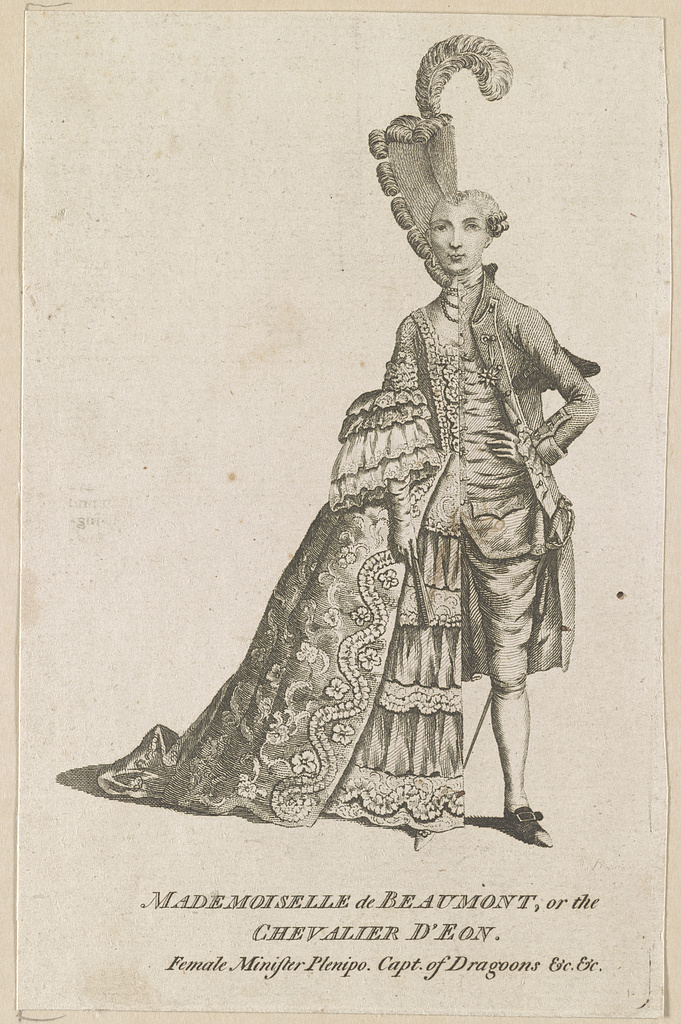
Mademoiselle de Beaumont or The Chevalier D'Eon. (Photo: Library of Congress/LC-DIG-ds-03347)

Mademoiselle de Beaumont or The Chevalier D’Eon. (Photo: Library of Congress/LC-DIG-ds-03347)

When the Chevalier d’Eon left France in 1762, it was as a diplomat, a spy in the French king’s service, a Dragoon captain, and a man. When he returned in July 1777, at the age of 49, it was as a celebrity, a writer, an intellectual, and a woman — according to a declaration by the government of France.

What happened? And why?

The answer to those questions is complex, obscured by layers of bad biography, speculation and rumor, and shifting gender and psychological politics in the years since, as well as d’Eon’s own attempts to reframe his story in a way that would make sense to his contemporary society. (Note: In consultation with d’Eon’s biographer, I have decided to use the male pronoun when talking about d’Eon before the gender shift and the female pronoun after.) Professor Gary Kates of Pomona College is one of the first modern academics to look closely at the life — or lives — of the Chevalier d’Eon, in his comprehensive biography Monsieur d’Eon Is a Woman. Kates had access to d’Eon’s personal papers, a treasure trove of manuscripts, diaries, financial records, documents, and letters housed at the University of Leeds, and his work is widely considered the best place to start when considering d’Eon.

The story Kates tells is a complex narrative, involving Ancien Regime intrigue, secret spy rings, political necessity, burgeoning celebrity culture, and nascent feminism. The meaning of d’Eon’s transformation has been dissected for centuries; feminist writer Mary Wollstonecraft praised d’Eon in their lifetime and contemporary trans groups have named themselves in d’Eon’s honor.

Even so, Kates cautions that the history of this fascinating figure is far from complete. “I don’t think I’ve written the definitive book on d’Eon,” he says. How could he? This is a person who lived enough for three lifetimes.


August 2, 2016

The Great Explorer – Ernest Shackleton I WHO DID WHAT IN WW1?

Filed under: Europe, History, Military, WW1 — Tags: — Nicholas @ 03:00

Published on 1 Aug 2016

Ernest Shackelton set sail for the Antarctic when most young men in Europe were setting sail to fight a war. While millions of them died, he was completely isolated trying to survive the harsh conditions. Shackelton’s expediton was probably one of the last grand ventures from the age of wonder and when he reached civilisation again, the world had truly gone mad.

August 1, 2016

Top 10 Misconceptions About World War 1 I THE GREAT WAR Special

Filed under: Europe, History, Military, WW1 — Tags: , — Nicholas @ 03:00

Published on 31 Jul 2016

We thought about a list of misconceptions about World War 1 that don’t want to die even 100 years later.

July 31, 2016

The Trench Coat – Entente or Allies? I OUT OF THE TRENCHES

Filed under: Europe, History, Military, WW1 — Tags: , — Nicholas @ 03:00

Published on 30 Jul 2016

It’s Chair of Wisdom time again where we answer all your questions about World War 1.

QotD: The Finnish language

Filed under: Education, Europe, History, Quotations, Russia — Tags: , — Nicholas @ 01:00

Russians did not realize how much establishing the Finnish language to be the priority language of the Finnish people and govt (and the jaegers/military officers — very important) became a strength to allow a seemingly meek and poor people to sever themselves from the regime. Of course, it was a bloody civil war, but not knowing Finnish was a blow to the Russians. And, they had the same problem in 1939 again. Side story: Russian soldiers easily surrendered so they could get into the Finnish prisons since they were starving and didn’t have proper clothes … some never went back home after WW2. I was told by a relative: “to win a war, you need food (supply lines) and lots of money, that’s really it.”

To this day, Finnish is one of the hardest languages to learn. There are 13 cases and no regular verbs … words change meaning by just adding a few other words to it — some as long as 24 letters! I did meet a Brooklyn guy who is a professor in Helsinki (married to a Finn) who speaks fluent Finnish with a Brooklyn accent!

Finns don’t really care if people don’t want to learn their language (not related to Germanic or Latin languages whatsoever) but they are eager (and required in school) to learn other languages. By the time I was 8, I added English (learned by watching a lot of American TV) to Finnish and Swedish. French and Spanish I learned around 12, and, I have tried to start another language for fun. Side issue: This is also, my own opinion why Finnish kids do so well on the Pisa test (although not as good these last 2 years) every year … the fact that it is normal to know 2-4 languages by age 14.

Although there are some words in Finnish that are similar to Swedish/English, it is still so few for anyone to see a connection — Icelandic, weirdly, has more similarities as far as words. And, despite that it is called a Finno-Ugric language, I don’t see the connection with Hungarian. And, on top of that, half my family (Swedish & ethnic Finnish) are Karelian, so there were words or dialect introduced in addition to mainstream Finnish — enough to confuse a kid even today.

Although, I marvel at the few children of immigrants from Asia or Africa who are fluent in Finnish today, it is still a country of mostly Finns. There are immigrants, but Finland presciently, did not allow the development of ghetto-like housing in the outskirts of cities — immigrants are scattered across metropolitan areas. Needless to say, Finland, because of the climate, and the difficult language, is not a favorite to emigrate to. You can get by with English, but you will not be in the inner circle unless your spouse is Finnish speaking, or you make a concerted effort to learn the language. And, the overwhelming reticence (and need for privacy) of the Finnish people can make for a lonely existence there … summers are nice.

Lagertha“, commenting on Steve Sailer’s “Freeman Dyson on Human Biological and Cultural Diversity” at The Unz Review, 2015-02-05.

July 30, 2016

First Opium War – Lies – Extra History

Filed under: Britain, China, History — Tags: , , — Nicholas @ 03:00

Published on 23 Jul 2016

Order the limited edition Opium Wars wall scroll before it leaves forever on July 27! http://bit.ly/2a138ur
James talks about our mistakes, and adds additional stories, for Federico da Montefeltro and the First Opium War!
____________

Quick story about Federico da Montefeltro: after losing an eye in a jousting accident, he ordered his doctor to cut a divot out of his nose so that his remaining eye had a better view and he could still fight in battles.

Now on to the Opium War! The Macartney expedition did not draw on the knowledge of Jesuit missionaries or even merchants who were familiar with Chinese court customs, because the British felt that a noble like Macartney was the only fitting representative. He didn’t come prepared to handle the kowtow, and he didn’t understand that the Chinese would have been more interested in British agricultural tech than they were in trinkets. James reads the disdainful letter which the Daoguang Emperor wrote to King George III in response to the embassy. There also happened to be a political upheaval in the Chinese palace at the time, so if the British had arrived sooner, they may have met with a different result and avoided the Opium Wars entirely. Once the war came to a head, it caused great division in Britain. Even though it was a war to sell illegal drugs, it was often recast as a war the Chinese provoked by insisting on the kowtow and treating other nations as vassals. Two traders by the names of James Matheson and William Jardine helped tip the scales for war because it helped their business, which had gotten a huge start in the opium trade. The Jardine-Matheson trading firm still exists today, and is a multibillion dollar company. Back in China, the British blockade of Canton’s port led to an odd first confrontation. A British ship called the Royal Saxon ran the blockade, so the British fired a warning shot to make it turn back. The Chinese, to prove they still controlled their sovereign waters, took this as an opportunity to challenge the blockade. Thus, their defense of a British smuggler led them into a war that, ironically, was about stopping British smugglers. The British official directing the war efforts, Charles Elliot, found himself in an awkward situation. He loved his country, but he morally objected to the British agenda in China. He tried to pave a moderate path, only to be fired and reviled as a failure. But after he left, the war truly got vicious. The British committed many atrocities in their campaign. They never sought to hold China, however, because their wars in India had taught them how impossible such an undertaking would be. Thus they settled on the unequal treaty. And as for Walpole… well, he started it, of course. Tea became such a large part of Britain’s economy because of the large tax levied on it. And who levied that tax? It was Walpole. He actually repealed an earlier, heavily resented tax and got political accolades for doing so, then introduced a much higher tax under a different name that flew under the radar even while it brought in hundreds of thousands of pounds for the government every year. The government’s reliance on tea for funding would later propel them to take such extraordinary measures to secure access to tea via Chinese trade. So who really started the Opium War? Well. It was Walpole.

QotD: What were the long-term effects of the First Crusade?

Filed under: France, History, Middle East, Quotations, Religion — Tags: , , , , — Nicholas @ 01:00

Q: What were the long-term effects of the First Crusade?

A: The most immediate long-term effect was that French states were established in the Middle East. People usually think of the Crusades as failures because they did [ultimately] fail, but in fact there were French-speaking states, Christian Catholic states created in the Middle East that lasted for about 200 years. We tend to forget that the West included the Middle East for this stretch of medieval history. If you live in the Middle East it’s more obvious because there are Crusader monuments and medieval-style architectural details everywhere. The entry to Al-Aqsa Mosque in Jerusalem, for example, could be the entry to any ornate 12th-century church in Europe, the styling is so close.

Another impact of it, which I’m beginning to think has been more enduring than is often recognized, is that on the Islamic side, the notion of jihad was dying out [before the Crusade]. Holy war was something that had happened in the past, and there had been this steady state reached in the Middle East. I’m not sure that the Turks saw what they were doing when they were engaging the Byzantines as engaging in jihad. After the First Crusade, within 10 years of it, you get Islamic voices like Ali ibn Tahir al-Sulami, in the last document in my source reader, saying we need to revive jihad. He says: The Franks have been waging jihad against us; now we have to get the jihad going back up again.

It also seems to me that the new model of jihad borrowed from what the Crusaders brought. You get the idea of martyrdom — the idea that if you died you would go straight to heaven. You get mythical holy figures appearing in battles that Muslims were fighting against Christians. You get a more poisonous relationship between religion and warfare than existed before.

Virginia Postrel talking to Jay Rubenstein, “Why the Crusades Still Matter”, Bloomberg View, 2015-02-10.

July 29, 2016

Happy Birthday World War 1 I THE GREAT WAR – Week 105

Filed under: Europe, History, Military, Russia, WW1 — Tags: , , — Nicholas @ 04:00

Published on 28 Jul 2016

2 years. It has been 2 years since Austria-Hungary declared war on Serbia which led to a downwards spiral that we now remember as World War 1. And this week 100 years ago, the three biggest battles in human history are being fought simultaneously: The Battle of Verdun, the Battle of the Somme, the Brusilov Offensive. Happy Birthday.

July 26, 2016

The British Uniforms of World War 1 I THE GREAT WAR Special

Filed under: Britain, Europe, History, Military, WW1 — Tags: , , — Nicholas @ 04:00

Published on 25 Jul 2016

Matthew Moss helped us with this episode, check out his website: http://www.historicalfirearms.info

The British Army was probably the best equipped at the beginning of the war. They already transitioned to the more practical khaki colour, faded out the differences between infantry and other branches and developed uniforms for different climates. But of course World War 1 brought its own number of problems for the British Army.

July 25, 2016

The Evolution of German Infantry Tactics I OUT OF THE ETHER

Filed under: Europe, Germany, History, Military, WW1 — Tags: , , — Nicholas @ 02:00

Published on 24 Jul 2016

Indy sits on the Chair of Wisdom and reads out some of the best comments we get every month. This week, we deal with the evolution of German Infantry Tactics.

July 24, 2016

Rubber Duckies – The Return of Angel and Snake I OUTTAKES

Filed under: History, Humour — Tags: — Nicholas @ 02:00

Published on 23 Jul 2016

Time for another glimpse into the mind of Indy Neidell.

July 23, 2016

The First Opium War – IV: Conflagration and Surrender – Extra History

Filed under: Britain, China, History — Tags: , , — Nicholas @ 02:00

Published on 9 Jul 2016

The Chinese attempt to retake Canton by force failed. New British commanders took charge and would accept nothing less than total Chinese capitulation. They captured cities all the way up to Nanking, forcing the Emperor to negotiate. He had no choice but to accept an unequal treaty, kicking off a period of subservience to Europe which China still remembers today as the Century of Humiliation.
____________

Disappointed in the treaty, the Daoguang Emperor replaced Qishan with three new commanders. One of them wanted to buy time and modernize the army, but the Emperor insisted the British be repelled immediately. They assaulted Canton from across the river, firing cannons and sailing fire ships at the British fleet. Their efforts fell far short, and soon the British controlled the river again. The Chinese were forced to pay them an indemnity to leave Canton, but in their wake riots and looting plagued the city anyway. Elliot still led the British forces, but upon returning to Hong Kong, he learned that he was now being replaced. His replacements had no interest in the compromises he’d tried to establish. They pushed immediately towards Beijing. In each new fort they captured, they found evidence that the Chinese resistance had ironically been weakened by crippling opium addiction. As the Chinese attacks grew more desperate, British retaliation grew more brutal. Finally, they stood ready to seize Nanking. With it would come control of the Yangtze River on which all of China depended, so the Emperor was forced to negotiate. They had no bargaining power, and gave the British nearly everything they wanted: a huge indemnity, new trade ports, no more Hong monopoly, generous tariffs, consulates, and sovereignty over Hong Kong. The only two matters they refused were Christian missionaries and legalizing opium, but the latter would only lead to the Second Opium War with similar results. These “unequal treaties” would go down in Chinese history as the beginning of what the Communist government later called “The Century of Humiliation.” The spectre of this shame and forced subservience to European interests continues to shape politics today, as this history is often invoked or used as a rallying cry during dealings with the West.

July 22, 2016

Australia’s Darkest Hour – The Battle of Fromelles I THE GREAT WAR – Week 104

Filed under: Australia, Europe, History, Military, WW1 — Tags: , — Nicholas @ 02:00

Published on 21 Jul 2016

North of the Somme battlefield, the newly arrived Australian troops are supposed to prevent German forces reinforcing their comrades in the South. The following Battle of Fromelles is described as a the worst 24 hours in Australian history as the troops are sent against German defenders in a disastrous attack. At the same time, the French and Germans are licking their wounds at Verdun and the Russians are continuing their attack on the Eastern Front.

July 20, 2016

First Opium War – III: Gunboat Diplomacy – Extra History

Filed under: Britain, China, History — Tags: , , , — Nicholas @ 04:00

Published on 2 Jul 2016

The British set up a blockade outside Canton, but one of their own private merchant ships tried to run through it. When the Chinese came to its defense, war began in earnest. Since the British had far superior firepower, they easily conquered Chuenpee and Chusan. Elliot and the Emperor’s new envoy, Qishan, soon sought a treaty and agreed on generous terms… which their overseers harshly rejected.
___________

The British responded to the Chinese halting their ships by erecting a blockade outside Canton. They fired a warning shot to turn back a private British merchant ship, the Royal Saxon, which attempted a blockade run, and the Chinese sent out their own navy to defend the runner. They were demolished. The British had better ships and better firepower. They made to discuss a treaty, but the Chinese refused to give in to the British demands regarding ownership of Hong Kong. The British moved on to capture Chusan, an island near Shanghai. Then a rumor prompted them to believe that China planned to strike against them, so they acted pre-emptively and kicked off the Battle of Chuenpee. Again they won, but the slaughter was so horrifying that Superintendent Elliot was glad to seek a peace treaty with the emperor’s envoy, Qishan. Finally Qishan agreed to give up Hong Kong, to give the British better trade status, in exchange for which Britain returned the land they’d taken. But Elliot’s supervisor back in London, Lord Palmerston, felt the treaty didn’t go far enough, especially since it didn’t re-establsih opium trading rights. And the Emperor found Qishan’s capitulation disgraceful, even threatened to have him hanged for it. What had looked like moderate wins for both sides suddenly threatened to fall apart.

July 19, 2016

The Best Sniper Of World War 1 – Francis Pegahmagabow I WHO DID WHAT IN WW1?

Filed under: Cancon, Europe, History, Military, WW1 — Tags: , , — Nicholas @ 04:00

Published on 18 Jul 2016

Francis Pegahmagabow was not only the most successful sniper of World War 1, but he is also among the most decorated aboriginal soldiers in history. He joined the Canadian Army in 1914 and quickly made a name for himself as a sniper during reconnaissance missions.

« Newer PostsOlder Posts »

Powered by WordPress
