
Published on 13 Apr 2014
Full title reads: “Helensburgh. Goodbye To A Great Ship”.
Helensburgh, Scotland.
LV Battleship HMS Duke of York in the breakers yard at Helensburgh. LV Looking down on the bows. GV Duke of York in the breakers yard. LV Looking at the massive guns on the foredeck. CU Broken life-belt from the Duke of York. LV Panning shot showing lifeboats lying amongst other rubble on the deck. CU One of the lifeboats.
Library shots. GV Duke of York putting to sea during her hey-day. SV White ensign flying from the mast. GV Panning shot as the Duke of York puts to sea, name can be seen on the stern. GV Duke of York at full steam sailing between two other ships. LV Head on shot as the Duke of York ploughs through the sea.
Shots in breakers yard. GV Elevated shot looking down over the foredeck gun turrets. SV Massive guns. GV Elevated shot of a man with an acetylene cutter cutting away at the base of a gun turret for scrap.
LV Interior shot of a Hungarian refugee working on the bridge during the breaking operations. GV Scrap metal lying in the breakers yard. SV Panning shot of same. SV Man with acetylene cutter cutting through thick girder. LV Section of the battleship being loaded onto railway trucks. GV Looking across the breakers yard to the Duke of York in the background.
February 10, 2017
Goodbye To A Great Ship (1958)
QotD: “First world problems” used to be just “very rich people’s problems”
… my bathroom book (bathroom books are essays or short stories, because if you have never gotten trapped by a novel someone had forgotten in the bathroom and lost the entire morning as well as all circulation in your legs, I can’t explain it to you) is a Daily Life In Medieval England thing. And most of the time I read something that I’m sure the authors thought was new and exotic and think “Well, heck, it was like that in the village.”
[…]
Which brings us back, through back roads to the main point of this post. I was (being evil) reading some of the entries in the medieval life book to older son (having brought the book out of the bathroom to pontificate) and I said “bah, it was like that for us, too. It wasn’t that bad.” And son said “mom, it sounds horrific.” And I said “that’s because you grew up in a superabundant society, overflowing at both property and entertainment, which is why the problems we suffer from are problems that only affected the very rich in the past” (Crisis of identity, extreme sensitivity to suffering, etc.)
Which is also true. And note kindly, that though we’re overflowing at the seams with material goods, property crimes we still have with us, not counting on anything else.
But for my child this is the normal world and it doesn’t occur to him to think of it as superabundant. He just thinks of the conditions I grew up under (I think it was the “most people only had one change of clothes, including underwear” that got him) as barbaric and horrible.
I’ve long since realized that I grew up somewhere between medieval England and Victorian England. Tudor England feels about as familiar to me as the present day which is why I like visiting now and then.
Sarah A. Hoyt, “Time Zones”, According to Hoyt, 2015-06-23.
February 9, 2017
The Year of Battles Comes To An End I THE GREAT WAR WW1 Summary Part 8
Published on 8 Feb 2017
With the end of the Battle of Verdun, the year 1916 ends. A battle that was described as “World War 1 in a microcosm” and has been remembered in infamy ever since. Late 1916 also brings political shake-ups, an end to the Romanian campaign and new action in the Middle East. And still no end in sight.
The History Of British Racing Green By Top Gear!
Uploaded on 21 Oct 2011
February 8, 2017
British History’s Biggest Fibs with Lucy Worsley Episode 1 War of the Roses [HD]
Published on 27 Jan 2017
Lucy debunks the foundation myth of one of our favourite royal dynasties, the Tudors. According to the history books, after 30 years of bloody battles between the white-rosed Yorkists and the red-rosed Lancastrians, Henry Tudor rid us of civil war and the evil king Richard III. But Lucy reveals how the Tudors invented the story of the ‘Wars of the Roses’ after they came to power to justify their rule. She shows how Henry and his historians fabricated the scale of the conflict, forged Richard’s monstrous persona and even conjured up the image of competing roses. When our greatest storyteller William Shakespeare got in on the act and added his own spin, Tudor fiction was cemented as historical fact. Taking the story right up to date, with the discovery of Richard III’s bones in a Leicester car park, Lucy discovers how 15th-century fibs remain as compelling as they were over 500 years ago. As one colleague tells Lucy: ‘Never believe an historian!
February 7, 2017
The Hindenburg Line – Ludendorff’s Defence In Depth I THE GREAT WAR Special
Published on 6 Feb 2017
1916, the Year of Battles, had strained Germany’s resources everywhere but especially on the Western Front they needed to defend their captured territory against an ever growing number of Entente Forces. Erich Ludendorff decided to shorten the front line where possible and built a new “Defence In Depth” line: The Siegfried Line. This defensive network was supposed to grind the Entente forces down while freeing up more German resources.
Simón Bolívar – Lies – Extra History
Published on Jan 21, 2017
James talks about our mistakes, and adds additional stories, for the Simón Bolívar series!
February 6, 2017
The “beer before bread” theory gains strength
The received wisdom about the transition from hunter-gatherer to agrarian societies is that clans or tribes stopped being nomadic in order to grow crops and secure their food supply more consistently … that growing grain for bread was one of the strongest underlying reasons for the change in lifestyle. That theory is being challenged by researchers who believe the real reason was to produce grains for brewing instead:
The story of humanity’s love affair with alcohol goes back to a time before farming — to a time before humans, in fact. Our taste for tipple may be a hardwired evolutionary trait that distinguishes us from most other animals.
The active ingredient common to all alcoholic beverages is made by yeasts: microscopic, single-celled organisms that eat sugar and excrete carbon dioxide and ethanol, the only potable alcohol. That’s a form of fermentation. Most modern makers of beer, wine, or sake use cultivated varieties of a single yeast genus called Saccharomyces (the most common is S. cerevisiae, from the Latin word for “beer,” cerevisia). But yeasts are diverse and ubiquitous, and they’ve likely been fermenting ripe wild fruit for about 120 million years, ever since the first fruits appeared on Earth.
From our modern point of view, ethanol has one very compelling property: It makes us feel good. Ethanol helps release serotonin, dopamine, and endorphins in the brain, chemicals that make us happy and less anxious.
To our fruit-eating primate ancestors swinging through the trees, however, the ethanol in rotting fruit would have had three other appealing characteristics. First, it has a strong, distinctive smell that makes the fruit easy to locate. Second, it’s easier to digest, allowing animals to get more of a commodity that was precious back then: calories. Third, its antiseptic qualities repel microbes that might sicken a primate. Millions of years ago one of them developed a taste for fruit that had fallen from the tree. “Our ape ancestors started eating fermented fruits on the forest floor, and that made all the difference,” says Nathaniel Dominy, a biological anthropologist at Dartmouth College. “We’re preadapted for consuming alcohol.”
[…]
Flash forward millions of years to a parched plateau in southeastern Turkey, not far from the Syrian border. Archaeologists there are exploring another momentous transition in human prehistory, and a tantalizing possibility: Did alcohol lubricate the Neolithic revolution? Did beer help persuade Stone Age hunter-gatherers to give up their nomadic ways, settle down, and begin to farm?
The ancient site, Göbekli Tepe, consists of circular and rectangular stone enclosures and mysterious T-shaped pillars that, at 11,600 years old, may be the world’s oldest known temples. Since the site was discovered two decades ago, it has upended the traditional idea that religion was a luxury made possible by settlement and farming. Instead the archaeologists excavating Göbekli Tepe think it was the other way around: Hunter-gatherers congregated here for religious ceremonies and were driven to settle down in order to worship more regularly.
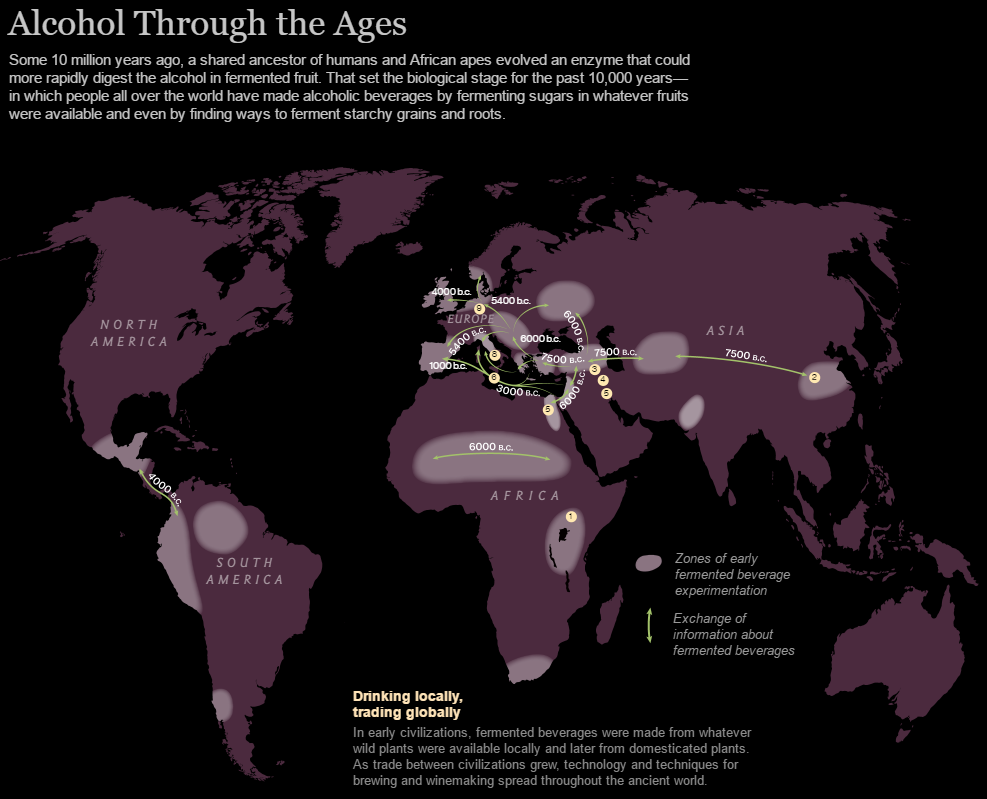
H/T to Tamara Keel for the link.
QotD: General officer ranks in the Waterloo campaign
There were a lot of generals involved in the campaign in northern France and Flanders that began on June 14, 1815, and culminated in the memorable Battle of Waterloo on June 18th. Altogether there were 240 of them, to command nearly 360,000 troops. And since the troops came from a lot of different armies — British, French, Prussian, Netherlands, Hanover, Brunswick, and a few others, telling the generals apart can be a bit confusing.
[…]
Note that the rank structure is not really comparable to that prevailing today in the U.S. Army. The functional equivalent of a British major general or a French general de brigade or marechal de camp would actually be brigadier general based on their commands. The French rank system was actually much more complicated than may appear from the table. To begin with, the highest actual rank in the army was general de division. Marechal de l’Empire was technically a distinction, not a rank. Now it gets really complicated. A corps commander who was officially a general de division might by courtesy be designated a general de corps d’armee. However, a general de division might also sometimes be referred to as a lieutenant-general, particularly if he was functioning in a staff position. Meanwhile, the chief-of-staff of the army was designated major general. In addition, an officer commanding a brigade was more likely to be designated a marechal de camp (i.e., “field marshal”) rather than general de brigade, which was reserved for officers with special duties, such as the commanders of the regiments of the Garde Imperial. This complexity had developed as a result of the Revolution, which favored functional titles for military officers, chef de battailon for example, rather than major. Unfortunately, staff personnel often required rank, so the old Royal hierarchical titles of rank survived for a long time alongside the functional Revolutionary ones.
Further complicating matters was the fact that in all the armies an officer’s social rank was often used rather than his military rank. Thus, although Wellington was a Field Marshal he was usually referred to as “His Grace, the Duke” without his military rank. In Wellington’s case this could become quite complicated, as he was a duke thrice over, the Portuguese and Spanish having created him such even before the British, and he was also a Prince of the Netherlands. As each of these gave him a different title, references to him in Portuguese, Spanish, or Dutch works can easily become obscure. For example, to the Portuguese he was the Duque de Douro, and one Portuguese language history of the Peninsular War nowhere uses any other name for him. Then there is the problem of multiple ranks. Wellington, for example, was a field marshal in the British, Prussian, Netherlands, and Portuguese armies, as well as being a Capitan General in the Spanish Army. Although none of the other officers in the campaign had so many different ranks, several held more than one. For example, the Prince of Orange was a Dutch field marshal and a general in the British Army, while the Duke of Brunswick, who commanded his division in his capacity as duke, was also a lieutenant-general in the British Army.
Al Nofi, “Al Nofi’s CIC”, Strategy Page, 2000-02-01.
February 5, 2017
Smoking – Hearing Protection – Sanitation I OUT OF THE TRENCHES
Published on 4 Feb 2017
This week Indy talks about the smoking habits of the soldiers, how sanitation was organised in the trenches and how soldiers protected their ears during fighting.
February 3, 2017
Germany Resumes Unrestricted Submarine Warfare I THE GREAT WAR Week 132
Published on 2 Feb 2017
This week 100 years ago, Germany goes all in and resumes unrestricted submarine warfare, their goal is to starve Britain out of the war before Germany cannot continue the war. All doubts are brushed aside and all shipping around the British Isles will be sunk without warning. At the same time, the economic situation in Russia gets worse and worse and winter prevents any major action.
“In a secular age … it is inevitable that people will attach themselves like limpets to miniature religions”
Colby Cosh draws some parallels between the early Federalists in post-revolutionary America and the mainstream media today: both groups attempted to retain their privileged position in society as that society changed dramatically all around them:
But now the seeds of fleeting confusion have fallen into the fertile soil of Internet crap-mongering. On social media there were immediate, unabashed, conflicting total lies circulating about the identities of the “two” perpetrators. Now, before much is known at all of the actual killer, we are seeing deliberately engineered hints at some kind of inexplicable cover-up by the (Muslim-controlled?!) police of Quebec, or by higher authorities — Liberals, reptoids, George Soros clones? Pick your poison!
Those trivial little wobbles in the initial news coverage are being exploited by journalists and commentators who have abandoned respect for facts like “there are always reports of a second shooter” in favour of efficient, direct manipulation of “the narrative.” The actual full-fledged conspiracy theories are being designed as we speak, and soon will be ready for harvest.
We live in a post-revolutionary media environment, and traditional newspapers and broadcasters are like the American Federalists: we are hoping to stay on top as trusted, sensible informers and teachers. I make no claim that this hope is well-founded or appropriate, but either way, the strategy did not end very well for the Federalists. One notices that they are already in irreversible, humiliating retreat at the moment when Wood’s book begins.
There is money in offering an alternative account, any alternative account of anything important or dramatic, to the gullible. Build a suspicious audience of millenarians and ignoramuses, and some of them will keep following you until you can start selling them protein supplements, bulk food for the apocalypse, religious knick-knacks, or penis pills. (Which business line will Rebel Media break into first? It’s only a matter of time!)
In a secular age, like ours or like the late 18th century, it is inevitable that people will attach themselves like limpets to miniature religions. Today they range from gold-bugs to survivalist “preppers” to disturbingly overenthusiastic Harry Potter fans to Gwyneth Paltrow’s Goop. (My apologies to those readers, and I’m sure there are a few, who are devotees of all four faiths.) Such subcultures are the reliable basis of a bulletproof “news” media model. The horrible part is this: they might be the only such model.
February 2, 2017
QotD: Noblesse oblige
I was raised with noblesse oblige, which, as we all know is a kind of almond and mare’s milk pastry made in the mountains of outer Mongolia and eaten at wedding feasts to assure good luck.
Okay, I lie. Noblesse Oblige is literally – as all of you know! However, let me unpack it, because sometimes it’s good to reflect on things we know – the obligations of noblemen.
In a world in which station was dictated by birth (most of the world, most of the time) the way to keep society from becoming completely tyrannical and the burden of those on the lower rungs of society from becoming unbearable was “noblesse oblige” – that is a set of obligations that the noblemen/those in power accepted as a part of their duty to society. Most of these involved some form of moderation of force.
The amount of moderation depended on the culture itself. For instance, in those lands in which the nobleman got first night rights (or claimed them anyway) it might be noblesse oblige to return the bride after that. It might also be noblesse oblige to stand godfather to the oldest child, who, after all, might be more than a godchild. And in other cultures, though the first night thing wasn’t there, the godchild thing still applied. A small return for faithful service to closer servants and courtiers, etc.
In the same way, while you might treat your serfs or villains like dirt, you forebore to take their last crumb of bread and left them enough to live on. This might not be because you were smart or merciful or whatever, but because someone had dinged it into you.
Noblesse oblige, by that name or others, appears every time there is a gross imbalance of power in human society. Or that is, it appears if society is to survive.
Sarah Hoyt, “Noblesse Oblige and Mare’s Nests”, According to Hoyt, 2015-05-05.
February 1, 2017
QotD: Che Guevara and his modern fans
Denial is also a common factor among people on the left who want to believe in the failed experiment known as Communism. This is nothing new, since Walter Duranty of the New York Times was famous for denying the atrocities of Stalin and is still honored by the media elite to this day. Though some of the worst deniers are those who want to believe the romantic story of Cuba being liberated by Che Guevara and Fidel Castro from the evil grasp of the Batista regime. The Cuban revolution is by far one of the greatest stories ever sold.
People are always shocked to learn that the Cuban revolution succeeded with little resistance since Castro had bribed the top brass in Batista’s military to stand down. It also didn’t help that the Batista regime was so unpopular among the people that there weren’t too many who were willing to risk their lives to defend it. It’s also funny that Che Guevara is thought of as the George Washington of guerrilla warfare, but in reality Barney Fife was a better comparison. Actually I think that may be an insult to Barney Fife because at least he wasn’t dumb enough to shoot himself in the chin, like our “guerilla master” did. His failed revolutions in Bolivia and the Congo are a direct testament to his skills as a master in guerilla warfare.
The one thing that Che was good at was killing hundreds, if not thousands of unarmed people, including women and children. The man was such a humanitarian that he had a wall in his office knocked down so that he could have a nice view of the killing fields, when the “enemies of the state” were being purged. Hipsters who like to wear his T-Shirts as always shocked to hear that he wasn’t a selfless rebel who wanted to help the working class, except to take them to the killing fields of course.
To all the hippies, artists, musicians, and actors who like to venerate the man, you are the type of person that Che despised the most. If you had long hair, wore blue jeans and listened to Rock ‘n’ Roll or had any flare for the arts, you would likely find yourself thrown into a labor camp.
Sean Gangol, “Denial”, Libertarian Enterprise, 2015-07-19.
January 31, 2017
Anti-U-Boat Strategy and Tactics in World War 1 I THE GREAT WAR Special
Published on 30 Jan 2017
During World War 1, German submarines were a major thread to shipping routes of the Entente everywhere. The Royal Navy and and her allies had to come up with defence mechanisms against the silent hunters. They deployed flying boats and airships to spot the enemy U-Boats, harassed them with depth charges and mines. But the most effective measure against them proved to be the convoy.


