
Published on 1 Jul 2017
Czechs and Slovaks were minorities with the Austro-Hungarian and Russian Empire. Even before the outbreak of the war they demanded more rights as industrious citizens but were often overheard. During the war, they decided to take matter into their own hands and fight. And that they did in many armies across Europe.
July 2, 2017
Fighting Without A Country – Czechoslovak Legions of World War 1 I THE GREAT WAR Special
Comments Off on Fighting Without A Country – Czechoslovak Legions of World War 1 I THE GREAT WAR Special
The US Navy’s WW2 floating drydocks
I’d never heard of these massive mobile drydock facilities before:
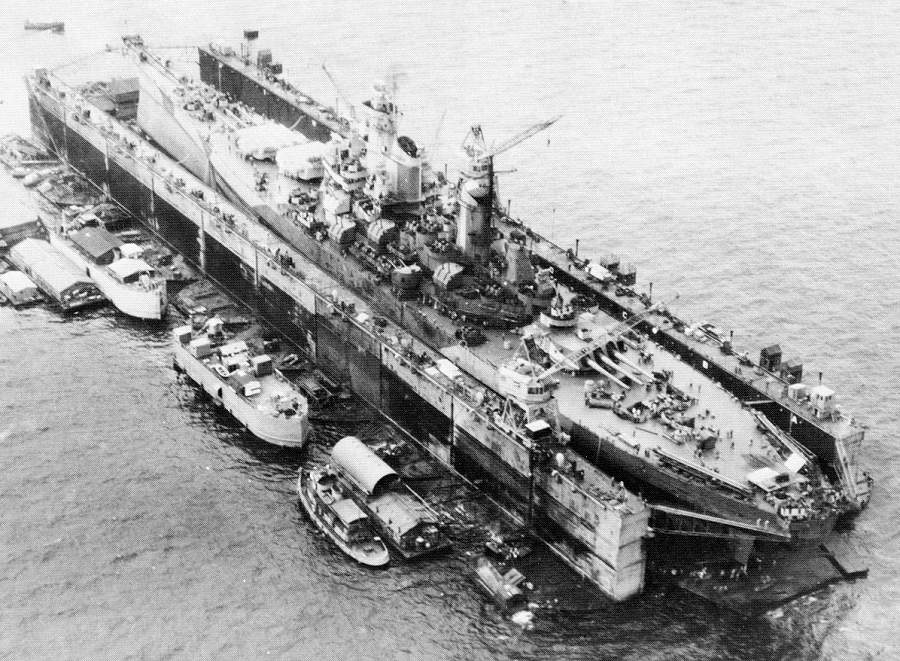
USS Iowa (BB-61) in a floating drydock at Manus Island, Admirality Islands, 28 December 1944. (via Wikimedia)
The United States Navy, during World War 2, decided to create a temporary forward base utilizing service stations; these stations meant the United States Navy could operate throughout the huge Pacific Ocean for more sustained amounts of time.
Creating these pretty much meant they could have a major naval base within a short distance of any operation carried out in the area. The base was able to repair; resupply and refit, meaning fewer ships had to make the journey to a facility at a major port, which allowed them to remain in the Pacific for up to a year and beyond.
These stations were officially named Advance Base Sectional Docks (ABSDs) and were put together section by section. Each part was welded to the next once in their correct position.
There were two different sizes of floating docks created, the largest ones were created using ten sections and could lift 10,000 tons each – being 80 feet wide and 256 feet long. Once these sections were welded together, it became a fully assembled dock that was a whopping 133 feet wide, 827 feet long and could lift up to 90,000 tons.
This was more than enough lifting power for any ship within the Fleet.
The post also included this film, showing the USS Idaho being moved into an ABSD at Esperitu Santo in August, 1944:
Published on 7 May 2015
On August 15, 1944 the mighty battleship Idaho arrived at Espiritu Santo in the Pacific and slipped into a floating dry dock so that emergency repairs could be made to the ship’s blisters. This special film — likely made by the crew of the battleship’s observation aircraft — documents the activities as the ship is maneuvered into position. The dry dock shown is likely one of the Large Auxiliary Floating Dry Docks (AFDB), probably AFDB/ABSD-1. This was constructed in sections during 1942 and 1943 at Everett Shipbuilding Co., Everett, WA., by the Chicago Bridge & Iron Co., Eureka, CA., the Pollack-Stockton Shipbuilding Co., Stockton, CA., and Chicago Bridge & Iron Co., Morgan City, LA. During World War II ABSD-1 was assigned to the Asiatic-Pacific Theater and towed to Espiritu Santo in the New Hebrides and assembled for service. Later it was disassembled and towed to Manicani Bay, P.I. and reassembled for service by September 1945.
USS Idaho had been damaged during long days of combat that began with the bombardment of Saipan in June. With the landing assault underway on 15 June, the battleship moved to Guam for bombardment assignments. As the American fleet destroyed Japanese carrier air power in the Battle of the Philippine Sea from 19–21 June, Idaho protected the precious transport area and reserve convoys. After returning to Eniwetok from 28 June to 9 July, the ship began preinvasion bombardment of Guam on 12 July, and continued the devastating shelling until the main assault eight days later. As ground troops battled for the island, Idaho stood offshore providing vital support until anchoring at Eniwetok on 2 August.
After repair, Idaho‘s mighty guns were needed for the next giant amphibious assault on the way to Japan. She sailed from San Diego on 20 January 1945 to join a battleship group at Pearl Harbor. After rehearsals, she steamed from the Marianas on 14 February for the invasion of Iwo Jima. As Marines stormed ashore on 19 February, Idaho was again blasting enemy positions with her big guns, and fired star shells at night to illuminate the battlefield. She remained off Iwo Jima until 7 March, when she underway for Ulithi and the last of the great Pacific assaults – Okinawa.
At the end of the conflict Idaho made her triumphal entry into Tokyo Bay with occupation troops on 27 August, and was anchored there during the signing of the surrender on board the Missouri on 2 September. Four days later she began the long voyage to the East Coast of the United States, steaming via the Panama Canal to arrive at Norfolk on 16 October. She decommissioned on 3 July 1946 and was placed in reserve until sold for scrap on 24 November 1947 to Lipsett, Incorporated, of New York City.
Comments Off on The US Navy’s WW2 floating drydocks
QotD: Not (yet) ready for democracy
The absolutely vital elements of a successful democratic component of government (note – component of a system, not the entire system): is that there be a literate population; a free and enquiring press; a well developed and just rule of law; and a tradition of give and take being acceptable to the society.
Tribal societies have none of these things. That is why democracies have consistently failed in African countries where tribalism is still the most important element. (In fact politics in some of these places is still largely a competition between which tribal groups served in the imperial militaries, versus which served in the imperial civil services. With very bloody competition between the two.) The fact that illiteracy is rampant; free presses almost non-existent; and the rule of law where judges are not beholden to tribal interests, or simply threats, doesn’t exist: makes democracy impossible to sustain.
Muslim culture has none of these things. A system where a woman’s evidence in court is one third of a man’s – and dhimmitude is recognized even if slavery officially isn’t – is unlikely to have these things. And for literacy, free press, or rule of law, see Africa, but doubled.
It is also possible to suggest that without a clear understanding of the logic of natural laws, you can’t have a democracy. The fact that Muslim scholarship specifically rejects natural law on the basis that Allah can cause anything, so there are no ‘natural laws’, means you cannot have these things. The reason the Muslim world lost its scientific supremacy of the 11th and 12th centuries relates specifically to their decision to turn their back on empirical evidence. Without that basic understanding, I do not believe democracy is possible. (In fact that basic approach helps explain why democracy is actually anathema to good Muslims, and why Boko Haram literally means ‘Western education is evil’!)
So the concept that an ‘Arab Spring’ could work in the Middle East is a sad indictment on the Western media and ‘intelligentsia’s’ failed understanding about how democracy works.
In fact the entire deluded Western project of attempting to impose ‘republics’ on tribal societies as part of post-colonialism, is an indictment on the western fantasy that republics are workable, let alone good things.
Let’s face it, no western republic, even in the most educated, literate, and rule of law abiding parts of the Anglosphere, has survived a first century without a collapse and or bloody civil war. The most ‘successful’ Western republics have included the American (see above), French (see above), Weimar (heard of the popularly elected Adolf Hitler?), Italian (50 governments in 50 years), Greek (how’s that brilliant financial planning going?) and Polish (are they on their 3rd, 4th, or 5th?). Those are the good ones. 90% of all republics ever founded in Europe, South America, Asia, Africa, or the Middle East, have collapsed into dictatorship, civil war, mass murder, or ethnic cleansing, within 20 years of being set up.
And that’s what we thought would work in the Middle East?
Nigel Davies, “The ‘Arab Spring’, 1848, and the 30 Years War/s…”, rethinking history, 2015-09-19.
July 1, 2017
Meet the Romans with Mary Beard 2/3 – HD
Published on 16 May 2013
1. All Roads Lead to Rome
2. Street life
3. Behind Closed Doors
Comments Off on Meet the Romans with Mary Beard 2/3 – HD
Happy 150, Canada … now get back to work
Chris Selley on the artificial sesquicentennial celebrations beginning today:
On Wednesday evening, indigenous protesters marched on to Parliament Hill and, after some back and forth with the local constabulary, erected a large white tepee. The group’s leaders told reporters they intended to “reoccupy” “unceded Algonquin territory,” and remind Canadians that “reconciliation” with the people who were here before them lies far down a bumpy road.
If nothing else, it was a welcome moment of coherence: big white tepee, Parliament Hill, three days before Canada Day — no one is going to wonder what that’s about. By contrast, I’m not sure what “Canada 150,” the officially branded and hash-tagged celebration of this country’s existence, is supposed to be. It certainly isn’t a focused reflection on Canada’s history, much less on Confederation. Passport2017.ca, the Canada 150 online portal, reads like an in-flight magazine’s Canada Day edition.
You can check in with the “Canada 150 Ambassadors.” Singer-songwriter Rufus Wainwright appreciates Canada’s “civility, reasoning and compassion.” Sprinter Bruny Surin appreciates moving from Haiti to a country where, his mother told him, anyone can accomplish anything. Nobel laureate astrophysicist Art McDonald provides the obligatory shout-out to Lester Pearson’s role in the Suez Crisis.
[…]
Had Canada 150 been a thoughtful reflection of Canada’s history, it might have been worth defending against rhetorical excesses and disruptions. Instead we got a Molson commercial gone to seed — a facile, hackneyed celebration of our national superiority. Amidst all that, if Canadians and their big-talking government are forced to confront some of this country’s most notable failings, I would deem that a Canada 150 Essential.
Also in the National Post, Colby Cosh is not feeling the paroxysms of nationalistic fervour and joy he’s supposed to be feeling:
Could it be that going all-in on a 150th anniversary… was a mistake? One hundred and fifty is sort of an awkward number to be the occasion for a grand national celebration. That the word “sesquicentennial” exists, and that it is only ever used to describe contrived festivals of this sort, seems like a hint.
Me, I would probably be unenthusiastic over a rounder number anyway. My suspicion and resentment of any state-led hoo-rah or whoop-up is probably about half politics and half personality. No doubt in 1967 I would have been writing columns grumbling about Expo 67 being a showcase for high-modernist delusion, doomed hopes for national unity, and brutal industrialism.
But, of course, there is much to be said for the grouchy view. From our vantage, we look back mostly on the fashions and design coups of Expo 67 and ignore the larger details. Any ordinary cultured person of 2017 whisked back to Expo 67 in a time machine would step out of the pod and recoil instantly at the sexism of signs blaring “Man And His World.” We would look askance at the abusive landscaping of the Montreal riverside. We would sprain our eyebrows raising them at the glorification of European explorers and the endorsement of an unjust world order.
[…]
So maybe the grouches are usually right in the long run, and particularly about moral enterprises of the state, which are so often born and planned in a frenzy of self-congratulation and political calculation. Celebrating a 150th anniversary is inherently weird, but when I have pointed this out I have usually been offered the justification that Gen X-ers like me missed out on Expo 67 by accident of birth, and probably will not make it to see Hadrien Trudeau preside over CanadaFest 2067.
He also posted something on Twitter that might well be a response to Chris Selley’s article:
“In 2017, the original ‘Dominion Day’ was still being called ‘Canada Day’, and not ‘Maple Leaf Yom Kippur’.”
— Colby Cosh (@colbycosh) June 30, 2017
Comments Off on Happy 150, Canada … now get back to work
Hunting the Bismarck – III: A Chance to Strike – Extra History
Published on May 25, 2017
Sponsored by Wargaming! New players: Download World of Warships and use the code EXTRA1 for free goodies! http://cpm.wargaming.net/i3v7c6uu/?pu…
The order went out: Sink the Bismarck. Ships converged from all over the Atlantic to hunt down the pride of the German navy, and Swordfish planes launched from the aircraft carrier Ark Royal raced to harry the great warship.
Comments Off on Hunting the Bismarck – III: A Chance to Strike – Extra History
QotD: Lying about our age on Canada Day
“We are a young nation,” declared Prime Minister Paul Martin. “Look into the face of Canada, and you will see the world.”
Well, maybe. But, more likely, if you looked into the face of Canada, you’d wonder why the old gal keeps lying about how old she is. “We are a young nation.” How old were you when you first heard a Liberal apparatchik drone about what a “young” nation we are? Maybe you were young yourself, and now, as the healthy glow of late middle-age fades from your cheeks, you’re wondering why you’re so old but your country is younger than ever. It’s like The Passport Photo of Dorian Gray.
For me, no sooner did Paul start burbling about what a young nation we are than the years fell away, like calendar leaves signalling flashback-time in an old movie — the sort Hollywood used to make before it discovered there was a young nation up north where you could make them a lot cheaper. Anyway, the years fell away, and suddenly I was a wee slip of a thing again and it was 1497 and on the windswept prow nice Mister Cabot was saying to me, “Aargh, Mark lad, is me eyes deceiving me or is that a big rock up ahead?”
No, hang on, that can’t be right. We’re a young nation. My mistake, it was 1997 and I was at the “Canada Day” festivities at the Old Port in Montreal. We’re a young nation with an old port, don’t ask me how that happens. And Lucienne Robillard, then our citizenship minister, was addressing a couple of dozen brand new Canadians: “Fifty years ago we were British subjects,” she said. “We forget how young a country we really are.” Mme Robillard forgets more than she realizes: it was only 20 years — 1977 — since the term “British subjects” was discreetly removed from Canadian passports. But what’s a decade or two when you’re shaving half a millennium off your age?
Isn’t there something deeply weird about an entire nation that lies about its age? Canada is, pace Mr Martin, one of the oldest countries in the world — the result of centuries of continuous constitution evolution. Even if one takes the somewhat reductive position that Canada as a sovereign entity dates only from the 1867 British North America Act or the 1931 Statute of Westminster, that would still make us one of the oldest nations in the world. We are, for example, one of the founding members of the United Nations, ahead of three-quarters of the present membership.
As George Orwell wrote in 1984, “He who controls the present controls the past. He who controls the past controls the future.” A nation’s collective memory is the unseen seven-eighths of the iceberg. When you sever that, what’s left just bobs around on the surface, unmoored in every sense. Orwell understood that an assault on history is an assault on memory, and thus a totalitarian act. What, after all, does it really mean when Mme Robillard and Mr Martin twitter about how “young” we are? Obviously, it’s a way of denigrating the past. Revolutionary regimes routinely act this way: thus, in Libya, the national holiday of Revolution Day explicitly draws a line between the discredited and illegitimate regimes predating December 1st, 1969, and the Gadaffi utopia that’s prevailed since. In Cambodia, the Khmer Rouge literally reset the clock, to “Year Zero.”
Mark Steyn, “Happy Dominion Day!”, The Western Standard, 2005-07-01 (reposted at SteynOnline, 2015-07-01).
Comments Off on QotD: Lying about our age on Canada Day
June 30, 2017
Russia’s New Offensive – The Russian Women’s Battalion of Death I THE GREAT WAR Week 153
Published on 29 Jun 2017
After the Russian Revolution, fresh optimism is gripping the troops at the front line and another offensive is planned. The first American troops arrive in France and Greece officially joins the Entente.
Comments Off on Russia’s New Offensive – The Russian Women’s Battalion of Death I THE GREAT WAR Week 153
Meet the Romans with Mary Beard 1/3 – HD
Published on 16 May 2013
Comments Off on Meet the Romans with Mary Beard 1/3 – HD
June 29, 2017
Hidden fears about Germany’s national character
Some interesting thoughts about Germany and the current German chancellor, Angela Merkel. First from Theodore Dalrymple a few weeks back in City Journal:
When the German chancellor, Angela Merkel, decided to take in 1 million migrants and refugees (the precise numbers have yet to be established and probably never will be), it is difficult to believe that thoughts of Hitler and Nazism were far from her mind. Hitler believed that the German national interest was the touchstone of morality; anything that served it, in his opinion, was justified. So catastrophic was this monstrous ethic that for a long time, it seemed virtually impossible for anyone other than a neo-Nazi to speak of the German national interest. When Germany won the soccer World Cup in 2014, the nation exploded in joy and celebration. Newspapers suggested that Germany had finally overcome its postwar feelings of guilt, so that it was possible for Germans to express an unapologetic pride in their country. This, however, seems false: everyone understands that, in this context, sport is unimportant, a distraction. A rally to celebrate the German trade surplus as a vindication of the German people compared with its neighbors would be another thing entirely — and it is inconceivable that it would take place.
One can imagine no policy more distant from Hitler’s than Merkel’s acceptance of the million migrants. Her gesture says: we Germans are as far from Hitler as it is possible to be. We need not think whether the policy is wise or just; it is sufficient that it should distinguish us from what we were before.
It is not only in Germany, however, that the national interest may not be mentioned for fear of appealing to Nazi-like sentiments; indeed, any such appeal routinely winds up labeled as “far right,” a metonym for Hitler or Nazism. The identification is a means of cutting off whole areas of inquiry, nowhere more so than in the question of immigration.
One of the justifications for the European Union that I have often heard is that it brings peace to the continent. This, usually unbeknown to its proponents, is an argument ad Hitlerum, for the likeliest source of war on the continent is Germany: Portugal would never attack Denmark, for example, or Sweden Malta. No: what is being said here is that the Germans, being Germans, are inherently militaristic and racist nationalists, and the logical consequence or final analysis of these traits is Nazism; and that unless Germany is bound tightly into a supranational organism, it will return to violent conquest. I personally do not believe this.
And this, from Nikolaas de Jong in American Thinker earlier this week:
… it is important to point out that the popular image both of Angela Merkel and of modern Germany is deeply flawed. Because far from representing a negation — or a misguided attempt at negation — of past German policies and attitudes, the modern German mentality is in many ways a mutation or an update of the same mentality that has guided Germany since the eighteenth century, and especially since the unification of the country in 1870.
Let us begin with the more obvious parallel: German support for further European integration. Despite all the German talk about subordinating narrow national interests to the European project, careful observers must have noticed the coincidence that the Germans always see themselves as the leaders of this disinterested project, and that the measures deemed to be necessary for further European cooperation always seem to be German-made.
Are the Germans really such idealistic supporters of the European project? It is more probable that in reality they see the European Union as an ideal instrument to control the rest of Europe. Indeed, in 1997 the British author John Laughland wrote a book about this subject, The Tainted Source: the Undemocratic Origins of the European Idea, which is still worth reading for anyone who wants understand what kind of organization the EU actually is. According to Laughland, the Germans are such big supporters of the European ideal because they know that all important decisions in a confederation of states can ultimately only be taken by or with the approval of the most important state — in this case, Germany.
Thus, on closer scrutiny, there is a strong continuity between the foreign policy of Wilhelm II, Hitler, and Merkel. And this continuity can easily be explained by looking at Germany’s position within Europe. On the one hand, Germany is the strongest and largest country in Europe, but on the other hand it is not strong or large enough to dominate the rest of Europe automatically. In consequence, ever since German unification in 1870, the country has been presented with the choice either to subordinate its wishes to those of the rest of Europe — which has always appeared rather humiliating — or to attempt the conquest of Europe, in order to ensure that Germany’s wishes would always prevail. Unsurprisingly, the Germans have consistently chosen the second course, and both World Wars were attempts to permanently bring the rest of Europe under German control.
Realpolitik or reductio ad Hitlerum?
Comments Off on Hidden fears about Germany’s national character
Tank Chats #12 TOG II*
Published on 17 Dec 2015
This enormous tank was designed on the premise that World War II would evolve in the same way as the First World War. Some believed that existing tanks would not be able to deal with such conditions, and one of the most influential was Sir Albert Stern, who had been secretary to the Landships Committee in the First World War. In company with many others involved in tank design in 1916, including Sir William Tritton, Sir Eustace Tennyson D’Eyncourt, Sir Ernest Swinton and Walter Wilson, Stern was authorised by the War Office to design a heavy tank on First World War principles.
Two prototypes were built, both known as TOG for The Old Gang and they were even manufactured by the company that built Little Willie and the first tanks in 1916, William Foster & Co. of Lincoln.
http://tankmuseum.org/museum-online/vehicles/object-e1951-49
Comments Off on Tank Chats #12 TOG II*
[Winter War] Motti Tactics – How The Finns Destroyed Soviet Divisions
Published on 18 Nov 2016
» SOURCES & LINKS «
Mountain Operations FM 3 97.6
https://archive.org/details/Mountain_Operations_FM_3-97.6Chew, Allen F.: Fighting the Russians In Winter – Three Case Studies
https://archive.org/details/FightingTheRussiansInWinter-nsiahttps://en.wikipedia.org/wiki/Climate_of_Finland
» CREDITS & SPECIAL THX «
Song: Ethan Meixsell – Demilitarized Zone
Comments Off on [Winter War] Motti Tactics – How The Finns Destroyed Soviet Divisions
June 28, 2017
TANKFEST 2017 – At The Tank Museum, Bovington
Published on 27 Jun 2017
Tanks. They’re like big, angry houses.
The Tank Museum: http://www.tankmuseum.org/home
Comments Off on TANKFEST 2017 – At The Tank Museum, Bovington
QotD: How “Jim Crow” laws were brought in to suppress competition
Lebergott’s historical account – which reinforces the important findings of Robert Higgs about the postbellum economic trajectory of blacks in America – reveals the equalizing powers of economic competition. Contrary to popular myth, even racist southerners put their own economic well-being ahead of their irrational prejudices by competing with offers of higher wages for blacks’ labor and with offers of low prices for blacks’ business. This competition, in turn, increased blacks’ geographic and economic mobility and raised their incomes. The reason southerners – whether racists or rent-seekers (or both) – turned to government to get Jim Crow legislation is that market forces were undermining their racist preferences and competing away their uncompetitively high profits, rents, and wages.
Lebergott’s account also further reveals the utter implausibly of the claims of those who assert that today’s market in America for low-skilled workers is infected with monopsony power. While this market isn’t textbook perfect (no real-world market is), and while this market would be improved by making it even freer (for example, by eliminating occupational-licensing statutes and zoning restrictions), the ability of low-skilled workers today throughout the U.S. to move from job to job is surely better than was the ability of low-skilled blacks 150 years ago throughout the American south to move from job to job. And yet, as Lebergott documents, low-skilled American blacks of 150 years ago in the American south did indeed enjoy such mobility that economic competition raised their wages. Similarly, the ability today of entrepreneurs and business owners to discover and compete for under-priced labor is surely greater than was the ability of employers 150 years ago to do the same – and yet, again as Lebergott documents, such competitive initiative by employers was common 150 years ago and served to increase low-skilled workers’ mobility and wages.
Don Boudreaux, “Quotation of the Day…”, Café Hayek, 2017-05-22.
Comments Off on QotD: How “Jim Crow” laws were brought in to suppress competition
June 27, 2017
Armoured Trains of World War 1 I THE GREAT WAR Special feat. Military History Visualized
Published on 26 Jun 2017
Check out Military History Visualized and his video on armoured trains: https://www.youtube.com/watch?v=dvHTR-5n2_E
Armoured Trains were heavily armed and armored trains operating the vast rail networks of Europe, especially on the Eastern Front of World War 1. Their tactics and design evolved considerably during the First World War and the later Russian Civil War. From rather improvised locomotives to sophisticated designs specially built for combat purposes.


