
Then there are the charming SJWs (no, it’s not an insult. They called themselves Social Justice Warriors. They don’t get to escape the name when it turns out everyone knows how stupid it is) in my field who call me a race and gender traitor. Children are confused like that. How can you be a traitor to an allegiance that doesn’t exist and which you never swore fealty to.
Doesn’t exist, you say? But race! Gender! Well, they SAY gender is a social construct and as for race, I know enough history (if they don’t) to know it’s a cultural construct. In the nineteenth century they talked of “the Portuguese race” and the “British race.” I understand that under the microscope, absent some kind of marker like sickle cell, you can’t tell anyone’s skin color. You can, interestingly enough, at the cellular level, tell the sex of the cells. But the SJWs tell us it’s a social construct, and they are honorable women and girly men.
Actually what is a social construct are the archetypes they push into those things: females and other races as archetypal oppressed races. As a Samoan e-friend put it, her people weren’t oppressed by whites. They didn’t care what whites were doing. The Portuguese might have been oppressed by the whiter parts of Europe, kind of sort of. I mean, at various times English Literature referred to them as a vile race, the French did whatever the French were doing, and the Germans tried to organize the study of Portuguese literature (among other things.) But in the end, the Portuguese were too busy fighting their eternal enemies, the Portuguese, and occasionally distracted enough to fight the Spaniards, to care overmuch about more remote European countries. They were rather busy not being eaten by Spain, as every other country in the Peninsula was. (Well, technically not being eaten by Castile, but…)
Here do I get oppressed by non-Latin people? Meh. I’d like to see the idiot with enough gumption to try to oppress me. Sometimes they stereotype me and are rude to me, but I ignore them and that works.
Sarah Hoyt, “The Privilege Of Not Caring”, According to Hoyt, 2015-05-17.
February 20, 2017
February 19, 2017
French Railway Guns – Physical Requirements For WW1 Pilots I OUT OF THE ETHER
Published on 18 Feb 2017
It’s time for another episode of Out Of The Ether – Indy reads the best and most insightful comments of recent weeks. This week we talk about French railway guns and the physical and mental requirements of World War 1 pilots.
February 18, 2017
Top Gear‘s James May on How to drive a Ford model T
Published on 23 Aug 2016
Top Gear‘s James May on How to drive a Ford model T
February 17, 2017
Russian Bombing On The Eastern Front – US Prisoners of War I THE GREAT WAR Week 134
Published on 16 Feb 2017
After breaking off diplomatic relations, the tensions between the US and Germany are still strong. This week the so called Yarrowdale prisoners become pawns in the power play between the great powers. At the same time, the Russian air force is bombing targets all over the north Eastern Front and little skirmishes happen on the overall quiet Western Front.
Railways Of The Great War With Michael Portillo Part 1 A Railway War Begins
Published on 9 Feb 2015
In the run up to the 100 yr anniversary of the end of the First World War Michael Portillo travels across France and Belgium to find out the history of raiways of the past and present….
February 15, 2017
Yale’s name change doesn’t go far enough
Names matter, as the recent decision to rename Calhoun College at Yale clearly indicates. As a distinguished alumni of Yale, Calhoun rated having a college named after him, until modern awareness of his involvement in the slavery issue demanded that his name be expunged immediately. Case closed, right?
Well, not so fast. As it turns out that there are much worse examples of things named after slave owners and slave trade supporters at Yale:
Calhoun owned slaves. But so did Timothy Dwight, Calhoun’s mentor at Yale, who has a college named in his honor. So did Benjamin Silliman, who also gives his name to a residential college, and whose mother was the largest slave owner in Fairfield County, Conn. So did Ezra Stiles, John Davenport and even Jonathan Edwards, all of whom have colleges named in their honor at Yale.
Writing in these pages last summer, I suggested that Yale table the question of John Calhoun and tackle some figures even more obnoxious to contemporary sensitivities. One example was Elihu Yale, the American-born British merchant who, as an administrator in India, was an active participant in the slave trade.
President Salovey’s letter announcing that Calhoun College would be renamed argues that “unlike … Elihu Yale, who made a gift that supported the founding of our university … Calhoun has no similarly strong association with our campus.” What can that mean? Calhoun graduated valedictorian from Yale College in 1804. Is that not a “strong association”? (Grace Hopper held two advanced degrees from the university but had no association with the undergraduate Yale College.)
As far as I have been able to determine, Elihu Yale never set foot in New Haven. His benefaction of some books and goods worth £800 helped found Yale College, not Yale University. And whereas the 11th edition of the Encyclopaedia Britannica praises Calhoun for his “just and kind” treatment of slaves and the “stainless integrity” of his character, Elihu Yale had slaves flogged, hanged a stable boy for stealing a horse, and was eventually removed from his post in India for corruption. Is all that not “fundamentally at odds” with the mission of Peter Salovey’s Yale?
I anticipate a quicker response to these revelations than the administrators managed in the Calhoun College case…
H/T to Amy Alkon for the link.
February 14, 2017
Reconstructive and Plastic Surgery During World War 1 I THE GREAT WAR Special
Published on 13 Feb 2017
Filmed at Romagne 14-18 museum: http://romagne14-18.com
Plastic and reconstructive surgery saw rapid development during World War 1. Modern medical care and better equipment increased the chances of survival for the soldiers. But these survivors were often disfigured or lost limbs as a result. To help them return to a somewhat normal life, reconstructive surgeons developed methods to restore their faces and aided them with prosthetics.
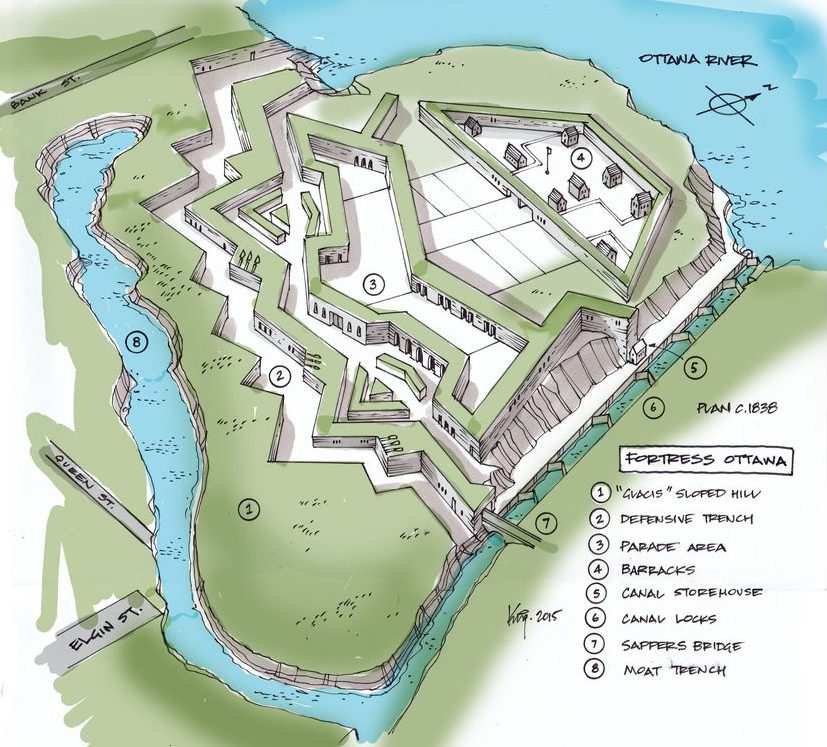
Fortress Ottawa, a post-War of 1812 alternative use for Parliament Hill
Colby Cosh linked to this Ottawa Citizen article by Andrew King:
Mapped out with defensive moats, trenches and cannon placements, Bytown’s sprawling stone fortification on the hill was a typical 19th century “star fort,” similar to Fort George in Halifax, also known as Citadel Hill, and the Citadelle de Québec in Quebec City. The “star fort” layout style evolved during the era of gunpowder and cannons and was perfected by Sebastien Le Prestre de Vauban, a French engineer who studied 16th century forts designed by the Knights of Malta. A star fort built by the order with trenches and angled walls withstood a month-long siege by the Ottoman Empire. This layout remained the standard in fort design until the 20th century.
Ottawa’s planned fortress would have also integrated a water-filled moat trench to the south, where Laurier Street is now, to impede an attack. On the northern side, the natural limestone cliffs along the Ottawa River would have served as a defensive measure. Access and resupply points were at the canal near the Sappers Bridge, and a zigzagging trench with six-metre-high stone walls would have run parallel to Queen Street. Parliament Hill, with its gently sloping banks to the south, was called a “glacis” positioned in front of the main trench so that the walls were almost totally hidden from horizontal artillery attack, preventing point-blank enemy fire.
Conceptual image by Andrew King of the “alternate reality” where Fortress Ottawa came to be.
After the rebellions were quashed and the threat of an attack from the United States fizzled out by the mid-1850s, Canada abandoned plans to fortify Bytown.
In 1856, the Rideau Canal system was relinquished to civilian control, and three years later Bytown was selected as the capital of the Province of Canada. The grand plans for Ottawa’s massive stone fortress were shelved and the area that would have been Citadel Hill became the scene of a different kind of battle, that of politics.
QotD: Explaining why men tend to be slobs, but women very much don’t
The central fact that controls the the preferences of both sexes is that bearing children is difficult and dangerous for women, but fertilizing a woman is almost trivially easy for a man. Furthermore, the female investment in childbearing is front-loaded (proportionally more of the risk is before and at birth) while the male investment is back-loaded (proportionately more of the risks and costs are incurred after birth).
Moderns living in a largely disease-free environment seldom realize how cruel and pressing these differences were over most of our species history. But before modern sanitation, death in childbirth was so common that men wealthy enough to afford it expected to have several wives during their lifetimes, losing many of them to childbed fever and other complications.
Also relevant is the extremely high rate of childhood death from infectious diseases and parasites that was characteristic of premodern societies. Disease resistance in humans is highly variable and generally increases with genetic mixing (the same reason a mongrel puppy or kitten is less likely to catch a disease than a purebreed). Thus, both men and women have instincts intended to maximize genetic variety in their offspring in order to maximize the chances that some will survive to reproductive age.
Our instincts evolved to cope with these patterns of life and death. The next piece we need to understand those instincts is what physical beauty means. Recent anthropology revealing strong cross-cultural patterns in the perception of pulchritude is helpful here.
In both sexes, the most important beauty indicators include symmetrical features and a good complexion (clear skin without blemishes, warts, etc.). It turns out these are indicators of resistance to infection and parasites, especially resistance in childhood and during adolescent growth. Good hair is also a health indicator.
In men, physical signs of strength, dexterity, and agility are also favored; this reflects the value female instinctive wiring puts on male specializations in burst exertion, hunting, and warfare. In women, signs of fertility and fitness to bear are favored (healthy and generous breasts, a certain range of hip-to-waist ratios).
Men fixate on physical beauty and youth because under primitive conditions it is a leading indicator of the ability to bear and suckle children. Through most of history, plain or ugly women were bad risks for the next round of infectious diseases — and their children, carrying their genes, were too.
The last piece of the puzzle is that men and women have asymmetrical information about the parentage of their children. A woman is seldom in doubt about which children are the issue of her womb; a man, by contrast, can never be as sure which are the fruit of his seed. Thus, genetic selfishness motivates the woman in a mated pair to sacrifice more for her children than it does the man. This is why women abandon their children far less often than men do.
While women do respond to male good looks, it’s not the agenda-topper for them that it is for men. To understand why this is, it helps to know that the optimal mating strategy for a woman begins with hooking a good provider, a man who will stick around to support the kids in spite of not being as sure that he’s their father as the woman is of being their mother. Where men look for fitness to bear children, women seek the capability and willingness to raise them.
Thus, robust health and infection resistance, while desirable in a potential husband, are not the be-all and end-all. Behavior traits indicating attachment, loyalty, nurturance, and kindness are more important than a tight six-pack. Men instinctively worry about these things less because they know women are more certain of parentage and thus more tightly bonded to their children. Fitness-to-raise also means that indicators of success and social status count for more in men. Men marry health and beauty, women marry security and good prospects.
There is, however, one important exception — one circumstance under which women are just as physical, beauty-oriented, and “shallow” in their mating preferences as men. That’s when they’re cheating.
Both sexes have a genetic-diversity incentive to screw around, but it manifests in different ways. Again, the reason is parentage uncertainty. For a man, diversity tactics are simple — boff as many hot babes as possible, accepting that you don’t know which of their kids are yours and counting on stronger maternal bonding to ensure they will have at least one devoted parent around. Because a woman can be more sure of who her offspring are, her most effective diversity tactic is different — get married to a good provider and then cheat on him.
Under those circumstances, she doesn’t have to value good character in a mating partner as much; hubby, who can’t tell the kids aren’t his, will supply that. Thus the relative value of handsomeness goes up when a woman is taking a lover on the sly. Marrying the lord and screwing the gardener is an old game, and from a genetic-selfishness point of view a very effective one.
Eric S. Raymond, “A Unified Theory of Male Slobbishness and Female Preening”, Armed and Dangerous, 2005-01- 06.
February 12, 2017
Recap Of Our Trip To Verdun I THE GREAT WAR Special
Published on 11 Feb 2017
Exploring the Verdun Area: http://www.meusetourism.com/en/mobile-apps/around-verdun.html
Verdun Game: http://verdungame.com
The Restaurant: http://www.les-colimencarts.fr/
British History’s Biggest Fibs with Lucy Worsley Episode 2: The Glorious Revolution
Published on 3 Feb 2017
In this episode, Lucy debunks another of the biggest fibs in British history – the ‘Glorious Revolution’.
In 1688, the British Isles were invaded by a huge army led by Dutch prince, William of Orange. With his English wife Mary he stole the throne from Mary’s father, the Catholic King James II. This was the death knell for absolute royal power and laid the foundations of our constitutional monarchy. It was spun as a ‘glorious and bloodless revolution’. But how ‘glorious’ was it really? It led to huge slaughter in Ireland and Scotland. Lucy reveals how the facts and fictions surrounding 1688 have shaped our national story ever since.
QotD: Magna Carta
It’s remarkable that the English-speaking world remembers Magna Carta. The product of a struggle between King John and his barons, it was sealed on the bank of the Thames 800 years ago, on June 15, 1215. But in a sense, the most valuable thing about Magna Carta is precisely that it is remembered. Other charters were issued across medieval Europe, but they were rapidly forgotten.
Magna Carta alone endured because the kings of England never consolidated their power fully enough to be able to ignore their subjects. The charter was a useful political weapon in this struggle against arbitrary royal power, which is why it was so often reissued, appealed to, and celebrated, not least in the United States by the Founding Fathers: The Massachusetts state seal adopted in 1775 includes a patriot holding the Great Charter. To remember is, literally, to recall to mind, to renew in thought, which is why memory, as Orwell recognized in 1984, is a great defense of liberty.
This year, Magna Carta is being acclaimed as the contract that first established the idea that law was above government. As British politician and historian Daniel Hannan has put it, from Magna Carta flowed “all the rights and freedoms that we now take for granted: uncensored newspapers, security of property, equality before the law, habeas corpus, regular elections, sanctity of contract, jury trials.” And that’s fair: The barons wanted to limit King John’s arbitrary power, and without limits there is no liberty under law.
But it does not take very much bravery now to celebrate our rights. Today, the language of rights is universal, though often hypocritical. Worse, the danger to liberty in the U.S. and Britain today is not arbitrary power of the sort exercised by King John, who offered no real theory except that he needed the money he was stealing to fight his wars in France. The danger to liberty today, ironically, comes more from arbitrary power backed up by the rights-talk that can trace its origins back to Magna Carta. Against my right to free expression stands your supposed right not to be offended. My right to property must now pay for your right to free health care. My right not to be discriminated against must give way to your right to be discriminated in favor of.
Ted R. Bromund, “Magna Carta limited government”, National Review, 2015-06-15.
February 11, 2017
QotD: The Nazi Final Solution in Denmark and Bulgaria
… most nations of Central and Eastern Europe were occupied by or allied with Germany during this period. The Nazis made it clear that deporting their Jews to the concentration camps in Nazi territory was a condition for continued good relations; a serious threat, when bad relations could turn a protectorate-type situation into an outright invasion and occupation.
Pride of place goes to Denmark and Bulgaria, both of which resisted all Nazi demands despite the Germans having almost complete power over them. Most people have heard the legend of how, when the Germans ordered that all Jews must wear gold stars, the King of Denmark said he would wear one too. These kinds of actions weren’t just symbolic; without cooperation from the Gentile population and common knowledge of who was or wasn’t Jewish, the Nazis had no good way to round people up for concentration camps. Nothing happened until 1943, when Himmler became so annoyed that he sent his personal agent Rolf Gunther to clean things up. Gunther tried hard but found the going impossible. Danish police refused to go door-to-door rounding up Jews, and when Gunther imported police from Germany, the Danes told them that they couldn’t break into apartments or else they would arrest them for breaking and entering. Then the Danish police tipped off Danish Jews not to open their doors to knocks since those might be German police. When it became clear that the Nazis weren’t going to accept any more delays, Danish fishermen offered to ferry Jews to neutral Sweden for free. In the end the Nazis only got a few hundred Danish Jews, and the Danish government made such a “fuss” (Arendt’s word) about them that the Nazis agreed to send them all to Theresienstadt, their less-murderous-than-usual camp, and let Red Cross observers in to make sure they were treated well. In the end, only 48 Danish Jews died in the entire Holocaust.
Bulgaria’s resistance was less immediately heroic, and looked less like the king proudly proclaiming his identity with oppressed people everywhere than with the whole government just dragging their feet so long that nothing got done. Eichmann sent an agent named Theodor Dannecker to get them moving, but as per Arendt:
not until about six months later did they take the first step in the direction of “radical” measures – the introduction of the Jewish badge. For the Nazis, even this turned out to be a great disappointment. In the first place, as they dutifully reported, the badge was only a “very little star”; second, most Jews simply did not wear it; and, third, those who did wear it received “so many manifestations of sympathy from the misled population that they actually are proud of their sign” – as Walter Schellenberg, Chief of Counterintelligence in the R.S.H.A., wrote in an S.D. report transmitted to the Foreign Office in November, 1942. Whereupon the Bulgarian government revoked the decree. Under great German pressure, the Bulgarian government finally decided to expel all Jews from Sofia to rural areas, but this measure was definitely not what the Germans demanded, since it dispersed the Jews instead of concentrating them.
The Bulgarians continued their policy of vaguely agreeing in principle to Nazi demands and then doing nothing, all the way until the Russians invaded and the time of danger was over. The result was that not a single Bulgarian Jew died in the Holocaust.
Scott Alexander, “Book review: Eichmann in Jerusalem”, Slate Star Codex, 2017-01-30.
February 10, 2017
Bulgaria Digs In At Doiran – The Final Blow Against The Senussi I THE GREAT WAR Week 133
Published on 9 Feb 2017
While the US breaks off diplomatic relations with Germany in response to unrestricted submarine warfare, the Western Front is rather quiet. On the Macedonian Front, the Bulgarian Army is digging in at Doiran. They built a formidable defence network without the Entente realising it and this week 100 years ago the British get a first taste of that. The British also deal the final blow against the Senussi tribesmen on the Libyan Front.


