
Published on 20 Feb 2015
Welcome to IT’S HISTORY! We are kicking off this new history channel by taking you on a journey through the Industrial Revolution. In our first episode about INVENTIONS, Brad Explains everything about the history of the light bulb – it was a long way from the discovery of fire till the first electrical lightning. Learn who else, besides Thomas Alva Edison and Nikola Tesla helped form the technology that illuminates our nights to this day!
March 4, 2017
Let There Be Light – The Invention Of The Light Bulb I THE INDUSTRIAL REVOLUTION
Comments Off on Let There Be Light – The Invention Of The Light Bulb I THE INDUSTRIAL REVOLUTION
QotD: The freedoms of yesteryear versus the freedoms of today
I am deeply concerned for the United Kingdom and its future. I look at the old country as it was in my youth and as it is today and, to use a fine Scots word, I am scunnered.
I know that some things are wonderfully better than they used to be: the new miracles of surgery, public attitudes to the disabled, the health and well-being of children, intelligent concern for the environment, the massive strides in science and technology.
Yes, there are material blessings and benefits innumerable which were unknown in our youth.
But much has deteriorated. The United Kingdom has begun to look more like a Third World country, shabby, littered, ugly, run down, without purpose or direction, misruled by a typical Third World government, corrupt, incompetent and undemocratic.
My generation has seen the decay of ordinary morality, standards of decency, sportsmanship, politeness, respect for the law, family values, politics and education and religion, the very character of the British.
Oh how Blimpish this must sound to modern ears, how out of date, how blind to “the need for change and the novelty of a new age”. But don’t worry about me. It’s the present generation with their permissive society, their anything-goes philosophy, and their generally laid-back, inyerface attitude I feel sorry for.
They regard themselves as a completely liberated society when in fact they are less free than any generation since the Middle Ages.
Indeed, there may never have been such an enslaved generation, in thrall to hang-ups, taboos, restrictions and oppressions unknown to their ancestors (to say nothing of being neck-deep in debt, thanks to a moneylender’s economy).
We were freer by far 50 years ago — yes, even with conscription, censorship, direction of labour, rationing, and shortages of everything that nowadays is regarded as essential to enjoyment.
We still had liberty beyond modern understanding because we had other freedoms, the really important ones, that are denied to the youth of today.
We could say what we liked; they can’t. We were not subject to the aggressive pressure of special interest minority groups; they are. We had no worries about race or sexual orientation; they have. We could, and did, differ from fashionable opinion with impunity, and would have laughed PC to scorn, had our society been weak and stupid enough to let it exist.
We had available to us an education system, public and private, that was the envy of the world. We had little reason to fear being mugged or raped (killed in war, maybe, but that was an acceptable hazard).
Our children could play in street and country in safety. We had few problems with bullies because society knew how to deal with bullying and was not afraid to punish it in ways that would send today’s progressives into hysterics.
We did not know the stifling tyranny of a liberal establishment, determined to impose its views, and beginning to resemble George Orwell’s Ministry of Truth.
Above all, we knew who we were and we lived in the knowledge that certain values and standards held true, and that our country, with all its faults and need for reforms, was sound at heart.
George MacDonald Fraser, “The last testament of Flashman’s creator: How Britain has destroyed itself”, Daily Mail, 2008-01-05.
Comments Off on QotD: The freedoms of yesteryear versus the freedoms of today
March 3, 2017
Conrad Loses His Job – Nivelle’s Coup I THE GREAT WAR Week 136
Published on 2 Mar 2017
The new Austro-Hungarian Kaiser is not happy about his Empire’s dependence on the German ally. And he is also not happy about their own military decisions and over the winter has worked to replace key positions with his own men. The last step in that process is convincing Conrad von Hötzendorf to take a position on the Italian Front. At the same time, French Commander Robert Nivelle is trying to get control over the British Armies on the Western Front and the Zimmermann Telegram is released to the press.
Comments Off on Conrad Loses His Job – Nivelle’s Coup I THE GREAT WAR Week 136
“Apollo 8 altered the self-perception of our species forever”
Colby Cosh contrasts the insane bravado of John F. Kennedy’s moonshot announcement with the more recent insane bravado of Elon Musk and SpaceX:
SpaceX, the private rocketry company founded in 2002 by billionaire adventurer Elon Musk, says it is developing plans to fly two unnamed persons to the moon late in 2018. This announcement has created both skepticism and alarm. This is, I think, partly a matter of confusion about prepositions.
If I announced that, despite being Canada’s most sedentary citizen, I was going to Mount Everest next week, you would probably know better than to assume I was going UP the mountain. SpaceX’s proposal is to send a manned spacecraft beyond the moon. That’s the word they use in the SpaceX press release, and whoever chose it should get a big fat bonus. “Beyond” is an English word of unparalleled connotative power and romance.
But, of course, going beyond the moon — more prosaically, looping around it and coming back — is much, much simpler than landing ON it. It is probably not a fantastically difficult challenge, and the company’s zany-sounding timeline may be justified. (Mind you, this is not a prediction.)
Even if you are old enough to have followed the golden age of spaceflight as it happened, you may not understand or remember the half-insane ambition of John F. Kennedy’s original proposal to land men on the moon. For young and old, the moment that the Apollo 11 lunar module landed on the Sea of Tranquility tends to obscure everything else about the tale in retrospect. But no U.S. astronaut had orbited the Earth yet when JFK threw down the gauntlet. No spaceship had photographed, much less touched, the moon.
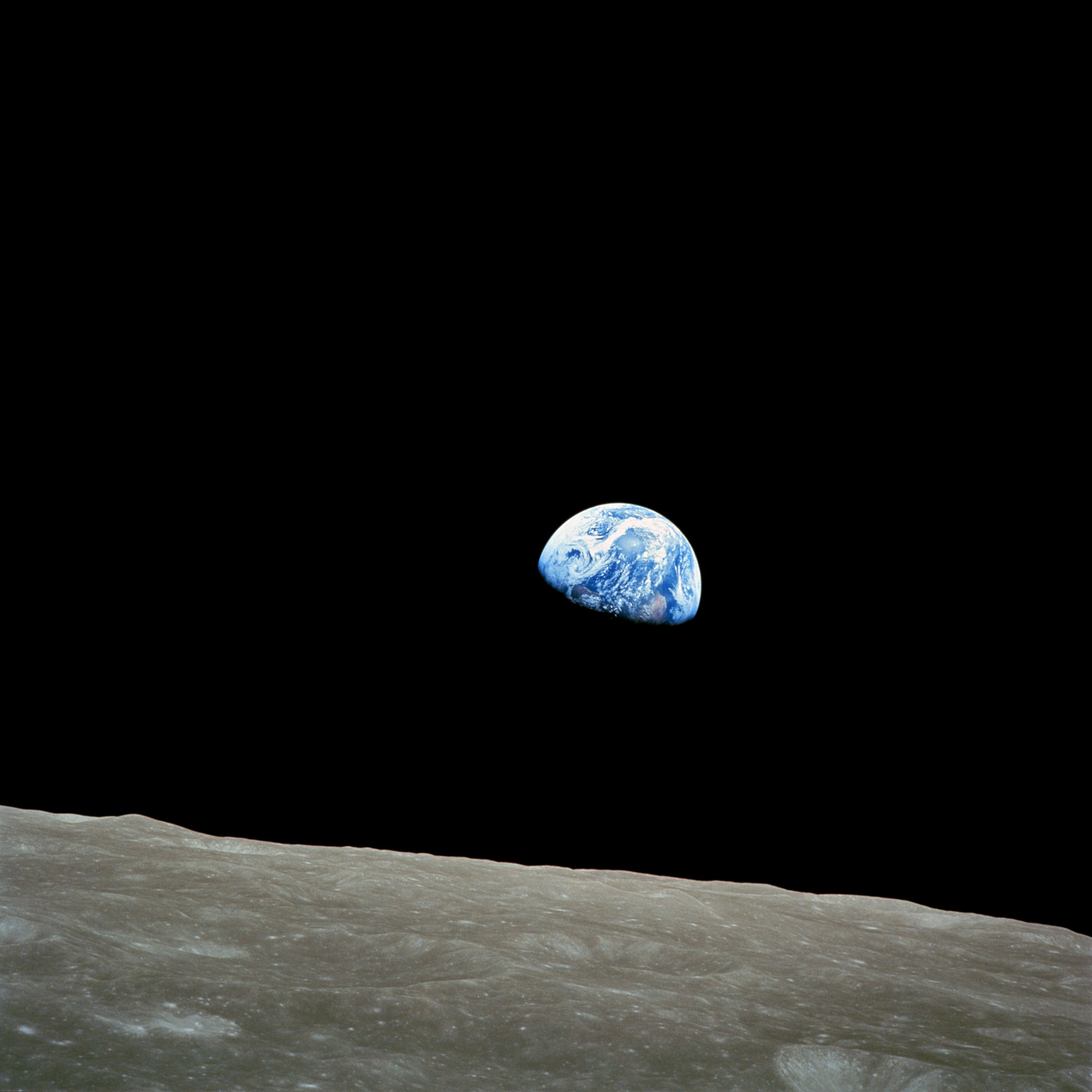
Taken by Apollo 8 crew member Bill Anders on December 24, 1968, at mission time 075:49:07 (16:40 UTC), while in orbit around the Moon, showing the Earth rising for the third time above the lunar horizon. The lunar horizon is approximately 780 kilometers from the spacecraft. Width of the photographed area at the lunar horizon is about 175 kilometers. The land mass visible just above the terminator line is west Africa. Note that this phenomenon is only visible to an observer in motion relative to the lunar surface. Because of the Moon’s synchronous rotation relative to the Earth (i.e., the same side of the Moon is always facing Earth), the Earth appears to be stationary (measured in anything less than a geological timescale) in the lunar “sky”. In order to observe the effect of Earth rising or setting over the Moon’s horizon, an observer must travel towards or away from the point on the lunar surface where the Earth is most directly overhead (centred in the sky). Otherwise, the Earth’s apparent motion/visible change will be limited to: 1. Growing larger/smaller as the orbital distance between the two bodies changes. 2. Slight apparent movement of the Earth due to the eccenticity of the Moon’s orbit, the effect being called libration. 3. Rotation of the Earth (the Moon’s rotation is synchronous relative to the Earth, the Earth’s rotation is not synchronous relative to the Moon). 4. Atmospheric & surface changes on Earth (i.e.: weather patterns, changing seasons, etc.).
NASA photo via Wikimedia.
Comments Off on “Apollo 8 altered the self-perception of our species forever”
March 2, 2017
Catherine the Great – II: Not Quite Empress Yet – Extra History
Published on 4 Feb 2017
Sophia’s excitement to meet her future husband deflated when she realized Peter III was a boor who cared nothing about Russia. By contrast, she threw herself into learning the culture with such vigor that she earned the love of the people. She was rechristened Catherine and married Peter… but when he became emperor, his mistakes and her popularity began to add up to a crisis situation.
Comments Off on Catherine the Great – II: Not Quite Empress Yet – Extra History
February 28, 2017
Outbreak of World War 1 – A Banker’s Perspective I THE GREAT WAR Special
Published on 27 Feb 2017
The classic narrative of the outbreak of World War 1 is that everyone saw it coming and was awaiting it with patriotic fervor. But studying the people that profited most from a war, the bankers, that idea is definitely challenged.
Comments Off on Outbreak of World War 1 – A Banker’s Perspective I THE GREAT WAR Special
Remembering the Royal Navy’s humiliation at the Battle of Chatham
Apparently the Royal Navy’s long unbroken tradition of glorious victories had a few setbacks after all, like the 1667 Battle of Chatham, which a flotilla of Dutch sailing vessels will be commemorating this June:
The Dutch are preparing to invade English seas with a fleet of 90 vessels after a previous expedition boarded the Royal Navy’s flagship and stole the Royal Coat of Arms from her.
In a celebration of Dutch Admiral De Ruyter’s 1667 raid on Chatham Dockyard, which resulted in English flagship HMS Royal Charles being boarded and ransacked by Dutch sailors, their modern-day civilian counterparts are planning a memorial cruise to Chatham.
The raid is known in British naval history as the Battle of Chatham, and formed part of the endless naval scrapping of the middle of the last millennium which eventually forged Britain’s 19th century dominance of the high seas.
In the battle, the numerically superior Dutch fleet sailed right up the River Medway into Chatham, Kent, and generally caused mayhem amongst the laid-up English warships moored there. The English fleet, starved of money and manpower, could not afford to put to sea in numbers despite wreaking havoc on the Dutch in the previous year.
Amongst other booty, the Dutch made off with the English royal coat of arms from fleet flagship HMS Royal Charles, which adorned the warship’s stern. The ornate carving can be viewed in the Netherlands’ Rijksmuseum today.
Comments Off on Remembering the Royal Navy’s humiliation at the Battle of Chatham
How to Make Medieval Stocks – Torture Your Friends and Family With This DIY Pillory
Published on 7 Oct 2016
You can make this fun DIY medieval torture device in a weekend! FREE PLANS and full article►► http://woodworking.formeremortals.net/2016/10/how-to-make-medieval-stocks-pillory/
Comments Off on How to Make Medieval Stocks – Torture Your Friends and Family With This DIY Pillory
QotD: “Mr. Keynes’ excellent little book”
Interestingly, Mussolini found much of John Maynard Keynes’s economic theories consistent with fascism, writing: “Fascism entirely agrees with Mr. Maynard Keynes, despite the latter’s prominent position as a Liberal. In fact, Mr. Keynes’ excellent little book, The End of Laissez-Faire (l926) might, so far as it goes, serve as a useful introduction to fascist economics. There is scarcely anything to object to in it and there is much to applaud.”
After the worldwide Great Depression, Mussolini became more vocal in his claims that fascism explicitly rejected the capitalist elements of economic individualism and laissez-faire liberalism. In his “Doctrine of Fascism,” Mussolini wrote: “The Fascist conception of life accepts the individual only in so far as his interests coincide with the State. . . . Fascism reasserts the rights of the state. If classical liberalism spells individualism, Fascism spells government.” In his 1928 autobiography, Mussolini made clear his dislike for liberal capitalism: “The citizen in the Fascist State is no longer a selfish individual who has the anti-social right of rebelling against any law of the Collectivity.”
Lawrence K. Samuels, The Socialist Economics of Italian Fascism, quoted by Perry de Havilland in “Mussolini admired ‘Mr. Keynes’ excellent little book'” at Samizdata, 2015-07-08.
Comments Off on QotD: “Mr. Keynes’ excellent little book”
February 27, 2017
“Dumb Norsemen go into the north outside the range of their economy, mess up the environment and then they all die when it gets cold”
Debunking the Greenland myth in the Smithsonian:
Those tough seafaring warriors came to one of the world’s most formidable environments and made it their home. And they didn’t just get by: They built manor houses and hundreds of farms; they imported stained glass; they raised sheep, goats and cattle; they traded furs, walrus-tusk ivory, live polar bears and other exotic arctic goods with Europe. “These guys were really out on the frontier,” says Andrew Dugmore, a geographer at the University of Edinburgh. “They’re not just there for a few years. They’re there for generations — for centuries.”
So what happened to them?
**********
Thomas McGovern used to think he knew. An archaeologist at Hunter College of the City University of New York, McGovern has spent more than 40 years piecing together the history of the Norse settlements in Greenland. With his heavy white beard and thick build, he could pass for a Viking chieftain, albeit a bespectacled one. Over Skype, here’s how he summarized what had until recently been the consensus view, which he helped establish: “Dumb Norsemen go into the north outside the range of their economy, mess up the environment and then they all die when it gets cold.”
[…]
But over the last decade a radically different picture of Viking life in Greenland has started to emerge from the remains of the old settlements, and it has received scant coverage outside of academia. “It’s a good thing they can’t make you give your PhD back once you’ve got it,” McGovern jokes. He and the small community of scholars who study the Norse experience in Greenland no longer believe that the Vikings were ever so numerous, or heedlessly despoiled their new home, or failed to adapt when confronted with challenges that threatened them with annihilation.
“It’s a very different story from my dissertation,” says McGovern. “It’s scarier. You can do a lot of things right — you can be highly adaptive; you can be very flexible; you can be resilient — and you go extinct anyway.” And according to other archaeologists, the plot thickens even more: It may be that Greenland’s Vikings didn’t vanish, at least not all of them.
H/T to Kate at Small Dead Animals for the link.
Comments Off on “Dumb Norsemen go into the north outside the range of their economy, mess up the environment and then they all die when it gets cold”
February 26, 2017
Disc Grenade – Camel Corps – Austro-Hungarian Heroes I OUT OF THE TRENCHES
Published on 25 Feb 2017
Indy sits in a French Chair this time and answers your questions about World War 1. This week we talk about the German disc grenades and the heroes that were celebrated in Austria-Hungary.
Comments Off on Disc Grenade – Camel Corps – Austro-Hungarian Heroes I OUT OF THE TRENCHES
British History’s Biggest Fibs with Lucy Worsley Episode 3: The Jewel in the Crown
Published on 10 Feb 2017
In the final episode, Lucy debunks the fibs that surround the ‘jewel in the crown’ of the British Empire – India. Travelling to Kolkata, she investigates how the Raj was created following a British government coup in 1858. After snatching control from the discredited East India Company, the new regime presented itself as a new kind of caring, sharing imperialism with Queen Victoria as its maternal Empress.
Tyranny, greed and exploitation were to be things of the past. From the ‘black hole of Calcutta’ to the Indian ‘mutiny’, from East India Company governance to crown rule, and from Queen Victoria to Empress of India, Lucy reveals how this chapter of British history is another carefully edited narrative that’s full of fibs.
Comments Off on British History’s Biggest Fibs with Lucy Worsley Episode 3: The Jewel in the Crown
February 24, 2017
Mechanised War In Mesopotamia – Toplica Uprising I THE GREAT WAR Week 135
Published on 23 Feb 2017
After the humiliating defeat at Kut last year, the British upped their game in Mesopotamia and this week 100 years ago the British Indian Army starts making gains towards Baghdad. In the occupied territories of Serbia the local population is rising up against the Bulgarian and Austro-Hungarian occupants and on the Western Front, the British make surprisingly easy progress against the German Army.
Comments Off on Mechanised War In Mesopotamia – Toplica Uprising I THE GREAT WAR Week 135
February 23, 2017
Catherine the Great – I: Not Quite Catherine Yet – Extra History
Published on Jan 28, 2017
Before she became Catherine the Great, legendary empress of Russia, she was a smart but lonely girl named Sophia. Her mother ignored her until family connections proposed a marriage between Sophia and the presumptive heir to the Russian throne – and suddenly she was thrown from her quiet life in a backwoods mansion to the center of a cutthroat political world.
Comments Off on Catherine the Great – I: Not Quite Catherine Yet – Extra History
February 21, 2017
Medical Treatment in World War 1 I THE GREAT WAR Special
Published on 20 Feb 2017
Some sources say that during the four years of World War 1, medicine and medical treatments advances more than during any other four year period in human history. The chances for a soldier to survive his injury were far greater in 1918 than in 1914.
Comments Off on Medical Treatment in World War 1 I THE GREAT WAR Special


