
The Tank Museum
Published on 5 Aug 2016In the 24th Tank Chat, David Fletcher looks at the rather unusual Vickers A1E1 Independent. The Independent originated in 1922 with a War Office specification for a heavy tank. Ultimately it proved to be a failed project was abandoned in 1935, by which time it had cost more than £150,000, and sent to Bovington. It is the only tank of its kind in existence.
March 17, 2018
Tank Chats #24 Vickers A1E1 Independent | The Tank Museum
Comments Off on Tank Chats #24 Vickers A1E1 Independent | The Tank Museum
QotD: Translation error?
Here are two more facts known to many educated people:
1. The Christians did not begin to arrive at a settlement of the question of the divinity of Jesus until surprisingly late – the council of Nicaea in AD 325, and important controversies remained live until the Third Council of Constantinople in 680.
2. The original Aramaic-speaking Christians of Palestine having been effectively wiped out in the aftermath of the Bar Kokba revolt in AD 70, Christianity was re-founded by Paul of Tarsus among speakers of Koine Greek. The entire New Testament is written in Koine Greek.
Now here are two facts generally known only among a handful of specialist scholars. I picked them up through omnivorous reading and did not fully realize their significance for a long time.
3. In other Aramaic sources roughly contemporary with the New Testament, the phrase “Son of God” occurs as an idiom for “guru” or “holy man”. Thus, if Jesus refers to himself as “the son of God”, the Aramaic sense is arguably “the boss holy man”.
4. The Koine Greek of the period, on the other hand, did not have this idiom.
Now, imagine a Koine speaker reading the lost Aramaic source documents of which the Gospels are redactions, with only an indifferent command of the latter language He does not know that “Son of God” is an idiom…
Yes, that’s right. I’m suggesting that Jesus got deified by a translation error!
(Correction: The Bar Kokba revolt was AD 132; I was confusing it with the revolt of AD 70 in which the Temple at Jerusalem was destroyed.)
Eric S. Raymond, “Translation Errors”, Armed and Dangerous, 2009-02-12.
Comments Off on QotD: Translation error?
March 16, 2018
Allied Unified Command On The Horizon I THE GREAT WAR Week 190
The Great War
Published on 15 Mar 2018While Germany is occupying a territory from the Baltics to the Black Sea and planning its huge spring offensive, the Allies are still trying to get behind the idea of a unified command.
Comments Off on Allied Unified Command On The Horizon I THE GREAT WAR Week 190
The Imperial German Army’s final throw of the dice – Operation Michael, March 1918
Victor Davis Hanson summarizes the Central Powers’ brief moment of strength early in 1918:
One hundred years ago this month, all hell broke loose in France. On March 21, 1918, the German army on the Western Front unleashed a series of massive attacks on the exhausted British and French armies.
German General Erich Ludendorff thought he could win World War I with one final blow. He planned to punch holes between the French and British armies. Then he would drive through their trenches to the English Channel, isolating and destroying the British army.
The Germans thought they had no choice but to gamble.
The British naval blockade of Germany after three years had reduced Germany to near famine. More than 200,000 American reinforcement troops were arriving each month in France. (Nearly 2 million would land altogether.) American farms and factories were sending over huge shipments of food and munitions to the Allies.
Yet for a brief moment, the war had suddenly swung in Germany’s favor by March 1918. The German army had just knocked Russia and its new Bolshevik government out of the war. The victory on the Eastern Front freed up nearly 1 million German and Austrian soldiers, who were transferred west.
Germany had refined new rolling artillery barrages. Its dreaded “Stormtroopers” had mastered dispersed advances. The result was a brief window of advantage before the American juggernaut changed the war’s arithmetic.
The Spring Offensive almost worked. Within days, the British army had suffered some 50,000 casualties. Altogether, about a half-million French, British and American troops were killed or wounded during the entire offensive.
But within a month, the Germans were sputtering. They could get neither supplies nor reinforcements to the English Channel. Germany had greedily left 1 million soldiers behind in the east to occupy and annex huge sections of conquered Eastern Europe and western Russia.
The British and French had learned new ways of strategic retreat. By summer of 2018, the Germans were exhausted. In August, the Allies began their own (even bigger) offensive and finally crushed the retreating Germans, ending the war in November 1918.
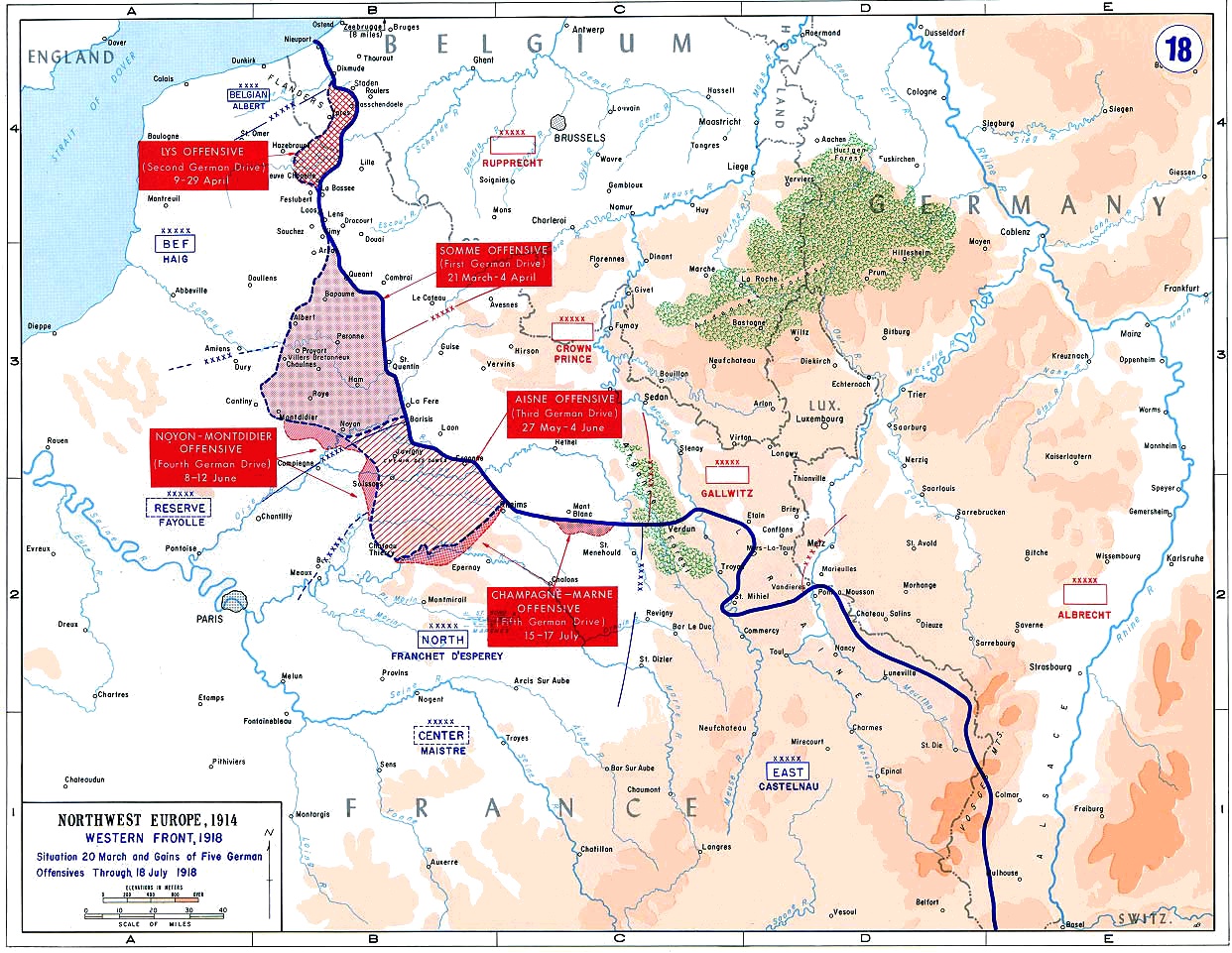
Click to see full-sized image.
For more information on Operation Michael, sometimes known as “The Kaiser’s Battle”, here’s the Wikipedia entry.
Comments Off on The Imperial German Army’s final throw of the dice – Operation Michael, March 1918
Anti-semitism and the alt-right
Jonathan Anomaly and Nathan Cofnas discuss the widespread anti-semitism of the various groups we generally lump together as “alt-right”:
For many on the alt-right, every grievance is, at root, about Jews. Andrew Anglin, host of the most popular alt-right/neo-Nazi website, explains: “the only thing in our movement that really matters [is] anti-Semitism.” If only the Jews were gone, he argues, the white race, freed from bondage, would immediately overcome all of its problems. Where does this attitude come from?
Jews are a conspicuous people, small in number but large in footprint. As Mark Twain wrote in 1899:
If the statistics are right, the Jews constitute but one quarter of one percent of the human race….Properly, the Jew ought hardly to be heard of, but he is heard of, has always been heard of. He is as prominent on the planet as any other people, and his importance is extravagantly out of proportion to the smallness of his bulk….What is the secret of his immortality?
For many people throughout history, the answer to Twain’s question was simple: Jews conspire among themselves to dominate and disadvantage gentiles. This answer fell out of fashion, at least in polite society, after World War II. Since the 1990s, however, the conspiratorial account of Jewish prominence has taken on a new, more meretricious form in the work of (now retired) California State University, Long Beach psychologist Kevin MacDonald, known affectionately among alt-righters as “KMac.” According to Richard Spencer, the inventor of the term “alt-right” and unofficial leader of the movement: “There is no man on the planet who has done more for the understanding of the pole around which the world revolves than Kevin MacDonald.” And: “KMac…may be the most essential man in our movement in terms of thought leader[ship].” To understand the alt-right’s anti-Semitism, we must understand MacDonald’s ideas, particularly as outlined in his most influential book, The Culture of Critique.
According to MacDonald, Judaism is a “group evolutionary strategy.” Jews possess both genetic and cultural adaptations (including, on the genetic side, high IQ and ethnocentrism) that allow them to develop successful intellectual movements that undermine gentile society and promote their own group continuity. “Jewish intellectual movements,” MacDonald argues, are led by charismatic figures analogous to rabbis. They attack white nationalism while promoting Jewish nationalism, and use pseudoscience to “pathologize” anti-Semitism, which in reality is a justified response to “Jewish aggression.” According to MacDonald, Jewish intellectual movements include Freudianism, Frankfurt School critical theory, and multiculturalism. These movements, MacDonald claims, taught white gentiles to reject ethnocentrism and accept high levels of nonwhite immigration to their countries while tolerating Jewish ethnocentrism and racially restrictive immigration policies in Israel.
MacDonald’s theory and the anti-Semitism of many on the alt-right are largely reactions to the perceived liberalism of Jews. One of us (Cofnas) has just published an academic paper that examines MacDonald’s most influential book, The Culture of Critique, and finds that it is chock full of misrepresented sources, cherry-picked facts, and egregious distortions of history. MacDonald and the alt-righters are, nevertheless, correct that many liberal leaders over the last hundred years have been Jewish. We’d like to offer an explanation for this phenomenon, as well as determine whether Jewish liberalism is the cause or the result of anti-Semitism.
Comments Off on Anti-semitism and the alt-right
How Rifles & Railroads influenced Warfare in the 19th Century
Military History Vlogs
Published on 23 Feb 2018The introduction of the breech-loading rifle and the railroad had a tremendous influence on Warfare in the 19th Century. Although, not everyone was as fast or able to adopt then the Prussians. Austria, France and Russia had major issues. Most notably visible in the Austro-Prussian War (1866) and Franco-Prussian War (1870-1871).
Comments Off on How Rifles & Railroads influenced Warfare in the 19th Century
March 15, 2018
DicKtionary – H is for Homicide – Francisco Macias Nguema
TimeGhost
Published on 14 Mar 2018H is for homicide, the taking of lives
Bloodthirsty people with pistols or knives
Or government leaders than strangled their nations
And Macias Nguema killed whole populations.Join us on Patreon: https://www.patreon.com/TimeGhostHistory
Written and Hosted by: Indy Neidell
Based on a concept by Astrid Deinhard and Indy Neidell
Produced by: Spartacus Olsson
Executive Producers: Bodo Rittenauer, Astrid Deinhard, Indy Neidell, Spartacus Olsson
Camera by: Ryan Tebo
Edited by: Bastian BeißwengerA TimeGhost format produced by OnLion Entertainment GmbH
Comments Off on DicKtionary – H is for Homicide – Francisco Macias Nguema
March 14, 2018
Battle Stack: The Battle of Isandlwana tactics
BattleStack
Published on 25 Nov 2016The Battle of Isandlwana was fought between the British and Zulus in 1879. Find out what happened with this animated tactics video!
Comments Off on Battle Stack: The Battle of Isandlwana tactics
March 13, 2018
German Tactics For 1918 Spring Offensive I THE GREAT WAR Special
The Great War
Published on 12 Mar 2018The German Spring Offensive in 1918, the so called Kaiserschlacht or Operation Michael, was the biggest German offensive of World War 1 and Quartermaster-general Erich Ludendorff prepared his troops for this battle by incorporating everything the German Army had learned in this war until now. Hutier Infiltration Tactics, Georg Bruchmüller’s artillery targeting and more lessons from the Eastern Front mean the Entente was facing a different army than before.
Comments Off on German Tactics For 1918 Spring Offensive I THE GREAT WAR Special
From slavery to Jim Crow to the civil rights movement
In the latest Libertarian Enterprise, Sean Gabb discusses the role of international affairs in reducing racial inequality in the United States from 1877 to 1981:
The year 1877 is significant in America history, as this was the year in which the Federal Government ceased to interfere in the affairs of its Southern States, and these States began to construct the system of white racial supremacy known as “Jim Crow.” It is also a useful starting point for charting the rise of America to world supremacy. In the years before 1914, the Americans regarded opposition to European colonial rule as a prime foreign policy objective. They resented British/Indian control of the far East and they were strongly opposed to any division of China between the European colonial powers. They preached an ’Open Door Policy’ for China in which none of the white powers would have political control.
Again, this concern for the independence and self-determination of others was inconsistent with their own internal policies. As put by Paul Gilroy in the introduction of The Autobiography of Malcolm X, “the American civil war did not end in 1865.” Until the 1960s and even later blacks remained systematically at a legal and social and economic disadvantage in America. In most of the Southern States, blacks were not allowed to vote or to sit on juries, public and most private services were racially segregated, racial intermarriage was made illegal.
[…]
In the end America did not sign the treaty of Versailles and did not join the League of Nations. American domestic affairs remained insulated from foreign affairs. Wilson himself did much to keep them so. The early twentieth century saw a grown of racial consciousness among American blacks, and a number of charismatic leaders emerged to press the case for black equality. These included intellectual activist W. E. B. Du Bois, entrepreneur C. J. Walker, National Equal Rights League founder William Monroe Trotter, and activist Wells-Barnett, and Marcus Garvey, founder of The Universal Negro Improvement Association. These men wanted to attend and address the Paris Peace Conference in 1919. Wilson ensured that they were kept out.
By the 1930s, we see a growing realisation of the conflict between foreign and domestic policy. Look, for example, at chapter 26 of Harper Lee’s classic novel To Kill A Mockingbird. It is the 1930s and a teacher in the protagonists’ school denounces Nazi mistreatment of the Jews in Germany. She seems completely unaware that the Nuremburg decrees may have compared rather well with the ‘Jim Crow’ system in which she lived.
[…]
What matters about the Cold war for America is that its race relations became a serious embarrassment to its foreign policy. In order to oppose Communism the Americans had to preach their own versions of human rights which included all the usual liberal freedoms – i.e. freedom of speech, freedom of association, equality before the law, and so forth. It also needed the cooperation of an increasing number of non-white post-colonial governments. At every opportunity the Soviets tried to embarrass the Americans by drawing attention to their internal race relations.
Take, for example, the memorandum written in June 1963 by Thomas Hughes, Assistant Secretary of State for Intelligence and Research at the State Department. He summarises some of the main themes of Soviet broadcasts to the Third World: Capitalism provides a natural environment for racism, which will never end so long as the American system needs cheap labour; the federal government’s policy of limited intervention in Southern conflicts is tantamount to support of Southern racism; the United States cannot claim to be the leader of the free world while hypocritically refusing to support civil rights within its own borders.
Hughes adds that, most politically damaging, Soviet broadcasters were arguing that American domestic policy toward its black citizens was ‘indicative of its policy toward peoples of color throughout the world.’ Emerging African, Asian, and South American nations, in other words, should not count on Americans to support their independence.
The journalist Walter Lippmann had noted in 1957 that
the work of the American propagandist is not at present a happy one…. [Segregation] mocks us and haunts us whenever we become eloquent and indignant in the United Nations…The caste system in this country, particularly when as in Little Rock it is maintained by troops, is an enormous, indeed an almost insuperable, obstacle to our leadership in the cause of freedom and human equality.
We can write the history of the American civil rights movement purely in terms of domestic politics. We can for example write about the Brown decision and ’Massive Resistance’ and the crisis in Little Rock. Of course this is entirely legitimate. The struggle for racial equality has deep roots in American history and may well have triumphed even had there been no other countries in the world. However it does seem reasonable to see an international dimension in the rapid progress of racial equality after the 1940s.
Comments Off on From slavery to Jim Crow to the civil rights movement
The Queen of Lesbos – Poetess Sappho l THE HISTORY OF SEX
IT’S HISTORY
Published on 16 Sep 2015The Greek poetess Sappho from the Isle of Lesbos is the most important female lyricist of the classical age. She worshipped women and often addressed her work to beautiful ladies. Although her definite sexuality will remain a mystery, it is almost as widely discussed as her work itself. The constant myth that Sappho was gay remains which is why the term “lesbian” dates back to Sappho’s erotic poetry. Learn all about the great Sappho and what the term “doing it like the ladies of Lesbos” actually means, on IT’S HISTORY.
Comments Off on The Queen of Lesbos – Poetess Sappho l THE HISTORY OF SEX
March 12, 2018
Genghis Khan – Khan of All Mongols – Extra History – #4
Extra Credits
Published on 10 Mar 2018Temüjin had a plan: a set of strategies to keep amassing wealth and followers for himself while keeping unity between all the disparate Mongol tribes he was collecting. But Jamukha and Ong Khan had other plans…
Comments Off on Genghis Khan – Khan of All Mongols – Extra History – #4
March 11, 2018
Savage Division – Displaced People – Sexual Relations I OUT OF THE TRENCHES
The Great War
Published on 10 Mar 2018Chair of Wisdom time!
Comments Off on Savage Division – Displaced People – Sexual Relations I OUT OF THE TRENCHES
Soviet Leaders in 7 Minutes (History)
Austin Olney
Published on 19 Apr 2016Learn about the leaders of the Soviet Union.
Vladimir Lenin
1917-1922
Joseph Stalin
1922- 1953
Georgy Malenkov
1953-1955
Nikita Khrushchev
1953 – 1964
Leonid Brezhnev
1964 – 1982
Yuri Andropov
1982 – 1984
Konstantin Chernenko
1984 – 1985
Mikhail Gorbachev
1985 – 1991Music – Goldeneye 64 Menu
Comments Off on Soviet Leaders in 7 Minutes (History)


