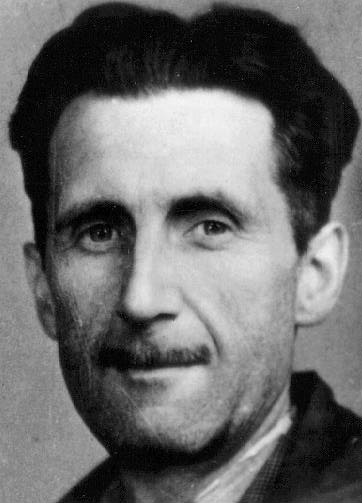
Orwell’s press card portrait, 1943
A few days ago a West African wrote to inform us that a certain London dance hall had recently erected a “colour bar”, presumably in order to please the American soldiers who formed an important part of its clientele. Telephone conversations with the management of the dance hall brought us the answers: (a) that the “colour bar” had been cancelled, and (b) that it had never been imposed in the first place; but I think one can take it that our informant’s charge had some kind of basis. There have been other similar incidents recently. For instance, I during last week a case in a magistrate’s court brought out the fact that a West Indian Negro working in this country had been refused admission to a place of entertainment when he was wearing Home Guard uniform. And there have been many instances of Indians, Negroes and others being turned away from hotels on the ground that “we don’t take coloured people”.It is immensely important to be vigilant against this kind of thing, and to make as much public fuss as possible whenever it happens. For this is one of those matters in which making a fuss can achieve something. There is no kind of legal disability against coloured people in this country, and, what is more, there is very little popular colour feeling. (This is not due to any inherent virtue in the British people, as our behaviour in India shows. It is due to the fact that in Britain itself there is no colour problem.)
The trouble always arises in the same way. A hotel, restaurant or what-not is frequented by people who have money to spend who object to mixing with Indians or Negroes. They tell the proprietor that unless he imposes a colour bar they will go elsewhere. They may be a very small minority, and the proprietor may not be in agreement with them, but it is difficult for him to lose good customers; so he imposes the colour bar. This kind of thing cannot happen when public opinion is on the alert and disagreeable publicity is given to any establishment where coloured people are insulted. Anyone who knows of a provable instance of colour discrimination ought always to expose it. Otherwise the tiny percentage of colour-snobs who exist among us can make endless mischief, and the British people are given a bad name which, as a whole, they do not deserve.
In the nineteen-twenties, when American tourists were as much a part of the scenery of Paris as tobacco kiosks and tin urinals, the beginnings of a colour bar began to appear even in France. The Americans spend money like water, and restaurant proprietors and the like could not afford to disregard them. One evening, at a dance in a very well-known cafe some Americans objected to the presence of a Negro who was there with an Egyptian woman. After making some feeble protests, the proprietor gave in, and the Negro was turned out.
Next morning there was a terrible hullabaloo and the cafe proprietor was hauled up before a Minister of the Government and threatened with prosecution. It had turned out that the offended Negro was the Ambassador of Haiti. People of that kind can usually get satisfaction, but most of us do not have the good fortune to be ambassadors, and the ordinary Indian, Negro or Chinese can only be protected against petty insult if other ordinary people are willing to exert themselves on his behalf.
George Orwell, “As I Please” Tribune, 1944-08-11.
August 30, 2019
QotD: Racism in London during WW2
August 29, 2019
“‘Neo-liberalism’ is actually little more than … ‘market socialism'”
Peter Boettke responds to a New York Times opinion piece by Binyamin Appelbaum, blaming economists for the state of the western world:
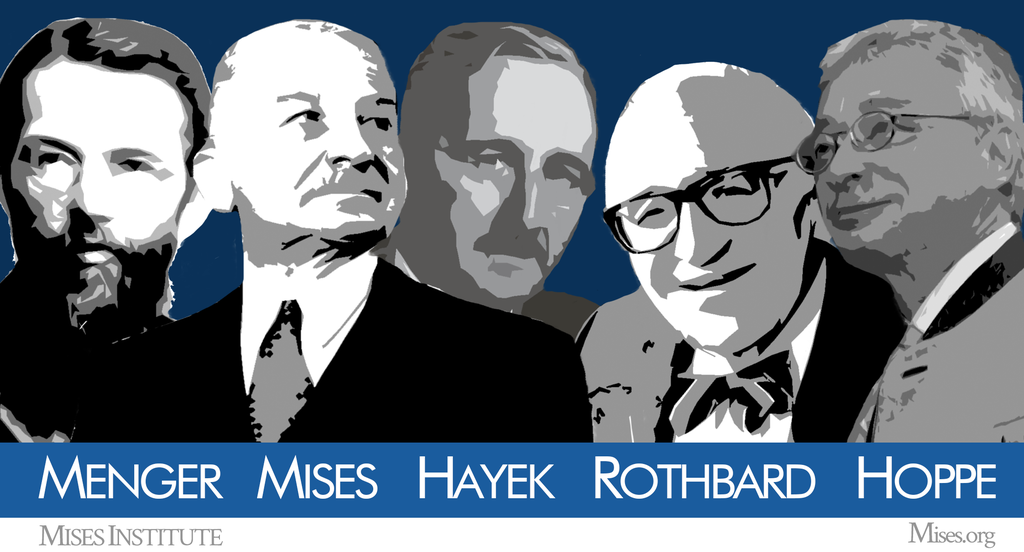
A Mises Institute graphic of some of the key economists in the Austrian tradition (Carl Menger, Ludwig von Mises, Friedrich Hayek, Murray Rothbard, and Hans-Hermann Hoppe.
Mises Institute via Wikimedia Commons.
But the problem is deeper than economists, it is ANYBODY put in this position of power and prestige, and to do so is fundamentally anti-democratic as was argued by Frank Knight in various writings, and then by Vincent Ostrom in The Intellectual Crisis of American Public Administration, and more recently in David Levy and Sandra Peart’s Escape from Democracy. We cannot fix this problem by replacing one set of “experts” with another set. We have to stop thinking of the relationship between economics and public administration along these lines altogether.
I try to lay out the argument in my SEA address on “Economics and Public Administration“, which also served as an attempt to summarize two decades of research that several of us have undertaken in this spirit. The critical argument in that text for this issue is that I argue that economics is a derived demand, if we conceive of the task of public administration one way, that will shape not only shape the supply and demand of economists, but dictate what it means to produce an economist — and thus, what is means to be an economist.
The problem with narratives like Appelbaum’s isn’t that he is suspicious of the pretensions of economists, it is that he is blaming the wrong culprit for the mess we’re in. Here it is important that everyone of these critics read Gregory Mankiw’s very important piece, published BEFORE the financial crisis, on the macroeconomist as scientists (read Chicago New Classical and Monetarists) and the macroeconomists as engineers (read MIT/Harvard Keynesian and New Keynesians). The Chicago folks — and the Austrian, Virginia, UCLA, etc. folks — did not go to DC, did not write laws, didn’t attempt to orchestrate economic miracles abroad, or stimulate growth at home. They taught, they lectured, the researched and wrote papers in journals and published books, and a subset of them wrote opinion editorials and did interviews in various forms of popular media. In short, they were teachers and students of society. They did not get paid to be experts for the government in general. They were not advisors. But others were — from Keynes to Larry Summers — the line is long. Just look at the number of central bankers that were PhD students under Stan Fischer at MIT. Can you trace that same lineage to Milton Friedman? How about to F. A. Hayek? Mises? Right, I didn’t think so.
“Neo-liberalism” is actually little more than an effort to bring neoclassical models of efficiency into the operation of governmental agencies — that in another era was called “market socialism” — just look at Abba Lerner’s The Economics of Control. He actually thought he had found the right way to combine socialist aspirations with the teachings of economics so he could ensure microeconomic efficiency and macroeconomic stability and provide economists with the tools to successfully steer the economic ship. That basic idea from mid-20th century to today has never disappeared in those halls of power — what has appeared is a waffling between liberal (in the American sense) Keynesianism, and conservative Keynesianism, but Keynesianism exists throughout. The Samuelsonian Neo-classical synthesis achieved the status he hoped for it … and provides the meaning behind his statement in the teachers manual “I don’t care who writes a nation’s laws … if I can write its economics textbooks.” Samuelson knew that if he could wrest control of the tacit presuppositions of public policy functionaries, then there thoughts and actions would be guided by what he taught about market failure, macroeconomic instability, and government as a corrective to our economic woes. It’s an amazing achievement what he did. For at least a generation, perhaps two, he controlled both the introduction to economics market, and the advanced training of PhD students in economics market.
Thinkers rose up in opposition to this hegemony from the older generation such as Knight, Mises and Hayek, but also among his contemporaries such as Alchian, Coase and Friedman, and of course a younger generation such as Becker and Lucas, but also Demsetz, Kirzner, etc. But, look at those names … they did not go to Washington DC to work for domestic policy agencies or the international agencies in economic policy. They were content in their jobs as economic scholars/teachers. They were humble students of society, and some among them rose to the status of social critics and intellectuals. But again none were master manipulators of the organs of power to try to shape the economy into the image of their ideal.
August 28, 2019
And then came Genghis Khan – Sorrow of the Song Dynasty l HISTORY OF CHINA
IT’S HISTORY
Published on 10 Aug 2015The Song dynasty is often described as an early modern economy. It marked a lot of economical changes from previous dynasties. Starting with the decentralisation of power and reduced economical involvement, it brought on industrial growth and agricultural expansion. Although being forced to advance in military technology due to wars with the Liao and the Jurchen, the Song would eventually fall to the Mongols. Crumbling under Genghis Khan’s attacks it would only take one generation until his successor Kublai Khan would declare a new Yuan Dynasty. Find out all about this Epoch on IT’S HISTORY!
» SOURCES
Videos: British Pathé (https://www.youtube.com/user/britishp…)
Pictures: mainly Picture Alliance
Content:
Benn, Charles (2002), China’s Golden Age: Everyday Life in the Tang dynasty, Oxford University Press
Ebrey, Patricia Buckley (1999), The Cambridge Illustrated History of China, Cambridge: Cambridge University Press
Gascoigne, Bamber; Gascoigne, Christina (2003), The Dynasties of China: A History, New York
Levathes, Louise (1994), When China Ruled the Seas, New York: Simon & Schuster
Whitfield, Susan (2004), The Silk Road: Trade, Travel, War and Faith, Chicago: Serindia» ABOUT US
IT’S HISTORY is a ride through history – Join us discovering the world’s most important eras in IN TIME, BIOGRAPHIES of the GREATEST MINDS and the most important INVENTIONS.» HOW CAN I SUPPORT YOUR CHANNEL?
You can support us by sharing our videos with your friends and spreading the word about our work.» CAN I EMBED YOUR VIDEOS ON MY WEBSITE?
Of course, you can embed our videos on your website. We are happy if you show our channel to your friends, fellow students, classmates, professors, teachers or neighbors. Or just share our videos on Facebook, Twitter, Reddit etc. Subscribe to our channel and like our videos with a thumbs up.» CAN I SHOW YOUR VIDEOS IN CLASS?
Of course! Tell your teachers or professors about our channel and our videos. We’re happy if we can contribute with our videos.» CREDITS
Presented by: Guy Kiddey
Script by: Guy Kiddey
Directed by: Daniel Czepelczauer
Director of Photography: Markus Kretzschmar
Music: Markus Kretzschmar
Sound Design: Bojan Novic
Editing: Markus KretzschmarA Mediakraft Networks original channel
Based on a concept by Florian Wittig and Daniel Czepelczauer
Executive Producers: Astrid Deinhard-Olsson, Spartacus Olsson
Head of Production: Michael Wendt
Producer: Daniel Czepelczauer
Social Media Manager: Laura Pagan and Florian WittigContains material licensed from British Pathé
All rights reserved – © Mediakraft Networks GmbH, 2015

August 27, 2019
The Secret Invention That Made D-Day Possible | INTEL
Forces TV
Published on 7 Jun 2019As much as the success of D-Day was down to the bravery of soldiers … it was made possible by inventions and new machines. These Mulberry Harbours were a real World War 2 engineering victory.
More Mulberry: https://www.forces.net/d-day/mulberry-harbours-how-allies-floated-concrete-win-d-day
Forces Net D-Day Hub: http://forces.net/dday
H&K Mk23 SOCOM .45 Development
Forgotten Weapons
Published on 28 Jun 2019http://www.patreon.com/ForgottenWeapons
Cool Forgotten Weapons merch! http://shop.bbtv.com/collections/forg…
The H&K Mk 23 pistol was developed in the 1990s for the US Special Operations Command and US Navy. The goal was to produce an “offensive handgun” that could serve as a primary armament for a special forces operator as well as a backup arm. It was required to be no more than 12 inches long, fit a suppressor and aiming module with laser and illumination options in both visible and IR spectrum, have at least 10-round magazines, chamber .45 ACP (specifically a 185gr +P loading), and pass a 30,000 round endurance test.
Only two companies were able to supply acceptable initial pistols; H&K and Colt. The Colt pistol failed to pass the 1st phase testing. H&K presented a gun based on the recently-developed USP design, was ultimately chosen as the project winner; adopted as the Mk 23 pistol in 1996. The testing this pistol went through during development is really quite remarkable.
Contact:
Forgotten Weapons
PO Box 87647
Tucson, AZ 85754

QotD: Salvador Dali and the “benefit of clergy”
Orwell’s press card portrait, 1943
Now, if you showed this book, with its illustrations, to Lord Elton, to Mr. Alfred Noyes, to The Times leader writers who exult over the “eclipse of the highbrow” — in fact, to any “sensible” art-hating English person — it is easy to imagine what kind of response you would get. They would flatly refuse to see any merit in Dali whatever. Such people are not only unable to admit that what is morally degraded can be aesthetically right, but their real demand of every artist is that he shall pat them on the back and tell them that thought is unnecessary. And they can be especially dangerous at a time like the present, when the Ministry of Information and the British Council put power into their hands. For their impulse is not only to crush every new talent as it appears, but to castrate the past as well. Witness the renewed highbrow-baiting that is now going on in this country and America, with its outcry not only against Joyce, Proust and Lawrence, but even against T. S. Eliot.
But if you talk to the kind of person who can see Dali’s merits, the response that you get is not as a rule very much better. If you say that Dali, though a brilliant draughtsman, is a dirty little scoundrel, you are looked upon as a savage. If you say that you don’t like rotting corpses, and that people who do like rotting corpses are mentally diseased, it is assumed that you lack the aesthetic sense. Since Mannequin rotting in a taxicab is a good composition. And between these two fallacies there is no middle position, but we seldom hear much about it. On the one side Kulturbolschevismus: on the other (though the phrase itself is out of fashion) “Art for Art’s sake.” Obscenity is a very difficult question to discuss honestly. People are too frightened either of seeming to be shocked or of seeming not to be shocked, to be able to define the relationship between art and morals.
It will be seen that what the defenders of Dali are claiming is a kind of benefit of clergy. The artist is to be exempt from the moral laws that are binding on ordinary people. Just pronounce the magic word “Art”, and everything is O.K.: kicking little girls in the head is O.K.; even a film like L’Age d’Or* is O.K. It is also O.K. that Dali should batten on France for years and then scuttle off like rat as soon as France is in danger. So long as you can paint well enough to pass the test, all shall be forgiven you.
One can see how false this is if one extends it to cover ordinary crime. In an age like our own, when the artist is an altogether exceptional person, he must be allowed a certain amount of irresponsibility, just as a pregnant woman is. Still, no one would say that a pregnant woman should be allowed to commit murder, nor would anyone make such a claim for the artist, however gifted. If Shakespeare returned to the earth to-morrow, and if it were found that his favourite recreation was raping little girls in railway carriages, we should not tell him to go ahead with it on the ground that he might write another King Lear. And, after all, the worst crimes are not always the punishable ones. By encouraging necrophilic reveries one probably does quite as much harm as by, say, picking pockets at the races. One ought to be able to hold in one’s head simultaneously the two facts that Dali is a good draughtsman and a disgusting human being. The one does not invalidate or, in a sense, affect the other. The first thing that we demand of a wall is that it shall stand up. If it stands up, it is a good wall, and the question of what purpose it serves is separable from that. And yet even the best wall in the world deserves to be pulled down if it surrounds a concentration camp. In the same way it should be possible to say, “This is a good book or a good picture, and it ought to be burned by the public hangman.” Unless one can say that, at least in imagination, one is shirking the implications of the fact that an artist is also a citizen and a human being.
* Dali mentions L’Age d’Or and adds that its first public showing was broken up by hooligans, but he does not say in detail what it was about. According to Henry Miller’s account of it, it showed among other things some fairly detailed shots of a woman defecating.
George Orwell, “Benefit of Clergy: Some Notes on Salvador Dali”, Saturday Book for 1944, 1944.
August 26, 2019
Russia attempts to retroactively “normalize” the Molotov-Ribbentrop Pact
Just before the outbreak of World War II on the Polish-German frontier, the Soviet Union concluded a non-aggression pact with Hitler’s Germany that included a large slice of Polish territory and a free hand in the Baltic for Soviet expansion (only the early Finnish success prevented total Soviet domination of the eastern Baltic region). The current Russian government is conducting a public relations (propaganda) campaign to recast this pact as being unexceptional diplomatic activity by attempting to cast Britain, France, and all the other countries that had active diplomatic arrangements with Germany as being “just the same” as the infamous Molotov-Ribbentrop Pact. Wikipedia sums up the fate of the two chief diplomats:
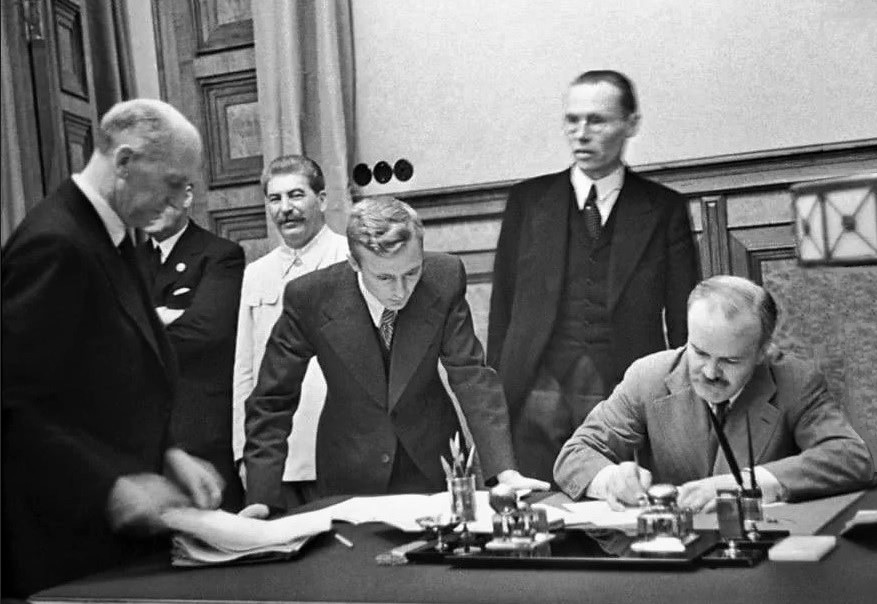
Translation of the Russian caption for this image:
People’s Commissar of Foreign Affairs of the USSR V.M. Molotov signs a friendship and border treaty between the USSR and Germany. Among those present: I.V. Stalin, translator of the Ministry of Foreign Affairs V.N. Pavlov, German diplomat G. Hilger (“truncated” version of the photograph of M. Kalashnikov distributed on the net)
Photograph attributed to Mikhail Mikhaylovich Kalashnikov (1906-1944) via Wikimedia Commons.
The Pact was terminated on 22 June 1941, when Nazi Germany launched Operation Barbarossa and invaded the Soviet Union (thus as well executing the ideological goal of Lebensraum). After the war, von Ribbentrop was convicted of war crimes and executed. Molotov died aged 96 in 1986, five years before the USSR’s dissolution. Soon after World War II, the German copy of the secret protocol was found in Nazi archives and published in the West, but the Soviet government denied its existence until 1989, when it was finally acknowledged and denounced. Vladimir Putin, while condemning the pact as “immoral”, has also defended the pact as a “necessary evil”, a U-turn following his earlier condemnation
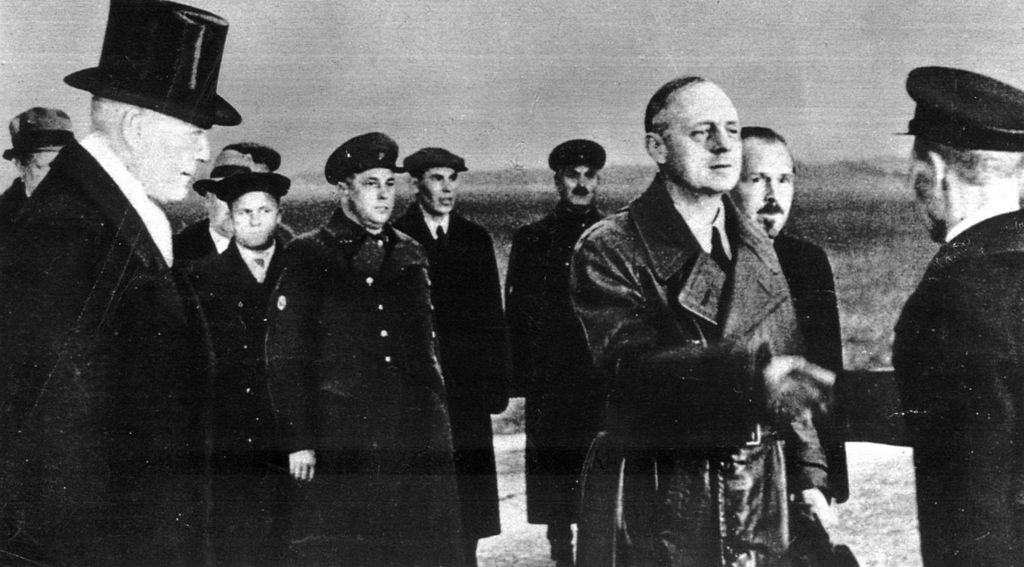
Ribbentrop arrives at Moscow airport, August 1939.
Photograph via Wikimedia Commons.
Arthur Chrenkoff explains why we should vigorously resist this attempt to “normalize” Molotov-Ribbentrop:
1. While the shameful Western appeasement of Hitler, culminating in the infamy of Munich, allowed the Reich to bloodlessly dismember the sovereign and democratic Czechoslovakia, neither Great Britain nor France participated in or benefited from Germany’s cannibalism of this “faraway country of which we know little”. The difference is that while the West remains ashamed of Munich (a name which quickly become synonymous with a craven sell-out), a few years back, Russia’s culture minister Vladimir Medinsky called the Ribbentrop-Molotov pact “a great achievement of Soviet diplomacy”.
2. Unlike all the other agreements signed with Germany during the 1930s, it was the Ribbentrop-Molotov pact that green-lit the armed German aggression and led to the outbreak of the deadliest war in human history. It’s difficult to blame Germany’s neighbours or countries threatened by the Soviet Union (like Poland, Romania and the Baltic states) for trying to stay on Germany’s good side. It was naive and in any case it didn’t work in the end, as they all later found out to their detriment and downfall. Soviet Union, on the other hand, not only climbed into bed with Nazi Germany but it fully and enthusiastically consummated this marriage of convenience.
3. Unlike other agreements cited above, thanks to the “secret protocols” attached to the Ribbentrop-Molotov pact, the Soviet Union was both a co-aggressor in and a co-beneficiary of the start of World War Two. Stalin has relatively bloodlessly acquired the by-then (mid-September) almost defenseless eastern Poland (subsequently incorporated into Belarussian and Ukrainian Soviet Republics; these historically Polish areas remain today parts of Belarus and Ukraine), Bessarabia from Romania (incorporated into the Moldovan Soviet Republic), the Baltic States of Lithuania, Latvia and Estonia, as well as being given a free hand in the invasion of Finland, a country which otherwise might have counted on German friendship and support. All these aggressive territorial gains were the consequence of the Ribbentrop-Molotov division of Eastern Europe between the Reich and the Soviet Union into the respective spheres of interest, soon confirmed as the “facts on the ground” by Wehrmacht and Red Army.
4. While Britain and France, their empires and their allies, fought Germany for almost two years after September 1939, first through the period of the “phony war”, then through the Blitzkrieg in the West and the Battle of Britain, the Soviet Union remained a de facto Nazi ally, continuing to cooperate in security matters and supplying Germany with food and raw materials. Grain trains were still rolling west across the border with the Reich as Wehrmacht was launching Operation Barbarossa in the morning of 22 June 1941. During the period of Nazi-Soviet cooperation, Germany conquered Poland, Norway, Denmark, Belgium, the Netherlands, Luxembourg, France, Yugoslavia and Greece. Soviet exports helped to feed and build up the German war machine before it was unleashed against the West in 1940; German troops surging into the Low Countries walked on their stomachs (to borrow from Napoleon) full of bread baked from Russian wheat or were carried on the tanks and trucks made with Russian coal and ores. Never forget that for Russia, World War Two – or the Great Patriotic War as it is called there – begins only in June 1941, not September 1939, as it does in all Western history books.
5. It’s true that the Ribbentrop-Molotov pact was partly defensive in nature as far as the Soviet Union was concerned, aiming to postpone the inevitable armed clash between the two rival totalitarianisms and in the meantime give Russia some essential breathing space to build up its army and strategic reserves (the top leadership of the Soviet armed forces was decapitated by Stalin during the purges in 1937-8, leaving them even more unprepared to face Germany than would have otherwise been the case). But as I pointed out above, it was also offensive and directly benefited Stalin’s territorial ambitions while it lasted. In some ways, the legacy of the pact lives on in the shape of Poland’s post-war borders, which have nothing to do with its thousand-year history. This is the real #TruthAboutWWII and this is why the Ribbentrop-Molotov pact remains singled out in the infamy of the interwar European democracy.
The Inca Empire – Out of Thin Air – Extra History – #1
Extra Credits
Published on 24 Aug 2019Join us on Patreon! http://bit.ly/EHPatreon
There’s a lot that we don’t know for sure about the Inca Empire, because we have conflicting accounts among Spanish colonizers, as well as the fact that Inca history itself is told non-linearly. But we do know that they used Andean accomplishments, from architecture to knotted quipu, to create a city that ruled the largest indigenous empire in the Americas, starting with Manco Capac and the successive Sapa Inca rulers.

Belgian GP35: The First Military Browning High Power
Forgotten Weapons
Published on 29 Jul 2019http://www.patreon.com/ForgottenWeapons
Cool Forgotten Weapons merch! http://shop.bbtv.com/collections/forg…
The Grande Puissance — High Power — was John Browning’s last firearms design. In fact, he only began the design; it was taken to completion by his protege Dieudonné Saive at FN in Belgium. It was the best military handgun of the time, with a double-stack 13-round magazine capacity, and chambered for the 9x19mm cartridge. Belgium was the first nation to adopt it for military service, purchasing 1,000 guns for field trials and approving them in 1935 for standard issue as the GP-35.
The Belgian trials guns have a distinctive oval ejection port, which would be changed on production models. They were also fitted with flat board shoulder stocks and tangent sights adjustable up to 500 meters. These features would last until German occupation of the FN factory complex during World War Two, when the guns were simplified under German occupation production.
Contact:
Forgotten Weapons
PO Box 87647
Tucson, AZ 85754

August 25, 2019
The Battle of Britain is a Bitch – WW2 – 052 – August 24 1940
World War Two
Published on 24 Aug 2019This week, the communists attack the Japanese in the Battle of 100 Regiments. Meanwhile in Europe, the Battle of Britain enters phase three with the Luftwaffe actively targeting British airfields.
Join us on Patreon: https://www.patreon.com/TimeGhostHistory
Or join The TimeGhost Army directly at: https://timeghost.tvFollow WW2 day by day on Instagram @World_war_two_realtime https://www.instagram.com/world_war_t…
Join our Discord Server: https://discord.gg/D6D2aYN.
Between 2 Wars: https://www.youtube.com/playlist?list…
Source list: http://bit.ly/WW2sourcesWritten and Hosted by: Indy Neidell
Produced and Directed by: Spartacus Olsson and Astrid Deinhard
Executive Producers: Bodo Rittenauer, Astrid Deinhard, Indy Neidell, Spartacus Olsson
Creative Producer: Joram Appel
Post-Production Director: Wieke Kapteijns
Research by: Indy Neidell
Edited by: Iryna Dulka
Map animations: EastoryColorisations by Norman Stewart and Julius Jääskeläinen https://www.facebook.com/JJcolorization/
Sources:
IWM: H7019, H005772, Q 7928
Color of Trotsky and Soviet leaders by Klimbim
Mercader picture from a public mural by Grahame Miller Ware, Wikimedia Commons
Icons by Sergey Tikhonov, Ely Wahib and Ivan Boyko from iconfinder.comEastory’s channel: https://www.youtube.com/channel/UCEly…
Archive by Screenocean/Reuters https://www.screenocean.com.A TimeGhost chronological documentary produced by OnLion Entertainment GmbH.
From the comments:
World War Two
2 days ago
Last Sunday, we had our one year anniversary livestream in which we talked about the last year, our current challenges and the plans for the road ahead, and answered a lot of your questions. We explained how we want to increase our Patreon income to be able to travel to the known and unknown locations of World War Two. To do so, you can help us by supporting us on https://www.patreon.com/TimeGhostHistory or https://timeghost.tv. Literally every dollar counts. If you’d like to see the livestream I mentioned, you can check that out right here -> https://youtu.be/EKws1jNIAmECheers,
Joram
August 24, 2019
Italy’s African Destiny | BETWEEN 2 WARS I 1931 Part 1 of 3
TimeGhost History
Published on 23 Aug 2019When Mussolini wants to solidify Italy’s North African colonies, he faces massive opposition by one man: Omar Mukhtar, the Lion of the Desert.
Join us on Patreon: https://www.patreon.com/TimeGhostHistory
Subscribe to our World War Two series: https://www.youtube.com/c/worldwartwo…
Hosted by: Indy Neidell
Written by: Spartacus Olsson
Directed by: Spartacus Olsson and Astrid Deinhard
Executive Producers: Bodo Rittenauer, Astrid Deinhard, Indy Neidell, Spartacus Olsson
Creative Producer: Joram Appel
Post-Production Director: Wieke Kapteijns
Research by: Naman Habtom
Edited by: Daniel Weiss
Sound design: Iryna DulkaArchive by Reuters/Screenocean http://screenocean.com
Sources:
Online:
https://www.politico.com/blogs/ben-sm…
Muslim Fascist Party and Youth Wing
http://countrystudies.us/libya/21.htm (Library of Congress)
https://www.nam.ac.uk/explore/senussi…
https://awayfromthewesternfront.org/c…
https://www.brookings.edu/blog/order-…
https://trove.nla.gov.au/newspaper/ar…Journal Articles:
Arielli, Nir. “Italian Involvement in the Arab Revolt in Palestine, 1936-1939.” British Journal of Middle Eastern Studies, vol. 35, no. 2, 2008, pp. 187–204. JSTOR, www.jstor.org/stable/20455584.Bussotti, L. (2016) “A History of Italian Citizenship Laws during the Era of the Monarchy (1861-1946)”. Advances in Historical Studies, 5, 143-167. doi: 10.4236/ahs.2016.54014.
Cooke, James J. “Destino Affricano De Popolo Italiano: Franco-Italian Controversy Over Tunisia, 1936-1940.” Proceedings of the Meeting of the French Colonial Historical Society, 13/14, 1990, pp. 203–216. JSTOR, www.jstor.org/stable/42952205.
Collins, Carole. “Imperialism and Revolution in Libya.” MERIP Reports, no. 27, 1974, pp. 3–22. JSTOR, www.jstor.org/stable/3011335.
KOPANSKI, ATAULLAH BOGDAN. “ISLAM IN ITALY AND IN ITS LIBYAN COLONY (720-1992).” Islamic Studies, vol. 32, no. 2, 1993, pp. 191–204. JSTOR, www.jstor.org/stable/20840121.
Pankhurst, Richard. “Education in Ethiopia during the Italian Fascist Occupation (1936-1941).” The International Journal of African Historical Studies, vol. 5, no. 3, 1972, pp. 361–396. JSTOR, www.jstor.org/stable/217091.
Pretelli, Matteo. “Education in the Italian colonies during the interwar period.” Modern Italy, Vol. 16, No. 3, August 2011, 275–293
Books:
Mark I. Choate: Emigrant nation: the making of Italy abroad, Harvard University Press, 2008, ISBN 0-674-02784-1, page 175.Peter Bandella The Eternal City: Roman Images in the Modern World, Chapter 7 – The University of North Carolina Press, 1987, ISBN 0-8078-6511-7
Ahmad Hassanein Bey The Lost Oases (read a Swedish translation by Ulla Ericson), American University of Cairo, reprinted 2006 (original 1925), ISBN 978-91-87771-41-5
A TimeGhost chronological documentary produced by OnLion Entertainment GmbH.
From the comments:
TimeGhost History
1 hour ago
As we approach one year of WW2 In Real Time we cannot express our gratitude for your support enough. It is the financial and spiritual involvement of the TimeGhost Army at https://www.patreon.com/TimeGhostHistory and https://timeghost.tv that has made it possible for us to do all of this – so thank you, once again!This episode comes out as our WW2 series is covering the first battles in the North African theatre. The Second World War there will have major impact on world events between 1940 and 1944. And this is the second episode covering the background to the conflict in North Africa and the Middle East. We will return to Africa again, but before that we will look at what is going on in Germany, Japan and the USSR in the early 1930s – as some of you might already guess or know, those are dramatic times in those places and it is in these years that the world takes its first concrete steps towards the conflict that erupts into world war in 1939.

“82nd All The Way” – Alvin York – Sabaton History 029 [Official]
Sabaton History
Published on 22 Aug 2019When the Americans joined the Great War in Europe, the 82nd “All American” division was the division that would engage in heavy fighting at St Mihiel. Among them was Alvin York, leading his battalion at the ferocious Battle of Hill 223.
Support Sabaton History on Patreon: https://www.patreon.com/sabatonhistory
Listen to The Great War (Where “82nd All the Way” is featured):
CD: http://nblast.de/SabatonTheGreatWar
Spotify: https://sabat.one/TheGreatWarSpotify
Apple Music: https://sabat.one/TheGreatWarAppleMusic
iTunes: https://sabat.one/TheGreatWarItunes
Amazon: https://sabat.one/TheGreatWarAmazon
Google Play: https://sabat.one/TheGreatWarGooglePlayWatch the official music video for “82nd All the Way” right here: https://www.youtube.com/watch?v=0LS0Z…
Hosted by: Indy Neidell
Written by: Markus Linke and Indy Neidell
Directed by: Astrid Deinhard and Wieke Kapteijns
Produced by: Pär Sundström, Astrid Deinhard and Spartacus Olsson
Creative Producer: Joram Appel
Executive Producers: Pär Sundström, Joakim Broden, Tomas Sunmo, Indy Neidell, Astrid Deinhard, and Spartacus Olsson
Maps by: Eastory
Edited by: Iryna Dulka
Sound Editing by: Marek KaminskiEastory YouTube Channel: https://www.youtube.com/channel/UCEly…
Archive by: Reuters/Screenocean https://www.screenocean.com
Music by Sabaton.Sources:
– IWM: Q 516, 23706
– National Library of Scotland: 3155
– Saturday Evening Post scan and Alvin York portraits courtesy of the Tennessee State Library & Archives.
– National WWI Museum and Memorial
– Alvin York colorized by Chiel ZilverbergAn OnLion Entertainment GmbH and Raging Beaver Publishing AB co-Production.
© Raging Beaver Publishing AB, 2019 – all rights reserved.
From the comments:
Sabaton History
2 days ago
This video is about the 82nd Division who, together with Sergeant Alvin York stormed Hill 223 in September 1918. Just before that, the “Lost Battalion” made a stand against German forces in the same area. We have made an episode about the Sabaton Song “Lost Battalion” as well, which you can watch right here: https://youtu.be/pgNxijbDlJMWe love the reception of our weekly videos, and have some great stuff coming up over coming weeks. We want as many of our fans to see this, so make sure to share this channel with your friends, family, neighbours, colleagues, teachers and other loved ones. You’d be doing them and us a real favour! Cheers!
August 23, 2019
Sterling S11: Donkey in a Thoroughbred Race
Forgotten Weapons
Published on 26 Jun 2019http://www.patreon.com/ForgottenWeapons
Cool Forgotten Weapons merch! http://shop.bbtv.com/collections/forg…
In the 1960s, the Sterling company began to worry about the prospects of continued sales of the Sterling (Patchett) SMG, especially in light of new competitors like the H&K MP5. Its chief design engineer, Frank Waters, created the S11 as a gun to replace the classic Sterling. The S11 was based on a simple stamped/folded steel receiver, and was intended to have a lower unit cost than the Sterling. It kept the excellent Patchett magazine, but had a barrel and sights offset to the left side, and offered two separate bayonet lugs – one for the No5 rifle and one for the L1A1/FAL.
Unfortunately for Sterling, it was determined that the tooling cost would have made the S11 actually more expensive than the existing guns, whose tooling costs had been long since covered. Also, the S11 was just not a very good or very reliable design – a “donkey in a thoroughbred race” to quote one Sterling manager. This one prototype was the only example ever made, and the project was shelved in 1967 in favor of expanding into more civilian models of the original Sterling.
Many thanks to the Royal Armouries for allowing me to film and disassemble this one of a kind submachine gun! The NFC collection there – perhaps the best military small arms collection in Western Europe – is available by appointment to researchers:
https://royalarmouries.org/research/n…
You can browse the various Armouries collections online here:
https://royalarmouries.org/collection/
Contact:
Forgotten Weapons
PO Box 87647
Tucson, AZ 85754

QotD: The ego of Salvador Dali
Orwell’s press card portrait, 1943
[Dali’s] aberrations are partly explicable. Perhaps they are a way of assuring himself that he is not commonplace. The two qualities that Dali unquestionably possesses are a gift for drawing and an atrocious egoism. “At seven”, he says in the first paragraph of his book, “I wanted to be Napoleon. And my ambition has been growing steadily ever since.” This is worded in a deliberately startling way, but no doubt it is substantially true. Such feelings are common enough. “I knew I was a genius”, somebody once said to me, “long before I knew what I was going to be a genius about.” And suppose that you have nothing in you except your egoism and a dexterity that goes no higher than the elbow; suppose that your real gift is for a detailed, academic, representational style of drawing, your real métier to be an illustrator of scientific textbooks. How then do you become Napoleon?
There is always one escape: into wickedness. Always do the thing that will shock and wound people. At five, throw a little boy off a bridge, strike an old doctor across the face with a whip and break his spectacles — or, at any rate, dream about doing such things. Twenty years later, gouge the eyes out of dead donkeys with a pair of scissors. Along those lines you can always feel yourself original. And after all, it pays! It is much less dangerous than crime. Making all allowance for the probable suppressions in Dali’s autobiography, it is clear that he had not had to suffer for his eccentricities as he would have done in an earlier age. He grew up into the corrupt world of the nineteen-twenties, when sophistication was immensely widespread and every European capital swarmed with aristocrats and rentiers who had given up sport and politics and taken to patronising the arts. If you threw dead donkeys at people, they threw money back. A phobia for grasshoppers — which a few decades back would merely have provoked a snigger — was now an interesting “complex” which could be profitably exploited. And when that particular world collapsed before the German Army, America was waiting. You could even top it all up with religious conversion, moving at one hop and without a shadow of repentance from the fashionable salons of Paris to Abraham’s bosom.
That, perhaps is the essential outline of Dali’s history. But why his aberrations should be the particular ones they were, and why it should be so easy to “sell” such horrors as rotting corpses to a sophisticated public — those are questions for the psychologist and the sociological critic. Marxist criticism has a short way with such phenomena as Surrealism. They are “bourgeois decadence” (much play is made with the phrases “corpse poisons” and “decaying rentiers class”), and that is that. But though this probably states a fact, it does not establish a connection. One would still like to know why Dali’s leaning was towards necrophilia (and not, say, homosexuality), and why the rentiers and the aristocrats would buy his pictures instead of hunting and making love like their grandfathers. Mere moral disapproval does not get one any further. But neither ought one to pretend, in the name of “detachment”, that such pictures as Mannequin rotting in a taxicab are morally neutral. They are diseased and disgusting, and any investigation ought to start out from that fact.
George Orwell, “Benefit of Clergy: Some Notes on Salvador Dali”, Saturday Book for 1944, 1944.
August 22, 2019
No Wheat? Rice Bread – Gluten Free Recipe
Townsends
Published on 18 Jun 2018Today’s featured cookbook ➧ https://amzn.to/2MCOF6A ➧➧
Visit Our Website! ➧ http://www.townsends.us/ ➧➧
Help support the channel with Patreon ➧ https://www.patreon.com/townsend ➧➧