Quotulatiousness

January 7, 2020

Isaac Asimov at 100 … ish

Filed under: Books, History, Media, Russia — Tags: , , , — Nicholas @ 03:00

It’s probably the centenary year for the late Isaac Asimov, but the date is only approximately correct:
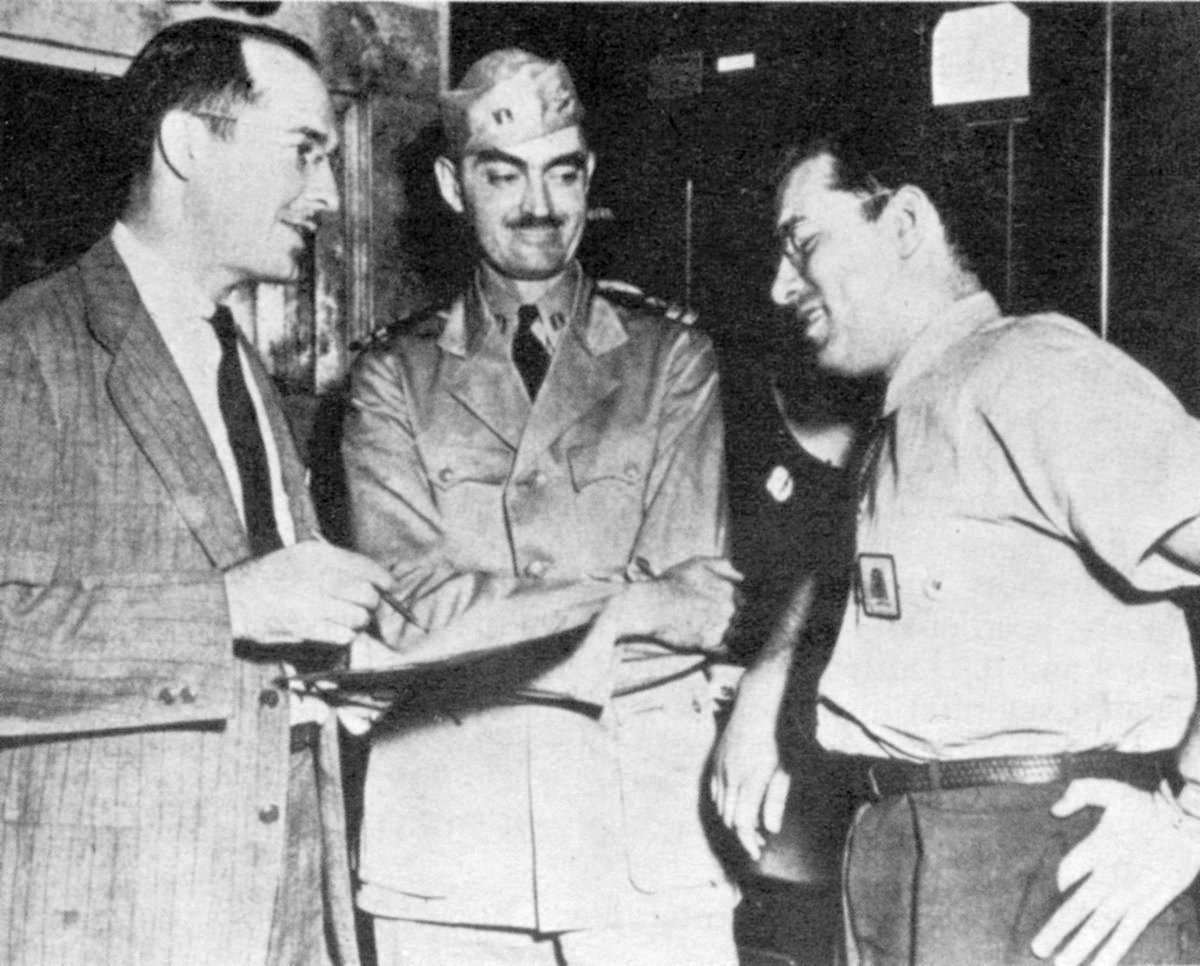
Robert Heinlein, L. Sprague de Camp and Isaac Asimov at the Philadelphia Navy Yard in 1944.
US government photo via Wikimedia Commons.

In actual fact the centenary is a bit of a fudge because Asimov never knew his actual birthday and picked January 2 as a likely date, and one that allowed for an extra holiday after the Christmas festivities. He was born around the turn of the year in 1920, three years after the Russian revolution, in the Soviet town of Petrovichi, although he emigrated to the US at the age of three.

Like many Russian Jews the family moved to Brooklyn in New York, and Asimov’s father ended up running a confectionery store and newsagent. Asimov taught himself to read at the age of five and taught his sister too, and consumed the pulp science fiction magazine stocked in his father’s shop.

At the age of 15 he applied to Columbia but was rejected, ostensibly on age grounds but, as he wrote in his autobiography I, Asimov, he recounted that the university had filled its quota of Jews for the year. After multiple rejections he eventually earned his Master of Arts degree in chemistry in 1941 and earned a Doctor of Philosophy degree in chemistry in 1948, serving as a civilian in the US Army in the Second World War.

An academic career beckoned and in 1949 he joined the Boston University School of Medicine as a biochemistry teacher. But by then he had already been getting science fiction short stories published for nearly ten years. In 1950 he wrote his first book and largely abandoned his teaching career, finding writing more lucrative and enjoyable.

[…]

Some thought Asimov had peaked as a science fiction writer by the mid 1960s, as he spent the next few years writing a lot of popular science books, non-fiction and school textbooks. He was even asked by Paul McCartney to write a science fiction musical for his then-band Wings, although the idea was eventually dropped.

But in the 1970s he came back into the SF fold with a series of books and short stories, winning two Hugo and two Nebula awards in the decade. He was also involved in some television and film work, having acted as a consultant on Star Trek in the 1960s.

In 1981 he was approached by a publisher to return to the Foundation series and add more to the canon. Foundation’s Edge was published the next year year, to wide acclaim. This was followed by Foundation and Earth in 1986, Prelude to Foundation in 1988, and finally Forward the Foundation, which was published in 1993, one year after Asimov’s death.


Wars of the Roses | 3 Minute History

Filed under: Britain, History, Military — Tags: , , , , — Nicholas @ 02:00

Jabzy
Published 23 Jan 2015

Of course there’s a lot I left out.

And when I say “Lancaster”, it sounds out of place because I had to just record over me continuously saying “Lancashire”.

QotD: The cult of Le Corbusier

What accounts for the survival of this cold current of architecture that has done so much to disenchant the urban world — the original modernism having been succeeded by different styles, but all of them just as lizard-eyed? According to Curl, the profession of architecture has become a cult. It is worth quoting him in ­extenso:

    A dangerous cult may be defined as a kind of false religion, adoption of a system of belief based on mere assertions with no factual foundations, or as excessive, almost idolatrous, admiration for a person, persons, an idea, or even a fad. The adulation accorded to Le Corbusier, accorded almost the status of a deity in architectural circles, is just one example. It has certain characteristics which may be summarized as follows: it is destructive; it isolates its believers; it claims superior knowledge and morality; it demands subservience, conformity, and obedience; it is adept at brainwashing; it imposes its own assertions as dogma, and will not countenance any dissent; it is self-referential; and it invents its own arcane language, incomprehensible to outsiders.

Anyone who thinks this is an exaggeration has not read much Le Corbusier. (His writing is as bad as his architecture, and bears out precisely what Curl says.) Nor is it difficult to find in the architectural press examples of cultish writing that is impenetrable and arcane, devoid of denotation but with plenty of connotation. Here, for example, is Owen Hatherley, writing about an exhibition of Le Corbusier’s work at London’s Barbican Centre (itself a fine example of architectural barbarism). According to Hatherley, Le Corbusier was:

    the architect who transformed buildings for communal life from mere filing cabinets into structures of raw, practically sexual physicality, then forced these bulging, anthropomorphic forms into rigid, disciplined grids. This might be the work of the “Swiss psychotic” at his fiercest, but the exhibition’s setting, the Barbican — with its bristly concrete columns and bullhorn profiles, its walkways and units — proves that even its derivatives can become places rich with perversity and intrigue, without a pissed-in lift [elevator] or a loitering youth in sight. … [T]hese collisions of collectivity and carnality have no obvious successors today.

Theodore Dalrymple, “Crimes in Concrete”, First Things, 2019-06.

January 6, 2020

Macedonian Battle Tactics

Filed under: Europe, Greece, History, Military — Tags: , , , — Nicholas @ 06:00

Historia Civilis
Published 5 Jul 2017

Patreon | http://patreon.com/HistoriaCivilis
Donate | http://www.paypal.com/cgi-bin/webscr?…
Merch | http://teespring.com/stores/historiac…
Twitter | http://twitter.com/HistoriaCivilis
Website | http://historiacivilis.com

Sources:
Parallel Lives, by Plutarch: http://amzn.to/2sOfr4O
Alexander of Macedon, by Peter Green: http://amzn.to/2rMJqpn
Alexander the Great, by Robin Lane Fox: http://amzn.to/2sOKqh3
Ghost on the Throne, by James Romm: http://amzn.to/2tpuNxq

We are a participant in the Amazon Services LLC Associates Program, an affiliate advertising program designed to provide a means for us to earn fees by linking to Amazon.com and affiliated sites.

Music:
“Seeing the Future,” by Dexter Britain
“Infados,” by Kevin MacLeod
“Drums of the Deep,” by Kevin MacLeod
“Hallon,” by Christian Bjoerklund

The Nazis, The British Accent, and BBC News

Filed under: Britain, History, Media, WW2 — Tags: , , , — Nicholas @ 04:00

Today I Found Out
Published 29 Apr 2016

In this video:

The British Broadcasting Corporation (BBC) is an institution known and respected the world over for its relative impartiality and objectivity compared to many other news sources, with numerous surveys showing that the BBC is one of the most trusted sources of news in both the UK and the US. But we’re not here to talk about that. We’re here to talk about dinner jackets, Received Pronunciation, the Nazis, and what all of this has to do with the BBC News.

Want the text version?: http://www.todayifoundout.com/index.p…

Sources:

http://www.bl.uk/learning/langlit/sou…
https://books.google.co.uk/books?id=B…
http://www.bbc.co.uk/voices/yourvoice…
https://books.google.co.uk/books?id=Q…
http://news.bbc.co.uk/aboutbbcnews/sp…
https://books.google.co.uk/books?id=c…
http://www.theguardian.com/uk/2008/ap…
https://en.wikipedia.org/wiki/John_Re…

Lee Metford MkI*: Britain’s First Repeating Rifle (Almost)

Filed under: Britain, History, Military, Weapons — Tags: , , , — Nicholas @ 02:00

Forgotten Weapons
Published 26 Feb 2018

Sold for $4,025.

The first repeating rifle adopted by the British military was the Lee-Metford MkI, or as it was later redesigned, the Magazine Rifle MkI. This design combined the cock-on-closing action and detachable box magazine of James Paris Lee with the rounded-land Metford rifling pattern. Formally adopted in 1888, about 350,000 Lee-Metford rifles would be produced in total, among the LSA, BSA, Sparbrook, and Enfield factories.

It would not be long until the design began to be modified, however. The Lee-Metford we have here today was made in 1891 as a MkI pattern, but updated to the MkI* variant in 1892. This modification involved removing the manual safety, changing from Lewis pattern sights to traditional barleycorns, and modifying the upper hand guard for easier removal. Other changes would follow, with the MkII pattern adopted in 1893 with a 10-round magazine, Enfield pattern rifling adopted in 1895, and ultimately charger loading adopted in 1907.

Despite the fairly large number of Lee Metford rifles made, they are very scarce to find in original condition like this one. Typically the British military would update any older pattern rifle to meet new specifications, or convert them in to rimfire training rifles if such a conversion was not possible. Few left the military in the early configurations.

http://www.patreon.com/ForgottenWeapons

Cool Forgotten Weapons merch! http://shop.bbtv.com/collections/forg…

If you enjoy Forgotten Weapons, check out its sister channel, InRangeTV! http://www.youtube.com/InRangeTVShow

January 5, 2020

It’s 1941 – A World at War – WW2 – 071 – January 4 1941

World War Two
Published 4 Jan 2020

1941 begins with action in North-Africa and China, but Indy also takes a moment to assess the current stakes and stakeholders in the East-Asian theatre. What is sure, is that 1941 will be an eventful year!

Join us on Patreon: https://www.patreon.com/TimeGhostHistory
Or join The TimeGhost Army directly at: https://timeghost.tv

Follow WW2 day by day on Instagram @World_war_two_realtime https://www.instagram.com/world_war_t…
Join our Discord Server: https://discord.gg/D6D2aYN.
Between 2 Wars: https://www.youtube.com/playlist?list…
Source list: http://bit.ly/WW2sources

Written and Hosted by: Indy Neidell
Produced and Directed by: Spartacus Olsson and Astrid Deinhard
Executive Producers: Bodo Rittenauer, Astrid Deinhard, Indy Neidell, Spartacus Olsson
Creative Producer: Joram Appel
Post-Production Director: Wieke Kapteijns
Research by: Indy Neidell
Edited by: Iryna Dulka
Map animations: Eastory (https://www.youtube.com/c/eastory)

Colorizations by:
– Adrien Fillon – https://www.instagram.com/adrien.colo…
– Julius Jääskeläinen – https://www.facebook.com/JJcolorization/

Sources:
– IWM: MH 2718, C 1850, E2294, E 18542, E 378, E 443, E 3721E, E 1573
– Bundesarchiv, Bild 101I-783-0104-09 / Moosmüller / CC-BY-SA 3.0
– Prison by FORMGUT. from the Noun Project
– Artillery by Creative Mania from the Noun Project

Soundtracks from Epidemic Sound:
– “Easy Target” – Rannar Sillard
– “The Inspector 4” – Johannes Bornlöf
– “Magnificent March 3” – Johannes Bornlöf
– “March Of The Brave 10” – Rannar Sillard
– “March Of The Brave 9” – Rannar Sillard
– “Deviation In Time” – Johannes Bornlof
– “Disciples of Sun Tzu” – Christian Andersen
– “Last Point of Safe Return” – Fabien Tell

Archive by Screenocean/Reuters https://www.screenocean.com.

A TimeGhost chronological documentary produced by OnLion Entertainment GmbH.

From the comments:

World War Two
2 days ago (edited)
Happy New Year to you all!! We hope you all had a great turn of the decade. We certainly have! Here’s a casual, spoiler-free statement: 1941 will be an interesting year. We are all very grateful for those who found us at the very start with the Invasion of Poland, during the Phoney War, the early fighting Northern and Western Europe and the more recent conflicts in Greece and North-Africa. Those of you who joined the TimeGhost Army and support us financially on patreon.com/timeghosthistory or Timeghost.tv deserve extra praise – as we would not have made 1941 without you! And we have BIG plans for the coming year, so please consider supporting us as well! Make history with us and join the TimeGhost Army!!

Here’s to a great 2020 and ‘interesting’ 1941.
Cheers, Joram

Based On vs Inspired By

Filed under: History, Media — Tags: — Nicholas @ 02:00

History Buffs
Published 20 Oct 2017

SUPPORT HISTORY BUFFS ON PATREON
https://www.patreon.com/HistoryBuffs

January 4, 2020

The Rise and Fall of the Japanese Zero

Filed under: History, Japan, Military, Pacific, Technology, USA, WW2 — Tags: , , , — Nicholas @ 06:00

Real Engineering
Published 31 Aug 2018

Patreon:
https://www.patreon.com/user?u=282505…
Instagram:
https://www.instagram.com/brianjamesm…
Twitter:
https://twitter.com/thebrianmcmanus
Discord:
https://discord.gg/s8BhkmN

Thank you to AP Archive for providing footage: https://www.youtube.com/channel/UCHTK…

Get your Real Engineering shirts at: https://standard.tv/collections/real-…

References:
[1] https://www.thoughtco.com/world-war-i…
[2] http://rwebs.net/avhistory/history/ze…
[3] http://aboutjapan.japansociety.org/im…
[4] https://www.history.com/news/the-akut…
[5] https://www.japanpowered.com/history/…
[6] https://www.warbirdforum.com/sakai.htm

Credits:
Narrator/Director: Brian McManus
Co-Director: Mike Ridolfi (https://www.moboxgraphics.com/)
3D Animations: Eli Prenten (http://eliprenten.com/)
Research: Stephanie Sammann (https://www.stephanie-sammann.com/)
Sound: Graham Haerther (https://haerther.net/)

Blue’s Dumb History Tales #2

Overly Sarcastic Productions
Published 3 Jan 2020

Happy new year, have some memes.

Our content is intended for teenage audiences and up.

DISCORD: https://discord.gg/y7uUnzJ

PATREON: https://www.Patreon.com/OSP

MERCH LINKS: https://www.redbubble.com/people/OSPY…

OUR WEBSITE: https://www.OverlySarcasticProductions.com
Find us on Twitter https://www.Twitter.com/OSPYouTube
Find us on Reddit https://www.Reddit.com/r/OSP/

Looking back at the ’20s … the 1620s

In the latest installment of Anton Howes’ Age of Invention, he takes us back to what he calls the “transformative 20s” of the seventeenth century:

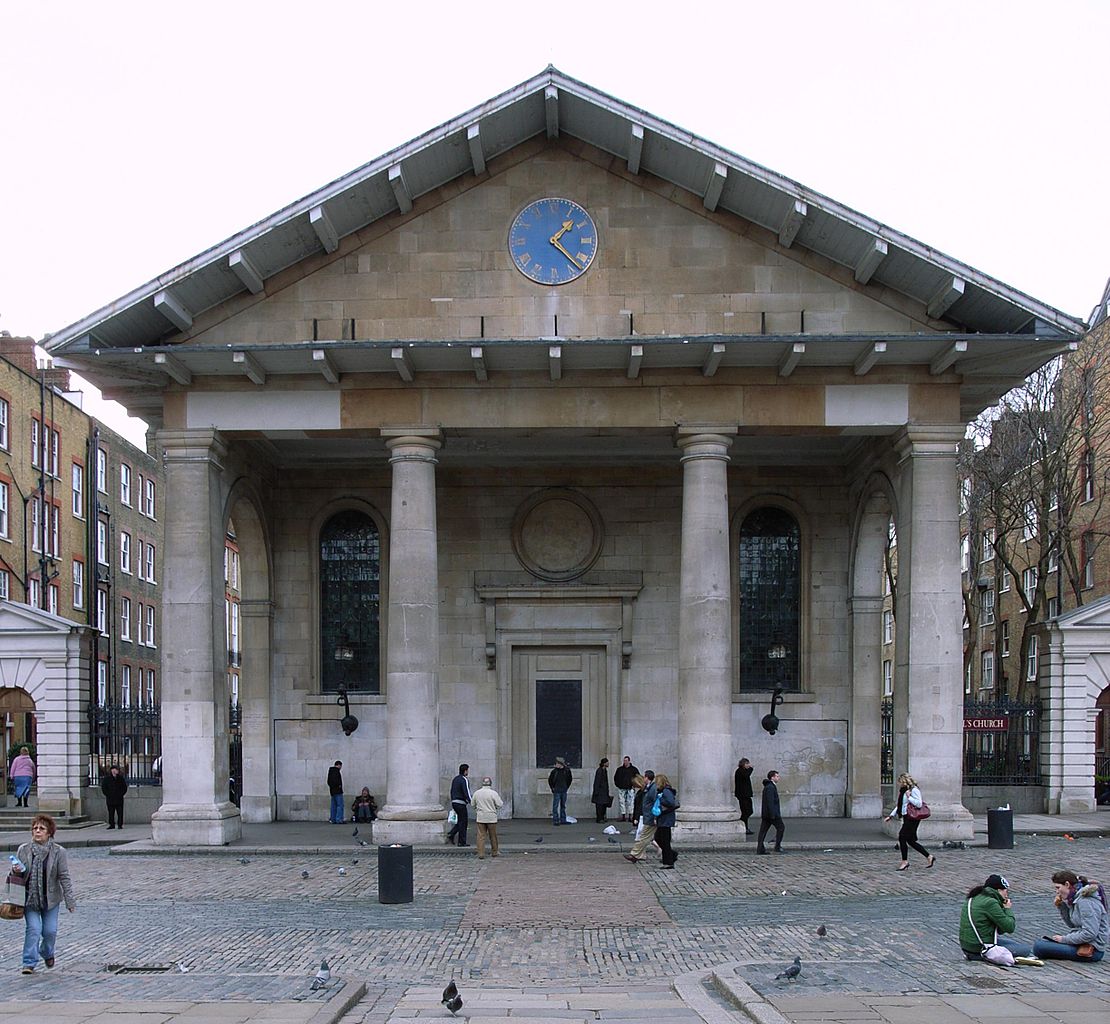
St. Paul’s Church in Covent Garden (built 1631-8) by Inigo Jones.
Photo by Steve Cadman via Wikimedia Commons.

The 1620s saw an upsurge in major projects to transform Britain’s landscape. Engineers from the Dutch Republic like Cornelius Vermuyden came to straighten its rivers, build canals, and even drain its marshes, converting them into pasturage and farmland — in the decades that followed, they would even begin to drain the Great Fens. The cityscapes changed too. The former theatre designer and architect Inigo Jones — by 1615 the Surveyor-General of the King’s Works — introduced classical architecture from the continent, drawing upon the rules of beauty and proportion that had been set down by Vitruvius in the first century BCE and resuscitated in Renaissance Italy by Andrea Palladio. Jones’s influence transformed England’s palaces, churches, cathedrals, and even Covent Garden square, to reflect his ancient Roman ideal.

But the environment, built or natural, would be most transformed by the experiments of a few individuals with fossil fuels. Dud Dudley, an illegitimate child of the 5th Baron Dudley, in the 1620s experimented with smelting iron with peat and coal. Dudley was not the first to do so — the patent on using coal instead of charcoal to work iron had been sold on from person to person since at least 1589 — but his experiments were among the most influential. The famous Abraham Darby, who achieved commercial success in applying coal to smelting metals in the early eighteenth century, was Dud Dudley’s great-great-nephew.

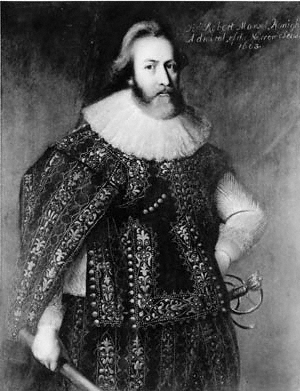
Sir Robert Mansell (1570/71–1652), by an unknown artist.
Image via Wikimedia Commons.

The decade also saw major new attempts to use coal as a fuel in other processes, such as glass-making. Although the patent on using coal to make glass had been around since at least 1610, by the 1620s Sir Robert Mansell had bought out the partners who owned it and was pouring a fortune into setting up glassworks at Newcastle. In this case, the transformation was institutional. Mansell’s political connections allowed him to widen the terms of his patent, such that he even tried to ban all other kinds of glass in England, regardless of whether they were made using other fuels, or even imported. Usually, patents of invention were for things entirely new, and were not supposed to interfere with existing English industries. But over the course of the 1610s, various abuses like Mansell’s came to light. King James I, eager for cash, had sold monopolies on ancient trades, as well as the new — one crony was even awarded a patent for inns and alehouses. Mansell’s patent, along with the others, was attacked in Parliament in the 1620s, and even revoked. The outcry ultimately led to the Statute of Monopolies of 1624 — the earliest patent legislation in England, which sought to regulate the royal practice of granting them. (Ironically, Mansell was so well-connected that he managed to get his controversial glass-making patent renewed and then exempted from the new Act.) The Statute of Monopolies was the only English patent legislation in force during the Industrial Revolution — there was no more patent legislation until 1852.

Finally, the ’20s saw a transformation of science. It was the decade in which Francis Bacon published some of his most significant works, on how to collect, refine, and systematise human knowledge for the good of humankind. He set out a comprehensive programme for the organisation of science and invention, with his utopian work New Atlantis setting out his ideal R&D lab – “Salomon’s House”. (Despite these high-minded aims, Bacon was also Mansell’s brother-in-law, and as attorney-general had helped draft the controversial glass-making patent. In 1621 he was convicted, fined, and even briefly imprisoned in the Tower of London for his role in the corrupt early patent system, though he appears to have been a scapegoat.)

Ivan the Terrible – the first Russian tsar I IT’S HISTORY

Filed under: History, Russia — Tags: , , — Nicholas @ 02:00

IT’S HISTORY
Published 14 Feb 2018

Ivan IV Vasilyevich commonly known as Ivan the Terrible was the first tsar of Russia. Did he deserve his title?

QotD: “Starchitects”

In my school, the status of “Corb” (as we were encouraged to affectionately call him) as a hero was a given, and dissenting from this position was risky. Such is the power of group-think which universities are, sadly, no less prone to than anywhere else. To be fair, nobody was still plugging the megalomaniac aspect of their hero; his knock-down-the-center-of-Paris side. All those undeniably God-awful tower blocks for “rationally” housing “the people” that sprang up all over Europe in his name? Well, we were assured, they could not be blamed on Corb; it was just that his more pedestrian architectural acolytes hadn’t properly understood what he had meant. In addition to the persistence of Corb-hero worship itself, two cancerous aspects of its radical mindset have survived intact in our schools of architecture.

One is the idea that an architect aspiring to greatness must also aspire to novelty. It is this imperative to “innovate” that underpins the diagrammatic design concepts of the Deconstuctivists. There is of course nothing wrong with innovation per se; it is the knee-jerk compulsion to innovate, or “reinterpret” — as a kind of moral imperative — that is the mid-20th-century aesthetic legacy. To be fair to the profession, I would come to the defense of much innovative public and commercial architecture, most of it by architects that the public has never heard of. Tragically though, these unpretentious and unsung essays in steel, glass, and masonry have been eclipsed in the public imagination by the “starchitect” bling that is currently turning the centers of our great cities into a collection of (in James Stevens Curl’s memorable phrase) “California-style roadside attractions”.

The other cancer is the idea that building design has sociological, psychological, and macro-economic dimensions that the architect — simply by virtue of being an architect — is competent to judge. What really matters to your average architecture student is drawing — which is fine, and just as it should be, until the vain idea emerges that their drawings represent some kind of implicit vision for mankind. At my school, any student’s design presentation had to include a verbal rationale — often post hoc and invariably half-baked — of how the form, massing, and materials of the design are expressive of such imponderables as the supposed psychological “needs” and “aspirations” of the users and the wider “community” that the building is to serve. The students were simply reciting the bogus language of their tutors — in which buildings might be said to be “fun,” “thought provoking,” “democratic,” “inclusive” and other such nonsense.

Graham Cunningham, “Why Architectural Elites Love Ugly Buildings”, The American Conservative, 2019-11-01.

January 3, 2020

The Battle of Alesia (52 B.C.E.)

Filed under: Europe, France, History, Military — Tags: , , , , — Nicholas @ 06:00

Historia Civilis
Published 24 Apr 2015

Patreon | http://patreon.com/HistoriaCivilis
Donate | http://www.paypal.com/cgi-bin/webscr?…
Merch | http://teespring.com/stores/historiac…
Twitter | http://twitter.com/HistoriaCivilis
Website | http://historiacivilis.com

Music is “The Life and Death of a Certain K. Zabriskie, Patriarch” by Chris Zabriskie. (http://chriszabriskie.com/)

Fallen flag – the Pennsylvania Railroad

Filed under: Business, History, Railways, USA — Tags: , , , , — Nicholas @ 05:00

The origins and an outline history of the “Standard Railroad of the World” for Classic Trains magazine by George Drury:

The original Pennsylvania Railroad ran from Philadelphia to Pittsburgh. Much of its subsequent expansion was accomplished by leasing or purchasing other railroads.

Construction began in 1847. Two years later the Pennsy made an operating contract with the Harrisburg, Portsmouth, Mountjoy & Lancaster, and by late 1852 rails ran from Philadelphia to Pittsburgh via a connection with the Portage Railroad between Hollidaysburg and Johnstown, Pa. The summit tunnel was opened in 1854, bypassing the inclined planes and creating a continuous railroad from Harrisburg to Pittsburgh.

In 1857 PRR bought the Main Line of Public Works and in 1861 leased the Harrisburg, Portsmouth, Mountjoy & Lancaster, putting the entire Philadelphia to Pittsburgh line under one management.

PRR also acquired interests in two major railroads, the Cumberland Valley and the Northern Central. The Cumberland Valley was opened in 1837 from Harrisburg to Chambersburg, and it was extended by another company in 1841 to Hagerstown, Maryland. The Baltimore & Susquehanna was incorporated in 1828 to build north from Baltimore. Progress was slowed because of the reluctance of Pennsylvania state officials to charter a railroad that would carry commerce to Baltimore. The line reached Harrisburg in 1851 and Sunbury in 1858. By then the railroad companies that formed the route had been consolidated as the Northern Central Railway. Pennsy acquired majority ownership of the Northern Central in 1900.

The Pennsy expanded into northwestern Pennsylvania by acquiring an interest in the Philadelphia & Erie Railroad in 1862 and assisting that road to complete its line from Sunbury to the city of Erie in 1864. The line to Erie was not particularly successful, but from Sunbury to Driftwood it could serve as part of a freight route with easy grades. The rest of that route was the Allegheny Valley Railroad, conceived as a feeder from Pittsburgh to the New York Central and Erie railroads. The Pennsylvania obtained control in 1868, and in 1874 opened a route with easy grades from Harrisburg to Pittsburgh via the valleys of the Susquehanna and Allegheny rivers. PRR leased the Allegheny Valley Railroad in 1900.

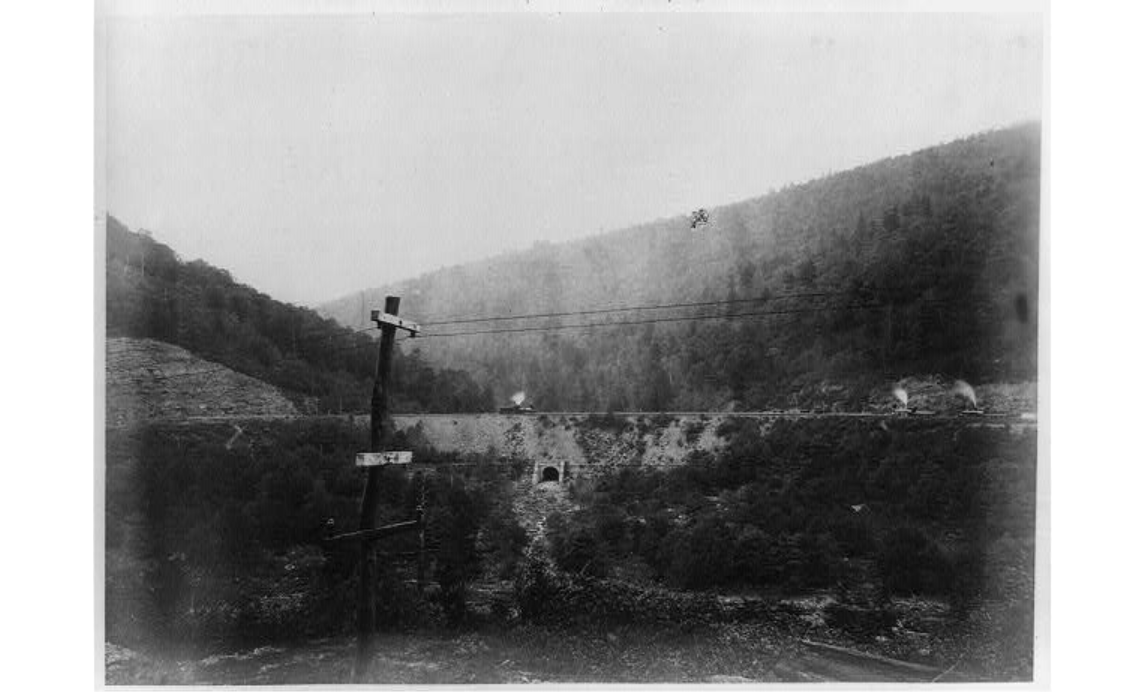
Horse shoe curve near Altoona on the Pennsylvania Railroad, circa 1874.
Photo by W.P. Mange & Co. via the Library of Congress.

But even the mighty can fall, and the PRR fell into difficult times after WW2:

During World War II Pennsy’s freight traffic doubled and passenger traffic quadrupled, much of it on the eastern portion of the system. The electrification was of inestimable value in keeping the traffic moving. After the war Pennsy had the same experiences as many other railroads but seemed slower to react. PRR was slower to dieselize, and when it did so it bought units from every manufacturer.

As freight and passenger traffic moved to the highways, Pennsy found itself with far more fixed plant than the traffic warranted or could support, and it was slow to take up excess trackage or replace double track with Centralized Traffic Control.

PRR was saddled with a heavy passenger business. It had extensive commuter services centered on New York, Philadelphia, and Pittsburgh and lesser ones at Chicago, Washington, Baltimore, and Camden, New Jersey. It had gone through the Depression without going bankrupt.

Pennsylvania and New York Central surprised the railroad industry by announcing merger plans in 1957. The two had long been rivals, and the merger would be one of parallel roads rather than end-to-end. The merger took place on February 1, 1968 — and Penn Central fell apart faster than it went together.

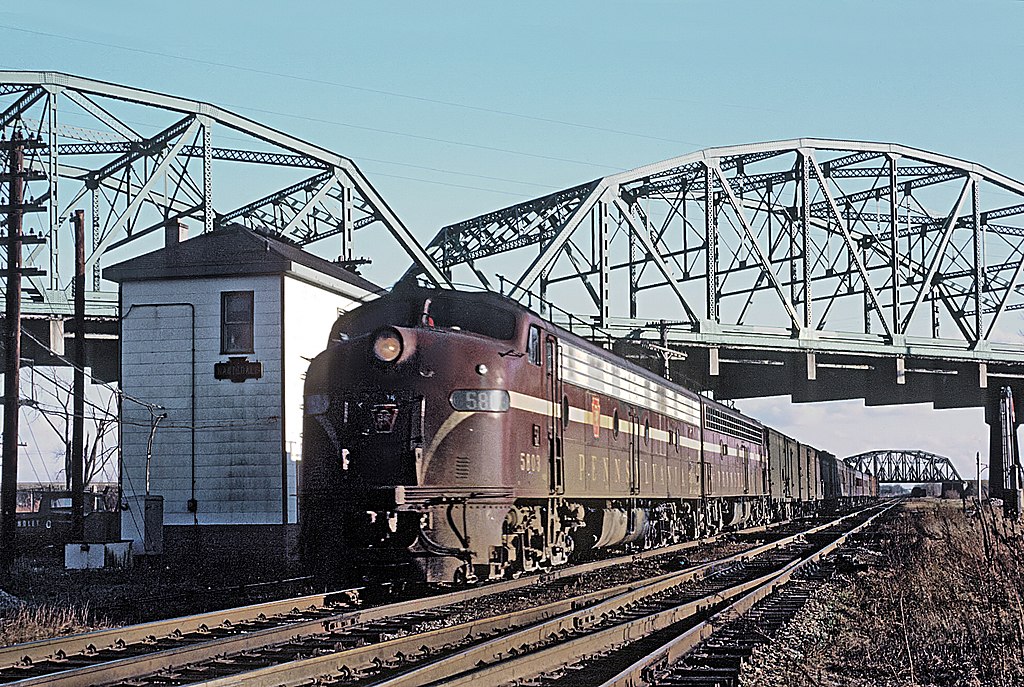
PRR E8A 5803 with Train 72, The Red Bird, passing the Hartsdale, Indiana tower and crossing the NYC and EJ&E on November 26, 1965.
Photo from the Roger Puta collection via Wikimedia Commons.

« Newer PostsOlder Posts »

Powered by WordPress