Quotulatiousness

August 22, 2020

Creoles, Kaintucks, and the Culture War of Early New Orleans (feat. The Cynical Historian)

Filed under: Americas, France, History, Humour, USA — Tags: , , , , , — Nicholas @ 06:00

Atun-Shei Films
Published 21 Aug 2020

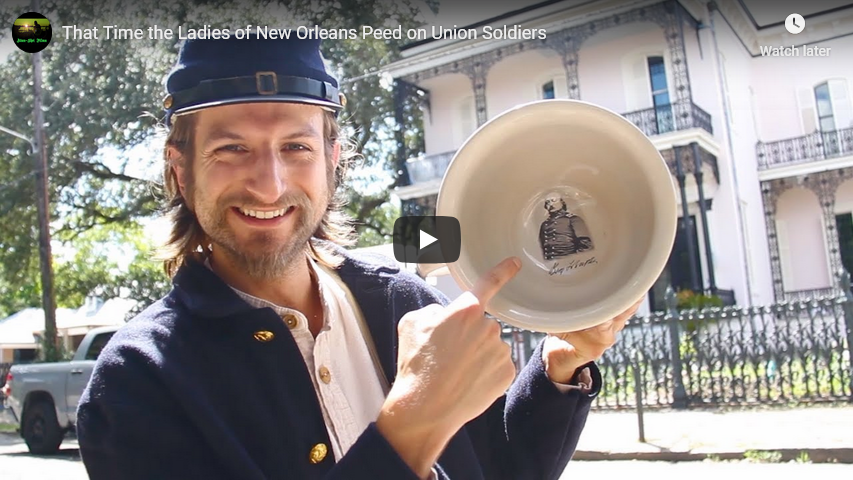
For #ProjectFrance, I collaborated with @The Cynical Historian to teach y’all about the cosmopolitan cultural exchange between revolutionary France and a country called the United States of America in the late 18th and early 19th century. In this video, I discuss the contentious relationship between Anglo-Americans and French Creoles in New Orleans in the years after the Louisiana Purchase.

Support Atun-Shei Films on Patreon ► https://www.patreon.com/atunsheifilms

Leave a Tip via Paypal ► https://www.paypal.me/atunsheifilms (All donations made here will go toward the production of The Sudbury Devil, our historical feature film)

Buy Merch ► teespring.com/stores/atun-shei-films

#NewOrleans #History

Watch our film ALIEN, BABY! free with Prime ► http://a.co/d/3QjqOWv
Reddit ► https://www.reddit.com/r/atunsheifilms
Twitter ► https://twitter.com/atun_shei

~REFERENCES~

[1] Lo Faber. “Anglo-Americans” (2018). 64Parishes https://64parishes.org/entry/anglo-am…

[2] Richard Campanella. Bienville’s Dilemma: A Historical Geography of New Orleans (2008). University of Louisiana at Lafayette, Page 170-171

[3] Peter J. Kastor. “Louisiana Purchase and Territorial Period” (2018). 64Parishes https://64parishes.org/entry/louisian…

[4] Daniel Rasmussen. American Uprising: The Untold Story of America’s Largest Slave Revolt (2011). Harper Perennial, Page 16

[5] Kimberly S. Hanger. Bounded Lives, Bounded Places: Free Black Society in Colonial New Orleans, 1769-1803 (1997). Duke University Press, Page 54-56

[6] Mary Gehman. The Free People of Color of New Orleans (2009). Sheridan Books, Page 49-51

[7] Rasmussen, Page 159-163

History-Makers: Thucydides

Overly Sarcastic Productions
Published 21 Aug 2020

Start your free trial at http://squarespace.com/overlysarcastic and use code OVERLYSARCASTIC to get 10% off your first purchase.

Ahh ancient Greece, it has been entirely too long. Today we’ll take a look at the foundational work of my entire career path — Thucydides’ History of the Peloponnesian War, a book that almost single-handedly set the standard for how we engage in historical inquiry. Also it has the added benefit of being about Ancient Greece so win-win!

SOURCES & Further Reading: History of the Peloponnesian War by Thucydides, Histories by Herodotus, Hellenica by Xenophon, and the 4 straight years I spent studying this in university — Boy do I love doing a video about a topic I’m specifically trained in.

This video was edited by Sophia Ricciardi AKA “Indigo”. https://www.sophiakricci.com/
Our content is intended for teenage audiences and up.

PATREON: https://www.Patreon.com/OSP

DISCORD: https://discord.gg/kguuvvq

MERCH LINKS: https://www.redbubble.com/people/OSPY…

OUR WEBSITE: https://www.OverlySarcasticProductions.com
Find us on Twitter https://www.Twitter.com/OSPYouTube
Find us on Reddit https://www.Reddit.com/r/OSP/

John Cabot’s patent monopoly grant and the rise of the modern corporation

Filed under: Britain, Business, Government, History, Law — Tags: , , , , — Nicholas @ 03:00

In the latest Age of Invention newsletter, Anton Howes traces the line of descent of modern corporate structures from the patent granted to John Cabot to explore (and exploit) a trade route to China:

The replica of John Cabot’s ship Matthew in Bristol harbour, adjacent to the SS Great Britain.
Photo by Chris McKenna via Wikimedia Commons.

I discussed last time [linked here] how the use of patent monopolies came to England in the sixteenth century. Since then, however, I’ve developed a strong hunch that the introduction of patent monopolies may also have played a crucial role in the birth of the business corporation. I happened to be reading Ron Harris’s new book, Going the Distance, in which he stresses the unprecedented constitutions of the Dutch and English East India Companies — both of which began to emerge in the closing years of the sixteenth century. Yet the first joint-stock corporation, albeit experimental, was actually founded decades earlier, in the 1550s. Harris mentions it as a sort of obscure precursor, and it wasn’t terribly successful, but it stood out to me because its founder and first governor was also one of the key introducers of patent monopolies to England: the explorer Sebastian Cabot.

As I mentioned last time, Cabot was named on one of England’s very first patents for invention — though we’d now say it was for “discovery” — in 1496. An Italian who spent much of his career serving Spain, he was coaxed back to England in the late 1540s to pursue new voyages of exploration. Indeed, he reappeared in England at the exact time that patent monopolies for invention began to re-emerge, after a hiatus of about half a century. In 1550, Cabot obtained a certified copy of his original 1496 patent and within a couple of years English policymakers began regularly granting other patents for invention. It started as just a trickle, with one 1552 patent granted to to some enterprising merchant for introducing Norman glass-making techniques, and a 1554 patent to the German alchemist Burchard Kranich, and in the 1560s had developed into a steady stream.

Yet Cabot’s re-certification of his patent is never included in this narrative. It’s a scarcely-noted detail, perhaps because he appears not to have exploited it. Or did he? I think the fact of his re-certification — a bit of trivia that’s usually overlooked — helps explain the origins of the world’s first joint-stock corporation.

Corporations themselves, of course, were nothing new. Corporate organisations had existed for centuries in England, and indeed throughout Europe and the rest of the world: officially-recognised legal “persons” that might outlive each and any member, and which might act as a unit in terms of buying, selling, owning, and contracting. Cities, guilds, charities, universities, and various religious organisations were usually corporations. But they were not joint-stock business corporations, in the sense of their members purchasing shares and delegating commercial decision-making to a centralised management to conduct trade on their behalves. Instead, the vast majority of trade and industry was conducted by partnerships of individuals who pooled their capital without forming any legally distinct corporation. Shares might be bought in a physical ship, or even in particular trading voyages, but not in a legal entity that was both ongoing and intangible. There were many joint-stock associations, but they were not corporations.

And to the extent that some corporations in England were related to trade, such as the Company of Merchant Adventurers of London, or the Company of Merchants of the Staple, they were not joint-stock businesses at all. They were instead regulatory bodies. These corporations were granted monopolies over the trade with certain areas, or in certain commodities, to which their members then bought licenses to trade on their own account. Membership fees went towards supporting regulatory or charitable functions — resolving disputes between members, perhaps supporting members who had fallen on hard times, and representing the interests of members as a lobby group both at home and abroad — but not towards pooling capital for commercial ventures. The regulated companies were thus more akin to guilds, or to modern trade unions or professional associations, rather than firms. Members were not shareholders, but licensees who used their own capital and were subject to their own profits and losses.

Before the 1550s, then, there had been plenty of unincorporated business associations that were joint-stock, and even more unincorporated associations that were not joint-stock. There had also been a few trade-related corporations that were not joint-stock. Sebastian Cabot’s innovation was thus to fill the last quadrant of that matrix: he created a corporation that would be joint-stock, in which a wide range of shareholders could invest, entrusting their capital to managers who would conduct repeated voyages of exploration and trade on their behalves.

August 21, 2020

British Deserters, Sword Fights, and Poison Gas – WW2 – OOTF 016

Filed under: Britain, China, Germany, History, Japan, Military, Weapons, WW2 — Tags: , , , , — Nicholas @ 06:00

World War Two
Published 20 Aug 2020

What happened to deserters in the British Army? Did Chinese and Japanese troops ever engage in sword to sword combat? Why didn’t Germany use poison gas on the battlefield? Find out the answers to all these questions in today’s Out of the Foxholes!

Join us on Patreon: https://www.patreon.com/TimeGhostHistory
Or join The TimeGhost Army directly at: https://timeghost.tv

Follow WW2 day by day on Instagram @World_war_two_realtime https://www.instagram.com/world_war_two_realtime
Between 2 Wars: https://www.youtube.com/playlist?list…
Source list: http://bit.ly/WW2sources

Hosted by: Indy Neidell
Written by: Rune Væver Hartvig
Director: Astrid Deinhard
Producers: Astrid Deinhard and Spartacus Olsson
Executive Producers: Astrid Deinhard, Indy Neidell, Spartacus Olsson, Bodo Rittenauer
Creative Producer: Joram Appel
Post-Production Director: Wieke Kapteijns
Research by: Rune Væver Hartvig
Edited by: Jakub Janiec
Sound design: Marek Kamiński

Colorizations:
Mikołaj Uchman

Visual Sources:
Imperial War Museums: HU 762498, Q 79508, El Alamein 1942, E 18542, B5114, MH 26392, F2845,
Library of Congress
Antoine from Flickr.com
National Archives NARA
Bundesarchive
Narodowe Archiwum Cyfrowe
The icons from Noun Project by: Milinda Courey, Arthur Shlain, Delwar Hossain, ahmad, Muhamad Ulum, Rooty, Simon Child, carlotta zampini, Wonmo Kang, Vectors Point, Eucalyp

Music:
“Break Free” – Fabien Tell
“Ancient Saga” – Max Anson
“Defeated” – Wendel Scherer

Archive by Screenocean/Reuters https://www.screenocean.com.

A TimeGhost chronological documentary produced by OnLion Entertainment GmbH.

“Uprising” Pt. 2 – The Liberation of Paris 1944 – Sabaton History 081 [Official]

Filed under: France, Germany, History, Media, Military, WW2 — Tags: , , , , , — Nicholas @ 04:00

Sabaton History
Posted 20 Aug 2020

Mid-August 1944. The battle for France enters its decisive phase. With the Allied spearheads just 100 km away from Paris, the Résistance prepares for its long-awaited uprising. While collaborators and fascist officials flee the city in panic, many insurgents are eager to immediately rise up against the occupation and fight the Germans in the streets. But there is need for caution. The Germans are still there in force, and they have tanks and machine guns. The fear that this might turn into “another Warsaw” if the Allies don’t show up in time is very real.

Support Sabaton History on Patreon: https://www.patreon.com/sabatonhistory

Listen to “Uprising” on the album Coat Of Arms:
https://music.sabaton.net/CoatOfArms

Watch the Official Music Video of “Uprising”:
https://www.youtube.com/watch?v=01IaK…

Listen to Sabaton on Spotify: http://smarturl.it/SabatonSpotify
Official Sabaton Merchandise Shop: http://bit.ly/SabatonOfficialShop

Hosted by: Indy Neidell
Written by: Markus Linke and Indy Neidell
Directed by: Astrid Deinhard and Wieke Kapteijns
Produced by: Pär Sundström, Astrid Deinhard, and Spartacus Olsson
Creative Producer: Maria Kyhle
Executive Producers: Pär Sundström, Joakim Broden, Tomas Sunmo, Indy Neidell, Astrid Deinhard, and Spartacus Olsson
Post-Production Director: Wieke Kapteijns
Editor: Iryna Dulka
Sound Editor: Marek Kaminski
Archive by: Reuters/Screenocean https://www.screenocean.com
Community Manager: Maria Kyhle
All music by Sabaton

Sources:
– Imperial War Museum: B 9298
– Bundesarchiv, CC-BY-SA 3.0: Bild_101I-027-1477-16, Bild_183-2008-0710-500, Bild_183-2003-1112-500
– lubini from freesound.org

An OnLion Entertainment GmbH and Raging Beaver Publishing AB co-Production.

© Raging Beaver Publishing AB, 2019 – all rights reserved.

Virtuesplaining Blazing Saddles

Filed under: History, Humour, Media, Politics, USA — Tags: , , , , , , — Nicholas @ 03:00

Paul du Quenoy says that Mel Brooks is cancelled after all:

It seems like only yesterday that HBO Max, the financially troubled American cable television network’s new film streaming service, signalled its virtue by removing Gone With The Wind from viewing so that the classic film could be properly “contextualised” as what presenter and University of Chicago film professor Jacqueline Stewart calls “a prime text for examining expressions of white supremacy in popular culture”. She believes this is useful for the “re-education” of audiences who might otherwise stray into thoughtcrime.

Mel Brooks’s smash hit 1974 comedy Blazing Saddles, which seems to have been added to HBO Max since the Gone With The Wind dust up and is known for its liberal use of the feared and loathed “n-word”, arrived with a similarly patronising disclaimer already installed. In a three-minute introduction that apparently cannot be skipped over, Stewart is there again, this time to inform viewers that “racist language and attitudes pervade the film”, while instructing them that “those attitudes are espoused by characters who are portrayed here as explicitly small-minded, ignorant bigots … The real, and much more enlightened, perspective is provided by the main characters played by Cleavon Little and Gene Wilder”.

Thanks, Aunt Jacqueline. If you have not seen Blazing Saddles – and if you are under the age of forty there is an excellent chance some prudish authority figure sanitised it out of your cosseted millennial existence – it stands as one of the greatest, and the certainly the funniest, anti-racist films of all time. Based on a story by Andrew Bergman, Brooks conceived it as a scathing send-up of racism and the hypocrisy that still enabled it after the great civil rights victories of the 1960s. Brooks’s idiom was a parody of the classic Western, by then an exhausted genre that had, among other flaws, become inanely predictable and was much criticised for leaving out minorities. A landmark of American film, Blazing Saddles was selected in 2006 for inclusion in the US National Film Registry, which recognises “culturally, historically, or aesthetically significant films” worthy of preservation.

Drenched in hilarity – and by my count using the “n-word” 17 times in its 93-minute run – the plot involves a conspiracy by an avaricious U.S. state attorney general who wants to drive white settlers off land he needs to complete a profitable railroad project. After having outlaws wreak mayhem on the townspeople, he recommends that the governor appoint a black sheriff to restore law and order, cynically assuming that their racism will cause them to reject the new lawman and give up. Despite a rough initial reception, the sheriff outwits attempts to get rid of him and, with the help of a washed up but sympathetic alcoholic gunslinger, leads the townspeople to victory, winning their love and respect before moving on to other brave deeds.

While HBO no longer wants to risk having its paying customers think for themselves (and what stale corporate outfit uneasily transitioning to a crowded new market wouldn’t?), it could rightly be said that anyone dumb enough to miss the film’s message might be a recent product of Anglo-American higher education. I do not mean this at all facetiously. Decaying and run by a self-important clerisy whose demands to be taken seriously only become shriller as it declines in reach and vitality – and from which any participant can be dismissed for even the slightest speech or behavioural infraction – academia naturally discourages humour. Jokes, which can almost always cause some kind of offence, are simply too risky to be told or laughed at, even in private. Finding the wrong thing funny can invite career-hobbling accusations that one has demeaned a student or colleague and thereby made them feel unacceptably “uncomfortable” or even physically “unsafe”. Perceived flippancy bruises sanctified “professional seriousness” in a way tantamount to sacrilege. The only tolerated exceptions are a kind of solemn irony that offers comfort in coping with academia’s increasing irrelevance and a resigned gallows humor about its ever more limited prospects.

August 20, 2020

Thomas Becket, Archbishop of Canterbury 1162-1170

Filed under: Britain, History, Religion — Tags: , , , — Nicholas @ 05:00

Reverend Steve Morris tries to show why St. Thomas of Canterbury needs a “reboot” for modern eyes:

Stained glass showing the murder of St. Thomas at Canterbury on 29 December, 1170.
Wikimedia Commons.

It’s 850 years since that night when four knights murdered the Archbishop of Canterbury. It’s been a rocky old road for Thomas Becket despite hundreds of years as the poster-boy of the cult of saints which swept medieval England. His reputation, his legacy and his conduct have been filleted over the last few centuries and we are left with just a ghost of the man who, once upon a time, stood for all that was good.

It is a cautionary tale of historical revisionism, measuring yesterdays’ saints by today’s “standards” and assembling a set of half-truths to trash the reputation of England’s great, perhaps greatest, saint. It is high time he made a comeback – especially in these political times. After all, Becket was perhaps the greatest political martyr we have. Of course, there is always truth in just about any criticism. And Becket lays himself open. He was, to say the least, stubborn. He was a contrarian and he was reckless with his own safety. In an age of kingly power, it doesn’t do to embarrass the monarch.

The charge sheet does quickly stack up. Becket was a canny careerist (although you’d be hard pushed to find anyone of influence at the time who wasn’t). He seemed to have a death wish, or at least refused to listen to perfectly sensible advice on taking a more circumspect path. And his cause, seen through a certain lens, seems off-beam for modern times. He has been painted as standing for the ancient legal power of the church against a reforming king who began to kick-start Common Law. But of course, it’s never as simple as this.

But none of this was the real problem and none of it was what caused our great saint to be consigned to the historical dustbin. As is often the way, the problem comes down to background and class. Becket was born to only modestly well-off parents in London (he has always been London’s saint). His father was middle-class, and a merchant. Becket was “trade” by background and it was something he couldn’t shake off. But his rise was an astounding feat of defying gravity.

In an era of complex geopolitics and conflicts between pope and state Thomas rose through the ranks and became Archbishop of Canterbury. At first, he seemed like the king’s man, but relations soured. Becket and the king were entangled in a fight to the death, with the archbishop excommunicating various opponents and generally throwing his weight around.

His death was gruesome. Four knights ambushed him. He could have run or barricaded himself in the cathedral, but he told his followers that God’s house should not be made a fortress. He pushed one of his attackers. What followed was a flurry of sword-strokes to the head – one of which took his tonsured skull right off. The contemporaneous reports paint a ghastly picture of brain fluid and blood mixing freely on the cathedral floor. But it didn’t end there.

Britain, France, and Israel’s War Collusion | The Suez Crisis | Prelude 2

Filed under: Africa, Britain, France, History, Middle East, Military — Tags: , , , , , — Nicholas @ 04:00

TimeGhost History
Published 19 Aug 2020

Britain and France are becoming increasingly worried about the growing threat of Egypt to the Middle East and Africa — they are not alone — Israel is also worried. Israel’s close proximity to Egypt makes them a valuable secret accomplice in finding justification for a war that will seek to remove Gamal Abdel Nasser.

Join us on Patreon: https://www.patreon.com/TimeGhostHistory

Hosted by: Indy Neidell
Written by: Joram Appel and Francis van Berkel
Director: Astrid Deinhard
Producers: Astrid Deinhard and Spartacus Olsson
Executive Producers: Astrid Deinhard, Indy Neidell, Spartacus Olsson, Bodo Rittenauer
Creative Producer: Joram Appel
Post-Production Director: Wieke Kapteijns
Research by: Joram Appel
Image Research: Ian Irungu, Shaun Harrison & Daniel Weiss
Edited by: Daniel Weiss
Sound design: Marek Kamiński
Maps: Ryan Weatherby

Colorizations:
– Mikolaj Uchman
– Daniel Weiss
– Carlos Ortega Pereira (BlauColorizations) – https://www.instagram.com/blaucoloriz…
– Norman Stewart – https://oldtimesincolor.blogspot.com/

Sources:
National Archives NARA
Library of Congress Geography and Maps Department
Munich_conference – Mareček2000

From the Noun Project:
– Paris – Vonn Weisenberger

Soundtracks from Epidemic Sound:
– “Devil’s Disgrace” – Deskant
– “Dreamless Nights” – The New Fools
– “Where Kings Walk” – Jon Sumner
– “Invocation” – Deskant
– “Call of Muezzin” – Sight of Wonders
– “Crying Winds” – Deskant
– “Divine Serpent” – Deskant
– “Pepper Seeds” – Rune Dale
– “Searching Through Sand” – Deskant
– “Scented Nectar” – Rune Dale
– “As the Rivers Collapse” – Deskant

Archive by Screenocean/Reuters https://www.screenocean.com.

A TimeGhost chronological documentary produced by OnLion Entertainment GmbH.

From the comments:

TimeGhost History
2 days ago
“And now for our second prologue episode on the Suez Crisis. This one is all about a conspiracy where three countries believe they can fool the US, USSR, and entire UN all at the same time. Hindsight is of course 20/20, but it really is astounding that Britain, France, and Israel thought they could start a war with another member of the UN with a completedly engineered casus belli. This isn’t the first or last time something like this has happened in the history of international relations. Still, the pure audacity of Britain and France in their plans here really does seem quite unique. Can you guys think of any other examples of this kind of thing?”

Cheers,
Francis.

Nock 6 Barrel Flintlock

Filed under: Britain, History, Weapons — Tags: , , , — Nicholas @ 02:00

Forgotten Weapons
Published 16 Nov 2016

Sold for $40,250.

Cool Forgotten Weapons Merch! http://shop.bbtv.com/collections/forg…

Henry Nock was a highly respected and very talented British gunsmith, who manufactured a wide variety of arms including military muskets for the British Army. He is probably best known on the internet for his 7-barreled volley gun (which fires all seven charges simultaneously), intended for naval ship boarding operations. This particular gun resembled that volley gun design, but is actually a self-priming flintlock pepperbox. Its cluster of 6 barrels is manually rotated, allowing the used to fire six separate shots before needing to reload. The priming mechanism and lock bear a remarkable similarity to the Collier repeating flintlocks, and it is suspected that this system was developed by Artemis Wheeler of the United States.

August 19, 2020

The Luftwaffe and Barbarossa, Part II – No Longer Masters of the Sky – WW2 Special

Filed under: Germany, History, Military, Russia, WW2 — Tags: , , , , , , — Nicholas @ 04:00

World War Two
Published 18 Aug 2020

As Barbarossa unfolds and the Germans take ever more Soviet territory, they have ever fewer planes with which to fly over it. What does this mean for the forces on the ground? What does this mean for their other theaters of war?

Join us on Patreon: https://www.patreon.com/TimeGhostHistory
Or join The TimeGhost Army directly at: https://timeghost.tv

Follow WW2 day by day on Instagram @World_war_two_realtime https://www.instagram.com/world_war_two_realtime
Between 2 Wars: https://www.youtube.com/playlist?list…
Source list: http://bit.ly/WW2sources

Written and Hosted by: Indy Neidell
Director: Astrid Deinhard
Producers: Astrid Deinhard and Spartacus Olsson
Executive Producers: Astrid Deinhard, Indy Neidell, Spartacus Olsson, Bodo Rittenauer
Creative Producer: Joram Appel
Post-Production Director: Wieke Kapteijns
Research by: Indy Neidell
Edited by: Miki Cackowski
Sound design: Marek Kamiński
Map animations: Eastory (https://www.youtube.com/c/eastory)

Colorizations by:
Dememorabilia – https://www.instagram.com/dememorabilia/
Cassowary – https://www.flickr.com/photos/cassowa…
Norman Stewart – https://oldtimesincolor.blogspot.com/
Election1960 https://commons.wikimedia.org/wiki/Ca…

Sources:
Bundesarchiv
Stuka by Kaboldy https://commons.wikimedia.org/wiki/Fi…
from the Noun Project: Bomb by A184, explosion by Nico Tzogalis, Deteriorated building by Tokka Elkholy, Skull by Muhamad Ulum, Air Crash by Lee Mette

Soundtracks from the Epidemic Sound:
Rannar Sillard – “March Of The Brave 4”
Max Anson – “Maze Heist”
Philip Ayers – “Trapped in a Maze”
Johan Hynynen – “Dark Beginning”
Fabien Tell – “Last Point of Safe Return”

Archive by Screenocean/Reuters https://www.screenocean.com.

A TimeGhost chronological documentary produced by OnLion Entertainment GmbH.

Dieppe 1942 – Slaughter on the Shingle

Filed under: Cancon, History, Military, WW2 — Tags: , , — Nicholas @ 02:00

Mark Felton Productions
Published 14 Mar 2020

Find out how and why the Dieppe Raid was launched in 1942 and why is went so disastrously wrong.

Visit my new audio book channel ‘War Stories with Mark Felton’: https://youtu.be/xszsAzbHcPE

Help support my channel:
https://www.paypal.me/markfeltonprodu…
https://www.patreon.com/markfeltonpro…

Disclaimer: All opinions and comments expressed in the ‘Comments’ section do not reflect the opinions of Mark Felton Productions. All opinions and comments should contribute to the dialogue. Mark Felton Productions does not condone written attacks, insults, racism, sexism, extremism, violence or otherwise questionable comments or material in the ‘Comments’ section, and reserves the right to delete any comment violating this rule or to block any poster from the channel.

Credits: YouTube Creative Commons; WikiCommons; Google Commons; Mark Felton Productions

August 18, 2020

Napoleon’s First Victory: Siege of Toulon 1793

Filed under: Britain, France, History, Military — Tags: , , , , , — Nicholas @ 06:00

Epic History TV
Published 31 Mar 2018

Get Epic History TV early access & voting rights at Patreon: https://www.patreon.com/epichistorytv

With big thanks to HistoryMarche, check out his channel here: https://www.youtube.com/channel/UC8MX…

Find Osprey books on the Napoleonic Wars here:
https://ospreypublishing.com/

#EpicHistoryTV #NapoleonicWars #Napoleon
Music from Filmstro https://www.filmstro.com/
Get 20% off an annual license with this exclusive code: EPICHISTORYTV_ANN

From Osprey Publishing (as an Amazon Associate I earn from qualifying purchases):
Toulon 1793: Napoleon’s first great victory: http://geni.us/vUITM
French Revolutionary Infantry 1789-1802: http://geni.us/RsWkNN
Napoleon’s Guns 1792-1815 (1): Field Artillery: http://geni.us/YWU1HaZ
Napoleon’s Guns 1792-1815 (2): Heavy and Siege Artillery: http://geni.us/SJn9I

Jamestown v. Plymouth: Where is America’s Hometown?

Atun-Shei Films
Published 11 Feb 2020

With the help of the Witchfinder General, I examine the historical mythology surrounding Jamestown and Plymouth, the first two permanent English colonies in the continental United States. Can we confidently point to the founding of these two settlements as the origin of American identity and culture? No, thou knave!

Support Atun-Shei Films on Patreon ► https://www.patreon.com/atunsheifilms

#Jamestown #Plymouth #AmericanHistory

Watch our film ALIEN, BABY! free with Prime ► http://a.co/d/3QjqOWv
Reddit ► https://www.reddit.com/r/atunsheifilms
Twitter ► https://twitter.com/alienbabymovie
Instagram ► https://www.instagram.com/atunsheifilms
Merch ► https://atun-sheifilms.bandcamp.com

August 17, 2020

Alcibiades, the Peloponnesian War, and the Art of Intrigue

Filed under: Europe, Greece, History, Military — Tags: , , , , , , , , — Nicholas @ 04:00

The History Guy: History Deserves to Be Remembered
Published 27 Dec 2019

Intrigue has always been a part of both diplomacy and war. In ancient Greece, one enterprising politician and general took the art of switching sides to the extreme. The History Guy remembers Alcibiades, a general who had an out-sized effect on the Peloponnesian War.

This is original content based on research by The History Guy. Images in the Public Domain are carefully selected and provide illustration. As images of actual events are sometimes not available, images of similar objects and events are used for illustration.

All events are portrayed in historical context and for educational purposes. No images or content are primarily intended to shock and disgust. Those who do not learn from history are doomed to repeat it. Non censuram.

Find The History Guy at:

Patreon: https://www.patreon.com/TheHistoryGuy

The History Guy: History Deserves to Be Remembered is the place to find short snippets of forgotten history from five to fifteen minutes long. If you like history too, this is the channel for you.

Awesome The History Guy merchandise is available at:
teespring.com/stores/the-history-guy

Script by JCG

#history #thehistoryguy #ancienthistory

Dateline Ayodhya, Uttar Pradesh, 5 August 2020

Filed under: History, India, Religion — Tags: , , , , — Nicholas @ 03:00

That’s a significant date, as Tom Holland explains at UnHerd:

Indian Prime Minister Narendra Modi performing Bhoomi Pujan at Shree Ram Janmabhoomi Mandir, in Ayodhya, Uttar Pradesh on August 05, 2020.
Photo released by the Press Information Bureau on behalf of the Prime Minister’s Office, (ID 90071) via Wikimedia Commons.

Last week, on 5 August, the Prime Minister of India laid a foundation stone and helped bury a distinctive period in global history. Narendra Modi had travelled to Ayodhya, a city long identified by Hindus with one of their most beloved gods. Lord Rama — avatar of Vishnu and hero of the Sanskrit epic, the Ramayana — was said to have ruled within its walls as the very model of those who uphold truth and justice. Like Camelot, the court of Rama glimmers tantalisingly in the imaginings of those who fall beneath its spell: the reminder of a vanished golden age, the hope that it might come again.

In recent decades, the mingled regret and yearning that the memory of Rama’s capital can inspire among Hindus had come to be focused on one particular location in the modern city of Ayodhya: the Ram Janmabhoomi, the “birthplace of Rama”. At the moment, nothing serves to mark the sacred spot. But soon enough that will change. A great complex of buildings will rise. As Modi, officially declaring the process of construction begun, put it: “A great temple will now be built for our Lord Rama.”

A fortnight earlier, the President of Turkey had celebrated a similar reconsecration. In 1453, when the Christian capital of Constantinople fell to the Ottomans, its most stupefying building, the great cathedral of Hagia Sophia, had been converted into a mosque, and duly served for almost half a millennium as a monument to the triumph of Islam over a defeated and superceded order. Then, in 1935, a decade and more after the collapse of the Ottoman Empire and its replacement within its heartlands by a Turkish republic, the mosque of Ayasofya was turned into a museum. So, for decades, it remained. Then, this summer, the museum once again became a mosque. On 24 July, Hagia Sophia opened for Friday prayers. “It is breaking away from its chains of captivity,” President Erdogan declared rhapsodically. “It was the greatest dream of our youth. It was the yearning of our people and it has been accomplished.”

The synchronicity between Modi’s trip to Ayodhya and Erdogan’s to Hagia Sophia is striking, and only flimsily obscured by the fact that the Prime Minister of India is trampling the legacy of an Islamic empire much as the President of Turkey has trampled the legacy of a Christian one. In the early sixteenth century, shortly after the Moghul conquest of the lands that once, so Hindus believed, had constituted the Ram Rajya, the “realm of Rama”, a mosque was built in Ayodhya. By the twentieth century, large numbers of Hindus had come to believe that this same mosque, the Babri Masjid, stood directly on the site of the Ram Janmabhoomi. In the 1980s, the BJP — the party to which Modi belongs — began a campaign to demolish it. In 1992 a mob duly tore it down. Communal riots exploded. Thousands died.

Last November, even as the site was formally granted to Hindus, the Supreme Court of India condemned the demolition of the mosque as a crime. But a crime by whose standards? Not, it would seem, by Modi’s. Just as Erdogan justified the conversion of Hagia Sophia to a mosque by “right of conquest”, so the Prime Minister of India, hailing the opportunity to build a temple on the site where the Babri Masjid had stood, invoked the ancient traditions of his country. It was, he declared, “a unique gift from law-abiding India to truth, non-violence, faith and sacrifice.” History as well as justice stood on his side.

« Newer PostsOlder Posts »

Powered by WordPress