
World War Two
Published 12 Jan 2022Even the best sniper needed a reliable and accurate rifle. During the Second World War, all warring nations fielded designated sniper and marksman rifles, but different manufacturers had different ideas, from optical sights to breech-loading mechanisms, to gas-piston systems. Some preferred traditional bolt-action, others favored the new semi-automatic approach.
(more…)
January 13, 2022
Sniper Rifles of 1942 – WW2 Special
Comments Off on Sniper Rifles of 1942 – WW2 Special
January 12, 2022
Sniper Warrior – Vasily Zaitsev – WW2 Biography Special
World War Two
Published 11 Jan 2022From the woods of the Urals to the burning city of Stalingrad, Vasily Zaitsev went out to hunt his prey. As a sniper, he learned his trade in the grim reality of Stalingrad street fighting. Deep in the ruins of the factories, he stalked his enemies with a team of battle-hardened snipers. For days on end, they would lay in wait for valuable targets to show up. With a finger on the trigger, they would decimate the German ranks within a few deadly moments.
(more…)
Comments Off on Sniper Warrior – Vasily Zaitsev – WW2 Biography Special
Soviet PPD-40: Degtyarev’s Submachine Gun
Forgotten Weapons
Published 28 Aug 2017Degtyarev’s PPD-40 was the first submachine gun adopted on a large scale by the Soviet Union. Its development began in 1929 with a locked breech gun modeled after Degtyarev’s DP light machine gun, but evolved into a much simpler blowback system. It was accepted as the best performing gun of 14 different submissions in Soviet trials of 1931/2, and first entered production in 1934. In this form, it used a 25 round curved stick magazine, and was chambered for the 7.62x25mm cartridge. In 1938 Degtyarev made a number of changes, most importantly developing a drum magazine based on the Finnish Suomi m31 drum. The PPD-38 drum had a short section of feed tower to allow the gun to use either drums or stick magazines, and this was dropped with the final iteration in 1940 when the gun was again changed, this time to accept only 71-round drum magazines of the m31 type.
The PPD-40 finally entered serious production in 1940, with just over 81,000 made. This production would continue into early 1941 with another roughly 6,000 made before it was replaced by the faster-to-produce PPSh-41 submachine gun. The PPD-40 was a relatively heavy SMG at 12 pounds (5.45 kg) unloaded, and with a rate of fire of approximately 900 rounds per minute. This particular example was captured and used by the Finnish military, and appears to have a PPD38 bolt in it.
http://www.patreon.com/ForgottenWeapons
Cool Forgotten Weapons merch! http://shop.bbtv.com/collections/forg…
If you enjoy Forgotten Weapons, check out its sister channel, InRangeTV! http://www.youtube.com/InRangeTVShow

Comments Off on Soviet PPD-40: Degtyarev’s Submachine Gun
QotD: Baumol’s cost disease in architecture and furniture
Remember, the Baumol effect [Wiki] happens when new technology makes some industries more productive. Since the high-tech industries are so lucrative, wages go up. Then low-tech industries have to raise their wages so that their workers don’t all desert them for the high-tech industries. But since low-tech industries aren’t improving their productivity, they just because more expensive, full stop.
If stonemasonry is a low-tech industry, and new high-tech industries are arising all around it, stonemason wages could get prohibitively high (compared to everything else) until nobody wants to hire them anymore. This would create pressure for architectural styles that require as little masonry (or, generalized, human labor) as possible.
This has gotten me thinking about furniture.
I got a new place recently and have been looking for furnishings. Sometimes I look at people’s furniture Pinterests. If Pinterest is any kind of representative window into the soul of the modern furniture-enthusiast, people really like Art Nouveau. […] As far as I can tell, you can’t buy any of these anywhere — they’re a combination of antiques and concept pieces. The people who pin these and pine after these end up getting minimalist Scandinavian furniture with names like UJLIBLÖK, just like everyone else.
Anything that even comes close to the above costs high four to five digits. I don’t know if this is because it’s antique, because it requires more labor, or both.
I’m harping on furniture because it avoids a lot of the complicating factors in architecture. There isn’t some vague collection of “elites” making our furniture decisions. It’s a pretty free market! There are lots of normal middle-class people spending big chunks of money on furniture, lots of them really really like the old stuff, and the old stuff is still either unavailable or unaffordable. It seems like it used to be affordable — it wasn’t just kings and dukes who had the old Art Nouveau stuff — but for some reason that’s changed. I think Baumol effects offer a tidy explanation here, and if we use them to explain furniture, then they start looking really attractive for architecture.
I want this one to be true, because it exonerates our civilization. If we could make things like the Art Nouveau furniture above, or the Taj Mahal, relatively cheaply and easily, then the question of why we aren’t doing that demands an answer. If it’s just a quirk of basic economics, then our civilization is fine, and maybe we can hope that stoneworking technology advances to the point where we can do this kind of thing again cheaply.
Scott Alexander, “Highlights From The Comments On Modern Architecture”, Astral Codex Ten, 2021-10-04.
Comments Off on QotD: Baumol’s cost disease in architecture and furniture
January 11, 2022
Through the North-West Passage 1940-1942
Vancouver Maritime Museum
Published 21 Aug 2020in 1942, the St. Roch became the first vessel to complete the west-east traverse of the Northwest Passage. This documentary chronicles the historic journey. This film was prepared in 1942 for the R.C.M.P. by Cst. F.S. Farrar, first mate of St. Roch from 1930-34 and 1938-43.

Comments Off on Through the North-West Passage 1940-1942
QotD: The decline of the “Blimp class” in the British empire
Thirty years ago the Blimp class was already losing its vitality. The middle-class families celebrated by Kipling, the prolific lowbrow families whose sons officered the army and navy and swarmed over all the waste places of the earth from the Yukon to the Irrawaddy, were dwindling before 1914. The thing that had killed them was the telegraph. In a narrowing world, more and more governed from Whitehall, there was every year less room for individual initiative. Men like Clive, Nelson, Nicholson, Gordon would find no place for themselves in the modern British Empire. By 1920 nearly every inch of the colonial empire was in the grip of Whitehall. Well-meaning, over-civilized men, in dark suits and black felt hats, with neatly rolled umbrellas crooked over the left forearm, were imposing their constipated view of life on Malaya and Nigeria, Mombasa and Mandalay. The one-time empire builders were reduced to the status of clerks, buried deeper and deeper under mounds of paper and red tape. In the early ‘twenties one could see, all over the Empire, the older officials, who had known more spacious days, writhing impotently under the changes that were happening. From that time onwards it has been next door to impossible to induce young men of spirit to take any part in imperial administration. And what was true of the official world was true also of the commercial. The great monopoly companies swallowed up hosts of petty traders. Instead of going out to trade adventurously in the Indies one went to an office stool in Bombay or Singapore. And life in Bombay or Singapore was actually duller and safer than life in London. Imperialist sentiment remained strong in the middle class, chiefly owing to family tradition, but the job of administering the Empire had ceased to appeal. Few able men went east of Suez if there was any way of avoiding it.
George Orwell, “The Lion And The Unicorn: Socialism and the English Genius”, 1941-02-19.
Comments Off on QotD: The decline of the “Blimp class” in the British empire
January 10, 2022
English counties explained
Jay Foreman
Published 13 Sep 2021BUY MAP MEN MUGS, T-SHIRTS, POSTERS ETC…
http://www.mapmenmerch.comSEE NEW EPISODES EARLY, AND BEHIND-THE-SCENES EXTRAS…
http://www.patreon.com/jayforemanWritten, presented and edited by
JAY FOREMAN https://www.twitter.com/jayforeman
MARK COOPER-JONES https://www.twitter.com/markcooperjonesAD, Camera, Props and Costumes
JADE NAGI https://www.twitter.com/jade_nagihttps://commons.wikimedia.org/wiki/Fi…
Maximilian Dörrbecker (Chumwa), CC BY-SA 3.0 https://creativecommons.org/licenses/…, via Wikimedia Commons
I wouldn’t say it explains why my home town seemed to move from county to county every few years since my family emigrated, but at least it provides a few clues about the changes.

Comments Off on English counties explained
QotD: Absolute monarchs versus modern bureaucracy
True. His Majesty was an absolute tyrant — in theory. But in practice he was in his palace hundreds of miles away. A pantalooned emissary might come prancing into your dooryard once every half-decade and give you a hard time, but for the most part you got on with your life relatively undisturbed. In Tocqueville’s words:
Although the entire government of the empire was concentrated in the hands of the emperor alone, and although he remained, in time of need, the arbiter of all things, the details of social life and of individual existence ordinarily escaped his control.
Just so. You were the mean and worthless subject of a cruel and mercurial despot but, even if he wanted to, he lacked the means to micro-regulate your life in every aspect. Yet what would happen, Tocqueville wondered, if administrative capability were to evolve to make it possible “to subject all of his subjects to the details of a uniform set of regulations”?
That moment has now arrived.
Mark Steyn, After America, 2011.
Comments Off on QotD: Absolute monarchs versus modern bureaucracy
January 9, 2022
A Soviet Offensive Along the Entire Front? – WW2 – 176 – January 8th, 1943
World War Two
Published 8 Jan 2022Things look grim for the Germans, surrounded at Velikie Luki and Stalingrad and with no real help of relief. The Soviets are, in fact, making plans for attacks all along the front, as are the Americans to push the Japanese off of Guadalcanal.
(more…)
Comments Off on A Soviet Offensive Along the Entire Front? – WW2 – 176 – January 8th, 1943
The Korsac EM1 – a British/Polish Bullpup FG-42
Forgotten Weapons
Published 26 Jun 2017Armament Research Services (ARES) is a specialist technical intelligence consultancy, offering expertise and analysis to a range of government and non-government entities in the arms and munitions field. For detailed photos of the guns in this video, don’t miss the ARES companion blog post:
http://armamentresearch.com/british-k…
The Korsac EM-1 (not to be confused with the Thorpe EM-1, which is a completely different rifle) was a bullpup light machine gun based on captured examples of the German FG-42 paratroop rifle. It was developed between 1945 and 1947 by a team led by a Polish refugee designer named Korsac.
It was chambered for the 8mm Mauser cartridge, and used an 18 round magazine adapted from the ZB-26. The operating mechanism was closely copied from the FG-42, as were many elements of the rifle’s controls, including the capability for firing from an open bolt in fully automatic and from a closed bolt in semi-automatic. Unlike the FG-42, it used a short stroke tappet type gas piston, and had a detachable barrel. Ultimately only two examples were built, and only one of those (the one in this video) was completed to firing condition. It suffered from reliability problems in semi-automatic mode, and was quickly sidelined in favor of the other development projects ongoing by 1947. However, many lessons from its development would be put into the EM-2 rifle.
Cool Forgotten Weapons merchandise! http://shop.bbtv.com/collections/forg…
http://www.patreon.com/ForgottenWeapons
If you enjoy Forgotten Weapons, check out its sister channel, InRangeTV! http://www.youtube.com/InRangeTVShow

Comments Off on The Korsac EM1 – a British/Polish Bullpup FG-42
January 8, 2022
Antique Antics: The Pantheon
Overly Sarcastic Productions
Published 7 Jan 2022It’s a good dome, simple as that.
SOURCES & Further Reading: The Great Courses lectures: “The Most Celebrated Edifice – The Pantheon” from Understanding Greek and Roman Technology by Stephen Ressler, and “Roman Art and Architecture” from The Roman Empire: From Augustus to The Fall of Rome by Gregory Aldrete. “The Pantheon” by Chris Legare via ATouchOfRome https://www.atouchofrome.com/the_pant…. Additionally, I have a university degree in Classical Studies.
Our content is intended for teenage audiences and up.
PATREON: https://www.Patreon.com/OSP
PODCAST: https://overlysarcasticpodcast.transi…
DISCORD: https://discord.gg/osp
MERCH LINKS: http://rdbl.co/osp
OUR WEBSITE: https://www.OverlySarcasticProductions.com
Find us on Twitter https://www.Twitter.com/OSPYouTube
Find us on Reddit https://www.Reddit.com/r/OSP/

Comments Off on Antique Antics: The Pantheon
The Board of Green Cloth — the original “we investigated ourselves and found us innocent” organization
In the latest Age of Invention newsletter, Anton Howes explains how England managed to avoid the first attempt by King James I to impose absolute monarchy — that is, putting the Stuart notions of the “divine right of kings” in place of royal powers limited by the Parliamentary control of the royal income:
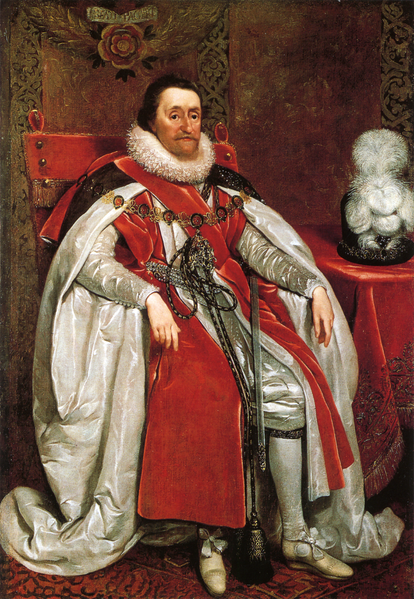
King James I (of England) and VI (of Scotland)
Portrait by Daniel Myrtens, 1621 from the National Portrait Gallery via Wikimedia Commons.
The year 1610 might by the most under-rated year in British history. It was the year in which England almost became a more permanent absolutist monarchy. Had things gone only a little differently, King James I might have obtained a substantial annual income — enough to pay off his debts within just a few years, to run a substantial surplus, and perhaps even to never have to summon a Parliament ever again. Over the course of a few decades, so long as they didn’t require too many extraordinary taxes to pay for one-off wars, the Stuart kings could have ruled without challenge, issuing proclamations that would have gradually taken on the force of laws.
[…]
As we saw in the last instalment of this series, James I’s finances were desperate. His predecessor had left him substantial war debts, and he was running a large deficit, so the chances of repaying them anytime soon were slim. So in 1604 he had summoned a Parliament with the aim of making a financial deal. Parliaments were typically called in order for the monarch to raise one-off, extraordinary taxes, usually in times of rebellion or war. Rather confusingly from today’s perspective, these taxes were known as “subsidies”, because they were a subsidy to the Crown. Yet James and his ministers wanted Parliament to instead establish peacetime taxes that would be both ongoing and ordinary — what came to be known as “support”. The deal was that he would give up some of his least popular feudal prerogative rights in return.
The House of Commons did not go for the deal in 1604, as we saw. They may have hated feudal obligations like purveyance or wardship — the requisitioning of goods for the court, and the Crown’s control of noble heirs whose fathers had died before they came of age — but they also saw some major risks in trying to make a deal with the king.
When it came to the matter of purveyance, for example, many members of Parliament wanted to stamp out the abuses rather than see the institution abolished. They thought it perfectly legal for the Crown to compulsorily purchase goods, and even to requisition the carts to carry them. What they complained of was that many purveyors were failing to give compensation immediately, and that corrupt purveyors were sometimes taking more than was required, pocketing the difference for themselves. Many MPs also argued that there was no legal basis for purveyors to determine their own prices for the provisions that they seized — a privilege that the Crown adamantly insisted upon.
James’s predecessor Queen Elizabeth I had granted a concession over patent disputes — “patents” at that time were a rather different and much wider legal notion than our more product-oriented modern patents: the monarch granted patents to assign lands and titles, appoint officials, create cities or guilds, or to allow monopoly privileges over an economic resource among other purposes. The concession was that patent disputes would be litigated in common-law courts rather than by royally appointed judges.
Yet by extending the jurisdiction of the common-law courts to monopolies, Elizabeth opened the floodgates of complaints against all prerogative courts — especially against the court of royal household officials responsible for commissioning the purveyors, known as the Board of Green Cloth.
To Hyde and his followers, this court was especially corrupt. Whereas the trying of monopoly patents had at least been done in the more general prerogative courts, anyone hauled before the Green Cloth for denying the purveyors was effectively being tried, judged, fined, and even imprisoned, by the very organisation that was accusing them. Even if purveyors really were acting illegally by naming their own prices, as opponents maintained, there would be no justice so long as the purveyors effectively judged themselves. For Hyde and his allies then, they wished to do to purveyance what they had done to monopolies — to subject them to the common law.
Comments Off on The Board of Green Cloth — the original “we investigated ourselves and found us innocent” organization
Battle of the River Plate 1939: Minute-by-Minute
Historigraph
Published 24 Jul 2018The Battle of the River Plate took place in December 1939, and featured the Royal Navy cruisers Exeter, Achilles and Ajax, against the German Panzerschiffe, Graf Spee.
–
If you’d like to support the creation of more videos like this, please consider supporting us at: https://www.patreon.com/historigraph
If you’d like to join the historigraph community, consider joining my discord server, which is shared with my strategy gaming channel: https://discord.gg/f8JZw93
Follow the channel on Twitter: https://twitter.com/historigraph
And on facebook: https://www.facebook.com/historigraph/
Sources:
Richard Petrow, The Bitter Years: The invasion and Occupation of Denmark and Norway April 1940-May 1945 (London: Hodder and Stoughton, 1974). — The first chapter of the book includes a brief description of the hunt for the Graf SpeeCorelli Barnett, Engage The Enemy More Closely: The Royal Navy in the Second World War (London: Penguin, 1991)
Commodore Harwood’s own account of the battle, made available here: http://naval-history.net/WW2LGGrafSpe…
Graf Spee‘s voyage described here: https://www.deutschland-class.dk/admi…
Video clips from World of Warships gameplay and the Battle of the River Plate film, 1958
Music:
“Crypto” Kevin MacLeod (incompetech.com)
Licensed under Creative Commons: By Attribution 3.0 License
https://creativecommons.org/licenses/by/3.0/“Division” Kevin MacLeod (incompetech.com)
Licensed under Creative Commons: By Attribution 3.0 License
https://creativecommons.org/licenses/by/3.0/“Crossing the Chasm” Kevin MacLeod (incompetech.com)
Licensed under Creative Commons: By Attribution 3.0 License
https://creativecommons.org/licenses/by/3.0/Sound Effects:
Gunshots and so on are recordings from World of Warships, where the gameplay footage of the ships hails from.

Comments Off on Battle of the River Plate 1939: Minute-by-Minute
January 7, 2022
Desert War – Dysentery, Disease, and Dehydration – WW2 Special
World War Two
Published 6 Jan 2022North Africa. The Axis and Allies are fighting each other but even more, they’re fighting the desert itself. The men of the desert burn during the day and freeze at night. They do most of their fighting on a litre of water and a packet of army biscuits. What is life in such a hostile environment?
(more…)
Comments Off on Desert War – Dysentery, Disease, and Dehydration – WW2 Special
“This is not satire. This is academic archaeology gone woke”
In the New English Review, Timothy H. Ives asks whether the many stone heaps across New England are actually the ruins of First Nations sacred sites:
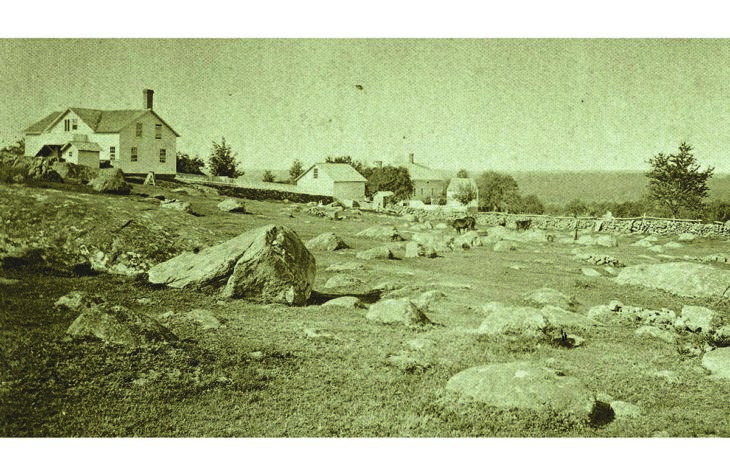
Historic photograph of Woodvale Farm, Rhode Island. The pasture shown here, enclosed by stone walls, features several stone heaps
Photo via New English Review.
Brightman Hill lies deep in the forests of Hopkinton, Rhode Island. It is named for the Brightmans, one of the families who farmed it, and evidence of its agricultural past is, to most observers, unambiguous: old building foundations, a nineteenth-century burial ground, an extensive network of stone walls and hundreds of stone heaps, the results of field clearing. But in 2019, a federally-funded survey of Brightman Hill shattered these traditional interpretations.
The surveyors, Ceremonial Landscapes Research, LLC, are a small group of antiquarians led by Alexandra Martin, a registered professional archaeologist who recently earned her doctorate in anthropology. Instead of stone heaps and walls, the surveyors reported “linear stone groupings” on Brightman Hill. One, they said, “brings to mind a turtle.” Another “appears to have the head of a snake”; another contains “a ‘nest’, large enough for an individual to sit in.” Boulders, naturally milled and deposited by glacial ice, came alive. One was categorized as “an apparent effigy of a human head,” significantly facing southwest, while the flat section of another became a “stone seat” from which celestial alignments could be observed.
This is not satire. This is academic archaeology gone woke. New Englanders may not realize it, but the ground is moving beneath their feet.
Stone heaps, walls and other ruined stone structures are scattered across the secondary forests of New England. Traditionally, archaeologists agreed that they were vestiges of abandoned farmsteads, reclaimed by the forests when many farmers left for the cities or pastures new. But now the culture wars have come to this previously polite field.
Today, radical left-wing academics support claims that the stones are the ruins of ancient Native American ceremonial constructions, and that they need protection from ongoing “settler-colonial” development. Tribal officials champion this claim, presumably to further their own campaigns for “decolonization”. Their “resistance” is applauded by attention-seeking antiquarians and a public entranced by guilt and ideas of social justice. I call this confluence the Ceremonial Stone Landscape Movement (or CSLM).
CSLM claims are fashionable, and almost uniquely powerful. None of these stone structures were signed and dated by their creators, but ceremonial claims carry particular weight — especially when anyone who dismisses them risks being accused of continuing the destruction of Native American culture. Yet the movement’s roots are neither ancient nor grounded in Native American tradition. They’re not even that deep.
The movement and its bizarre theory originated in the late twentieth century among a group of white, middle-class antiquarians. Many are members of the New England Antiquities Research Association (NEARA), founded in 1964; at the time NEARA’s founders resented academic archaeologists for refusing to take seriously their theory that New England’s farmstead ruins are in fact the remains of a megalithic culture transplanted by settlers from Europe in prehistoric times. By 1984, one NEARA member detected a “persecuted-crusader” complex among its members, who seemed determined to “wave the banner of truth with regards to the ‘real’ prehistory of New England” until the “mainstreamers … fall in line and admit the visions of a minority were accurate after all.”
Comments Off on “This is not satire. This is academic archaeology gone woke”


