
Before we dive in, I want to give a brief primer on the basics of how nearly all Greek poleis – Athens, Sparta, Corinth, Thebes, Plataea, Tegea, whatever – are structured, because it’ll help in understanding Sparta. (Reminder: the polis, sometimes called a city-state, is the basic unit of Greek governance – these are all independent micro-states).
The standard ingredients of a Greek polis are an assembly of all adult citizen males (often called an ekklesia, meaning “assembly”), a smaller advisory committee (frequently called a boule), and then a set number of elected officials who carried out the laws of the other two (magistrates). I’ve given the common names for these components, but they often have different names in different poleis.
Those basic units don’t change from a democracy (like Athens) to an oligarchy (like Corinth) or even a tyranny (like Syracuse) – the type of government just reflects the division of power between them, and the method of selection. In a democracy, like Athens, the ekklesia will have most of the power, being able to overrule the boule or the magistrates. Often the members of the boule can come from a wide range of wealth classes or even be randomly selected.
In an oligarchy, power is generally focused in the magistrates – drawn from the upper-crust of society – and a smaller boule, with the ekklesia having much less power to restrain them. Alternately, the ekklesia may be restricted in size to only a wealthy subset of the citizenry. In a tyranny, a single person (the tyrant) is able to gain control of the system, through a mix of demagoguery, charisma and well-placed cronies. Even under a tyranny, the basic three-part system still exists, it is simply subverted and controlled by one person (much like how some modern dictatorships have all of the institutions of a democracy – courts, elections, etc – but all of the power is still in one set of hands and the elections are shams).
I want to note this up front because it is important to recognize that the existence of a popular assembly does not make a Greek polis a democracy, nor does the existence of a powerful magistrate make it a tyranny. As we’ll see, Sparta has an assembly, it is just laughably weak; it also has two very powerful magistrates, but their power is strongly checked. What matters is the division of power between these parts. I also wanted to start here because Sparta follows this basic model, but with some interesting variations. Knowing what the normal model looks like will make it easier to spot the variations that are unique to Sparta.
Bret Devereaux, “Collections: This. Isn’t. Sparta. Part V: Spartan Government”, A Collection of Unmitigated Pedantry, 2019-08-29.
February 10, 2022
QotD: Classical Greek Polis governance
February 9, 2022
In The Highest Tradition – Episode 1
British Army Documentaries
Published 18 Oct 2021[From the episode transcript – “Apart from discipline what emerges when you delve into British military tradition is that there’s no such entity as a British army. What you find is a confederation of regiments hopefully fighting on the same side all fiercely preserving their individuality by being as different from one another as possible.”]
First transmitted in 1989, this is the first episode in a six-part series that delves into the world of regimental tradition. This programme includes looks at the origins of Emperor Joseph Bonaparte’s chamber pot, a druid oration, and the story of a goat who escaped being eaten to become a regimental mascot.
© 1989
This production is for viewing purposes only and should not be reproduced without prior consent.
This film is part of a comprehensive collection of contemporary Military Training programmes and supporting documentation including scripts, storyboards and cue sheets.
All material is stored and archived. World War II and post-war material along with all original film material are held by the Imperial War Museum Film and Video Archive.
February 8, 2022
Roman Republic to Empire: 01 Mistress of the Mediterranean
seangabb
Published 21 Jan 2021[Update 2023-03-02 – Dr. Gabb took down the original posts and re-uploaded them.]
In 120 BC, Rome was a republic with touches of democracy. A century later, it was a divine right military dictatorship. Between January and March 2021, Sean Gabb explored this transformation with his students. Here is one of his lectures. All student contributions have been removed.
(more…)
Semlor: The Dessert That Killed A King
Tasting History with Max Miller
Published 16 Feb 2021For information on Svensk Hyllningsfest in Lindsborg, KS, visit https://www.visitlindsborg.com/
Help Support the Channel with Patreon: https://www.patreon.com/tastinghistory
Tasting History Merchandise: crowdmade.com/collections/tastinghistoryFollow Tasting History here:
Instagram: https://www.instagram.com/tastinghist…
Twitter: https://twitter.com/TastingHistory1
Tiktok: TastingHistory
Reddit: r/TastingHistory
Discord: https://discord.gg/d7nbEpyLINKS TO INGREDIENTS & EQUIPMENT**
Sony Alpha 7C Camera: https://amzn.to/2MQbNTK
Sigma 24-70mm f/2.8 Lens: https://amzn.to/35tjyoW
Silpat: https://amzn.to/3rFIFxM
KitchenAid 8-Quart Stand Mixer: https://amzn.to/3cTfbs1LINKS TO SOURCES**
Hjelpreda I Hushållningen För Unga Fruentimber by Cajsa Warg: https://gupea.ub.gu.se/handle/2077/41…
A Journey Through Swedish history by Herman Lindqvist: https://amzn.to/2Z0D3Sb
The world of Cajsa Andersdotter by Bengt Hällgren: https://amzn.to/3jKNMKl**Amazon offers a small commission on products sold through their affiliate links, so each purchase made from this link, whether this product or another, will help to support this channel with no additional cost to you.
Subtitles: Jose Mendoza
#tastinghistory #semlor #semla #fattuesday

QotD: The East India Company’s rise to power
In many ways the EIC was a model of corporate efficiency: 100 years into its history, it had only 35 permanent employees in its head office. Nevertheless, that skeleton staff executed a corporate coup unparalleled in history: the military conquest, subjugation and plunder of vast tracts of southern Asia. It almost certainly remains the supreme act of corporate violence in world history. For all the power wielded today by the world’s largest corporations – whether ExxonMobil, Walmart or Google – they are tame beasts compared with the ravaging territorial appetites of the militarised East India Company. Yet if history shows anything, it is that in the intimate dance between the power of the state and that of the corporation, while the latter can be regulated, it will use all the resources in its power to resist.
When it suited, the EIC made much of its legal separation from the government. It argued forcefully, and successfully, that the document signed by Shah Alam – known as the Diwani – was the legal property of the company, not the Crown, even though the government had spent a massive sum on naval and military operations protecting the EIC’s Indian acquisitions. But the MPs who voted to uphold this legal distinction were not exactly neutral: nearly a quarter of them held company stock, which would have plummeted in value had the Crown taken over. For the same reason, the need to protect the company from foreign competition became a major aim of British foreign policy.
The transaction depicted in the painting [Wiki] was to have catastrophic consequences. As with all such corporations, then as now, the EIC was answerable only to its shareholders. With no stake in the just governance of the region, or its long-term wellbeing, the company’s rule quickly turned into the straightforward pillage of Bengal, and the rapid transfer westwards of its wealth.
Before long the province, already devastated by war, was struck down by the famine of 1769, then further ruined by high taxation. Company tax collectors were guilty of what today would be described as human rights violations. A senior official of the old Mughal regime in Bengal wrote in his diaries: “Indians were tortured to disclose their treasure; cities, towns and villages ransacked; jaghires and provinces purloined: these were the ‘delights’ and ‘religions’ of the directors and their servants.”
Bengal’s wealth rapidly drained into Britain, while its prosperous weavers and artisans were coerced “like so many slaves” by their new masters, and its markets flooded with British products. A proportion of the loot of Bengal went directly into Clive’s pocket. He returned to Britain with a personal fortune – then valued at £234,000 – that made him the richest self-made man in Europe. After the Battle of Plassey in 1757, a victory that owed more to treachery, forged contracts, bankers and bribes than military prowess, he transferred to the EIC treasury no less than £2.5m seized from the defeated rulers of Bengal – in today’s currency, around £23m for Clive and £250m for the company.
William Dalrymple, “The East India Company: The original corporate raiders”, Guardian, 2015-03-04.
February 7, 2022
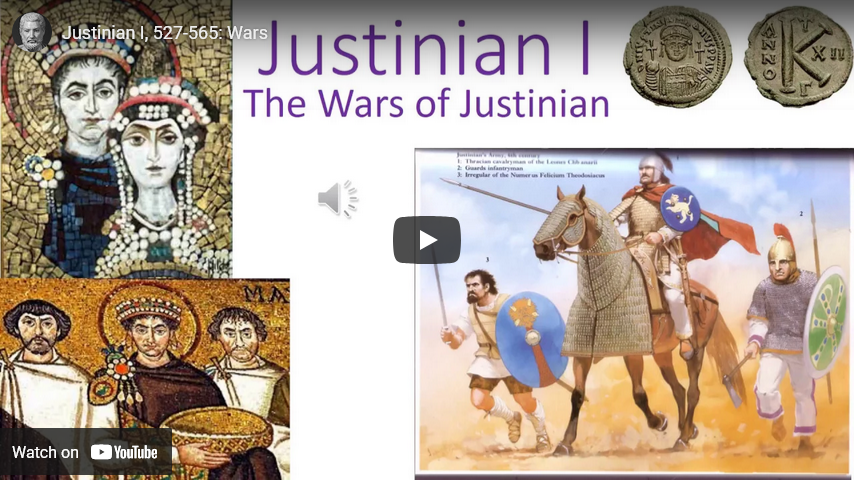
Justinian I, 527-565: Wars
Thersites the Historian
Published 21 Sep 2017In this video, I look at the wars of conquest waged by the Emperor Justinian and explore whether or not these conflicts advanced the long-term interests of the Byzantine state.
American pizza
At An Eccentric Culinary History, H.D. Miller makes a strong case for pizza being more an American dish than an Italian one:

“Pizza” by rdpeyton
Today, standing atop the sprawling edifice that is the American restaurant industry, it’s hard to imagine a time when pizza wasn’t popular. But, prior to World War Two, pizza was barely known in the United States outside of a few Italian enclaves in the Northeast. For all of the praise heaped upon Lombardi’s in New York City, until the war, few people north of Houston Street had heard of it, or the dish it served.
From the mid-19th century forward, there were plenty of Italians in America, in places like New York, New Orleans and San Francisco. Most of those early Italian immigrants — around 75,000 before 1880 — were from northern Italy, not the South, and the restaurants they built were usually serving multi-course, table d’hôte meals of meat, bread, macaroni, wine and coffee at reasonable prices. The model was Caffe Moretti’s in Manhattan. Established in 1858 by Stefano Morretti, an ex-seminarian from the Veneto, Morretti’s offered diners generous portions and cheap prices. It did not, however, offer pizzas.
I have to emphasize this, you couldn’t order a pizza in the vast majority of Italian restaurants in America prior to 1945. And the reason you couldn’t order a pizza in Italian restaurants is because pizza isn’t Italian.
Let me repeat that: Pizza isn’t Italian.
Pizza is Neapolitan. It’s a distinct speciality of Naples, developed at at time when Italy didn’t even exist as a nation. Saying pizza is Italian is like saying haggis is British. It might be technically true, but not really.
As in America, prior to the 1950’s, pizza wasn’t something most Italians knew or cared about. In 1900, there were supposedly no pizzerias in Italy anywhere outside of the medieval walls of Napoli. You couldn’t even get pizza in the suburbs. Pizza was strictly street food for poor people in the crowded tangled alleys near the port. […]
In other words, pizza was not something the average Tuscan, Ligurian or Venetian would have thought suitable for a sit-down meal. Or, if they ever did think of it, it was to revile pizza as oily, unappetizing and a likely vector of cholera. This is because Naples was really famous at the time for being dirty and disease-ridden. (If you’re serious about early pizza history, one that strips away the just-so stories, then go read Inventing the Pizzeria by Antonio Mattozzi.)
What brought pizza to America was the mass immigration of southern Italians between 1880 and 1910, when more than 4 million people moved to the United States. That’s why Lombardi’s didn’t get going until 1905, when there were finally enough Neapolitans in Little Italy to keep the doors open.
The same dynamic played out in South America, in Argentina, Uruguay and Brazil. The first successful pizza restaurant in the world located outside of Naples was founded in Buenos Aires in 1882, when a Neapolitan immigrant baker named Nicolas Vaccarezza started selling the pies out of his shop in Boca. For reference purposes, a decade earlier, an attempt to open a pizzeria in Rome, Italy, had ended in bankruptcy, meaning, at the turn of the last century, you could get a pizza in Buenos Aries, São Paulo or New York, but not in Rome, Florence or Venice.
H/T to Ed Driscoll for the link.
History Summarized: Vikings
Overly Sarcastic Productions
Published 14 Jul 2017Huge thanks to our friend Shad at Shadiversity! Check out his channel for historical weaponry and much more: https://www.youtube.com/user/shadmbrooks
Grab your swords and hop in your longboats, because it’s time to learn a thing or two about the Vikings!
This video was produced with assistance from the Boston University Undergraduate Research Opportunities Program.
Thanks to patron Karl Erik L Hoftaniska for suggesting this topic!
PATREON: www.patreon.com/user?u=4664797
MERCH LINKS:
Shirts – https://overlysarcasticproducts.threa…
All the other stuff – http://www.cafepress.com/OverlySarcas…Find us on Twitter @OSPYouTube!
From the comments:
Finn Chitwood
4 years ago
In the words of a brilliant Icelandic magazine: “Viking was a seasonal, temporary occupation, not an ethnicity.”
February 6, 2022
Guadalcanal, A New Offensive – WW2 – 180 – February 5, 1943
World War Two
Published 5 Feb 2022This week sees the 10th anniversary of Hitler’s ascension to power in Germany, but while there may be celebrations and speeches in Germany, the Battle of Stalingrad comes to its end with the surrender of the German 6th Army. The Soviets are on the move all over, launching yet more winter offensives. It is the Axis who are attacking in Tunisia, and in the Solomon Islands … well, the Allies aren’t sure what the Japanese are up to.
(more…)
Quebec Papal Zouave’s Ceremonial Gewehr 71/84
Forgotten Weapons
Published 4 Oct 2021http://www.patreon.com/ForgottenWeapons
https://www.floatplane.com/channel/Fo…
Cool Forgotten Weapons merch! http://shop.forgottenweapons.com
Here’s a rifle with an interesting twisting history …
This began life as a German military Gewehr 71/84, made in 1888. It was issued to a unit, but eventually replaced by the Gewehr 1888. It was sold to the Francis Bannerman company at some point around 1900, as part of a big batch of surplus weapons (Bannerman was a massive international dealer in arms and military equipment). Moving ahead a few years, World War One breaks out and prompts the organization of a couple Canadian “Home Guard” units. The Montreal Home Guard has some money, and buys a batch of Savage Model 99 lever action rifles (in .303 Savage, interestingly). The Quebec Home Guard isn’t quite so well-heeled, so they go to Bannerman to see what they can afford. Bannerman sells them a batch of Gewehr 71/84 tube-magazine repeating rifles, in the same configuration as when they were sold off by the German military.
Incidentally, I believe these become the only Mauser rifles formally purchased and issued by the Canadian government, when they are acquired by the Home Guard. At any rate, after the war ends, a subset of those old rifles are given to the Quebec Papal Zouaves, a ceremonial vestige of the Quebecois military volunteers who went to Italy in the 1860s to help defend the Papacy during Italian unification. By this time, the Zouaves are basically just acting as guards in parades, and they crudely cut down the 71/84s, removed their magazines, and fit them with cut-down British Snider bayonets for use as single-shot, blank-firing arms.
Quite the journey, right? And also a reminder that sometimes what looks like sporterized junk is actually something with distinct historical provenance …
Many thanks to Mike Carrick of Arms Heritage Magazine for providing me access to film this example!
Contact:
Forgotten Weapons
6281 N. Oracle 36270
Tucson, AZ 85740

QotD: Marcus Tullius Cicero
Cicero was a key politician in the Late Republic, but it was his misfortune that his life was spent in an era where words meant less than weapons. He sided with Pompey against Caesar, but was granted clemency after Pompey’s defeat. He was not involved in Caesar’s assassination – he was still too much an outsider for some of the stuck-up Roman elitists who made up the conspiracy (though he correctly pointed out at the time that leaving Antony alive would be a fatal mistake). In the aftermath of the assassination, he identified (correctly) Antony as the key threat to the Republic and worked to discredit him politically in a devastating series of speeches named the Philippics (in honor of a similar set of speeches made by the Athenian Demosthenes against Philip II of Macedon, father of Alexander). Cicero’s political assault on Antony succeeded – his reputation was ruined and his popularity in Rome never recovered – but it cost Cicero his life when Antony, in league with Octavian, moved into the capital and had Cicero murdered. Cicero’s literary legacy survived him, however, in part because it was useful for Augustus’ own political ends (e.g. Plut. Cic. 49.5-6).
Cicero’s position as the most eloquent orator of the Latin language – and probably its best prose stylist – is largely uncontested. It was his speaking skills – honed in the courts – that made him so politically successful. He was also a prolific writer and a tremendous amount of his writings survive, including both legal and political speeches, private letters, handbooks on oratory, and a set of philosophical works. As anyone who has read Cicero can tell you, he also has a deserved reputation for pride and self-aggrandizement. While many of Cicero’s contemporaries and readers down to the modern era have been impressed by Cicero’s thinking and eloquence, I feel confident in asserting no one – alive or dead – will ever be more impressed by Cicero than Cicero was impressed by himself.
Bret Devereaux, “Collections: A Trip Through Cicero (Natural Law)”, A Collection of Unmitigated Pedantry, 2019-12-12.
February 5, 2022
City Minutes: The Roman Empire
Overly Sarcastic Productions
Published 4 Feb 2022The funny thing about Empire is that ~*Rome*~ includes far more than just the City of Rome. Spread out across every corner of the Mediterranean — and then some — Roman Civilization was always adapting to local circumstances and changing over time. Today we’ll look at 5 cities that show the diversity of just how much “Rome” could really mean in the days of the empire.
The Great Cities In History by John Julius Norwich, “A Wonder of the World – Ephesus” from The Great Tours: Greece and Turkey, from Athens to Istanbul by John R. Hale, “Ephesus”, “Leptis Magna”, “Roman Britain”, “Pompeii” from World History Encyclopedia https://www.worldhistory.org/ephesos/, https://www.worldhistory.org/Lepcis_Magna, https://www.worldhistory.org/Roman_Britain, https://www.worldhistory.org/pompeii/. “Ephesus”, “Leptis Magna” “London”, “Pompeii” from Britannica https://www.britannica.com/place/Ephesus, https://www.britannica.com/place/Leptis-Magna, https://www.britannica.com/place/Lond…, https://www.britannica.com/place/Pompeii. I also have a degree in Classical Studies.
Chapters:
0:00 — Rome
0:58 — Ephesus
2:00 — Leptis Magna
3:03 — Londinium
4:12 — Pompeii
5:17 — ConclusionOur content is intended for teenage audiences and up.
PATREON: https://www.Patreon.com/OSP
PODCAST: https://overlysarcasticpodcast.transi…
DISCORD: https://discord.gg/osp
MERCH LINKS: http://rdbl.co/osp
OUR WEBSITE: https://www.OverlySarcasticProductions.com
Find us on Twitter https://www.Twitter.com/OSPYouTube
Find us on Reddit https://www.Reddit.com/r/OSP/
Centurion – Tiger Tank’s Nemesis
Mark Felton Productions
Published 22 Oct 2020The Centurion, the famous Cold War tank, was actually developed to take on the dreaded German Tiger in WW2. Find out whether they ever met on the battlefield in 1945.
Dr. Mark Felton is a well-known British historian, the author of 22 non-fiction books, including bestsellers Zero Night and Castle of the Eagles, both currently being developed into movies in Hollywood. In addition to writing, Mark also appears regularly in television documentaries around the world, including on The History Channel, Netflix, National Geographic, Quest, American Heroes Channel and RMC Decouverte. His books have formed the background to several TV and radio documentaries. More information about Mark can be found at: https://en.wikipedia.org/wiki/Mark_Fe…
Visit my audio book channel ‘War Stories with Mark Felton’: https://youtu.be/xszsAzbHcPE
Help support my channel:
https://www.paypal.me/markfeltonprodu…
https://www.patreon.com/markfeltonpro…Disclaimer: All opinions and comments expressed in the ‘Comments’ section do not reflect the opinions of Mark Felton Productions. All opinions and comments should contribute to the dialogue. Mark Felton Productions does not condone written attacks, insults, racism, sexism, extremism, violence or otherwise questionable comments or material in the ‘Comments’ section, and reserves the right to delete any comment violating this rule or to block any poster from the channel.
Credits: David Holt; Simon Q.; Tony Hisgett; Danie van der Merwe; Oliver Gottlob.
Thumbnail: The Tank Museum

February 4, 2022
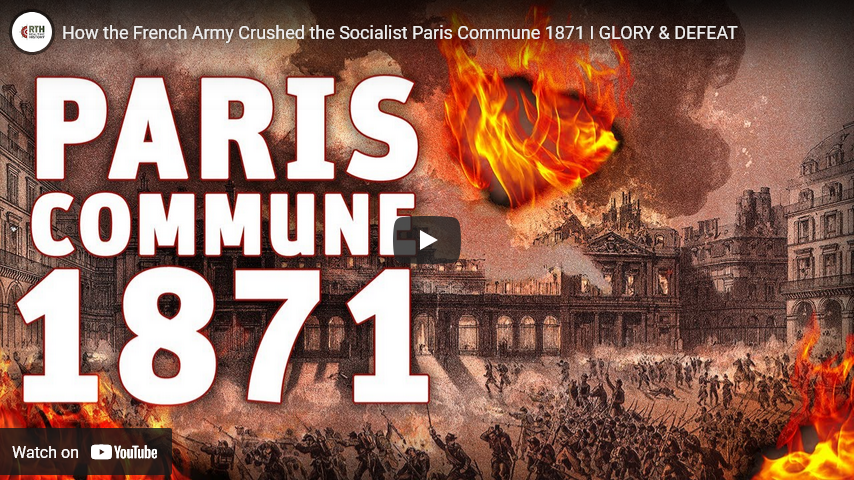
How the French Army Crushed the Socialist Paris Commune 1871 I GLORY & DEFEAT
Real Time History
Published 3 Feb 2022https://curiositystream.com/realtimeh… – get Nebula and CuriosityStream for less than $15 for an entire year.
The siege of Paris and the end of the Franco-Prussian War had brought social unrest in Paris (and other French cities) to a boiling point. Radical citizens take up arms and proclaim La Commune, a self-organized alternative to the French Republic. But soon the French Army is cracking down and Paris experiences a Week of Blood.
» THANK YOU TO OUR CO-PRODUCERS
John Ozment, James Darcangelo, Jacob Carter Landt, Thomas Brendan, Kurt Gillies, Scott Deederly, John Belland, Adam Smith, Taylor Allen, Rustem Sharipov, Christoph Wolf, Simen Røste, Marcus Bondura, Ramon Rijkhoek, Theodore Patrick Shannon, Philip Schoffman, Avi Woolf, Daniel L Garza, Chris Daley, Manfred Billenstein, Simdoom, Malcolm Swan» OUR PODCAST
https://realtimehistory.net/podcast – interviews with historians and background info for the show.» LITERATURE
Arand, Tobias: 1870/71. Der Deutsch-Französische Krieg erzählt in Einzelschicksalen. Hamburg 2018Bauer, Gerhard u.a. (Hrsg.): Ausst.-Kat. MHM Dresden‚ Krieg – Macht – Nation. Wie das deutsche Kaiserreich entstand. Dresden 2020
Buk-Swienty, Tom: Feuer und Blut. Hauptmann Dinesen. Hamburg 2014
Gouttman, Alain: La grande défaite. 1870-1871. Paris 2015
Horne, Alistair: Es zogen die Preußen wohl über den Rhein. Bern, München, Wien 1967
» SOURCES
Bernhardt, Sarah: Ma double vie. Memoires. Paris 1907
Déclaration de la Commune de Paris. (19 avril 1871) https://gallica.bnf.fr/ark:/12148/bpt…
Goncourt, Edmond de: Journal des Goncourts. II.1. 1870-1871. Paris 1890
Hérisson, Maurice d’: Nouveau Journal d’un officier d’ordonannce. Paris 1889
Hoppenstedt, Julius von: Ein neues Wörth. Ein Schlachtenbild der Zukunft. Berlin 1909
Hugo, Victor: Choses vues, 2e série. Ollendorf 1913.
Kühnhauser, Florian: Kriegs-Erinnerungen eines Soldaten des königlich-bayerischen Infanterie-Leib-Regiments. Partenkirchen 1898
Meisner, Heinrich Otto (Hrsg.). Kaiser Friedrich III. Kriegstagebuch 1870/71. Berlin, Leipzig 1926
Plitt, Franz: Rückerinnerungen eines Dreiundachtzigers. Kassel 1903
Zola, Émile: La Débâcle. Paris 1892
» OUR STORE
Website: https://realtimehistory.net»CREDITS
Presented by: Jesse Alexander
Written by: Cathérine Pfauth, Prof. Dr. Tobias Arand, Jesse Alexander
Director: Toni Steller & Florian Wittig
Director of Photography: Toni Steller
Sound: Above Zero
Editing: Toni Steller
Motion Design: Philipp Appelt
Mixing, Mastering & Sound Design: http://above-zero.com
Maps: Battlefield Design
Research by: Cathérine Pfauth, Prof. Dr. Tobias Arand
Fact checking: Cathérine Pfauth, Prof. Dr. Tobias ArandChannel Design: Battlefield Design
Contains licensed material by getty images
All rights reserved – Real Time History GmbH 2022
The Origins of the SAS – WW2 Special Episode
World War Two
Published 3 Feb 2022“Who dares, wins”. Nowadays the British SAS — Special Air Service — is considered one of the best special forces in the world. Yet its wartime origins are shrouded in mysteries and legends. From the first ideas of top-secret “special raiding squadrons”, to the first raids in North Africa accompanying the Long Range Desert Group, the SAS’s beginnings resemble one big experiment. An experiment from which a truly legendary special service would emerge.
(more…)


